engine AUDI A5 COUPE 2008 Owners Manual
[x] Cancel search | Manufacturer: AUDI, Model Year: 2008, Model line: A5 COUPE, Model: AUDI A5 COUPE 2008Pages: 313, PDF Size: 13.86 MB
Page 271 of 313
Self-help269
Controls
Safety
Driving tips
General maintenance
Self-help
Technical data
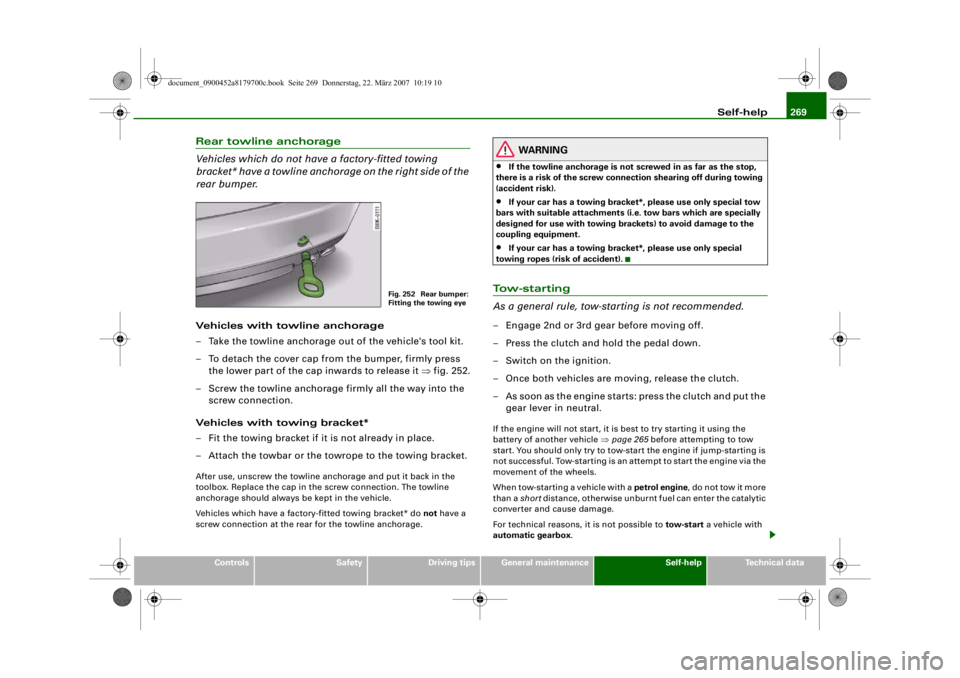
Rear towline anchorage
Vehicles which do not have a factory-fitted towing
bracket* have a towline anchor age on the right side of the
rear bumper.Vehicles with towline anchorage
– Take the towline anchorage out of the vehicle's tool kit.
– To detach the cover cap from the bumper, firmly press
the lower part of the cap inwards to release it ⇒fig. 252.
– Screw the towline anchorage firmly all the way into the screw connection.
Vehicles with towing bracket*
– Fit the towing bracket if it is not already in place.
– Attach the towbar or the towrope to the towing bracket.After use, unscrew the towline anchorage and put it back in the
toolbox. Replace the cap in the screw connection. The towline
anchorage should always be kept in the vehicle.
Vehicles which have a factory-fitted towing bracket* do not have a
screw connection at the rear for the towline anchorage.
WARNING
•
If the towline anchorage is not screwed in as far as the stop,
there is a risk of the screw connection shearing off during towing
(accident risk).
•
If your car has a towing bracket*, please use only special tow
bars with suitable attachments (i .e. tow bars which are specially
designed for use with towing brac kets) to avoid damage to the
coupling equipment.
•
If your car has a towing bracket*, please use only special
towing ropes (risk of accident).
To w - s t a r t i n g
As a general rule, tow-s tarting is not recommended.– Engage 2nd or 3rd gear before moving off.
– Press the clutch and hold the pedal down.
– Switch on the ignition.
– Once both vehicles are moving, release the clutch.
– As soon as the engine starts: press the clutch and put the
gear lever in neutral.If the engine will not start, it is best to try starting it using the
battery of another vehicle ⇒page 265 before attempting to tow
start. You should only try to tow-start the engine if jump-starting is
not successful. Tow-starting is an attempt to start the engine via the
movement of the wheels.
When tow-starting a vehicle with a petrol engine, do not tow it more
than a short distance, otherwise unburnt fuel can enter the catalytic
converter and cause damage.
For technical reasons, it is not possible to tow-start a vehicle with
automatic gearbox .
Fig. 252 Rear bumper:
Fitting the towing eye
document_0900452a8179700c.book Seite 269 Donnerstag, 22. März 2007 10:19 10
--4 -
-T
---- &
•
-+ +-
Page 272 of 313
Self-help
270
WARNING
There is a high risk of accidents when tow-starting, as the towed
vehicle can easily be driven into the towing vehicle.
Caution
When tow-starting the vehicle, do not tow it further than 50 metres:
otherwise the catalytic converter could be damaged.Towing a vehicle with manual gearbox and front-wheel drive
Towing is relatively straightforward.Please observe the notes ⇒page 267 .
The vehicle can be towed using a towbar or towrope in the normal
way, with all four wheels on the road; it can also be towed with
either the front or rear wheels lifted off the road. The vehicle must
not be towed faster than 50 km/h.Towing a vehicle with automatic gearbox and front-wheel drive
Certain restrictions must be observed when towing your
vehicle.Please observe the notes ⇒page 267 .
The vehicle can be towed with a towbar or towrope in the normal
way, with all four wheels on the ground. When doing so, please note
the following points:•
Release the parking brake ⇒page 121 .
•
Make sure the selector lever is in the N position.
•
The vehicle must not be towed faster than 50 km/h.
•
The vehicle must not be towed further than 50 km. The reason
for this is: when the engine is not running, the gearbox oil pump
does not work and the gearbox is not adequately lubricated for
higher speeds or longer distances.
If the vehicle has to be towed with a breakdown truck, it must only
be suspended at the front wheels. The reason for this is: the drive
shafts are located on the front whee ls. If the car is towed with the
rear wheels lifted off the road (i.e. travelling backwards), the drive
shafts also turn backwards. The planetary gears in the automatic
gearbox then turn at such high speeds that the gearbox will be
severely damaged in a short time.Note
If it is not possible to tow the vehicle as described above, or if it has
to be towed further than 50 km, it must be transported on a special
car transporter or trailer.Towing a vehicle with manual gearbox and four-wheel drive
Certain restrictions must be observed when towing your
vehicle.Please observe the notes ⇒page 267 .
The vehicle can be towed with a towbar or towrope in the normal
way, with all four wheels on the ground. It can also be towed by a
breakdown truck, with the wheels li fted at either the front or rear.
When doing so, please note the following points:•
The vehicle must not be towed faster than 50 km/h.
•
The vehicle must not be towed further than 50 km.
document_0900452a8179700c.book Seite 270 Donnerstag, 22. März 2007 10:19 10
--4 -
-T
0
•
---- [I)
-+
•
•
+-
Page 273 of 313
Self-help271
Controls
Safety
Driving tips
General maintenance
Self-help
Technical data
Note
If it is not possible to tow the vehicle as described above, or if it has
to be towed further than 50 km, it must be transported on a special
car transporter or trailer.Towing a vehicle with automatic gearbox and four-wheel drive
Certain restrictions must be observed when towing your
vehicle.Please observe the notes ⇒ page 267.
The vehicle can be towed with a towbar or towrope in the normal
way, with all four wheels on the ground. When doing so, please note
the following points:•
Release the parking brake ⇒page 121 .
•
Make sure the select or lever is in the N position.
•
The vehicle must not be towed faster than 50 km/h.
•
The vehicle must not be towed further than 50 km. The reason
for this is: when the engine is not running, the gearbox oil pump
does not work and the gearbox is not adequately lubricated for
higher speeds or longer distances.
The vehicle must not be towed with the wheels lifted at either the
front or rear.Note
If it is not possible to tow the vehicle as described above, or if it has
to be towed further than 50 km, it must be transported on a special
car transporter or trailer.
document_0900452a8179700c.book Seite 271 Donnerstag, 22. März 2007 10:19 10
--4 -
-
(I]
T
•
-+ +-
(I]
•
Page 278 of 313
Fuses and bulbs
276BulbsChanging bulbs
Changing bulbs requires a certain degree of practical
skill.You can change the following bulbs for exterior lights yourself:•
Halogen headlights: Bulb for dipped headlights
•
Halogen headlights: Bulb for main beam headlights
•
Halogen headlights: Bulb for side lights
•
Xenon headlights*: Bulb for turn signals
•
Bulb for fog light
•
Bulbs for rear lights in boot lid
•
Bulbs for rear lights in side panel
•
Bulbs for number plate light
The following bulbs should only be changed by a qualified work-
shop :
•
Halogen headlights: Bulb for turn signals
•
Xenon headlights*: Light source for daytime running
lights/parki ng lights
•
Bulb for headlights: Bi-xenon lights ⇒
•
Light source for turn signal in exterior mirror housing
•
Light source for high-level brake light
As a rule, you require a certain degree of practical skill to change
defective bulbs. This applies in particular to those bulbs which are
only accessible from the engine compartment.
If in doubt, we recommend that you have defective bulbs changed
by a qualified workshop or qualified mechanic.
If you do decide to change bulbs in the engine compartment your-
self, be aware of the safety risks involved ⇒page 231 ⇒ .
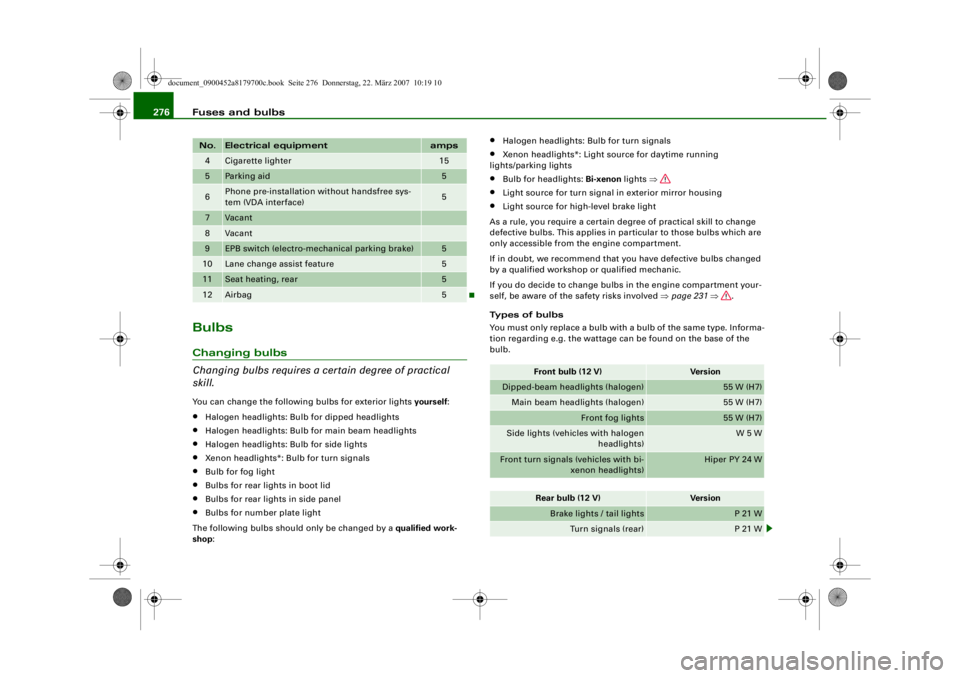
Types of bulbs
You must only replace a bulb with a bulb of the same type. Informa-
tion regarding e.g. the wattage can be found on the base of the
bulb.
4
Cigarette lighter
15
5
Parking aid
5
6
Phone pre-installation without handsfree sys-
tem (VDA interface)
5
7
Vacant
8
Vacant
9
EPB switch (electro-mechanical parking brake)
5
10
Lane change assist feature
5
11
Seat heating, rear
5
12
Airbag
5
No.
Electrical equipment
amps
Front bulb (12 V)
Vers io n
Dipped-beam headlights (halogen)
55 W (H7)
Main beam headlights (halogen)
55 W (H7)
Front fog lights
55 W (H7)
Side lights (vehicles with halogen headlights)
W 5 W
Front turn signals (vehicles with bi-
xenon headlights)
Hiper PY 24 W
Rear bulb (12 V)
Vers io n
Brake lights / tail lights
P 21 W
Turn signals (rear)
P 21 W
document_0900452a8179700c.book Seite 276 Donnerstag, 22. März 2007 10:19 10
--4 -
1111
-
T
1111
-
6
1111
-
1111
-
1111
-
•
6
-+ +-
Page 279 of 313
Fuses and bulbs277
Controls
Safety
Driving tips
General maintenance
Self-help
Technical data
WARNING
•
Take particular care when working on components in the
engine compartment if the engine is warm - risk of burns!
•
Bulbs are sensitive to pressure. The glass can break when you
touch the bulb, causing injury.
•
Incorrect handling of the high-voltage element of xenon gas-
discharge bulbs* can have potentially fatal consequences.
•
When changing bulbs, please take care not to injure yourself on
sharp edges, in particular on the headlight housing.Caution
•
Always remove the ignition key before carrying out any work on
the electrical system - danger of short circuiting!
•
Switch off the lights or parking lights before you change a bulb.
•
Take good care to avoid damaging any components.
•
Removing the lights in particular can lead to the paintwork
becoming damaged. This is another reason why we recommend
having the bulbs changed by a qualified workshop.For the sake of the environment
Please ask your specialist retailer how to dispose of used bulbs in
the proper manner.
Note
Place the parts you have removed on a soft cloth so that they do not
become scratched.
•
Please check at regular intervals that all lighting (especially the
exterior lighting) on your vehicle is functioning properly. This is not
only in the interest of your own sa fety, but also in that of all other
road users.
•
Before changing a bulb, make sure you have the correct new
bulb.
•
Do not touch the glass part of the bulb with your bare hands, use
a cloth or paper towel instead. Otherwise, the fingerprints left on
the glass will vaporise as a result of the heat generated by the bulb,
be deposited on the reflector and impair its surface.
Bulbs with a bayonet fastenerBulbs with a bayonet fastener must be changed as follows:
Removing the bulb
– Lightly press the defective bulb into the bulb holder, then turn it anti-clockwise and remove it.
– Do not touch the glass part of the new bulb with your bare hands, use a cloth or paper towel instead.
Fitting the bulb
– Fit the new bulb, pressing it into the bulb holder, and turn it clockwise as far as it will go.
– If necessary, use a cloth to remove any fingerprints from the glass part of the bulb.
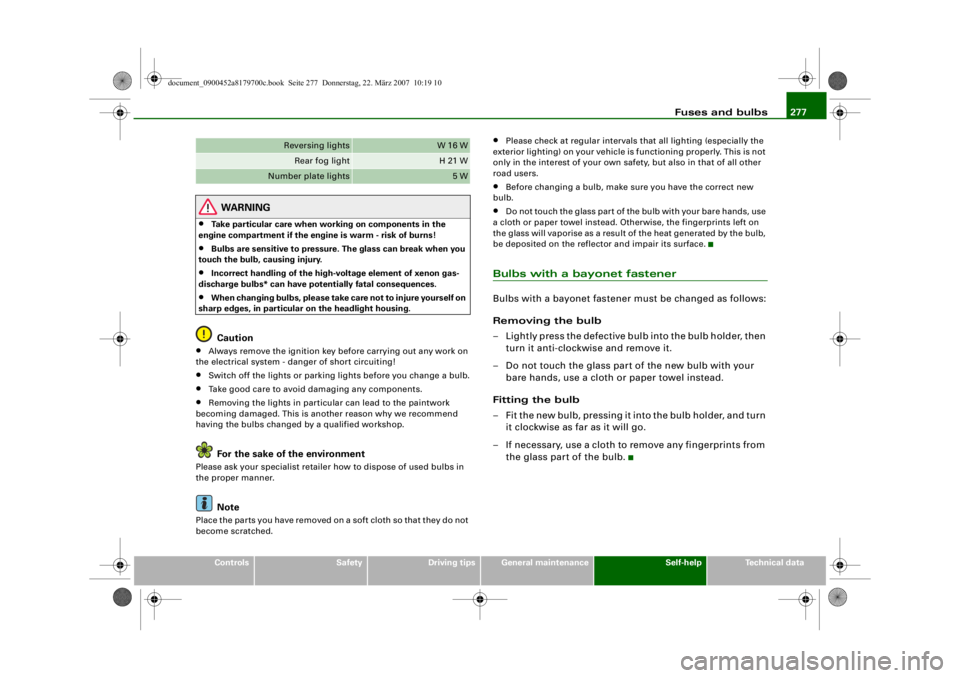
Reversing lights
W 16 W
Rear fog light
H 21 W
Number plate lights
5 W
document_0900452a8179700c.book Seite 277 Donnerstag, 22. März 2007 10:19 10
--4 -
-T
•
-+
0
+-
•
[I]
Page 294 of 313
General notes
292General notesExplanation of technical dataWhere not otherwise indicated or separately listed, all technical
data apply to vehicles with st andard equipment for the German
market. Other figures may apply for special versions and export
models.
Please note that the details listed in the vehicle's registration docu-
ments can be taken as correct.
Engine data
The figures for engine power output are determined according to
EU standards.
Performance figures
The performance figures were measured without equipment which
may influence performance, such as mudflaps or extremely wide-
section tyres.
Kerb weight (unladen weight)
These figures (kerb weight according to the currently applicable
version of EU Directive 92/21/EEC) apply to the vehicle with the tank
90% full, with no special equipment. The figures include an addi-
tional 75 kg to allow for the weight of the driver.
When towing a trailer, the gross vehicle weight may be exceeded by
up to 30 kg and the maximum rear axle weight may be exceeded by
up to 80 kg.
Maximum trailer weights
The maximum trailer weights are calculated in accordance with the
currently applicable version of EU Directive 92/21/EEC.
The figures for a trailer with brakes, on gradients up to 8% are appli-
cable only up to a maximum speed of 80 km/h (even though higher
speeds may be permitted when towing a trailer in some countries). The figures for a trailer with brakes on gradients up to 12%
and for
the weight of car and trailer on gradients up to 12% are applicable
up to a maximum speed of 100 km/h. This maximum speed must not
be exceeded even in countries where higher speeds are permitted.
Maximum draw bar loading
The vertical load exerted by the trailer drawbar on the ball joint of
the towing bracket must not exceed 80 kg.
In the interest of safety, we recommend applying the maximum
permitted draw bar weight. The stability of the trailer could be
adversely affected if too little weight is applied.
If the maximum permitted drawbar weight cannot be obtained, e.g.
when using small or light trailers, statutory regulations require that
the drawbar weight be at least 4% of the actual trailer weight (for
single-axle trailers or twin-axle trailers with an axle spacing less
than 1.0 m).
Dimensions1) The height of the vehicle depends on the tyres and suspension.
Take care not to damage low-mounted parts of the car (such as the
spoiler or exhaust system) on steep ramps, uneven road surfaces or
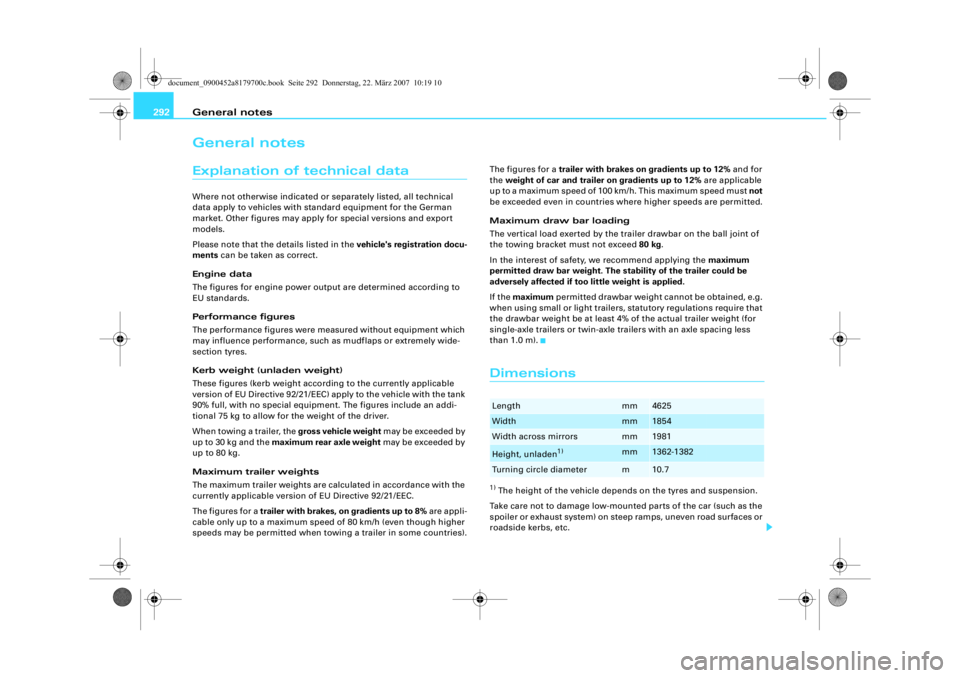
roadside kerbs, etc.Length
mm
4625
Width
mm
1854
Width across mirrors
mm
1981
Height, unladen
1)
mm
1362-1382
Turning circle diameter
m
10.7
document_0900452a8179700c.book Seite 292 Donnerstag, 22. März 2007 10:19 10
--4 -
-T
-+
•
+-
Page 295 of 313
General notes293
Controls
Safety
Driving tips
General maintenance
Self-help
Technical data
This applies especially when the vehicle is fully laden.
CapacitiesFuel tank
Windscreen washerVehicle identification data
Vehicle identification
number on the sound
system or MMI
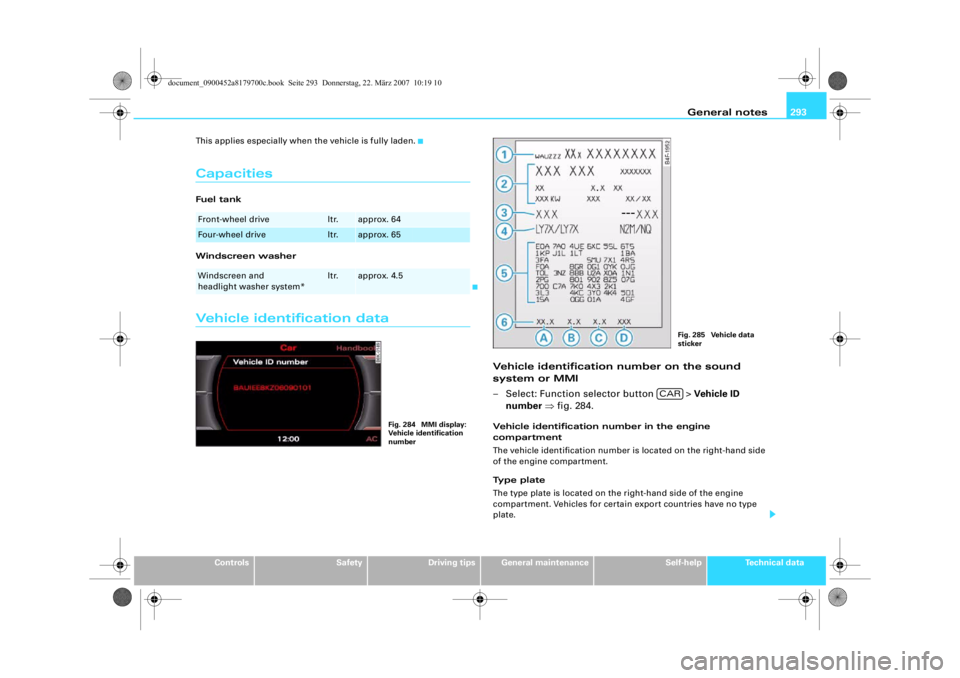
– Select: Function selector button > Vehicle ID
number ⇒ fig. 284.Vehicle identification number in the engine
compartment
The vehicle identification number is located on the right-hand side
of the engine compartment.
Type plate
The type plate is located on the right-hand side of the engine
compartment. Vehicles for certain export countries have no type
plate.
Front-wheel drive
ltr.
approx. 64
Four-wheel drive
ltr.
approx. 65
Windscreen and
headlight washer system*
ltr.
approx. 4.5
Fig. 284 MMI display:
Vehicle identification
number
Fig. 285 Vehicle data
sticker
CAR
document_0900452a8179700c.book Seite 293 Donnerstag, 22. März 2007 10:19 10
T
•
-+
I
~;;~ x1~~xxx,;;;,:x ~ :X.Kw
,;;;,_x xx
XX/XX
XXX ---XXX
L Y7X/LY7X N2M/NQ ,.... EOA
7f'D
4UE 6XC 5SL 6TS
11
FOA 6i:;ll OGl OYI< OJG
- TOL JNZ 8BB LIZA
XOA
!Nl
2PG 801
902
825 07G
• 700 C7A 71<0 4XJ 2Kl
)LJ
'lKC
3YO 4K4 501
_ lSA OGG 01A 4 GF
+-
Page 296 of 313
General notes
294Vehicle data sticker
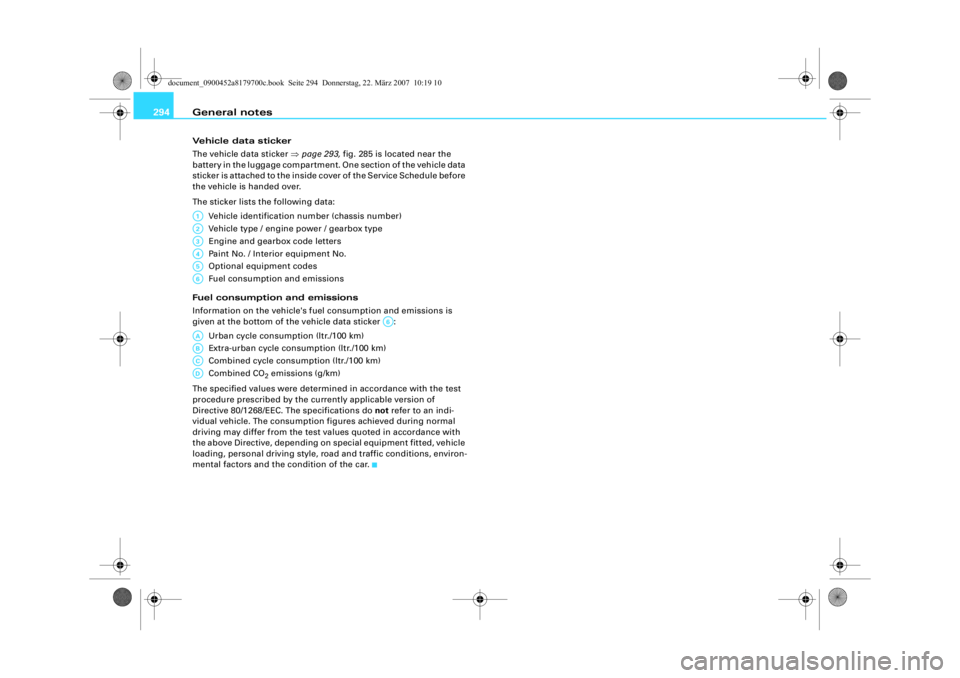
The vehicle data sticker ⇒ page 293, fig. 285 is located near the
battery in the luggage compartment. One section of the vehicle data
sticker is attached to the inside cover of the Service Schedule before
the vehicle is handed over.
The sticker lists the following data:
Vehicle identification number (chassis number)
Vehicle type / engine power / gearbox type
Engine and gearbox code letters
Paint No. / Interior equipment No.
Optional equipment codes
Fuel consumption and emissions
Fuel consumption and emissions
Information on the vehicle's fuel consumption and emissions is
given at the bottom of th e vehicle data sticker :
Urban cycle consumption (ltr./100 km)
Extra-urban cycle consumption (ltr./100 km)
Combined cycle consumption (ltr./100 km)
Combined CO
2 emissions (g/km)
The specified values were determined in accordance with the test
procedure prescribed by the currently applicable version of
Directive 80/1268/EEC. The specifications do not refer to an indi-
vidual vehicle. The consumption figures achieved during normal
driving may differ from the test values quoted in accordance with
the above Directive, depending on special equipment fitted, vehicle
loading, personal driving style, r oad and traffic conditions, environ-
mental factors and the condition of the car.
A1A2A3A4A5A6
A6
AAABACAD
document_0900452a8179700c.book Seite 294 Donnerstag, 22. März 2007 10:19 10
--4 -
-T
-+ +-
•
Page 297 of 313
Performance, weights and dimensions295
Controls
Safety
Driving tips
General maintenance
Self-help
Technical data
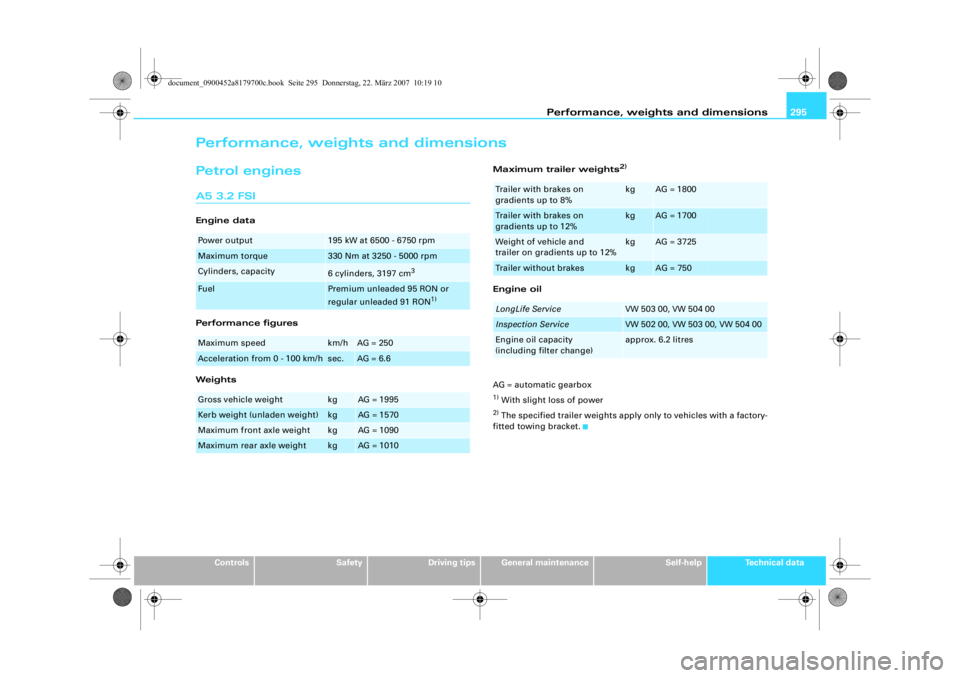
Performance, weights and dimensionsPetrol enginesA5 3.2 FSIEngine data
Performance figures
Weights Maximum trailer weights
2)
Engine oil
AG = automatic gearbox1) With slight loss of power2) The specified trailer weights apply only to vehicles with a factory-
fitted towing bracket.
Power output
195 kW at 6500 - 6750 rpm
Maximum torque
330 Nm at 3250 - 5000 rpm
Cylinders, capacity
6 cylinders, 3197 cm
3
Fuel
Premium unleaded 95 RON or
regular unleaded 91 RON
1)
Maximum speed
km/h
AG = 250
Acceleration from 0 - 100 km/h
sec.
AG = 6.6
Gross vehicle weight
kg
AG = 1995
Kerb weight (unladen weight)
kg
AG = 1570
Maximum front axle weight
kg
AG = 1090
Maximum rear axle weight
kg
AG = 1010
Trailer with brakes on
gradients up to 8%
kg
AG = 1800
Trailer with brakes on
gradients up to 12%
kg
AG = 1700
Weight of vehicle and
trailer on gradients up to 12%
kg
AG = 3725
Trailer without brakes
kg
AG = 750
LongLife Service
VW 503 00, VW 504 00
Inspection Service
VW 502 00, VW 503 00, VW 504 00
Engine oil capacity
(including filter change)
approx. 6.2 litres
document_0900452a8179700c.book Seite 295 Donnerstag, 22. März 2007 10:19 10
--4 -
-T
-+ +-
•
Page 298 of 313
Performance, weights and dimensions
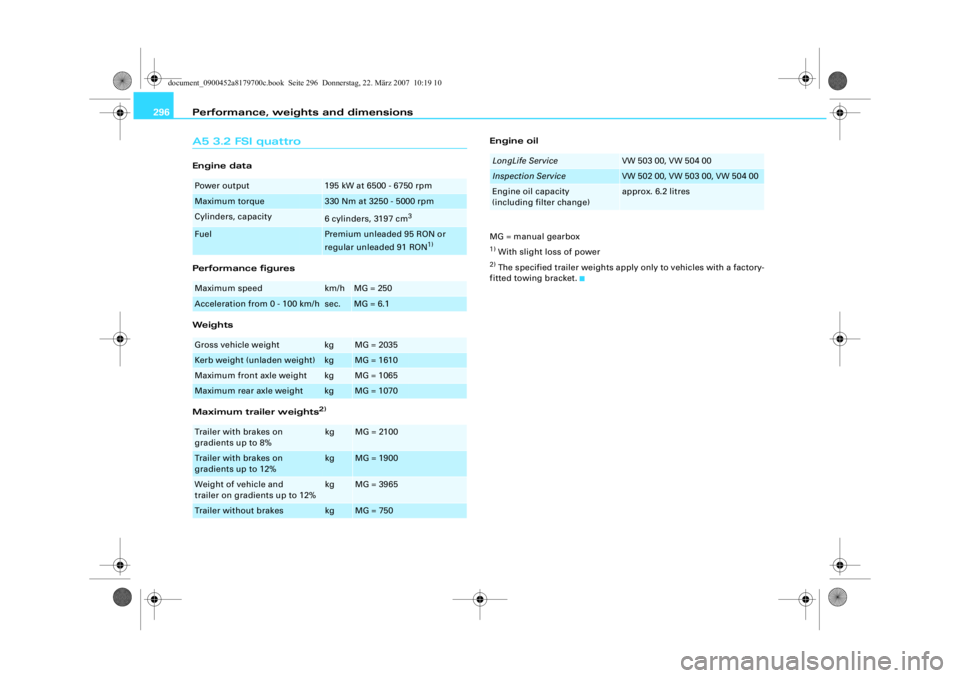
296A5 3.2 FSI quattroEngine data
Performance figures
Weights
Maximum trailer weights
2)
Engine oil
MG = manual gearbox1) With slight loss of power2) The specified trailer weights apply only to vehicles with a factory-
fitted towing bracket.
Power output
195 kW at 6500 - 6750 rpm
Maximum torque
330 Nm at 3250 - 5000 rpm
Cylinders, capacity
6 cylinders, 3197 cm
3
Fuel
Premium unleaded 95 RON or
regular unleaded 91 RON
1)
Maximum speed
km/h
MG = 250
Acceleration from 0 - 100 km/h
sec.
MG = 6.1
Gross vehicle weight
kg
MG = 2035
Kerb weight (unladen weight)
kg
MG = 1610
Maximum front axle weight
kg
MG = 1065
Maximum rear axle weight
kg
MG = 1070
Trailer with brakes on
gradients up to 8%
kg
MG = 2100
Trailer with brakes on
gradients up to 12%
kg
MG = 1900
Weight of vehicle and
trailer on gradients up to 12%
kg
MG = 3965
Trailer without brakes
kg
MG = 750
LongLife Service
VW 503 00, VW 504 00
Inspection Service
VW 502 00, VW 503 00, VW 504 00
Engine oil capacity
(including filter change)
approx. 6.2 litres
document_0900452a8179700c.book Seite 296 Donnerstag, 22. März 2007 10:19 10
--4 -
-T
•
-+ +-