engine AUDI A5 COUPE 2008 Manual PDF
[x] Cancel search | Manufacturer: AUDI, Model Year: 2008, Model line: A5 COUPE, Model: AUDI A5 COUPE 2008Pages: 313, PDF Size: 13.86 MB
Page 212 of 313
Towing a trailer
210•
In low outside temperatures , both the towing vehicle and the
trailer should be fitted with winter tyres.
WARNING
It is essential that you adjust your speed to suit the weather, road
and traffic conditions. Do not let the trailer stabilisation system
tempt you into taking any risks wh en driving – this can cause acci-
dents.•
The ESP and trailer stabilisatio n system cannot defy the laws
of physics. This should be kept in mind, particularly on slippery
and wet roads and when towing a trailer with a light load.
•
The trailer stabilisation system is functional, regardless of
whether the trailer has a mechanical overrun brake or not.
•
The trailer stabilisation system is not always able to detect
swaying of trailers with a light load and will therefore not inter-
vene.
•
A trailer can still “jack-knife” on slippery roads with little grip,
even if the towing vehicle is eq uipped with the trailer stabilisation
system.
•
Trailers with a high centre of gravity may even tip over before
they start to sway sideways.
•
If you are not towing a trailer, but the trailer socket is being
used (e.g. for an illuminated bicycl e rack), the trailer stabilisation
system may be activated in extreme driving conditions.
•
Please note the additional information and warnings
⇒ page 210 .
Notes on towing
Driving with a trailer always requires extra care.Weight distribution
Try to avoid towing a loaded trailer with an unladen vehicle. If this
cannot be avoided, drive extra slowly to allow for the unbalanced
weight distribution.
Speed
The stability of the car and trailer is reduced with increasing speed.
For this reason it is advisable not to drive at the maximum permis-
sible top speed in unfavourable road, weather or wind conditions.
This applies especially on a downhill gradient.
You should always reduce speed immediately if the trailer shows
the slightest sign of swaying. Never try to stop the swaying by accel-
erating further.
Always brake in good time. If the trailer has an overrun brake, apply
the brakes gently at first and then firmly. This will prevent the jerking
that can be caused by the trailer wheels locking. Change down in
good time before going down a steep hill so that you can use the
engine braking effect to slow down the vehicle.
Swaying and pitching can be reduced by stabiliser aids. We recom-
mend having stabiliser aids installed when towing trailers with a
high trailer weight. They can be purchased and installed at an Audi
dealer.
Overheating
When climbing long hills in hot weather with the engine running
fast in low gear, you should keep an eye on the coolant temperature
gauge ⇒page 11 . Reduce speed immediately if the needle moves to
the top end of the scale. If the temperature warning lamp
in the
instrument cluster should start flashing, stop the car and let the
engine cool down by running it at idling speed for a few minutes.
document_0900452a8179700c.book Seite 210 Donnerstag, 22. März 2007 10:19 10
--4 -
-T
-+ +-
•
•
Page 229 of 313

Fuel and filling the tank227
Controls
Safety
Driving tips
General maintenance
Self-help
Technical data
Fuel and filling the tankPetrolApplies to vehicles: with petrol enginePetrol grade
The correct grade of petrol is listed inside the fuel tank
flap.The vehicle is equipped with a catalytic converter and must only be
run on unleaded petrol . Unleaded petrol must comply with the
European EN 228 standard. The petrol grades have different octane
ratings (RON). If, in exceptional circumstances, the correct octane
rating is not available, please note the following:•
For engines which require Premium unleaded petrol (95 RON)
according to ⇒page 295, “Performance, weights and dimensions”:
Regular unleaded fuel with 91 RON can also be used. This will,
however, result in a slight loss of power.
•
For engines which require Super Plus unleaded petrol (98 RON)
according to ⇒page 295, “Performance, weights and dimensions”:
Premium unleaded fuel with 95 RON can also be used. This can,
however, result in a slight loss of power under certain driving condi-
tions. – If premium unleaded petrol is not available, the engine can
be run on regular unleaded petrol with 91 RON as an emergency
measure . In this case only use moderate engine speeds and a light
throttle. Avoid using full throttle. Fi ll up with premium or Super Plus
petrol as soon as possible.Caution
•
Petrol complying with the EN 228 standard can contain small
quantities of ethanol. However, “bioethanol fuels”, which are
retailed under various different names such as E50 and E85, and
which contain a large proportion of ethanol, must not be put into
the vehicle, as this would damage the fuel system.
•
Even one tankful of leaded fuel would permanently impair the
efficiency of the catalytic converter.
•
High engine speed and full throttle can damage the engine when
using petrol with an octane rating lower than the correct grade for
the engine.
DieselApplies to vehicles: with diesel engineDiesel fuel
Please note the information on the inside of the fuel tank
flap.Diesel fuel must comply with the European EN 590 standard. It must
have a cetane number (CN) of at least 51. The cetane number indi-
cates the ignition quality of the diesel fuel.
Winter-grade diesel
Diesel fuel can thicken in winter. For this reason petrol stations in
some countries also offer winter diesel.
Caution
•
The vehicle is not designed for the use of biodiesel (FAME fuel).
The fuel system would be damaged if you use biodiesel.
•
Do not mix fuel additives (“thinners”, petrol or similar additives)
with the diesel fuel.
•
If poor-quality diesel fuel is used, it may be necessary to drain
the water separator on the fuel filter more frequently than is speci-
fied in the Service Schedule. We recommend having this done by a
specialist workshop. If water is allowed to collect in the filter, this
can cause engine performance problems.
document_0900452a8179700c.book Seite 227 Donnerstag, 22. März 2007 10:19 10
--4 -
-T
•
-+ +-
CD
CD
•
Page 231 of 313
Fuel and filling the tank229
Controls
Safety
Driving tips
General maintenance
Self-help
Technical data
−
Insert the filler nozzle as far as possible into the spare fuel
canister.
− If the spare fuel canister is made of metal, the filler nozzle
must be in contact with the canister during filling. This helps
prevent an electrostatic charge building up.
− Make sure you never spill fuel in the vehicle or in the luggage
compartment. Fuel vapour is ex plosive. Risk of fatal accident!
Caution
•
If any fuel is spilt onto the vehicle, it should be removed immedi-
ately, as it could otherwise damage the paintwork.
•
Never run the tank completely dry. If there is an irregular fuel
supply, misfiring can occur. As a result unburnt fuel can enter the
exhaust system and cause damage to the catalytic converter(s).
•
When filling the fuel tank after having run it completely dry on a
vehicle with a diesel engine the ignition must be switched on for at
least 30 seconds without starting the engine. When you then start
the engine it may take longer than normal (up to one minute) for the
engine to start firing. This is because air needs to be bled from the
fuel system while starting.For the sake of the environment
Do not try to put in more fuel after the automatic filler nozzle has
switched off; this may cause the fuel to overflow if it becomes warm.
Note
The tank flap is not locked when you lock the vehicle from the
inside.
Releasing the tank flap manually
The tank flap can be released manually if the central
locking system should fail to operate.The manual release mechanism is located behind the side
trim on the right of the luggage compartment.
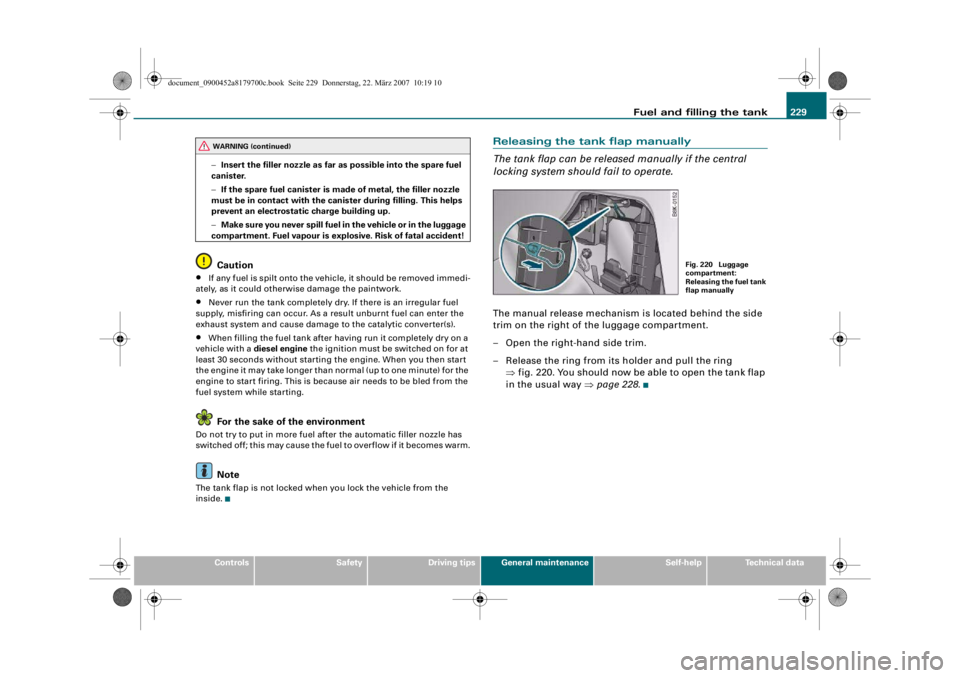
– Open the right-hand side trim.
– Release the ring from its holder and pull the ring
⇒ fig. 220. You should now be able to open the tank flap
in the usual way ⇒page 228 .
WARNING (continued)
Fig. 220 Luggage
compartment:
Releasing the fuel tank
flap manually
document_0900452a8179700c.book Seite 229 Donnerstag, 22. März 2007 10:19 10
--4 -
-T
CD
-+ +-
•
[I]
•
Page 232 of 313
Checking and topping up fluids
230Checking and topping up fluidsBonnetReleasing the bonnet
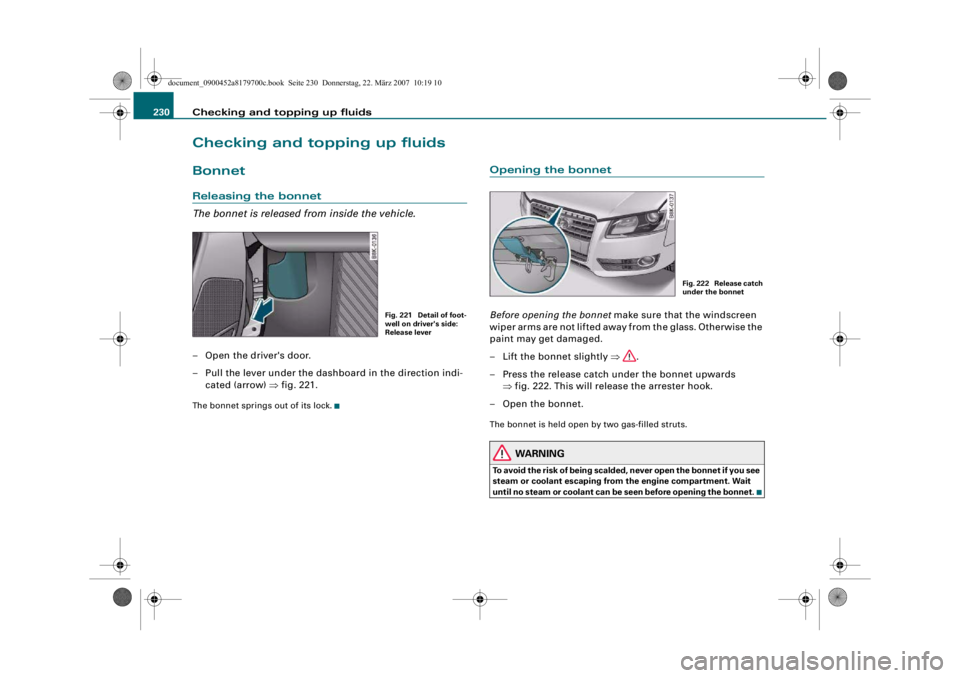
The bonnet is released from inside the vehicle.– Open the driver's door.
– Pull the lever under the dash board in the direction indi-
cated (arrow) ⇒fig. 221.The bonnet springs out of its lock.
Opening the bonnetBefore opening the bonnet make sure that the windscreen
wiper arms are not lifted away from the glass. Otherwise the
paint may get damaged.
– Lift the bonnet slightly ⇒.
– Press the release catch under the bonnet upwards ⇒fig. 222. This will release the arrester hook.
– Open the bonnet.The bonnet is held open by two gas-filled struts.
WARNING
To avoid the risk of being scalded, never open the bonnet if you see
steam or coolant escaping from the engine compartment. Wait
until no steam or coolant can be seen before opening the bonnet.
Fig. 221 Detail of foot-
well on driver's side:
Release lever
Fig. 222 Release catch
under the bonnet
document_0900452a8179700c.book Seite 230 Donnerstag, 22. März 2007 10:19 10
--4 -
-T
-+ +-
•
.I
Page 233 of 313
Checking and topping up fluids231
Controls
Safety
Driving tips
General maintenance
Self-help
Technical data
Working on components in the engine compartment
Extra caution is necessary when working on components
in the engine compartment.Always be aware of the danger of injury and scalding as well as the
risk of accident or fire when working in the engine compartment
(e.g. when checking and refilling fluids). Always observe the warn-
ings listed below and follow al l normal safety precautions. The
engine compartment of any motor vehicle is a potentially
hazardous area . ⇒ .
WARNING
•
Switch off the engine.
•
Remove the ignition key.
•
Apply the parking brake.
•
Put the gear lever in neutral or selector in P.
•
Wait for the engine to cool down.
•
Keep children away from engine compartment.
•
Never spill fluids on hot engine components. These fluids can
cause a fire (e.g. radiator anti-freeze).
•
Take care not to cause short circ uits in the electrical system,
especially when working on the battery.
•
Do not touch the radiator fan when the engine is hot. The fan
may start running suddenly.
•
Do not unscrew the cap on the ex pansion tank when the engine
is hot. The cooling system is under pressure.
•
Protect face, hands and arms by covering the cap with a large,
thick rag to protect against escaping coolant and steam.
•
If any tests have to be performed with the engine running,
there is an extra safety risk from the rotating parts, such as the
drive belts, alternator and radiator fan, etc., and from the high-
voltage ignition system.
•
Vehicles with automatic gearbox: Never open the throttle inad-
vertently (for instance by hand from the engine compartment) if a
gear is engaged while the vehicle is stationary with the engine
running. The vehicle could otherwise start moving immediately
and possibly cause an accident.
•
Observe the following a dditional warnings if work on the fuel
system or the electrical system is necessary:
−Always disconnect the battery.
− Do not smoke.
− Never work near naked flames.
− Always keep an approved fire extinguisher immediately
available.Caution
When topping up fluids make sure the correct fluid is put into the
correct filler opening. This can otherwise cause serious malfunc-
tions or engine damage.
For the sake of the environment
Inspect the ground un derneath your vehicle regularly so that any
leaks are detected at an early stag e. If you find oil spots or other
fluids, have your vehicle inspected by a qualified workshop.
Note
On right-hand drive vehicles* some of the containers/ reservoirs
mentioned below are located on the other side of the engine
compartment.
WARNING (continued)
document_0900452a8179700c.book Seite 231 Donnerstag, 22. März 2007 10:19 10
--4 -
-T
-+
CD
+-
[I]
•
Page 234 of 313
Checking and topping up fluids
232Closing the bonnet– To close the bonnet, pull it down to overcome the spring
pressure.
– Then let it drop into the catches; do not press down ⇒ .
WARNING
•
For safety reasons the bonnet must always be completely
closed when the vehicl e is moving. After closing it always check
that it is properly secured. The bonnet must be flush with the adja-
cent body panels.
•
Should you notice that the bonne t is not safely secured when
the vehicle is moving, stop the ve hicle immediately and close the
bonnet properly, otherwise it could cause an accident.
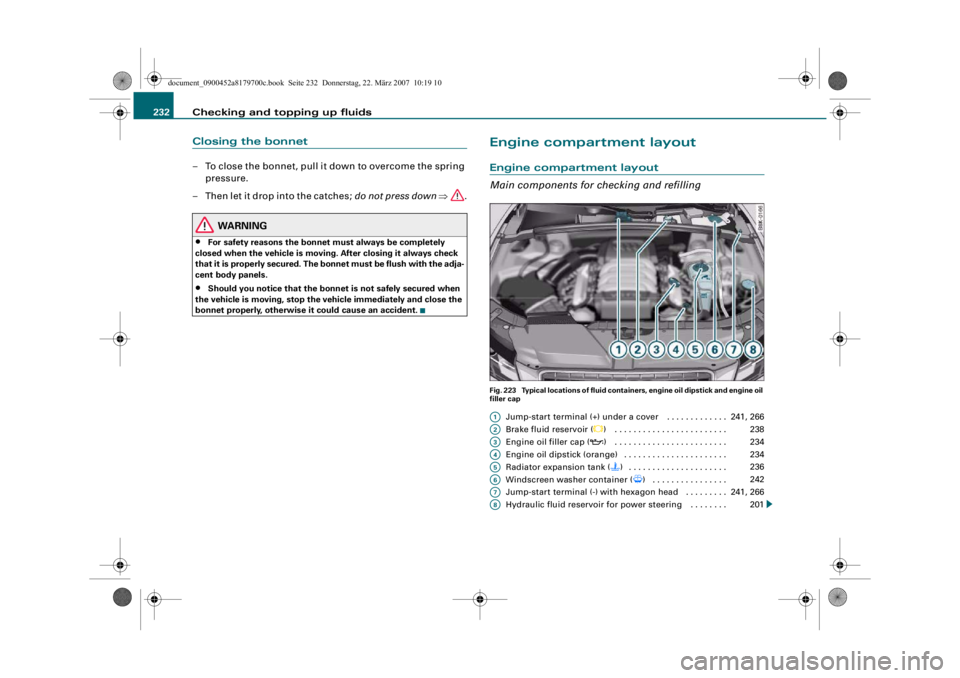
Engine compartment layoutEngine compartment layout
Main components for checking and refillingFig. 223 Typical locations of fluid containers, engine oil dipstick and engine oil
filler cap
Jump-start terminal (+) under a cover . . . . . . . . . . . . .
Brake fluid reservoir (
) . . . . . . . . . . . . . . . . . . . . . . . .
Engine oil filler cap (
) . . . . . . . . . . . . . . . . . . . . . . . .
Engine oil dipstick (orange) . . . . . . . . . . . . . . . . . . . . . .
Radiator expansion tank () . . . . . . . . . . . . . . . . . . . . .
Windscreen washer container (
) . . . . . . . . . . . . . . . .
Jump-start terminal (-) with hexagon head . . . . . . . . .
Hydraulic fluid reservoir for power steering . . . . . . . .
A1
241, 266
A2
238
A3
234
A4
234
A5
236
A6
242
A7
241, 266
A8
201
document_0900452a8179700c.book Seite 232 Donnerstag, 22. März 2007 10:19 10
--4 -
-T
-+
•
+-
Page 235 of 313
Checking and topping up fluids233
Controls
Safety
Driving tips
General maintenance
Self-help
Technical data
The positions of the engine oil filler cap and the engine oil dipstick
⇒
page 232, fig. 223 (items and ) may be different on some
engine versions.
Engine oilGeneral notesWe recommend that you have the oil change carried out by an Audi
dealership/qualified workshop according to the intervals stated in
the Service Schedule or according to the service interval display in
the instrument cluster.
Whether your vehicle is serviced at flexible service intervals or fixed
service intervals is shown in the Service Schedule.
The correct oil specifications for your engine are listed in the Te c h -
nical data section ⇒page 295, “Performance, weights and dimen-
sions”.
Check that the specifications quoted (VW standards) appear on the
container either singly or in combination with other specifications.
Flexible service intervals (Audi LongLife Service*)
Special engine oils ⇒page 295, “Performance, weights and dimen-
sions” have been developed as part of the Audi LongLife Service
( ⇒ “Service Schedule”).
This type of oil must be used if you intend to take advantage of the
extended maintenance intervals allowed by the Audi LongLife
Service.•
Do not mix the LongLife oil with oil intended for fixed service
intervals, as the requirements for the extended service intervals are
then no longer guaranteed.
•
In exceptional circumstances, if the engine oil level is too low
⇒ page 234 and you cannot obtain the specified LongLife oil, you
can put in a small quantity of oil for fixed service intervals -
⇒ page 295, “Performance, weights and dimensions”. This should not be done more than once and no more than 0.5 litres should be
used.
Fixed service intervals (Inspection Service)*
If you do not take advantage of th
e LongLife service for your car, you
can use the oils for fixed service intervals - ⇒ page 295, “Perform-
ance, weights and dimensions”. In this case, your car must be serv-
iced after a fixed interval of 1 year / 15,000 km (10,000 miles) – see
Service Schedule.
•
In exceptional circumstances, if the engine oil level is too low
⇒ page 234 and you cannot obtain the oil specified for your vehicle,
you can put in a small quantity of oil conforming to the specification
ACEA A2 or ACEA A3 (petrol engines) or ACEA B3 or ACEA B4 (diesel
engines). This should not be done more than once and no more than
0.5 litres should be used.
Vehicles with diesel particulate filter*
The Service Schedule states whether your vehicle is fitted with a
diesel particulate filter.
•
Vehicles with diesel particulate filter must only be filled with
engine oil VW 507 00. This oil can be used regardless of whether the
vehicle is serviced at flexible service intervals (Audi LongLife
Service) or fixed service intervals.
•
Avoid mixing this oil with other engine oils.
•
In exceptional circumstances, if the engine oil level is too low
⇒ page 234 and you cannot obtain the oil specified for your vehicle,
you can put in a small quantity of oil conforming to the specification
VW 506 00 / VW 506 01 or VW 505 00 / VW 505 01 or ACEA B3 /
ACEA B4. This should not be done more than once and no more than
0.5 litres should be used.
A3
A4
document_0900452a8179700c.book Seite 233 Donnerstag, 22. März 2007 10:19 10
--4 -
-T
•
-+ +-
•
Page 236 of 313
Checking and topping up fluids
234Checking the oil levelChecking oil level
– Park your vehicle on a level surface.
– Allow the warm engine to run briefly at idling speed and
then switch off the ignition.
– Wait approx. 2 minutes.
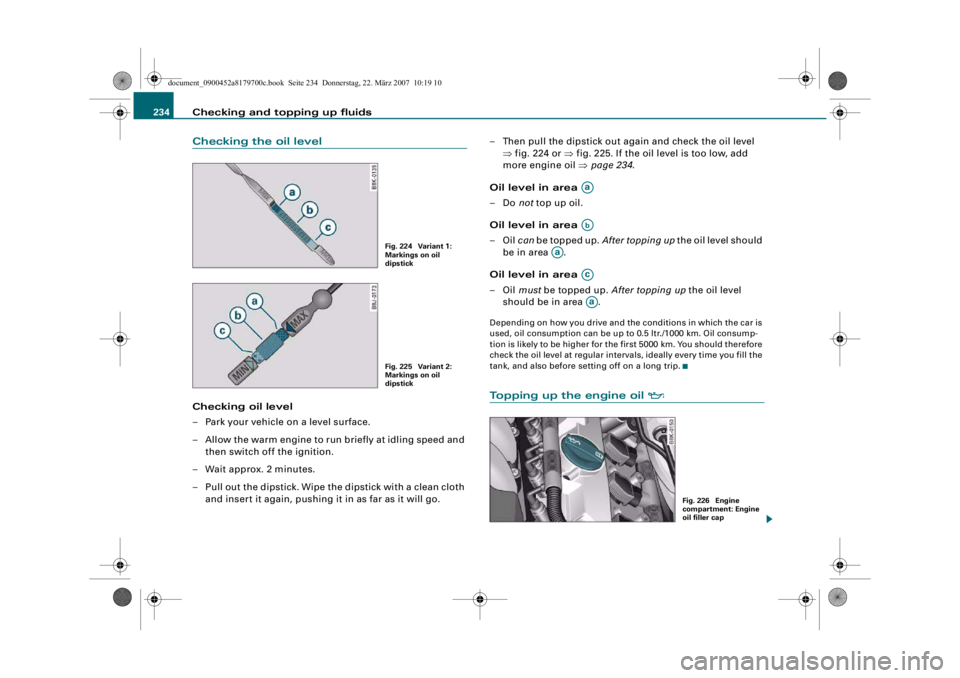
– Pull out the dipstick. Wipe the dipstick with a clean cloth and insert it again, pushing it in as far as it will go. – Then pull the dipstick out again and check the oil level
⇒fig. 224 or ⇒fig. 225. If the oil level is too low, add
more engine oil ⇒page 234 .
Oil level in area
–Do not top up oil.
Oil level in area
–Oil can be topped up. After topping up the oil level should
be in area .
Oil level in area
–Oil must be topped up. After topping up the oil level
should be in area .
Depending on how you drive and the conditions in which the car is
used, oil consumption can be up to 0.5 ltr./1000 km. Oil consump-
tion is likely to be higher for the first 5000 km. You should therefore
check the oil level at regular intervals, ideally every time you fill the
tank, and also before setting off on a long trip.Topping up the engine oil
Fig. 224 Variant 1:
Markings on oil
dipstickFig. 225 Variant 2:
Markings on oil
dipstick
AaAb
Aa
AcAa
Fig. 226 Engine
compartment: Engine
oil filler cap
document_0900452a8179700c.book Seite 234 Donnerstag, 22. März 2007 10:19 10
--4 -
-T
-+
•
+-
Page 237 of 313
Checking and topping up fluids235
Controls
Safety
Driving tips
General maintenance
Self-help
Technical data
–Unscrew cap
from oil filler opening ⇒page 234,
fig. 226.
– Carefully put in the specified grade of oil ⇒page 295
0.5 litres at a time.
– After two minutes check the oil level once again ⇒page 234 .
– If the oil level is too low, add more engine oil.
– Replace the oil filler cap carefully and push the dipstick all the way in.
WARNING
•
Ensure that no oil comes into contact with hot engine compo-
nents when topping up: th is could cause a fire.
•
Wash your skin thoroughly if it comes into contact with engine
oil.Caution
•
The oil level must never be above area , as this may result in
damage to the catalytic converter or to the engine. Contact a quali-
fied workshop to extract the engine oil if necessary.
•
No additives should be used with engine oil. Any damage caused
by the use of such additives woul d not be covered by the factory
warranty.For the sake of the environment
•
Never pour oil down drains or into the ground.
•
Always observe statutory requ irements when disposing of
empty oil canisters.
Cooling systemCoolant
The purpose of the coolant is to carry heat away from the
engine. The correct amount of anti-freeze is important to
prevent the cooling system from freezing in winter.The cooling system is filled for life at the factory, so the coolant does
not need to be changed. The coolant consists of a mixture of water
and anti-freeze additive G12+. This is a glycol-based anti-freeze with
anti-corrosion additives.
Anti-freeze additive
The amount of anti-freeze additive required depends on the temper-
atures to be expected in the winter season. If the anti-freeze concen-
tration is too low the coolant can freeze, resulting in failure of the
cooling system and heater.
The cooling system is filled at the factory with the correct amount of
anti-freeze for the country concerned.
In most cases the mixture consists of 60% water and 40% additive.
This mixture gives the necessary antifreeze protection down to –
25 °C and protects the alloy part s of the cooling system against
corrosion. It also prevents scaling an d raises the boiling point of the
coolant.
Countries with warm climate
The coolant concentration must not be reduced by adding plain
water, even in the summer or in warm climates. The concentration
of the anti-freeze additive must always be at least 40%.
Countries with cold climate
If greater anti-freeze protection is required in very cold climates, the
proportion of the anti-freeze additive G12+ can be increased. A
concentration of 60% offers protection down to about -40 °C. The
concentration of the antifreeze additive must not be more than 60%,
Aa
document_0900452a8179700c.book Seite 235 Donnerstag, 22. März 2007 10:19 10
--4 -
-T
-+
CD
+-
•
Page 238 of 313
Checking and topping up fluids
236otherwise this would reduce the antifreeze protection. In addition,
the cooling effect will be adversely affected.
Vehicles for export to countries with a cold climate (such as Sweden,
Norway and Finland) are supplied with antifreeze protection down
to about -35 °C. The concentration of the antifreeze additive for
these countries should always be at least 50%.
Caution
•
It is advisable to have the cooling system checked before the
winter season to make sure that the antifreeze concentration is
adequate for the conditions to be expected. This applies particularly
if you intend to take the car into a colder climate zone. If necessary,
have the anti-freeze concentration increased to 50 - 60% as required.
•
Use only anti-freeze additive G12+, an additive meeting the spec-
ification “TL-VW 774 F ”. Other additives may give considerably infe-
rior corrosion protection. The resulting corrosion in the cooling
system can lead to a loss of coolant, causing serious damage to the
engine.
•
The coolant additive G12+ can be mixed only with additives G11
and G12.
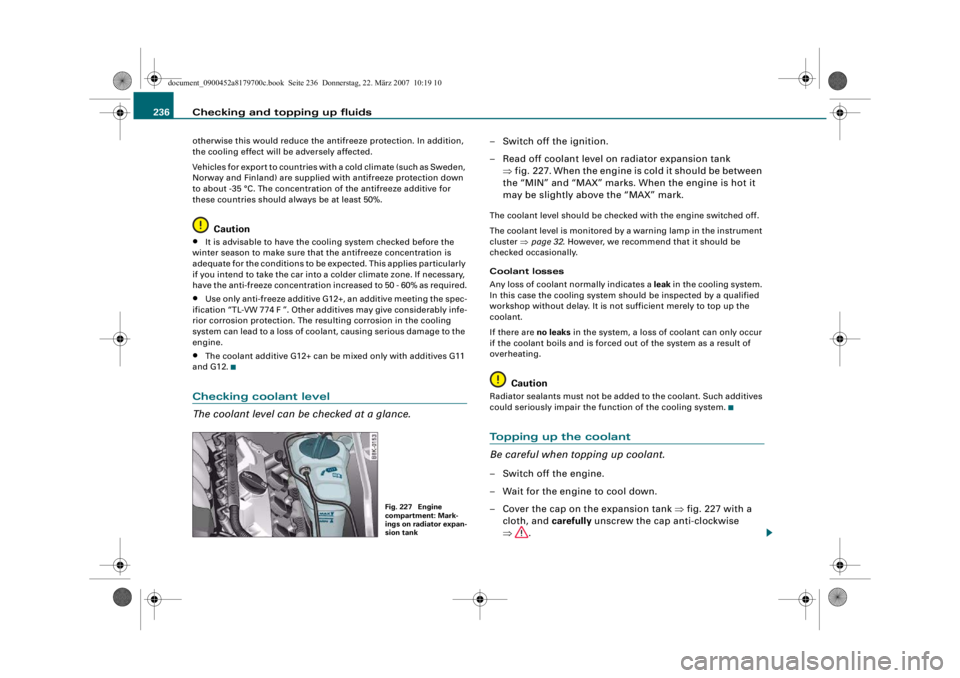
Checking coolant level
The coolant level can be checked at a glance.
– Switch off the ignition.
– Read off coolant level on radiator expansion tank ⇒fig. 227. When the engine is cold it should be between
the “MIN” and “MAX” marks. When the engine is hot it
may be slightly above the “MAX” mark.The coolant level should be checke d with the engine switched off.
The coolant level is monitored by a warning lamp in the instrument
cluster ⇒page 32 . However, we recommend that it should be
checked occasionally.
Coolant losses
Any loss of coolant normally indicates a leak in the cooling system.
In this case the cooling system should be inspected by a qualified
workshop without delay. It is no t sufficient merely to top up the
coolant.
If there are no leaks in the system, a loss of coolant can only occur
if the coolant boils and is forced out of the system as a result of
overheating.
Caution
Radiator sealants must not be added to the coolant. Such additives
could seriously impair the function of the cooling system.Topping up the coolant
Be careful when topping up coolant.– Switch off the engine.
– Wait for the engine to cool down.
– Cover the cap on the expansion tank ⇒fig. 227 with a
cloth, and carefully unscrew the cap anti-clockwise
⇒ .
Fig. 227 Engine
compartment: Mark-
ings on radiator expan-
sion tank
document_0900452a8179700c.book Seite 236 Donnerstag, 22. März 2007 10:19 10
--4 -
-T
0
-+
•
+-
0
•