transmission AUDI A5 COUPE 2013 Owner's Guide
[x] Cancel search | Manufacturer: AUDI, Model Year: 2013, Model line: A5 COUPE, Model: AUDI A5 COUPE 2013Pages: 294, PDF Size: 73.84 MB
Page 219 of 294
-Apply the parking brake.
- Move selector lever of automatic trans-
mission to "P" (Park); put manual trans
mission in Neutral.
- Always let the engine cool down . Hot
components will burn skin on contact.
- To reduce the risk of being burned, never
open the hood if you see or hear steam
or coolant escaping from the engine
compartment . Wait until no steam or
coolant can be seen or heard before care
fully opening the hood .
- Keep children away from the engine com
partment .
- Never spill fluids on hot engine compo
nents. They can cause a fire.
- Never touch the radiator fan. The auxili
ary electric fan is temperature controlled
and can switch on suddenly.
- Never open the coolant reservoir cap
when the engine is still warm. The cool
ant system is pressurized and hot cool ant could spray out .
-Protect your face, hands and arm from
steam or hot engine coolant by placing a
thick rag over the cap when you open the
coolant reservoir .
- Do not remove the engine cover under
any circumstances. This increases the
risk of burns.
- If work on the fuel system or the electri
cal system is necessary:
- Always disconnect the battery.
- Never smoke or work near heaters or
open flames. Fluids in the engine com
partment could start a fire.
- Keep an approved fire extinguisher im
mediately available.
- To avoid electrical shock and personal in
jury while the engine is running or being
started, never touch:
- Ignition cables
- Other components of the high voltage
electronic ignition system.
-If you must perform a check or repair
with the engine running:
Checking and filling 217
- First, fully apply the parking brake,
move selector lever of automatic trans
mission to "P" (Park); put manual
transmission in Neutral.
- Always use extreme caution to prevent
clothing, jewelry, or long hair from get
ting caught in the radiator fan, V -belts
or other moving parts, or from contact ing hot parts. Tie back hair before
starting, and do not wear clothing that
will hang or droop into the engine.
- Minimize exposure to emission and
chemical hazards~,& .
.8, WARNING
California Proposition 65 Warning:
- Engine exhaust, some of its constituents,
and certain vehicle components contain
or emit chemicals known to the State of
California to cause cancer and birth de
fects and reproductive harm. In addition,
certain fluids contained in vehicles and
certain products of component wear con
tain or emit chemicals known to the
State of California to cause cancer and
birth defects or other reproductive harm.
- Battery posts, terminals and related ac
cessories contain lead and lead com
pounds, chemicals known to the State of
California to cause cancer and reproduc
tive harms. Wash hands after handling.
(D Note
When adding fluids, always make sure that
they are poured into the proper container
or filler opening, otherwise serious dam
age to vehicle systems w ill occur.
@ For the sake of the environment
To detect leaks in time, inspect the vehicle
floor pan from underneath regularly. If
you see spots from oil or other veh icle flu
i ds, have your vehicle inspected by an au
thorized Audi dealer . •
•
Page 258 of 294
256 What do I do now?
@ Tips
-Never use the hexagonal socket in the
handle of the screwdriver to loosen or
tighten the wheel bo lts.
- If a whee l bolt is very tight, you may find
it easier to loosen by carefully pushing
down on the end of the wheel bolt
wrench with
one foot only. As you do so,
hold on to the car to keep your balance
and take care not to slip.
Raising the vehicle
The vehicle must be lifted with the jack first
before the wheel can be removed .
*
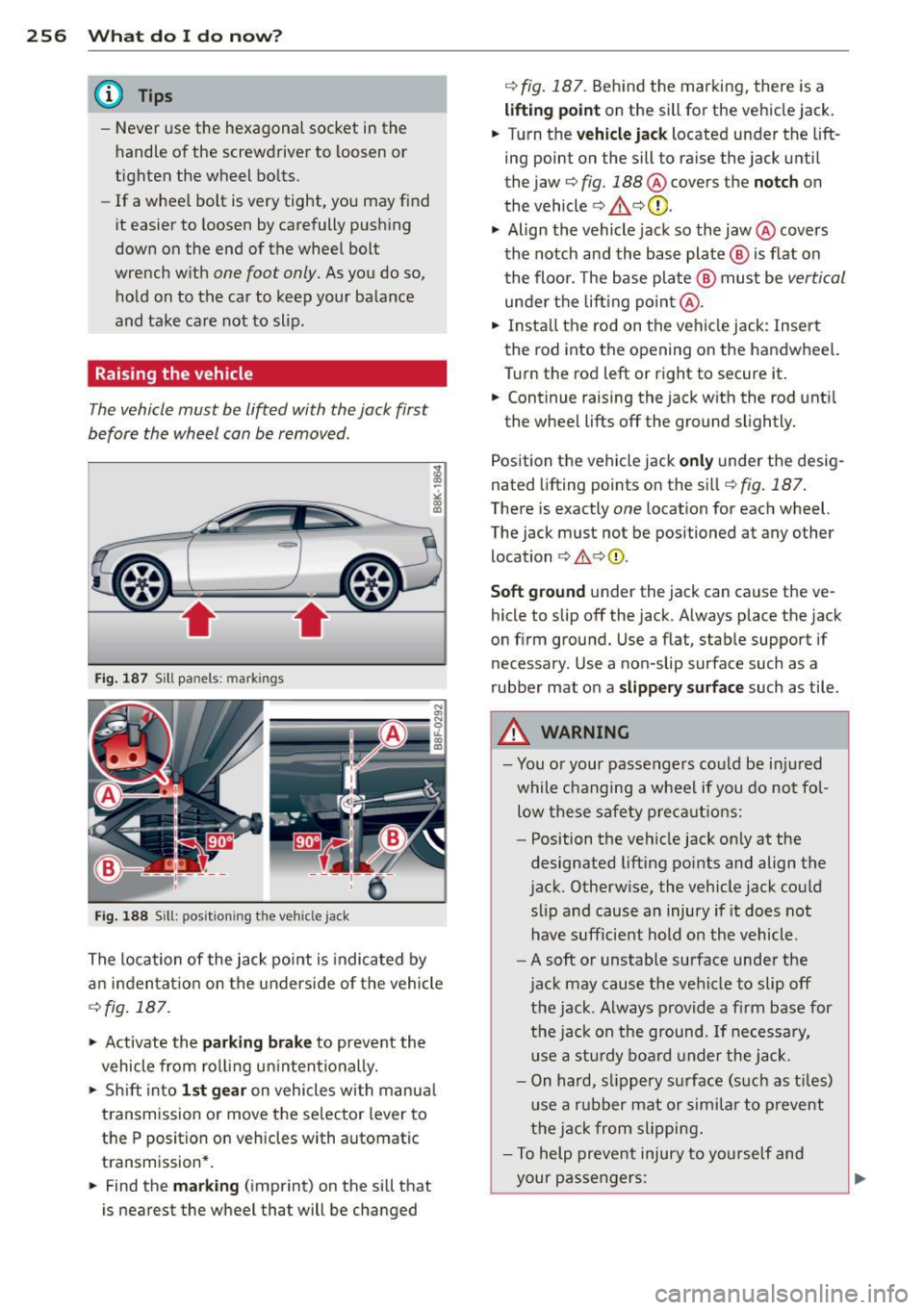
Fig. 187 Sill panels: mark ings
Fi g. 188 Sill : posit ion ing th e vehicle jack
The location of the jack point is indicated by
an indentat io n on the underside of the vehicle
¢fig . 187.
... Activate the parking brake to prevent the
vehicle from rolling unintentionally.
... Shift into
1st gear on vehicles with manua l
transmission or move the selector lever to
the P position on vehicles with automatic
transmission*.
... Find the
marking (imprint) on the sill that
is nearest the wheel that will be changed
¢fig. 187. Behind the marking, there is a
lifting point on the sill for the vehicle jack.
... Turn the
vehicle jack located under the lift
ing point on the sill to raise the jack unti l
the jaw ¢
fig. 1 BB @covers the notch on
the vehicle ¢
.&,¢(D .
... Align the vehicle jack so the jaw @covers
the notch and the base plate ® is flat on
the floor. The base plate
@ must be vertical
under the lifting point @.
... Insta ll the rod on the vehicle jack: Insert
the rod into the opening on the handwheel.
Turn the rod left or right to secure it.
... Continue raising the jack w ith the rod unti l
the wheel lifts off the ground slightly.
Position the vehicle jack
only under the desig
nated lifting points on the sill ¢
fig . 187.
There is exactly one location for each wheel.
The jack must not be positioned at any other location ¢,&. ¢(}).
Soft ground under the jack can cause the ve
hicle to slip off the jack. Always place the jack
on firm ground. Use a flat, stab le support if
necessary . Use a non-slip surface such as a
rubber mat on a
slippery surface such as tile .
&_ WARNING
--You or your passengers could be injured
while changing a wheel if you do not fol
low these safety precautions:
- Position the vehicle jack only at the
designated lifting points and align the
jack. Otherwise, the vehicle jack could
slip and cause an injury if it does not
have sufficient hold on the vehicle.
- A soft or unstable surface under the
jack may cause the vehicle to slip off
the jack . Always provide a f irm base for
the jack on the ground.
If necessary,
us e a sturdy board under the jack.
- On hard, slippery surface (such as til es)
u se a r ubber mat or similar to prevent
the jack from slipping.
- To help prevent injury to yourself and
your passengers:
Page 265 of 294
Emergency situations
General
This chapter is intended for trained emer
gency crews and working personnel who
have the necessary tools and equipment to
perform these operations.
Starting by pushing or
towing
(D Note
Vehicles with an automatic transmission
cannot be started by pushing or towing .
Starting with jumper
cables
If necessary, the engine can be started by
connecting it to the battery of another vehi
cle.
If the engine should fail to start because of a
discharged or weak battery, the battery can be
connected to the battery of
another vehicle,
using a
pair of jumper cables to start the en
g ine.
Jumper cables
Use only jumper cables of sufficiently
largecross section to carry the starter current
safe ly. Refer to the manufacturer's specifica
tions.
Use only jumper cables with
insulated termi
na l clamps which are distinctly marked:
plus(+) cable in most cases colored red
minus(-) cable
in most cases colored black .
A WARNING
Batteries contain electricity, acid, and gas.
Any of these can cause very serious or fatal
injury. Follow the instructions below for
safe handling of your vehicle's battery.
- Always shield your eyes and avoid lean
ing over the battery whenever possible.
Emergency situations 263
-A discharged battery can freeze at tem
peratures just below 32 °F (0 °C). Before
connecting a jumper cable, you must
thaw the frozen battery completely, oth
erwise it could explode.
- Do not allow battery acid to contact eyes
or skin . Flush any contacted area with
water immediately .
- Improper use of a booster battery to
start a vehicle may cause an explosion.
- Vehicle batter ies generate explosive gas
es. Keep sparks, flame and lighted c iga
rettes away from batteries.
- Do not try to jump start any veh icle w ith
a low ac id level in the battery.
- The voltage of the booster battery must
also have a 12-Volt rating. The capacity
(Ah) of the booster battery should not be
lower than that of the discharged bat
tery. Use of batteries of diff erent voltage
or substantially different "Ah" rat ing
may cause an exp losion and personal in
jury.
- Never charge a frozen battery. Gas trap
ped in the ice may cause an explosion.
- Never charge or use a battery that has
been frozen . The battery case may have
be weakened.
- Use of batter ies of different voltage or
substantially different capacity (Ah) rat
ing may cause an exp losion and injury .
The ca pa city (Ah) of the booster battery
should not be lower than that of the dis
charged battery.
- Before you check anything in the engine
compartment, always read and heed all
WARNINGS¢
page 209, Engine com
partment.
(D Note
- App lying a higher voltage booster bat
tery will cause expensive damage to sen
sit ive electronic components, such as
control units, relays, rad io, etc .
- There must be no electrical contact be
tween the vehicles as otherwise current
could already start to flow as soon as the
posit ive(+) terminals are connected. ..,. •
•
Page 266 of 294
264 Emergency situations
@ Tips
The discharged battery must be properly
connected to the vehicle's electrical sys
tem. When jump starting or charging the
battery, never connect the negative
ground cable to the battery negative post
because the batte ry manager system must
be able to detect the battery 's state of
charge. Always connect the negative
ground cab le to the negative ground post
of the battery manager control unit.
Use of jumper cables
Make sure to connect the jumper cable
clamps in exactly the order described below!
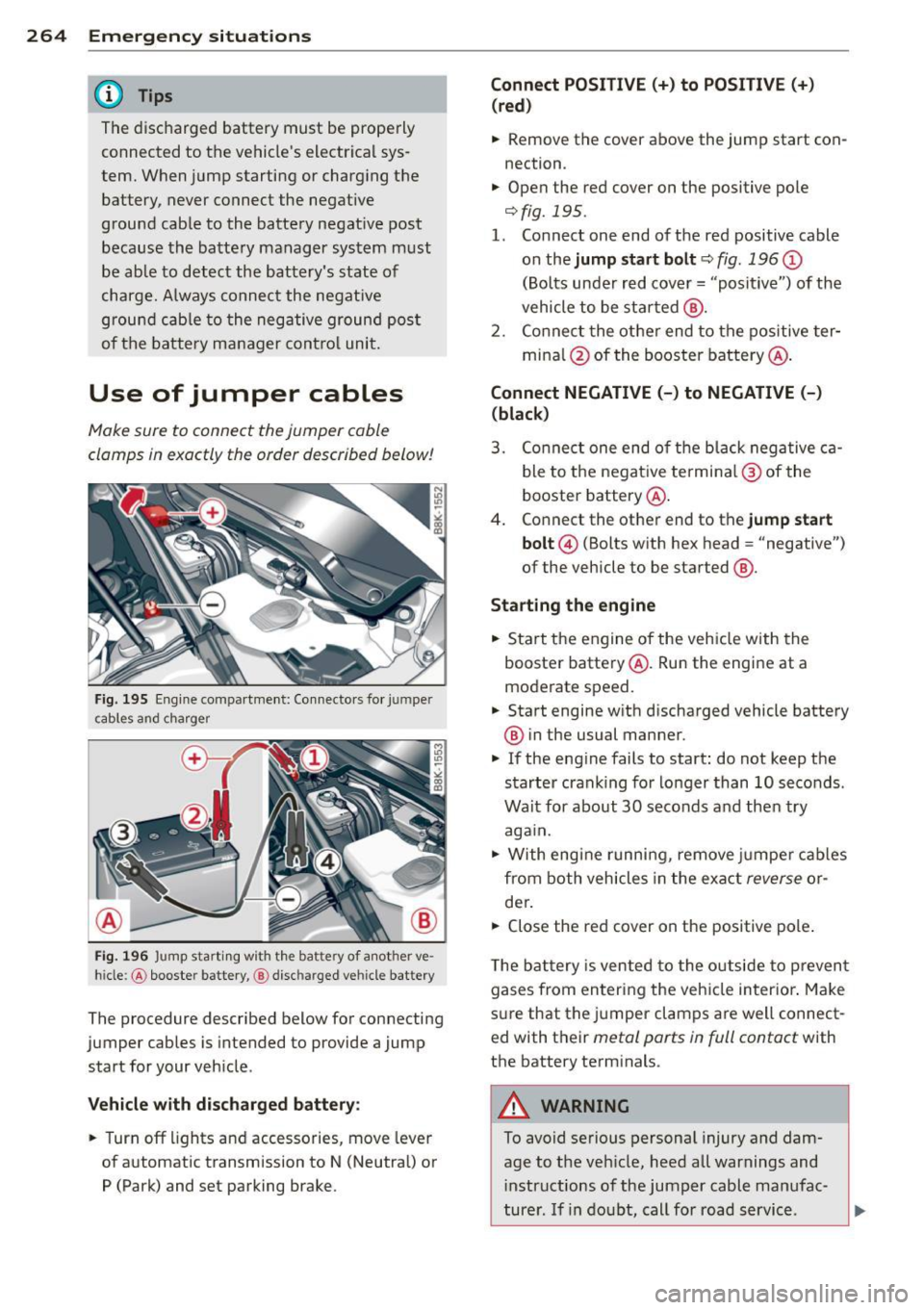
Fig. 195 Engine compartment: Connecto rs fo r jum per
cables and charger
Fig. 196 Jump sta rting wi th the battery of anot her ve ·
h ide :@ booster battery, @ disc harged vehicle battery
The procedure described below for connecting
jumper cables is intended to provide a jump
start for your vehicle .
Vehicle with discharged battery:
.. Turn off lights and accessories, move lever
of automatic transmission to N (Neutral) or
P (Park) and set parking brake .
Connect POSITIVE(+) to POSITIVE(+)
(red)
.. Remove the cover above the jump start con
nection .
.. Open the red
cover on the positive pole
¢fig. 195.
1. Connect one end of the red positive cable
on the
jump start bolt c::> fig. 196 @
(Bolts under red cover= "positive") of the
vehicle to be started @.
2. Connect the other end to the positive ter-
mina l@ of the booster battery@.
Connect NEGATIVE (-) to NEGATIVE (-)
(black)
3. Connect one end of the b lack negative ca
ble to the negative terminal @of the
booster battery @.
4. Connect the other end to the
jump start
bolt @
(Bolts with hex head= "negative")
of the vehicle to be started ®·
Starting the engine
.. Sta rt the engine of the vehicle with the
booster battery@. Run the engine at a
moderate speed.
.. Start engine with discharged vehicle battery
® in the usual manner .
.. If the eng ine fails to start: do not keep the
starter cranking for longer than 10 seconds .
Wait for about 30 seconds and then try
again .
.. With engine running, remove jumper cables
from both vehicles in the exact
reverse or
der .
.. Close the red
cover on the positive pole .
T he battery is vented to the outside to prevent
gases from entering the vehicle interior . Make
sure that the jumper clamps are well connect
ed with their
metal parts in full contact with
the battery terminals.
A WARNING
--
To avoid serious personal injury and dam
age to the veh icle, heed all warnings and
i nstructions of the jumper cable manufac-
turer . If in doubt, call for road service . ..,.
Page 270 of 294
268 Emergency situations
fall from a lift if there is a change in ve
hicle weight distribution and balance.
This might happen, for example, when
heavy components such as the engine
block or transmission are removed .
- When removing heavy components like
these, anchor vehicle to hoist or add cor
responding weights to maintain the cen
ter of gravity. Otherwise, the vehicle
might tilt or slip off the hoist, causing
serious personal injury.
(D Note
- Be aware of the following points before
lifting the vehicle:
-The vehicle should never be lifted or
jacked up from underneath the engine
oil pan, the transmission housing, the
front or rear axle or the body side
members. This could lead to serious
damage.
- To avoid damage to the underbody or
chassis frame, a rubber pad must be
inserted between the floor jack and
the lift points.
- Before driving over a workshop hoist,
check that the vehicle weight does not
exceed the permissible lifting capacity
of the hoist.
- Before driving over a workshop hoist,
ensure that there is sufficient clear
ance between the hoist and low parts
of the vehicle.
Page 277 of 294
-Always make sure the transm ission se
lector lever (automatic transmiss ion) is
in "P" (Park position) or Neutral (manual
transmission) and the park brake is firm
ly appl ied .
® For the sake of the environment
-Changing the eng ine settings w ill ad
versely affect em ission levels. This is det
rimental to the environment and increas
es fuel consumption .
- Always observe env ironmental regula
tions when d ispos ing of old engine oil,
used brake fluid, dirty engine coolant,
spent batter ies or worn out t ires.
- Undeployed airbag modules and p reten
s ioners might be classified as Perchlo
rate Material -special handling may ap
ply, see www.dtsc.ca .gov/hazardous
waste/perch lorate . When the veh icle or
parts of the restraint system including
airbag modules safety belts with preten
s ioners are scrapped, all applicable laws
and regulations must be observed. Your
authorized Audi dealer is familiar w ith
these requirements and we recommend
that you have your dealer perform this
serv ice for you .
Additional accessories,
modifications and
parts replacement
Additional accessories and parts
replacement
Always consult on authorized Audi dealer be
fore purchasing accessories.
Your veh icle incorporates the latest safety de
sign featu res ensu ring a high standard of ac
tive and passive safety.
This safety could be compromised by non-ap
proved changes to the veh icle. For this reason ,
if parts have to be replaced, p lease observe
the following points when installing addition
al accessories:
Con sumer In formation 275
Approved Audi accessories and genuine Audi
parts are available from authorized Audi deal
ers.
T hese dea lers a lso have the necessary facili
ties, tools and trained specialists to install the
parts and accessories proper ly.
A WARNING
Using the wrong spare parts or using non
approved accessories can cause damage to
the vehicle and serious persona l injury.
- Use on ly accessories express ly approved
by Audi and genuine Audi spare parts
- These parts and accessories have been
specially designed to be used on your ve
hicle.
- Never install accessories such as tele
phone cradles or beverage holders on air
bag covers or within the airbag deploy
ment zones . Do ing so will increase the
risk of injury if a irbags are triggered in an
accident!
- Before you check anything in the engine
compartment, always read and heed all
WARNINGS ~
page 209.
(D Note
-If items other than genuine Audi spare
parts, add-on equipment and accessory
items are used or if repair work is not
performed accord ing to specified meth
ods, this can result in severe damage to
your vehicle's engine and body (such as
corrosion) and adversely affect your vehi
cle's warranty .
- If emergency repairs must be performed
elsewhere, have the vehicle examined by
an authorized Audi dealer as soon as
possible.
- The manufacturer cannot be held liable
for damage wh ich occurs due to failure
to comply with these stipulations.
•
•
Page 280 of 294
278 Index
A
Accessories ... .. .. ..... ... .. .. .... . 275
AC (automatic cl imate control) ... .. .. . . 68
adapt ive cruise control
Vehicles with manual transmission . . . . 97
Adap tive cr uise con trol ................ 95
C leaning sensors/camera . ... .. .... . 202
M essages . . . . . . . . . . . . . . . . . . . . . . . . 103
Request for dr iver intervention . ..... . 10 1
Sett ing th e driving program .. .. .. ... 100
A dapt ive dampers .......... .... .... . 109
Adapt ive light ................ ... .... 43
Ada ptive Light (defective) ... .. .. .... .. 22
Adding Eng ine coolan t .................... 224
E ng ine oil . .... .. ..... ... .. .. .... . 22 1
Windshie ld washer fl uid ... .. .. .... . 230
Addit ional accessories
Addit ives 275
Eng ine oil .. ............. .. .. .. .. . 221
Ad justa ble s teer ing column . ... .. .... .. 71
Ad justing
A ir dist ribution (automatic climate con -
trol) . .. .. .. ............. .. .. .... .. 69
I ns trumen t illum ina tion . .. .. .. .. .. . . 46
Steer ing column .. ..... ... .. .. .... .. 71
Tempe rature (automatic climate control) 69
A irbag
War ning/ indica to r ligh ts ... .... .... .. 20
A irbag system . . . . . . . . . . . . . . . . . 142, 161
Advanced Airbag System ........ .... 146
Advanced Airbag System compone nts . 149
Ca re . .. .. ... ....... ........ ..... . 155
C hil dren . ............... .. .. .. .. . 167
C hil d restr aints ........... .. .. .. .. . 16 8
Componen ts (front airbags) .. .... .. . 1 49
D anger of fitting a child safety seat on
the front passenger seat . . . . . . . . . . . . 143
Disposal . .... ........... .. .. .... . 155
Front airbags . . . . . . . . . . . . . . . . 146, 147
H ow do the front airbags work? . .. .. . 151
H ow ma ny airbags does my vehicle
have? .... ................... ... . 14 9
H ow t he Advan ced Airbag System com-
p o nents wo rk toge ther ............. 150
I mpor tan t safety instru ctions on the
knee ai rbag system .. ... .. .. .. .... . 159 Important things to know ....
.... . .. 14 2
In dicator light ... .. ... ..... ... .. .. 153
Knee airbags ... .. ... .. ..... ... .. .. 157
Monitoring .... .. ............. .... 153
PASSENGER AIR BAG OFF light ....... 153
Repairs ......... .. .............. . 155
Safety instr uctions ..... ....... ... .. 155
S ide a irbags . .. ................... 160
S ide cu rtain airbags ............ .. .. 162
We igh t-sensing m at ........... .. .. 16 7
When m ust the sys tem be inspected? . 153
all-wheel d rive .. .. .. ... ....... ... .. 190
Alloy wheels .... .. ... .. ..... .... . .. 205
All w heel drive
W inter tires ... .. ............. .... 246
An ti- freeze
refer to Eng ine coolant system ....... 223
Anti -lock b raking system . . . . . . . . . . . . . 185
Warning/ind icator lights ............ . 19
An ti- slip reg ulation . .. .. ..... ... .. .. 185
An ti-theft ala rm wa rning system ........ 32
Anti -theft systems
E lectronic immob ilizer .......... .... . 38
Armres t ............................ 56
Asht ray ....... ... .. .............. .. 58
Aste risk
What does it mean when something is
marked with an aster isk? . . . . . . . . . . . . . . 6
A udi braking guar d
refer to braking guard ....... ... .. .. . 95
Audi dr ive select . ................... 109
Adaptive dampers ... .......... .. .. 109
D es cription .. .. .. ............. .. .. 109
D ynam ic steer ing .............. .... 109
Setting the dr iv ing mode ..... ... .. .. 110
Spo rt differential .... .. ..... ... .. .. 109
Audi Se rv ice Repair Manuals a nd Litera-
tu re ... .. .. .. .. .. .... ......... .... 273
A UTO
Automa tic cl imate contro l . . . . . . . . . . . . 69
Automa tic headlights ......... ... .. . 43
Auto Lock .. .. .. .. ............. .. .. . 32
A ut oma tic be lt retra ctor ............. 137
Automat ic car wash
refer to Washing .................. 201
Page 281 of 294
Automatic climate control Air vents ... ................ ... .... 69
Operation . . . . . . . . . . . . . . . . . . . . . . . . . 68
Setup ... .. ................. .. .... 70
Automatic Shift Lock (ASL) . . . . . . . . . . . . 85
Automatic transmission . . . . . . . . . . . 82, 88
Automatic Shift Lock (ASL) . . . . . . . . . . . 85
Driving .. .. ............. .... .. .. .. 82
Dynamic shift program . . . . . . . . . . . . . . 86
Emergency mode . . . . . . . . . . . . . . . . . . . 87
Emergency release . . . . . . . . . . . . . . 88, 94
Kick -down . . . . . . . . . . . . . . . . . . . . . . . . . 85
Manual shift program . . . . . . . . . . . . . . . 86
Removal lock (ignition key) . .. .. .. .. .. 71
Selector lever . . . . . . . . . . . . . . . . . . . . . .
84
S tronic .. ..... ........... ... ... ... 88
also refer to S tronic transmission ..... 88
Automatic wipers ................ .. .. 49
Auto Safety Hotline ........ .. .. .. .. . 132
Average speed . . . . . . . . . . . . . . . . . . . . . . . 25
Avoid damaging the vehicle ... ... .. .. . 193
B
Battery . . . . . . . . . . . . . . . . . . . . . . . 17,226
Battery location inside the luggage com-
partment .. ................ ... ... 227
Charging ... ................ ... ... 229
Important warnings when working on
the battery . ............. .... .. ... 227
Jump starting ............ .... .. ... 263
Low ..... ... ...... ............. .. 191
Replacing the battery ..... .. .. .. .. . 230
State of charge ........... .... .. .. . 191
W inter operation ......... .. .. .. .. . 226
Working on the battery .... .. .. .. .. . 227
Before driving . . . . . . . . . . . . . . . . . . . . . . 124
Bio-ethanol (Fuel) ................ .. . 212
Blended gasoline .......... .. .. .. .. . 211
Blower (automatic climate control) . . . . . . 69
Body cavity sealing ............ ... .. . 205
Booster seats .............. ... ... .. 174
Brake fluid Changing the brake fluid ... .. .. .. .. . 226
Checking the brake fluid level ... .. .. . 225
Reservoir .. ... .. .. ...... .. .. .. .. . 225
Index 279
What is the correct brake fluid level? . . 225
What should I do if the brake fluid warn- ing light comes on? ............... . 225
B rake system .. .. .. .... ........... .. 225
Anti- lock b raking system ........ .. .. . 19
Brake assist system ............... . 185
Brake fluid . ..... ................. 225
Brake fluid specifications for refill and re-
placement .. .. .. .... ........... .. 226
Brake light defective ............... . 21
Brake power assist unit ............. 188
Brakes .. .. .. .. .. .. . .. .... ........ 188
Ceramic brakes ... .. ............... 188
Electromechanical parking brake ..... . 76
Warning/ind icator lights ........ .. .. . 15
Worn brake pads symbol . . . . . . . . . . . . . 20
Braking Emergency braking function .......... 78
braking guard . .. .. .... ............. . 95
Messages . .. .. .. .. ............... 103
Settings .. .. .. .. .... ... .... .... .. 102
Break-in period . ..... ............... 193
Tires ........... .. ............... 193
Bu lbs .......... .... ............... 262
C
California Proposition 65 Warning ... .. 217
Battery specific ...... ......... .. .. 228
Capacities .. .. .. .. .... ........... .. 271
Car care ..... ... .... ............... 200
Interior ..... .... .. ............... 206
Plastic and vinyl .... .............. . 203
Care of exterior .. .. .... ........... .. 200
Cargo area
refer to Luggage compartment. . . 63, 130
Catalytic converter . . . . . . . . . . . . . . . . . . 194
Center armrest . . . . . . . . . . . . . . . . . . . . . . 56
Central locking .. .. ............... .. . 32
Central locking switch .......... .... . 36
Convenience key . . . . . . . . . . . . . . . . . . . . 36
Remote control key .... ....... .... .. 35
Ceramic brake rotors New brake pads .. ................. 188
Certification .. .. .. ... ............ .. 276
Changing a flat tire ................. . 253
Changing a wheel .... .............. . 253
•
•
Page 285 of 294
Front passenger's door emergency locking 3 7
Front seats Adjusting .. ............. .... .. ... 126
C hi ld restra ints in the front seat . .. .. . 14 3
Fue l
Addit ives . ..... ........... ... ... .. 211
Blended gasoline .............. .... 211
Consumpt ion . . . . . . . . . . . . . . . . . . . . . . 25
Fill er ne ck .. .. ........... .. .. .. ... 2 13
Fu el gauge . ............. .. .. .. .. .. 12
Gasoline ... .... ...... ... .. .. .. ... 211
Gasoline additives ..... ... .. .. .. .. . 2 12
L ow fuel level symbo l . . . . . . . . . . . . . . . 21
Octane rating ............ .... .. .. . 211
Recommendation . . . . . . . . . . . . . . . . . . 211
Refue lling ..... ........... ... ... .. 213
Reserve .. ..... ........... ... ... ... 1 2
Tank capacity ............... ... ... 271
Tank system ............. .... .. .. .. 2 1
Un loc king the f ue l filler fl ap by hand . . 215
Fuel economy messages (eff iciency pro-
gram) ..... ... ...... ............. ... 29
F ue l filler flap
Unlock ing the fue l filler f lap by hand 215
F uses
Assignment . . . . . . . . . . . . . 2 59 , 26 0, 26 1
Replacing . ... .... .... ... .. .. .. ... 259
G
Garage door opener (Home Link) .. .. .. . 119
Garment hooks . . . . . . . . . . . . . . . . . . . . . . 60
Gas discharge lamps ..... ... .. .. .. .. . 262
Gauges Eng ine coolan t temper ature .. .. .. .. .. 10
Fu el gauge ... .. .. .... ... .. .. .... .. 12
Tac hometer . . . . . . . . . . . . . . . . . . . . . . . 11
Gea r recommendat ion . . . . . . . . . . . . . . . . 28
Gearshift ind icator ......... .. .. .. .. .. 27
Gea rshift lever
6 -speed manual transmission ... .. .. .. 82
Ge ne ral illustra tion
I nstruments and controls . . . . . . . . . . . . . 8
Generator (warn ing/indicator lights) .. .. 17
Glossa ry o f tir e and load ing te rm ino logy 232
Glove compartment . . . . . . . . . . . . . . . . . . 60
GPS controlled clock ..... ... .. .. .. .. .. 1 2
Inde x 283
Gross Vehicle Weight Rating (GVW R) ... 269
H
Head lights
C leaning sys tem . ... .. .. ...... ... .. . 49
De fective . . . . . . . . . . . . . . . . . . . . . . . . . 21
Head light range control ..... ... .. .. . 22
Left hand drive, r ight hand drive .. .. .. . 4S
Travel mode . . . . . . . . . . . . . . . . . . . . . . . 45
Head light washer rese rvoir .... ... .. .. 2 30
Head restraints .. .. .. ... ....... .... . 127
Adjusting ....... .. ........ 56, 57, 127
Remov ing/ instal ling .. ......... .. .. . 57
Heated exter ior mirro rs .. .... ... .... .... .. . 46
r ear w indow ..... .. ..... ........... 69
seats ........ ... .. ..... ........... 69
windshield washer sp ray no zzles . .. .. . 49
Heating ...... .. ...... ............. . 67
Heavy clothing and safety be lts . ... .. .. 137
Hig h beam .. .. .. .. .. . .. .... .... .. .. . 44
Hig h voltage warning label ......... .. 269
Hill des cent con tro l .. .. ......... .. .. . 91
Homelink (remote control)
Hood 119
Opening . ... .. .... . ... ...... ... .. 216
Re lease lever .. .. ............. .... 216
Horn ...... .. .. .. ................... 8
How are child rest raint system anchors re -
lated to ch ild safety .. .. .. ...... .... . 180
How many a irbags does my vehicle have? 149
How ofte n should I che ck my tire pres -
s ur es? ..... .. .. .. ... ............ .. 238
How safety belt pretens ioners work .... 140
Hydrop laning ..... ... .. .. ..... ... .. 242
I
Ign it ion
switching on/off .. .. . ... ...... ... .. . 71
Ig nition key
E mergen cy un lo ck ing ........... .. .. . 35
Ig nition lock .. .. .. .. ............... . 71
Ind icator light ... .. . .. .... .... .. .. . 18
Malfunction . . . . . . . . . . . . . . . . . . . . . . . 23
Immobilizer . . . . . . . . . . . . . . . . . . . . . . . . 12
•
•
Page 287 of 294
Luggage compartment ... ... .. .. .. .. .. 63
Cargo net .. .... .. .... ... .. .. .. .... 64
Enlarg ing . ..... ...... ... .. .. .. .. .. 63
Lid .. .... .. ................. .. .... 39
Loading .. .. ............. .... .. ... 130
Pass -t h rough . . . . . . . . . . . . . . . . . . . . . . 65
Ski sack . ... ... .. .. ...... .. .. .. .. .. 65
T ie-downs ............ ...... .. 64, 13 1
Lumbar support ........... .... .. .... 54
M
Maintenance ... .... .... ... .. .. .. ... 273
M alf unct io n I ndicator Lamp (MIL) . . 20, 30
Manual transmission ....... .. .. .. .. .. 82
M echanical key . . . . . . . . . . . . . . . . . . 33, 34
M emory funct ion .... ...... .. .. .. .. .. 57
M ileage
Average .. .. ............. .... .. .... 25
Instantaneous ........... .. .. .. .. .. 25
M ir rors
Ad justing the exte rior mirrors ... .. .... 46
Compass . .. .. .. ......... .. .. .. .... 51
d imm ing . .. ............. .... .. .. .. 47
Vanity mirrors ........... .. .. .. .. .. 48
M on itoring the Advanced Airbag System 1 53
N
Na tur al leat her ............ .... .. .. . 20 7
Net .. .. .. .. .. ........ ... .. ... ... .. 60
New tires and w heels .... ... .. .. .. .. . 242
NHTSA Contac ting . ............. .. .. .. .. . 13 2
Number of seats ........... .. .. .. ... 134
0
Occupant seating posit ions
125
Octane r ating ............. .... .. .. . 211
Odometer ... .. ........ ... .. ... ... .. 12
O FF (automatic climate contro l) . . . . . . . . 68
O il
refer to Engine oil . . . . . . . . . . . . 218, 22 1
O il consumption .. ...... ... .... .. ... 221
Inde x 285
On-Boa rd Di agnost ic System (O BD)
Data Link Connector (D LC) .... ... .. .. . 30
E lectronic speed limiter . . . . . . . . . . . . . . 31
Malfunction Ind icator Lamp (MIL) .. .. . 30
Open door or fron t lid warn ing .... .. .. . 24
Open ing
Pano ram ic t ilting sunroof ............ 41
Power w indows .. .... ........... .. . 40
Su n blin d ... .. ...... ............. . 41
Su n sh ad es .. .. .. .. . ............... 48
Opening/closing at the lock cylinder .................. 37
by remote control ............. .. .. . 35
with t he ce ntra l locki ng sw itch ... .. .. . 36
wi th t he conve nien ce key ............ . 36
Operate your vehicle economically and
minimize pollution . .. .. .. ...... ..... 195
Optional equipment Marked w ith an asterisk . . . . . . . . . . . . . . . 6
Other equ ipment (efficiency program)
Outs ide mir ro rs 28
refer to Exte
rio r mirro rs ........... .. 46
Outs ide temperature disp lay . . . . . . . . . . . 24
Own er's ma nual
How the Owner's Manual is organ ized ... 6
p
Paint
T o uch-up .. .. .. .. ... ............ .. 20 3
Pa int No . ...... ... .. ............... 269
Pano ramic ti lting sunroof ..... ... .. .. . 41
Convenience opening/clos ing .... .... . 40
Emergency clos ing .... ......... .. .. . 42
Su n bli nd . .... .. .. . ............... 41
Tilt ing and closing .. ..... ......... .. 41
Pa rcel she lf ... .... .. . .. .. ..... ... .. . 66
Pa rkass ist .. .. .. .. .. .. ........... .. 112
Parking ...... .. ...... ............. . 77
Automat ic transm iss ion .. .. ... ... .. . 82
S t ronic tra nsmission . . . . . . . . . . . . . . . . 90
Valet pa rking .. .. .. .. .. ...... .... .. 42
Parking brake . .. .. ............. .... . 76
also refer to Electromechanical parking
brake . .. .. .. .. .... .. ........ ...... 76
•
•