light AUDI A5 COUPE 2014 Service Manual
[x] Cancel search | Manufacturer: AUDI, Model Year: 2014, Model line: A5 COUPE, Model: AUDI A5 COUPE 2014Pages: 286, PDF Size: 70.99 MB
Page 75 of 286
Starting the vehicle with the emergency
key
Applies to vehicles: with ignition lock
You can use the emergency key as an ignition
key in an emergency.
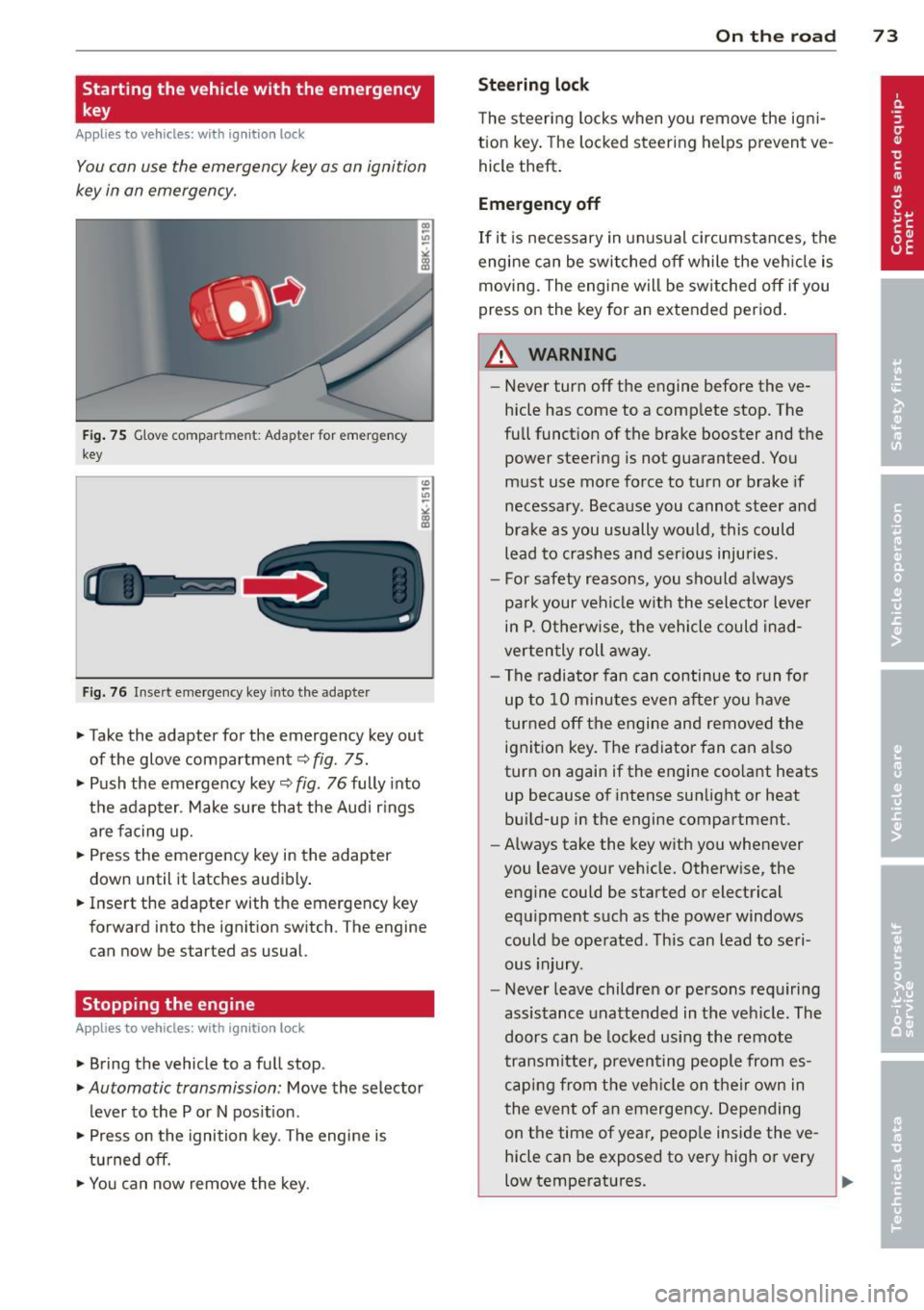
Fig . 75 G love compar tmen t: Adapter for emergency
key
Fig. 76 Insert emergency key into the adapter
.,.. Take the adapter for the emergency key out
of the glove compartment <=:>fig . 75 .
.,.. Push the emergency key~ fig . 76 fully into
the adap ter . Make sure that the Audi r ings
are facing up.
.,.. Press the emergency key in the adapter
down until it latches audibly .
.,.. Insert the adapter with the emergency key
forward into the ignition switch . The engine
can now be started as usual.
Stopping the engine
App lies to vehicles: with ig ni tion loc k
.,.. Bring the vehicle to a full stop.
.,.. Automatic transmission: Move the selector
lever to the P or N pos ition .
.,.. Press on the ignition key. The engine is
tu rned off.
.,.. You can now remove the key.
On th e road 73
Ste ering lo ck
The steering locks when yo u remove the ig ni
tion key. The lo cked steering helps prevent ve
hicle theft .
Emergency off
If it is necessary in unus ual circumstances, the
engine can be switched off while the veh icle is
moving. The engine will be switched off if you
press on the key for an extended period .
A WARNING
-Never turn off the engine before the ve
hicle has come to a comp lete stop. The
full funct ion of the brake booster and the
power steering is not guaranteed . You
must use more force to turn or brake if
necessary. Because you cannot steer and
brake as you usually would, this could
lead to crashes and ser ious injuries.
- For safety reasons, you should always
pa rk your vehicle with the selector lever
in P . Otherwise, the vehicle could inad
verten tly roll away.
- The radiator fan can continue to run fo r
up to 10 minutes even after you have
turned off the engine and removed the ignition key. The radiator fan can a lso
turn on again if the engine coo lant heats
up because of intense sunlight or heat
build-up in the engine compartment.
- Always take the key with you whenever
you leave your vehicle. Otherw ise, the
engine could be started or electrical
equipment such as the power windows
could be operated . This can lead to seri
ous injury.
- Never leave children or persons requiring
assistance unattended in the vehicle. The
doors can be locked using the remote
transmitter, preven ting people from es
caping from the veh icle on their own in
the event of an emergency . Depending
on the time of year, peop le inside the ve
hicle can be exposed to very high or very
low temperatures .
Page 77 of 286
in the hy draulic valve adjus ters. This is
norma l and not a cause for concern .
- If you leave the vehicle with the ignit ion
switched on, the ignition will switch off
after a certain pe riod of time . Please
note that e lectr ica l equipment such as
exterior lights will swi tch off as well
when tha t happens .
Switching engine off
Applies to vehicles: with conven ie nce key
.,. Bring your vehicle to a complete stop .
.,. Automatic transmiss ion: Move the selector
lever to the P or N pos it ion.
.. Press the
I STA RT ENGINE STOPI button
~ page 74, fig. 77.
Steering lock
The steering locks when you turn the engine
off us ing the
I STAR T ENGIN E STOP I button
and open the dr iver's door. The locked stee r
i ng helps prevent vehi cle theft.
Emergency off
If necessary , the eng ine can be sw itched off
with the selector lever in the R or D/S pos i
tions. To do so , step on the brake peda l and
p ress and hold the
I S TA RT E NGINE STO PI bu t
ton vehicle speed must be less than 6 mph (10 km/h).
A WARNING
- Never turn off the eng ine before the ve
hicle has come to a complete stop . The
full function of the brake booster and the
power steering is not guaranteed. You
must use more force to turn or brake if
necessary . Because you cannot steer and
brake as you usua lly would, t his could
lead to crashes and serious injur ies .
- For safety reasons, you should always
par k your vehicle with the se lector lever
in P. Otherwise, the ve hicle co uld i nad
vertent ly roll away.
- T he rad iator fan ca n con tinue to ru n for
u p to 10 min utes eve n after yo u have
t ur ned o ff the eng ine and removed the
On th e ro ad 75
ignition key. The radiator fan can a lso
turn on again if the engine coo lant heats
up because of intense sunlight or heat
bu ild-up in the engine compartment.
- Always take the key w ith you whenever
you leave your ve hicle. Otherw ise, the
engine could be started or electrical
equ ipme nt such as the power windows
could be ope rated. This can lead to seri
ous injury.
0 Note
If the engine has been under heavy load
fo r an extended pe riod, heat bu ilds up in
the engine compartm ent after the engine
i s sw itched off -th ere is a r is k of damag ing
the engine . A llow the engi ne to run at id le
fo r abo ut two minutes before switching it
off.
Driver messages
Ignition is o n
This message appears and a warning tone
sou nds if you open the d river's door when the
ignition is sw itched on .
No key ident ified
This message appears when the
I S TART ENG IN E STOP I bu tton is pressed if
there is no master key ins ide the veh icle or if
the system does not recognize it . Fo r exam
ple , the master key cannot be recogni zed if it
is covered by an obje ct (e.g . al uminum brief
case) which
screens t he radio s ignal. Elec tron
i c dev ices such as cell phones can also inter
fere with the radio s ignal.
Pre ss brak e pedal to start engine
This message appears if you do not press the
brake pedal to start the eng ine in a vehicle
with an automat ic transm iss ion.
Press clutch pedal to start engine
T his message appears if you do not press the
clutch pedal to start the engine in a veh icle
with a manual tr ansmission . ..,.
Page 78 of 286
76 On the road Shift to N or P to start engine
This message appears when attempting to
start the engine if the selector lever for the
automatic t ransmission is not in the P or N
position. The engine can on ly be started with
the selector in these posi tions.
Is the ke y in the vehicl e?
This message appears if the master key is re
moved from the vehicle with the eng ine run
n ing .
If the master key is no longer in the ve
hi cle, yo u cannot swit ch o n the ignition after
stopping the engine and you also cannot star t
the engine again. Moreover, yo u cannot lock
the vehicle from the outside with the key .
Shift to P otherwise vehicle ca n roll away .
Door s do not l ock if l ev er i s not in P.
This m essage appears for safety reasons
a long w ith a warning signa l.
It appears if the
selec tor lever for the automat ic transm iss ion
is not in the P position when switch ing
off the
i gnition . Move the selector lever to the P posi
t ion, otherwise the vehicle is not sec ured
against rolling away. You also cannot lock the
vehicle using the locking button * on the door
handle or using the remo te key.
C on ven ience key defecti ve! U se ignition loc k
This message appea rs if the engine mus t be
started or s topped using the igni tion key and
not the
I S TART ENGINE ST OP ! button.
Electromechanical
parking brake
Operation
The electromechanical parking brake replaces
the hand brake.
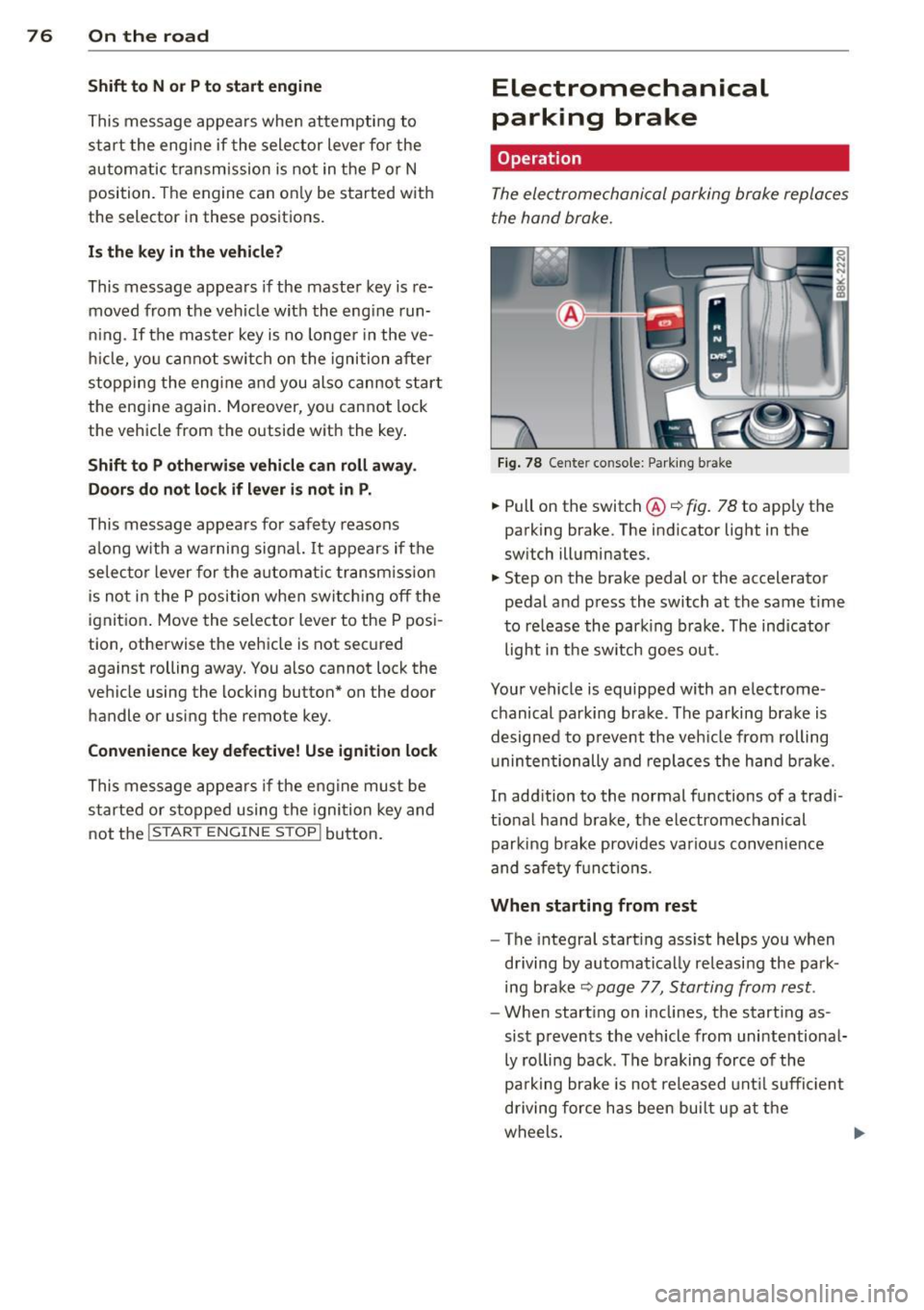
F ig . 78 Cen ter co nsole: Park ing b rake
.,. Pull on the switch@¢ fig. 78 to app ly the
parking brake. The indicator light in the
sw itch ill um inates.
.,. Step on the brake pedal or the accelerator
pedal and p ress the switch at the same t ime
to re lease the park ing brake. The indicator
light in the sw itch goes out.
Your vehicle is equipped with an electrome
chanical parking brake . The parking b rake is
designed to p revent the veh icle from rolling
u nintentionally and replaces the hand b rake .
I n add ition to the normal functions of a tradi
tional hand brake, the electromechanical
parking brake provides vario us convenience
and safe ty f unct io ns.
When starting from rest
- The integral start ing ass ist helps you when
driving by automat ically releasi ng the park
ing brake
~ page 77 , Starting from rest .
-When start ing on i nclines, the start ing as
sist prevents the vehicle from uni ntentional
ly ro lling back . The braking force of the
pa rk ing brake is no t released unt il suff ic ient
driving force has been bui lt up at the
wheels . ..,.
Page 79 of 286
Emergency brake fun ction
An emergency brake ensures that the vehicle
can be slowed down even if the
normal b rakes
fail
c::> pag e 78 , Emergency broking .
Indicat or light s
-If the par king b rake is closed w ith the igni
t ion
s wit ched on the . (USA mode ls) /
• (Canada models) indica tor lights come
on in the instrument cluster and the switch .
-If the par king brake is closed w ith the igni
tion
s witched off the . (USA mode ls) /
• (Canada models) indicator lights come
on in the instrument cluster and the switc h
for about 20 seconds.
A WARNING
If a gear or a drive range (automat ic trans
m ission) is engaged with the vehicle s ta
tionary and the engine runn ing, you must
in no instance accelerate or release the
clutch* care lessly. Otherw ise the vehicle
w ill sta rt to move immediately- risk of an
accident.
(D Note
If the . symbol in the display or the.
(USA models) . (Canada mode ls) indica
tor light i n the instrument cluster flashes,
there is a mal function i n the brake system.
By pressing the
I SETI button, you can bring
up a driver message which explains the
malfunction in more detai l. If the driver
message
Park ing brake! appears, there is
an operating malfunct ion in the parking
brake wh ich you shou ld have repa ired im
mediately by an author ized Audi dealer or
qualified workshop
c::> poge 15.
(D} Tips
-You can apply the parking brake at any
time -even w ith the ignition switched
off . The ignit ion must be t urned on and
the brake peda l must be pressed in o rder
to release the pa rking bra ke .
On th e ro ad 77
-Occasional noises when the parking
brake is app lied and released are normal
and are not a cause for concern.
- When the vehicle is pa rked, the park ing
brake goes through a self -test cycle at
regu lar interva ls. Any associated noises
are normal.
Parking
.,. Press the brake pedal to stop the veh icle .
.. Pull the sw itch @
c::> page 76, fig . 78 to set
the parking brake .
.,. Automatic transmission : M ove the selecto r
lever to P.
.. Tu rn the engine off¢,&. .
.. Manual transmission: Shift into 1st gear.
.. When on inclines or declines, turn the steer
ing wheel so that the vehicle will roll into
the curb if i t beg ins to move.
A WARNING
--- When you leave your vehicle -even if on-
ly briefly -always remove the ignition
key . Thi s app lies pa rticula rly whe n chil
dren remain in the vehicle. Ot herwise t he
children could star t the eng ine , release
the par king brake or operate electrical
equipment (e.g. power windows). There
is the risk of an accident.
- When the veh icle is locked, no one -par
ticularly not children should remain in
the vehicle . Locked doors make it more
difficult for emergency workers to get in
to the vehicle -putting lives at risk .
Starting from rest
The starting assist function ensures that the
parking brak e is r ele ased automatically upon
star ting.
Stopping and applying park ing brake
.. Pull the switch @¢ page 76, fig. 78 to ap-
ply th e parking brake. ..,.
Page 82 of 286
80 On the road
Warning threshold 2 can be set in the speed range starting from
20 mph to 150 mph (30
km/h to 240 km/h). Settings can each be ad
justed in intervals of
6 mph (10 km/h).
Cruise control
Switching on
The cruise control system makes it possible to
drive at a constant speed starting at
20 mph
(30 km/h).
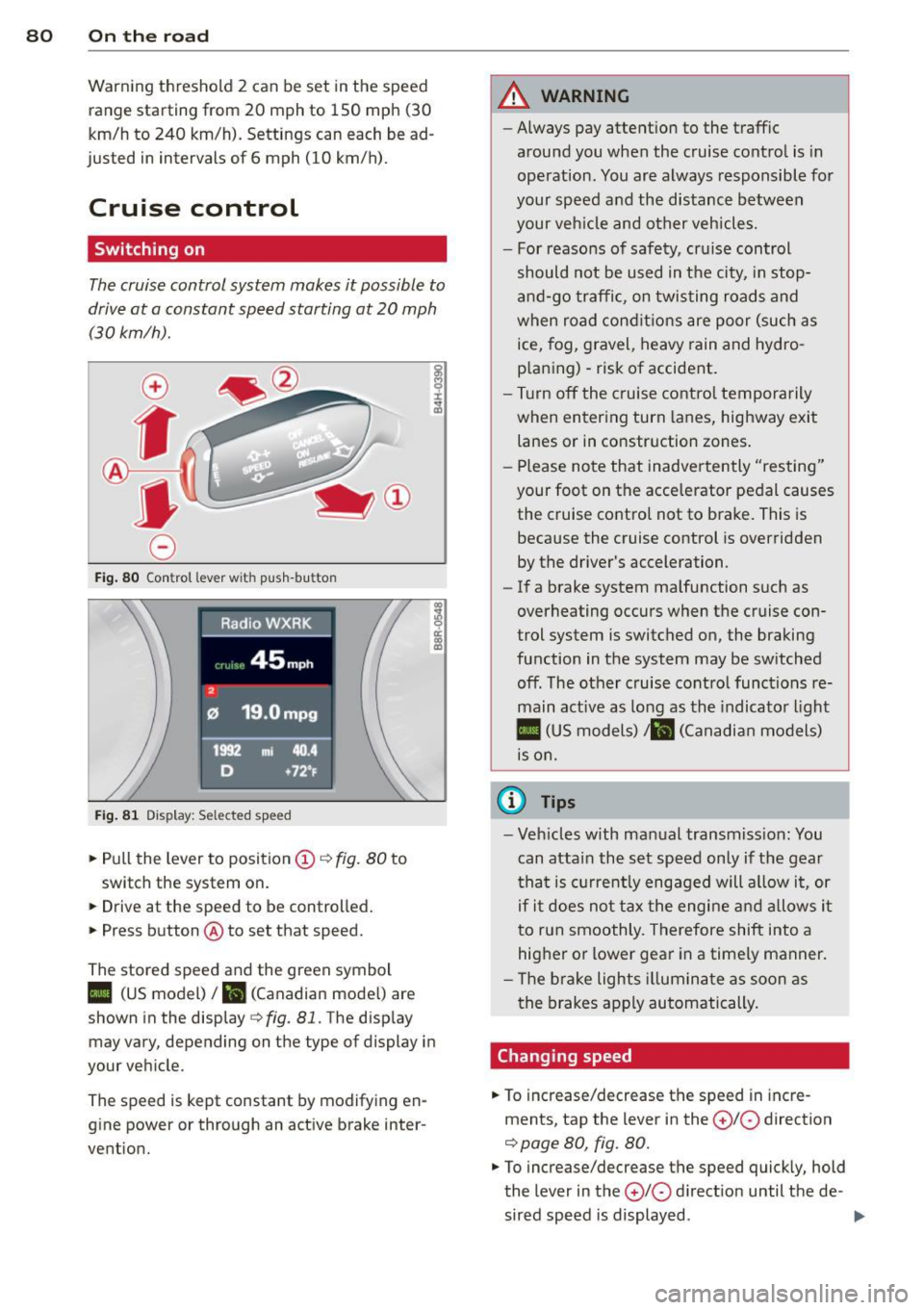
Fig. 80 Control lever w it h push-bu tton
Fig. 81 Dis play : Sel ected speed
.. Pull the lever to position(;)¢ fig. 80 to
switch the system on.
.. Drive at the speed to be controlled .
.. Press button @ to set that speed.
The stored speed and the green symbol
co ~ 9 a:
l:l
II (US model)/ B (Canadian mode l) are
shown in the display¢
fig. 81. The display
may vary, depending on the type of display in
your vehicle.
The speed is kept constant by modifying en
g ine power or through an active brake inter
vention.
A WARNING
-- Always pay attent ion to the traffic
around you when the cruise control is in
operation. You are always responsible for
your speed and the distance between
your veh icle and other vehicles.
- For reasons of safety, cruise control
should not be used in t he city, in stop
and-go traffic, on twisting roads and
when road conditions are poor (such as
ice, fog, gravel, heavy rain and hydro
p laning) -risk of accident .
- Turn off the cruise control temporarily
when entering turn lanes, highway exit
lanes or in constr uction zones .
- Please note that inadve rtently "resting"
your foot on the accelerator pedal causes the cruise control not to brake. This is
because the cruise control is overridden
by the driver's acceleration.
- If a brake system malfunction such as
overheating occurs when the cruise con
trol system is switched on, the braking
function in the system may be sw itched
off. The other cruise control functions re
main active as long as the indicator light
II (US models)/ ... (Canadian models)
is on.
(D Tips
-Veh icles with manual transmiss ion: You
can attain the set speed only if the gear
th at is cur rently engaged will allow it, or
if it does not tax the engine and allows it
to run smoothly. Therefore shift into a
hig her or lower gear in a timely manner.
- Th e brake lights illuminate as soon as
the brakes apply automatically.
Changing speed
.. To increase/decrease the speed in incre
ments, tap the lever in the
0 10 direction
¢ page 80, fig. 80.
.. To increase/decrease the speed quickly, hold
the lever in the
0 10 d irect io n until the de -
sired speed is displayed . ..,.
Page 84 of 286
82 Transmission
Transmission Manual transmission
Gearshift lever
Applies to vehicles: with manual transmission
The clutch pedal must be depressed all the
way before you can start the engine.
The manual transmission in your Audi is
equipped with an
interlock-feature .
• Depress the clutch pedal all the way.
• Start the engine with the gearshift lever in
Neutral and the clutch pedal depressed.
(D Note
Always depress the clutch pedal fully when
changing gears. Do not hold the vehicle on
a hill with the clutch pedal partially de
pressed. This may cause premature clutch
wear or damage .
@ Tips
-Resting your hand on the gearshift lever
knob while driving will cause premature
wear in the transmission.
- The back-up lights go on when you sh ift
in to Reverse with the ignition on.
Gearshift pattern (6-speed manual
transmission)
Applies to vehicles: with manual transmission
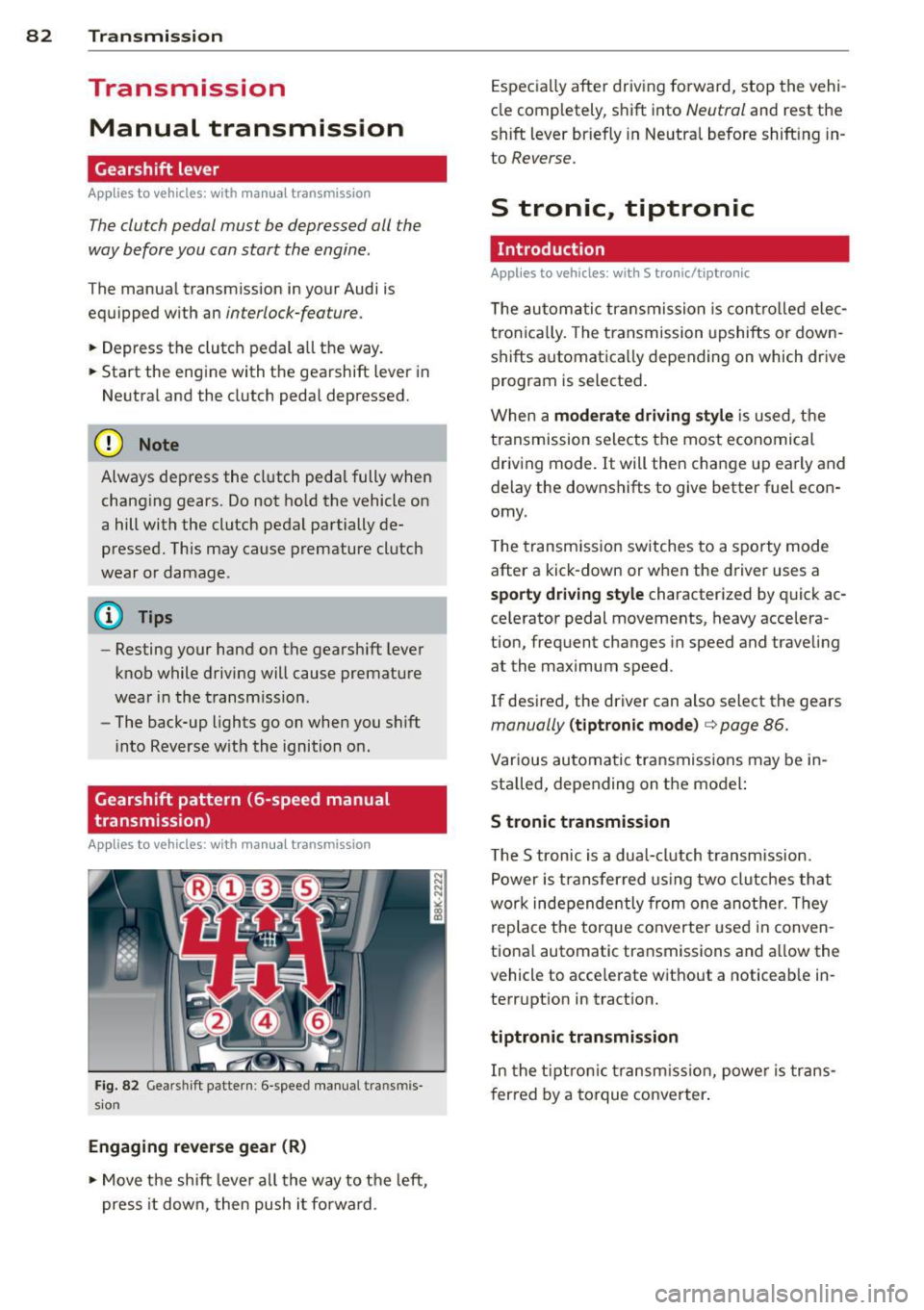
Fig. 82 Gears hi ft pattern : 6 -speed manual tra n smi s
sio n
Engaging reverse gear (R)
• Move the shift lever all the way to the left,
press it down, then push i t forward . Especially
after driving forward, stop the vehi
cle completely, shift into
Neutral and rest the
shift lever briefly in Neutral before shift ing in
to
Reverse.
S tronic, tiptronic
Introduction
Applies to vehicles: with S tronic/tiptronic
T he automatic transmission is controlled elec
tronically. The transmission upshifts or down
shifts automatica lly depending on which drive
program is selected.
When a
moderate driving style is used, the
transmission selects the most economical
driving mode. It will then change up early and
delay the downshifts to give better fuel econ
omy .
T he transmission switches to a sporty mode
after a kick-down or when the driver uses a
sporty driving style characterized by quick ac
ce lerator pedal movements, heavy accelera
tion, frequent changes in speed and traveling
at the maximum speed.
If desired, the driver can also select the gears
manually (tiptronic mode) c> page 86.
Various automatic transmissions may be in
stalled, depending on the model:
S tronic transmission
The S tronic is a dual-clutch transmission.
Power is transferred using two clutches that
work independe ntly from one another. Th ey
replace the torque converter used in conven
tional automatic transmissions and al low the
vehicle to acce lerate without a noticeable in
terruption in tract ion.
tiptronic transmission
In the tiptronic transmission, power is trans
f er red by a torque converter.
Page 87 of 286
~ Press and hold the release button in these
lector lever handle, se lect the desired se lec
tor lever position such as D/S and re lease
the button.
~ Wait br iefly until the transmission has shift
ed (you will feel a slight movement).
~ Remove your foot from the brake pedal and
acce lerate.
Stopp ing temporaril y
~ Keep the vehicle stationary us ing the brak
ing pedal, for example at traffic lights.
~ Do not press the accelerator pedal when do
i ng this.
~ To p revent the veh icle from rolling when you
sta rt driving, set the pa rking brake whe n
stopp ing on steep inclines ¢
&-
~ The parking brake will re lease automatically
and the vehicle will start moving once yo u
press the accelerator peda l.
Stopping /pa rking
If the selecto r lever is not in the P position
when yo u ope n the dr iver's door, the vehicle
could ro ll. The message
Transmis sion: Car
m ay ro ll! Shift to pa rk!
appears.
~ Press and ho ld the brake pedal unt il the ve-
hicle has come to a comple te stop.
~ Apply the parking brake ¢ page 77, Parking.
~ Select the P selector lever position c::, & -
Stopping on an incline
~ Always press t he b rake pedal to hold the ve
hicle i n place and preven t it from " rolling
back" ¢
& -Do not try to prevent the vehi
cle from "rolling back" when a gear is en
gaged by increasing the engine speed ¢(D .
Starting on an incline
~ Activate the par kin g b rake.
~ Wi th the driving gea r se lected, press the ac
ce lerato r pedal ca re fully . The parking brake
will release a utomatically i f yo ur seat belt is
fastened.
Under certain circumstances, s uch as driv ing
in the mountains, it may be useful to switch
temporari ly to the manua l shift program in or-
Tran sm iss ion 85
der to ad just the gears to the driv ing cond i
tions by hand
c::, page 86.
On s lopes, activ ate the parki ng b rake first and
then move the selec to r l ever to the P posi tion.
T his prevents too much st ress from being
placed on the locking mechanism .
A WARNING
-The vehicle can also roll when the engine
is stopped.
- Unintended vehicle movement can cause
serio us injury.
- Never leave your vehicle with the engine
ru nning while in gear. If yo u must leave
your veh icle when the engine is running,
activate the parking brake and move the
selector lever to P.
- Power is still transm itted to the wheels
when the engine is runn ing at idle. To
prevent the vehicle from "creeping", you
must keep your foot on the brake when
the eng ine is ru nning and the se lector
leve r is in D/S o r R or "t ipt ron ic" mode is
selec ted .
-Do not press the accelerator pedal when
changing t he se lector lever posi tion
while the veh icle is s ta tionary and the
engine is running .
- Never sh ift into R o r P wh ile d rivi ng.
- Before driving dow n a steep slope, re-
duce your speed and shift into a lowe r
gear wi th "tiptronic".
- Do not ride the bra kes o r press the bra ke
pe dal too ofte n or too long whe n driving
down a hi ll. Constant braking causes the
brakes to over heat and substantially re
duces braking performance, increases
brak ing distance or causes complete fa il
ure of t he brake system.
- To prevent the vehicle from ro lling back
when stopp ing o n inclines, always ho ld it
in place with the brake pedal or parking
brake.
- Never hold the vehicle on an incline with
a slipping clutch. The clutch opens auto mat ically when it becomes too hot from
the overload. An indicato r lamp
mJ
Page 89 of 286
"To upshift, push the selector lever fo rward
to the plus position
0 ~ fig. 86.
" To downshift, push the lever to the minus
pos it ion
Q .
Gea r se lection with paddle lever s*
The shift buttons are act ivated when these
l ector lever is in D/S or the tiptronic manual
shift program .
"T o upsh ift, touch the button on the right
0
~ fig. 87.
"To downshift, touch the button on the left
Q .
"If you do not press a shift button within a
short time while in the D/S position, the
transmission will return to automatic mode .
To keep shifting using the shift buttons, move the selector lever to the right out of
the D/S position .
T he transmission automatically shifts up or
down before critical engine speed is reached .
The transmission only a llows manua l shifting
when the engine speed is within the permit ted range .
(D Tips
-When yo u sh ift into the next lower gear,
the transmiss ion will downshift only
when there is no possibility of over-rev
v ing the engine .
- When the kick-down comes on, the
transmission will sh ift down to a lower
gear, depending on vehicle and engine
speeds.
- Tiptronic is inoperat ive when the trans
mission is in the fail-safe mode .
Kick-down
Appl ies to vehicles: with S tro nic/t iptronic
Kick -down enables maximum acceleration .
When you depress the accelerator pedal be
yond the resistance po int, the automat ic
transmission downshifts into a lower gear, de pending on vehicle speed and engine speed .
The upshift into the next higher gear takes
Tran sm iss ion 87
place once the max imum specified engine
speed is reached.
A WARNING
P lease note that the drive wheels can spin
if kick-down is used on a smooth slippery
road - there is a risk of skidd ing .
Launch Control Program
App lies to vehicles : wi th S tronic
The Launch Control Program provides the
best acceleration possible when starting from
a stop.
Req uirement: The engine must be at operat
ing temperature and the steering whee l must
not be t urned.
" Press the
I~ O FF ! button r::!:> page 182 whi le
the engine is running. The
II indicator light
ill uminates in the instrument cl uster and
Stabili zat ion control (ESC): Sport. Warn ·
ing! Restricted stability
appears in the driv
er information system display .
" Move the selector lever to the D/S posit ion
to select sport mode (S) or se lect the
d y
nami c driv ing mode in dr ive se lect*
r::!:> page 105.
"Press the brake pedal s trongly with yo ur left
foot and hold it down for at least 1 second .
" At the same time, press the acce lerator ped
al down completely with your right foot un
til the eng ine reaches and maintains a high
RPM.
" Remove your foot from the brake pedal
w ith in 5 seconds
r::!:> & .
A WARNING
-Always adapt your dr iving to the traffic
f low.
- On ly us e th e Launch Cont ro l Program
when road and t raff ic condi tions a llow i t
an d other d rivers w il l not be e ndangered
or annoyed by your driving and the vehi
cle's acceleration.
- Please no te that t he drivin g wheels c an
spin and the vehicle can break away
-
Page 90 of 286
88 Transmi ssion
when sport mode is sw itched on,
especially when the road is slippery.
- Once you have accelerated, yo u should
switch sport mode
off by pressing the
I ~ OFF I button.
@ Tips
- The transmission temperat ure may in
crease significantly after using the Launch Control Program. If that hap
pens, the program may not be available
fo r a few minutes . It will be availab le
again afte r a cool-down period .
- When accelerating using t he Launch
Control program, all vehicle parts are
subject to heavy loads. This can res ult in
i nc reas ed wea r.
Transmission malfunction
Applies to vehicles: with S tronic/tiptronic
DI Transmi ssion : Pr ess brake pedal and se
le ct gear again .
Press the brake pedal and se lect the des ired
se lecto r lever posit io n aga in. You can then
con tinue dr iv ing .
DI Transmi ssion overheating: Pleas e drive
conservatively .
The transmission temperature has increased
significantly due to the sporty driving ma nner .
Drive in a less sporty manner unt il the tem
pe rat ure retu rns to the no rmal range a nd the
i ndicator light sw itches of.
DI Transmiss ion malfunct ion: You can con
tinue driving
There is a system ma lf u nction in the transmis
sion. You may continue driving. Drive to your
author ized Audi dealer or qualified repair fa
cility soon to have the malfunction corrected.
DI Transmission malfunction: Limited driv
ing funct ionality
There is a system ma lf u nction in the transmis
sion. The transmission is switching to emer
gency mode. Th is mode only shifts into cer
tain gears or will no longer shift at a ll. The en- gine may sta
ll. Drive to your a uthorized Audi
dealer or qualified repair facility immediately
to have the mal function cor rected .
[O] lit Transmis sion malfunction : No reverse
You can continue driving
S t roni c tra nsmission: The re is a system mal
f unc tion in the transm ission. The t ransmis
s io n is swi tching to emerge ncy mode. This
mode only shifts into ce rtain gea rs or will no
l o nger shift at a ll. The engine may stall. You
cannot engage the reverse gear . Dr ive to your
autho riz ed Aud i dea ler or qualified repa ir fa
c ili ty immediately to have the malfunction
cor rected .
DI Transmission malfunction: Stop vehicle
and shift to park.
Do not continue dr iving. Se lect the P selector
lever positio n and see your authorized A udi
dealer or qualif ied repai r facility for assis
tance.
(D Note
If the transmission switches to emergency mode, yo u should ta ke the vehicle to an
a uth ori zed Audi dea lership as so on as pos
s ible to have the condition corrected.
Page 95 of 286
Audi adaptive cruise control and braking guard 93
Switching on and off
Applies to vehicles: with Audi adaptive cruise control
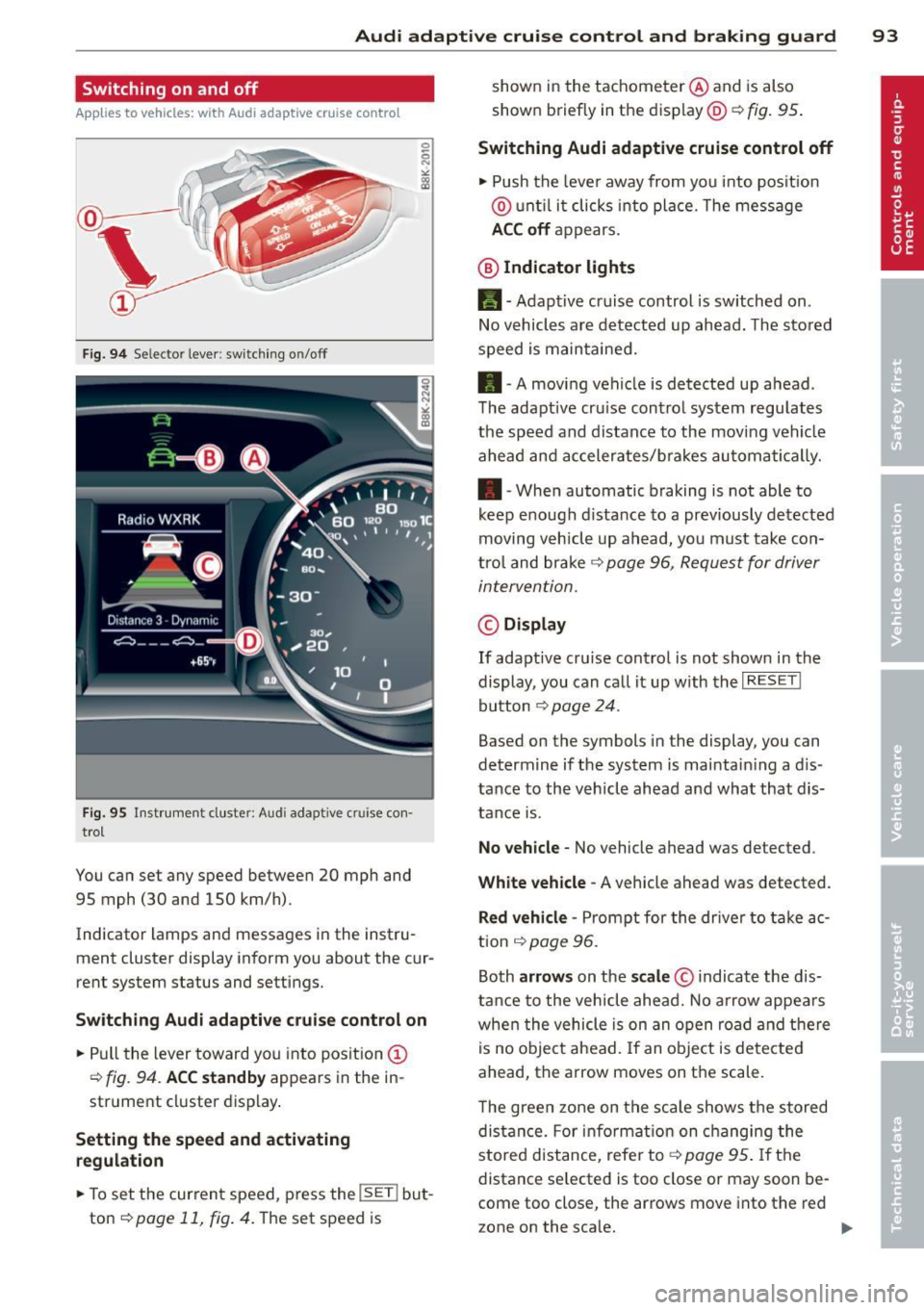
Fig. 9 4 Selector lever : sw it ching o n/off
Fi g. 95 Instrum ent cluste r: Audi a da ptive c ruise co n·
trol
You can set any speed between 20 mph and
95 mph (30 and 150 km/h).
Indicator lamps and messages in the instru· ment cluster d isplay inform you about the cur
rent system sta tus and settings .
Switching Audi adaptive cruise control on
.,. Pull the lever toward you into position @
¢
fig. 94. ACC standby appears in the in
strument cluster display .
Setting the speed and activating
regulation
.,. To set the current speed , press the !SE T! but
ton
q page 11, fig . 4. The set speed is shown in
the tachometer @ and is also
shown briefly in the display@~
fig. 95 .
Switching Audi adaptive cruise control off
.,. Push the leve r away from you into position
@ until it clicks into place. The message
ACC off appears.
@ Indicator lights
Ill -Adapt ive cruise control is switched on .
No vehicles are detected up ahead. The stored
speed is maintained.
• -A moving vehicle is detected up ahead .
The adaptive cru ise control system regulates
the speed and distance to the moving vehicle
ahead and accelerates/b rakes automatically.
• -When automatic braking i s not able to
keep enough distance to a previously detected
moving vehicle up ahead, you must take con
trol and brake ~
page 96, Request for driver
intervention.
© Display
If adapt ive cru ise control is not shown in the
display, you can call it up with the
I RES ET I
button ¢ page 24 .
Based on the symbol s in the display , you can
determine if the system is maintain ing a d is
tance to the vehicle ahead and what that dis
tance is.
No vehicle· No veh icle ahead was de tected .
White vehicle -A vehicle ahead was detected.
Red vehicle -Prompt for the driver to take ac
tion
q page 96.
Both
arrows on the scale © indicate the d is
tance to the vehicle ahead. No arrow appears
when the vehicle is on an open road and there
is no object ahead. If an object is detected
ahead, the arrow moves on the scale.
T he green zone on the scale shows the stored
distance. For infor mation on changing the
stored distance, refer to¢
page 95 . If the
distance selected is too close or may soon be
come too close, the arrows mov e into the re d
z one on the sca le. .,._