lock AUDI A6 2011 Repair Manual
[x] Cancel search | Manufacturer: AUDI, Model Year: 2011, Model line: A6, Model: AUDI A6 2011Pages: 370, PDF Size: 87.15 MB
Page 154 of 370
-Automatic transmission .n,..__ ______________ _
Appli es to veh icles : wi th 6-spe ed a utomatic t ransm iss ion
Emergency release for selector Lever
If the vehicle's power supply fails, the selector lever can
be released in an emergency.
Fig. 144 Remove the
ashtray insert
Fig. 145 Emergency
release for selector
lever
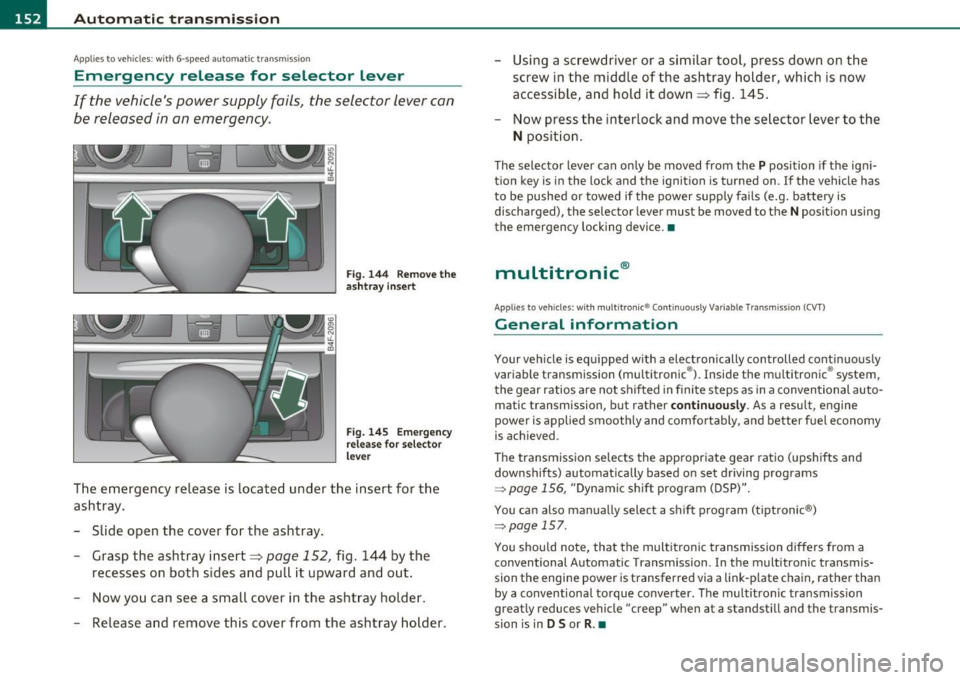
The emergency release is located under the insert for the
ashtray.
- Slide open the cover for the ashtray.
- Grasp the ashtray insert=>
page 152, fig. 144 by the
recesses on both sides and pull it upward and out.
- Now you can see a small cover in the ashtray holder.
- Release and remove this cover from the ashtray holder. -
Using a screwdriver or a similar tool, press down on the
screw in the middle of the ashtray holder, which is now
accessible, and hold it down=> fig. 145.
- Now press the interlock and move the selector lever to the
N position.
The selector lever can only be moved from the P position if the igni
tion key is in the lock and the ignition is turned on . If the vehicle has
to be pushed or towed if the power supply fails (e.g. battery is
discharged), the selector lever must be
moved to the N position using
the emergency locking device.•
multitronic ®
Appli es to vehi cles: w ith mul tit ron ic® Co ntin uous ly Var ia ble Tra nsm iss ion ( CVT)
General information
Your vehicle is equipped with a electronically controlled continuously
variable transmiss ion (multitronic ®). Inside the multitronic ® system,
the gear ratios are not shifted in finite steps as in a conventional auto
matic transmission, but rath er
continuously. As a result, engine
power is applied smoothly and comfortably, and better fuel economy
is achieved .
The transm ission selects the appropriate gear ratio (upshifts and
downshifts) automatically based on set driving programs
~ page 156, "Dynamic shift program (DSP)".
You can also manually select a shift program (tiptronic ®)
~ page 157.
You should note, that the multitronic transmission differs from a
conventional Autom ati c Transmission . In the multitronic transmis
sion the engine power is transferred via a link-plate chain, rather than
by a conventional torque converter. The multitronic transmission
greatly reduces vehicle "creep" when at a standstill and the transmis
sion is in
D Sor R . •
Page 156 of 370
IIJIL___!A~u~t~o~m~a~t~i~c ~t~ra~n~s~m~i~s~s~i~o~n~ -------------------------------------------
& WARNING (conti nu ed )
-When the selector le ver is in a driving position, the vehicle
may creep, even at idle speed. Therefore do not relea se the
parking brake or foot brake until you are ready to mov e,
becau se power is transmitted to the wheel s as soon a s a driving
po sition i s engaged .
- Do not a ccelerate while selecting a driving position . At this
time th e engine must be at idle sp eed so that undue stres s is
not placed on the clutche s in the tran smis sion .
- Remember: -even when stopped b riefly with the automatic
tran smi ssion in "D ", "S " or "R ", engine power is being tran s
mitted to the wheels . Your vehicle could "creep " forward or
ba ckward. When stopped , keep the brake pedal fully
depre ssed and use the parking brake if necessary to keep the
vehicle from roll ing.
- If the selector lever is unintentionally moved into N while
you are driving, take your foot off the accelerator pedal and
wait for the engine to return to idle speed before s electing a
driving pos ition .
- Never shift into "R " or "P " when the vehicle i s in motion .
- Never get out of the driver 's seat when the engine i s running.
- If you must get out of the vehicle , move the selector leve r
s ecurely into the P position and apply the parking brake firmly .
-If the engine must remain running , never have any driving
po sition engaged when checking und er the hood . Make sure
the selector leve r has securely engaged and is locked in "P"
with the parking brake firmly set=>
page 271, "Engine
compartment ". Otherwise , any increase in engine speed may
set the vehicle in motion, even with the parking brake
applied. a
Applies to vehicles: with mu lt itron ic® Continu ous ly Vari able Transmission (CVT)
Selector Lever positions
This section descri bes the selector lever positions and
driving r ang es .
Fig . 14 7 Displ ay in
the in strume nt clu ster :
selecto r leve r in posi
ti on P
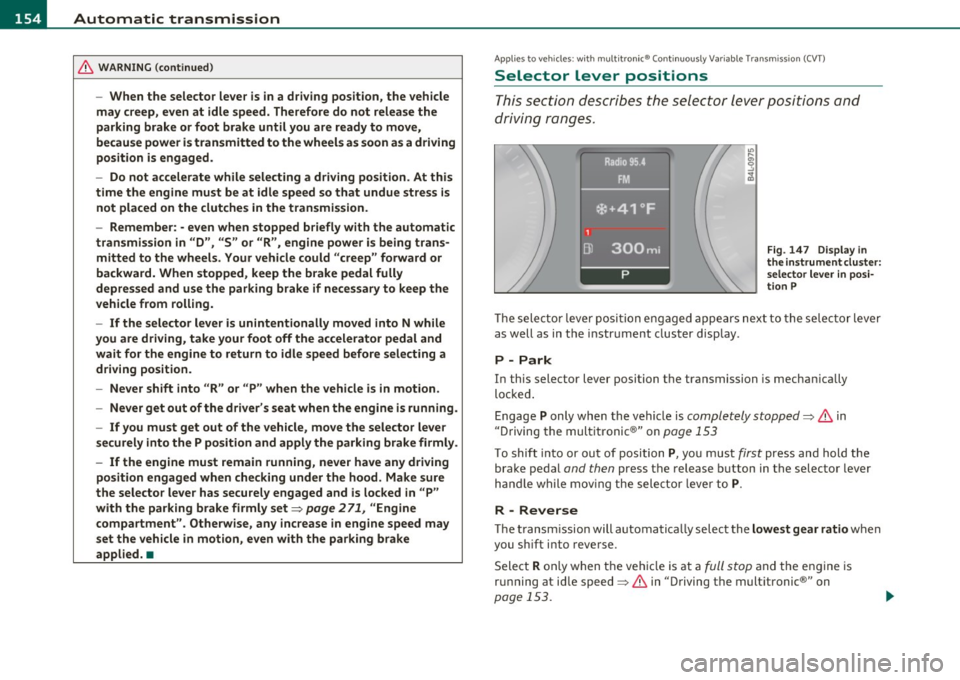
Th e sele cto r lever posi tio n engaged appears nex t to the se lec tor lever
as well as in the i nstr ument clus ter disp lay .
P - Park
In this selector lever position t he transmission is mechan ically
lo ck ed.
Engage P only wh en the vehicle is completely stopped=>
& in
" Dr iving the mult itronic ®" on page 153
T o shift into or out of position P, yo u mus t first press an d hold the
brake pedal and then press the release b utton in the selector lever
h andl e wh ile mov ing the sele cto r leve r to P.
R - Reverse
Th e tran smi ssion will a utoma tica lly selec t the lowest gear ratio when
you sh ift into reve rse.
Select R only when t he veh icle is at a full stop and the eng ine is
running at idle speed=>
& in "Driving the multitronic®" on
page 153.
~
Page 157 of 370

Automatic transmission Ill
----------------
Before you move the selector lever to R, press both, the button in the
hand le of the se lector lever
and the brake pedal at the same time.
When the ignition is on, the backup lights illuminate when the
selector lever is moved into
R.
N -Neutral
Shift to this position for standing with brakes applied=> page 155.
When the vehicle is stat ionary o r at speeds below 3 mph (5 km/h),
you must always apply the footbrake before and wh ile moving the
lever out of
N.
Do not use N for coasting downhill.
D -Normal driving position for forward
Depending on the load on the engine, vehicle speed and the dynamic
control program, the transmission will se lect the
optimal gear ratio.
In certa in circumstances it may be advantageous to temporarily
switch to the manual shift program to manually select gear ratios to
match specific driving conditions=>
page 157.
When the vehicle is stationary or at speeds below 3 mph (5 km/h),
you must always apply the footbrake before and while moving the
lever to
D out of N .
S -Sport position
Select this position for sportier performance. In this position, the
transmission will not upshift as soon, allowing the veh icle to use the
increased power available at higher engine speeds to achieve livelier
acceleration.
When the vehicle is stat ionary or at speeds below 3 mph (5 km/h),
you must always app ly the foot brake before and whi le moving the
lever to
S out of N.
& WARNING
Read and follow all WARNINGS=> & in "Driving the multi
tronic ®" on
page 153.
Controls and equip
ment Safety first
0 Note
Coasting downhill
with the transmission in N and the engine not
operating will result in damage to the automatic transmission and
poss ibly the catalytic converter.•
Applies to veh icles: w ith mult itronic ® Continuously Va riable T ransmiss ion (C VT)
Automatic Shift Lock (ASL)
The Automatic Shift Lock safeguards you against acci
dentally shifting into a forward or the reverse gear and
causing the vehicle to move unintentionally.
Fig. 148 Shift gate:
selector lever lock posi
tions and inter lock
button highlighted
The selector lever lock is released as follows:
- Turn the ignition on.
- Step on the brake pedal.
At the some time press and hold
the interlock button on the side of the gear se lector knob
=> fig. 148 with your thumb until you have moved the
selector lever to the desired position .
Automatic selector lever lock
The selecto r lever is locked in th e P and N positions when the ignition
is turned on. To move the lever from these pos itions the driver must
depress the brake pedal. As a reminder to the driver, the following .,_
Vehicle care Technical data
Page 158 of 370
1111....__A_ u_ t_o _m_ a_ t_ic _ t_ r_ a_ n_s _m_ i _s_ s_ i_ o_ n ____________________________________________ _
warning appears in the instrument cluster display when the selector
is in
P and N:
When stationary apply footbrake while selecting gear
A time delay element prevents the selector lever from locking when
it is moved through the
N position (going from R to D). The locking
element will lock the selector lever if the lever is left in N (Neutral) for
more than approximately 1 second, without the brake pedal be ing
pressed .
At speeds above about 3 mph (5 km/h) the Automatic Shift Lock is
automatically deactivated in the
N position.
Interlock button
The lock button on the selector lever prevents the lever from being
accidentally shifted into certain positions. Pressing this button deac
tivates the selector lever lock. Depending on the direction of the
shift, the selector lever locks at different positions. The positions are
high light ed in the illustrat ion~
page 155 , fig. 148.
Ignition key safety interlock
The key cannot be removed from the ignition unless the selector lever
is in the
P park position. When the ignition key is removed, the
selector lever w ill be locked in the
P pos it ion .•
Ap plies to v ehicles : w ith mult itronic ® Contin uously Var iable Transm issio n (C VT)
Kick-down
The kick-down feature allows the vehicle to generate
maximum acceleration.
When you press the accelerator pedal beyond the resistance point
that is reached at full throttle, the transmission will select a lower
gear ratio based on vehicle speed and engine RPM . The engine RPM
w ill be contro lled to produce maximum vehicle acceleration as long
as you continue to press the accelerato r pedal beyond th is resistance
point .
& WARNING
Be careful when using the kick-down feature on slippery roads.
Rapid acceleration may cause the vehicle to skid. •
Applies to veh icl es: w it h mul tit ro nic® Con tin uous ly Va ria bl e Tran smis s io n ( CVT)
Dynamic shift program (DSP)
The multitronic ® transmission is electronically
controlled .
The transmission selects the appropriate gear ratio (upshifts and
downshifts) automatically based on preset d riving programs.
The transmission will select one of the
economy programs when you
drive at a steady speed or a gradua lly changing speeds without heavy
acceleration . Th is gives best fuel eff iciency, with early upshifting and
delayed downshifting.
Th e transmission will automatically select the
sporty shift programs
when you dr ive at higher speeds, or w ith heavy acceleration and
frequently changing speeds. Upshifts are delayed to make full use of
engine power . Downshifting takes place at higher engine speeds than
in the economy programs.
Th e selection of the most suitab le shift program is a continuous,
automatic process. The driver can a lso make the transmission switch
to a sporty program by
quickly pressing down the gas pedal.
This causes the transmiss ion to shift down into a lower gear ratio and
makes quick acceleration possible (to pass another vehicle) You do
not need to press the gas pedal into the kickdown range. After the
transmission has upshifted, the original program is selected
according to your driving style.
An additional shift prog ram allows the automatic t ransmission to
select the proper gear for uph ill and downh ill grad ients.
This prevents the transmiss ion from shifting up and down unneces
sari ly on hills. The transmission will shift down to a lower gear ratio _,,,
Page 161 of 370

____________________________________________ A_ u_ t_ o_ m_ a_ t_ i_ c _ t_ra _ n_s_ m __ is_s_ i_ o _ n _ __._
App lies to vehicles : wi th mul titro nic® Continu ous ly Va riable Trans missi on (CV T)
Emergency release for selector lever
If the vehicle's power supply fails, the selector lever can
be released in an emergency.
Fig. 152 Remove the
asht ray insert
F ig . 153 E mergen cy
release for se lector
l ever
The emergency release is located under the insert for the
ashtray.
- Slide open the cover for the ashtray .
- Grasp the ashtray insert~ fig. 152 by the recesses on
both sides and pull it upward and out.
- Now you can see a small cover in the ashtray holder.
- Release and remove this cover from the ashtray holder.
Con tro ls a nd e quip
m en t Vehicle
OP-eration
-Using a screwdriver or a similar tool, press down on the
screw in the middle of the ashtray holder , which is now
accessible, and hold it down~ fig. 153 .
- Now press the interlock and move the selector lever to the
N position.
The selector lever can only be moved from the P position if the igni
tion key is in the lock and the ignition is turned on. If the vehicle has
to be pushed or towed if the power supply fails (e.g. battery is
discharged), the selector lever must be moved to the
N position using
the emergency locking device. •
Vehicle care Do-it-yourselt service iTechnical data
Page 180 of 370

___ D_ r_ i_ v _i_n _.g"-- S_ a_ f_ e__. LY.__ _____________________________________________ _
Proper occupant seating positions
Proper seating position for the driver
The proper driver seating position is important for safe,
relaxed driving.
Fig. 166 The correct
distance between
driver and steering
wheel
Fig . 167 Correct head
restraint position for
driver
For your own safety and to reduce the risk of injury in the
event of an accident, we recommend that you adjust the
driver's seat to the following position:
- Adjust the driver's seat so that you can easily push the
pedals all the way to the floor while keeping your knee(s)
slightly bent==>& . -
Adjust the angle of the seatback so that it is in an upright
position so that your back comes in full contact with it
when you drive.
- Adjust the steering wheel so that there is a distance of at least 10 inches (25 cm) between the steering wheel and
your breast bone==> fig. 166. If not possible, see your
authorized Audi dealership about adaptive equipment.
- Adjust the steering wheel so that the steering wheel and airbag cover points at your chest and not at your face.
- Grasp the top of the steering wheel with your elbow(s) slightly bent.
- Adjust the head restraint so that the upper edge is as even
with the top of your head as possible but no lower than eye
level and so that it is as close to the back of your head as
possible ==> fig. 167.
- Fasten and wear safety belts correctly=>
page 191.
-Always keep both feet in the footwell so that you are in
control of the vehicle at all times.
For detailed information on how to adjust the driver's seat, see
=:>page 76 .
& WARNING
Drivers who are unbelted, out of position or too close to the airbag
can be seriously injured by an airbag as it unfolds. To help reduce
the risk of serious personal injury:
• Always adjust the driver's seat and the steering wheel so that
there are at least 10 inches (25 cm) between your breastbone and
the steering wheel.
• Always hold the steering wheel on the outside of the steering
wheel rim with your hands at the 9 o'clock and 3 o'clock positions ..
Page 181 of 370
______________________________________________ D_ ri_v _ i_n _,,g ,c.._ S_a_ f_ e_ l..:: y __ _
& WARNING (continued)
to help reduce the risk of personal injury if the driver's airbag
inflates .
• Never hold the steering wheel at the 12 o 'clock position or with
your hands at other positions inside the steering wheel rim or on
the steering wheel hub. Holding the steering wheel the wrong way can cause serious injuries to the hands, arms and head if the
driver's airbag deploys.
• Pointing the steering wheel toward your face decreases the
ability of the supplemental driver's airbag to protect you in a colli·
sion .
• Always sit in an upright position and never lean against or
place any part of your body too close to the area where the airbags
are located.
• Before driving, always adjust the front seats and head
restraints properly and make sure that all passengers are properly
restrained.
• Never adjust the seats while the vehicle is moving. Your seat
may move unexpectedly and you could lose control of the vehicle .
• Never drive with the backrest reclined or tilted far back! The
farther the backrests are tilted back, the greater the risk of injury due to incorrect positioning of the safety belt and improper
seating position.
• Children must always ride in child safety seats =>
page 219.
Special precautions apply when installing a child safety seat on
the front passenger seat =>
page 197. •
Controls and equip
ment Safety first Vehicle operation
Proper seating position for the front
passenger
The
proper front passenger seating position is important
for safe, relaxed driving.
For your own safety and to reduce the risk of injury in the
event of an accident, we recommend that you adjust the seat
for the front passenger to the following position:
- Adjust the angle of the seatback so that it is in an upright
position and your back comes in full contact with it when
ever the vehicle is moving.
- Adjust the head restraint so that the upper edge is as even
with the top of your head as possible but not lower than
eye level and so that it is as close to the back of your head
as possible=>
page 181.
- Keep both feet flat on the floor in front of the front
passenger seat.
- Fasten and wear safety belts correctly=>
page 191.
For detailed information on how to adjust the front passenger's seat,
see=>
page 75 .
& WARNING
Front seat passengers who are unbelted, out of position or too
close to the airbag can be seriously injured or killed by the airbag
as it unfolds. To help reduce the risk of serious personal injury:
• Passengers must always sit in an upright position and never
lean against or place any part of their body too close to the area
where the airbags are located.
• Passengers who are unbelted, out of position or too close to
the airbag can be seriously injured by an airbag as it unfolds with
great force in the blink of an eye. .,_
Vehicle care Do-it-yourself service Technical data
Page 186 of 370
• ....__D_ r_iv _i_ n_, g=-- S_ a _ f_e _,Ly _ ______________________________________________ _
in. WARNING
Improperly stored luggage or other items can fly through th e
vehicle c au sing seriou s per sonal injury in the event of hard braking
or an accident . To h elp reduce the risk of serious personal injury :
• Always put objects, for examp le, luggage or other heavy items
in the luggag e compartment .
• Alway s secure objects in the luggage compartment using the
tie -down eyelets and suitable straps.
& WARNING
Heavy loads will influence the way your vehicle handles. To help
reduce the ri sk of a loss of control leading to seriou s personal
injury:
• Always keep in mind when tran sporting heavy objects, that a
c hange in the center of gr avity can also cause changes in vehicle
handling:
-Always di stribute the load as evenly as po ssible.
- Place heavy objects as far forward in the luggage compart-
ment as po ssible.
• Never e xceed the Gross Axle Weight Rating or the Gross Vehicle
Weight Rating specified on the safety compliance sticker on the
left door jamb . Exceeding permissible weight standards can cause
the vehicle to slide and handle differently .
• Please observe information on safe driving =>
page 176 .
in. WARNING
To help prevent poisonous exhaust gas from being drawn into the
vehicle, always keep the rear lid closed while driving.
• Never transport objects larger than those fitting completely
into the luggage area because the rear lid cannot be fully closed.
& WARNING (c on tinued )
• If you absolutely must drive with the rear lid open , ob serve the
following note s to reduce the risk of poisoning:
- Close all windows ,
- Close the power roof*,
- Open all air outlet s in the instrument panel,
- Switch off the air recirculation ,
- Set th e fresh air fan to the high est speed .
in. WARNING
Always make sure that the doo rs , all windows, the power roof*
and the rear lid are securely clo sed and locked to reduce the risk of
i njury when the vehicle is not be ing used.
• After closing the rear lid, always make sure that it is properly
closed and locked.
• Never leave your vehicle unattended especially with the rear lid
left open. A child could c rawl into the vehicle through the luggage
c ompartment and clo se the rear lid becoming trapped and unable
to get out . Being trapped in a vehicle can lead to serious personal
injury.
• Never let children play in or around the vehicle.
• Never l et pa ssengers ride in the luggage compartment. Vehicle
occupants must always be properly restrained in one of the
vehicle 's seating positions .
(I) Tips
• Air circulation helps to re d uce win dow fogging. Sta le air es capes
to the outside through vents in the trim panel, on the left s ide of the
lugg age compa rtmen t. B e sur e to keep these s lots free and ope n.
• Th e tire pressure m ust correspond to the load . The tire pressure is
shown o n the tir e pressu re label. The tire pressu re label is loc ated o n .,_
Page 194 of 370

alll!II Safety belts Pffl _______________ _
-Ins ert t he tongue into the correct buckle of your seat unti l
you hear it latch secure ly=> fig. 176 .
- Pull on t he be lt to make sure t hat it is secure ly latched in
the buck le.
Automatic safety belt retractors
Every safety be lt is equipped with an automatic be lt retractor on the
shoulder bel t. This fea ture locks the be lt whe n the belt is pulled out
fast, during hard braking and in an acc ident. The belt may also lock
w hen you dr ive up or dow n a s teep hill or throug h a sharp curve.
During norma l dr iving the belt lets you move freely.
Safety belt pretensioners
The safety bel ts are equipped w ith a belt pretensioner that helps to
t ighten the s afety be lt and remove sla ck when the pre tensioner is
act ivated. The function of the pretensioner is monitored by a warn ing
light =>
page 14.
Switchable locking featu re
Eve ry sa fe ty be lt exc ep t the one on the driver sea t is e quipped wi th a
switchable locking feature that
must be used when the safety belt is
used to attach a child safety seat. Be s ure to read t he import ant info r
mation about this feature=>
page 229.
& WARNING
Improperly positio ned safety belts can cause serious injury in a n
accident =>
page 192, "Safety belt po sition ".
• Safety belts offer optimum p rote ction onl y when the seat back
i s upright and belts are properly positioned on the body .
• Always make sure th at the rear seat backre st to which the
center rear safety b elt is attached i s securely latched whenever the
rear center safety belt is being used. If the ba ckrest is not securely
latch ed, the passenger will move forward with the ba ckrest during
sudden br aking, in a s udden maneu ve r and e speci ally in a crash.
& WARNING (contin u ed )
• Never atta ch the safety belt to the buckle fo r another seat.
Attaching the b elt to the w rong buckle will reduce safety belt
effecti veness and can cause serious personal injury.
• A pass enger who is not properly restr ained can be s eriou sly
injured by the safety belt it self when it move s from the stronger
parts of th e body into critical
areas like the abdomen.
• Alway s lock the convertible locking retractor when y ou are
securing a child safety seat in the vehicle=>
page 231. •
Safety belt position
Correct belt posi tion is the key to get ting maximum
protection from safety belts .
Fig. 17 7 Hea d
re stra int an d safe ty
belt posi tio n as se en
fro m the s ide
Standard features on your vehicle help you adjust the position of the
safety belt to match your body size.
• belt height adj ustment for the fro nt seats,
• automatic belt height adjustment for the rear seats .
Page 211 of 370

_______________________________________________ A_ ir_ b_ a_,,,g '--- s.:.y _s _t_ e _ m ___ _
PASSENGER AIR BAG OFF light
·~ .~~I f -
-a• -· ... JI •
-a II .. ~ ----- -
• II _, -
MSSENGEIIAIRBAGOfF
Fig. 184 Section from
the instrument panel:
PASSENGER AIR BAG
OFF light
The PASSENGER AIR BAG OFF light is located in the center of the
instrument panel~ fig. 184.
Th e
PASSENGER AIR BAG OFF light will come on and stay on to tell
you when the front Advanced Airbag on the passenger side has been turned
off by the electronic control unit. Each time you turn on the
ign ition, the
PASSENGER AIR BAG OFF light will flash fo r a few
seconds and:
• will stay on if the front passenger seat is not occupied,
• will stay on if there is a small child or child restraint on the front
passenge r seat,
• will go out if the front passenger seat is occupied by an adult as
registe red by the weight-sens ing mat.
The
PASSENGER AIR BAG OFF light must come on and stay on if the
ign ition is on and
• a car bed has been installed on the front seat, or
• a rearward-facing child restraint has been installed on the front
passengerseat,or
• a forward-facing child restraint has been insta lled on the front
passenger seat, or
• the weight registe red on the front passenger seat is equal to or
less than the combined weight of a typical 1 year-o ld restrained in
Controls and equip
ment Safety first
Vehicle operation
one of the rear-facing or forward-facing infa nt restraints listed in
Federal Motor Vehicle Safety Standard 208 with w hich the Adva nced
Airbag System in your vehicle was certified .
If the front passenger seat is not occupied, the front airbag wi ll not
dep loy, and the
PASSENGER AIR BAG OFF light will stay on. Never
install a rearward-facing child restraint on the front passenger seat,
the safest pla ce fo r a child in any kind of chi ld restraint is at one of the
seating positions on the rear seat~
page 199, "Child restraints on
t he front seat-some impo rtant things to know" and~
page 219,
"Child Safety" .
If the PASSENGER AIR BAG OFF light comes on when one of the
conditions listed above is met, be sure to check the light regu larly to
make certain that the
PASSENGER AIR BAG OFF lig ht stays on
continuously whenever the ignition is on.
If the PASSENGER AIR BAG
OFF
light does not appear on and does not stay on all the t ime, stop
as soon as it is safe to do so and
• reactivate the system by turning the ignition
off and then turning
it on again;
• remove and reinstall the ch ild restraint. Make sure that the child
restraint is properly installed and that the safety belt fo r the front
passenger seat has been correctly routed through the child restraint
as described in the child restraint manufacturer's instructions;
• make sure that the convertible locking feature on the safety belt
for the front passenge r seat has been activated and that the safety
belt has been pulled t ight. The belt must not be loose or have loops
of slack so that the senso r be low the safety belt latch on the seat can
do its job~
page 229.
• make sure that things that may increase the weight o f the chi ld
and child safety seat are not being transported on the front
passenger seat;
• make sure that the safety belt tension sensor is not blocked.
Shake the safety belt latch on the front passenge r seat back and
forth;
• If a strap or tether is be ing used to tie the child safety seat to the
front passenger seat, make sure that it is not so tight that it causes .,
Vehicle care Do-it-yourself service Technical data