ECO mode AUDI A6 2018 Owner's Manual
[x] Cancel search | Manufacturer: AUDI, Model Year: 2018, Model line: A6, Model: AUDI A6 2018Pages: 266, PDF Size: 41.38 MB
Page 156 of 266
Airbag system
Monitoring the
Advanced Airbag System
:~ (USA models) /!f (Canada models)
Airbag monitoring indicator light
Two separate indicators monitor the function of
the Advanced Airbag System : the airbag moni
toring indicator light and the
PASSENGER AIR
BAG OFF
ligh t.
The Advanced Airbag System as well as the side
airbags and side curtain airbags with eject ion
mitigation features (including the e lectroni c con
trol unit, sensors and system wiring) are all
monitored continuously to make sure that they
are funct ion ing prope rly whenever the ignition is
on . Every time you turn on the ignition, the air
bag system indicator light
II (USA models) 1fll
(Canada models) will come on for a few seconds
(function check).
The system must be inspected when the
indicator light
II (USA models) tfll
(Canada models):
-does not come on w hen the ignition is switched
on,
-does not go out a few seconds after you have
switched on the ign ition, or
-comes on wh ile driving .
If an airbag system ma lf u nction is detected, the
ind icator light wi ll come on to serve as a constant
reminder to have the system inspected immedi
ately.
If a malfunction occurs that turns the front air
bag on the passenger side off, the
PASSENGER
AIR BAG OFF
light will come on and stay on
whenever the igni tion is on .
A WARNING
An airbag system that is not funct ioning prop
erly cannot provide supplemental protection
in a frontal crash .
-If the airbag indicato r light ¢page 16
comes when the vehicle is being used, have
the system inspected immediate ly by your
authorized Audi dealer . It is possible that
154
the airbag will inflate when it is not sup
posed to, or will not inflate when it should.
PASSENGER AIR BAG OFF light
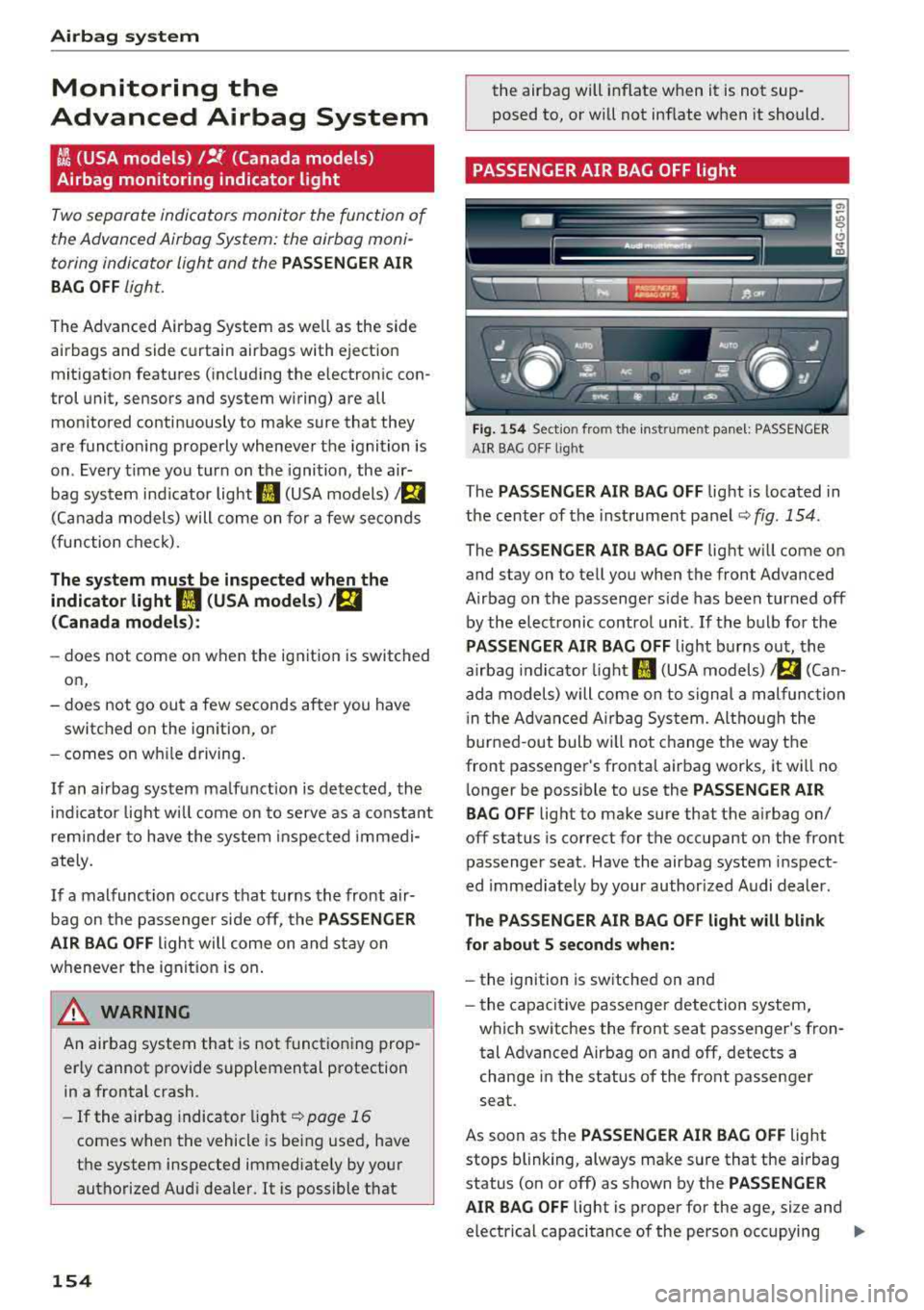
Fig. 154 Sect io n fro m t he inst rume nt panel: PASSENGER
AIR BAG O FF lig ht
The PASSENGER AIR BAG OFF light is located in
the center of the instrument panel ¢
fig. 154.
The PASSENGER AIR BAG OFF light will come on
and stay on to tell you when the front Advanced
Airbag on the passenger side has been turned off
by the electronic contro l unit . If the bulb for the
PASSENGER AIR BAG OFF light burns out, the
airbag indicator light
II (USA models) a (Can
ada models) will come on to signal a malfunction
i n the Advanced A irbag System. Although the
burned-out bulb will not change the way the
front passenger's frontal airbag works, it wi ll no
l onger be poss ible to use the
PASSENGER AIR
BAG OFF
lig ht to make sure that the a irbag on/
off status is correct for the occupant on the front
passenger seat . Have the airbag system inspect
ed immediately by your author ized Audi dealer .
The PASSENGER AIR BAG OFF light will blink
for about 5 seconds when:
-the ignition is switched on and
- the capacit ive passenger detection system,
which switches the front seat passenger's fron
tal Advanced Airbag on and off, detects a
change in the status of the front passenger
seat.
As soon as the
PASSENGER AIR BAG OFF light
stops blinking, always make sure that the airbag
status (on or off) as shown by the
PASSENGER
AIR BAG OFF
light is proper for the age, size and
electrical capacitance of the person occupying
.,..
Page 159 of 266
a co .... N
" N .... 0 0 \,;J '
install a forward-facing child restraint on
the front passenger seat, always move the
seat into its rearmost position in the seat's
fore and aft adjustment range, as far away
from the airbag as possible. The backrest must be adjusted to an upright position.
- Make sure that the
PASSENGER AIR BAG
OFF
light comes on and stays on all the time
whenever the ignition is switched on.
A WARNING
- If the PASSENGER AIR BAG OFF light does
not go out when an adult is sitting on the
front passenger seat after taking the steps
described above, make sure the adult is
properly seated and restrained at one of the
rear seating positions.
- Have the airbag system inspected by your
Audi dealer before transporting anyone on
the front passenger seat .
(D Tips
If the capacitive passenger detection system
determines that the front passenger seat is
empty, the frontal airbag on the passenger
side will be turned off, and the
PASSENGER
AIR BAG OFF
light will stay on.
Repair, care and disposal of the airbags
Parts of the airbag system are installed at many
different places on your Audi . Installing , remov
ing , servicing or repairing a part in an area of the
vehicle can damage a part of an airbag system
and prevent that system from working properly
in a collision.
There are some important things you have to
know to make sure that the effectiveness of the
system will not be impaired and that discarded
components do not cause injury or pollute the
environment.
A WARNING
Improper care, servicing and repair proce
dures can increase the risk of personal injury
and death by preventing an airbag from de-
-
Airbag system
ploying when needed or deploying an airbag
unexpectedly :
- Never cover, obstruct, or change the steer
ing wheel horn pad or airbag cover or the in
strument panel or modify them in any way.
- Never attach any objects such as cup holders
or telephone mountings to the surfaces cov
ering the airbag units.
- For cleaning the horn pad or instrument
panel, use only a soft, dry cloth or one mois
tened with plain water . Solvents or cleaners
could damage the airbag cover or change
the stiffness or strength of the material so
that the airbag cannot deploy and protect properly.
- Never repair, adjust, or change any parts of
the airbag system.
-All work on the steering wheel, instrument
panel, front seats or electrical system (in
cluding the installation of audio equipment,
cellular telephones and CB radios, etc.)
must be performed by a qualified technician
who has the training and special equipment
necessary.
- For any work on the airbag system, we
strongly recommend that you see your au
thorized Audi dealer or qualified workshop.
- Never modify the front bumper or parts of
the vehicle body.
- Always make sure that the side airbag can inflate without interference:
- Never install seat covers or replacement
upholstery over the front seatbacks that
have not been specifically approved by
Audi .
- Never use additional seat cushions that
cover the areas where the side airbags in
flate.
- Damage to the original seat covers or to
the seam in the area of the side airbag
module must always be repaired immedi
ately by an authorized Audi dealer.
- The airbag system can deploy only once. Af
ter an airbag has been deployed, it must be
replaced with new replacement parts de
signed and approved especially for your
Audi model version. Replacement of com plete airbag systems or airbag components
157
Page 171 of 266
a co .... N
" N .... 0 0 \,;J '
one of the rear seating positions . If in exception
a l circumstances you must use it on the front
passenger seat, carefully read all of the informa
tion on chi ld safety and Advanced Airbags and
heed all of the applicable WARNINGS . Make cer
tain that the child and ch ild restraint are correct
l y recogn ized by the capacitive passenger detec
tion system in the front passenge r seat, that the
front passenger airbag is turned off, and t hat the
airbag status is always cor rectly signaled by the
PASSENGER AIR BAG OFF light.
M any types and models of ch ild rest rai nts have
been available ove r th e yea rs , new mode ls are in
trod uced regular ly incorporat ing new and im
proved designs and older mode ls are taken out o f
production . Chi ld restraints are not standardized .
Ch ild restraints of the same type typica lly have
d ifferent weights and s izes and different "foot
prints", the size and shape of the bottom of the
child restraint that sits on the seat, when they
are installed on a vehicle seat . T hese differences
make it virtually impossible to certify compliance
w ith the requirements fo r advanced airbags with
e ach and eve ry c hild rest raint t hat has ever been
sold in the past o r will be sold over t he course o f
the useful life of your vehicle.
F or this reason, the U nited States National High
way Tr affic Safety Adminis tration has p ublished a
lis t of specific type, makes and models of child
restraints that must be used to certify compli
ance of th e Advanced Airbag System in your vehi
cle with the suppression requirements of Federal
Motor Vehicle Safety Standard 208. These child
restraints are:
Subpart A -Car bed child re straint s
Model Manufactured on or
after
Ange l Guard Angel September 25, 2007
Ride AA2403FOF
Ch ild saf ety
Subpart B -Rear-facing child restraints
Model Manufactured on or
after
Century SmartFit 4543 December 1, 1999
Cosco Arr iva September 25, 2007
22-013PAW and base
22 -999WHO
Evenflo Discovery
Ad-December 1, 1999
just Right 212
E venflo First Choice December 1, 1999
204
Graco Infant 8457 December 1, 1999
Graco Snug ride September 25, 2007
P eg Pe rego P rimo Viag- September 25, 2007
g io SI P IM UNOOUS
Subpart C -Forward -facing and convertible
child restraints
Model Manufactured on or
after
Britax Roundabout September 25, 2007
E9L02xx
Cosco Tou riva 025 19 Decembe r 1, 1999
Cosco Summit De luxe September 25, 2007
H igh Back Booster
22-262
Cosco High Back Boos -September 25, 2007
ter 22 -209
E venflo Tr ibute V September 25, 2007
379xxxx
Evenflo Medallion 254 December 1, 1999
E venflo Generat io ns September 25, 200 7
352xxxx
Graco ComfortSport September 25, 2007
Graco Todd le r Safety September 25, 200 7
Seat Step 2
Graco Platinum Cargo September 25, 2007
A WARNING
To reduce the r isk of serious injury, ma ke sure
that the
PASSENGER AIR BAG OFF l ight
comes on and stays on whenever a chil d re
straint is installed on the front passenger seat
and the ignition is switched on .
169
Page 210 of 266

Wheels
by the tire manufacturer. This in
formation is used to contact con sumers if a tire defect requires a
recall.
Vehicle capacity weight
means the rated cargo and lug
gage load plus 150 lbs. (68 kilo
grams) times the vehicle's desig nated seating capacity .
Vehicle maximum load on the
tire
means that load on an individual
tire that is determined by distrib
uting to each axle its share of the
maximum loaded vehic le weight
and dividing by two.
Vehicle normal load on the tire
means that load on an individual
tire that is determined by distrib
uting to each axle its share of the
curb weight, accessory weight,
and normal occupant weight (dis
tr ibuted in accordance
with¢ ta
ble on page
2 13) and d ividing by
two .
Occupant loading and distri
bution for vehicle normal load
for various designated seating capacities
Re fer to the tire inflation pres
sure
label¢ page 211, fig. 188
2 08
for the n umbe r of seating posi
tions. Refer to the
table ¢ table
on page
213 for the number of
people tha t correspond to the ve
hicle normal load.
New tires or wheels
Audi recommends having all work
on t ires or wheels performed by
an authorized Audi dealer or au
thorized Audi Service Facility.
These facilities have the proper
know ledge and are eq uipped with
the required too ls and rep lace
ment parts.
... New t ires do not yet have the
optim um gripping properties.
Drive carefully and at moderate
speeds for the first 35 0 m iles
(500 km) with new tires .
... Only use tires with the same de
sign, size ( rolling circumfer
ence) , and as close to t he same
tread pattern as possible on a ll
four wheels .
...
Do not replace tires individually.
At least replace bo th tires on the
same axle at the same time .
... Audi recommends that you use
Audi O riginal Tires. If you would
like to use di fferent tires, please
note that the tires may perform
...
Page 215 of 266
a co .... N
" N .... 0 0 \,;J '
Please note that the information
contained in the following table
was correct at the time of print
ing, and the information is sub
ject to change. If there are differ
ences between this information
and the tire pressures specified
on the label on the driver's side B
pillar, always follow the specifica
tion on the B-pillar label
¢page 211, fig. 187.
Model/ Tire designation
Wheels
Make sure that the tire designa
tion on your tire matches the des
ignation on the tire pressure label
and the tire pressure table.
The following table lists recom mended tire pressures in cold
tires according to the load and
the size of the tires installed.
Tire pressure
Engine Normal load Maximum load
(up to 3
people)3>
front
PSI kPA
A6:
225/55 Rl 7 97H 3 2 220
2.0L
245/45 Rl8 l00H 33 230
4 cylinders 255/40 Rl9 l00H 33 230
255/40 Rl9 l00Y 32 220
255/35 R20 97Y 35 2
40
A6: 225/55 Rl7 97H 35 240
3.0L
245/45 Rl8 l00H 35 240
6
cylinders 255/40 Rl9 l00H 35 240
255/40 Rl9 l00Y 36 250
255/35 R20 97Y 39 270
56: 255/40 Rl9 l00Y 39 270
4.0L
255/35 R20 97Y 44 300
8 cylinders
a) 2 people in the front, 1 person in the rear
A WARNING
Please note the important safe
ty precautions regarding tire
rear front rear
PSI kPA PSI kPA PSI kPA
29 200 35 240
38 260
32 220 35 240 38 260
32 220 35 240
38 260
32 220 33 230 36 250
3 2 220
38 2
60 4 1 280
32 220 38 260 41 280
32 220 38 260 41 280
32 220 38 260 41 280
33 230
39 270 42 290
36 250 44 300 46 320
35 240 42 290 44 300
39 270 46 320 48 330
pressure ¢page 211 and load
limits
¢ page 214.
213
Page 219 of 266
a co .... N
" N .... 0 0 \,;J '
You can also use all season tires instead of
winter tires . Please note that in some coun
tries where winter tires are required, only
winter tires with
the ~ symbol may be per
mitted.
Snow chains
Snow chains not only improve the driving in win
ter road conditions, but also the braking .
.. Only install snow chains on the front wheels.
This applies also to vehicles with all wheel
drive* .
.. Check and correct the seating of the snow
chains after dr iv in g a few feet, if necessary . Fol
low the instructions from the manufacturer .
.. Note the maximum speed of 30 mph (SO km/
h). Note the loca l regulations.
Use of snow chains is only perm itted with certain
rim/tire combinations due to technical reasons.
Check with an authorized Audi dealer or author
ized Audi Service
Facility to see if you may use
snow chains.
You must remove the snow chains on roads with
out snow. Otherwise, you could impair driving
ability and damage the tires.
A WARNING
Using incorrect snow chains or installing snow
chains incorrectly can result in loss of vehicle
control, which increases the risk of an acci
dent .
{[J) Note
- Snow chains can damage the rims/wheel
covers* if the chains come into direct con
tact with them . Remove the wheel covers*
first . Use coated snow chains.
- Using snow chains that add more than 0.4
inch (10.5 mm) of height can severely dam
age the wheel housings and other vehicle
components.
- Do not install and use snow chains if there is
a malfunction in the air suspension*, be
cause the vehicle height will be very low. If
Wheels
you drive with snow chains anyway, the
wheel housings and other vehicle compo
nents can be severely damaged.
(D Tips
When using snow chains, it may be useful to
switch on sport
mode¢ page 120.
Low-profile tires
Applies to: vehicles with low-profile tires
Compared to other tire/rim combinations, low
profile tires offer a wider tread surface and a
larger rim diameter with shorter tire sidewalls.
This results in an agile driving style . However, it
may reduce the level of comfort and increase
road noise when driving on roads in poor condi
tion.
Low -profile tires can become damaged more
quickly than standard tires when driving over
large bumps, potholes, manhole covers , and
curbs . Therefore, it is particularly important to
maintain the correct tir e pressure
¢ page 211.
To reduce the risk of damage to the tires and
rims, drive very carefully on poor roads.
Check your wheels regularly every 2,000 mi
(3,000 km) for damage . For example, check for
bulges/cracks on the tires or deformations/
cracks on the rims.
After a heavy impact or damage, have the tires
and rims inspected or replaced immediately by
an authorized Audi dealer or authorized Audi
Service Facility.
Low-profile tires can wear out faster than stand
ard tires .
Uniform tire quality grading
-Tread wear
- Traction AA ABC
- Temperature ABC
Quality grades can be found where applicable on
the tire side wall between tread shoulder and maximum section width
¢ page 202, fig. 185 .
217
Page 229 of 266
a co .... N
" N .... 0 0 \.J '
The vehicle jack* in your vehicle is mainte
na nee-free.
Replacing wheels
Before changing a wheel
Observe the following precautions for your own
and your passenger's safety when changing a
wheel .
'"After you experience a tire failure, pull the car
well away from moving traff ic and try to reach
le ve l ground before you stop ¢,&. .
'"All passe ngers should le ave the car and move
to a safe location (for instance, be hind the
guardra il) ¢ ,&. .
.. Engage the parkin g brake to p revent your vehi
cle from rolling
unintentionally ¢,&. .
'"Move selecto r lev er to p osition P ¢ ,&. .
'"If you are towing a trailer, unh itch the trailer
from your veh icle.
'" Take the jac k and the sp are tir e* out of the lug
gage compartment
i::> page 226 .
A WARNING
You or your passengers cou ld be inju red w hile
chang ing a wheel if you do not follow these
safety precautions :
- If you have a flat t ire, move a safe distance
off t he road. Tur n off the engine, t urn the
emergency flashers on and use other warn
ing devices to alert other motorists .
- Make s ure tha t pa ssengers w ait in a sa fe
place away from the vehicle and we ll away
from the road and traffic.
- T o help prevent the vehicle from moving
sudden ly and possibly slipping o ff th e jack,
always fully set the parking brake and b lock
the front and back of the wheel diagonally opposite the wheel be ing changed. When
one front whee l is lifted off the ground,
placing the Automatic Transm ission in P
(Park) w ill
not prevent the veh icle from
moving.
Em ergenc y ass is tanc e
-Before you change a whee l, be sure the
ground is level and firm . If necessary, use a
sturdy board under the jack.
- Always store the vehicle too l kit, the jack
and the replaced tire in the luggage com
partment
¢ page 130.
(D Tips
Before changing the wheel, you must activate
the jacking mode, so that the automatic con
tro ls for the Adaptive Air Suspension* do not
make it more difficult to lift the vehicle with
the
jack ¢ page 229 .
Changing a wheel
When you change a wheel , follow the sequence
described below step-by-step and in exactly that
order .
l. Activate the vehicle jack mode* ¢ page 229.
2. Remove the deco rati ve wheel co ver* or the
wheel bolt c aps *. For more details see also
¢ page 228, Decorative wheel covers or
¢ page 228, Wheels with wheel bolt caps .
3. Loosen the wheel bolt s ¢page 229.
4. Locate t he p roper mount ing point for the
jack and align the jack be low that poin t
¢page 229 .
S. R ais e the car with the jack ¢ page 229 .
6. Remove the wheel with the fl at tir e and then
install
the spare ¢ page 231.
7. Tig hte n all wheel bolts lightly .
8 .
Lower the vehicle with the jack .
9 . Use the wheel bolt wrench and
firml y tighten
all wheel
bo lts ¢ page 229.
10. Replace t he decorat ive wh eel cover * or the
wheel bolt cap s*.
11. Deactivate the vehicle jack mode* in t he
MMI :
ICAR I function button > (Car )* sys tem s
contro l button > Ser vicing & che cks > Air
s usp.: jack mod e> Off.
The vehicle jack mode * switches off automatica l-
ly at speeds abov e 6 mph (10 km/h).
.,.
227
Page 242 of 266
Emergency situations
@ Tips
The discharged battery must be properly con
nected to the vehicle's electrical system .
When jump starting or charging the battery,
never connect the negative ground cable to
the battery negative post because the battery
manager system must be able to detect the
battery's state of charge. Always connect the
negat ive g round cable to the negative ground
post of the battery manager control unit.
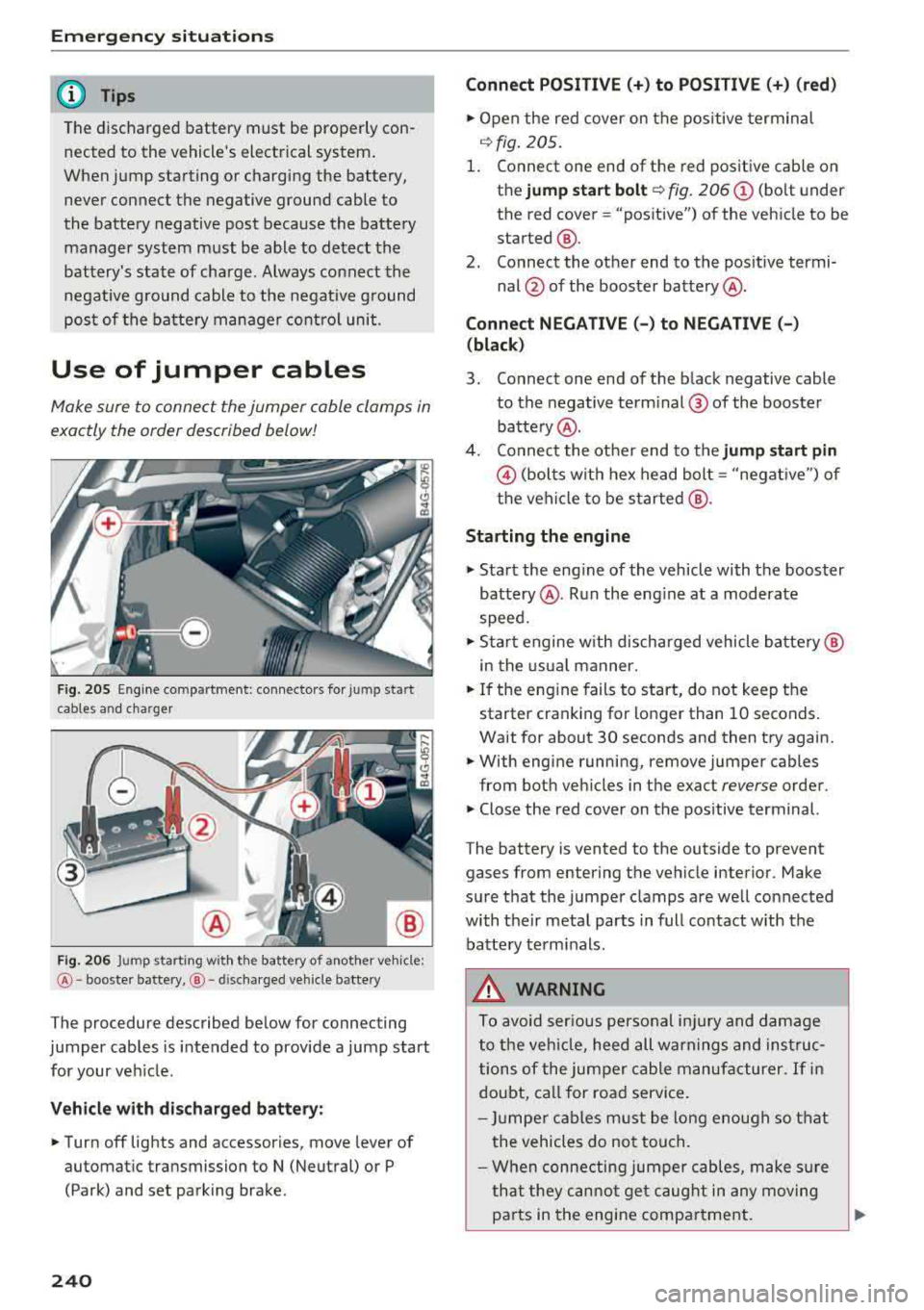
Use of jumper cables
Make sure to connect the jumper cable clamps in
exactly the order described below!
Fig . 205 Engine compartmen t: connecto rs for jump start
cables and charger
@
F ig . 206 Jump starting w it h the battery of anot her vehicle :
@-booster battery, @- discha rged vehicle battery
The procedure described below for connecting
jumper cables is intended to provide a jump start
for your veh icle.
Vehicle with discharged battery:
• Turn off lights and accessories, move lever of
automatic transmission to N (Neutral) or P (Park) and set park ing brake.
240
Connect POSITIVE(+) to POSITIVE(+) (red)
• Open the red cover on the positive terminal
i:!.> fig. 205.
1. Connect one end of the red positive cable on
the
jump start bolt ~ fig. 206@ (bolt under
the red cover= "positive") of the vehicle to be
started @.
2. Connect the other end to the positive termi-
nal @of the booster battery @.
Connect NEGATIVE(-) to NEGATIVE(-)
(black)
3. Connect one end of the black negative cable
to the negative terminal @ of the booster
battery @.
4. Connec t the other end to the
jump start pin
@ (bolts with hex head bolt= "negative") of
the vehicle to be started @.
Starting the engine
• Start the eng ine of the vehicle with the booster
battery @. Run the eng ine at a moderate
speed.
• Sta rt engine w ith discharged vehicle battery@
in the usual manner.
• If the engine fails to start, do not keep the
starter cranking for longer than 10 seconds.
Wait for about 30 seconds and then try again.
• With engine running, remove jumper cables
from both veh icles in the exact
reverse order.
• Close the red cover on the pos itive terminal.
The battery is vented to the outside to prevent
gases from entering the vehicle interior . Make
sure that the jumper clamps are well connected
with their metal parts in full contact w ith the
battery terminals.
A WARNING
To avoid serious personal injury and damage
to the vehicle, heed all warnings and instruc
tions of the jumper cable manufacturer. If in
doubt, call for road service .
- Jumper cables must be long enough so that
the vehicles do not touch.
- When connecting jumper cables, make sur e
that they cannot get caug ht in any moving
pa rts in the engine compartment.
.,.
Page 254 of 266
Index
Audi Service Repair Manuals and Literature 24 7
AUTO 4-zone deluxe automatic climate cont rol . . 61
Automatic headlights . . . . . . . . . . . . . . . . . 38
D eluxe automatic climate control . . . . . . . . 59
Auto Lock (central locking) . . . . . . . . . . . . . . 24
Automatic belt retractor . . . . . . . . . . . . . . . 13 7
Automatic climate control . . . . . . . . . . . . . . . 58
Key recogn ition . . . . . . . . . . . . . . . . . . . . . . 58
Operation . . . . . . . . . . . . . . . . . . . . . . . . . . . 59
Automatic key . . . . . . . . . . . . . . . . . . . . . . . . . 25
Automatic post-collision braking system . . 119
Autom atic transmission . . . . . . . . . . . . . . . . . 74
Em ergency mode . . . . . . . . . . . . . . . . . . . . . 79
H ill descent control . . . . . . . . . . . . . . . . . . . 77
Kick-down . . . . . . . . . . . . . . . . . . . . . . . . . . . 78
Selector lever emergency re lease . . . . . . . . 80
Selector lever pos itions . . . . . . . . . . . . . . . . 7 5
Shifting manually . . . . . . . . . . . . . . . . . . . . 78
Steer ing whee l with shift paddles . . . . . . . . 78
tiptronic mode . . . . . . . . . . . . . . . . . . . . . . . 78
Automatic wipe/wash system . . . . . . . . . . . .
44
Auto Safety Hotline . . . . . . . . . . . . . . . . . . . 132
Average consumption . . . . . . . . . . . . . . . . . . .
20
Average speed . . . . . . . . . . . . . . . . . . . . . . . . 20
B
Battery
Ju mp starting ...... .......... .. .. .. .
also refer to Vehicl e battery .......... .
Before driving
Belt tensioner 239
19 7
125
Drive select . . . . . . . . . . . . . . . . . . . . . . . . . 104
Belt tensioners . . . . . . . . . . . . . . . . . . . . . . . 140
Blended gasoline . . . . . . . . . . . . . . . . . . . . . 185
Blower (4-zone deluxe automatic climate con-
trol) . . . . . . . . . . . . . . . . . . . . . . . . . . . . . . . . . 61
Blower (deluxe automatic climate control) . . 59
Booster seats . . . . . . . . . . . . . . . . . . . . . . . . 176
Brakes . . . . . . . . . . . . . . . . . . . . . . . . . . . . . . 120
Brake assist .. .. ............. .... .. . 119
Brake booster . . . . . . . . . . . . . . . . . . . . . . . 120
Brake fluid . . . . . . . . . . . . . . . . . . . . . . . . . 197
Ceram ic brake rotors . . . . . . . . . . . . . . . . . 120
E lect romechan ical park ing brake . . . . . . . . 72
252
Emergency braking function . . . . . . . . . . . . 73
Indicator light . . . . . . . . . . . . . . . . . . . . 12, 17
New brake pads . . . . . . . . . . . . . . . . . . . . . 120
Worn brake pads . . . . . . . . . . . . . . . . . . . . . 16
Braking guard ..... .. .. ............. ... 91
93
Messages
Settings ............................ 93
Break-in security featu re . . . . . . . . . . . . . . . . 30
Breaking in New brake pads . . . . . . . . . . . . . . . . . . . . . 120
N . ew engine . . . . . . . . . . . . . . . . . . . . . . . . . 64
New tires . . . . . . . . . . . . . . . . . . . . . . . . . . 208
Bu lbs . . . . . . . . . . . . . . . . . . . . . . . . . . . . . . . 238
C
California Proposition 65 Warning . . . . . . . 190
Battery specific . . . . . . . . . . . . . . . . . . . . . 197
Capacities Fuel tank. . . . . . . . . . . . . . . . . . . . . . . . . . . 245
Washer fluid reservoir . . . . . . . . . . . . . . . . 245
Cargo area . . . . . . . . . . . . . . . . . . . . . . . . . . . 130
Cata lytic converter . . . . . . . . . . . . . . . . . . . . 188
Central locking . . . . . . . . . . . . . . . . . . . . . . . . 24
C . k onvernence ey . . . . . . . . . . . . . . . . . . . . . . 2 7
Luggage compartment lid . . . . . . . . . . . . . . 30
Mechanically locking . . . . . . . . . . . . . . . . . . 29
Panorama glass roof . . . . . . . . . . . . . . . . . . 34
Power windows . . . . . . . . . . . . . . . . . . . . . . 34
Remote control key . . . . . . . . . . . . . . . . . . . 2 7
Setting . . . . . . . . . . . . . . . . . . . . . . . . . . . . . 29
Su nroof . . . . . . . . . . . . . . . . . . . . . . . . . . . . . 34
C entra l locking switch . . . . . . . . . . . . . . . . . . 28
Ceramic brake rotors
New brake pads . . . . . . . . . . . . . . . . . . . . . 1 20
Certification . . . . . . . . . . . . . . . . . . . . . . . . . 250
Changing engine oil . . . . . . . . . . . . . . . . . . . 194
Child res tra ints
Danger of using child res traints in the front
seat............................... 143
Where can I get additiona l information
abo ut child restraints and their use? . . . . 184
Child res traint system anchors . . . . . . . . . . 180
Page 255 of 266
a co .... N
" N .... 0 0 \,;J '
Important safety instructions for using chi ld
safety seats . . . . . . . . . . . . . . . . . . . . . . . . 170
Important things to know when driving with
children . . . . . . . . . . . . . . . . . . . . . . . . . . . 166
Tether anchors . . . . . . . . . . . . . . . . . . . . . . 183
Tether straps . . . . . . . . . . . . . . . . . . . . . . . 183
Child safety lock Power windows . . . . . . . . . . . . . . . . . . . . . . 33
Rear doors . . . . . . . . . . . . . . . . . . . . . . . . . . 33
Child safety seats . . . . . . . . . . . . . . . . . . . . . 172
Booster seats . . . . . . . . . . . . . . . . . . . . . . . 176
Convertible child seats . . . . . . . . . . . . . . . 174
Convertible locking retractor . . . . . . . . . . 179
How do I properly install a child safety seat
. h' l 7 170 in myve 1c e . ................. ... .. .
Infant seats .. ................ ... .. . 172
Installing a child restraint using the LATCH
system . . . . . . . . . . . . . . . . . . . . . . . . . . . . 182
L ATCH system . . . . . . . . . . . . . . . . . . . . . . 182
L owe r anchorages . . . . . . . . . . . . . . . . . . . 181
Mounting and releasing the anchorage
hook . . . . . . . . . . . . . . . . . . . . . . . . . . . . . . 182
Safety instructions . . . . . . . . . . . . . . . . . . . 170
Securing . . . . . . . . . . . . . . . . . . . . . . . . . . . 177
Unused safety belts on the rear seat . . . . 172
Cigarette lighter . . . . . . . . . . . . . . . . . . . . . . . 51
Cleaning . . . . . . . . . . . . . . . . . . . . . . . . . . . . 221
Cleaning/removing ice from windows . . . . . 223
C leaning Alcantara . . . . . . . . . . . . . . . . . . . . 224
Cleaning artificial leather . . . . . . . . . . . . . . . 224
Cleaning carbon parts . . . . . . . . . . . . . 223, 224
C leaning contro ls . . . . . . . . . . . . . . . . . . . . . 223
Cleaning decorative parts/trim . . . . . . 222, 223
C leaning displays . . . . . . . . . . . . . . . . . . . . . 223
Cleaning exhaust tail pipes . . . . . . . . . . . . . 222
Cleaning plastic parts . . . . . . . . . . . . . . . . . . 223
C leaning rims . . . . . . . . . . . . . . . . . . . . . . . . 222
Cleaning textiles . . . . . . . . . . . . . . . . . . . . . . 224
Climate control system . . . . . . . . . . . . . . . . . 58
Automatic recirculation . . . . . . . . . . . . . . . . 62
Basic settings . . . . . . . . . . . . . . . . . . . . . . . . 62
Drive select . . . . . . . . . . . . . . . . . . . . . . . . . 104
C losing
Hood . . . . . . . . . . . . . . . . . . . . . . . . . . . . . . 191
Sunroof. . . . . . . . . . . . . . . . . . . . . . . . . . . . . 35
Windows . . . . . . . . . . . . . . . . . . . . . . . . . . . 34
Index
Closing/opening
By remote control . . . . . . . . . . . . . . . . . . . . 27
Using the door lock cylinder . . . . . . . . . . . . 29
With the convenience key . . . . . . . . . . . . . . 27
Closing aid (doors) . . . . . . . . . . . . . . . . . . . . . 24
Cockpit (overview) . . . . . . . . . . . . . . . . . . . . . . 6
Coming home . . . . . . . . . . . . . . . . . . . . . . . . . 40
Compartments . . . . . . . . . . . . . . . . . . . . . . . . 52
Compliance . . . . . . . . . . . . . . . . . . . . . . . . . . 250
Consumer Information ............. 132, 247
Consumption (fuel) . . . . . . . . . . . . . . . . . . . . 20
Contacting NHTSA . . . . . . . . . . . . . . . . . . . . 132
Convenience key
Starting the engine (STAR T ENGINE STOP
button) . . . . . . . . . . . . . . . . . . . . . . . . . . . . . 68
Stopping the engine (STAR T ENGINE ST OP
button) . . . . . . . . . . . . . . . . . . . . . . . . . . . . . 68
Switching the ignition on . . . . . . . . . . . . . . 68
Unlocking/locking . . . . . . . . . . . . . . . . . . . . 27
Convenience opening . . . . . . . . . . . . . . . . . . . 34
Convertib le child safety seats . . . . . . . . . . . 17 4
Convertib le locking retractor
Activating . . . . . . . . . . . . . . . . . . . . . . . . . . 179
Deactivating . . . . . . . . . . . . . . . . . . . . . . . . 180
Using to secure a child safety seat . . . . . . 179
Cooling down . . . . . . . . . . . . . . . . . . . . . . . . . 64
Cooling mode (4-zo ne deluxe automatic cli-
mate control) . . . . . . . . . . . . . . . . . . . . . . . . . 61
Cooling mode (deluxe automatic climate con -
trol) . . . . . . . . . . . . . . . . . . . . . . . . . . . . . . . . . 59
Cooling system Adding coolant . . . . . . . . . . . . . . . . . . . . . . 196
Coolant . . . . . . . . . . . . . . . . . . . . . . . . . . . . 195
Coolant level checking . . . . . . . . . . . . . . . . 196
Coolant temperature indicator . . . . . . . . . . . 9
Indicator light . . . . . . . . . . . . . . . . . . . . . . . 13
Cornering light . . . . . . . . . . . . . . . . . . . . . . . 104
Crossing water . . . . . . . . . . . . . . . . . . . . . . . . 64
Cruise control system Changing speed . . . . . . . . . . . . . . . . . . . . . . 85
Preselecting speed . . . . . . . . . . . . . . . . . . . . 85
Switching off . . . . . . . . . . . . . . . . . . . . . . . . 85
Switching on . . . . . . . . . . . . . . . . . . . . . . . . . 84
Cup holders . . . . . . . . . . . . . . . . . . . . . . . . . . . 52
Current consumption . . . . . . . . . . . . . . . . . . . 20
253