sport mode AUDI A7 2017 Owner´s Manual
[x] Cancel search | Manufacturer: AUDI, Model Year: 2017, Model line: A7, Model: AUDI A7 2017Pages: 284, PDF Size: 72.29 MB
Page 109 of 284
co
co
.... N ,..._
N .... 0
00
\.J '
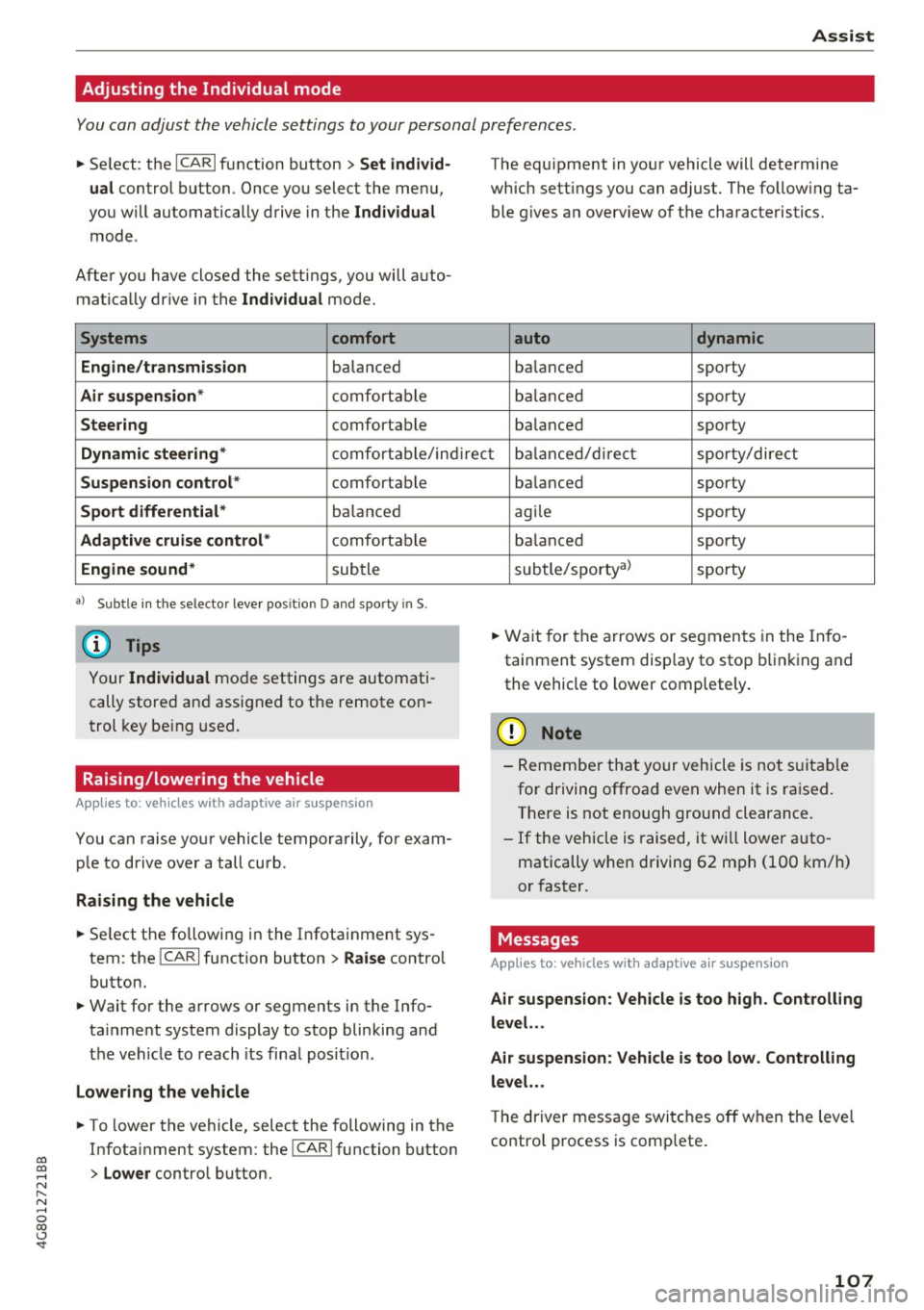
Adjusting the Individual mode
You can adjust the vehicle settings to your personal preferences.
~ Se lect : the ICARI function button > Set individ
ual
control button . Once you select the menu,
you will automatically drive in the
Individual
mode .
After you have closed the sett ings, you will auto
mat ically dr ive in the
Individual mode.
Systems comfort
Engine/transmission
balanced
Air suspension* comfortab le
Steering comfortable The equipment
in your vehicle will determine
which settings you can adjust. The follow ing ta
ble g ives a n overview of the characteristics.
auto dynamic
balanced sporty
balanced sporty
ba lanced sporty
Dynamic steering* comfortable/indirect balanced/direct sporty/direct
Suspension control* comfortable
Sport differential* balanc ed
Adaptive cruise control* comfortable
Engine sound* subtle
a} Sub tle in th e se lector lever positio n D and sporty in S.
(D Tips
Your Individual mode settings are automati
cally stored and assigned to the remote con
trol key being used.
Raising/lowering the vehicle
Applies to: veh icles with adaptive air suspension
You can raise your vehicle temporarily, for exam
ple to drive over a tall curb .
Raising the vehicle
~ Select the following in the Infotainment sys
tem : the
ICARI function button > Raise control
button.
~ Wait for the arrows or segments in the Info
ta inme nt system display to stop blinking and
the vehicle to reach its final posit ion.
Lowering the vehicle
~ To lower the vehicle, select the following in the
Infotainment system: the
! CAR I function button
> Lower control button . balanced
sporty
agile sporty
ba lanced sporty
subtle/sportyal sporty
~ Wait for the arrows or segments in the Info
tainment system disp lay to stop blinking and
the vehicle to lower completely.
(D Note
- Remember that your vehicle is not suitab le
for driving offroad even when it is ra ised.
There is not enough ground clearance.
- If the vehicle is raised, it will lower auto
matically when driving 62 mph (100 km/h)
or faster.
Messages
Appl ies to : vehicles with adaptive air suspension
Air suspension : Vehicle is too high . Controlling
level. ..
Air suspension : Vehicle is too low. Controlling
level. ..
T he driver message switches off when the leve l
contro l process is comp lete.
107
Page 123 of 284

co
co
.... N
" N .... 0
00
<..:l 'SI"
you into taking risks. This could increase
your risk of a collision.
- Please note the risk of a co llision increases
when driving fast, especially through curves
and on slippery or wet roads, and when driv
ing too close to objects ahead. The ESC and
its integrated systems cannot always pre
vent collisions -there is still a r isk of acci
dents!
- Press the accelerator pedal carefully when
accelerating on even, slippery surfaces such
as ice and snow. The drive wheels can spin
Switching on /off
Intelligent Technology
even when these control systems are instal
led and this can affect driving stability and
increase the risk of a collision.
(D Tips
- ABS and ASR only function correctly when
all four wheels are equipped with identical
tires. Different tire s izes can lead to a reduc
tion in engine power.
- You may hear noises when the systems de
scribed are working.
ESC turns on automatically when you start the engine .
Fig. 140 Center console: OFF ~ button
The following examples are unusual situations
where it may make sense to switch sport mode
on in order to allow the wheels to spin:
ESC levels
Sport mode on
- Rocking the vehicle to free it when it is stuck
-Driving in deep snow or on loose ground
- Driving with snow chains
Applies to: RS models: the ESC is designed to
function in levels. Depending on the level that is
selected, the stabil izat ion function of the ESC is
limited or switched off. The amount of stabiliza
tion control will differ depending on the level.
Sport mode off
Behavior
The ESC and ASR stabilization functions The
full stabilization function of the ESC
are limited
c::> & . and ASR is available again.
Operation Press the I~ OFF I button . Press the 1.$ OF FI button again .
Indicator Ill turns on. II turns off.
lights
Messa ges Stabilization control (ESC ): Sport Warn- Stabilization control (ESC): On
ing! Reduced stability
121
Page 124 of 284
Intelligent Technology
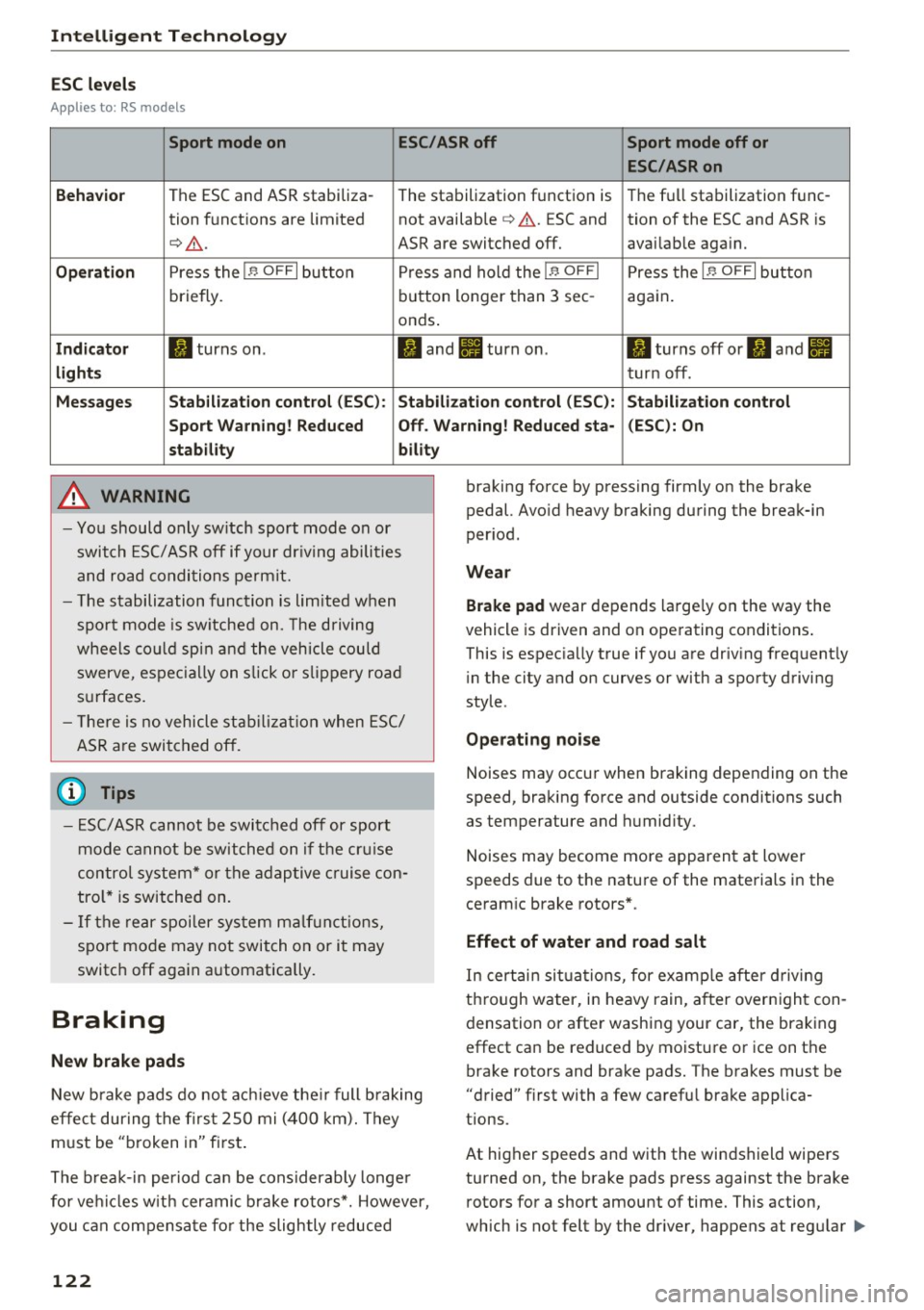
ESC levels
Ap plies to : RS models
Sport mode on ESC/ASRoff Sport mode off or
ESC /ASRon
Beha vior
The ESC and ASR stabiliza-
The stabilization function is The fu
ll stabilization func-
tion funct ions are limited not available
¢ ,& . ESC and tion of the ESC and ASR is
¢ .&. . ASR are switched off. availab le aga in.
Op eration Press the I.$ OFF I button P ress and hold the j.$ OF FI Press the I.$ OFF I button
briefly. b
utton longer than 3 sec- aga in .
onds .
Indicator II turns on . II and Ill turn on. II turns off or II and Ill
light s turn off .
Me ssage s Stabilization control (ESC ): S tabilization control (ESC ): Stabilization control
Sport Warn ing ! Reduced Off . Warning! Reduced sta - (ESC): On
stab ility bility
A WARNING
-Yo u should only sw itch sport mode on or
switch ESC/ ASR off if your dr iving abili ties
and road condi tions permit.
- T he stabilization func tion is limited w hen
spo rt m ode is sw itche d on. The driving
wheels co uld spi n and the vehicle could
swerve, espec ially on s lick or slippery road
s u rfaces.
- T here is no vehicle sta bilizat ion when E SC/
ASR a re swi tched off.
(D Tips
- ES C/ASR can not be switc hed off or sport
mode cannot be switche d on if the cr uise
contro l system * or the adap tive c ruise con
tro l* is switched on.
- If the re a r spoiler sys tem m alf unct ions,
sport mo de may not switch on or it may
switc h off aga in automatically.
Braking
New brake pads
New b rake pads do not ac hieve the ir full b raking
effe ct during the firs t 2S 0 mi (400 km). They
m ust be "broken in" fi rst .
The b rea k-in period ca n be considerably longe r
for ve hicles w it h cer amic b rake rotors*. However,
you can compensa te fo r the slightly reduced
122
braking force by pressing firmly on the brake
pedal. Avo id heavy braking during the break-in
per iod.
Wear
Brake pad
wear depends large ly on the way the
vehicle is driven and on ope rating conditions .
This is espec ia ll y true if you a re driv ing frequent ly
i n the city and on curves or with a sporty driving
sty le .
Ope rating noi se
Noises may occur when braking depending on the
speed, braking force and outside conditions such
as temperature and humid ity.
Noises may become mo re apparent at lower
speeds due to the nature of the materials in the
ceram ic brake rotors* .
Effect of water and road salt
In certain situa tions, for e xamp le after d riving
thro ugh water, in heavy rain, a fter over nigh t con
densation or after washing your car, the brak ing
effect can be reduced by moisture or ice on the bra ke rotors and brake pads. The brakes must be
"dried" f irst with a few ca refu l brake app lica
tions.
At higher speeds and with the windshield wipers
turned on, the brake pads press against the brake rotors for a short amount of time. This action,
wh ich is not felt by the dr iver, happens at regu lar .,..
Page 140 of 284

Audi pre sense
Audi pre sense
Preventative passenger
protection
A pp lies to: ve hicles w ith Audi p re se nse
Pre sense can initiate steps to protect vehicle oc
cupants in certain dangerous situations. The
functions described are available depending on
veh icle equipment:
Pre sense basic*
The following functions can be triggered in cer
tain driving situations:
- Tensioning of the safety belts (for example,
during heavy braking): the front safety belts
have reversible belt tensioners. If a collision
does not occur, the safety belts loosen slightly
and are ready to trigger again.
- Closing the windows and the sunroof* (for ex
ample, when
over-or understeering): the win
dows and the sunroof* close until there is only
a small gap open.
The function of the pre sense basic is activated at
a speed of 20 mph (30 km/h) or higher.
Drive select: the deployment time is adapted in
Dynamic mode.
Pre sense front (vehicles with adaptive cruise
control*}
Pre sense front contains the functions of pre
sense basic . In addition, the likelihood of a rear
end collision with the vehicle ahead is also calcu
lated, within the limits of the system. If the risk
of a collision is detected, the following functions
can trigger:
- Braking guard
c:> page 94
- Tensioning of the safety belts
- Closing the windows and the sunroof*
Pre sense rear (vehicles with side assist*)
Pre sense rear contains the functions of pre sense
bas ic. In addition, the likelihood of a rear-end
coll ision from the vehicle beh ind is also calculat
ed, within the limits of the system. If the risk of a
collision is detected, the following functions can
trigger:
138
- Tensioning of the safety belts
- Closing the windows and the sunroof*
Pre sense plus*
Pre sense plus contains the functions of pre
sense front and pre sense rear .
Error message
Audi pre sense: Unavailable
Preventative passenger protection is not availa
ble. Drive to your authorized Audi dealer or au
thorized Audi Service Facility immediately to have
the malfunction corrected.
A WARNING
Pre sense cannot overcome natural physical
laws. It is a system designed to assist and it
cannot prevent a collision . Do not let the in
creased safety provided tempt you into taking
risks. This could increase your risk of a colli
sion.
- The system can deploy incorrectly .
- Please note that the sensors do not always
detect all objects . This increases the risk of
a collision .
- Pre sense does not react to people or ani
mals or objects that are crossing the vehi
cle 's path or are difficult to detect
c:> page 89.
- Reflective objects such as guard rails or the
entrance to a tunnel, heavy rain and ice can
affect the function of the radar sensors and
the system's ability to detect a collision risk.
(D Note
The sensors can be displaced by impacts or
damage to the bumper, wheel housing and
underbody. Pre sense can be impaired by this.
Have an authorized Aud i dealer or authorized
Audi Service Facility check their function.
{!) Tips
-Certain pre sense front functions switch off
when sport mode is switched off or when
driving in reverse. ..,.
Page 165 of 284
co
co
.... N r-N .... 0
00
\.J -
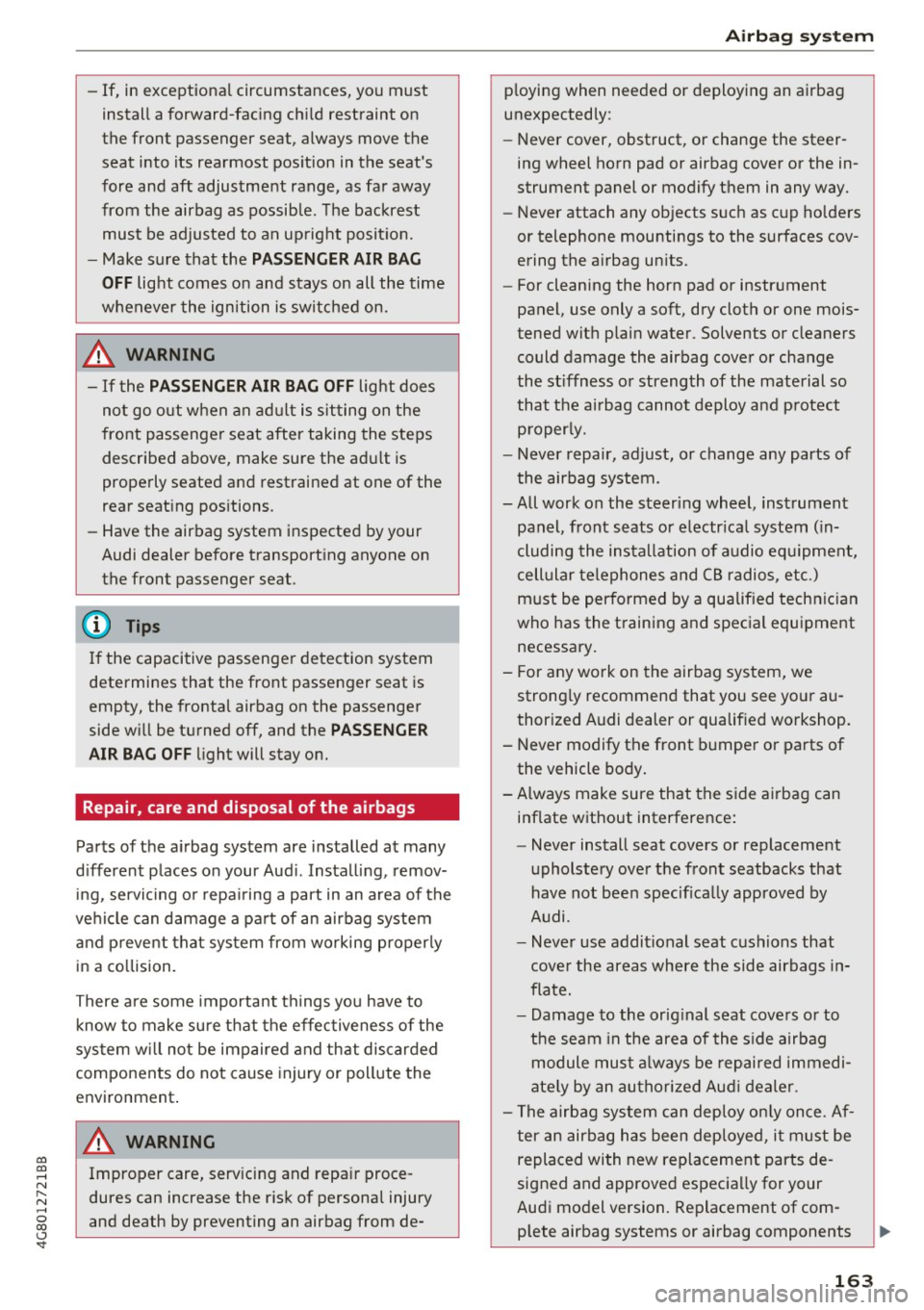
install a forward-facing child restraint on
the front passenger seat, always move the
seat into its rearmost position in the seat 's
fore and aft adjustment range, as far away
from the airbag as possible . The backrest
must be adjusted to an upright position.
- Make sure that the
PASSENGER AIR BAG
OFF
light comes on and stays on all the time
whenever the ignition is switched on.
_& WARNING
- If the PASSENGER AIR BAG OFF light does
not go out when an adult is sitting on the
front passenger seat after taking the steps
described above, make sure the adult is
properly seated and restrained at one of the
rear seating positions .
- Have the airbag system inspected by your
Audi dealer before transporting anyone on
the front passenger seat .
(D Tips
If the capacitive passenger detection system
determines that the front passenger seat is
empty, the frontal airbag on the passenger
side will be turned off, and the
PASSENGER
AIR BAG OFF
light will stay on.
Repair , care and disposal of the airbags
Parts of the airbag system are installed at many
different places on your Audi. Installing , remov
ing , servicing or repairing a part in an area of the
vehicle can damage a part of an airbag system
and prevent that system from working properly
in a collision.
There are some important things you have to
know to make sure that the effectiveness of the
system will not be impaired and that discarded
components do not cause injury or pollute the
environment.
_& WARNING
Improper care, servicing and repair proce
dures can increase the risk of personal injury
and death by preventing an airbag from de-
-
Airbag system
ploying when needed or deploying an airbag
unexpectedly :
- Never cover, obstruct, or change the steer
ing wheel horn pad or airbag cover or the in
strument panel or modify them in any way.
- Never attach any objects such as cup holders
or telephone mountings to the surfaces cov
ering the airbag units.
- For cleaning the horn pad or instrument
panel, use only a soft, dry cloth or one mois
tened with plain water. Solvents or cleaners
could damage the airbag cover or change
the stiffness or strength of the material so
that the airbag cannot deploy and protect properly.
- Never repair, adjust, or change any parts of
the airbag system.
-All work on the steering wheel, instrument
panel, front seats or electrical system (in
cluding the installation of audio equipment,
cellular telephones and CB radios , etc.)
must be performed by a qualified technician
who has the training and special equipment
necessary.
- For any work on the airbag system, we
strongly recommend that you see your au
thorized Audi dealer or qualified workshop.
- Never modify the front bumper or parts of
the vehicle body.
- Always make sure that the side airbag can
inflate without interference:
- Never install seat covers or replacement
upholstery over the front seatbacks that
have not been specifically approved by
Audi .
- Never use additional seat cushions that
cover the areas where the side airbags in
flate.
- Damage to the original seat covers or to
the seam in the area of the side airbag
module must always be repaired immedi
ately by an authorized Audi dealer.
- The airbag system can deploy only once. Af
ter an airbag has been deployed, it must be
replaced with new replacement parts de
signed and approved especially for your
Audi model version. Replacement of com plete airbag systems or airbag components
163
Page 177 of 284
co
co
.... N
" N .... 0
00
\.J '
one of the rear seating positions . If in exception
al c ircumstances you must use it on the front
passenger seat, carefully read all of the informa
tion on child safety and Advanced Airbags and heed all of the applicable WARNINGS. Make cer
tain that the child and child restraint are correct
ly recognized by the capacitive passenger detec
tion system in the front passenger seat, that the
front passenger airbag is turned off, and that the
airbag status is always correctly signaled by the
PASSENGER AIR BAG OFF light.
Many types and models of child restraints have
been available over the years, new mode ls are in
troduced regular ly incorporat ing new and im
proved designs and older mode ls are taken out of
production . Chi ld restraints are not standardized.
Ch ild restraints of the same type typically have
d ifferent weights and s izes and different "foot
prints", the s ize and shape of the bottom of the
child restraint that s its on the seat, when they
are installed on a vehicle seat. These differences
make it virtually impossible to certify compliance
with the requirements fo r advanced airbags with
each and every ch ild restraint that has ever been
sold in the past o r will be sold over the course o f
the useful life of your vehicle.
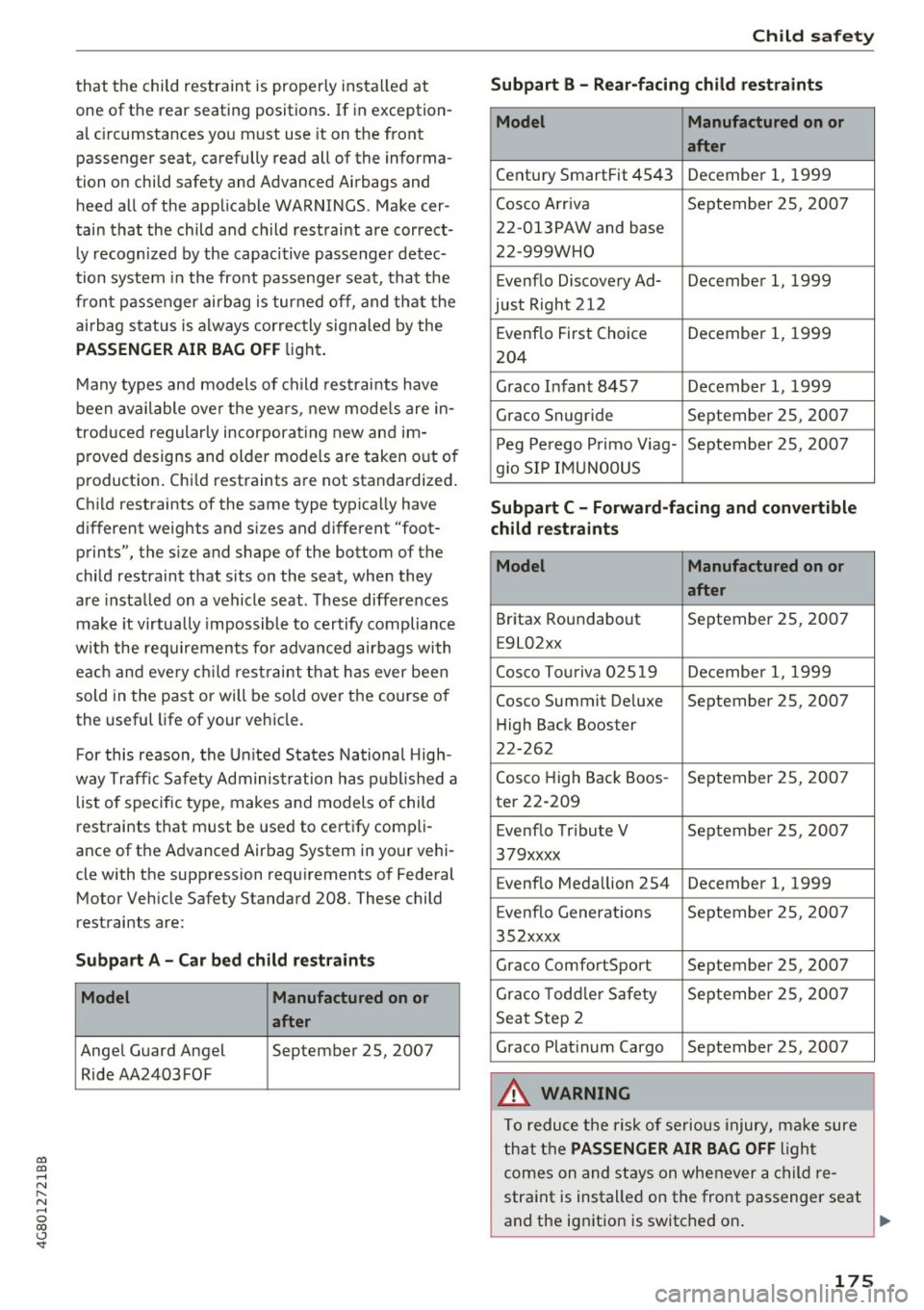
Fo r this reason, the United States National High
way Traffic Safety Administration has published a
list of specific type, makes and models of child
restraints that must be used to certify compli
ance of the Advanced Airbag System in your vehi
cle with the suppression requirements of Federal
Motor Vehicle Safety Standard 208. These child
restraints are:
Subpart A -Car bed child restraints
Model Manufactured on or
after
Ange l Guard Angel September 25, 2007
Ride AA2403FOF
Child safety
Subpart B -Rear-facing child restraints
Model Manufactured on or
after
Century SmartFit 4543 December 1, 1999
Cosco Arriva September 25, 2007
22-013PAW and base
22-999WHO
Evenflo Discovery Ad- December 1, 1999
just Right 212
Evenflo First Choice December 1, 1999
204
Graco Infant 8457 Decembe r 1, 1999
Graco Snugride September 25, 2007
Peg Perego Primo Viag- September 25, 2007
g io SIP IMUN00US
Subpart C -Forward-facing and convertible
child restraints
Model Manufactured on or
after
Britax Roundabout September 25, 2007
E9L02xx
Cosco Touriva 02519 December 1, 1999
Cosco Summit De luxe September 25, 2007
Hi gh Back Booster
22-262
Cosco High Back Boos- September 25, 2007
ter 22-209
Evenflo Tribute V September 25, 2007
379xxxx
Evenflo Medallion 254 December 1, 1999
E venflo Generations September 25, 2007
352xxxx
Graco ComfortSport September 25, 2007
Graco Todd le r Safety September 25, 2007
Seat Step 2
Graco Plat inum Cargo September 25, 2007
A WARNING
To reduce the risk of serious injury, make sure
that the
PASSENGER AIR BAG OFF ligh t
comes on and stays on whenever a child re
straint is installed on the front passenger seat
and the ignition is switched on . ..,.
175
Page 226 of 284
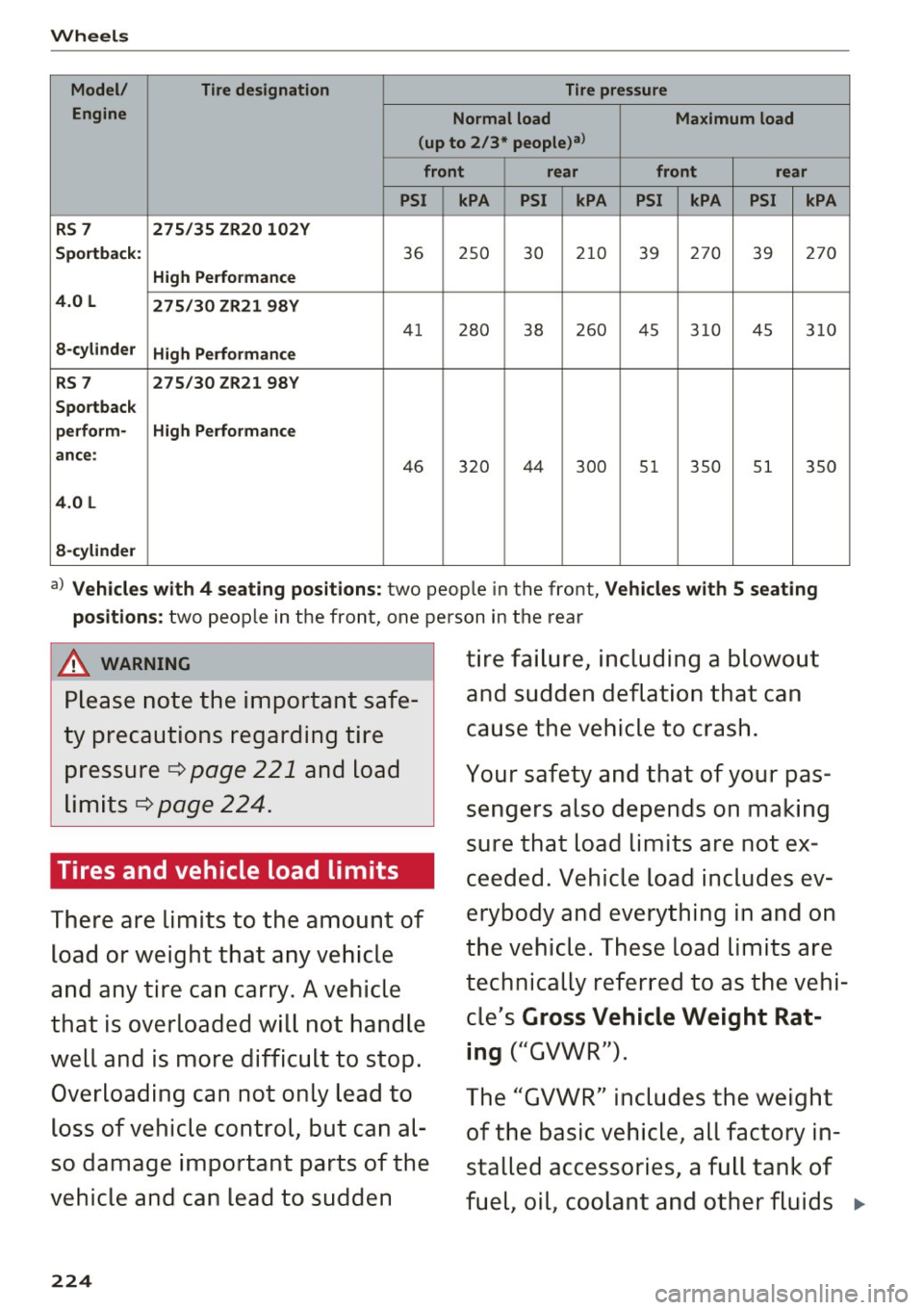
Wheels
Model/ Tire designation Tire pressure
Engine Normal load Maximum load
(up to 2/3* people)a>
front rear front rear
PSI kPA PSI kPA
PSI kPA PSI kPA
RS 7 275/35 ZR20 102Y
Sportback:
36 250 30 210 39 270
39 270
High Performance
4.0 L 275/30 ZR21 98Y
41 280 38 260 45 3 10 4 5 310
8-cylinder
High Performance
RS 7 275/30 ZR21 98Y
Sportback
perform- High Performance
ance:
46 320 44
300 51 350 51 350
4.0 L
8-cylinder
a) Vehicles with 4 seating positions: t wo people i n the front, Vehicles with 5 seating
positions:
two peop le in t he front , one pe rson in the re ar
A WARNING
Please note the important safe
ty precautions regarding tire pressure ¢
page 221 and load
limits¢
page 224.
Tires and vehicle load limits
There are limits to the amount of
load or weight that any vehicle
and any tire can carry. A vehicle
that is overloaded will not handle
well and is more difficult to stop.
Overloading can not only lead to
loss of vehicle control, but can al
so damage important parts of the
vehicle and can lead to sudden
224
tire failure, including a blowout
and sudden deflation that can
cause the vehicle to crash.
Your safety and that of your pas
sengers also depends on making
sure that load limits are not ex
ceeded. Vehicle load includes ev
erybody and everything in and on
the vehicle. These load limits are
technically referred to as the vehi
cle's
Gross Vehicle Weight Rat
ing
("GVWR").
The "GVWR" includes the weight
of the basic vehicle, all factory in
stalled accessories, a full tank of
fuel, oil, coolant and other fluids
111-
Page 274 of 284
Index
Electronic differential lock
Indicator light . . . . . . . . . . . . . . . . . . . . . . . 16
Electronic D ifferent ial Lock . . . . . . . . . . . . . 120
Electronic immobilizer . . . . . . . . . . . . . . . . . . 28
Electronic speed limiter . . . . . . . . . . . . . . . . . 26
Electronic stabilization control Indicator light . . . . . . . . . . . . . . . . . . . . . . . 16
Electronic Stabilization Control . . . . . . . . . . 120
Sport mode . . . . . . . . . . . . . . . . . . . . . . . . 121
Emergency assistance . . . . . . . . . . . . . . . . . 240
Emergency braking function . . . . . . . . . . . . . 74
E mergency flashers . . . . . . . . . . . . . . . . . . . . 42
Emergency locking the front passenger door 32
E mergency operation
Doors . . . . . . . . . . . . . . . . . . . . . . . . . . . . . . 32
Luggage compartment lid . . . . . . . . . . . . . . 3S
Selector lever . . . . . . . . . . . . . . . . . . . . . . . . 81
Sunroof. . . . . . . . . . . . . . . . . . . . . . . . . . . . . 38
Emergency release
Fuel filler door . . . . . . . . . . . . . . . . . . . . . . 195
Emergency starting 254
Energy management . . . . . . . . . . . . . . . . . . 126
I ndicator light . . . . . . . . . . . . . . . . . . . . . . . 14
Engi ne
Coolant . . . . . . . . . . . . . . . . . . . . . . . . . . . . 205
Prewarming . . . . . . . . . . . . . . . . . . . . . . . . . 69
Start-Stop system . . . . . . . . . . . . . . . . . . . . 71
Starting . . . . . . . . . . . . . . . . . . . . . . . . . . . . 69
Starting with jumper cables . . . . . . . . . . . 254
Stopping . . . . . . . . . . . . . . . . . . . . . . . . . . . . 70
Warming up/cooling down . . . . . . . . . . . . . 65
Engine compartment
Opening/closing the hood . . . . . . . . . . . . . 201
Overview . . . . . . . . . . . . . . . . . . . . . . . . . . . 202
Safety precautions . . . . . . . . . . . . . . . . . . . 199
Engine control (indicator light) . . . . . . . . . . . 17
Engine oil . . . . . . . . . . . . . . . . . . . . . . . . . . . 202
Adding . . . . . . . . . . . . . . . . . . . . . . . . . . . . 204
Changing . . . . . . . . . . . . . . . . . . . . . . . . . . 205
Checking the engine oil level . . . . . . . . . . . 204
Fue l consumption . . . . . . . . . . . . . . . . . . . 204
Indicator light . . . . . . . . . . . . . . . . . . . . . . . 15
O il consumption . . . . . . . . . . . . . . . . . . . . . 203
Specification and viscosity . . . . . . . . . . . . . 202
Temperature indicator . . . . . . . . . . . . . . . . . 87
Engine sound . . . . . . . . . . . . . . . . . . . . . . . . 105
Engine speed limitat ion (indicator light) . . . 18
272
Engine Start/Stop mode
refer to Start/Stop system . . . . . . . . . . . . . 73
Engine warm-up request
Ind icator light . . . . . . . . . . . . . . . . . . . . . . . 18
Environment Catalytic converter . . . . . . . . . . . . . . . . . . . 198
Diesel particulate filter . . . . . . . . . . . . . . . 199
Proper d isposa l of drained engine oil . . . . 205
Unleaded fuel.. .. .. .. .. ........... .. 191
EPC (engine contro l).. .. ............. ... 17
ESC Automatic post-collision braking system .
also refer to Electroni c stabilization con
trol
...............................
ESP
refer to Electronic stabilization control ..
Event Data Recorder (EDR) ............ . 120
120
120
127
Exterior lighting . . . . . . . . . . . . . . . . . . . . . . . 40
Exterior mirrors
Adjusting . . . . . . . . . . . . . . . . . . . . . . . . . . . 44
D ' . 1mming ........ .. .. ................ 44
Heating...... ... .. .. ................ 44
Exterior temperature display . . . . . . . . . . . . . 21
F
Fastening
Booster seats . . . . . . . . . . . . . . . . . . . . . . . 182
Convertible child safety seats . . . . . . . . . . 180
Infant seats . . . . . . . . . . . . . . . . . . . . . . . . 178
Floor mats . . . . . . . . . . . . . . . . . . . . . . . . . . . 134
Folding the rear seats . . . . . . . . . . . . . . . . . . . 55
Foot pedals . . . . . . . . . . . . . . . . . . . . . . . . . . 134
For the sake of the environment
E nvironmentally -friendly driving . . . . . . . . 66
Fueling . . . . . . . . . . . . . . . . . . . . . . . . . . . . 193
Leaks . . . . . . . . . . . . . . . . . . . . . . . . . . . . . . 200
Roof rack . .. .. .. .. .. ... .......... ... 55
Warming up the engine . . . . . . . . . . . . . . . . 69
Freeze protection
Coolant additive . . . . . . . . . . . . . . . . . . . . . 205
Front airbags Description . . . . . . . . . . . . . . . . . . . . . . . . . 152
How they work . . . . . . . . . . . . . . . . . . . . . . 158
Frontal collisions and the laws of physics . . 141
Page 280 of 284

Index
Speed limiter . . . . . . . . . . . . . . . . . . . . . . . . . 26
Speed warning system . . . . . . . . . . . . . . . . . . 85
Spoiler . . . . . . . . . . . . . . . . . . . . . . . . . . . . . . 125
Sport differentia l . . . . . . . . . . . . . . . . . . . . . 105
Indicator light . . . . . . . . . . . . . . . . . . . . . . . 19
Star button . . . . . . . . . . . . . . . . . . . . . . . . . . . 22
Start-Stop system . . . . . . . . . . . . . . . . . . . . . . 71
Start/Stop system Engine does not switch off . . . . . . . . . . . . . 72
Engine starts automatically . . . . . . . . . . . . 72
Indicator lights . . . . . . . . . . . . . . . . . . . . . . 72
Messages . . . . . . . . . . . . . . . . . . . . . . . . . . . 73
Starting/stopping the engine . . . . . . . . . . . 72
Switching off/on . . . . . . . . . . . . . . . . . . . . . 73
S T ART ENGINE STOP button . . . . . . . . . . . . . 69
Starting (engine) . . . . . . . . . . . . . . . . . . . 69, 72
Steering Electromechanical steering ..... .... . 124, 0
Indicator light . . . . . . . . . . . . . . . . . . . 15, 124
Locking . . . . . . . . . . . . . . . . . . . . . . . . . . . . . 70
also refer to Electromechanical steering . 124
Steering wheel Buttons . . . . . . . . . . . . . . . . . . . . . . . . . . . . . 22
Easy seat entry . . . . . . . . . . . . . . . . . . . . . . . 69
Manual adjustment . . . . . . . . . . . . . . . . . . . 67
Power adjustment . . . . . . . . . . . . . . . . . . . . 68
Shift padd les (automatic transmission) . . . 79
Steer ing whee l heating . . . . . . . . . . . . . . . . 64
Steps for determining correct load limit . . . 226
Stopping (engine) . . . . . . . . . . . . . . . . . . . 70, 72
Storage . . . . . . . . . . . . . . . . . . . . . . . . . . . . . . 57
Storage compartments . . . . . . . . . . . . . . . . . 53
Storage hooks . . . . . . . . . . . . . . . . . . . . . . . . . 57
S tronic (automatic transmission) . . . . . . . . . 76
Launch control program . . . . . . . . . . . . . . . 80
Sunroof . . . . . . . . . . . . . . . . . . . . . . . . . . . . . . 37
Convenience opening . . . . . . . . . . . . . . . . . . 37
Emergency closing . . . . . . . . . . . . . . . . . . . . 38
Sunshade . . . . . . . . . . . . . . . . . . . . . . . . . . . . 45
Sun visors . . . . . . . . . . . . . . . . . . . . . . . . . . . . 45
Symbols
refer to Indicator lights . . . . . . . . . . . . . . . . 10
T
Tachometer . ..... ................ 9, 10, 21
278
Tail lights
Cleaning
TOI clean diesel 236
refer to Ad
Blue . . . . . . . . . . . . . . . . . . . . . . 195
Technical data . . . . . . . . . . . . . . . . . . . . . . . . 260
Technical modifications . . . . . . . . . . . . . . . . 266
Temperature display Coolant . . . . . . . . . . . . . . . . . . . . . . . . . . . . . . 9
Exterior tern perature . . . . . . . . . . . . . . . . . . 21
Temperature indicator
Engine oil . . . . . . . . . . . . . . . . . . . . . . . . . . . 87
Tether anchors . . . . . . . . . . . . . . . . . . . . . . . 189
Tether strap . . . . . . . . . . . . . . . . . . . . . . . . . 189
Tie-downs . . . . . . . . . . . . . . . . . . . . . . . . 56, 136
Time ......... ... .. .. ................ 24
tiptronic mode (automatic transmission) . . . 79
tiptronic (automatic transmission) . . . . . . . . 76
Tire Mobility System (tire repair set) . . . . . . 241
Tire pressure (tire pressure monitor ing sys-
tem) ......... ... ... ...... ...... 230,231
T ires ......... .. .. .. .. ............. .. 211
All wheel drive . . . . . . . . . . . . . . . . . . . . . . 124
Low aspect ratio tires . . . . . . . . . . . . . . . . 228
Repair set . . . . . . . . . . . . . . . . . . . . . . . . . . 241
Replacing . . . . . . . . . . . . . . . . . . . . . . . . . . 243
Service life . . . . . . . . . . . . . . . . . . . . . . . . . 219
Tire pressure . . . . . . . . . . . . . . . . . . . . . . . 221
Tire pressure monitoring sys-
tem ......... ... .. .. ....... 229,230,231
Tire pressure table . . . . . . . . . . . . . . . . . . . 222
Treadwear indicators . . . . . . . . . . . . . . . . . 219
Unidirectional .. .. .. .. ............. .. 213
Uniform tire quality grading . . . . . . . . . . . 229
Tires and wheels Glossary of tire and loading terminology . 213
Tires and vehicle load limits . . . . . . . . . . . 224
Tool kit . . . . . . . . . . . . . . . . . . . . . . . . . . . . . 240
Torn or frayed safety belts . . . . . . . . . . . . . . 142
Towing Tow trucks
Towing loop
TPMS 256
256,257
Ind icator light . . . . . . . . . . . . . . . . . . . . . . 234
TPMS (tire pressure monitoring system) ....... ... .. .. ........... 230,231