ESP AUDI A7 2017 Owner´s Manual
[x] Cancel search | Manufacturer: AUDI, Model Year: 2017, Model line: A7, Model: AUDI A7 2017Pages: 284, PDF Size: 72.29 MB
Page 178 of 284
Child safety
-Take the child restraint off the front passen
ger seat and install it properly at one of the
rear seat positions if the
PASSENGER AIR
BAG OFF
light does not stay on.
- Have the airbag system inspected by your
authorized Audi dealer immediately.
(D Tips
The child seats listed in categories A to C have
been statically tested by Audi only for the Ad
vanced Airbag function.
Important safety instructions for using
child safety seats
Correct use of child safety seats substantially re
duces the risk of injury in an accident!
As the driver, you are responsible for the safety
of everybody in the vehicle, especially children:
.,. Always use the right child safety seat for each
child and always use it properly
c::> page 178.
.,. Always carefully follow the child safety seat
manufacturer's instructions on how to route
the safety belt properly through the child safe
ty seat .
.,. When using the vehicle safety belt to install a
child safety seat , you must first activate the
convertible locking retractor on the safety belt
to prevent the child safety seat from moving
c::> page 183.
.,. Push the child safety seat down with your full
weight to get the safety belt really tight so that
the seat cannot move forward or sideways
more than one inch (2.5 cm).
.,. Secure unused safety belts on the rear seat
c::> page 178 .
Always remember: Even though your vehicle is
equipped with an Advanced Airbag system, all
children, especially those 12 years and younger,
should always ride in the back seat properly re
strained for their age and size.
.&, WARNING
Not using a child safety seat, using the wrong
child safety seat or improperly installing a
176
child restraint increases the risk of serious
personal injury and death.
- All vehicle occupants and especially children
must be restrained properly whenever riding
in a vehicle. An unrestrained or improperly
restrained child could be injured by striking
the interior or by being ejected from the ve
hicle during a sudden maneuver or impact .
An unrestrained or improperly restrained
child is also at greater risk of injury or death
through contact with an inflating airbag.
- Commercially available child safety seats
are required to comply with U.S. Federal
Motor Vehicle Safety Standard (FMVSS) 213
(in Canada CMVSS 213).
- When buying a child restraint, select one
that fits your child and the vehicle .
- Only use child restraint systems that fully
contact the flat portion of the seat cush ion. The child restraint must not tip or
lean to either side . Audi does not recom
mend using child safety seats that rest on
legs or tube-like frames. They do not pro
vide adequate contact with the seat.
- Always heed all legal requirements per
taining to the installation and use of child
safety seats and carefully follow the in
structions provided by the manufacturer
of the seat you are using.
- Never allow children under 57 inches
(1.45 meters) to wear a normal safety belt .
They must always be restrained by a proper
child restraint system. Otherwise, they
could sustain injuries to the abdomen and
neck areas during sudden braking maneu
vers or accidents .
- Never let more than one child occupy a child
safety seat.
- Never let babies or older children ride in a
vehicle while sitting on the lap of another
passenger .
- Holding a child in your arms is never a sub
stitute for a child restraint system .
- The strongest person could not hold the
child with the forces that exist in an acci
dent. The child will strike the interior of
the vehicle and can also be struck by the
passenger.
Page 180 of 284
Child safety
-Take the child restraint off the front passen
ger seat and install it proper ly at one of the
rear seat positions if the
PASSEN GER AIR
BA G OF F
light does not stay on.
- Have the airbag system inspected by your
authorized Aud i dealer immediately.
Secure unused safety belts on the rear seat
l8
,h- --lJ ;g
--- 0
Fig . 16 5 Schematic overv iew: keep unused safety be lts
away from chi ld ren i n chil d safety seats.@-oute r rear
safety belt, @ - center rear safety be lt*
~
If a chi ld safety seat is used on the rear bench,
especially with LA TCH universal lower anchorag
es, the unused safety be lts
mu st be secured so
that the child in the child restraint cannot reach
them ¢,& .
- Gu ide the safety belt webbings @and
®* be
hind the head restraint of the seat where the
child restraint is installed
¢fig. 165. When do
ing so, do not engage the convertib le locking
retractor! You should not hear a "clicking"
sound when w inding up the safety be lt .
- Let the belt retractor wind up the safety belt
webb ing .
_& WARNING
A ch ild in a child safety seat installed with the
LATC H lowe r anchorages or w ith the standard
safety belt or a child in a booste r seat on the
rear seat could p lay wit h unused rear seat
safety belts and become entangled. This
cou ld cause t he chi ld ser ious personal injury
and even death.
- Always sec ure unused rear seat safety belts
o ut of reach of ch ild ren in child seats such
as by proper ly routing them aro und the
178
head restraint of the seat where the child
restraint is installed .
- Never activate t he convertible locking re
tractor when routing the safety belts around
the head restraints.
- Never let anyone s it at the center rear seat
ing position if the center rear safety belt has
been routed around a rear head restraint.
Child seats
Infant seats
Babies and infants up to about one year old and
20 lbs . or
9 kg need special rearward-facing
child restraints that support the back, neck and
head in a crash.
Fig. 166 Sc hema tic ove rview : rearward -facing infa nt sea t,
p rope rly installed on th e rear sea t
.. When using the veh icle safe ty belt to install a
c hild safe ty seat, yo u must first a ct ivate the
convertib le locking re tractor on the safe ty belt
to prevent the child safety seat from moving
r::!>poge 183 or insta ll the seat using the LATCH
attachments .
.. Push the child safety seat down with your full
weight to get the safety belt really tight so that
the seat cannot move forward or sideways
more than one inch (2 .5 cm).
.. Secure unused safety bel ts on the rear seat
c:!> page 178 .
Infants up to about one year (20 lbs . or 9 kg) are
bes t protected in special infant carr iers and child
safe ty seats designed for the ir age group. Many
expe rts be lieve that infa nts and small ch ildren
sho uld r ide o nly in special res tra ints in wh ich the
ch ild faces the back of the vehicle. These infant
II>
Page 184 of 284
Child safety
Booster seats and safety belts
Properly used booster seats can help protect
children weighing between about 40 lbs . and 80
lbs. (18 kg and 36 kg) who are less than 4
ft. 9
in. (57 inches/1.45 meters) tall .
Fig. 169 Rear seat: ch ild proper ly restrained in a booster
seat
The vehicle's safety belts alone will not fit most
children until they are at least 4
ft. 9 in. (57 in
ches/1.45 meters) tall and weigh about 80 lbs.
(36 kg). Booster seats raise these chi ld ren up so
that the safety belt will pass properly
over the
stronger parts of their bodies and the safety belt
can help protect them in a crash.
• Do not use the convertible locking retractor
when using the vehicle's safety belt to restrain
a chi ld on a booster seat.
• The shoulder be lt must lie as close to the cen
ter of the child's collar bone as possible and
must lie flat and snug on the upper body. It
must never lie across the throat or neck. The
lap belt must lie across the pelv is and never
across the stomach or abdomen . Make sure the
belt lies flat and snug. Pull on the belt to tight
en if necessary .
• If you must transport an older child in a boos
te r seat on the front passenger seat, you can
use the safety belt height adjustment to help
adjust the shoulder portion properly .
• Secure unused safety belts on the rear seat
c> page 178.
Children up to at least 8 years old (over 40 lbs or
18 kg) are best protected in child safety seats de
signed for their age and weight. Experts say that
the skeletal structure, particularly the pelvis, of
these children is not fully developed, and they
182
must not use the vehicle safety belts without a
suitable child restraint .
It is usually best to put these children in appro
priate booste r seats. Be sure the booster seat
meets all applicab le safety standards.
Booster seats raise the seating position of the
child and reposition both the lap and shoulder
parts of the safety belt so that they pass across
the child's body in the right places. The routing of
the be lt
over the chi ld's body is very important
for the child's protection, whether or not a boos
ter seat is used. Children age 12 and under m ust
always ride in the rear seat.
Children who are at least 4
ft. 9 in. (57 inches/
1.45 meters) ta ll can generally use the vehicle 's
three point lap and shoulder belts. Never use the
lap belt portion of the vehicle's safety belt alone
to restrain any child, regard less of how big the
c hi ld is. Always remember that children do not
have the p ronounced pelvic structure required for
the proper function of lap belt portion of the
ve
hicle's three point lap and shoulder belts. The
c hi ld's safety absolutely requ ires that a lap belt
portion of the safety belt be fastened snugly and
as low as possible around the pe lvis. Never let
the lap belt portion of the safety belt pass over
the child's stomach or abdomen.
In a crash, airbags must inflate within a blink of
an eye and with considerab le force . In order to do
i ts job, the airbag needs room to inflate so that it
will be there to protect the occupant as the occu
pant
moves forward into the airbag.
A ve hicle occupant who is out of position and too
close to the a irbag gets in the way of an inflating
airbag. When an occupant is too close, he or she
will be struck violently and will receive serious or
possibly even fatal injury .
In order for the a irbag to offer protection, it is
important that all vehicle occupants, especially
any ch ildren, who must be in the front seat be
cause of exceptional c ircumstances, be properly
re stra ined and as far away from the a irbag as
possible. By keeping room between the child's .,..
Page 185 of 284
co
co
.... N
" N .... 0
00
\.J '
ment, the airbag can inflate completely and pro
vide supp lemental protect ion in certain frontal
collisions.
_&. WARNING
Not using a booster seat, using the booster
seat improperly, incorrectly installing a boos
ter seat or using the vehicle safety belt im properly increases the risk of serious personal
injury and death in a collision or other emer
gency situat ion. To help red uce the risk of se
rious personal injury and/or death:
- T he shoulder be lt must lie as close to the
center of the child's collar bone as possible
and must lie f lat and snug on the upper
body. It must never lie across the throat or
neck. The lap belt must lie across the pelvis
and never across the stomach or abdomen.
Make sure that the belt lies flat and snug.
Pull on the belt to tighten if necessary .
- Failure to properly route safety belts over a
child's body will cause severe injuries in an
accident or other emergency situation
¢ page 140.
-The rear side of the child safety seat should
be pos itioned as close as poss ible to the
backrest on the vehicle seat.
- For adjustable head restraints : adjust or re
move the rear seat head restraint if it is d if
ficult to install the child seat with the head restra int in place
<=? page 50. Ins tall the
head restrain t again immediately once the
child seat is removed. Driving w ithout head
restraints or with head restraints that are
not properly adjusted increases the risk of
serious or fatal neck injury dramatically.
- Never let a child put the shoulder belt under
the arm or behind the back, because it cou ld
cause severe injur ies in a crash.
- Children on the front seat of any car, even
with Advanced Airbags, can be seriously in
jured or even killed when an airbag inflates.
- Never let a child stand or knee l on any seat,
for example the front seat.
- Never let a child ride in the cargo area of
your vehicle.
Ch ild safety
-Always remember that a child leaning for
ward, sitting sideways or out of position in
any way during an accident can be struck by
a deploying airbag. Th is w ill result in serious
personal injury or death .
- If you must install a booster seat on the
front passenger seat because of exceptional
circumstances the
PASSEN GER AIR BAG
OFF
li ght must come on and stay on, when
eve r the ignit io n is switched on.
- I f the
PASSENGER AIR BAG OFF light does
not come on and stay on, perform the
checks desc ribed
¢ page 160, Monitoring
the Advanced Airbag System.
- Take the child restra int off the front passen
ge r seat and install it prope rly at one of the
rear seat positions i f the
PAS SENGER AIR
BAG O FF
light does not stay on whenever
the ignition is switched on .
- Always read and heed all WARNINGS when
ever using a chi ld restrained in a vehicle is
be ing used ¢
page 140, Safety belts,
c:> page 148 , Airbag system and
c:> page 172, Important information.
Securing child seats
Securing a child safety seat using a safety
belt
Safety belts for the rear seats and the front pas
senger can be locked with the convertible locking
retractor to properly secure child safety seats .
The safety belts emergency lock ing retractors for
the rear seats safety be lts and for the front pas
senger's seat safety be lt have a conve rtible lock
ing retractor for child restraints . The safety be lt
must be locked so that be lt webbing cannot un
reel. The retractor can be activated to lock the
safety belt and prevent the safety belt webbing
from loosening up dur ing normal driving . A ch ild
safety seat can only be properly installed when
the safety be lt is locked so that the ch ild a nd
c hi ld safety seat will stay in place.
Always remember : Even though your veh icle is
equipped with an Advanced Airbag system, all
children, especially those 12 years and younger, .,.
183
Page 187 of 284
co
co
.... N
" N .... 0
00
\.J '
has been designed and certified by its man
ufacturer for use on a front seat with a
passenger front and side airbag.
- Never put the forward-facing child restraint
up, against or very near the instrument pan
el.
- Always move the front passenger seat to
the highest position in the up and down ad
justment range and move it back to the
rearmost position in the seat's fore and aft
adjustment range, as fa r away from the air
bag as possib le, before insta lling the for
wa rd-facing child restra int.
- Always make sure that the safety belt upper
anchorage is beh ind the child restraint and
not next to or in front of the chi ld restraint
so that the safety belt will be properly posi
tioned.
- Make sure that the
PAS SENGER AIR BAG
OFF
light comes on and stays on all the time
whenever the ignition is switched on .
_&. WARNING
Rearward-facing child restraints:
- A ch ild in a rearward-facing child safety seat
installed on the front passenger seat will be
seriously injured and can be killed if the
front airbag inflates - even with an Ad
vanced Airbag System.
- The inflating a irbag will hit the child safety
seat or infant carrier with great force and
will smash the ch ild safety seat and child
against the backrest, center armrest, door
or roof .
- Always be especially careful if you must in
stall a rearward facing child safety seat on
the front passenger seat in exceptional c ir
c u mstances.
- Make sure that the
PASSENGER AI R BA G
OFF
light comes on and stays on all the time
whenever the ignition is switched on.
- If the
PA SSENGER A IR BAG OFF light does
not come on and stay on, immediately in
sta ll the rear-fac ing ch ild safety seat in a
rear seating position and have the airbag
system inspected by your Audi dealer .
Child safety
Activating the convertible locking retractor
Use the convertible locking retractor to secure a
child restraint .
Always heed the ch ild safety seat manufacturer 's
instruct ions when installing a child restraint in
your vehicle. To activate the convertible locking retractor:
.. Place the child restraint on a seat, preferably
on the rear seat .
.. Slowly pull the belt
all the w ay out .
.. Route it around or through the child restra int
be lt path ¢&_ .
.. Push the ch ild safety seat down with you r full
weight to get the safety belt really tight.
.. Insert the belt tongue into the buckle for that
seating position.
.. Guide the safety belt back into the retractor un
til the belt lies flat and snug on the child safety
seat .
.. You should hear a ''cl icking" noise as the belt
w inds back into the inertia reel. Test the con
vert ible lock ing retractor by pull ing on the belt .
You shou ld no longer be able to pull the belt
out of the retractor. The convertib le loc kin g re
t ractor is now activated.
.. Make sure that the red release button is facing
away from the child restraint so that it can be
unbuckled quickly .
.. Pull on the belt to make sure the safety belt is
properly tight and fastened so that the seat
cannot move forward or sideways more than
one inch (2 .5 cm) .
,&. WARNING
Using the wrong ch ild rest raint o r an improp
e rly installed child restra int can cause se rious
personal injury or death in a crash.
- Always make sure that the safety be lt re
tr actor is locked when installing a child
safety seat . An un locked safety be lt retrac
tor cannot hold the chi ld safety seat in p lace
during normal driving or in a crash.
- Always buckle the child safety seat firm ly in
p lace even if a child is not sitting in it. A
loose child safety seat can fly around during
a sudden stop or in a crash. .,.
185
Page 192 of 284
Child safety
Releasing the tether strap
.,. Loosen the tension following the child restraint
manufacturer's instructions.
.,. Depress the spring catch on the hook and re
leas e it from the anchorage.
(D Note
If you leave the child restraint with the tether
strap firmly installed for several days, this
could leave a mark on the upholstery on the
seat cushion and backrest in the area where
the tether strap was installed. The upholstery
would also be permanently stretched around the tether strap . This applies especially to
leather seats.
Using tether straps on rearward-facing
child restraints
Currently, few rear-facing child restraint systems
come with a tether. Please read and heed the
child restraint system manufacturer's instruc
tions carefully to determine how to properly in
stall the tether.
A WARNING
A child in a rearward-facing child safety seat
installed on the front passenger seat will be
seriously injured and can be killed if the front
airbag inflates -even with an Advanced Airbag
System.
- The inflating airbag will hit the child safety
seat or infant carrier with great force and
will smash the child safety seat and child
against the backrest, center armrest, or
door.
- If you must install a rearward facing child
safety seat on the front passenger seat be
cause of exceptional circumstances and the
PASSENGER AIR BAG OFF light does not
come on and stay on, immediately install
the rear-facing child safety seat in a rear
seating position and have the airbag system
inspected by your Audi dealer.
190
Additional information
· Sources of information about child
restraints and their use
There are a number of sources of additional in
formation about child restraint selection, instal
lation and use :
NHTSA advises that the best child safety seat is
the one that fits your child and fits in your vehi
cle, and that you will use correctly and consis
tently.
Try before you buy!
U.S National Highway Traffic Safety Administra
tion
Tel.: 1-888-327-4236 (TTY: 1-800-424-9153)
http://www.nhtsa.gov
http:/ /www.safercar.gov
National SAFE KIDS Campaign
Tel.: (202) 662-0600 http://www.safekids .org
Safety BeltSafe U.S.A
Tel.: (800) 745-SAFE (English)
Tel.: (800) 747-SANO (Spanish)
http://www.carseat.org
Transport Canada Information Centre
Tel.: 1-800-333-0371 or call 1-613-998-8616 if
you are in the Ottawa area
http://www.tc.gc.ca/ eng/roadsafety/menu. htm
Audi Customer Relations
Tel.: (800) 822-2834
Page 194 of 284

Check ing and F illing
fi ll up at busy gas stations where the seasona l
adjustm ent is more likely to be mad e in time .
0 Note
-Me thanol f uels which do no t meet these re
quirements may cause corrosion and dam
age to plastic and rubber components in the
fuel system .
- Do not use fuels that fail to meet the spec i
fied criteria in this chapter .
- If you are unable to determine whether or not a particular fuel blend meets the spec i
fications, ask your service station or its fuel supplier.
- Do not use fuel for which the contents can
not be identified.
- Fuel system damage and performance prob
lems resulting from the use of fue ls differ
ent from those specified are not the respon
s ibility of Audi and are not covered under
the New Veh icle or the Emiss ion Control
System Warranties.
- If you experience a loss of fuel economy or
driveability and performance problems due
to the use of one of these fuel b lends, we
r ecommend that you switch to unblended
fuel.
Gasoline additives
A ma jo r concern among many auto manufactur
ers is carbon deposit build- up ca used by the type
of gasoline you use.
A lthough gasoline grades d iffer from one manu
facturer to another, they have cer tain things in
common . All gaso line grades contain substances
that can cause deposits to collect on vita l engine
parts, such as fue l injectors and intake valves. Al
though most gasoline brands include additives to
keep engine and fuel systems clean, they are not
equally effective .
Audi recommends using TOP TIE R Detergent Gas
oline. For more information on TOP TIER Deter
gent Gasoline, please go to the official website (www.toptiergas .com) .
192
After an extended period o f using inadequate
fuels, carbon deposit bui ld-ups can rob your en
gine of peak performance.
([) Note
Damage or ma lf u nction due to poor fue l qual
ity is not covered by the Audi New Vehicle
Limited Warranty .
Diesel fuel
Applies to: vehicles wi th diese l en gin e
Always use ULSD (Ultra Low Sulfur Diese l) No. 2 .
The ULSD No. 2 meets the ASTM D97S.
D iesel fuel w ith concentrations of b iod iesel high
er than 5 % such as B l 1, B20 or BlOO are st rict ly
prohibited .
Se rvice station fuel pumps are labe led wi th the
correc t fu el i nfo rmation for easy recogn ition by
the user . If the diesel fue l pump is not labe led
ask the station operator what fue l is being dis
pensed before filling up your vehicle .
U LSD No . 2 may no t be ava ilable outside the USA
and Canada . Be s ure to check befo re t raveling to
other countries .
U LSD No . 2 can become th ic k e r i n very co ld tem
peratures, and this can impa ir the e ng ine's s tart
i ng and running . Depend ing on the season, gas
stations provide ULSD No . 2 that flows better in
cold temperatures so that you can continue oper
at ing your vehicle as usual.
(D Note
- Your vehicle's diese l engine was designed
so ley for use with ULSD No . 2 . Therefore,
never use gasoline, heating oil, other fuels
or flow improvers. These contain substances
that will severely damage the fuel system and the engine. Such damage will not be
covered by your New Vehicle Limited War
ranty.
- If you put any amo unt of incorrect fuel in
the fuel tank, do not start the engine under
any c ircumstances. Immed iate ly contact the
nearest author ized A udi dealer or author-
ized Aud i Serv ice Facility fo r ass istance .
IJ,-
Page 199 of 284

co co .... N
" N .... 0
00
\.J -
Ad Blue can irritate the skin, eyes and respira
tory system. If there is contact with the fluid,
flush immediately with plenty of water . Con
sult a physician if necessary.
CD Note
- Only use Ad Blue that conforms to the
standard ISO 22241 -1. Do not mix any addi
tives w ith the AdBlue and do not d ilute it
with water.
- Do not add Ad Blue to the diesel ta nk or add
diesel fuel to the Ad Blue tank. Do not start
the engine under any circumstances if the
wrong f uel is filled in the tank. There is a
risk of damaging the fuel tank system and
the engine. See an author ized Audi dealer or
authorized Audi Service Facility for ass is
tance .
- Ad B lue attacks surfaces such as pa inted ve
hicle components, plast ic and carpet . Re
move the fluid as quickly as poss ible with a
damp cloth and plenty of cold water. If the
Ad Blue has already crysta llized, use warm
water and a sponge . AdBlue residue that is
not removed will crysta llize a nd can damage
the affected surface.
- Do not store refill bottles or canisters per
mane ntly in the vehicle . If the container
l ea ks, the escaping AdBl ue could damage
t h e veh icle inter io r.
- Do not allow AdBlue to come into co ntact
with clothing. If there is contact w ith the
f lui d, f lush immed iate ly w ith p lenty of wa
te r.
(j) Tips
Follow the Ad B lue man ufact urer's instr uc
t ions fo r use and storage.
Refilling AdBlue using a bottle
Applies to: vehicles with selective catalytic reduction
.. Remove the cap from the refi ll bottle ¢ A in
Filling AdBlue on page 197, ¢(Din Filling
AdBlue on page 197 .
Check ing and Filling
.. Position the bott le on the fi ller tube and turn
the bottle clockwise until it stops turning .
.. Press lightly against the bottom of the bottle
to empty it. Cont inue pressing the bottom of
the bottle until it is empty or until fluid stops
flow ing into the tank .
.,. Remove the bottle and seal the filler neck
¢ page 198, Completing AdBlue refill.
CD Note
Only use refill bottles that are approved for
your vehicle . Using other systems can cause
Ad B lue to leak.
@ Tips
- You can obtain ref ill bottles from an author
ized Aud i dea le r o r aut horized Aud i Serv ice
Facility.
- A permitted refi ll bottle contains approxi
mately 0.5 gallon (1.9 liters) of AdBl ue.
Refilling AdBlue using a canister
Applies to: vehicles with selective catalytic reduction
®
+®
Fig. 181 Can iste r w ith attachable hose
.. Remove the cover from the refill canister¢ A
in Filling AdBlue on page 197, ¢(Din Filling
AdBlue on page 197 .
.,. Secure the end of the hose (Don the opening in
t he caniste r@ by turni ng the hose to the right.
.,. Remove the cap @ from the o ther end of the
hose @.
.. Position the end of the hose @ on the filler
neck in the veh icle and turn the hose to the
r ight to tighten it .
.. Lift the canister up and then t ip it. Cont inue
holding the canister in a tipped pos ition until it ..,.
197
Page 208 of 284

Check ing and F illing
The coolant leve l is monitored through the. in
dicator light ¢
page 14. However, we do recom
mend occasionally check ing the coo lant level
manually.
I f you must add coolant, use a mixture of water
and coolant additive. Mixing the coolant additive
with d istilled water is recommended.
Coolant additiv e
The coolant addi tive is made of anti-freezi ng and
corros ion protection agents. Only use the fo llow
ing coolant additives . These additives may be
mixed with each other.
Coolant additive Specification
Gl3 TL 774)
Gl2++
TL 774 G
The amount of coolant add itive that needs to be
mixed w ith water depends on the climate where
the vehicle will be operated. If the coolant addi
tive percentage is too low, the coolant can freeze
a nd damage the engine.
Coolant
Freeze protec·
additive tion
Warm reg ions min. 40% m in. -13 ° F
max. 45% (-25 °C)
Cold regions min. 50% max . -40 °F
max . 55% (-40 °C)
([)
Note
-Before the start of winter, have your author
ized Audi dealer or authorized A udi Se rvice
Fac ility check if the coolant additive in you r
vehicle matches the percentage approp riate
fo r the clim ate. Thi s is especially important
when driving in co lder climates .
- If the approp riate coolant additive is not
available in an emergen cy, do no t add any
other additive. You cou ld damage the en
gine. If this happens, only use water and re store the correct mixture ratio with the
spec ified coolant additive as soon as possi
ble.
- Only refill with new coo lant.
- Radiator sealant must not be mixed w ith
the coo lant .
206
· Adding coolant
F ig. 186 En gin e compartment : coolant exp ansion tank
cover
-N
-~
~
Observe the safety precautions ~ .&. in Working
in the engine compartment on page 199.
Check ing the engin e coolant level
Park the vehicle on a leve l surface.
.,. Switch the ignit ion off.
.,. Read the coolant level on the coolant expansion
tank ¢
page 202, fig . 184. The coolant level
must be betwee n the MIN and MAX mark ings
when the e ngine in co ld. When the engine is
wa rm it c an be slightly above the MAX marking.
Adding coolant
Requirement: there must be a residual amount of
coolant in the expansion tank ¢(D .
.,. Let the engine cool down .
.,. Place a cloth over the coolant expansion tank
cap and unscrew the cap counterclockw ise
¢ .8_ .
.,. Add coo lant m ixed in the correct rat io
¢ page 205 up to t he MAX mar king.
.,. Make sure that the f luid level remains stab le.
Add mo re coolant if necessary.
.,. Close the cap securely .
Coolant loss usually ind icates there is a lea k. Im
med iate ly dr ive your vehi cle to a n author ized
Audi dealer or author ized A udi Service Fac ility
and have the cooling system inspected . If the
cooling system is not leaking, a loss can come
from the coolant boiling through overheating
and being pushed out of the cooling system.
Page 211 of 284
co
co
,...,
N
" N ,...,
0
00
\.J '
start pins according to the instructions. (pin un
der the red cover = "positive", pin with hexago
nal head = "negative").
~ Insert the power cable for the charging device
into the socket and switch the device on .
~ At the end of the charging process, switch the
charger off and pull the power cab le out of the
socket.
~ Remove the c harge r te rmi nal clamps.
~ Close the red cover on the positive term inal.
~ Close the hood ¢ page 201.
A WARNING
- A highly explosive mixtu re of gases can form
when charging batter ies. On ly charge the
vehicle battery in well-vent ilated areas.
- A drained battery can freeze at tempera
tures around 32 °F (0 °C). A frozen or
thawed vehicle battery must not be charged
and must not be used anymore . The battery
housing can crack and battery acid can leak
out if ice fo rms, wh ich increases the r is k of
an exp losion and chemical burns , Contact an
au thori zed Aud i dealer o r autho riz ed Aud i
Service Facility fo r more information.
- Do not con nect o r disconne ct the c harg ing
c able while charg ing be cause th is increases
the risk of an exp losion.
(j) Tips
- Only cha rge the vehicle bat tery through t he
con nections in the engine compartmen t.
- Read all of the manufacture r's instructions
fo r the charger befo re c harg ing the ve hicl e
batte ry.
Ch eck ing and Filling
Windshield washer
system
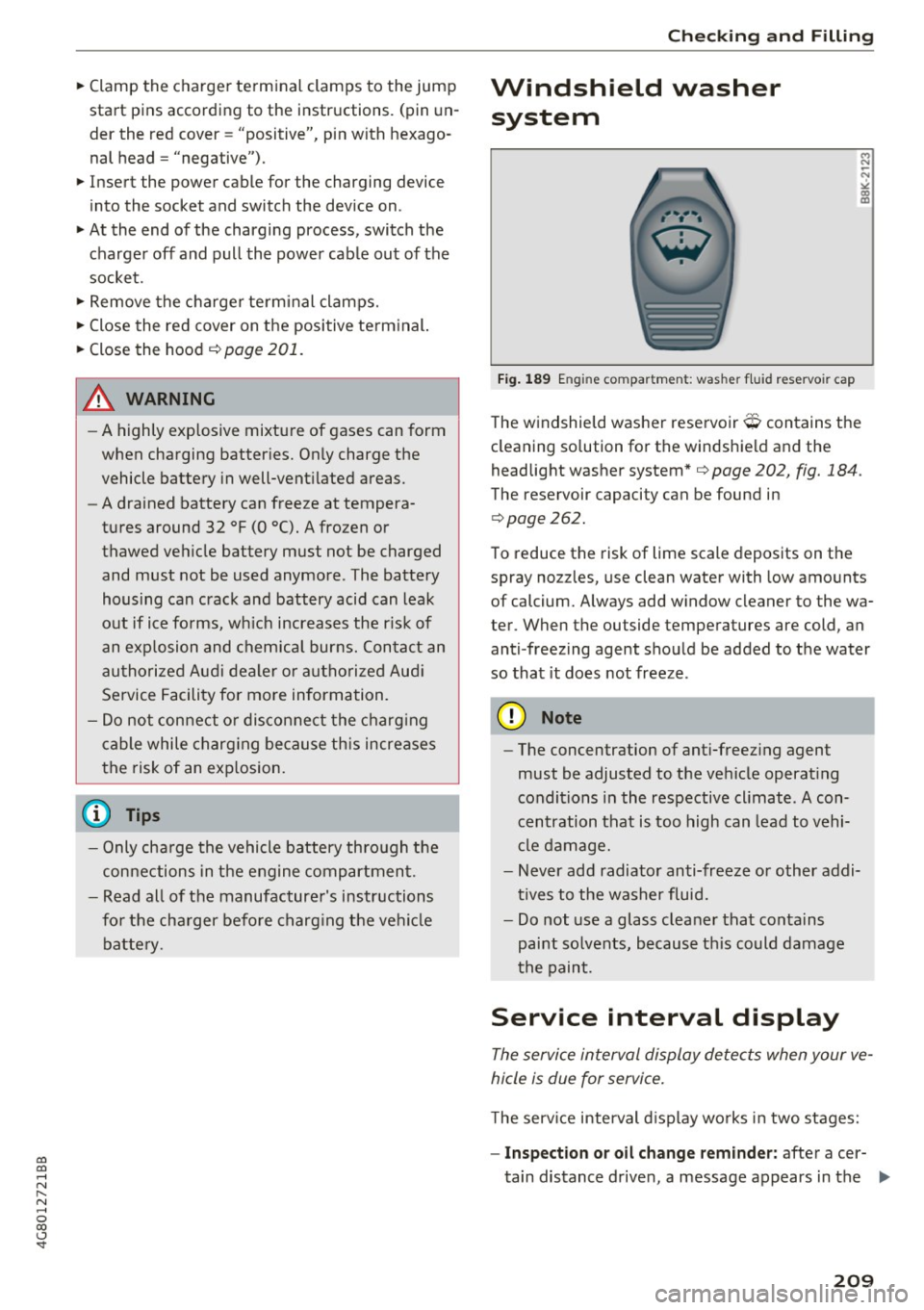
Fi g. 1 89 E ngine compar tmen t: washer f luid reservo ir cap
M N
-N ~
"' m
The windshield washer rese rvoir O contains the
cleaning so lution for the windshield and the
headlight washer system*
q page 202, fig. 184.
The reservoir capacity can be found in
¢page 262.
To reduce the risk of lime scale depos its on the
spray nozzles, use clean water with low amo unts
of calcium. Always add w indow cleaner to the wa
ter. When the outside temperatures are cold, an
anti-freezing agent shou ld be added to th e water
so that it does not freeze .
(!) Note
-The concentration of ant i-freez ing agent
must be adjusted to the vehicle operat ing
conditions in the respective climate . A con
centration that is too high can lead to vehi
cle damage.
- Never add radiator anti-freeze or other addi
tives to the washer fluid.
- Do not use a glass cleaner that contains
paint so lvents, because th is could damage
the paint.
Service interval display
The service in terval display detects when your ve
hicle is due for service.
T he serv ice inte rval d isplay wo rks in two stages:
-Inspect ion or oil change rem inder: after a cer-
tain distance driven, a message appears in the ..,.
209