roof AUDI A8 2018 User Guide
[x] Cancel search | Manufacturer: AUDI, Model Year: 2018, Model line: A8, Model: AUDI A8 2018Pages: 356, PDF Size: 54.71 MB
Page 216 of 356
Drivin g saf ety
A WARNING
Improperly stored luggage or other items can
fly through the vehicle causing serious per sonal injury in the event of hard braking or an
accident. To help reduce the risk of serious
personal injury:
- Always put objects, for example, luggage or other heavy items in the luggage compart
ment.
- Always secure objects in the luggage com
partment using the tie-down hooks and
suitable straps .
A WARNING
Heavy loads will influence the way your vehi
cle handles. To help reduce the r isk of a loss
of control leading to serious pe rsonal injury:
- Always keep in mind when transporting heavy objects, that a change in the center of
grav ity can also cause changes in vehicle
hand ling:
- Always distribute the load as even ly as
possible.
- Place heavy objects as far forward in the
luggage compartment as poss ible.
- Never exceed the Gross Axle Weight Rating
o r the Gross Vehicle Weight Rating specified
on the safety compliance sticker on the left
doo r jamb. Exceed ing permissible weight
standards can cause the vehicle to slide and
hand le differently .
- Please observe information on safe driving
c> page 208.
A WARNING
To help prevent poisonous exhaust gas from
being d rawn into the vehicle, always keep the
rear lid closed whi le driving.
- Never transport objec ts larger than those
fi tt ing complete ly into the luggage a rea be
ca use the rear l id cannot be fully closed.
- If you absolutely mus t drive w ith the rea r lid
open, obse rve the follow ing notes to reduce
t h e risk of poisoning:
- Close all windows,
- Close the power roof,
214
-
- Open all a ir outlets in the instrument pan
el,
- Switch off the air reci rculat ion
'
- Set the fresh air fan to the highest speed .
A WARNING -
Always make su re that the doo rs, all win
dows, the powe r roof and the rear lid are se
curely closed and locked to re duce the risk of
in jury when the veh icle is not being used.
- After closing the rear lid, always ma ke sure
that it is properly closed and locked.
- Never leave your veh icle unattended espe
cially with the rear lid left open . A child
could crawl into the vehicle through the lug
gage compartment and close the rea r lid be
coming trapped and unab le to get o ut. Be
ing trapped in a vehicle can lead to ser ious
pe rsonal injury.
- Never let ch ildren play in o r around the vehi
cle.
- Never let passengers ride in the luggage
compa rtment . Vehicle occupants mus t al
ways be properly restrained in one of the ve hicle's seat ing pos itions.
(D Tips
- Air circulation helps to reduce w indow fog
ging . Stale ai r esca pes to the outs ide
through vents in the trim panel, on the left
side of the luggage compartment. Be sure
to keep t hese s lo ts free and open.
- T he tire p ressure must correspond to the
load. The t ire pressure is shown on t he tire
press ure label. The ti re pre ssure label is lo
c ated on the drive r's side B- pilla r. The tire
pressu re label lists the recommen ded cold
t ire inflation pressures fo r the veh icle at its
maximum capac ity we ight and the tires that
we re on your veh icle at the time it was man
ufactured . For recommended t ire pressures
for normal load conditions, p lease see chap
ter
c> page 294.
Page 219 of 356
Audi pre sense Preventative passenger
protection
Applies to: ve hicles with Audi pre sense
Pre sense can initiate steps to protect vehicle oc
cupants in certain dangerous situations. The
functions descr ibed are available depending on
veh icle equ ipment:
Audi pre sense ba sic
The fo llowing functions can be triggered in cer
tain driving situat ions:
- Tightening of the safety belts (for examp le,
during heavy braking) : the front safety belts
have reversible belt tensioners. If a collision
does not occur, the safety belts loosen slightly
and are ready to trigger again.
- Closing the w indows and the sunroof*
The function of the pre sense basic is activated at
a speed of 20 mph (30 km/h) or hig her . The de
p loyment time is adapted in the drive select dy
namic mode .
Audi pre se ns e front ( vehicl es with adapti ve
cruise contr ol* }
Pre sense front contains the f unctions of pre
sense basic. In add ition, the likelihood of a rear
end collis ion with the vehicle ahead is also calcu
lated, within the limits of the system . If the risk
of a collision is detected, t he following functions
can t rigger:
- Audi braking guard
¢page 100
-Tensioning of the safety belts
- Closing the windows and the sunroof *
Audi pre sense rear (vehicles with side
a ss is t*)
Pre sense rear contains t he functions of pre sense
basic. In addition, the like lihood of a rear-end
col lision from t he vehicle behind is a lso ca lculat
ed, w ith in the lim its of the system. If the risk of a
collis ion is detected, the following functions can
~ tr igger :
.... N
~ -Tensioning of the safety belts
g -Closing the windows and the sunroof *
:c '
-Adjusting the seats : the settings for the powe r
head restrains, the upper sections of the backr
ests and the pne umatic side bolsters* change
on the front seats and the outer rear seats*. If
a co llision does not occur, the seat sett ings
that were previously used are restored .
Audi pre sen se plus
Pre sense plus contains the f unctions of pre
sense front and pre sense rear .
Error messag e
Audi pre sens e: Unavailable
Preventative passenger protect ion is not ava ila
ble. Drive to an autho rized Aud i deale r or author
ized Audi Se rvice Facility immed iately to have the
malfunction corrected.
& WARNING
--
Pr e sense cannot overcome natural p hys ica l
l aws .
It is a system designed to assist and it
cannot prevent a co llision. Do not let the in
creased safety provided tempt you into tak ing
risks. This could inc rease your r isk of a colli
sion.
- The system can dep loy incorrectly.
- Please note that t he sensors do not a lways
detect a ll objects. T his increases the r isk of
a co llision.
- Pre sense does not react to peop le or ani
mals or objects that are cross ing the vehi
cle's path or are difficu lt to detect
¢page 95.
- Reflective objects such as gua rd ra ils or the
entrance to a tunnel, heavy ra in and ice can
affect the funct io n of the radar sensors and
the system's ab ility to detect a collision risk.
@ Note
The sensors can be d isplaced by impacts or
damage to the bumper, wheel housi ng and
underbody. Pre sense can be impaired by this .
Have an autho rized Aud i deale r or au tho rized
A udi Se rvice Fac ility check the ir funct io n.
.,.
217
Page 232 of 356
Airbag syste m
-The inflating airbag will hit the child seat or
infant carrier w ith great force and will
smash the ch ild seat and c hild against the
backrest, center armrest , door or roof .
- Always install rear-facing child seats on the
rear seat.
- If you must install a rearward fac ing ch ild
seat on the front passenger seat because of exceptional c ircumstances and the
PA SSEN
GER AIR BAG OFF
light does not come on
and stay on, immediately insta ll the rear
facing child seat in a rea r seating position
and have the airbag system inspected by
yo ur Audi dealer.
- Forward-facing ch ild seats insta lled on the
front passenge r's sea t may in terfe re with
the deployment of the airbag and cause se
rious persona l injury to the child.
A WARNING
If, in exceptional circumstances, you must in
stall a forward-facing chi ld restraint on the
front passenger's seat :
- Always make sure the forward -facing seat
has been designed and cert ified by its man
ufact urer for use on a front seat with a pas
senger front and side a irbag.
- Never put the forward-facing child restraint up against or very near the instrument pan
el.
- Always move the front passenger seat to the h ighest position in the up and down ad
justment range and move it back to the
rearmost position in the seat's fore and aft
adjustment range, as fa r away from the air
bag as possib le, before insta lling the for
ward-facing child res trai nt.
- Always make sure that the safety belt upper
anchorage is beh ind the child restraint and
not next to or in front o f the child restrain t
so tha t the safety belt will be properly pos i
tioned.
- Make s ure tha t the
PASSENGER AIR BAG
OFF
light comes on and stays on all the time
whenever the ignition is switched on.
230
A WARNING
To reduce the risk of serious injury, make sure
that the
PASSENGER AIR BAG OFF light will
be d isplayed whenever a ch ild restraint is in
stalled on the front passenge r seat and the
ignit ion is switched on.
- If the
PASSENGER AIR BAG OFF light does
not stay on, perform the checks desc ribed
~ page 23 7, Monitoring the Advan ced Air
bag System.
- Take the child restra int off the front passen
ge r seat an d install it prope rly at one of the
rear sea t positions if the
PASSENGER AIR
BAG OFF
light does not stay on .
- Have the ai rb ag system inspec ted by your
Aud i dea ler immediately.
- Always carefully follow ins truc tions from
child restrain t manufacture rs when instal
ling child restra ints .
A WARNING
If, in exceptional ci rcumstances, you must in
stall a forward or rearward-fac ing child re
stra int on the front passenger's seat:
- Improper installat ion of child restraints can
reduce the ir effectiveness or even prevent
them from provid ing any protect ion.
- An improperly installed child restra int can
inter fere with the airbag as it deploys and
serious ly injure or even kill the child - even
w ith an Advanced A irbag System.
- Always carefully follow the manufacturer's instructions provided with the child seat or
car rier.
- Never p lace add itiona l items on the seat
that can increase the tota l weight registered
by the weight -sensing mat and can cause in
jury in a crash.
Page 235 of 356
u. co .... N
" N .... 0 0 :c '
a l Standard requires the airbag to meet the "low
risk" deployment criteria to help reduce the risk
of injury through interaction with the airbag.
"Low risk" dep loyment occurs in those crashes
that take place at lower decelerations as defined in the electronic control unit
r;:;. page 23 7.
Al way s remember: Even though your vehicle is
equ ipped w ith Advanced A irbags, the s afest p lace
for children is properly restrained on the back
seat . Please be sure to read the important infor
mat io n in the sect ions that follow and be su re to
h eed a ll of the WARN INGS.
A WARNING
T o red uce the r isk of injury when an airbag in
flates, a lways wear safety be lts properly .
- If you are unrest rained, lean ing fo rwa rd, s it
t ing s idew ays or o ut of pos it ion in any way,
yo ur risk of in jury is much higher .
- Yo u will also receive se rious injur ies a nd
cou ld even be killed if you are up aga inst the
airbag or too close to it when it inflates
-
even with an Advanced Airbag I!!> page 22 7.
A WARNING
A child in a rearward-facing chi ld seat insta l
led on the front passenger seat will be ser i
ously injured and can be k illed if the front air
bag inflates - even with an Advanced Airbag
System .
- Although the Advanced A irbag System in
yo ur vehicle is designed to turn off t he front
airbag when a rearward-facing ch ild re
straint has been insta lled on the front pas
senger seat, nobody can abso lutely g uara n
tee that deployment is impossible in a ll con
c e ivable s ituat ions that may happen dur ing
the usefu l life o f yo ur vehicle .
- T he inf lat ing air bag w ill hit th e chi ld sea t or
infant carrier w it h great fo rce and will
smash the c hild seat and child against the
backrest , center a rmrest, door, or roof.
- Always install rearward -fac ing c hild re
straints on the rear seat .
- If you must install a rearwar d fac ing c hild
seat on the front passenger seat because of
Airbag syste m
except io n al circumstances and the PASSEN
GER AIR BAG OFF
li ght does not come on
and stay on, immed iate ly install the rea r
faci ng chi ld seat in a rear seating pos it io n
a nd have the airbag system inspected by
your Aud i dea le r.
A WARNING
-
If, in exceptional c ircu mstances, you must in
stall a forward-fa cing child rest ra in t on the
fron t passenger's seat:
- Always make su re the forward-facing seat
has bee n des igned and certified by its man
uf acture r for use o n a front sea t with a pas
senge r front and side airbag.
- N eve r put the fo rw ar d-faci ng chi ld restra in t
up ag ainst o r very ne ar th e i nstr ument pan
el.
- Always move the fro nt passenge r seat to
the hig hest posit io n in the up and down ad
justment range and move it bac k to the
rearmost positio n in the seat's fo re and aft
ad justment range, as far away from the a ir
bag as poss ible, before install ing the for
ward-facing ch ild restraint .
- Always make sure that the safety be lt upper
anchorage is behind the c hild restraint and
not next to o r in front of the ch ild restraint
so that the safety be lt will be p roperly posi
tioned .
- Make sure that t he
PASSENGER AIR BAG
OFF
l ight comes on and stays on a ll the time
wheneve r th e ignit ion is switched o n.
Advanced Airbag System components
The front passenge r seat in your ve hicle has a lo t
of ve ry important parts of t he Advanced A irb ag
System in it. These parts incl ude the weight
sensing mat, sensors, wiring, brackets, and
more . The f unction of th e system in the front
passenger seat is checked by the electronic con
trol unit when the ign ition is on. The control unit
moni tors the Advanced Airbag System and turns
the a irbag ind icator light on when a malfunction
i n the system compone nts is detected . The func
t ion of the a irbag ind icator light is described in
greate r deta il be low. Because t he front
233
Page 238 of 356
Airbag syste m
Because airbags inflate in the blink of an eye with
great force, things you have on your lap or have
p laced on the seat cou ld become dangerous pro
jectiles, and be pushed into you if the airbag in
flates .
When an airbag deploys, fine dust is re leased.
This is normal and is not caused by a fire in the
veh icle. Th is dust is made up mostly of a powder
used to lubricate the airbags as they deploy. It
could irr itate sk in .
It is important to remember that while the sup
p lemental a irbag system is designed to reduce
the likelihood of serious injuries, other injuries,
for example swelling, bruising and m inor abra
sions, can also happen when airbags inflate . A ir
bags do not protect the arms or the lower parts
of the body. Front a irbags supplement the th ree
point safety belts only in some fronta l co llisions
in which the veh icle decelerat ion is high enough
to deploy the airbags.
Front airbags will not deploy:
- i f the ign it ion is switched off when a crash oc-
c ur s,
- i n s ide collisions,
- in rear -end collisions,
- in rollovers,
- when the crash deceleration measured by the
airbag system is less than the minimum thresh
o ld needed for airbag deployment as registered
by the electronic control unit .
The front passenger airbag als o will not
deplo y:
- when the front passenger seat is not occupied,
- when the weight on the front passenger seat as
sensed by the Advanced A irbag System indi
cates that the front airbag on the passenger
s ide has to be turned off by the electronic con
trol unit (the
P A SSENGER AIR BAG OFF light
comes on and stays on).
_& WARNING
Sitting in the wrong pos ition can increase the
r is k of serious in jury in c rashes.
- To reduce the risk of inju ry when the airbags
inflate, the d river an d passengers must
al-
236
ways sit in an upright posit ion, must not
lean aga inst or place any part of their body
too close to the area where the airbags are
located.
- Occupants who are unbe lted, out of posit ion
or too close to the airbag can be serious ly
in jured by an airbag as it unfolds with g reat
force in the blink of an eye
~ page 228.
_& WARNING
A child in a rearward-facing child seat instal led on the front passenger seat will be seri
ously injured and can be killed if the front air
bag inflates
-even with an Advanced Airbag
System.
- The infla ting air bag will h it the ch ild seat o r
infan t ca rrier wi th great force and wi ll
smash the child seat and child against the
backrest, center armrest, door or roof .
- Always install rear -fac ing ch ild seats on the
rear seat.
- If you must install a rea rw ar d facing child
seat on the front passenger seat because o f
except ional circumstances and the
PASSEN·
GER AIR BAG OFF
light does not come on
and stay on, immed iate ly install the rear
facing chi ld seat in a rear seating posit ion
and have the airbag system inspected by
your Aud i dea le r.
_& WARNING
Objects between you and the airbag will in
crease the r is k of injury in a c rash by interfe r
ing wi th the way the airbag unfolds or by be
ing p ushed into you as the air bag infla tes.
- Never hold things in you r hands o r on your
lap when the veh icle is in use.
- Never transport items on or in the a rea of
the front passenge r seat. Objects could
move into the area of the front airbags dur
ing b raking or other s udden maneuvers and
become dangerous projectiles that can
cause serious persona l injury if the airbags
inflate.
- Never p lace or attach accessories or othe r
objects (such as cup holders, telephone brackets, large, heavy or bulky ob jects) on -
Page 248 of 356
Airb ag syste m
by being pushed into you as the airbag in
flates.
- Never p lace or attach accessories or other
objects (such as cup holders, telephone brackets, or even Large, bulky objects) on
the doors, over or near the area marked
"AIRBAG" on the seat backrests.
- Such objects and accessories can become
dangerous projectiles and cause injury
when the supplemental side airbag de ploys.
- Never carry any objects or pets in the de ployment space between them and the
airbags or allow children or other passen
gers to travel in this position.
- Always use the built-in coat hooks only for
Lightweight clothing. Never leave any heavy
or sharp-edged objects in the pockets that
may interfere w ith side airbag deployment
and can cause personal injury in an accident.
- Always prevent the side airbags from being
damaged by heavy objects knocking against
or hitting the sides of the seatbacks.
- The airbag system can only be triggered
once. If the airbag has been triggered, the
system must be replaced by an author ized
Audi dealership .
- Damage (cracks, deep scratches etc.) to the
original seat covers or to the seam in the
area of the side a irbag mod ule m ust always
be repa ired immed iately by an authorized
Audi dealer .
- If children are seated imp roperly, their risk
of injury increases in the case of an acc ident
¢ page 249, Child safety.
- Never attempt to modify any components of
the a irbag system in any way.
- In a side collision, side a irbags w il l not func
t ion properly if sensors cannot correctly
measure increasing air pressure ins ide the
doors when air escapes through larger, un
closed openings in the door panel.
- Never drive with inter ior door tr im panels
removed .
- Never drive when parts have been re
moved from the inside door panel and the
open ings they leave have not been proper
ly closed.
2 4 6
- Never drive when loudspeakers in the
doors have been removed unless the
speaker holes have been properly closed.
- Always make certain that openings are
covered or filled if additional speakers or
other equipment is installed in the inside
door panels.
- Always have work on the doors done by an
authorized Aud i dea ler or qualified work
shop.
Side curtain airbags
Description of side curtain airbags
The side curtain airbag system can provide sup
plemental protection to properly restrained oc
cupants.
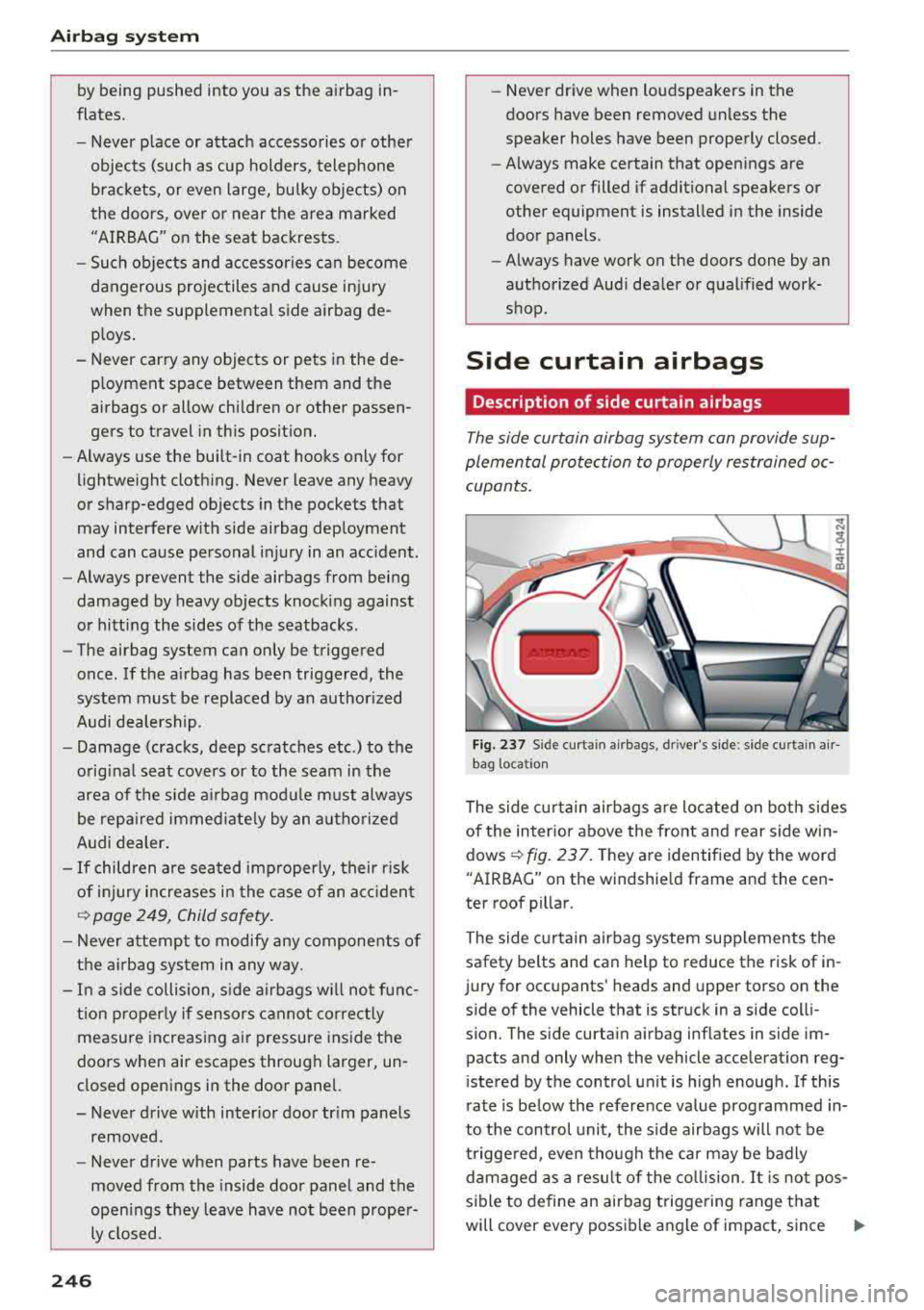
Fig. 237 S id e curt ain airbags, driver's sid e: side curtain air
bag location
The side curtain airbags are located on both sides
of the interior above the front and rear side win
dows¢
fig. 237. They are identified by the word
"AIRBAG" on the windshield frame and the cen
ter roof p illar .
The side curtain airbag system supplements the
safety belts and can help to reduce the risk of in
jury for occupants' heads and upper torso on the
s ide of the vehicle that is struck in a side colli
sion. The side curtain airbag inflates in side im
pacts and only when the vehicle acceleration reg
istered by the control unit is high enough. If this
rate is below the reference value programmed in
to the control unit, the side airbags will not be
triggered, even though the car may be badly damaged as a result of the collision .
It is not pos
sible to define an airbag triggering range that
will cover every possible angle of impact, since
..,.
Page 255 of 356
& WARNING
Not using a child safety seat, using the wrong
child safety seat or improperly installing a
child restra int increases the r isk of serious
personal injury and death.
- All vehicle occupants and especially children
must a lways be restrained properly whenev
er r iding in a vehicle.
- An unrest rained or imprope rly restrained
child can be injured or killed by being
thrown against the ins ide of the vehicle or
by being ejected from it during a s udden
maneuver or impact .
-An unrestrained or improperly restrained
child is at much greater risk of injury or
death by being struck by an inflating air bag.
-Commercially available child safety seats
are required to comply with U.S . Federa l
Motor Vehicle Safety Standard (FMVSS) 213
(in Canada CMVSS 213).
-When buying a ch ild rest raint, se lect one
that fits your child and the vehicle.
- Only use child restraint systems that fully
contact the flat portion of the seat cush ion. The child restrain t must no t tip or
lean to eithe r side. Audi does not recom
mend using child safety seats that rest on
legs or tube-like frames. They do not pro
vide adequate contact with the seat.
- Always heed a ll legal requirements per
taining to the installation and use of child
safety seats and carefully follow the in
structions provided by the manufacturer
of the seat you are using .
- Never allow ch ildren under 57 inches
(1.45 meters) to wear a normal safety belt.
They must always be restrained by a proper child restraint system . Otherwise, they
cou ld sustain injur ies to the abdomen and
neck a reas during sudden bra king maneu
vers or ac ciden ts.
-Never let mo re than one child occupy a child
safety seat.
~ -Never let babies or older chi ld ren ride in a
~ vehicle while sitting on the lap of ano ther ......
g p assenge r.
:c '
- Holding a child in your arms is never a sub
stitute for a chi ld restraint system.
- The strongest person cou ld not ho ld the
ch ild with the forces that exist in an acci
dent. The child will strike the interior of
the vehicle and can also be struck by the passenger .
- The child and the passenger can also in
jure each other in an accident .
- Never install rear-facing child safety seats
or infant carriers on the front passenger
seat . A child w ill be seriously injured and
can be killed when the passenger a irbag in
flates -even with an Advanced Airbag Sys
tem.
- The inflating airbag will h it the ch ild safety
seat o r infant ca rr ier with great force and
will sm ash the child safety seat and child
against the backrest, cente r arm res t, door
or roof .
-Always install rear-fac ing child safety seats
or infant carriers on the rear seat.
-Make sure the re is enough sp ace in front of
the child in the child seat . If ne cessary, ad
just the angle and position of the sea t in
front of the chi ld seat.
-Forward-fa cing child safety seats insta lled
on the front passenger's seat can interfere
with the airbag when it inflates and cause
serio us injury to the chi ld. Always install for
ward-facing ch ild safety seats on the rear
seat .
- If exceptional c ircumstances requ ire the use
of a fo rward-facing child restraint on the
front passenger's seat, the ch ild's safety
and well-being requ ire that the following
specia l precautions be taken:
- Make su re the forwa rd -facing seat has
been designed and certified by its manu
facturer for use on a front seat with a pas
senger front and side airbag.
-Always carefully follow the man ufacturer's
instruct ions prov ided with the ch ild safety
seat or carrier.
- Always move the front passenger seat to
the h ighest position in the up and down
adjustment range and move it back to the
rearmost position in the seat's fore and
~
253
Page 257 of 356
Child safety seats
Infant seats
Babies and infants up to about one year old and
20 lbs. or 9 kg need special rearward -facing
child restraints that support the back, neck and
head in a crash .
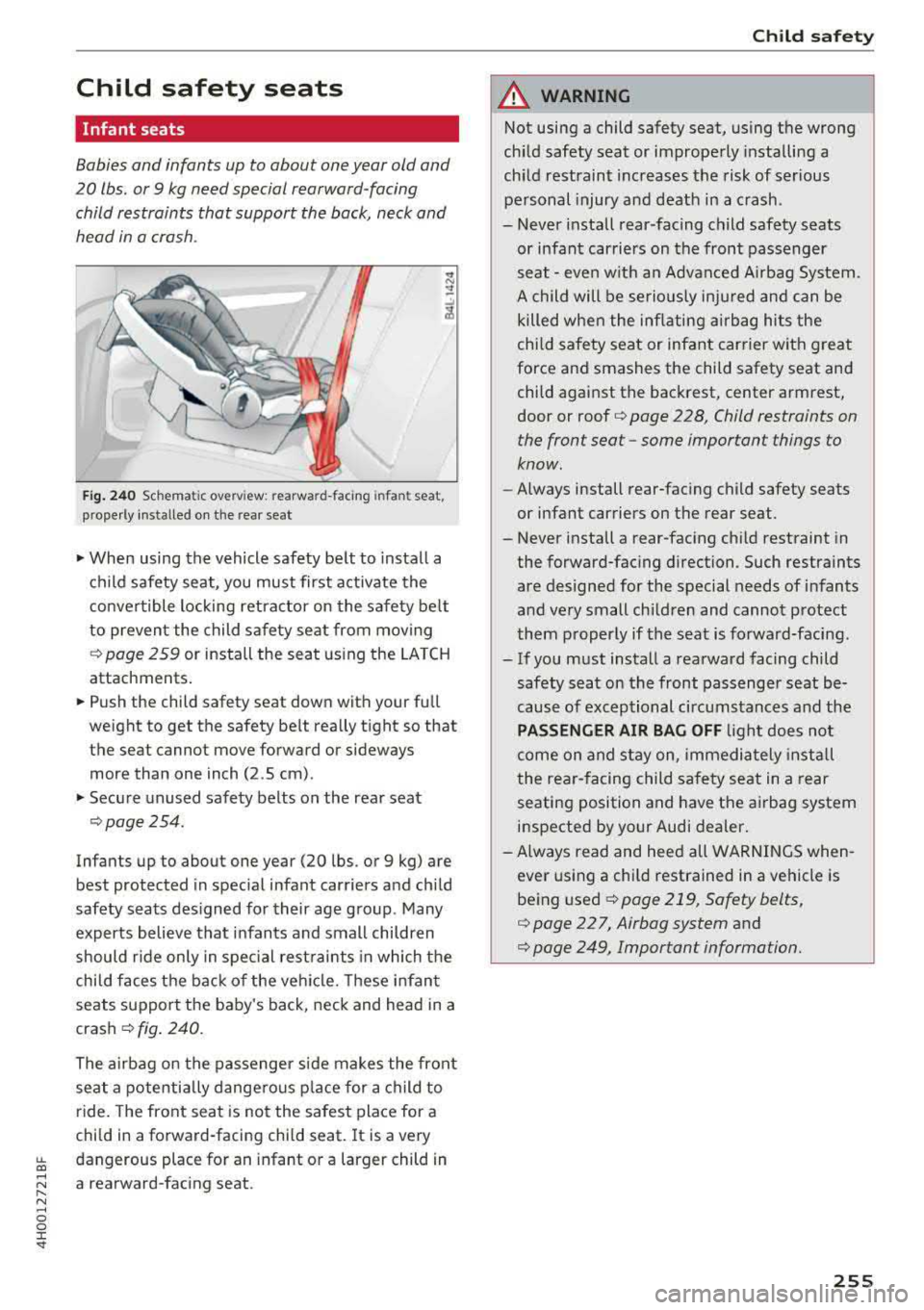
Fig. 2 4 0 Sche matic overview: rearward-facing infant seat,
properly installed on the rear seat
• When using the vehicle safety be lt to install a
child safety seat, you must first activate the
convertible locking retractor on the safety be lt
to prevent the child safety seat from moving
¢ page 259 or install the seat using the LA TCH
attachments.
• Push the child safety seat down with your full
weight to get the safety belt really tight so that
the seat cannot move forward or sideways
more than one inch (2.5 cm).
• Secure unused safety belts on the rear seat
¢page 254 .
Infants up to about one year (20 lbs. or 9 kg) are
best protected in spec ial infant carriers and child
safety seats des igned for their age group . Many
experts believe that infants and small children
should ride only in spec ial restraints in which the
chi ld faces the back of the veh icle. These infant
seats support the baby 's back, neck and head in a
crash
c!;> fig . 240.
The airbag on the passenger side makes the front
seat a potentially dangero us p lace for a child to
ride. The front seat is not the safest place for a
chi ld in a forward -facing child seat . It is a very
lL dangerous place for an infant or a larger child in t:0
;:::: a rearward-facing seat.
" N ...... 0 0 :c '
A WARNING
Not using a child safety seat, using the wrong
child safety seat or improperly installing a
child restraint increases the risk of ser ious
personal injury and death in a c rash .
-Never install rear-facing child safety seats
or infant car riers on the front passenger
seat
-even w ith an Advanced A irbag System .
A child will be serio usly inj ured and can be
killed when the inf lating airbag hits the
chi ld safety seat or infant carrier with great
force and smashes the child safety seat and
child against the backrest, center armrest,
door or roof
c!;> page 228, Child restraints on
the front seat
-some important things to
know.
- Always install rear-fac ing child safety seats
or infant carriers on the rear seat.
-Never install a rear-facing child restraint in
the forward-fac ing direction . Such restraints
are designed for the special needs of infants
and very small children and cannot protect
them p roperly if the seat is forward-facing .
-If you must install a rearward facing child
safety seat on the front passenger seat be
cause of exceptional circumstances a nd the
PASSENGER AIR BAG OFF li ght does not
come on and stay on, immedia tely install
the rea r-facing child sa fety seat in a rear
seating position and have the a irbag system
inspected by your Audi dealer .
-A lways read and heed all WARNINGS whe n
ever using a child restrained in a vehicle is
be ing used
c!;> page 219, Safety belts,
c!;> page 227, Airbag system and
c!;> page 249, Important information.
255
Page 258 of 356
Child safety
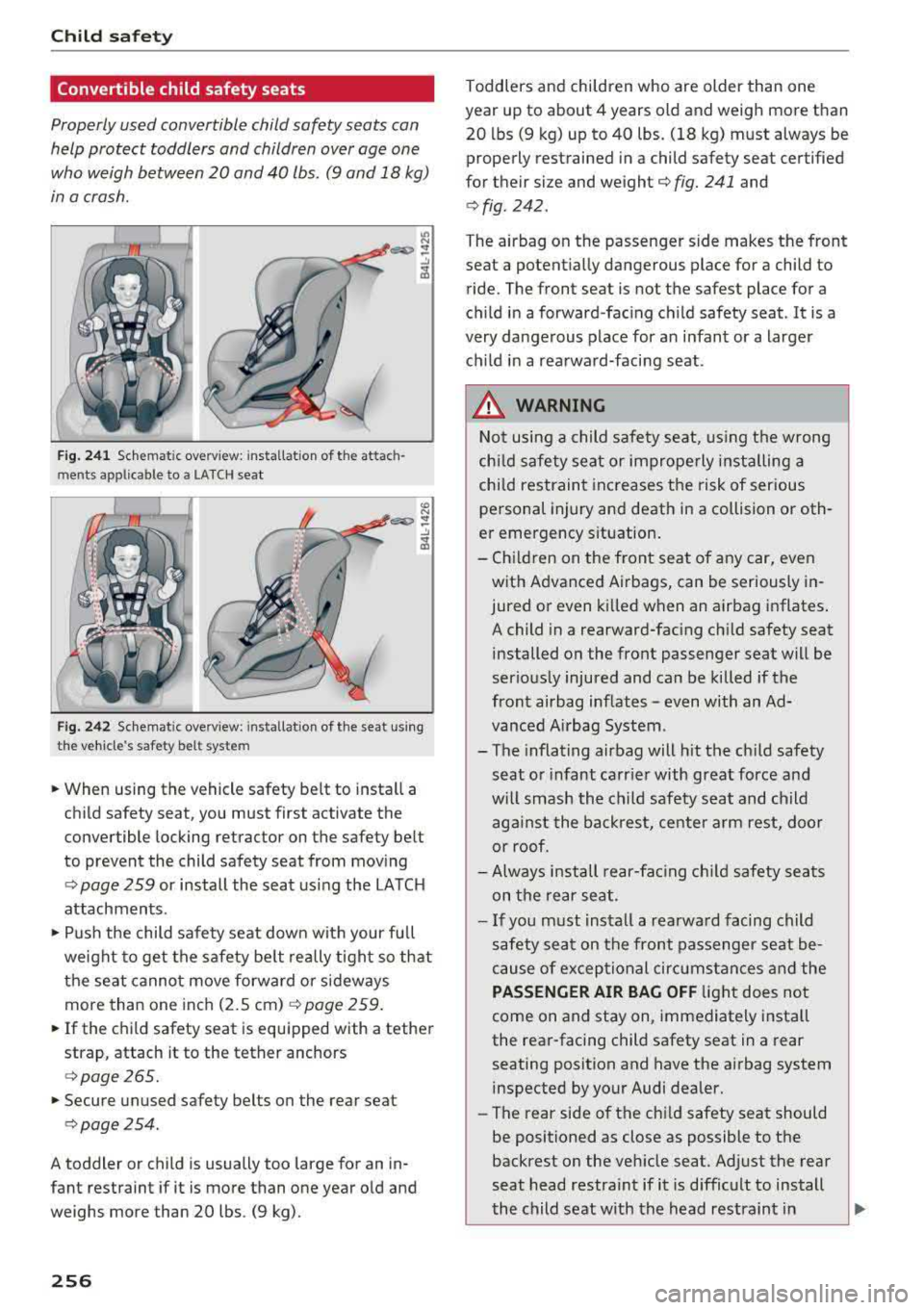
Convertible child safety seats
Properly used convertible child safety seats can
help protect toddlers and children over age one
who weigh between 20 and 40 lbs. (9 and 18 kg)
in a crash.
Fig. 241 Schematic overview: installat ion of the attach
ments app licable to
a LATCH seat
Fig. 242 Schematic overview: installat ion of the seat using
the vehicle 's safety belt system
... When using the vehicle safety belt to install a
child safety seat, you must first activate the
convertible locking retractor on the safety belt
to prevent the child safety seat from moving
c:>page 259 or install the seat using the LATCH
attachments .
... Push the child safety seat down with your full
weight to get the safety belt really tight so that
the seat cannot move forward or sideways more than one inch (2.5 cm)
c:>page 259.
... If the child safety seat is equipped with a tether
strap, attach it to the tether anchors
r::>page 265.
... Secure unused safety belts on the rear seat
r::>page254 .
A toddler or child is usually too large for an in
fant restraint if it is more than one year old and
weighs more than 20 lbs. (9 kg).
256
Toddlers and children who are older than one
year up to about 4 years old and weigh more than
20 lbs (9 kg) up to 40 lbs. (18 kg) must always be
properly restrained in a child safety seat certified
for their size and weight
c> fig. 241 and
c:>fig. 242 .
The airbag on the passenger side makes the front
seat a potentially dangerous place for a child to
ride. The front seat is not the safest place for a
child in a forward-facing child safety seat . It is a
very dangerous place for an infant or a larger
child in a rearward-facing seat .
.&_ WARNING
Not using a child safety seat, using the wrong
child safety seat or improperly installing a
child restraint increases the risk of serious
personal injury and death in a collision or oth
er emergency situation.
-Children on the front seat of any car, even
with Advanced Airbags, can be seriously in
jured or even killed when an airbag inflates. A child in a rearward-facing child safety seat
installed on the front passenger seat will be
seriously injured and can be killed if the
front airbag inflates -even with an Ad
vanced Airbag System .
-The inflating airbag will hit the child safety
seat or infant carrier with great force and
will smash the child safety seat and child
against the backrest, center arm rest, door
or roof.
-Always install rear-facing child safety seats
on the rear seat.
-If you must install a rearward facing child
safety seat on the front passenger seat be
cause of exceptional circumstances and the
PASSENGER AIR BAG OFF light does not
come on and stay on, immediately install
the rear-facing child safety seat in a rear seating position and have the airbag system
inspected by your Audi dealer .
- The rear side of the child safety seat should
be positioned as close as possible to the
backrest on the vehicle seat. Adjust the rear
seat head restraint if it is difficult to install
the child seat with the head restraint in
II>-
Page 261 of 356
any way during an accident can be struck by
a deploying air bag. This will result in ser ious
persona l injury or deat h.
- If you mus t install a boos ter seat on the
front passenger seat because of exceptional
c ircumstances the
PASSENGER AIR BAG
OFF
light must com e on and stay on, wh en
e v er th e ignition is switch ed o n.
- If the
PA SSEN GER AIR BAG OFF light does
not com e on and stay on, perform t he
c hecks d escribed
¢ page 237, Monitoring
t he A dvanced Airbag Syste m.
-Take the ch ild restraint off the front passen
ger seat and install it p roperly at one of the
rea r seat positions if the
PASSENGER AIR
BAG OFF
l ight does not stay on whenever
the ignition is switched on.
- Always read and heed all WARN INGS when
ever using a child res trained in a veh icle is
being used ¢
page 219, Safety belts,
¢ page 22 7, Airbag system and
¢ page 249, Important information.
Securing child safety
seats
Securing a child safety seat using a safety
belt
Safety belts for the rear seats and the front pas
senger can be locked with the convertible locking
retractor to properly secure child safety seats.
The safe ty be lts eme rgency locking ret racto rs fo r
the rear seats safety belts and for the front pas
senger's seat safety belt have a convertib le lock
ing retractor for child restraints. The safety belt
must be locked so that belt webbing cannot un
reel. The retractor can be activated to lock the
safety belt and prevent the safety belt webbing
from loose ning up du ring normal driving . A child
safety seat can only be p roperly installed w hen
the safety belt is locked so that the child and
chi ld safety seat w ill stay in pla ce.
A lways remember: Even though yo ur vehicle is
~ equ ipped w it h an Advanced A irbag system, all
~ chi ld ren, espe cially those 12 years and younge r,
g should always r ide in t he back se at prope rly re -
~ stra ined fo r their age and size .
Child s af ety
_& WARNING
= -
Imp roperly installed child safety seats in-
crease the risk of serious personal injury and
death in a co llision .
- Always make sure that the safety be lt re
tractor is locked when installing a child
safety seat. An un locked safety belt retrac
tor cannot hold t he ch ild safety seat in p lace
du ring normal driving or in a crash.
- Always buckle the child safety seat fi rm ly in
p lace even if a ch ild is not si tting in it. A
loose child safety seat can fly a round dur ing
a sudden s top or in a co llision .
- Always make sure that the rear seat back
rest to which the center rear safety belt is
at tached is securely lat ched whenever the
rear center safety belt is bein g used to se
cure a child restra int .
- If the backrest is not securely latched, the
child and the ch ild restraint will be thrown
forward togethe r with the backrest and w ill
strike parts of the veh icle inter io r. The child
can be seriously injured or killed.
- Never install rear-facing child safety seats or infant car riers on the front passenger
seat . A child w ill be seriously injured and
can be killed when the passenger a irbag in
flates .
- The inflating airbag will h it the ch ild safety
seat o r infant carr ier with great force and
will smash the child safety seat and child
aga inst the backrest, cente r arm res t, door
o r roof.
- Always install rear-fac ing child safety seats
or infant c arriers on t he rear se at.
- Forward-facing child safety seats o r infant
car riers installed on the front passenger's
se at m ay interfere w ith the deployment of
the airbag and ca use serio us in jury to the
child.
- I t is sa fer to install a forw ard- facing child
safety sea t on the rear seat.
- Always read and hee d all WARNINGS when
eve r using a child restrained in a vehicle is
be ing used ¢
page 249 . Special p recautions
apply when install ing a child safety seat on
the front passenger seat ¢
page 228, Child ~
259