ignition AUDI A8 2018 Workshop Manual
[x] Cancel search | Manufacturer: AUDI, Model Year: 2018, Model line: A8, Model: AUDI A8 2018Pages: 356, PDF Size: 54.71 MB
Page 254 of 356
Child safety
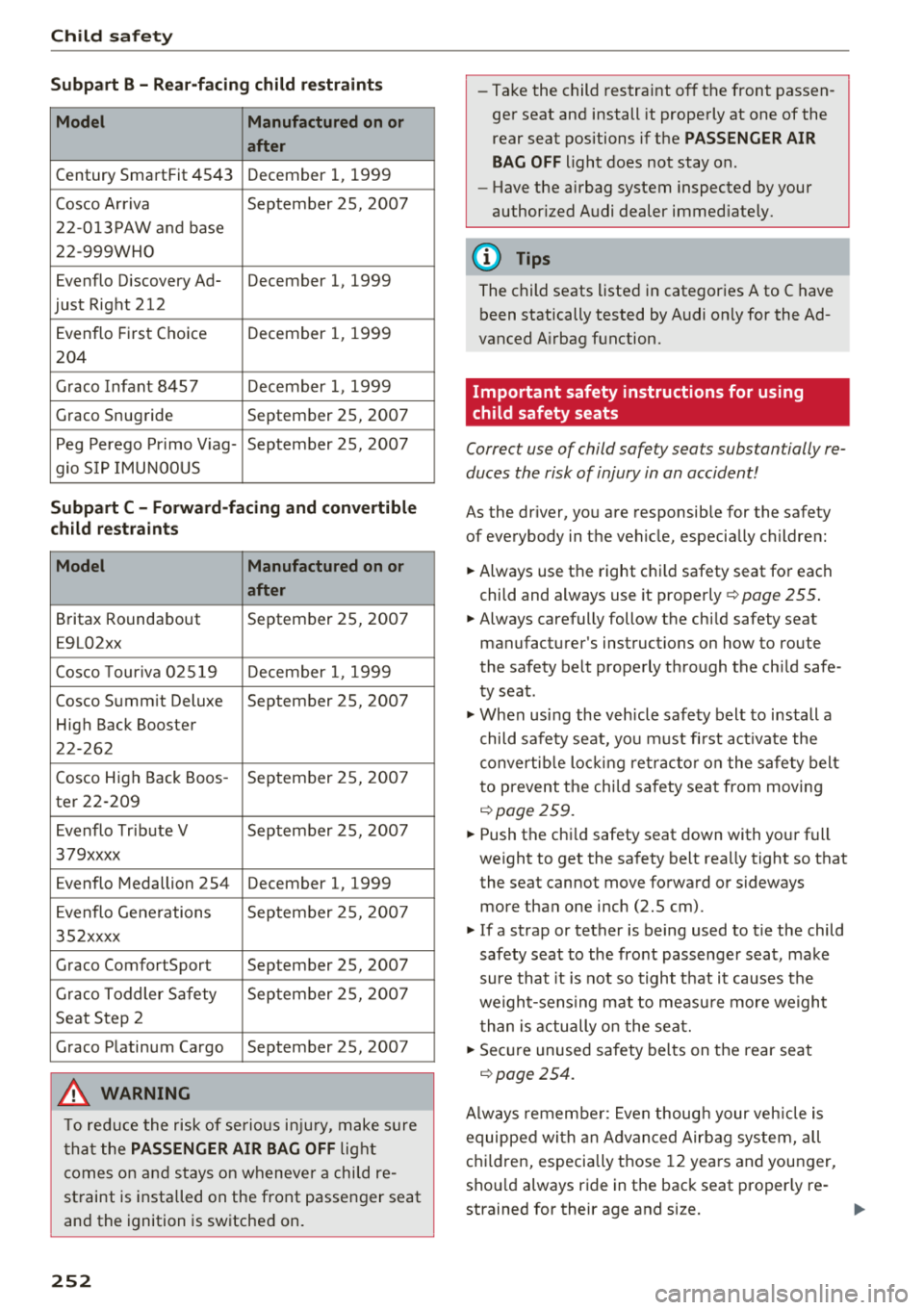
Subpart B - Rear-facing child restraints
Model Manufactured on or
after
Century SmartFit 4543 December 1, 1999
Cosco Arriva September 2S, 2007
22-013PAW and base
22-999WHO
Evenflo Discovery Ad- December 1, 1999
just Right 212
Evenflo First Choice December 1, 1999
204
Graco Infant 84S7 December 1 , 1999
Graco Snug ride September 25, 2007
Peg Perego Primo Viag- September 2S, 2007
gio S IP IMUN00US
Subpart C -Forward -facing and convertible
child restraints
Model Manufactured on or
after
Britax Roundabout September 2S, 2007
E9L02xx
Cosco Tour iva 02S19 December 1, 1999
Cosco Summ it Deluxe September 25, 2007
High Back Booster
22-262
Cosco High Back Boos-
September 25, 2007
ter 22-209
Evenflo Tribute V September 25, 2007
379xxxx
Evenflo Medallion 254 December 1, 1999
E venflo Generations September 25, 2007
352xxxx
Graco ComfortSport September 25, 2007
Graco Toddler Safety September 25, 2007
Seat Step 2
Graco Platinum Cargo September 25, 2007
A WARNING
To reduce the risk of serious injur y, make sur e
that the
PASSENGER AIR BAG OFF l ig ht
co mes on and stays on whenever a chi ld re
straint is installed on the front passenger seat
and the ignition is switched on.
252
-Take the child restraint off the front passen
ger seat and install it properly at one of the
rear seat positions if the
PASSENGER AIR
BAG OFF
light does not stay on.
- Have the airbag system inspected by your
author ized Audi dealer immed iately.
(D Tips
The child seats listed in categories A to C have
been statically tested by Audi only for the Ad
vanced Airbag function.
Important safety instructions for using
child safety seats
Correct use of child safety seats substantially re
duces the risk of injury in an accident!
As the dr iver, you are responsible for the safety
of everybody in the vehicle, especia lly children:
.,. Always use the right child safety seat for each
child and always use it properly
q page 255 .
.,. Always carefully follow the chi ld safety seat
manufacturer's instructions on how to route
the safety belt properly through the ch ild safe
ty seat .
.,. When using the vehicle safety belt to install a
child safety seat, you must first activate the
convertible locking retractor on the safety belt
to prevent the chi ld safety seat from moving
qpage 259.
.,. Push the chi ld safety seat down with your full
weight to get the safety belt really tight so that
the seat cannot move forward or sideways more than one inch (2.5 cm) .
.,. If a strap or tether is being used to tie the child
safety seat to the front passenger seat, make
sure that it is not so tight that it causes the
weigh t-sens ing mat to measure more weight
than is actually on the seat.
.,. Secure unused safety belts on the rear seat
,=;,page 254.
Always remembe r: Even though your vehicle is
equipped with an Advanced Airbag sys tem, all
children, especially those 12 years and younger,
shou ld always ride in the back seat proper ly re -
strained for their age and size.
.,,.
Page 256 of 356
Child safety
aft adjustment range, as far away from
the airbag as possible, before installing
the forward- facing child restraint.
- Always make sure that the safety belt up
per anchorage is behind the child restraint
and not next to or in front of the child re
straint so that the safety belt will be prop
erly positioned.
- Always make sure that nothing prevents
the front passenger's seat from be ing
moved to the rearmost position in its fore
and aft adjustment range.
- Always make sure that the backrest is in
the upright position.
-Always buckle the child safety seat firmly in
place even if a child is not sitting in it. A
loose child safety seat can fly around during
a sudden stop or in a collision.
-Always read and heed all WARNINGS when
ever using a child restrained in a vehicle is
being used
c::> page 219, Safety belts,
c::> page 22 7 , Airbag system and
c::> page 249, Child safety.
A WARNING
To reduce the risk of serious injury, make sure
that the
PASSENGER AIR BAG OFF light
comes on and stays on whenever a child re
straint is installed on the front passenger seat
and the ignition is switched on.
- Take the child restraint off the front passen
ger seat and install it properly at one of the
rear seat positions if the
PASSENGER AIR
BAG OFF
light does not stay on.
- Have the airbag system inspected by your
authorized Audi dealer immediately.
254
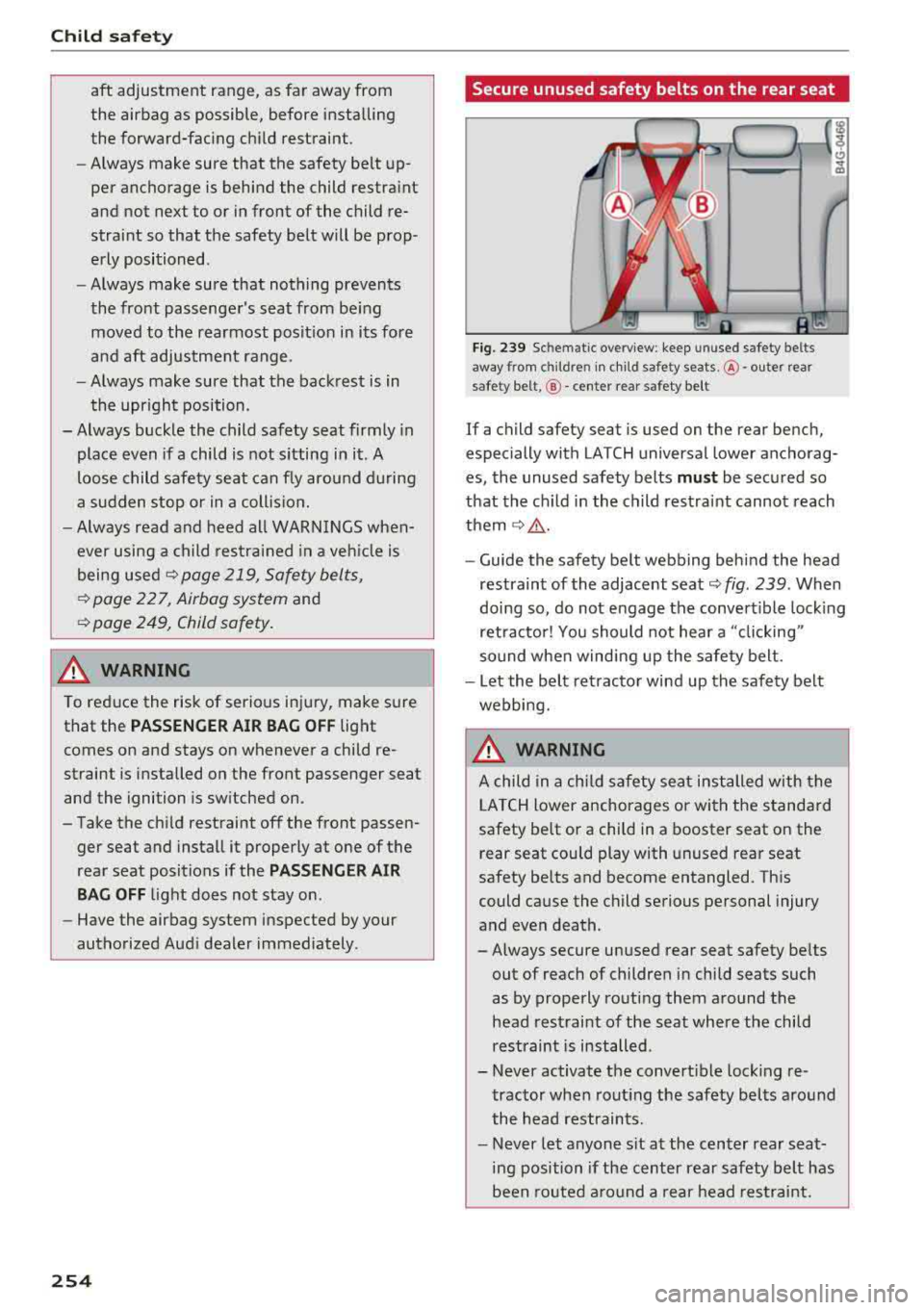
Secure unused safety belts on the rear seat
Fig. 239 Schematic overview: keep unused safety belts
away from children in child safety seats. @· ou ter rear
safety belt,® -center rear safety belt
If a ch ild safety seat is used on the rear bench,
especially with LATCH universal lower anchorag
es, the unused safety belts
must be secured so
that the child in the child restraint cannot reach
them
c::> .&. .
-Guide the safety belt webbing behind the head
restraint of the adjacent seat
c::> fig. 239 . When
doing so, do not engage the convertible locking
retractor! You should not hear a "clicking "
sound when winding up the safety belt.
- Let the belt retractor wind up the safety belt
webbing.
A WARNING
A child in a child safety seat installed with the
LATCH lower anchorages or with the standard
safety belt or a child in a booster seat on the
rear seat could play with unused rear seat
safety belts and become entangled. This
could cause the child serious personal injury
and even death.
-Always secure unused rear seat safety belts
out of reach of children in child seats such
as by properly routing them around the
head restraint of the seat where the child
restraint is installed .
- Never activate the convertible lock ing re
tractor when routing the safety belts around
the head restraints.
- Never let anyone sit at the center rear seat
ing position if the center rear safety belt has
been routed around a rear head restraint.
Page 259 of 356
lL t:0 ....
'"" " '"" .... 0 0 :c '
restraints that are not properly adjusted in
creases the risk of serious or fatal neck in
jury dramatically.
- Always read and heed all WARNINGS when
ever using a child restrained in a vehicle is
being used
c:> page 219, Safety belts,
¢ page 22 7, Airbag system and
¢ page 249, Important information.
A WARNING
If exceptional circumstances require the use
of a forward-facing child restraint on the
front passenger's seat, the child's safety and
well-being require that the following special
precautions be taken:
- Make sure the forward-facing seat has been
designed and certified by its manufacturer
for use on a front seat with a passenger
front and side airbag .
- Always follow the manufacturer's instruc
tions provided with the child safety seat or infant carrier.
- Always move the front passenger seat to
the highest position in the up and down ad
justment range and move it back to the
rearmost position in the seat's fore and aft
adjustment range, as far away from the air bag as possible, before installing the for
ward-facing child restraint.
-Always make sure that the safety belt upper anchorage is behind the child restraint and
not next to or in front of the child restraint
so that the safety belt will be properly posi
tioned.
- Always make sure that nothing prevents the
front passenger's seat from being moved to
the rearmost position in its fore and aft ad
justment range.
-Always make sure the backrest is in an up
right position.
- Make sure that the
PASSENGER AIR BAG
OFF
light comes on and stays on all the time
whenever the ignition is switched on.
- If the light does not stay on, perform the
checks
c:> page 2 3 7, Monitoring the Ad
vanced Airbag System.
Child safety
- Take the child restraint off the front passen
ger seat and install it properly at one of the
rear seat positions if the
PASSENGER AIR
BAG OFF
light does not stay on whenever
the ignition is switched on.
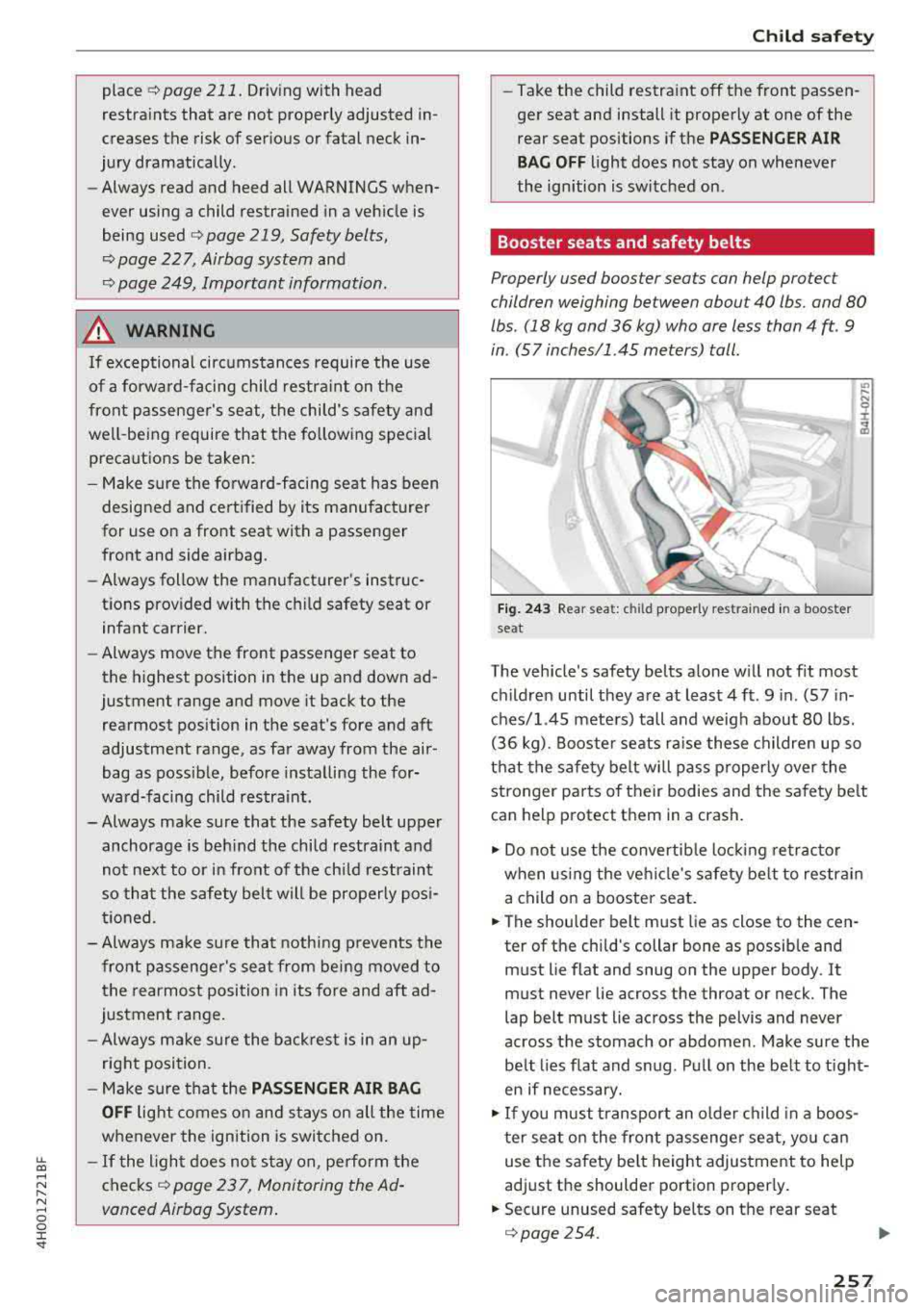
Booster seats and safety belts
Properly used booster seats can help protect
children weighing between about 40 lbs. and 80
lbs . (18 kg and 36 kg) who are less than 4
ft . 9
in . (57 inches/1 .45 meters) tall.
Fig. 243 Rear seat: c hild properly restrain ed in a boos ter
seat
The vehicle 's safety belts alone will not fit most
children until they are at least 4 ft . 9 in. (57 in
ches/1.45 meters) tall and weigh about 80 lbs.
(36 kg). Booster seats raise these children up so
that the safety belt will pass properly over the
stronger parts of their bodies and the safety belt
can help protect them in a crash.
" Do not use the convertible locking retractor
when using the vehicle's safety belt to restrain
a child on a booster seat.
"The shoulder belt must lie as close to the cen
ter of the child's collar bone as possible and
must lie flat and snug on the upper body. It
must never lie across the throat or neck. The
lap belt must lie across the pelvis and never
across the stomach or abdomen. Make sure the
belt lies flat and snug . Pull on the belt to tight
en if necessary.
"If you must transport an older child in a boos
ter seat on the front passenger seat, you can
use the safety belt height adjustment to help
adjust the shoulder portion properly.
" Secure unused safety belts on the rear seat
c:> page254.
257
Page 261 of 356
any way during an accident can be struck by
a deploying air bag. This will result in ser ious
persona l injury or deat h.
- If you mus t install a boos ter seat on the
front passenger seat because of exceptional
c ircumstances the
PASSENGER AIR BAG
OFF
light must com e on and stay on, wh en
e v er th e ignition is switch ed o n.
- If the
PA SSEN GER AIR BAG OFF light does
not com e on and stay on, perform t he
c hecks d escribed
¢ page 237, Monitoring
t he A dvanced Airbag Syste m.
-Take the ch ild restraint off the front passen
ger seat and install it p roperly at one of the
rea r seat positions if the
PASSENGER AIR
BAG OFF
l ight does not stay on whenever
the ignition is switched on.
- Always read and heed all WARN INGS when
ever using a child res trained in a veh icle is
being used ¢
page 219, Safety belts,
¢ page 22 7, Airbag system and
¢ page 249, Important information.
Securing child safety
seats
Securing a child safety seat using a safety
belt
Safety belts for the rear seats and the front pas
senger can be locked with the convertible locking
retractor to properly secure child safety seats.
The safe ty be lts eme rgency locking ret racto rs fo r
the rear seats safety belts and for the front pas
senger's seat safety belt have a convertib le lock
ing retractor for child restraints. The safety belt
must be locked so that belt webbing cannot un
reel. The retractor can be activated to lock the
safety belt and prevent the safety belt webbing
from loose ning up du ring normal driving . A child
safety seat can only be p roperly installed w hen
the safety belt is locked so that the child and
chi ld safety seat w ill stay in pla ce.
A lways remember: Even though yo ur vehicle is
~ equ ipped w it h an Advanced A irbag system, all
~ chi ld ren, espe cially those 12 years and younge r,
g should always r ide in t he back se at prope rly re -
~ stra ined fo r their age and size .
Child s af ety
_& WARNING
= -
Imp roperly installed child safety seats in-
crease the risk of serious personal injury and
death in a co llision .
- Always make sure that the safety be lt re
tractor is locked when installing a child
safety seat. An un locked safety belt retrac
tor cannot hold t he ch ild safety seat in p lace
du ring normal driving or in a crash.
- Always buckle the child safety seat fi rm ly in
p lace even if a ch ild is not si tting in it. A
loose child safety seat can fly a round dur ing
a sudden s top or in a co llision .
- Always make sure that the rear seat back
rest to which the center rear safety belt is
at tached is securely lat ched whenever the
rear center safety belt is bein g used to se
cure a child restra int .
- If the backrest is not securely latched, the
child and the ch ild restraint will be thrown
forward togethe r with the backrest and w ill
strike parts of the veh icle inter io r. The child
can be seriously injured or killed.
- Never install rear-facing child safety seats or infant car riers on the front passenger
seat . A child w ill be seriously injured and
can be killed when the passenger a irbag in
flates .
- The inflating airbag will h it the ch ild safety
seat o r infant carr ier with great force and
will smash the child safety seat and child
aga inst the backrest, cente r arm res t, door
o r roof.
- Always install rear-fac ing child safety seats
or infant c arriers on t he rear se at.
- Forward-facing child safety seats o r infant
car riers installed on the front passenger's
se at m ay interfere w ith the deployment of
the airbag and ca use serio us in jury to the
child.
- I t is sa fer to install a forw ard- facing child
safety sea t on the rear seat.
- Always read and hee d all WARNINGS when
eve r using a child restrained in a vehicle is
be ing used ¢
page 249 . Special p recautions
apply when install ing a child safety seat on
the front passenger seat ¢
page 228, Child ~
259
Page 262 of 356
Child sa fety
restraints on the front seat -some impor
tant things to know .
A WARNING
Always take special precautions if you must
install a forward or rearward-facing child re
straint on the front passenger's seat in excep
tional situations:
- Whenever a forward or rearward-facing
child restraint is installed on the front pas
senger seat, the
PASSENGER AIR BAG OFF
light must come on and stay on whenever
the ignition is switched on.
- If the PASSENGER AI R BAG OFF light does
not come on and stay on , perform the
checks descr ibed
~page 237, Monitoring
the Advanced Airbag System.
- T ake the ch ild restraint off the front passen
ger seat and install it p roperly at one of the
rear seat positions if the
PASSENGER AIR
B A G OFF
light does not stay on whenever
the ignition is switched on.
- Improper installation of chi ld restraints can
reduce their effectiveness or even prevent
them from providing any protection .
- An improper ly installed chi ld restraint can
interfere with the airbag as it deploys and
seriously injure or even kill the child.
- Always carefully follow the manufacturer's
instructions provided with the child safety
seat or carrier.
- Never place additional items on the seat
that can increase the total weight registered by the weight-sensing mat and can cause in
jury in a crash .
A WARNING
Forward-facing ch ild restraints:
- Always make sure the forward-facing seat has been designed and cert ified by its man
ufacturer for use on a front seat with a pas
senger front and side a irbag .
- Never put the forward-facing child restraint
up, against or very near the instrument pan
el.
-Always move the front passenger seat to
the h ighest position in the up and down
ad-
2 6 0
-
justment range and move it back to the
rearmost posit ion in the seat's fore and aft
adjustment range, as far away from the a ir
bag as poss ible, before install ing the for
ward-facing child restraint .
- Always make sure that the safety belt upper
anchorage is behind the ch ild restraint and
not next to or in front of the child restraint
so that the safety be lt will be properly posi
tioned.
- Make sure that the
PASSENGER AIR BAG
OFF
l ight comes on and stays on a ll the time
wheneve r the ignit ion is switched on.
A WARNING
Rearward-facing chi ld restraints:
- A child in a rearward-fac ing ch ild safety seat
installed on the front passenger seat will be
serious ly injured and can be killed if the
front airbag inflates -even with an Ad
vanced Airbag System.
- The inflating airbag will h it the ch ild safety
seat or infant carrier with great force and
will smash the child safety seat and child
aga inst the backrest, center armrest, door
or roof.
- Always be especially carefu l if you must in
stall a rearward facing child safety seat on
the front passenger seat in exceptiona l cir
cumstances .
- A t ight tether strap on a rearward-facing
child restraint attached to the front passen
ger seat can put too much pressure on the
weight-mat in the seat and reg ister a heav i
er weight in the Advanced Airbag System .
The heavier weight reg istered can make the
system work as though an ad ult were on the
seat and deploy the Advanced A irbag when
it must be suppressed causing serious or
even fata l injury to the child.
- Ma ke sure that the
PASSENGER AIR BAG
OFF
li ght comes on and stays on all the time
whenever the ignition is switched on .
- If the
PASSENGER AIR BAG OFF light does
not come on and stay on, immediately in
stall the rear-facing child safety seat in a rear seating posit ion and have the airbag
system inspected by your Audi dealer.
Page 274 of 356
Checking and Filling
Emissions control
systems
Catalytic converter
A pp lies to: ve hicles w ith gasoline engines
The vehicle may on ly be driven with unleaded
gasoline, otherwise the catalyt ic converter will be
destroyed.
Never d rive until the tank is comp letely empty .
The irregular supp ly of f uel that results from that
can cause engine m isfires. Uncombusted fuel will
enter the exhaust system , w hich can cause over
heating and damage to the catalyt ic converter .
A WARNING
The temperature o f the exha ust system is
hig h, bo th whe n driving and after stopping
t he engine.
-
- Never touch the exha ust ta il pi pes once they
h ave become ho t. This could resul t in burns.
- Do no t park you r vehicle ove r flammable
m aterials such as g rass or leaves because
t h e hi gh te mperat ure of the emiss io ns con
t rol sys te m c ould star t a fire.
- D o no t apply u nder bod y p rote ctant in the
exha ust syste m are a, bec au se t his in cre ases
t h e ris k of fire .
Engine compartment
Working in the engine compartment
Special core is required if you ore working in the
engine comportment
For work in the engine compartment such as
checking and filling fluids, there is a risk of in
jury , scalding , accidents, and burns . For this
reason, follow all the warnings and general
safety precautions provided in the following in
formation . The engine compartment is a dan
gerous area on the vehicle .
~ ,&..
A WARNING
- T urn the engine off.
- Switch the ign ition off .
- Set the parking b rake .
- Select the P selector leve r pos ition.
272
- Let the eng ine cool down .
- Never open the hood when there is steam o r
coo lant escapin g from the engine compart
ment, because there is a risk that yo u could
be burned. Wait unt il no steam or coolant is
escaping.
- Keep children away from the eng ine com
pa rtment.
- Never sp ill fluids on a hot engine. These flu
ids (such as the anti-freezing agent con
tained in the coolant) can ignite .
- Avoid short c ircuits in the electrical system.
- When working in the engine compa rtment,
remember that the radiator fan can switch
on even if the ignition is switched off, wh ich
increases the r isk of persona l injury.
- Never open the cap on the coolant expan
sion tank when the engine is warm. The
cooli ng system is under p ressure .
- To protect your face, hands, and a rms from
hot steam or coolant, cover the cap with a
large cloth when opening.
- Do not remove the engine cove r under any
circumstances . T his increases the risk of
burns.
- If tests need to be perfo rmed with the en
gine running, there is add itiona l danger due
to mov ing components (such as the r ibbed
be lt, alterna tor and rad iator fan) and from
the high-voltage ignition system.
- Do not unde r any circ ums tances activate the
throttle inadvertently (for example, by hand
from t he e ngine compartment) if the veh i
cle is stat ionary but the en gine is r un ning
an d a gea r is en gaged. Otherwise, the veh i
cle will start to move immediately and this
could result in an acc ident .
- Pay a ttent ion to the following wa rnings lis t
e d w hen wor k on the fue l system o r on the
electrical equipment is require d.
- Do no t smoke.
- Never work near open flames .
- Always have a working fire extinguisher
nearby.
- All work on the battery or elect rical system
in your vehicle can result in injuries, chemi
cal b urns, acc idents or bu rns. Because o f
this, all work m ust be perfo rmed
only b y an ~
Page 275 of 356
lL t:0 ....
"' ......
"' .... 0 0 :c '
Service Facility.
- To reduce the risk of electric shock and in
jury, never touch the following components
when the eng ine is running or is being start
ed :
- I gnition cable
- Othe r components in the electronic h igh-
voltage ignition system
- If you must check o r perform work on the
engi ne while it is run ning:
- Set the parking bra ke and p lace the se lec
tor lever in the P (pa rk) position first .
-Always p roceed with extreme ca utio n so
that clothing, jewelry or long ha ir do not
become caught in the radiator fan, fan
belt or other moving components or do
not come into contact with hot compo
nents . Tie back long ha ir before beginning
work and do not wear cloth ing that can
hang down into the engine .
- L imit your exposure to exhaust a nd chemi
cals to as short a time as poss ible ¢
A.
A WARNING
California Proposi tion 6S Warn ing:
- Engine exhaust, some of its constituents,
and certain vehicle components contai n or
em it chem icals known to the State of C ali
forn ia to ca use cancer and bi rth defects an d
re produc tive harm. In ad dition , ce rtain fl u
ids contained in vehicl es and certa in prod
ucts of com ponent wear contain o r emit
chemica ls known to the State of California
to cause cancer and birth defects or other
reproduct ive harm.
- Battery posts, termina ls and re lated acces
sories contain lead and lead compounds,
chemica ls known to the State of California
to cause ca ncer and reproduct ive harms .
Wash hands after handling .
(D Note
When fil ling fl uids, be sure not to mix the flu
ids up . Otherwise severe ma lfunctions and en
gine damage w ill occur.
Chec king and Filling
@) For the sake of the environment
You should regularly check t he gro und under
your vehicle in order to detect leaks quick ly .
If
the re are visible spots from o il or other fluids,
b ring your veh icle to an authorized A udi deal
er o r aut ho rized Aud i Serv ice Facility to be
checked .
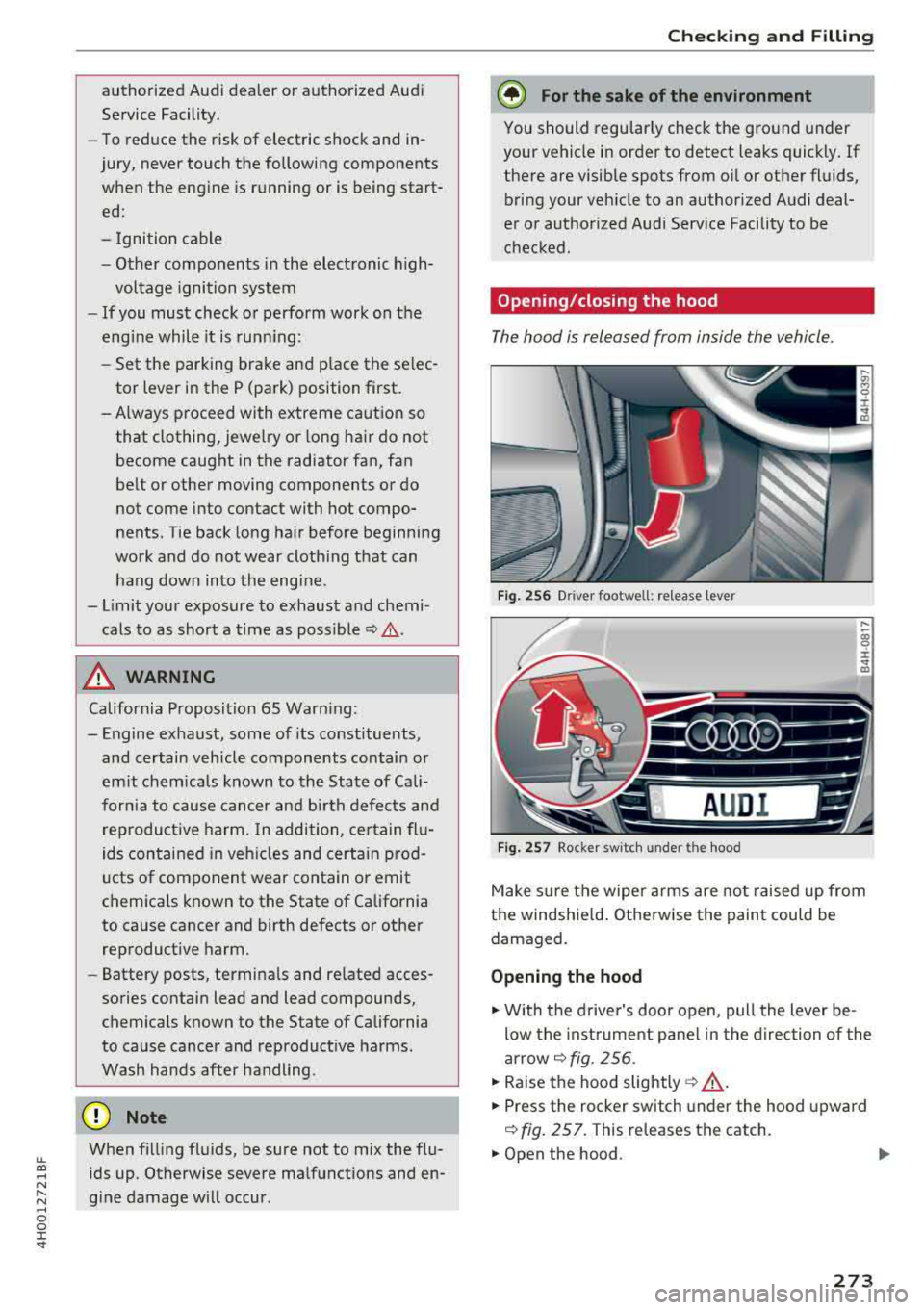
Opening/closing the hood
The hood is released from inside the vehicle .
Fig. 256 Drive r footwell : re lea se leve r
Fig. 25 7 Rocker sw itc h unde r the hood
M ake s ure th e wipe r arms are no t rais e d up from
t h e windshie ld . Otherwise the pain t could be
damaged.
Opening the hood
.,. With the d rive r's doo r open, pull the lever be
low t he instrume nt pane l in the direction of the
ar row ¢
fig. 256.
.,. Ra ise the hoo d slightly¢&_ .
.. Press the rocker switch under the hood upward
¢ fig . 257. T his re leases the catch.
.,. Open the hood . ..,.
273
Page 277 of 356
u. co ..... N
" N ..... 0 0 :c '
Read and follow all WARNINGS before check
ing anything in the engine
compartment~ .&.
in Working in the engine compartment on
page 272.
Engine oil
If the engine oil level is too low
If you need to add engine oil, use an oil that is listed on the sticker.
The sticker is located at the
front of the engine
compartment ~ page 274,
fig.
258.
If the recommended engine oil is not available,
in an emergency you may add a maximum of 1
quart
(I liter) of ACEA C3 or API SN engine oil
one time until the next oil change.
For more information on the correct engine oil
for your vehicle, contact an authorized Audi deal
er or authorized Audi Service Facility. Have the oil
changed by an authorized Audi dealer or author ized Service Facility.
Audi recommends
«;;castrol I /g@@g PrtfTr.:!\.7.Tri,'lAl.
Audi recommends using the Longlife high-per·
formance engine oil from Audi Genuine Parts.
Checking the engine oil level
The engine oil level can be checked in the Info
tainment system
Observe the safety precautions ~ A in Working
in the engine compartment on page 2 72.
~ Park your vehicle on a level surface.
~ Shut the engine off when it is warm.
~ Switch only the ignition back on.
~ Wait approximately two minutes.
~ Select: the ICARI function button> (Car)* Sys
tems
control button > Service & control > Oil
level.
~ Read the oil level in the Infotainment system .
Add engine oil if the bar in the oil level indica
tor is just before
"min"~ page 2 76.
Checking and Filling
@ Note
The engine oil level must not be under the
"min" marking, as this will increase the risk of
engine damage.
(D Tips
The oil level indicator in the display is only an
informational display.
If the oil level is too
low, a minimum oil warning appears in the in
strument cluster. Add oil and close the hood.
The current oil level is displayed in the Info
tainment system the next time the ignition is
switched on.
(D Tips
The engine oil consumption may be up to
0.5 quart/600 miles (0 .5 liter/1,000 km), de
pending on driving style and operating condi
tions. Consumption may be higher during the
first 3,000 miles (5,000 km). Because of this,
the engine oil level must be checked regular
ly. It is best to check each time you refuel
your vehicle and before long drives.
- In order to provide effective lubrication and
cooling of internal engine components, all
internal combustion engines consume acer
tain amount of oil. Oil consumption varies
from engine to engine and may change sig
nificantly over the life of the engine. Typi
cally, engines with a specified break-in peri
od consume more oil during the break-in pe
riod than they consume after oil consump
tion has stabilized.
- Under normal conditions, the rate of oil
consumption depends on the quality and
viscosity of the oil, the RPM (revolutions per
minute) at which the engine is operated, the
ambient temperature and road conditions.
Further factors are the amount of oil dilu
tion from water condensation or fuel resi
due and the oxidation level of the oil. As any
engine is subject to wear as mileage builds
up, the oil consumption may increase over
time until replacement of worn components
may become necessary.
.,.
275
Page 278 of 356
Checking and Filling
-With all these variables coming into play,
no standard rate of o il consumption can be
established or specified. There is no alterna
tive to checking the oil level regularly and
frequently.
- If you have the impression your engine con
sumes excessive amounts of oil, we recom
mend that you consult an authorized Audi
dealer to have the cause of your concern properly diagnosed . Keep in mind that the
accurate measurement of oil consumption
requires great care and may take some
time. An authorized Audi dealer has instruc
tions about how to measure oil consump
tion accurately.
- You can find information on engine oil and
engine oil capacities for the USA at
www.audiusa.com/help/maintenance, or
for Canada at www.audi.ca/ca/web/en/
customer-area/ care-a nd-maintena nee/ aud
i
service-schedules. html , or call
800 -822-2834.
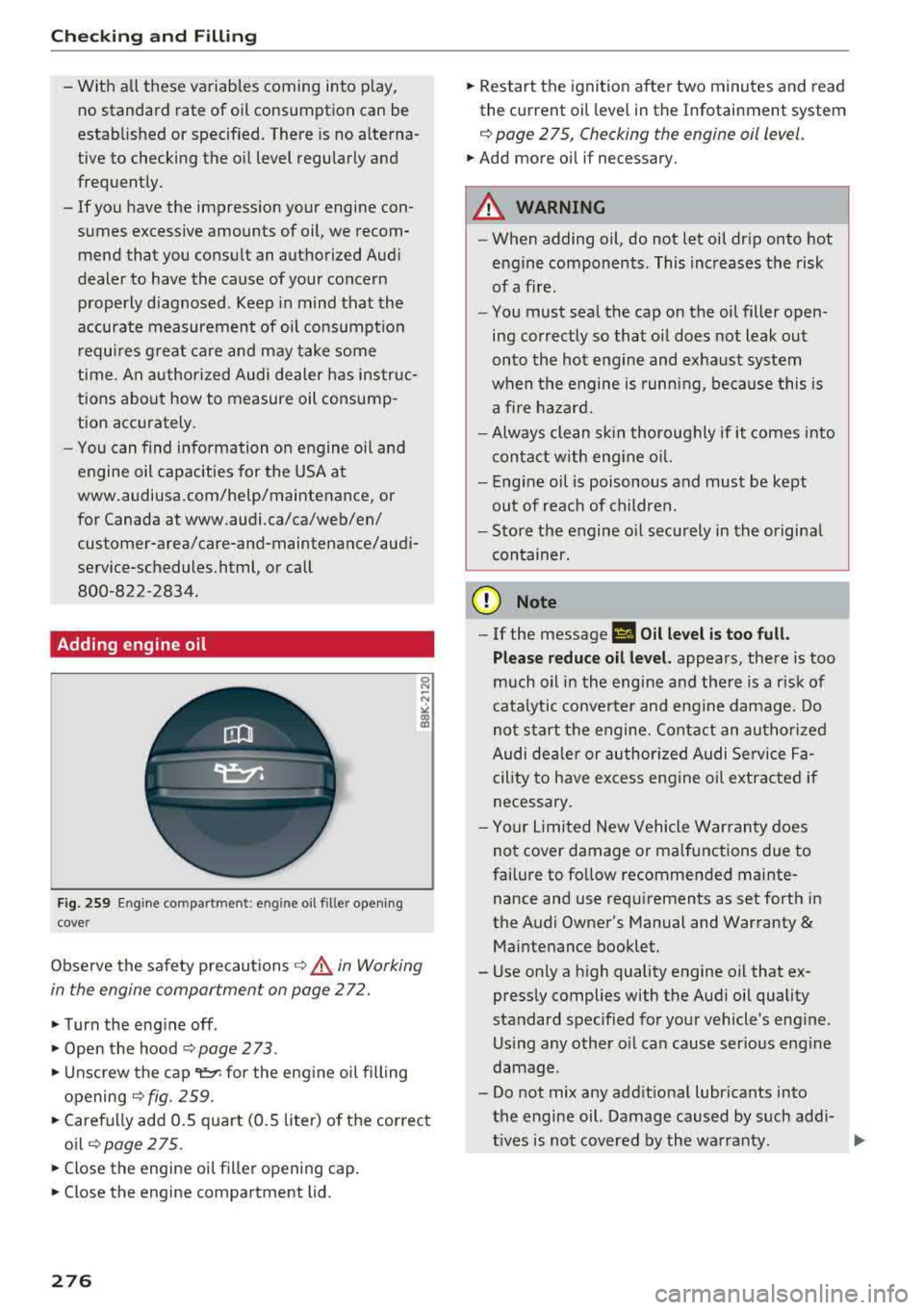
Adding engine oil
Fig. 259 Engine co mpartment : en gin e oil fille r opening
c ove r
0 N
-N ,.:
gi
Observe the safety precautions c::, &. in Working
in the engine compartment on page
2 72.
"Turn the engine off.
" Open the hood c::, page 2 73.
" Unscrew the cap 't=?1 for the engine oil filling
opening
c::, fig. 2 59.
"Carefully add 0.S quart (0 .5 liter) of the correct
oil
c::, page 275.
"Close the engine oil filler opening cap.
"Close the engine compartment lid.
276
"Restart the ignition after two minutes and read
the current oil level in the Infota inment system
c::, page 275, Checking the engine oil level.
"Add more oil if necessary.
A WARNING
-When adding oil, do not let oil drip onto hot
engine components . This increases the risk
of afire.
- You must seal the cap on the oil filler open
ing correctly so that oil does not leak out
onto the hot engine and exhaust system
when the engine is running, because this is
a fire hazard.
-Always clean skin thoroughly if it comes into
contact with engine oil.
- Engine oil is poisonous and must be kept
out of reach of children.
- Store the engine oil securely in the original
container.
(D Note
- If the message l!I Oil level is too full.
Please reduce oil level. appears, there is too
much oil in the engine and there is a risk of
catalytic converter and engine damage. Do
not start the engine . Contact an authorized
Audi dealer or authorized Audi Service Fa
cility to have excess engine oil extracted if
necessary.
- Your Limited New Vehicle Warranty does
not cover damage or malfunctions due to
failure to follow recommended mainte
nance and use requirements as set forth in
the Audi Owner's Manual and Warranty & Maintenance booklet.
- Use only a high quality engine oil that ex
pressly complies with the Audi oil quality
standard specified for your vehicle's engine .
Using any other oil can cause serious engine
damage .
- Do not mix any additional lubricants into
the engine oil. Damage caused by such addi-
tives is not covered by the warranty.
.,._
Page 281 of 356
lL
_& WARNING
-The cooling system is under pressure. Do
not open the coolant expansion tank cap
when the engine is hot. This increases the
risk of burns .
- The coolant additive and the coolant can be dangerous to your health. For this reason,
keep the coolant in the original container
and away from children. There is a risk of
poisoning.
- When working in the engine compartment,
remember that the radiator fan can switch
on even if the ignition is switched off, which
increases the risk of injury.
CD Note
Do not add coolant if the expansion tank is
empty. Air could enter the cooling system and
damage the engine. If this is the case, do not
continue driving. See an authorized Audi deal
er or authorized Audi Service Facility for assis
tance.
Brake fluid
N N
-N
" co IX)
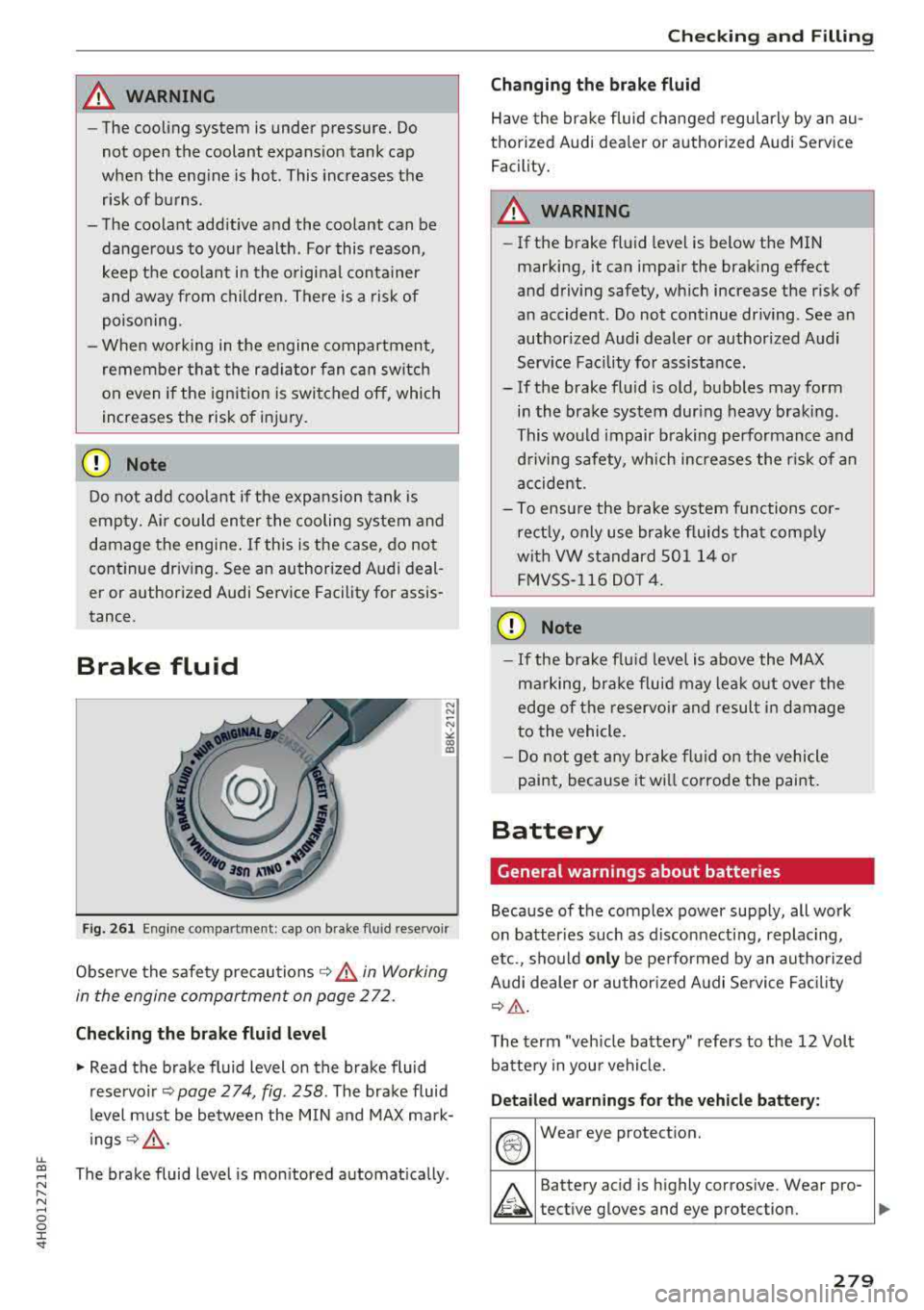
Fig. 261 Engine compartment: cap on brake flu id reservoir
Observe the safety precautions ~&. in Working
in the engine compartment on page 2
72.
Checking the brake fluid level
.. Read the brake fluid level on the brake fluid
reservoir
~ page 274, fig. 258. The brake fluid
level must be between the MIN and MAX mark
ings~&. -
~ The brake fluid level is monitored automatically .
...... N ...... 0 0 :c '
Changing the brake fluid
Have the brake fluid changed regularly by an au
thorized Audi dealer or authorized Audi Service
Facility.
_& WARNING
-
- If the brake fluid level is below the MIN
marking, it can impair the braking effect
and driving safety, which increase the risk of
an accident . Do not continue driving . See an
authorized Audi dealer or authorized Audi
Service Facility for assistance.
- If the brake fluid is old, bubbles may form
in the brake system during heavy braking.
This would impair braking performance and
driving safety, which increases the risk of an
accident.
- To ensure the brake system functions cor
rectly, only use brake fluids that comply
with VW standard 50114 or FMVSS-116 DOT 4.
CD Note
- If the brake fluid level is above the MAX
marking, brake fluid may leak out over the
edge of the reservoir and result in damage
to the vehicle.
- Do not get any brake fluid on the vehicle
paint, because it will corrode the paint.
Battery
General warnings about batteries
Because of the complex power supply, all work
on batteries such as disconnecting, replacing,
etc., should
only be performed by an authorized
Audi dealer or authorized Audi Service Facility
~ .&. .
The term "vehicle battery" refers to the 12 Volt
battery in your vehicle.
Detailed warnings for the vehicle battery:
® Wear eye protection.
b. Bat~ery acid is highly corrosive. Wear pro-
~ tect1ve gloves and eye protection. Ill>-
279