ESP AUDI Q2 2021 Owner´s Manual
[x] Cancel search | Manufacturer: AUDI, Model Year: 2021, Model line: Q2, Model: AUDI Q2 2021Pages: 364, PDF Size: 87.77 MB
Page 316 of 364
Care of vehicle and cleaning
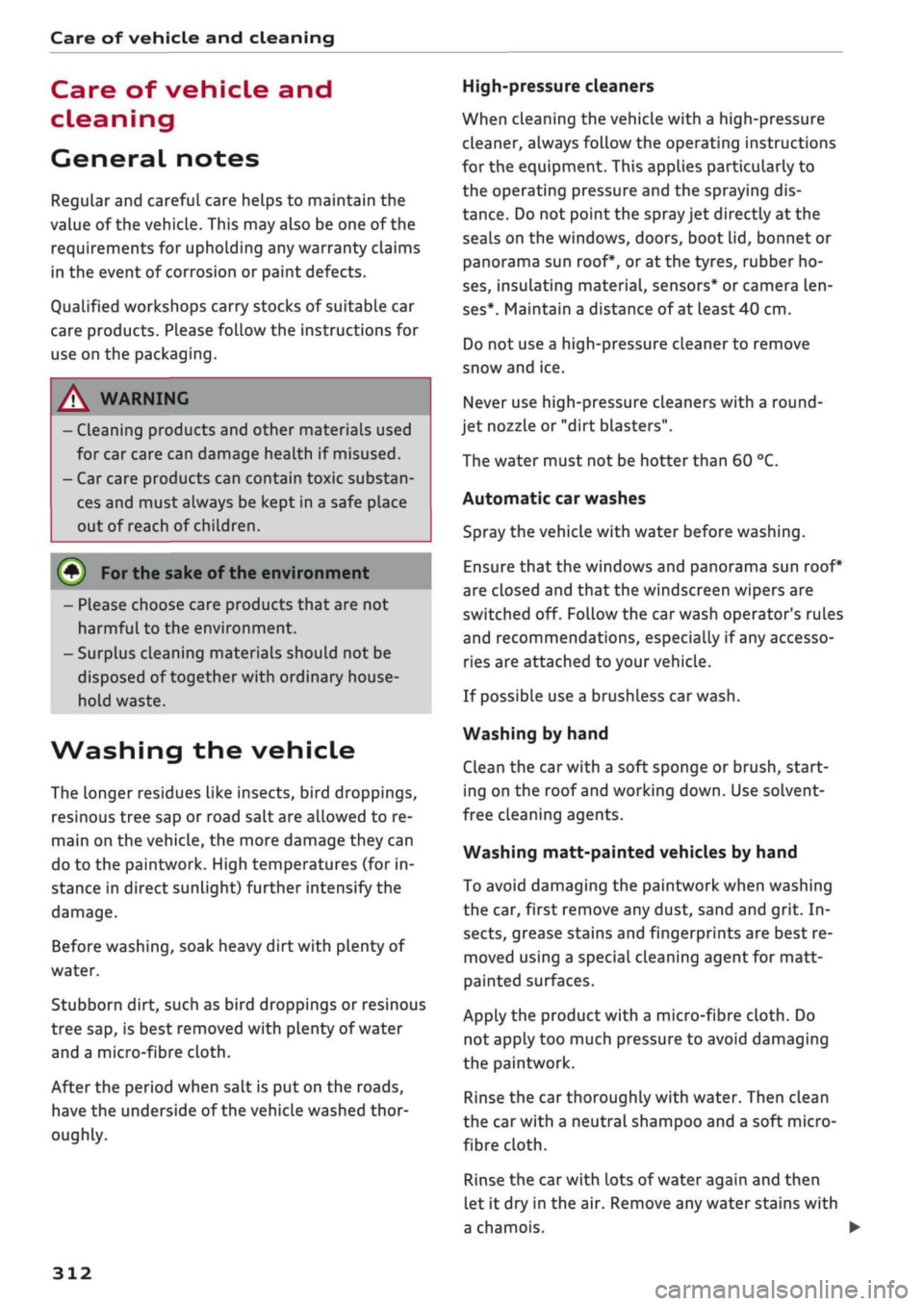
Care of vehicLe and
cleaning
General notes
Regular and careful care helps to maintain the
value of the vehicLe. This may also be one of the
requirements for upholding any warranty claims
in the event of corrosion or paint defects.
Qualified workshops carry stocks of suitable car
care products. PLease
foLLow
the instructions for
use on the packaging.
A WARNING
- Cleaning products and other materials used
for car care can damage health if misused.
- Car care products can contain toxic substan
ces and must always be kept in a safe place
out of reach of children.
+) For
the sake of the environment
- Please choose care products that are not
harmful to the environment.
- Surplus cleaning materials should not be
disposed of together with ordinary house
hold waste.
Washing the vehicle
The longer residues like insects, bird droppings,
resinous tree sap or road salt are alLowed to re
main on the vehicle, the more damage they can
do to the paintwork. High temperatures (for in
stance in direct sunlight) further intensify the
damage.
Before washing, soak heavy dirt with plenty of
water.
Stubborn dirt, such as bird droppings or resinous
tree sap, is best removed with plenty of water
and a micro-fibre cloth.
After the period when salt is put on the roads,
have the underside of the vehicLe washed thor
oughly.
High-pressure cleaners
When cleaning the vehicle with a high-pressure
cleaner, always follow the operating instructions
for the equipment. This applies particularly to
the operating pressure and the spraying dis
tance.
Do not point the spray jet directly at the
seals on the windows, doors, boot lid, bonnet or
panorama sun roof*, or at the tyres, rubber ho
ses,
insulating material, sensors* or camera
len
ses*.
Maintain a distance of at least 40 cm.
Do not use a high-pressure cleaner to remove
snow and ice.
Never use high-pressure cleaners with a round-
jet nozzle or "dirt blasters".
The water must not be hotter than 60 °C.
Automatic car washes
Spray the vehicle with water before washing.
Ensure that the windows and panorama sun roof*
are closed and that the windscreen wipers are
switched off. Follow the car wash operator's rules
and recommendations, especially if any accesso
ries are attached to your vehicle.
If possibLe use a brushless car wash.
Washing by hand
Clean the car with a soft sponge or brush, start
ing on the roof and working down. Use solvent-
free cleaning agents.
Washing matt-painted vehicles by hand
To avoid damaging the paintwork when washing
the car, first remove any dust, sand and grit. In
sects,
grease stains and fingerprints are best re
moved using a special cleaning agent for matt-
painted surfaces.
Apply the product with a micro-fibre cloth. Do
not apply too much pressure to avoid damaging
the paintwork.
Rinse the car thoroughly with water. Then clean
the car with a neutral shampoo and a soft micro-
fibre cloth.
Rinse the car with lots of water again and then
let it dry in the air. Remove any water stains with
a chamois. •
312
Page 318 of 364
Care of vehicle and cleaning
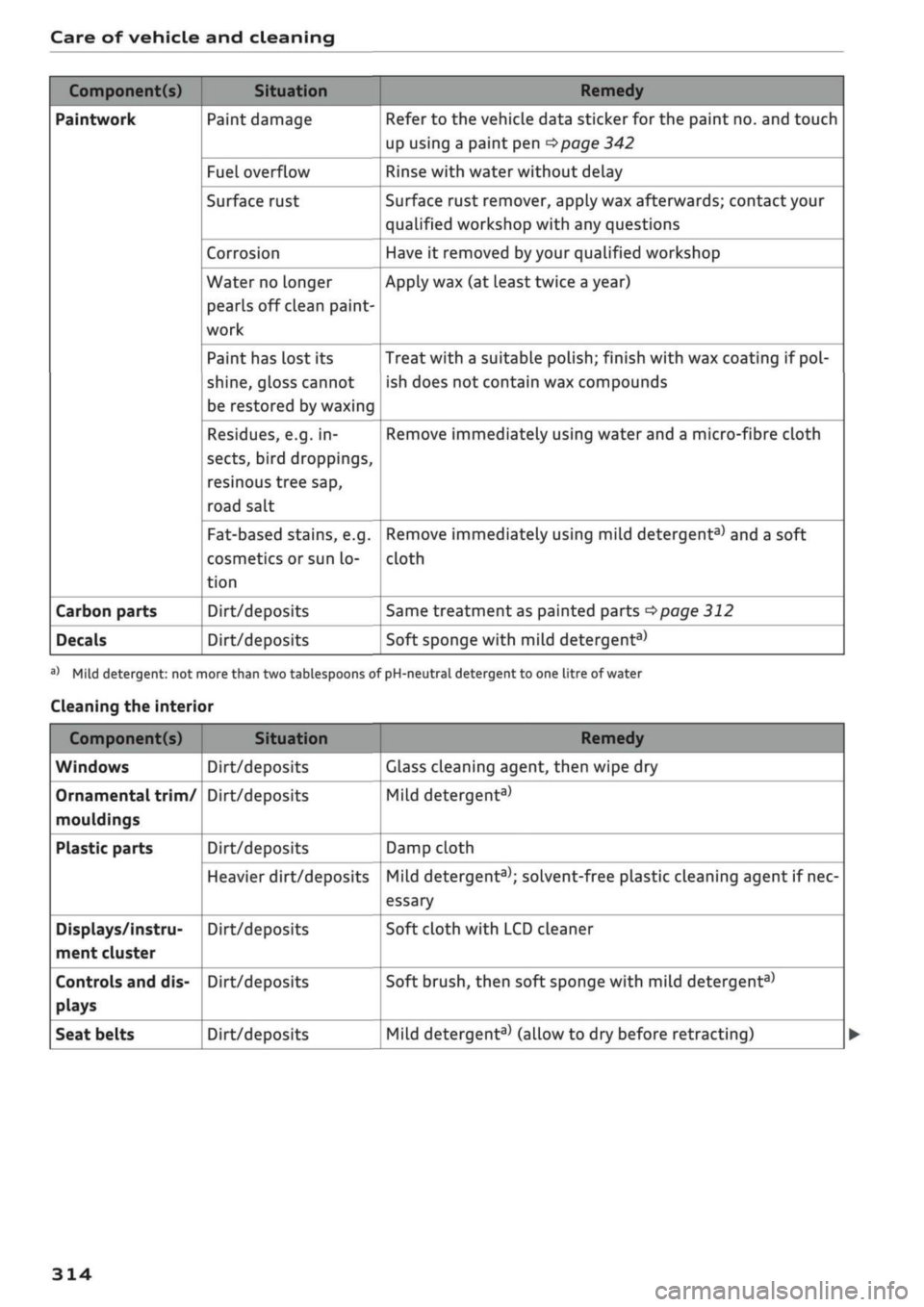
Component(s)
Paintwork
Carbon parts
Decals
Situation
Paint damage
Fuel overflow
Surface rust
Corrosion
Water no longer
pearls off clean paint
work
Paint has Lost its
shine,
gloss cannot
be restored by waxing
Residues, e.g. in
sects,
bird droppings,
resinous tree sap,
road salt
Fat-based stains, e.g.
cosmetics
or
sun lo
tion
Dirt/deposits
Dirt/deposits
Remedy
Refer to the vehicle data sticker for the paint no. and touch
up using a paint pen
^>page
342
Rinse with water without delay
Surface rust remover, apply wax afterwards; contact your
qualified workshop with any questions
Have it removed by your qualified workshop
Apply wax (at least twice a year)
Treat with a suitable polish; finish with wax coating if
pol
ish does not contain wax compounds
Remove immediately using water and a micro-fibre cloth
Remove immediately using
miLd
detergent3'
and a soft
cloth
Same treatment as painted parts
^page
312
Soft sponge with mild
detergent3'
a)
Mild detergent: not more than two tablespoons of
pH-neutral
detergent to one litre of water
Cleaning the interior
Component(s)
Windows
Ornamental trim/
mouldings
Plastic parts
Displays/instru
ment cluster
Controls and dis
plays
Seat belts
Situation
Dirt/deposits
Dirt/deposits
Dirt/deposits
Heavier dirt/deposits
Dirt/deposits
Dirt/deposits
Dirt/deposits
Remedy
Glass cleaning agent, then wipe dry
Mild
detergent3'
Damp cloth
Mild
detergent3';
solvent-free plastic cleaning agent if nec
essary
Soft cloth with LCD cleaner
Soft brush, then soft sponge with mild detergent3'
Mild detergent3' (allow to dry before retracting)
314
Page 319 of 364

Care of vehicLe and cleaning
CO
<
O
rN
r>
rN
•-i
00
Component(s)
Fabrics,
leatherette,
Alcantara
Natural leather
Carbon parts
Situation
Surface dirt
Water-based stains,
e.g.
coffee, tea,
blood,
etc.
Fat-based stains, e.g.
oil,
make-up, etc.
Special dirt/stains,
e.g.
ballpoint pen,
nail varnish, disper
sion paint, shoe
cream,
etc.
Fresh dirt/stains
Water-based stains,
e.g.
coffee, tea,
blood,
etc.
Fat-based stains, e.g.
oil,
make-up, etc.
Special dirt/stains,
e.g.
ballpoint pen,
nail varnish, disper
sion paint, shoe
cream,
etc.
Care of vehicle
Dirt/deposits
Remedy
Vacuum cleaner
Absorbent cloth and mild
detergent3'
Apply mild detergent3', dab off dissolved grease or colour
particles with absorbent cloth; if necessary treat with wa
ter
Special stain remover (dab off with absorbent fabric); if
necessary treat with mild
detergent3'
Cotton cloth with mild
detergent3'
Fresh stains: absorbent cloth
Dried stains: stain remover suitable for leather
Fresh stains: absorbent cloth and suitable stain remover
for leather
Dried stains: grease removal spray
Stain remover suitable for leather
Regularly apply leather-care cream with ultra-violet pro
tection and impregnating compound; if necessary use spe
cial colour leather cream
Same treatment as plastic parts
a^
Mild detergent: not more than two tablespoons of pH-neutral
A WARNING
Do not use water-repellent coatings on the
windscreen. In bad visibility conditions such
as Light
rain,
Low sun or when driving at night
these coatings can cause increased dazzle,
which is a serious safety hazard. Such coat
ings can also cause the wiper blades to
jud
der.
© CAUTION
-
Headlights/rear
lights
- Never clean the headlights/rear lights
with a dry cloth or sponge.
detergent to one litre of water
- Do not use cleaning agents containing al
cohol.
This could cause the glass to crack!
- Wheels
- Do not use paint polish or other abrasive
agents.
- If the protective paint coating on the
wheel rim is scratched or damaged by
stone chips etc., the damaged area should
be touched up without delay.
-Sensors/camera lenses
- Never remove snow and ice from the cam
era lens using warm or hot water - danger
of cracks appearing on the lens.
315
Page 332 of 364

Mobility
7. Connect one end of the black lead preferably
to the earth point or alternatively to the
neg
ative battery terminal © on the vehicle pro
viding assistance®.
8. Connect the other end of the
black
jump lead
only to the earth point © of the jump-start
connection on your vehicle ©
<=>(£).
9. Position the jump leads in such a way that
they cannot come into contact with any mov
ing parts in the engine compartment.
Starting the engine
10.
Start the engine of the vehicle with the
boosting battery and let it run at idling
speed.
11.
Start the engine of the
car
with the dis
charged battery and wait two or three mi
nutes until the engine is running smoothly.
12.
If the engine fails to start: do not operate the
starter for longer than 10 seconds. Wait for
about 30 seconds and try again.
13.
Switch on the blower and the rear window
heating on the vehicle which has been jump-
started in order to offset excessive voltage
which may occur when disconnecting the
leads.
The headlights must be switched off!
14.
Disconnect the leads in exactly the opposite
sequence to that described in
*page
327
with the engines running. Make sure that the
Leads cannot come into contact with any
moving parts in the engine compartment.
15.
Fold the cover back onto the battery in its
correct position.
16.
Switch off the blower and the rear window
heating again.
PLease refer to
<=>
A in Before starting the engine
on page 326 and
•=>©
in Before starting the en
gine on page 327.
© CAUTION
Do not use the negative battery terminal
when jump-starting (this could cause a
mal
function in the on-board electrical system).
- Connect the battery clamps so they have
good metal-to-metal contact with the bat
tery terminals.
- The vehicle battery is vented to the outside
to prevent gases entering the vehicle's inte
rior.
Tow-
start
ing / towing
away
General notes
Some experience is required to tow or tow-start a
vehicle, especially when using a tow-rope. Both
drivers should be familiar with the technique re
quired for towing. Inexperienced drivers should
not attempt to tow-start or tow away another ve
hicle.
Do not pull too hard with the towing vehicle and
take care to avoid jerking the tow-rope. When
towing off-road, there is aLways a risk that the
anchorage points may be overloaded.
Tow-bar / tow-rope
It is easier and safer to tow the vehicle with a
tow-bar. You should only use a tow-rope if you do
not have a tow-bar. It is advisable to use a tow-
rope made of elastic synthetic fibre or similarly
elastic material.
Notes on towing vehicles
The vehicle can be towed with a tow-bar or tow-
rope.
When the engine is not running, the
gear
box will not be adequately lubricated if the
fol
lowing speed/distance restrictions are not ob
served:
- The vehicle must not be towed faster than
50 km/h.
- The vehicle must not be towed further than
50 km. •
328
Page 339 of 364

Fuses and bulbs
CO
rN
IV
rN
•-i
00
- Make sure that the covers are correctly seat
ed on the headlights and the rear lights.
This will ensure that water cannot enter the
housings and cause the lights to malfunc
tion.
- Do not touch the glass part of the bulb with
your bare hands; use a cloth or paper towel
instead.
Otherwise, the fingerprints left on
the glass will vaporise as a result of the heat
generated by the bulb, be deposited on the
reflector and impair its surface.
© CAUTION
When removing or installing the rear light,
take care not to cause any damage.
- Removing the rear light in particular can
lead to the paintwork or rear light becoming
damaged.
This is another reason why we
recommend having the bulbs changed by a
qualified workshop.
- Never use metal tools (e.g. a screwdriver) or
sharp or pointed plastic tools to lever out
the rear light - risk of damaging the paint.
- Make sure you have a soft cloth ready to
place under the glass on the rear light, to
avoid any scratches.
® For the sake of the environment
A qualified workshop can advise you how to
dispose of used bulbs in the proper manner.
© Note
- Please check at regular intervals that
alL
lighting (especially the exterior Lighting) on
your vehicle is functioning properly. This is
not only in the interest of your own safety,
but also in that of all other road users.
- Before changing a bulb, make sure you have
the correct new bulb.
Bulbs at front of vehicle
Applies to: vehicles with halogen headlights
Fig.
279 Halogen headlights: Overview of left side of
vehi
cle
You must only replace a bulb with a bulb of the
same type. Information regarding e.g. the wat
tage can be found on the base of the bulb.
The description for changing the bulb refers to
the left headlight; the procedure for the right
headlight is similar.
Halogen headlights
The following bulbs can be changed:
Bulb (12 V)
(T)Main
beam headlight
© Dipped headlight
© Daytime running light
© Turn signal
Version
H7LL(55
W)
H7LL(55W)
PW24W
PWY24W
Bulbs at rear of vehicle
Applies to: vehicles with bulbs
Fig.
280
Rear
of
vehicle:
Bulbs on
leftside
of vehicle
335
Page 344 of 364

Accessories
and
modifications
to the
vehicle
Accessories
and
modifi
cations
to the
vehicle
Accessories,
replacement parts
and
repairs
Always
ask
your dealer
or
specialist retailer
for
advice before purchasing accessories
and
re
placement parts.
Your
car is
designed
to
offer
a
high standard
of
active and passive safety. For this reason,
we
rec
ommend that you ask your Audi dealer
for
advice
before fitting accessories
or
replacement parts.
Audi dealers have
the
latest information from
the manufacturer and
can
recommend accesso
ries and replacement parts which
are
suitable
for
your requirements. They can also answer
any
questions you might have regarding official
regu
lations.
We recommend you
to
use only Audi accessories
and Audi Genuine Parts. Audi has tested these
products
for
suitability, reliability and safety.
Audi dealers have
the
necessary experience
and
facilities
to
ensure that
the
parts
are
installed
properly.
Although
the
market
is
constantly scrutinised,
Audi
cannot
judge
or
assume responsibility
for
the reliability, safety and suitability
of
non-genu
ine products
-
even though
in
some instances,
these parts
may
have been approved
by
an
offi
cially recognised technical testing authority
or
accompanied
by
an official approval certificate.
Any retro-fitted equipment which has a direct
ef
fect on
the
vehicle and/or
the
way
it is
driven
(e.g.
cruise control system
or
electronically-con
trolled suspension) must
be
approved
for
use
in
your vehicle and bear
the e
mark
(the
European
Union's approval symbol).
If any additional electrical components are fit
ted which
do not
serve
to
controL
the
vehicLe
it
self
(for
instance a refrigerator box, laptop
or
ventilator
fan,
etc.), these must bear the C€ mark
(manufacturer conformity declaration
in the Eu
ropean Union).
A,
WARNING
Never attach accessories (such
as cup
holders
or telephone brackets)
to the
surfaces cover
ing
the
airbag units
or the
areas around
the
airbags: this could cause injury
if
the airbag
is
triggered.
Modifications
Modifications must always
be
carried
out
accord
ing
to our
specifications.
Unauthorised modifications
to the
electronic
components, software, wiring
or
data transfer
in
the vehicLe may cause malfunctioning. Due
to the
way
the
electronic components
are
linked togeth
er
in
networks, other systems
may be
affected
by
the faults. This can seriously impair safety, lead
to excessive wear
of
components,
and
also inva
lidate
the
type approval
for
your vehicle.
You will appreciate that your Audi dealer cannot
be held liable
for
any damage caused
by
modifi
cations and/or work performed incorrectly.
We recommend that
all
work should
be
per
formed
by
an Audi workshop using Audi Genuine
Parts.
/K
WARNING
- Incorrectly performed modifications
or
oth
er work
on
your vehicLe can lead
to
malfunc
tions and cause accidents.
-
Do not
use an additional
or
replacement
number plate holder other than
the
original
one fitted
at the
front
of
the vehicle.
Radio transmitters
and
business equipment
Transmitters
An external aerial
is
required
in
order
to
operate
radio equipment inside
the
vehicle. The maxi
mum range
of
the equipment can only
be
ach
ieved with
an
external aerial.
Retrofit installations
of
radio transmitters
in the
vehicle
are
subject
to
official approval and can
af
fect
the
type approval
for
your vehicle.
In •
340