Door AUDI Q3 2016 Owner's Guide
[x] Cancel search | Manufacturer: AUDI, Model Year: 2016, Model line: Q3, Model: AUDI Q3 2016Pages: 252, PDF Size: 62.81 MB
Page 86 of 252
Automatic transmissio n
Stopp ing temporarily
.,. Press the b rake peda l to stop the vehicle, fo r
example at a traffic light. Do not press the ac
ce lerator peda l when doing this.
... To prevent the vehicle from rolling when you
start driving, set the parking brake when stop
ping on steep inclines ¢
,&..
.,. The park ing brake w il l release automatically
and the vehicle will start moving once you press
the accelerator pedal.
Stopp ing /park ing
If the selector lever is not in the P posit ion when
you open the driver's door, the vehicle could roll.
The message
S hift to P and turn off ign it ion ,
otherwi se vehicle can roll awa y
appears.
.,. Press and hold the brake pedal
c> ,&. .
.,. Set the parking brake.
.,. To engage the P selector lever posit ion, press
the button on the selector lever and sh ift into
the P position
i:> page 82.
Stopp ing on an incline
.,. Always press the brake peda l to hold the vehi
cle in place and prevent it from "rolling back"
c> ,&. . Do not try to prevent the vehicle from
"ro lling back" when a gear is engaged by in
c reasing the eng ine speed
i:> 0.
Starting on a hill
.,. Set the parking brake.
.,. Se lect the D posit ion .
.,. Press t he accelerator pedal carefully . If you r
safety belt is fastened, the pa rking brake is au
tomat ica lly released a nd your ve hicle beg ins to
move .
Unde r ce rtain c ircumstances, such as driv ing in
the mountains, it may be usef ul to sw itch tempo
rarily to the manua l shift program in o rde r to ad
just the gea rs to the d riving conditions by hand
i:>page 85 .
On inclines, act ivate the park ing brake first and
then move the se lector lever to the P pos it ion
c>page 72. This prevents the lo cking mechanism
from being loaded too heav ily and w ill make i t
easier to move the se lec tor lever out of the P po
sition.
84
A WARNING
- The vehicle can also ro ll when the eng ine is
stopped.
- Unintended vehicle movement can cause se
rious injury.
- Never leave your veh icle with the engine
running while in gear. If you must leave
your veh icle w hen the engine is r unning, ac
tivate t he pa rking brake a nd move the selec
tor lever to P .
- Power is still transmitted to the wheels
when the engine is running at idle . To p re
vent the vehicle from "creeping", yo u m ust
keep your foo t on t he b rake when the en
g in e is ru nning and the selector lever is in D/
Sor R or "tiptronic" mode is se lected .
- Do not press the a cce le ra to r peda l when
changing the se lec to r l ever posi tion while
the vehicle is s ta tionary and the engine is
r u nning .
- Never sh ift into R or P whi le driving.
- Before d riving down a s teep sl ope, redu ce
your spee d and sh ift into a lower gea r w ith
"t i ptronic" .
- Do not ride the brakes or press the bra ke
pedal too of ten o r too long when dr iv ing
down a hi ll. Constant braking ca uses the
brakes to ove rheat and substantially re
duces brak ing performance, increases b rak
ing d istance or causes comp lete failure of
the brake system.
- To prevent the veh icle from rol ling back
when stopp ing on inclines, always hold it in
place with the brake peda l or park ing brake .
- Never hold the vehicle on an incline with a
slipping clutch. The clutch opens automati
cally when it becomes too hot from the
overload. An ind icator lam p. illumina tes
and a dr iver message appears¢
page 86
w hen t he clu tch is overloade d.
- If the e ngine must rema in running, never
have a ny driving posi tion engaged when
checking unde r th e hood. Make s ure these
lec to r l ever has secu rely eng aged an d is
loc ked in P with the parking b rake set
Page 87 of 252
.... N
c:i ::J CX)
.... I.Cl U"I
N I.Cl ......
c> page 177. Otherwise, any increase in en
gine speed may set the vehicle in motion,
even with the parking brake applied.
(D Note
- When stopping on an incline, do not try to
hold the vehicle in place by pressing the ac
celerator pedal whi le a driv ing gear is se
lected. This can cause the automatic trans
mission to overheat and can damage it . Set
the parking brake or press the brake pedal
to prevent the vehicle from ro lling.
- Allow ing the vehicle to roll when the eng ine
i s stopped and the selector lever is in
N po
s ition w ill damage the automatic transm is
s ion because i t is not lubricated under those
ci rc u ms tances.
- The transmiss ion can over heat and be dam
aged under certain driving and traffic co ndi
t ions s uch as frequent starts, creeping for a
l ong time, or stop -and -go traffic. When the
• indicator light turns on, stop the vehicle
at the next opportunity and let the trans
mission cool down
c> page 86.
@ Tips
For safety reasons, the parking brake is re
leased automatically only when the driver 's
safety belt is fastened and the dr iver 's door is
locked.
Hill descent control
Hill descent control assists the driver when dr iv
ing down hills.
Hill descent contro l is activated wh en th e se lec
tor lever is in the D or S position and you p ress
the b rake pedal. The transm ission automat ically
select s a gear that i s suitable for the incline . H ill
descent control tries to maintain the speed ach
ieved at the time of braking, within phys ical and
techn ical limitations . If may st ill be necessary to
adj ust the speed with the b rake pedal.
Hill descent control switches off once the hill lev
e ls out or you press the accelerator pedal.
Aut oma tic tr ansm iss ion
A WARNING
-Hill descent control cannot overcome physical
limitat io ns, so it may not be able to ma intain
a constant speed under all conditions . Always
be ready to app ly the brakes .
Shifting manually (tiptronic mode)
The tiptronic allow the driver to shi~ the gears
manually.
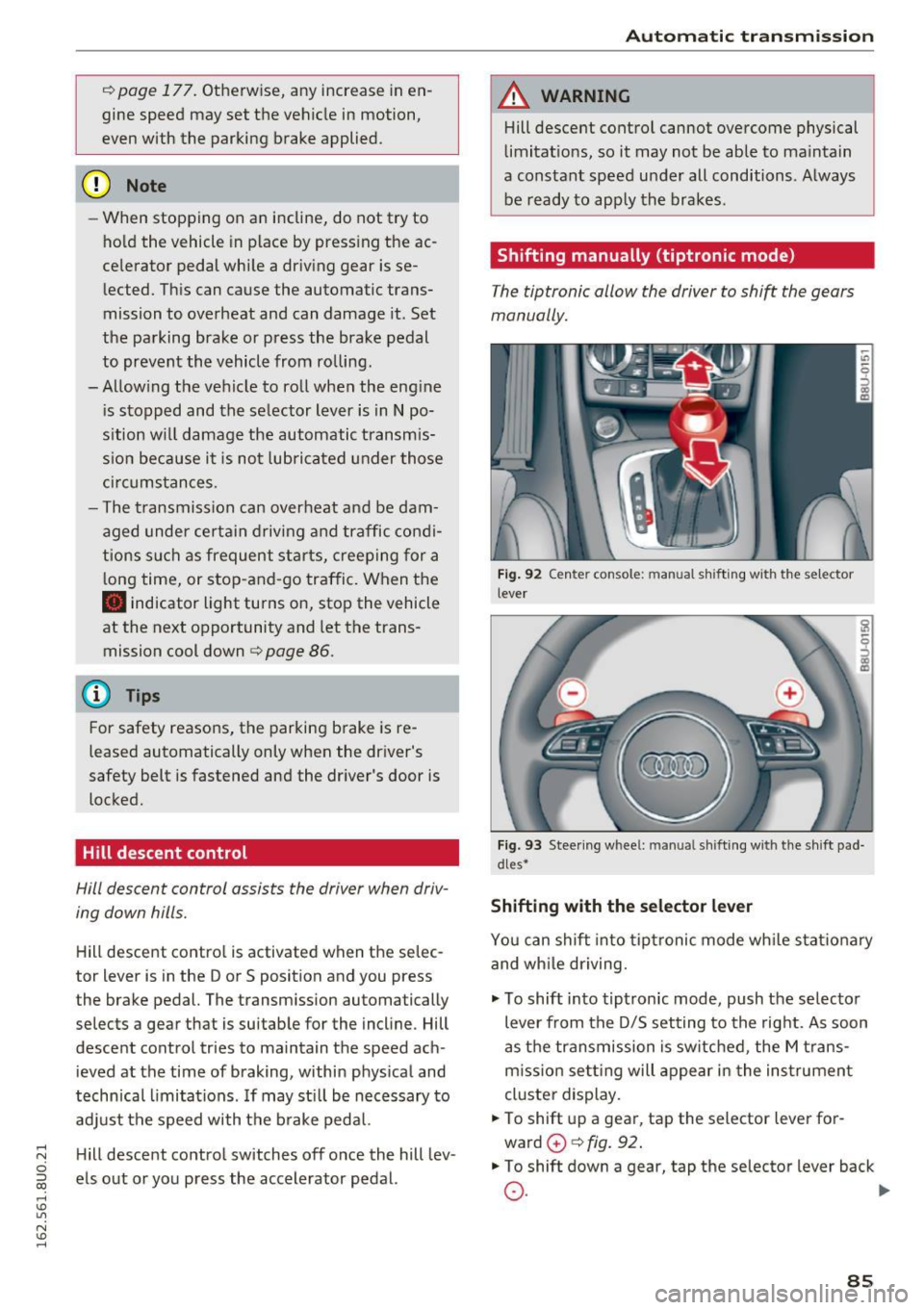
F ig. 92 Cente r con so le: m anu al shi ft ing w ith t he sel ect or
leve r
Fig . 93 Stee ring w hee l: manual s hift ing w ith the shi ft pad
d les•
Shifting with the selector lever
You can shift into tip tronic mode wh ile stat iona ry
and wh ile driving.
"' To shift into tiptronic mode, push the selecto r
lever from the D/S setting to the right. As soon
as the transmission is switched , the M trans
m iss ion se tting will appear in the ins trument
cluste r display.
"' To shift up a gea r, tap the selector lever for
ward
0 c> fig . 92 .
"'To shift down a gea r, tap the se lector lever back
0 . ~
85
Page 103 of 252
-Always put objects, for example, luggage or
other heavy items in the luggage compart
ment.
- Always secure objects in the luggage com
partment using the tie-down eyelets and
suitable straps.
A WARNING
Heavy loads will influence the way your vehi
cle handles . To help reduce the risk of a loss
of control leading to serious personal injury:
- Always keep in mind when transporting
heavy objects, that a change in the center of
gravity can also cause changes in vehicle
hand ling:
- Always distribute the load as evenly as
possible.
- Place heavy objects as far forward in the
luggage compartment as possible.
- Never exceed the Gross Axle Weight Rating
or the Gross Vehicle Weight Rating specified
on the safety compliance sticker on the left
door jamb. Exceeding permissible weight
standards can cause the vehicle to slide and
handle differently .
- Please observe information on safe driving
¢page 95.
A WARNING
To help prevent poisonous exhaust gas from
being drawn into the vehicle, always keep the
rear lid closed while driving .
- Never transport objects larger than those
fitting completely into the luggage area be
cause the rear lid cannot be fully closed .
- If you absolutely must drive with the rear lid
open, observe the following notes to reduce
the risk of poisoning:
- Close all windows,
- Close the Pano ramic sliding sunroof*,
- Open all air outlets in the instrument pan-
el,
- Switch off the air recirculation,
- Set the fresh air fan to the highest speed .
Driving safety
A WARNING
-
Always make sure that the doors, all win
dows, the Panoramic sliding sunroof* and the
rear lid are securely closed and locked to re
duce the risk of injury when the vehicle is not
being used .
-After closing the rear lid, always make sure
that it is properly closed and locked.
- Never leave your vehicle unattended espe
cially with the rear lid left open. A child
could crawl into the vehicle through the lug
gage compartment and close the rear lid be
coming trapped and unable to get out. Be
ing trapped in a vehicle can lead to serious
personal injury.
- Never let children play in or around the vehi
cle.
- Never let passengers ride in the luggage
compartment. Vehicle occupants must al
ways be properly restrained in one of the ve
hicle's seating positions.
(D Tips
-Air circulation helps to reduce w indow fog
ging . Stale air escapes to the outside
through vents in the trim panel. Be sure to
keep these slots free and open.
- The tire pressure must correspond to the
load. The tire pressure is shown on the tire
pressure label. The tire pressure label is lo
cated on the driver's side B-pillar . The tire
pressure label lists the recommended cold
tire inflation pressures for the vehicle at its
maximum capac ity weight and the tires that
were on your vehicle at the time it was man
ufactured. For recommended t ire pressures
for normal load conditions, please see chap
ter ¢
page 201.
Tie-downs
The luggage compartment is equipped with four
tie-downs to secure luggage and other items.
Use the tie-downs to secure your cargo properly
<=? page 100, Loading the luggage compartment. ..,_
101
Page 109 of 252
.... N
c:i ::J ex:, .... I.Cl U"I
N I.Cl ......
A WARNING
Not wearing safety belts or wearing them im
properly increases the risk of serious personal
injury and death . Safety belts can work only
when used correct ly.
-Always fasten your safety belts correctly be fore driving off and make sure all passen
gers are cor rect ly restrained.
- For maximum protection, safety belts must
always be posit ioned properly on the body .
- Never strap more than one person, includ
ing small ch ildren, into any belt .
- Never place a safety belt over a child sitt ing
on your lap.
- Always keep feet in the footwell in front of
the seat wh ile the vehicle is being driven.
- Never let any person ride w ith their feet on
the instrument panel or sticking out the
window or on the seat .
- Never remove a safety belt while the vehicle
is moving . Do ing so will increase your risk of
being injured or k illed.
- Never wear belts twisted.
- Never wear belts over rigid or breakable ob-
jects in or on your clothing, such as eye
glasses, pens, keys, etc., as these may cause
injury.
- Never allow safety belts to become dam
aged by being caught in door or seat hard
ware.
- Do not wear the shoulder part of the belt
under your arm or otherwise out of position .
- Several layers of heavy clothing may inter
fere with correct positioning of belts and re
duce the overall effectiveness of the system.
- Always keep belt buckles free of anything
that may prevent the buckle from latching
securely .
- Never use comfort clips or devices that cre
ate slack in the shoulder be lt . However, spe
cial clips may be requ ired for the proper use
of some child restraint systems.
- Torn or frayed safety belts can tear, and
damaged belt ha rdware can break in an acc i
dent. Inspect belts regularly.
If webbing,
bind ings, buckles, or re tractors are dam-
Safet y bel ts
aged, have belts rep laced by an authorized
Aud i dea ler or qualified workshop.
- Safety belts that have been worn and loaded
in an accident must be replaced with the
correct replacement safety belt by an au
thor ized Audi dealer. Replacement may be
necessary even if damage cannot be clearly
seen. Anchorages that were loaded must al
so be inspected.
- Never remove, mod ify, d isassemble, or try
to repair the safety belts yourse lf.
-Always keep the belts clean . Dirty belts may
not work properly and can impair the func
tion of the inert ia reel~
table Internal
cleaning on page 170.
Safety belts
Fastening safety belts
Safety first -everybody buckle up!
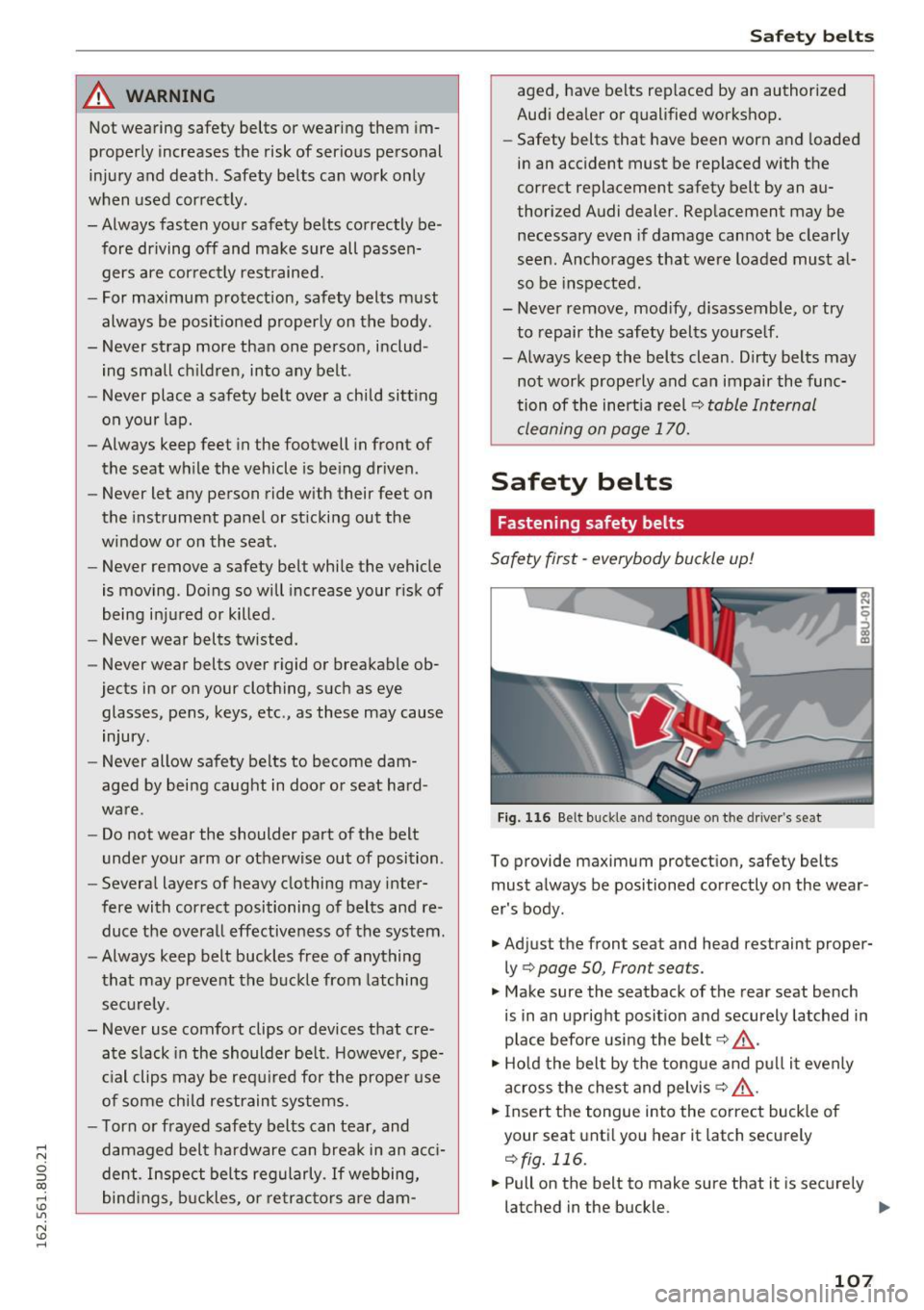
Fig. 116 Belt buckle and tongue on t he driver 's seat
To provide maximum protect ion, safety belts
must always be positioned correctly on the wear
er's body .
.. Adjust the front seat and head restraint proper
ly¢
page SO, Front seats.
.. Make sure the seatback of the rear seat bench
is in an upright posit ion and securely latched in
p lace before using the belt¢ ,&. .
.. Ho ld the belt by the tongue and pu ll it evenly
across the chest and pelvis~,&. .
.. Insert the tongue into the correct buckle of
your seat unti l you hear it latch securely
r:!)fig. 116 .
.. Pull on the belt to make sure that it is securely
latched in the buckle. ..,.
107
Page 117 of 252
recommend that children a lway s sit in t he b ack
seat ~
page 132, Child safety .
A WARNING
A child in a rearward-facing chi ld safety seat
installed on the front passen ger seat w ill be
seriously injured and can be killed if the front airbag inflates -even w it h an Advanced A irbag
System .
- The inflating a irbag w ill hit the child safety
seat or infant carrier with great force and
will smash the ch ild safety seat and chi ld
against t he backrest, center armrest, door
o r roof.
- Always install rear-facing child safety seats
on the rear seat.
- If you must i nstall a rearward fac ing ch ild
safety seat on t he front passenger seat be
cause of exceptiona l circumstances and the
PASSENGER AIR BAG OFF light does not
come on and stay on, immed iate ly install
the rear-fac ing ch ild safety seat in a rear
seating posit ion and have the airbag system
inspected by your a uthorized Audi dea ler.
- Forward-fac ing ch ild safety seats installed
on the front passenger's seat may interfere
with the deployment of the airbag and cause serious personal in jury to the child.
A WARNING
If, in except ional circumstances, you must in
stall a forward-facing chi ld restraint on the
front passenger's seat:
- Always make sure the forward-fac ing seat
has been designed and ce rtified by its man
ufacturer fo r use on a fron t seat with a pas
senger front and s ide a irbag.
- Never put the forward-facing child restraint
up against or ve ry near the instrument pan
el.
- Always move the passenger seat into its
rea rmost position in t he seat's fore and aft
adjus tme nt range, as f ar away from the ai r
bag as possib le befo re instal ling the for
wa rd -f acing child restra int . T he backrest
must be adjusted to an upright position .
Airbag sys tem
-Make sure that the PASSENGER AIR BAG
OFF
li ght comes on and stays on a ll the time
whenever the ignit ion is switched on.
A WARNING
To reduce the risk of serious injury, make sure
that the
PASSENGER AIR BAG OFF li ght will
be d isplayed whenever a child rest raint is in
stalled on the front passenger seat and the i gnition is switched on.
- If the PASSENGER AIR BAG OFF light does
not stay on, pe rform t he checks desc ribed
c> page 122, Monitoring the Advan ced Air
bag System.
- T ake the child restra int off t he front passen
ge r seat and install it prope rly at one of the
rear sea t positions i f the
PASSENGER AIR
BAG OFF
light does no t stay on .
- Have the ai rbag system inspec ted by your
author ized Audi dealer immed iate ly .
- Always carefully f ollow ins truc tions from
chi ld restrain t manufacturers when instal
ling child restra ints .
A WARNING ~ -If, in exceptional ci rcumstances, you must in -
stall a forward or rearward-facing child re
stra int on the front passenger's seat:
- Imp roper installation of child restrai nts can
reduce the ir effectiveness or even prevent
them from providing any protection.
- An imprope rly installed child restra int can
inter fere with the airbag as it deploys and
serio usly injure or even kill the chi ld -even
with an Advanced A irbag System.
- Always care fully follow the manufacturer's
instr uctions provided with the child safety
seat or carr ier.
- Never p lace add itiona l items on the seat
that can increase t he total weight registered
by the weight-sensi ng mat and can cause in
jury in a crash.
115
Page 120 of 252
Airbag syste m
-a small adu lt or teenager is on the front pas
senger seat
- a passenger who is not sitting upright with
their back against a non -reclined backrest with
their feet on the vehicle floor in front of the
seat is on the front passenger seat.
I f the front passenger airbag dep loys, the Feder
al Standard requires the airbag to meet the "low
risk" deployment criteria to help reduce the risk
of injury through interaction with the airbag.
"Low risk" deployment occurs in those crashes
that take place at lower decelerations as def ined
in the electronic control unit.¢
page 122
Alway s remember: Even though your vehicle is
equ ipped w ith Advanced Airbags, the safest place
for children is properly restrained on the back
seat . Please be sure to read the important infor
mat ion in the sections that follow and be sure to
heed a ll of the WARN INGS.
A WARNING
To red uce the risk of inj ury when an ai rbag in
fla tes, a lways wear safety bel ts p roperly.
- If you are unrestrained, leaning fo rwa rd, s it
t ing s ideways or o ut of pos ition in any way,
yo ur risk of in jury is much h igher .
- Yo u will also re ceive serious injur ies and
could even be killed if you are up aga inst the
airbag or too close to it when it inflates -
even with an Advanced Airbag
¢page 112.
A WARNING
A child in a rearward-facing chi ld safety seat
installed on the front passenger seat wi ll be
ser iously injured and can be killed if the front
airbag inflates - even w ith an Advanced Airbag
System.
- Although the Advanced A irbag System in
your vehicle is designed to turn off the front
airbag when a rearward-facing child re
straint has been installed on the front pas
senger seat, nobody can absolutely g uaran
tee that deployment is impossible in all con
ceivable s ituations that may happen during
the useful life of your vehicle .
- The inflating a irbag w il l hit the child safety
seat or infant c arrier with great force and
118
w ill smash the child safety seat and child
aga inst the back rest, center armrest, door,
or roof.
- Always install rearward-facing child re
straints in the back seat.
- If you must install a rearward facing child
safety seat on the front passenger seat be
cause of exceptional circumstances and the
PASSENGER AIR BAG OFF light does not
come on and stay on, immediately install
the rea r-facing child safety seat in a rear
seating posi tion and have the ai rbag system
inspected by your au thori zed Au di dealer.
A WARNING
If, in exceptional ci rcums tances, you must in
stall a forward-facing child res traint on the
front passenger's seat:
- Always make sure the forward-fa cing sea t
has been des igned and certified by its man
ufacturer for use on a front seat with a pas
senger front and side airbag.
- Never put the fo rward -facing child restraint
up against or very nea r the instrument pan ·
el.
-Always move the passenge r seat into its
rearmost position in the seat's fo re and aft
ad justment range, as far away from the a ir
bag as poss ible, before install ing the for
ward-facing chi ld restraint. The backrest
m ust be adjusted to an upr ight position.
- Make sure that the
PASSENGER AIR BAG
OFF
li ght comes on and stays on all t he time
wheneve r the ign it ion is switched on.
Advanced Airbag System components
The fro nt passenge r seat i n your veh icle has a lot
of ve ry important parts of the Advanced A irbag
System i n it. These parts incl ude t he weight
sens ing mat, senso rs, wir ing, bracke ts, and
more . The f unction o f the system in the front
passenger seat is checked by the electro nic con
tro l unit when the ignition is on . The control unit
monitors the Advanced Airbag System and turns
the airbag ind icator light on when a malfunction
i n the system components is detected. The func-
tion of the a irbag ind icator light is described in .,_
Page 123 of 252
-and the head restraints have been properly ad -
justed.
Because airbags inflate in the blink of a n eye w ith
great for ce, things you have on you r lap or have
p laced on the seat cou ld become dangerous pro
jectiles, and be pushed into you if the airbag in
flates.
When an a irbag deploys, fine dust is released .
This is normal and is not caused by a fire in the
vehicle. This dust is made up mostly of a powder
used to lubricate the airbags as they deploy. It
could irr itate skin.
It is important to remember that while the sup
p lemental airbag system is designed to reduce
the likelihood of ser ious injuries, other inj uries,
for example swell ing, bruising and minor abra
sions, can also happen when airbags inflate. Air
bags do not protect the arms or the lower parts
of the body . Front airbags only supplement the
three po int safety belts i n some fronta l co llisions
i n which the veh icle decelerat ion is high enough
to deploy the airbags.
F ront airbags will not deploy:
- if the ignit ion is switched off when a crash oc -
curs,
- in s ide collisions,
- in rear-end collisions,
- in rollovers,
- when the crash decelerat ion measured by the
airbag system is less than the minimum thresh
o ld needed for airbag deployment as registered
by the electronic contro l unit .
Th e front passeng er airbag will a lso not
deplo y:
- when the front passenger seat is not occupied,
- when the weight on the front passenger seat as
sensed by the Advanced Airbag System indi
cates that the front airbag on the passenger
s ide has to be turned off by the electronic con
trol unit (the
P A SSENGER AIR B AG OFF light
comes on and stays on).
A WARNING
Sitting in the wrong pos ition can increase the
r isk of se rious injury in c rashes.
Airb ag sys tem
-To reduce the risk of injury when the ai rbags
inflate, the driver and passengers must al
ways sit in an upright posit ion, must not
lean aga inst or place any part of their body
too close to the area where the airbags are located.
- Occupants who are unbelted, out of posit ion
or too close to the airbag can be seriously in jur ed by an airbag as it unfolds with g reat
for ce in the blink of an eye
Qpage 113.
A WARNING
A child in a rearward-facing child safety seat
i nsta lled on the front passenger seat will be
seriously injured and can be k illed if the front
a irbag inflates - even with an Advanced Airbag
System .
- The inflating airbag will hit the child safety seat or infant ca rrier with great force and
will smash the child safety seat and child aga inst the backrest, center armrest, door
or roof.
- Always install rear-fac ing child safety seats
on the rear seat.
- If you must install a rea rwa rd facing child
safety seat on the front passenger seat be
cause of exceptional circumstances and the
PA SS ENGER AIR BAG OFF light does not
come on and stay on, immediately install
the rea r-facing child safety seat in a rear
seating position and have the a irbag system
inspected by your au thori zed A udi dealer.
A WARNING
Objects between you and the airbag will in
crease the risk of injury in a crash by interfer
ing with the way the airbag unfolds or by be
ing p ushed into you as the airbag inflates .
- Never hold things in yo ur hands or on your
lap when the vehicle is in use .
- Never transport items on or in the area o f
the front passenger seat . Objects could
move into the area of the front airbags dur
ing braking or other sudden maneuver and
become dangerous projectiles that can
cause serious persona l injury if the airbags
inflate.
121
Page 124 of 252
Airbag syste m
-Never place or attach accessories or other
objects (such as cupholders, telephone
brackets, large, heavy or bulky objects) on
the doors, over or near the area marked "AIRBAG" on the steering wheel, instru
ment panel, seat backrests or between
those areas and yourself. These objects
could cause injury in a crash, especially
when the airbags inflate.
- Never recline the front passenger's seat to
transport objec ts. Items can also move into
the area of the side airbag or the front a ir
bag dur ing braking or in a sudden maneu
ver. Objects near the airbags can become projectiles and cause injury, particularly
when the seat is reclined.
A WARNING
The f ine dust created when airbags deploy can
cause breath ing problems for people w ith a
history of asthma or other breathing condi
t ions.
- To reduce the risk of breathing problems,
those w ith asthma or other respiratory con
ditions should get fresh air right away by
gett ing out of the vehicle o r opening w in
dows or doors.
- If you are in a collision in which airbags de
ploy, wash your hands and fa ce with mild
soap and water befo re eat ing.
- Be careful not to get the dust into your eyes,
o r into any cu ts or sc ratches.
- If the resid ue should get into yo ur eyes,
flush them with water.
Monitoring the
Advanced Airbag System
!f Airbag monitoring indicator light
Two separate indicators monitor the function of
the Advanced Airbag System: the airbag moni
toring indicator light and the
PA SSENGER AIR
BAG OFF
light.
The Advanced Airbag System as well as the side airbags and side curtain airbags with eject ion
mit igat ion features ( including the electronic con
trol unit, sensors and system wiring) are all
122
monitored continuous ly to make sure that they
are functioning properly whenever the ignition is
on . Each time you turn on the ignit ion, the airbag
monitoring indicator light
m will come on for a
few seconds (se lf diagnostics) .
The system mu st be inspected wh en th e
indicat or light
E,I:
- does not come on when the ignition is switched
on,
- does not go out a few seconds after you have
switched on the ignit ion, or
- comes on while driving.
If an airbag system malfunc tion is detec ted, the
indicator light will first start flashing to catch the
driver's attention and then stay on continuously
to serve as a constant rem inder to have the sys
tem inspected immediately.
If a malfunction occurs that turns the front air
bag on the passenger side off, the
PASSENGER
AIR BAG O FF
light will come on and stay on
whenever the ignition is on.
A WARNING
An airbag system that is not functioning prop
erly cannot provide supplemental protect ion
in a frontal crash .
- If the airbag ind icator light
q page 16
comes when the veh icle is being used, have
the system inspected immediately by your
author ized Audi dealer. It is possib le that
the airbag will i nfla te when i t is no t sup
posed to, or wi ll not inf late when it sho uld.
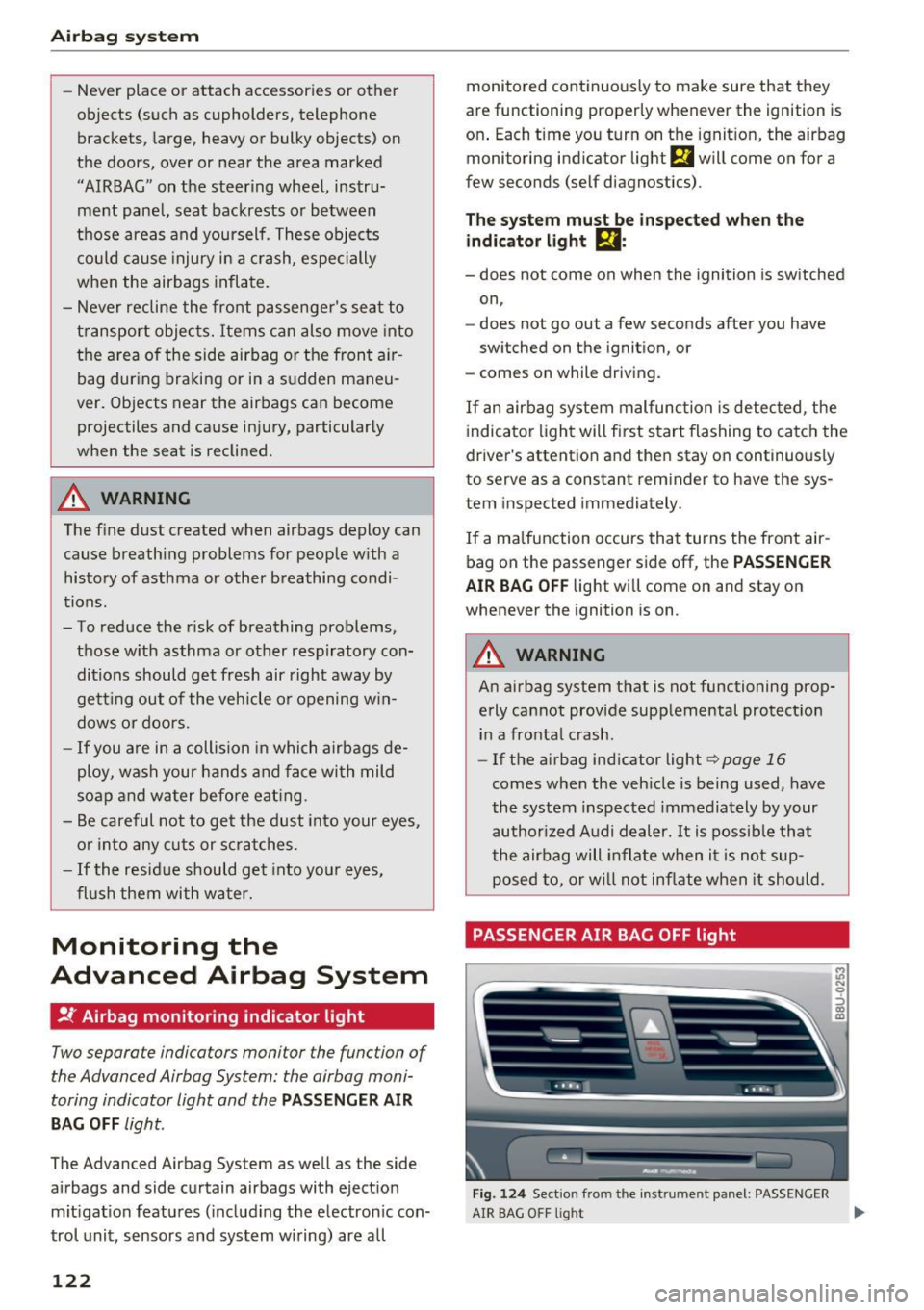
PASSENGER AIR BAG OFF light
Fig. 12 4 Section from the inst rument panel: PASSENGER
&l N 9 ::::, CD m
AIR BAG OFF l ight ...
Page 126 of 252
Airbag syste m
-the adu lt on the front passenger seat is proper
ly seated on the center of the seat cushion with
his or her back up against the backrest and the
backrest is not reclined
c> page 96, Correct pas
senger seating positions,
- the adult is not taking weight off the seat by
holding on to the passenger assist handle
above the front passenger door or supporting
their we ight on the armrest,
- the safety belt is being properly worn and that
there is not a lot of slack in the safety belt web
bing,
- accessory seat covers or cushions or other
th ings that may cause an incorrect read ing or
impression on the weight-sensing mat under
the upho lstery of the seat have been removed
from the front passenge r seat,
- a safety be lt extender has not been left in the
safety belt latch for the front passenge r seat.
In addition to the
PA SSE NGER AIR BA G OFF
lig ht in the center of the instrument panel, the
message
PASSENGER AIR BAG OFF or PASSEN
GER AIR BAG ON
w ill briefly appear in the inst ru
ment cluster display . T his is to inform the driver
of the current front passenger airbag status.
Important safety instructions on
monitoring the Advanced Airbag System
A WARNING
An airbag system that is not funct ion ing prop
er ly cannot p rovide supplemental p rotection
in a frontal crash.
- If the airbag indicato r light
c>page 16
comes when the vehicle is be ing used, h ave
the system inspected immediate ly by yo ur
authorized Audi dealer. It is possible that
the airbag will inflate when it is not s up
posed to, or will not inflate when it should.
A WARNING
If the front airbag inflates, a child without a
child restraint, in a rearward-facing child safe
ty seat or in a forward-facing child restra int
that has not been properly installed w ill be
ser iously injured and can be killed .
124
-Even tho ugh your vehicle is equipped with
an Advanced A irbag System, make certain
that a ll children, espec ia lly 12 years and
younger, always ride on the back seat prop
erly restrained for their age and s ize.
- Always install forward or rear-facing child
safety seats on the rear seat - even with an
Advanced A irbag System.
- If you must install a rearward-facing child
safety seat on the front passenger seat be
cause of exceptional circumstances and the
PASSENGER AIR BAG OFF light does not
appear and s tay on, immedi ately ins tall the
rear-facing child safety seat in a re ar seat ing
position and have the a irbag system in
spected by your authorized Audi dea ler.
- A t ight tether or other s trap on a rearward
facing chi ld restraint attached to the front
passenger seat can put too much pressure
on the weight-sensing mat in the seat and
register more weight than is actually on the
seat. The heavier weight registered can
make the system work as thoug h an adu lt
were on the seat and deploy the Advanced
Airbag when it must be suppressed causing
serious or even f atal injury to the child.
- If, in exceptional circumstances, you must
install a forward-facing child res traint on
the front p assenge r seat, always move the
seat into i ts rearmost position in the sea t's
fore and aft ad justment range, as far away
from the ai rbag as possible . The backrest
must be adjusted to an upr ight position.
Make sure that the
PASSENGER AIR BAG
OFF
li ght comes on and stays on all the time
wheneve r the ignit ion is switched on.
A WARNING
- If the PASSENG ER AIR BAG OFF light does
not go out when an adult is sitting on the
front passenger seat afte r taking the steps
described above, make s ure the adult is
p roper ly sea ted and restra ined at one o f the
rear sea ting posit ions .
- Have the ai rbag system inspected by your
author ized Audi dealer befo re t ransporting
anyone on the front passenger seat.
Page 128 of 252
Airbag syste m
with these requirements and we recommend
that you have your dealer perform this service
for you.
Other things that can affect Advanced
Airbag performance
Changing the vehicle's suspension system can
change the way that the Advanced Airbag System
performs in a crash. For examp le, using t ire-r im
comb inat ions not approved by Audi, lower ing the
veh icle, changing the stiffness of the suspens ion,
including the springs, suspension struts, shock
absorbers etc . can change the forces that are
measured by the airbag sensors and sent to the
electronic control unit. Some suspension changes
can, for example, increase the force levels meas
ured by the sensors and make the airbag system
deploy in crashes in wh ich it would not deploy if
the changes had not been made. Other kinds of
changes may reduce the force levels meas ured by
the sensors and prevent the airbag from deploy ing when it should.
A WARNING
Changing the vehicle's suspension including
use of unapproved tire-rim combinations can
change Advanced Airbag performance and in
crease the risk of serious personal injury in a
crash.
- Never install suspension components that
do not have the same performance charac
teristics as the components originally instal
led o n your veh icle .
- Never use tire-rim comb inations that have
not been approved by Audi.
A WARNING
Items stored between the safety belt buckle
and the center console can cause the senso rs
in the buckle to send the wrong info rmation
to the electronic control module and prevent
t he Advanced Airbag System from wor king
properly.
- Always make sure tha t noth ing can interfere
with the safety be lt buck les and that they
are not obstructed.
126
Side airbags
Description of side airbags
The airbag system can provide supplemental
protection to properly restrained occupants .
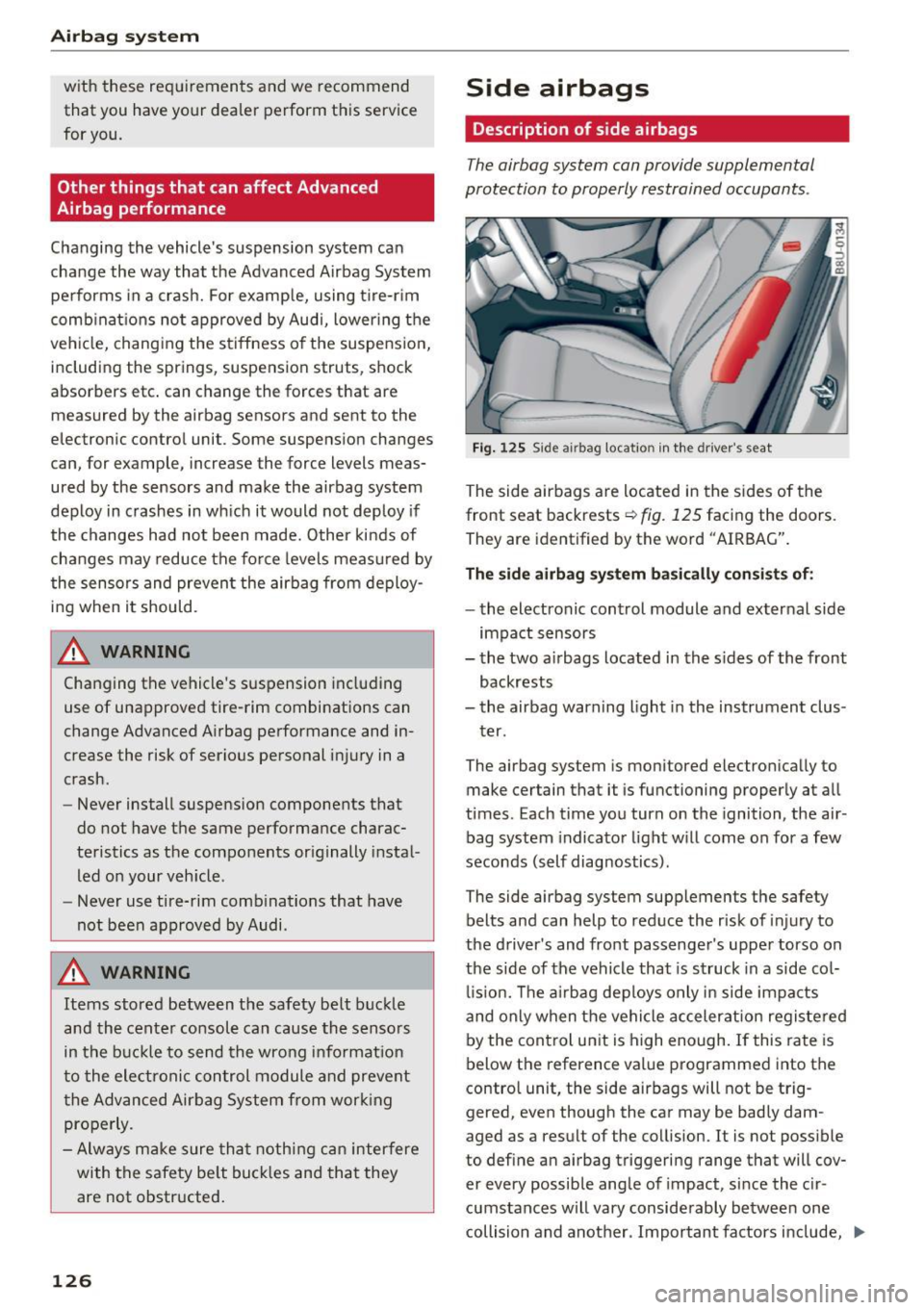
Fig. 125 S ide a irbag locat io n in the driver's seat
The side airbags are located in the sides of the
front seat backrests ¢
fig. 125 facing the doors.
They are identified by the word "AIRBAG".
The sid e airbag system ba sically con sis t s o f:
- the electronic control module and external side
impact sensors
- the two a irbags located in the s ides of the front
backrests
- the airbag warning light in the instrument clus -
ter.
The airbag system is monitored electronica lly to
make certain that it is functioning properly at a ll
t imes. Each time you turn on the ignition, the air
bag system indicator light w ill come on for a few
seconds (self diagnostics) .
The side airbag system supplements the safety belts and can help to reduce the risk of injury to
the driver's and front passenger's upper torso on
the side of the vehicle that is struck in a side co l
li sion. The a irbag deploys only in side impacts
and only when the vehicle acceleration registered by the control unit is high enough. If this rate is
below the reference val ue programmed into the
contro l unit, the side airbags will not be trig-
gered, even though the car may be badly dam-
aged as a result of the collision. It is not possible
to define an airbag triggering range that will cov er every possible angle of impact, si nce the c ir
cumstances w ill vary conside rably between one
collision and another . Important factors include, .,,.