warning AUDI Q5 2013 Owners Manual
[x] Cancel search | Manufacturer: AUDI, Model Year: 2013, Model line: Q5, Model: AUDI Q5 2013Pages: 316, PDF Size: 78.89 MB
Page 246 of 316
244 Checking and filling
Vehicles not driven for long periods
If you do not drive you r vehicle over a pe riod
of severa l days or weeks, electrical compo
nents are gradually cut back or switched off.
This reduces energy consumption and main
tains starting capability over a longer period
¢page 203.
Take into consideration that when yo u un lock
your vehicle, some convenience functions, such as the interior lights or the power seat
adjustment, may not be available. The con
venience funct ions w ill be available again
when you turn on the ignition and start the
engine .
Winter operation
During the winter months, battery capacity
tends to decrease as temperatures drop . This
is because more power is also consumed while
start ing, and the headl ights, rear window de
fogger, etc., are used more often .
Avoid unnecessary power consumption, par
ticularly in city traffic or when traveling only
short distances . Let your authorized Audi
dealer check the capacity of the vehicle bat
tery before winter sets in¢
page 245. A well
cha rged battery w ill not only prevent starting
prob lems when the weather is cold , but will
a lso last longer .
Working on the battery
Be especially careful when working on or near
the battery.
The battery is located in the luggage compart
ment under the floor. Before you check any
thing in the luggage compartment,
read and
heed all WARNINGS
¢ _&..
Hybr id drive*: you can find impo rtant informa
tion about the high voltage battery under
¢page 97 .
Always heed the safety warnings , when work
ing on the vehicle battery or the vehicle elec
trical system to prevent injury.
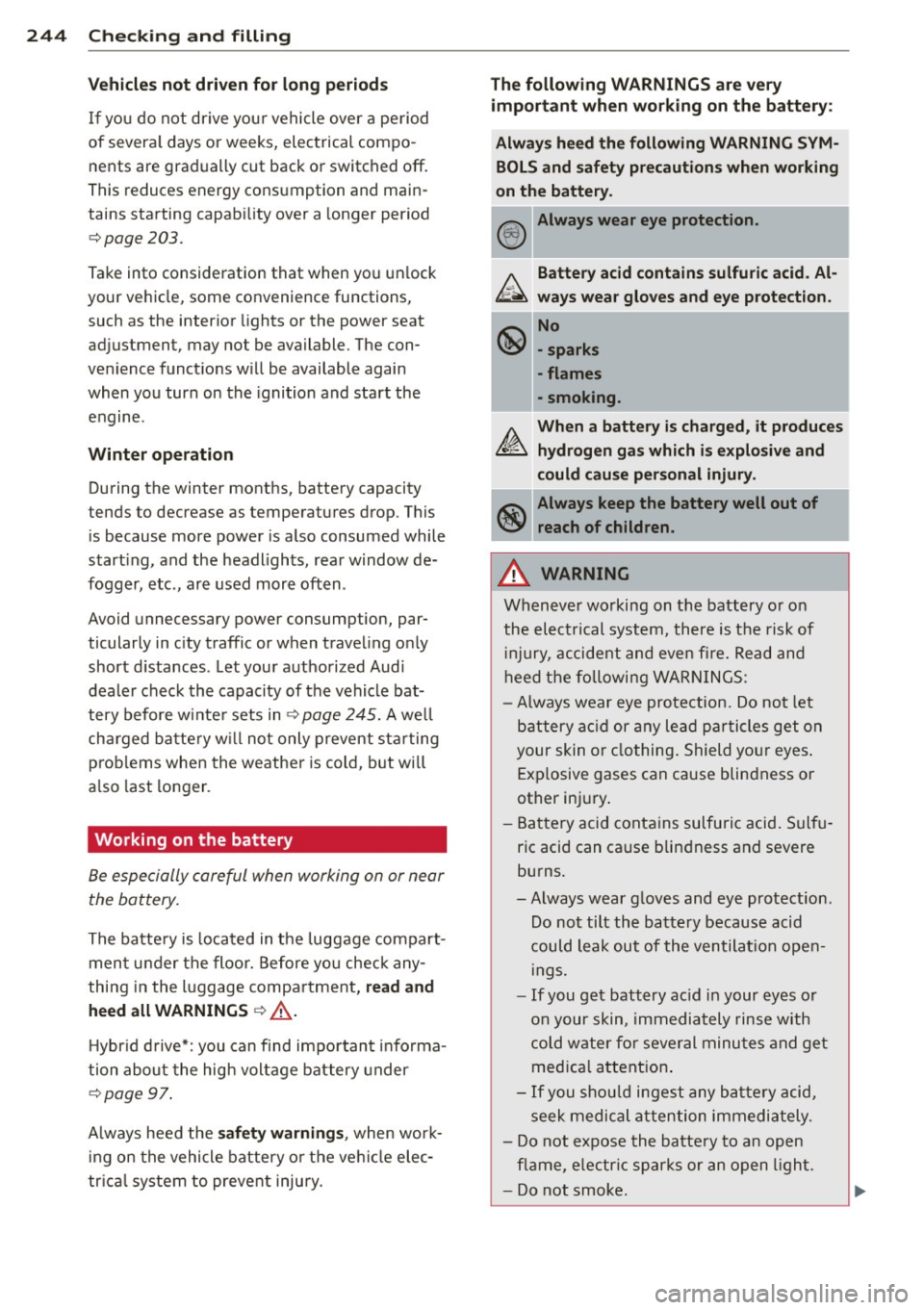
The following WARNINGS are very
important when working on the battery:
Always heed the following WARNING SYM BOLS and safety precaution s when working
on the battery.
@) Always wear eye protection .
I>. Battery acid contains sulfuric acid_-Al
~ ways wear gloves and eye protection.
~ No
\!=51 -sparks
-flames
-smoking.
A When a battery is charged, it produces
~ hydrogen gas which is explosive and
could cause personal injury.
/G Always keep the battery well out of
V!!JI reach of children.
A WARNING "--
Whenever working on the battery or on
the electrical system, there is the risk of
in jury, accident and even fi re. Read and
heed the following WARNINGS :
- Always wear eye protection. Do not let
battery ac id or any lead particles get on
your skin or clothing. Shield your eyes .
Exp losive gases can cause blindness or
other injury .
- Ba ttery acid contains sulfuric acid. Sulfu
ric acid can ca use blindness and severe
burns .
- Always wear gloves and eye protection .
Do not tilt the battery because acid
could leak out of the ventilat ion open
i ngs.
- If you get battery ac id in your eyes or
on your skin, immediately rinse with
cold water fo r several minutes and get
med ical attention .
-If you should ingest any battery acid,
seek medical attention immediately.
- Do not expose the battery to an open
flame, electr ic sparks or an open light.
- Do not smoke.
-
1
I
Page 247 of 316

-Do not interchange the positive and neg
ative cables .
- When working on the battery , be sure
not to short-circuit the terminals with
tools or other metal objects. This would cause the battery to heat up very quickly,
which could lead to damage or explosion
and personal injury.
- When a battery is charged, it produces
hydrogen gas which is explosive and
could cause personal injury .
- Always keep the battery well out of the
reach of children .
- Before work is done on the electrical sys
tem, disconnect the negative ground ca
ble .
- Before performing any work on the elec
trical system , switch off the engine and
ignition as well as any electrical equip
ment. The negative cable on the battery
must be disconnected. If you are just go
ing to replace a light bulb, then it is
enough to switch off the lights.
- Before disconnecting the battery , switch
off the anti-theft alarm system! Other
wise you will set off the alarm.
- When disconnecting the battery, first
disconnect the negative cable and then
the positive cable.
- Before reconnecting the battery, make
sure all electrical consumers are switch
ed off. Reconnect the positive cable first
and then the negative cable. Never inter
change the cables - this could start a fire!
- Never charge a fro zen or a thawed-out
battery. It could explode! If a battery has
frozen, then it must be replaced. A dis
charged battery can freeze over at 32°F
(OOC) .
-Make sure the vent hose is always attach
ed to the opening on the side of the bat
tery.
- Never use batteries which are damaged.
There is the danger of an explosion! Al
ways replace a damaged battery.
Checking and filling 245
A WARNING
California Proposition 65 Warning:
- Battery posts, terminals and related ac cessories contain lead and lead com
pounds, chemicals known to the State of
California to cause cancer and reproduc
tive problems . Wash hands after han
dling.
Q) Note
- Do not disconnect the vehicle battery
when the ignition is switched on or when
the engine is running, otherwise , you will
damage electronic components in the
electrical system.
- If your vehicle is going to stand for a
long period of time without being driven,
protect the battery from "freezing", oth
erwise it will be damaged and will then
have to be replaced.
Battery charging
Starting the engine requires a well charged
battery.
Fig. 201 Engin e compart ment: Co nn ectors for charger
and j umper cab les
Always read and heed all WARNINGS below
¢ .&. and ¢,&. in Working on the battery on
page 244.
~ Hybrid drive*: read the important informa
tion concerning a dead high voltage battery
under
¢ page 105.
~ Turn off the ignition and all electrical con
sumers.
~ Make sur e the area is well ventilated when
you charge the battery . ..,.
Page 248 of 316
246 Checking and filling
• Open the engine hood ¢ page 233.
• Remov e the cover (!) by pressing on the ar
row ¢
fig. 201.
• Open the cover @on the positive term inal.
• Connect the charger connectors according
to the instruct ions to the
jump start bolts.
(Bolts under the cover = "positive ", Bolts
with hex head= "negative").
• Only now plug the mains lead for the charg
i ng equipment into the wall outlet and turn
iton ¢,&. .
• Make sure the charging rate is not over
30 amps/14.8 Volt.
• When the battery is fully charged: Turn the
charging equ ipment off and remove the
mains lead from the wall outlet.
• Now remove the clamps for the charging
equipment.
• Close the cover @on the positive term inal
and re-install the cover (!).
• Close the hood ¢
page 233.
A discharged battery can freeze at tempera
tures of on ly 32 °F (0 °C). A llow a frozen bat
tery to thaw completely befo re attempt ing to
cha rge it~ &. . H owever, we recommend not
using a thawed battery again because the bat
tery casing can be cracked due to ice forma
tion and can leak battery acid.
Battery charging (Maximum charging rate
of
30 amps/14.8 Volt)
When charging at low voltages (e.g . with a
trickle charger ), the battery cables do not
have to be d isconnected first. The battery
caps should
not be opened when charging a
battery .
It is not necessary to remove the battery from
the luggage compartment.
Fast charging the battery (charging rate
above 14.8 Volts )
For technical reasons do not use a battery
charger that uses voltage greater than 14.8
Volts to charge your vehicle's battery.
.&_ WARNING
Charging a battery can be dangerous. -
Always follow the operating instructions
provided by the battery charger manu
facturer when charging your battery.
- Never charge a frozen battery. It may ex
plode because of gas trapped in the ice.
Allow a frozen battery to thaw out first.
- Do not reuse batteries wh ich were fro
zen. The battery housing may have
cracked and weakened when the battery
froze.
- Charge the battery in a well ventilated
area. Keep away from open flame or elec
tr ica l spark. Do not smoke. Hydrogen gas
generated by the battery is explosive.
- To reduce the danger of explosion, never
connect or disconnect charger cab les
while the charger is ope rat ing.
- Fast charging a battery is dangerous and
should only be attempted by a compe
tent technician with the proper equip
ment.
- Battery acid that may spill dur ing charg
ing should be washed off with a solution
of warm wat er and baking soda to neu
tralize the acid.
(I) Note
Never use a fast charger as a booster to
start the engine. This will seriously dam
age sensitive electronic components, such
as contro l units, re lays, radio, etc., as well
as the battery charger.
Battery replacement
The new battery must have the same specifi
cations and dimensions as the original equip
ment battery.
Intelligent energy management in your vehi
cle is responsible for distributing the electri
ca l energy throughout your vehicle
¢
page 203 . The intelligent energy manage
ment system will keep the engine battery
charged better then vehicles without this sys
tem . To make sure the additional electrical en
ergy is ava ilable once again after you have
changed the battery, we recommend that you ..,.
Page 249 of 316
install batteries of the same type and manu
facture only (the same as those installed at
the t ime your vehicle was delivered) . Specifi
cations are listed on the battery housing. Your
authorized dealer must code the battery in
the energy management system to enable you
to use the energy management functions cor rectly after replacing the battery .
If it is not possible to use a battery of this
type, the new battery must have the same ca
pacity, voltage (12 volts), amperage, con
struction and plug sea ling .
When installing the battery, make sure the ig
nition and all electr ica l consumers are turned
off.
(D Note
- Make sure the ventilation hose on the
s ide of the batte ry is connected, other
wise fumes or battery acid can leak out .
- Vehicles with the Start-Stop-System* are
equipped with a special cycle-proof AGM
battery . Installing a different type of
battery can cause problems in the vehi
cle elec trical system. When replacing the
vehicle battery, always insta ll one with
the same specifications as the original
battery.
@ For the sake of the environment
Because of the problem of proper disposal
of a battery, we recommend your author
ized Audi dealer change the battery for
you. Batteries contain su lfuric acid and
lead and must always be disposed of prop
erly in compliance with all environmental
regu lations . D isposing of vehicle batteries
improperly is very dangerous to the envi
ronment .
Checkin g and fillin g 247
Windshield/headlight
washer container
Fig. 202 Eng in e compar tment: cov er on the w inds hield
and headl ight* washe r fl uid reservoir
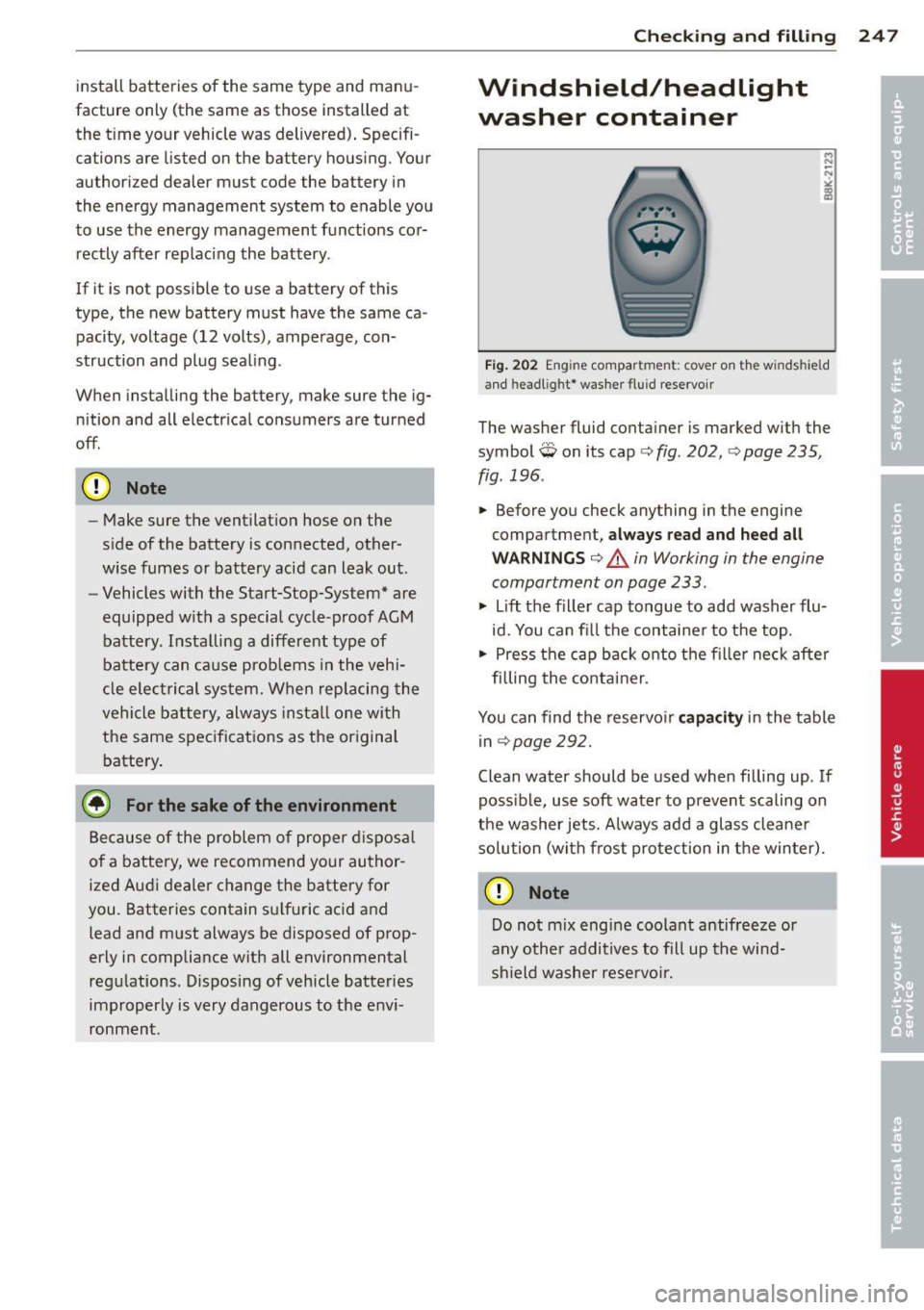
The washer fluid container is marked with the
symbol
Q on its cap c::> fig. 202, c::> page 235,
fig . 196 .
.., Before you check anything in the engine
compartment,
always read and heed all
WARNINGS c::> &. in Working in the engine
compartment on page 233 .
.., Lift the filler cap tongue to add washer flu
id . You can fill the container to the top.
.., Press the cap back onto the filler neck after
f illing the container.
You can find the reservoir
capacity in the table
in
c::> page 292.
Clean water should be used when filling up. If
possible, use soft water to prevent scaling on
the washer jets. A lways add a glass cleaner
solution (with frost protection in the winter).
(D Note
Do not mix engine coolant antifreeze o r
any other additives to fill up the wind
sh ield washer reservoir.
Page 250 of 316
248 Tire s and whee ls
Tires and wheels
Tires
General notes
Tires may be the least appreciated and most
abused parts of a motor vehicle .
Tires may be the least appreciated and most
abused parts of a motor vehicle. Tires are,
however, one of the most important parts of a
vehicle, particularly considering the compara
tive ly small patch of rubber on each tire that
assures that all -important contact between
you, your vehicle and the road.
Maintaining the correct tire pressure, making
sure that your vehicle and its tires do not have
to carry more weight than they can safe ly han
d le, avoiding damage from road hazards and
reg ularly inspecting t ires for damage includ
ing cuts, slashes irregu la r wear and overall
condition are the most important things that
you can do to he lp avoid sudden tire failure in
cluding tread separation and blowouts.
A vo idin g dama ge
I f you have to drive over a curb or similar ob
stacle, drive very slow ly and as close as possi
ble at a right angle to the curb.
A lways keep chem icals including grease, oil,
gasoline and b rake fluid off the tires.
Inspect the tires regularly for damage (cuts,
cracks or bl isters, etc.). Remove any foreign
bod ies embedded in the treads.
St orin g tire s
Mark tires when you remove them to indicate
the direction of rotation . Th is ensures you to
be ab le to mount them correctly when you re
install them.
When removed, the wheels or tires should be
stored in a cool, dry and preferably dark place .
Store tires in a vertical position if they are not mounted on rims, in a horizontal position if
they are mounted on rims. N
ew tir es
New t ires have to be broken in¢&,. .
The tread depth of new t ires may vary, accord
ing to the type and make of t ire and the tread
pattern .
Hidden damag e
Damage to tires and r ims is often not readily
vis ible . If you notice unusual vibrat ion or the
vehicle pulls to one s ide, th is may ind icate
that one of the t ires has been damaged . T he
t ir es must be checked immed iate ly by an au
tho rized Aud i dea le r or q ualified wor kshop.
Unidirecti onal t ires
A un idirectional tire can be identified by ar
rows on the sidewall, that po int in the direc
t ion the t ire is designed to rotate. You must
fol low the specified direction of rotation . This
is necessary so that these tires can develop
their optimum characteristics regarding grip, road noise, wear and hydrop laning resistance.
For more information ¢
page 2 78.
A WARNING
-New tires or tires that are old, worn or
damaged cannot provide maximum con
trol and braking ability .
-
-New tires tend to be slippery and must
also be broken-in. To reduce the risk of losing control, a collision and serious
pe rsonal injuries, drive w ith specia l care
for the first 350 miles (560 km).
- Driving with worn or damaged tires can lead to loss of control, sudden tire fail
ure, including a blowou t and sudden de
flation, c rashes and serious personal in
juries . Have worn or damaged tires re
p laced immediate ly.
- Tires age even if they are not being used
and can fai l sudden ly, especially at high
speeds. Tires that are more than 6 years
old can only be used in an emergency
and then w ith special care and at low
speed.
Page 256 of 316
254 Tire s and wheel s
A WARNING
Overloading a vehicle can cause loss of ve
hicle control, a crash or other accident, se
rious personal injury, and even death .
- Carrying more weight than your vehicle
was designed to carry will prevent the
vehicle from handling properly and in crease the risk of a loss of veh icle con
trol.
- The brakes on a vehicle that has been
overloaded may not be able to stop the
vehicle within a safe distance .
- Tires on a vehicle that has been overload
ed can fail suddenly causing loss of con
trol and a crash .
- Always make sure that the total load be
ing transported -including the we ight of
a tra iler hitch and the tongue weight of a
loaded trailer -does not make the veh i
cle heav ier than the veh icle's Gross Vehi
cle Weight Rating.
A WARNING
- Incorrect tire pressures and/or underin
flation can lead to a serious o r fatal acci
dent.
- Incorrect tire pressures and/or underin
flation cause increased tire wea r and can
affect the handling of the vehicle .
- Incorrect tire pressures and/or underin
flation can also lead to sudden tire fa il
ure, including a blowo ut and sudden de
flation, causing loss of vehicle control.
Checking tire pressure
-
The correct tire pressure for the tires originol
ly installed on your vehicle is listed on the tire
pressure label located on driver's side 8-pil
lar .
The recommended tire pressures are on the
tire pressure labe l and in the tab le
c:::> page 252, Cold tire inflation pressure .This
means that the pressure must be checked and
adjusted when the tire has not been driven for more than a couple of m iles (k ilometers) at
low speeds during the p revious three hours . Air in the tires expands when the tire heats up
as a result of interna l friction as it flexes in
u se . The tire pressure is h igher when the tire
has warmed up than when it is "cold."
It is the inflation pressure in a "co ld" tire that
counts . Therefore, you should never let air out
of a warm tire to match "Cold t ire inflat ion
pressure" recommendat ions
c:::> page 252 . The
t ires wou ld then be underinflated and could
fail suddenly .
The tire pressure label on your Audi lists the recommended co ld tire inflation pressures at
maximum capacity for the new, orig inal
equipment tires that were on your vehicle at
the time it was manufactured . Fo r the loca
t ion of the labe l
c:::>page 252, fig . 203 .
Most tires lose air naturally over t ime . They
can a lso lose some air if you drive over a pot
hole or hit a curb while park ing. It is usually
not possible to see whether the rad ia l tires
used today are underinflated jus t by looki ng
at them.
T he refo re, be sure to check t ire p ressures at
least once a month and always before going
o n a long trip. Ma ke sure to take the numbe r
of peop le and the amou nt o f luggage into ac
count when adjust ing tire pressu re for a trip -
even one that yo u wo uld not consider to be
" long." See
c:::> page 256, Tires and vehicle
load limits
for more important information .
Always use an ac curate tire p ress ure ga uge
when checking and adj usting inflation pres
s u res . Check a ll of the tires and be sure not to
forget the spare tire. If the pressure in any t ire
is too high when the tire is "cold," let air out
of the tire s low ly w ith the edge of the tire
gauge and keep checking the pressure until
you reach the pressure that is co rrect fo r the
load (passengers and luggage) and k ind of
dr iv ing you plan to do.
If the pressure in any tire is too low, note the
difference between the p ressure in the co ld
t ire and the pressure you need and add the air
t h at you need to reach the cor rect pressure for
t h e ve hicl e load (passengers and luggage) for
the tires on your vehicle as listed on the on
Page 257 of 316
your vehicle and in this manual and the kind of driving you p lan to do.
N eve r ex ce ed th e ma ximum inflati on pre s
s ur e listed on th e tire sidew all for any rea
so n.
Remembe r that the vehicle manufacturer, not
the t ire manufacturer , determ ines the co rrect
tire pressure for the t ires on your veh icle .
It is important to check the tire pressure when
the t ires are cold .
- Read the requ ired tire pressure from the tire
pressure label. The tire pressure label is lo
cated on the driver's side 8-p illar. The tire
pressure label lists the recommended cold
t ire inflat ion p ressu res for the veh icle at its
maximum capacity we ight and the tires that
were on yo ur vehicle at the time it was man
ufact ured. For recommended tire pressures
for normal load condit ions, please see chap
ter
¢ page 252.
-Turn the valve stem cap counter-clockwise
to remove it from the tire valve.
- Place the air pressure gauge on the valve.
- The tire pressures should only be checked
and adjusted when the tires are cold. The
s li ght ly ra ised pressures of warm tires must
not be reduced.
- Adjust the tire pressure to the load you are
carrying .
- Reinsta ll the valve stem cap on the valve.
When should I check the tire pressure?
The correct tire pressure is espec ially impor
tant at high speeds. The pressure sho uld
therefore be checked at leas t once a mon th
and a lways befo re starting a journey. Do not
forget to check the tire pressure for the spare
wheel.
When should I adju st the tir e pres sures?
Ad just the tire p ressu re to the load you are
carry ing . After changing a wheel
o r replacing
wheels you have to adjust the tire pressures
on all wheels . In addition, you must then
store the new tire pressures in the tire pres
sure monitor ing system* ¢
page 268.
Tires an d wheel s 255
A WARNING
Incorrect tire pressures and/or underinfla
tion can lead sudden tire fa ilure, loss of
control, collision, serious personal injury
or even death.
- When the warning symbol
[I] appears in
the instrument cluster, stop and inspect
the t ires.
- Incorrect tire pressure and/or underinfla
tion can cause increased tire wear and can affect the handling of the vehicle and
stopping ability.
- I nco rrect tire pressures and/or underin
f lation can a lso lead to sudden t ire fail
ure, including a blowou t and sudden de
f lation, ca using loss of veh icle contro l.
- The drive r is responsib le for the co rrec t
tire pressures for all tires on the veh icle.
The applicable pressure values are locat
ed on a sticke r on the driver's side B-pil
lar.
- On ly when all tires on the vehicle are fil
led to the correct pressure, the tire pres
sure mon itor ing system* can work cor
rectly.
- The use of incorrect tire pressure va lues
can lead to acc idents or other damage.
Therefore it is essential that the driver
observe the spec ified t ire pressure values
for the tires and the correct pressures for
the function of the t i re p ress ure monito r
ing system*.
- Always inf late tires to the recommended
a nd correct t ire p ress ure before dr iv ing
off.
- Driving with underinflated tires bend
mo re, letting t hem get too hot resulting
in tre ad separation, s udden tire failure
and loss of cont rol.
- Excessive speed and/overloading can
cause heat b uild- up, sudden tire failure
and loss of cont rol.
- If the tire pressure is too low or too high,
the t ires will wear prema turely and the
vehicle wi ll not handle well. .,.. •
•
Page 258 of 316
256 Tire s and wheel s
-If the tire is not flat and you do not have
to change a wheel immed iately, drive at
reduced speed to the nearest service sta
t ion to check the tire pressure and add
air as required .
(D Note
Driving without va lve stem caps can cause
damage to the t ire valves . To prevent this,
always make sure that factory installed
valve stem caps on all wheels are securely mounted on the
valve .
@) For the sake of the environment
Underinf lated tires will a lso increase the
fue l consumption .
Tires and vehicle load limits
There are limits to the amount of load or
weight that any veh icle and any t ire ca n car ry.
A vehicle that is overloaded w ill not ha ndle
well a nd is more difficult to stop. Over load ing
can not on ly lead to loss of vehicle contro l,
but can a lso damage important parts of the
ve hicle and can lead to sudden tire failure , in
cluding a blowout and sudden deflation that
can cause the veh icle to crash .
Your safety and that of yo ur passenge rs a lso
depends on making sure that load limits are not exceeded. Vehicle load includes everybody
a nd everyth ing in and on the vehicle . T hese
load limits are tech nica lly refe rred to as the
ve hicle 's
Gross V ehicle Weight Rating
("GVWR").
The "GVWR" includes the we ight of the basic
vehicle, all factory insta lled accesso ries, a full
tank of fuel, oi l, coo la nt and othe r fluids pl us
maximum load. The maxim um load includes
the number of passengers that t he vehi cle is
intended to carry ("seating capacity") w ith an
assumed weight o f 150 lbs (6 8 kg) for each
passenger at a designated seating pos ition
and the tota l weight of any l uggage in th e
ve
hicle. If you tow a trailer, the weight of the
trailer hitch and the tongue weig ht of the loaded tra
ile r must be included as part of the
vehicle load .
T he
Gro ss Axle Weight Rating (" GAWR") is
the max imum load th at can be applied at e ach
of the vehicle's two axles .
T he Gross Vehicle Weight Rat ing and the
G ross Ax le Weight Ra ting are listed on the
sa fety comp liance s ticke r label lo cated on the
driver's side B-pillar. Your Audi has 5 seat ing
positions, 2 in the front and 3 in the rear fo r
total seat ing capac ity of 5. Each seating posi
t ion has a seat be lt
c:> page 149, Safety bel ts.
The fact that there is an upper limit to yo ur
vehicle's G ross Vehicle Weight Rating means
that the total weight of whatever is being car
ried in the vehicle ( includ ing the weight of a
tra iler hitch and the tongue weight of the
loaded tra iler) is lim ited . The more passen
gers in the vehicle or passenge rs w ho are
heavier than th e standard we ights assumed
mea n tha t less we ight can be carried as lug
gage .
T he t ire pressure label on your Aud i also lis ts
the max imum combi ned weig ht of a ll of the
occupants and luggage or other cargo that
the vehi cle can carry . For t he lo ca tion of the
label <=>page 252, fig. 203.
A WARNING
Overloading a vehicle can cause loss of ve
hi cle cont ro l, a c rash or other accident, se
rious personal injury, and even death.
- Ca rrying more we ight than your veh icle
was des igned to carry wi ll prevent the
veh icle from handling pr operly and in
crease the risk of the loss of vehicle con
trol.
- The brakes on a vehicle that has been
overloaded may not be able to stop the
veh icle w ith in a safe distance.
- Tires on a vehicle that has been overload
ed can fail s uddenly, including a blowout
a nd sudden defla tion, causing loss of
contro l and a c rash .
~
Page 261 of 316
A WARNING
Sudden tire failure can lead to loss of con
trol, a crash and serious personal injury!
- Never drive a vehicle when the tread on
any tire is worn down to the wear indica
tors.
- Worn tires are a safety hazard, they do
not grip well on wet roads and increase
your risk of "hydroplaning" and loss of
control.
- Always keep chemicals that can cause
tire damage, such as grease, oil, gasoline
and brake fluid away from t ires.
- Tires age even if they are not be ing used
and can fail suddenly, especially at high
speeds . Tir es that are more than 6 years
old can only be used in an emergency
and then with special care and at lower
speeds.
- Never mount used tires on your vehicle if
you are not sure of their" previous histo
ry ." Old used tires may have been dam
aged even though the damage cannot be
seen that can lead to sudden tire failure
and loss of vehicle control. Tires and wheels 259
New tires and replacing tires and wheels
New tires and wheels have to be broken in
.
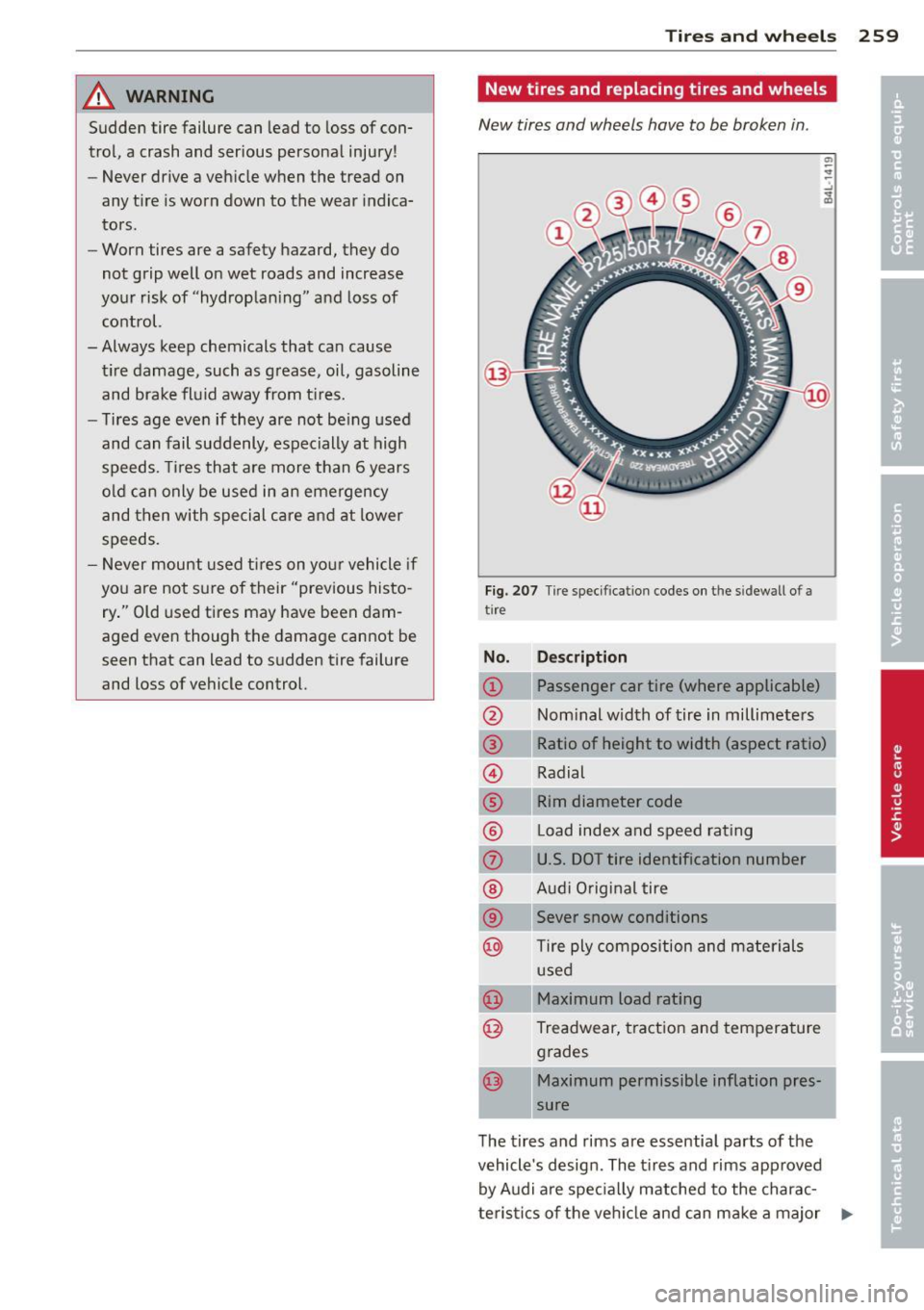
Fig. 207 Tir e specificat ion codes on t he s idewall o f a
tire
No. Description
CD Passenger car tire (where applicable)
@ Nominal width of tire in millimeters
® Ratio of height to width (aspect ratio)
© Radial
® Rim diameter code
® Load index and speed rat ing
(f) U.S. DOT tire identification number
® Audi Original tire
® Sever snow conditions
@ Tire ply composition and materials
used
@ Maximum load rating
@ Treadwear, traction and temperature
grades
@ Maximum permissible inflation pres-
sure
The tires and rims are essential parts of the
vehicle's design . The tires and rims approved
by Audi are specially matched to the charac
teristics of the vehicle and can make a major .,.
•
Page 263 of 316
T up to 118 mph (190 km/h)
U up to 124 mph (200 km/ h)
H up to 130 mph (210 km/ h)
V up to 149 mph (240 km/h)1
)
Z over 149 mph (240 km/h)1l
W up to 168 mph (270 km/h)1
)
Y up to 186 mph (298 km/h)1
)
Your veh icle is no rma lly factory equipped with
tires , which possess excellent driving charac
teristics and give your Audi opt imum driving
comfort . An e lectronic speed limiter
c::> page 2 7 wi ll normally prevent you r vehicle
from go ing faster than the tire speed ra ting
c:::> .& .
U.S . DOT T ire Identification Numb er (TIN )
and tire manufacture date
This is the t ire's "serial number". It begins
with the letters "DOT" and indicates that the
tire meets all federal standards . The next two
numbers or letters indicate the plant where it
was manufactured, and the last four numbers r ep resent the week and year of manufacture.
F or
examp le, the numbers 22 12 mean that
the tire was produced in the 22nd week o f
20 12. The other numbe rs are marketing co
des that may or may not be used by the tire
manufactu rer. This information is used to con
tact consumers if a tire defec t requi res a re
call.
Aud i O riginal ti re
Tires with the identification "AO" or "RO" have
been specia lly matched with your Audi . We
recommend using only these tires because
t hey meet the highest standards regard ing
safety and driving character istics when used
correctly . Your authorized Audi dealer w ill
g lad ly provide you with more information .
Tire ply compo sit ion and material s used
The number of plies ind icates the number of
layers of rubber-coated fabric in the t ire. In
general, the greater the number of plies, the
ll Fo r tires wit h a m ax im um s pee d ca pabil ity over 149
mph (2 4 0 k m/h) , tire man ufacturers some times u se
th e le tters " ZR."
Tire s an d wheel s 261
more weight a tire can support . Tire manufac
turers also must indicat e the materials in the
tire, which incl ude steel, nylon, po lyester, and
others.
Ma ximum Load Rating
This number indicates the maximum load in
ki lograms and pounds that can be ca rried by
the tire.
Tire quality grading for treadwear,
tract ion, and temp erature re sis tance
Tread wear, traction and temperat ure grades
c::> page 2 62 .
Maximum Permissible Inflation Pressu re
T his number is the greatest amount of a ir
pressure that should ever be put in the tire
u nder normal driving conditions .
A WARNING
-Using incorrect or unmatched tires and/
or wheels or improper tire and wheel
comb inat ions can lead to loss of control,
col lis ion and serious personal injury.
- Always use t ires, rims and whee l bolts
that meet the specifications of original
factory- installed tires or other combina
tions that have been specifically ap proved by the vehicle manufacturer.
- Tires age even if they are not being used
a nd can fai l sudden ly, especially at high
speeds. Tires that are more than 6 yea rs
old can only be used in an emergency
a nd then w ith special care and at lower
speeds.
- Neve r mo unt used tires o n your veh icle if
you are not sure of the ir "previo us histo
ry." O ld used tires may have been dam
aged even though the damage cannot be
seen that ca n lead to sudden tire fai lure
and loss of vehicle control.
•
•