warning AUDI Q5 2013 Owners Manual
[x] Cancel search | Manufacturer: AUDI, Model Year: 2013, Model line: Q5, Model: AUDI Q5 2013Pages: 316, PDF Size: 78.89 MB
Page 265 of 316
The relative perform a nee of ti res depends
upon the actua l conditions of their use, how
ever, and may depart sign ificantly from the
norm due to var iat ions in dr iving habits, serv
ice practices and differences in road character
istics and climate .
Trac tion
The traction grades, from highest to lowest,
are AA, A, Band
C. Those grades represent the
tire's ability to stop on wet pavement as measured under controlled cond itions on
specified government test surfaces of asphalt
and concrete . A tire marked C may have poor
traction performance ¢,&. .
Temp erature
The temperature grades are A (the h ighest),
B, and
C, representing the t ire's resistance to
the generat ion of heat and its ability to dissi
pate heat when tested under controlled condi
tions on a specified i ndoor laboratory test
wheel.
Sustained high temperature can cause the
materia l of the tire to degenerate and reduce
tire life, and excessive temperature can lead
to sudden ti re fa ilu re ¢ ,&. .
The grade
C corresponds to a level of perform
ance which all passenger car tires must meet
u nder the Federa l Moto r Veh icle Safety Stand
a rd No.
1 09. G rades Band A represent h igher
l eve ls of perfo rmance on the laboratory tes t
wheel than the m inimum required by law .
A WARNING
The traction grade assigned to this ti re is
based on stra ight-ahead b raking t raction
tests, and does not include acceleration,
cornering, hydrop lan ing or peak traction
character istics.
A WARNING
The temperature grade for this t ire is es
tablished for a t ire that is p roperly inflated
and not overloaded. Excessive speed, un
derinflation, or excessive loading, either
-
Tire s an d wheel s 263
separately or in combinat ion, can ca use
heat bui ldup and possible tire failure.
Winter tires
Winter tires can improve vehicle handling on
snow and ice. At temperatures below 45 °F (7 °C) we recommend changing to winter
tires.
In some heavy snow areas, local governments
may require true winter o r "snow" tires, those
with very deeply cut tread. These tires should
o nly be used in pairs and be installed o n all
four wheels . Make sure you purchase snow
t ires that are the same size and construction
type as the other tires on you r vehicle.
Your vehicle is equipped with all-wheel drive,
th is w ill improve traction during winter driv
i ng, even with the standa rd tires . However, we
strong ly recommend that you always equip all
fo ur wheels on you r vehicle wit h corre ct ly fit
ted winter tires or all-season t ires, when win
te r road cond itions are expected . This also im
proves the veh icle's braking per formance and
reduces stopping dista nces.
Summe r tires provide less grip on i ce and
snow.
Winter tires (snow tires) must always be fitted
o n all fo ur wheels .
Ask your authorized Audi dealer or qualified
workshop for permitted
winter tire size s. Use
o nly rad ial w inter t ires.
Winter tires lose their effectiveness when the
tread is worn down to a depth of
0 .157 inch
(4 mm) .
Only drive w ith w inter t ires under w inter con
dit ions. Summer t ires handle better when
there is no snow or ice on the roads and the
temperature is above 45 °F (7 °() .
If you have a flat tire, see notes on spare
whee l
¢page 259.
Please a lways remember that winter tires may
have a lowe r speed rating than the tires o rigi -
nally installed on your vehicle at the time it .,.
•
•
Page 266 of 316
264 Tire s and wheel s
was manufactured . Please see q page 260,
Speed roting (letter code) for
a listing of the
speed rating letter codes and the maximum
speed at which the t ires can be driven.
The speed rating letter code( ¢
page 251) is
on the side wall of the tire
c::> page 259.
A WARNING
Winter tires have maximum speed limits
that may be lower t han your vehicle's max
imum speed. Always know the maximum
speed before driving off . Never drive faster
than the speed permitted for your specific
w inter t ires. This will cause damage to the
tires leading to an accident and serious
pe rsonal inj ury to you and your passen
gers .
A WARNING
=
Driving faster than the maximum speed
for which the winter tires on your vehicle
were designed can cause tire fai lure in
cluding a blowout and sudden deflat ion,
loss of control, crashes and serious per
sonal injuries. Have worn or damaged tires
rep laced immed iate ly .
- Winter tires have maximum speed rat ing
that may be lower tha n your veh icle's
maximum speed .
- Never drive faster than the speed for
w hich the winter or other tires installed
on your vehicle are rated.
A WARNING
Always adjust your d riving to the road and
t raffic conditions. Neve r let the good ac
celeration of the wi nte r t ir es and all-whee l
dr ive temp t you in to taking extr a ris ks. A l
ways remember:
- Whe n bra king, an a ll-wheel d rive vehicle
hand les in the s ame way as
a front drive
vehicle.
- Drive caref ully and reduce your speed on
icy and slippery roads, even winter tires
cannot he lp under black ice conditions.
{® For the sa ke of the env ironment
Use summer tires when weather condi
tions permit. They are qu ieter, do not wear
as quickly and reduce fuel consumpt ion.
Snow chains
Snow chains may be fitted only to the rear
whee ls, and o nly to certain tire sizes . Ask your
autho rized Aud i deale r on which tire sizes
snow c hains ca n be used.
The snow chains must have low-prof ile links
and must not be t hicker than 0.53 inch
(13 .5 mm), includ ing the loc k.
Remove wheel center covers and trim discs
before putt ing snow chains on your vehicle
c::>@ . For safety reasons cover caps must then
be fitted over the wheel bolts. These a re ava il
able from autho rized Aud i deale rs.
A WARNING
Using the wrong snow chai ns for your veh i
cle o r insta lling them inco rrect ly can in
crease the risk of loss of cont ro l leading to
se rious personal injury.
- Snow chains are available in di fferent
sizes. Always make sure to follow the in
structions p rov ided by the snow chain
manufacturer.
- When driving with snow chains never
drive faster than the speed permitted for
your specif ic snow chains.
- Always observe local regulations .
(D Note
-Remove snow chains before dr iv ing o n
roads not covered with snow to avoid
damaging tires and wea ring the snow
chains down unnecessarily.
- Snow chains, which come into direc t con
tact with the whee l rim, ca n scratch or
damage it . Therefo re, make sure that the
snow chains are s uitably covered. Check
the pos ition of the snow chains after
Page 267 of 316
driving a few yards and correct if neces
sary . Follow the instructions from the
snow cha in manufacturer when doing so.
(D Tips
Where snow chains are mandatory oncer
tain roads, this norma lly also applies to
veh icles with all-whee l dr ive .
Wheel bolts
Wheel bolts must always be tightened to the
correct torque.
The design o f whee l bolts is matched to the
factory insta lled r ims . If different rims are fit
ted, the correct wheel bo lts wit h the right
l ength and correctly shaped bolt heads must
be used. This ensures that wheels are f itted
securely and that the brake system functions
correctly .
In certain circumstances, you may not use
wheel bo lts from a different vehicle -even if it
is the same model<=>
page 297.
A WARNING
Improperly tightened or maintained wheel
bolts can become loose caus ing loss of
cont ro l, a co llision and serious persona l in
Jury .
- Always keep the w heel bolts and the
threads in the wheel hubs clea n so the
w hee l bolts can t urn easily and be p rop
erly t igh tened.
- Never grease or oil the wheel bolts and
the threads in the wheel h ubs. They can
become loose wh ile d riving if greased or
oiled, even if tightened to the specified
torq ue.
- Only use whee l bo lts that belong to the
rim being installed .
- Never use different whee ls bolts on your
vehicle.
- Alw ays m ain ta in the co rrec t tig hten ing
torq ue fo r the wheel bo lts to reduce the
risk of a wheel loss . If the tightening tor
que of the wheel bo lts is too low, they
can loosen and come out when the vehi-
Tire s an d wheel s 265
cle is mov ing. If the tightening torq ue is
too high, the wheel bolts and threads
can be damaged and the whee l can be
come loose.
@ Note
The specified torque for the whee l bolts is
105 ft lb (140 Nm) with a to lerance of
± 7,4 ft lb(± 10 Nm). Torque wheel bolts
diagonally . After changi ng a wheel, the
torque m ust be checked as soon as poss i
ble with a to rque wrench -preferably by an
a uthorized Aud i dea le r or qualified wor k
shop.
Low aspect ratio tires
Your A udi is fac tory -eq uipped w ith low aspect
ratio tires . These tires have been tho ro ughly
tested and been se lected specifically for your
model for their superb performance, road fee l
and handling under a variety of driving condi
tions . Ask your authorized Aud i dealer for
more details.
The low aspect ratio of these t ires is ind icated
by a numeral of
55 or less in the tire's size
designation. The numera l represents the ratio
of the tire's sidewa ll height in relation to its
tread width exp ressed in percentage. Conven
tiona l tires have a he ight/w idth ratio of 60 or
more.
The performance of low-a spect-r atio tire s is
particularly sensit ive to improper inflation
pre ssure. It is therefor e important that low
a spect ratio tire s are inflated to the specified
pres sure and that th e inflation pr essure i s
regularly checked and maintained. Tire pre s
sure s should be chec ked at lea st once a
month and always before a long trip
<=> page 2 54, Checking tire pressure.
What you can do to avo id tire and rim
damage
Low aspect ratio tires can be damaged mo re
easily by impact w ith potholes, curbs, gull ies
or ridges on the road, particularly if the tire is
under inflated . ..,.
•
•
Page 269 of 316
When the malfunction indicator is illuminat
ed, the system may not be able to detect or
signal low tire pressure as intended. TPMS
malfunctions may occur for a variety of rea
sons, including the installation of replace
ment or alternate tires or whee ls on the veh i
cle that prevent the TPMS from funct io ni ng
p roperly . Always check the T PMS malfunct ion
tellta le afte r replacing one or more t ires or
wheels on your veh icle to ensure that the re
p lacement or a lternate tires and wheels allow
the TPMS to continue to function properly .
Tire pressure indicator appears
Applies to vehicles: with tire pressure monitoring system
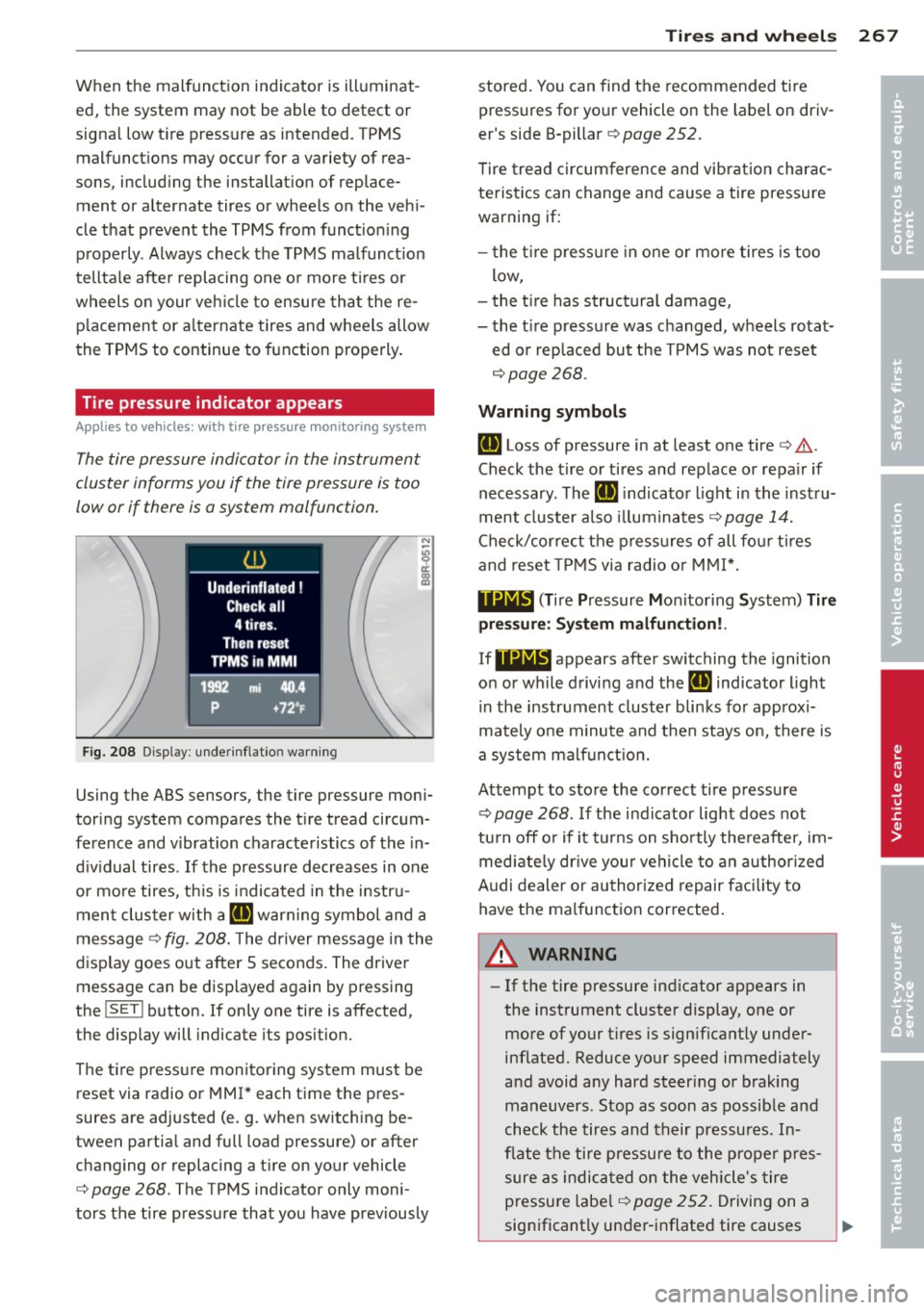
The tire pressure indicator in the instrument
cluster informs you if the tire pressure is too
low or if there is a system malfunction.
Fig. 208 Display : underinflatio n warning
Using the ABS sensors, the tire pressure moni
toring system compares the t ire tread circum
ference and vibration characteristics of the in
d iv idual tires . If the pressure decreases in one
or mo re tires, th is is indica ted in the instru
ment clus ter with a
IE warning symbol and a
message ¢
fig. 208. The driver message in the
display goes out after 5 seconds. The driver message can be displayed again by pressing
the
! SET ! button. If only one tire is affected,
the display will indicate its pos ition.
The ti re press ure monitoring system must be
reset via radio or MMI* each time the pres
sures are adjusted (e.g . when switching be
tween partia l and full load pressure) or after
changing or replacing a t ire on your vehicle
¢
page 268 . The TPMS indicator only moni
tors the tire pressure that you have prev iously
Tire s an d wheel s 267
stored . You can find the recommended t ire
pressures for yo ur vehicle on the label on driv
er's side B-pillar ¢
page 252.
Tire tread circum ference and vibration charac
teristics can change and cause a tire pressure
warning if:
- the t ire p ress ure in one or more tires is too
low,
- t he t ire has structural damage,
- the t ire pressure was changed, wheels rotat-
ed or replaced but the TPMS was not reset
¢ page 268.
Warning symbo ls
IE Loss of pressure in at least one tire¢.&,.
Check the tire or tires and replace or repa ir if
necessary. The
IE indicato r light in the inst ru
ment cluster a lso illuminates
c::!;> page 14.
Check/correct the press ures of all fou r tires
and reset TPMS via radio o r MMI*.
119;~, (T ir e Pressure Mon itoring System) Tire
pre ssure: Syst em malfun ction!.
If 11Nlf:1 appears afte r switching the ignition
on or while driving and the
IE indicator light
i n the instrument cluster blinks fo r approx i
mately one minute and then stays on, there is
a system malf unct ion.
Attempt to store the correct tire pressure
¢ page 268 . If the ind icator light does not
tu rn off o r if it turns on sho rtly the reafter, im
med iate ly dr ive your vehicle to a n author ized
Audi dealer or au thorized repair faci lity to
have the malfunc tion corrected .
A WARNING
-=
-If the tire pressure indicator appears in
the instrument cluster display, one or
more of your t ires is significant ly under
inflated. Reduce your speed immediately
and avoid any hard steer ing or braking
maneuvers. Stop as soon as possible and
check the tires and their pressures. In
flate the tire p ressure to the prope r pres
sure as indica ted on the vehicle's tire
pressu re labe l
¢page 252. Driving on a
significantly under-i nflated tire causes
•
•
Page 271 of 316
What do I do now?
Jack, tools and
inflatable spare tire
Onboard tool kit and vehicle jack
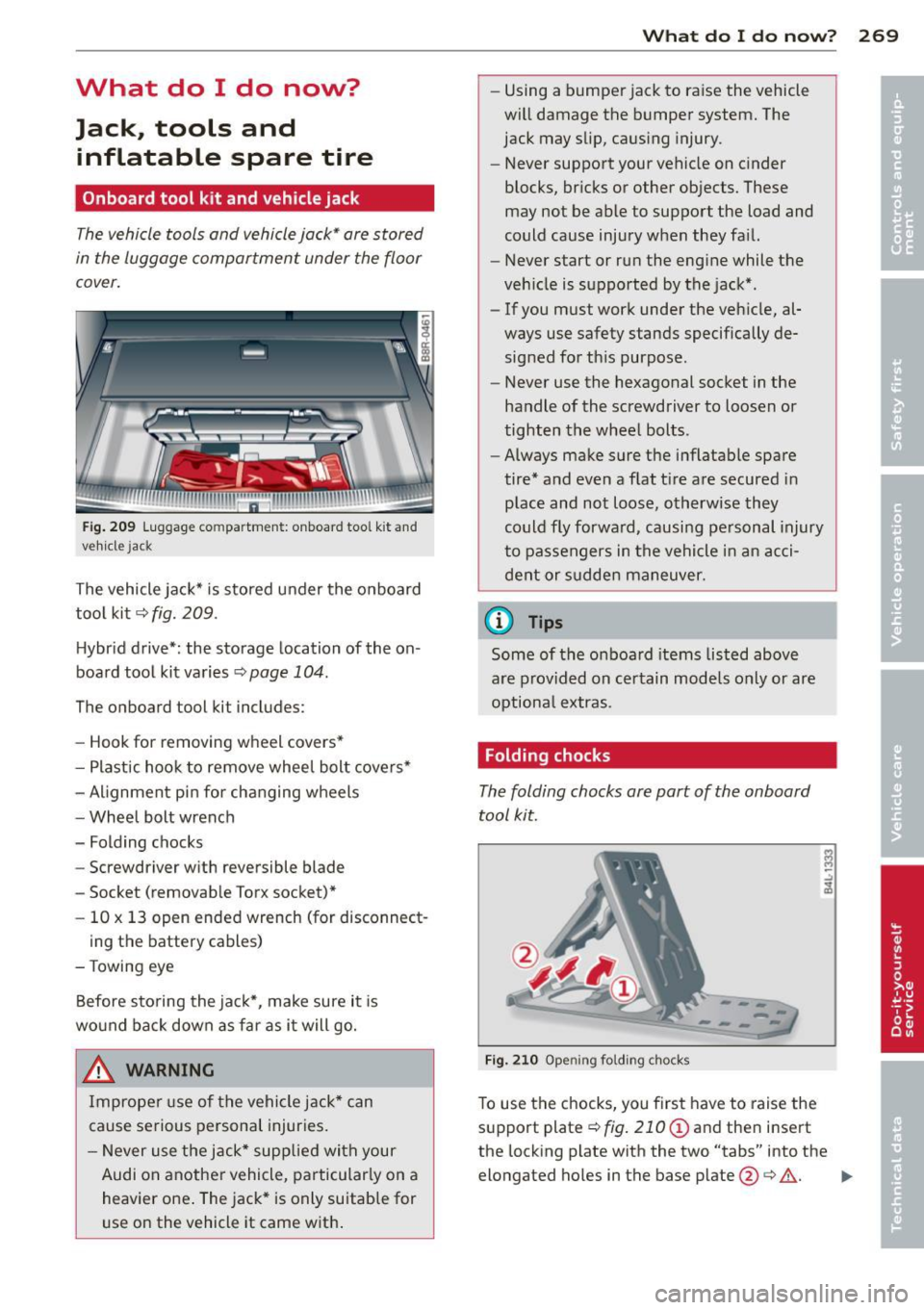
The vehicle tools and vehicle jack* are stored
in the luggage compartment under the floor
cover.
Fig . 209 Luggage co mpa rtment: onboard too l kit and
v e hicle jack
The vehicle jack* is sto red under the on board
tool kit¢
fig. 209.
Hybr id drive*: the storage location of the on
board tool kit varies
¢ page 104.
The on board tool kit includes:
- Hook for removing wheel covers*
- Plastic hook to remove wheel bolt covers*
- Al ignment p in for changing wheels
- Wheel bolt wrench
- Folding chocks
- Screwdriver with reversible blade
- Socket (removable Torx socket)*
- 10 x 13 open ended wrench (for disconnect-
ing the battery cables)
- Towing eye
Before storing the jack*, make sure it is
wound back down as far as it will go.
A WARNING
Imprope r use of the vehicle jack* can
cause serious personal injuries.
- Never use the j ack* supplied with your
Audi on another vehicle, particularly on a heavier one . The jack* is only suitable for
use on the vehicle it came with .
What do I d o now ? 269
-Using a bumper jack to ra ise the vehicle
will damage the bumper system. The
jack may slip, causing injury.
- Never support your vehicle on cinder
blocks, br icks or other objects. These
may not be able to support the load and
could cause injury when they fa il.
- Never start or run the engine while the
veh icle is supported by the jack* .
- If you must work under the vehicle, al
ways use safety stands specifically de signed for th is purpose .
- Never use the hexagonal socket in the
handle of the screwdriver to loosen or
tighten the wheel bolts .
- Always make sure the inflatable spare
tire* and even a flat tire are secured in
place and not loose, otherwise they
could fly forward, causi ng personal injury
to passengers in the vehicle in an acci
dent or sudden maneuver.
(0 Tips
Some of the on board items listed above
a re provided on certain models only or are
optiona l extras.
Folding chocks
The folding chocks are part of the on board
tool kit.
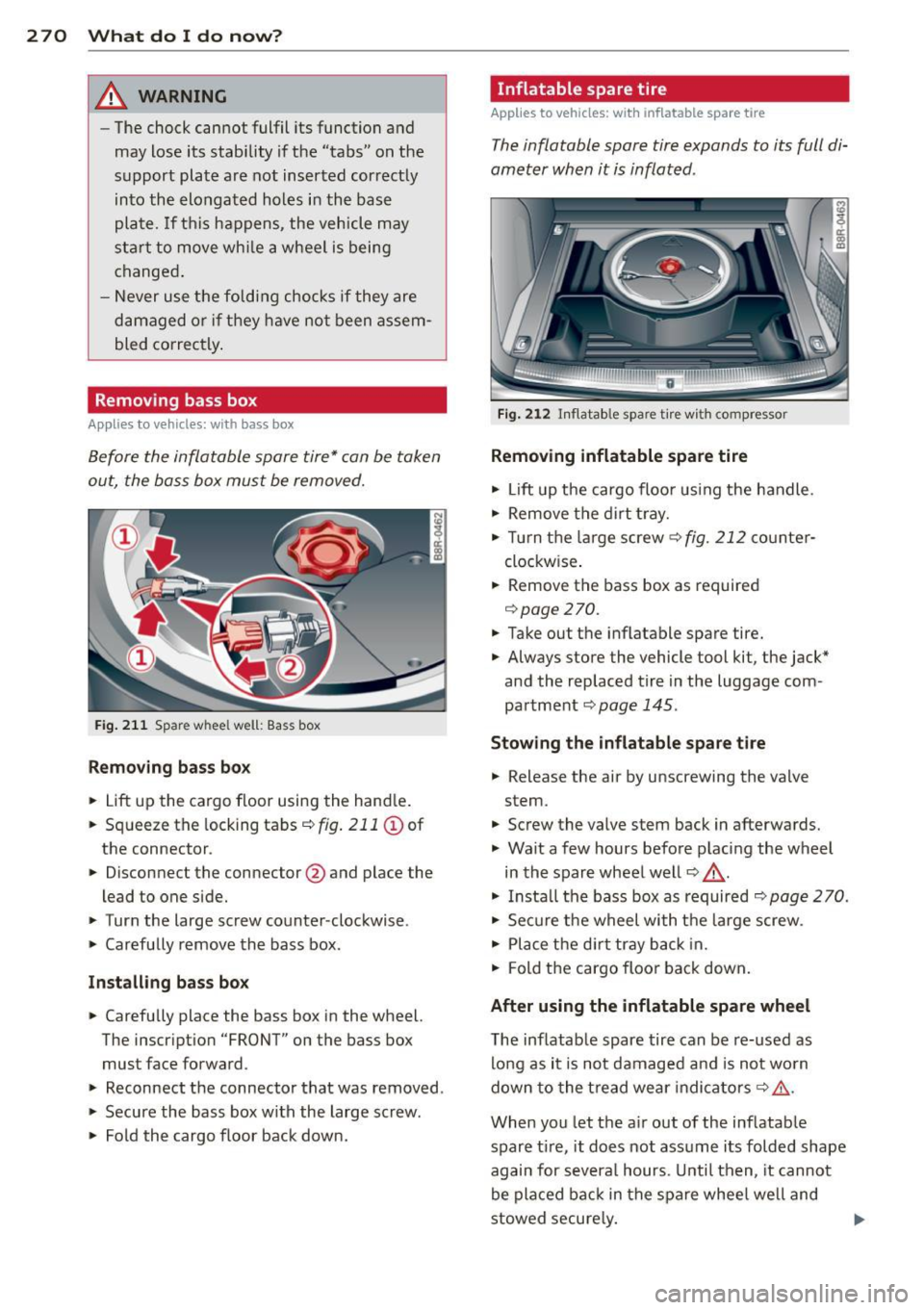
Fig . 210 Ope ning folding chocks .
To use the chocks, you first have to raise the
support plate¢
fig. 210 (D and then insert
the locking plate with the two "tabs" into the
elongated holes in the base plate@¢& . ""
Page 272 of 316
2 70 What do I do now ?
& WARNING
-The ch ock cannot fulfil its function and
may lose its stab ility if t he "tabs" on the
s u pport plate are not inserted cor rectly
in to the elongat ed ho les i n th e b ase
pla te. If th is happens, the veh icle may
sta rt to move wh ile a wheel is being
change d.
- N ever u se the f old ing chocks if they are
damaged o r if th ey have no t been assem
bled correc tly .
Removing bass box
Appl ies to vehicles: wit h bass box
Before the inflatable spare tire" can be taken
out, the bass box mus t be removed.
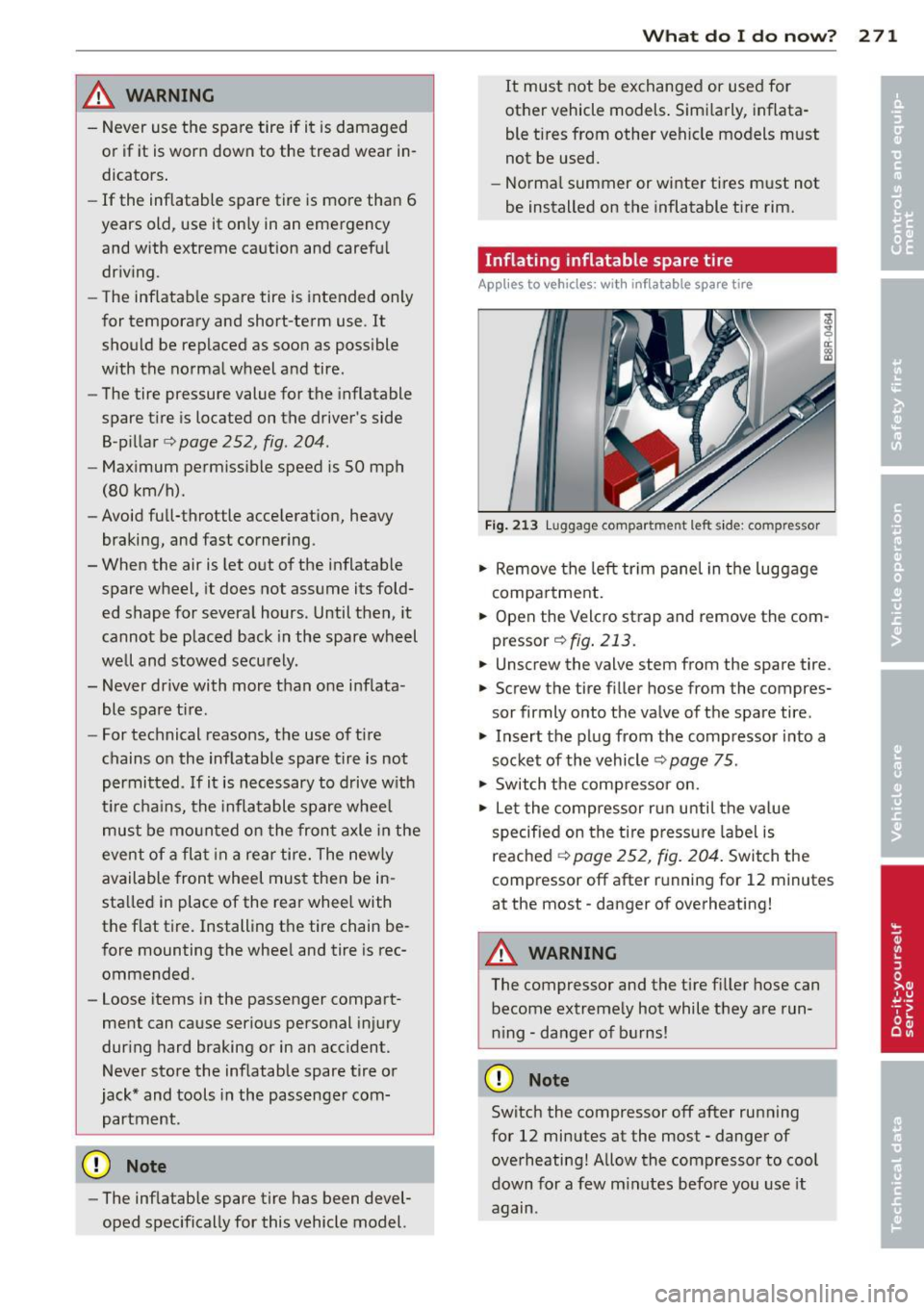
Fig . 211 Spare w hee l well : Bas s box
Removing bass box
., Lift up the cargo floor using the hand le .
., Sq ueeze the locking ta bs
c:::> fig . 211 © of
the connector .
., Disconnect the connector @and place the
l ead to one side.
., Turn the large screw counter -cloc kwise .
., Carefully remove the bass box .
Installing bass box
., Carefully place the bass box in the wheel.
The inscr ipt io n "FRO NT" on the bass box
must face forward .
., Reconnect the connector that was removed .
., Secure the bass box wi th the large sc rew.
., Fold the cargo floor back down.
Inflatable spare tire
Applies to vehicles: w ith inflatable spare t ire
The inflatable spare tire expands to its full di
ameter when it is inflated .
Fig . 2 12 In flatable spa re t ire wi th compresso r
Removing inflatable spare tire
., Lift up t he cargo floo r using the handle .
., Remove the dirt t ray .
., Tur n the large screw
c:::>fig. 212 co u nte r
clockw ise .
., Remove the bass box as required
¢ page 270 .
., Take out the inflatable spa re tire .
., Always store the vehicle tool kit, the jack*
and the rep laced tire in the luggage com
pa rtment
¢ page 145.
Stow ing the inflatable spare tire
., Release the air by unscrewing the va lve
stem .
., Screw the valve stem back in afterwards .
., Wait a few hours before p lacing the wheel
in the spare wheel well¢
A-
., Inst all the bass box as required¢ page 270.
., Se cure t he wheel with t he large screw .
., Place the d irt tr ay b ack in .
., Fold t he cargo floor back down.
After using the inflatable spare wheel
T he inflatab le spare tire can be re-used as
lo ng as it is not damaged a nd is not wo rn
down to the t read wear indi ca tors ¢
_A .
When you let the a ir out of the inf latab le
spar e tir e, it does not ass ume its folded shape
again for severa l hours . U nti l then, it cannot
be pla ced ba ck in the spare whee l we ll and
stowed secu re ly.
Page 273 of 316
/! WARNING
-Never use the spare tire if it is damaged
or if it is worn down to the tread wear in
dicators .
- If the inflatable spare tire is more than 6
years old, use it on ly in an emergency
and with extreme ca ution and carefu l
dr iv ing.
- The inflatab le spare tire is intended only
for temporary and short-term use . It
should be replaced as soon as poss ible
with the no rma l wheel and tire.
- The tire pressure value for the inflatable
spare t ire is located on the driver's side
8-p illar
c::> page 252, fig. 204.
- Maximum permiss ible speed is 50 mph
(80 km/h).
- Avoid full-throttle acce lerat ion, heavy
braking, and fast corner ing.
- When the air is let out of the inflatable
spare wheel, it does not assume its fold
ed shape for severa l hours. Until then, it
cannot be placed back in the spare wheel
well and stowed secu rely.
- Never drive with more than one inflata
ble spare tire.
- For technical reasons, the use of tire
chains on the inf latable spare tire is not
permitted .
If it is necessary to d rive w it h
t ir e cha ins, the inflatable spare whee l
must be mo unted on the fron t axle in the
event of a fla t in a rea r tire. The new ly
available front wheel must then be in
sta lled in place of the rear whee l with
the flat tire. Installing t he tire chain be
f ore mounting the whee l and tire is rec
ommended.
- loose items in the passenger compart
me nt can cause serious personal in jury
dur ing hard braking or in an acc ident.
Never store the inf latable spare tire o r
jack* and tools in the passenge r com
partment .
CD Note
-The inf latable spare tire has been devel
oped spec ifically for this vehicle model.
What do I d o now ? 271
It must not be exchanged or used for
ot her vehicle models . Sim ila rly, inflata
ble t ires from other vehicle models must
not be used.
- Norma l summer or winte r ti res m ust not
be installed on the inf latable tire rim.
Inflating inflatable spare tire
Applies to vehicles: with inflatable spare tire
Fig. 2 13 Lu ggage compartme nt left s ide: comp ressor
.,. Remove the left tr im panel in the luggage
compa rtment.
.,. Open the Velcro strap and
remove the com
pressor ¢
fig. 213.
.,. Unscrew the valve stem from the spare tire .
.,. Screw the tire f iller hose from the compres
sor firmly onto the va lve of the spare tire .
.,. Insert the pl ug from the comp ressor into a
socket of th e vehicle ¢
page 75.
.,. Switch t he comp ressor on.
.,. let the compressor r un unti l t h e va lue
specif ied on the ti re press ure la bel is
reached
c::> page 2 52, fig . 204 . Switch the
compressor off after r unning for 12 minutes
at the most -danger of overheating!
A WARNING
The compressor and the tire filler hose can
become extreme ly hot while t hey a re run
n ing -da nger of b urns!
CD Note
Switch the compressor off after running
for 12 mi nutes at the most -danger of
ove rheating! Allow the compressor to cool
down for a few m inutes befo re you use it
again .
Page 274 of 316
272 What do I do now ?
Tire repair
General information and safety
precaution s
Applies to vehicles: with tire repair kit
The tire repair is only meant for temporary
use.
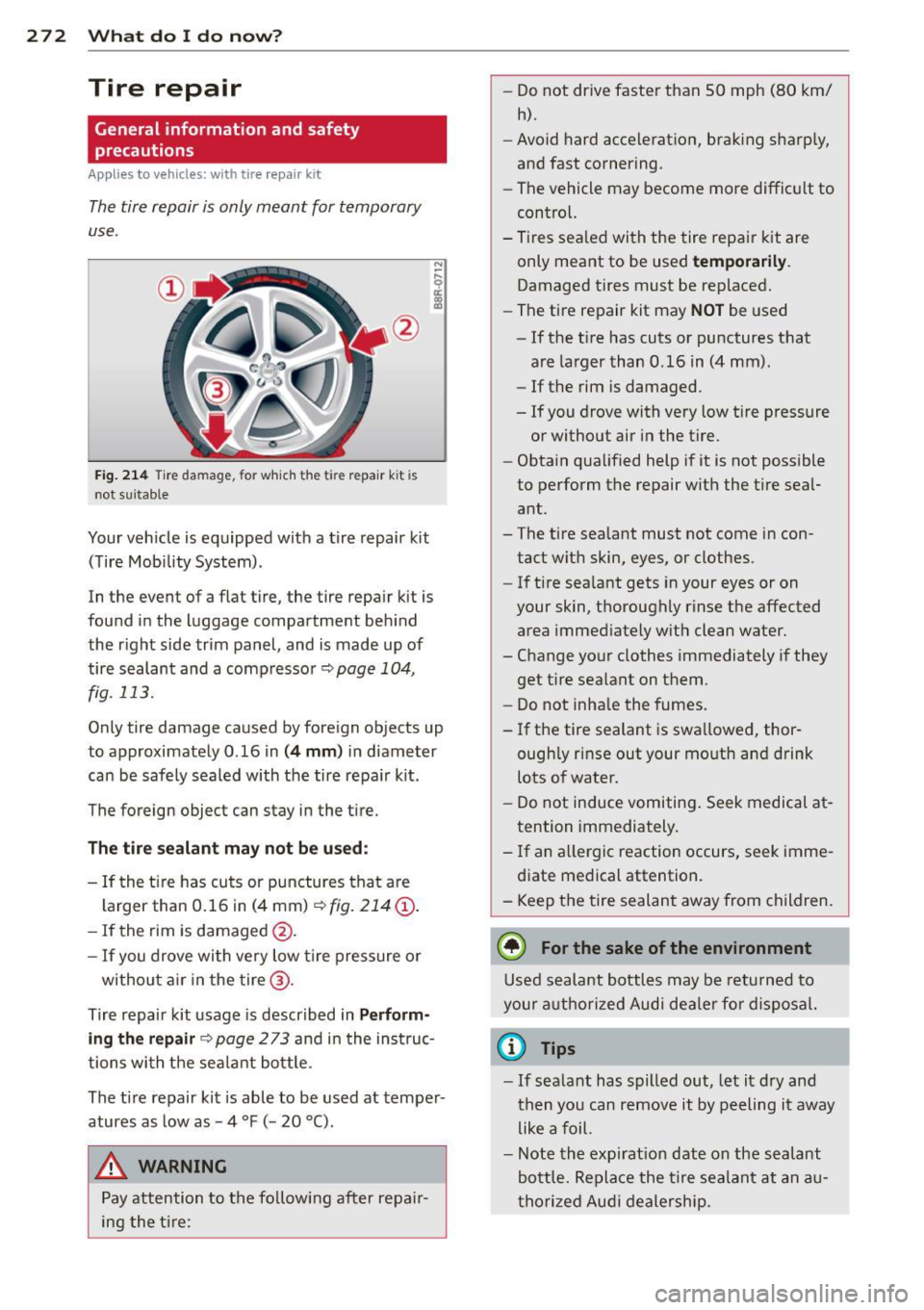
Fig. 214 Tir e damag e, for wh ich t he t ire re pair k it is
not sui tab le
Your veh icle is equipped with a tire repair kit
(Tire Mob ility System) .
In the event of a flat tire, the tire repair kit is
found in the luggage compartment beh ind
the r ight side trim panel, and is made up of
tire sealant and a compressor
Q page 104,
fig . 113.
Only tire damage caused by foreign objects up
to approximately 0 .16 in
(4 mm ) in diameter
can be safely sealed with the tire repa ir kit.
The foreign object can stay in the tire.
The tire sealant may not be used:
-If the tire has cuts or punctures that are
larger than 0.16 in (4 mm)
<=)fig. 214 @.
-If the rim is damaged @.
-If you drove with very low tire pressure or
without a ir in the tire@.
Tire repair kit usage is described in
Perform
ing the repair
9 page 2 73 and in the instruc
tions with the sealant bottle.
The tire repair kit is able to be used at tempe r
atures as low as -4 °F ( -20 °C) .
A WARNING
Pay attention to the follow ing after repair
ing the tire: -
Do not drive faster than 50 mph (80 km/
h) .
-Avoid hard acceleration, braking sharp ly,
and fast cornering .
- The vehicle may become more difficult to
control.
- Tires sea led with the tire repair kit are
only meant to be used
temporarily .
Damaged tires must be replaced.
- The tire repair kit may
NOT be used
- If the t ire has cuts or punctures that
are larger than 0.16 in (4 mm) .
- If the rim is damaged .
- If you drove with very low t ire pressure
or without air in the tire.
- Obtain qualified help if it is not possible
to perform the repair with the tire seal
ant .
- The tire sealant must not come in con
tact with skin, eyes, or clothes.
- If tire sea lant gets in your eyes or on
your skin, thoroughly rinse the affected
area immediately with clean water.
- Change your clothes immediately if they
get tire sealant on them.
- Do not inha le the fumes.
- If the tire sealant is swallowed, thor-
ough ly rinse out your mouth and drink
lots of water.
- Do not induce vomiting . Seek medical at
tention immediately.
- If an a llergic reaction occurs, seek imme
diate medical attention.
- Keep the tire sealant away from children.
@) For the sake of the environment
Used sealant bottles may be returned to
your authorized Audi dea ler fo r disposal.
(D Tips
- If sealant has spilled out, let it dry and
then you can remove it by peeling it away
like a foil.
- Note the expiration date on the sealant
bottle. Replace the tire sealant at an au
thorized Audi dealership.
Page 275 of 316
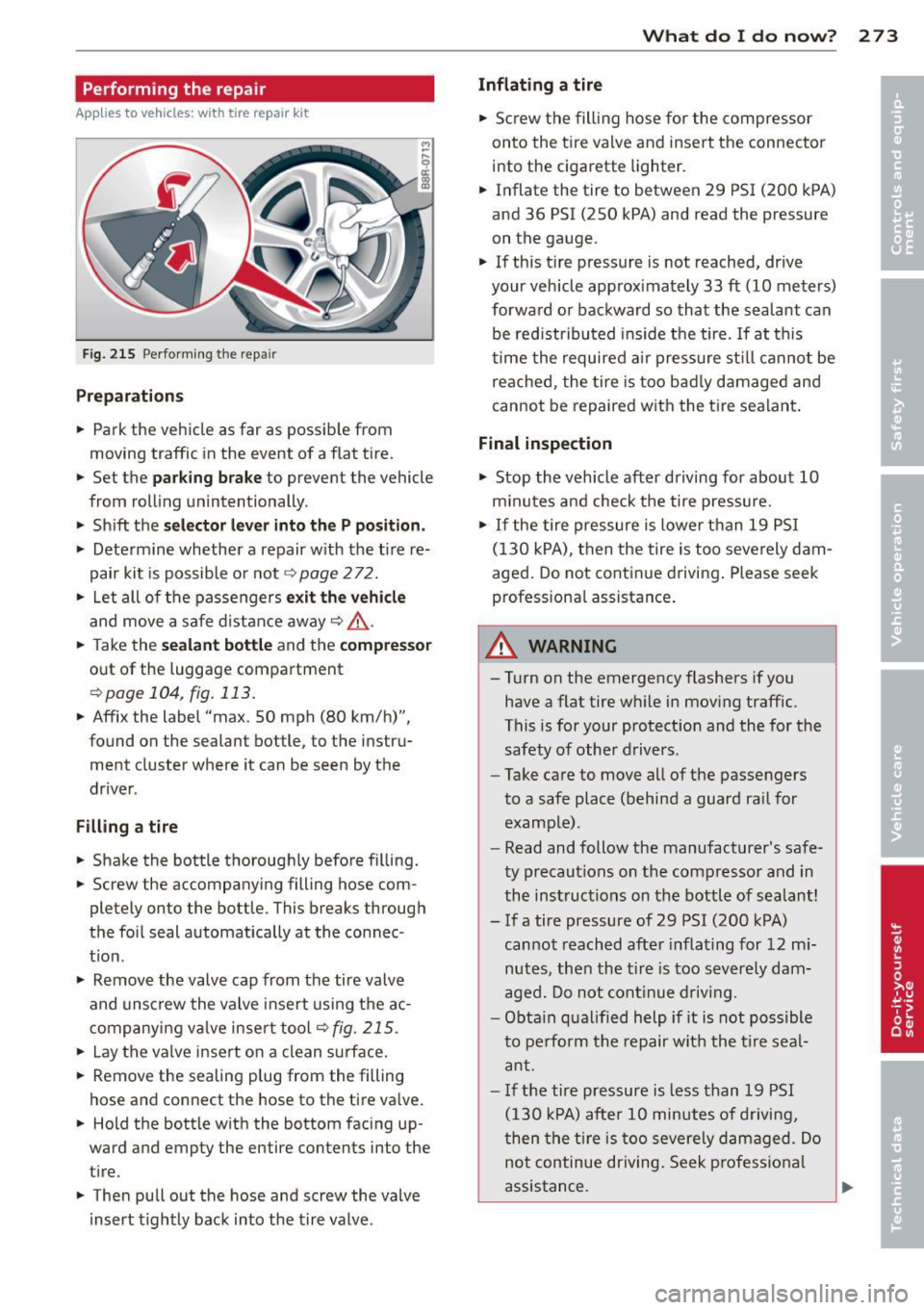
Performing the repair
Applies to vehicles: with tire repair kit
F ig. 2 15 Perform ing the repa ir
Prep arati ons
.. Park the veh icle as far as possib le from
moving traffic in the event of a flat tire.
.. Set the
park ing bra ke to prevent the vehicle
from roll ing unintentionally .
.. Sh ift the
s e le ctor l ever i nto th e P po sition .
.. Determ ine whether a repair w ith the t ire re
pair kit is possible o r not
9 page 2 72.
.. Let all of the passengers
exi t the vehicle
and move a safe distance away 9 &,. .
.. Take the sealant bottle and the compresso r
out of the luggage compartment
9page 104 , fig. 113.
.. Affix the label "max. 50 mph (80 km/h)",
found on the sealant bottle, to the instru ment cluster where it can be seen by the
driver .
Filling a tire
.. Shake the bottle thorough ly before fi lling.
.. Screw the accompanying filling hose com-
pletely onto the bottle. This breaks through
the foi l seal automatically at the connec
t ion .
.. Remove the valve cap from the tire valve
and unscrew the valve insert using the ac
companying va lve inser t tool
9 fig. 215 .
.. Lay the valve insert on a clean surface.
.. Remove the sealing plug from the filling
hose and connect the hose to the tire va lve .
.. Hold the bottle with the bottom fac ing up
ward and empty the entire contents into the
tire.
.. Then pull out the hose and screw the valve
i nsert t ightly back into the tire valve .
What do I do now ? 273
Inflating a tir e
.. Sc rew the fill ing hose for the compressor
onto the t ire valve and insert the connector
into the cigarette lighter .
.. Inflate the tire to between 29 PSI (200 kPA)
and 36 PSI (250 kPA) and read the pressure
on the gauge .
.. If this t ire pressure is not reached, dr ive
your veh icle approximately 33 ft (10 meters)
forward or backward so that the sealant can be red istributed inside the tire. If at th is
t ime the required a ir pressure st ill canno t be
reached, the tire is too bad ly damaged and
cannot be repaired w ith the t ire sea lant .
Final inspection
... Stop the vehicle aft er driving for about 10
m inutes and check the tire pressure.
... If the tire pressure is lower than 19 PSI
(130 kPA), then the tire is too severely dam
aged. Do not continue driving . Please seek
professiona l assistance .
A WARNING
-Turn on the emergency flashers if you
have a flat tire w hile in mov ing traffic .
This is for your protect ion and the for the
safety of other drivers.
- Take care to move all of the passengers
to a safe place (behind a guard ra il for
examp le) .
- Read and follow the manufacturer's safe
ty precautions on the compresso r and in
the instructions on the bottle of sealant!
- If a tire pressure of 29 PSI (200 kPA)
cannot reached afte r inflat ing for 12 m i
nutes, then the t ire is too severe ly dam
aged. Do not cont inue drivi ng.
- Obta in q ual ified help if it is not possible
to pe rform the repair wit h the tire seal
a nt .
- If the tire pressure is less than 19 PSI
(130 kPA) afte r 10 minutes of driving,
then the tire is too severely d amaged . Do
not continue dr iving. Seek p rofess ional
assistance. ..,.
Page 276 of 316
274 What do I do no w?
Special ca re is requ ired if you are repairin g
t he t ire o n a steep incline.
@ Tips
- Do not operate the compressor for more
than 12 minutes continuously, otherwise i t can overheat. Once the compressor has
cooled, you can continue to use it.
- If sealant has spi lled out, let it dry and
then you can remove it by pee ling it away
like a fo il.
- Remember to obtain a new bottle of
sealant from your authorized Audi dealer
after repairing a tire. After this, the func
tionality of the tire repair set is restored.
- Obey all laws.
Changing a wheel
Before changing a wheel
Observe the following precautions for your
own and your passenger's safety when chang
ing a wheel .
.,. After you experience a tire fa ilure, pull the
car well away from moving traffic and try to
reach
le ve l ground before yo u stop ¢&_ .
.,. All p assengers sho uld
le ave the c ar and
move to a safe location (for instance, behind
the guardrai l)¢
,A .
.,. Engage the parking brake to prevent your
vehicle from ro lling un intentionally¢ &_.
.,. Move
selecto r le ver to pos ition P ¢ ,A .
.,. If you are tow ing a trailer: unhitch the trail
er from your veh icle.
.,. Block the diagonally opposite wheel with
the fo ld ing chocks or other objects.
.,. Take the
jack * and the inflatab le spare tir e*
out o f the luggage compartmen t
¢page 269.
A WARNING
You or your passengers cou ld be injured
while changing a whee l if yo u do not fol
low these safety precautions:
-
- If you have a flat tire, move a safe d is
tance off the road. Turn off the engine,
turn the emergency flashers on and use
other warning devices to a lert other mo
torists.
- Make sure that passengers wait in a safe
place away from the vehicle and well
away from the road and traffic.
- To help prevent the vehicle from moving
suddenly a nd possib ly slipping off the
jack*, always fully set the pa rking brake
a nd b lock the wheel d iagonally opposite
t he wheel be ing c hanged w it h t he fold
ing chocks or other objec ts. When one
front wheel is lifted off the ground, plac
ing the Automatic Transmission in P
(Park) will
not prevent the vehicle from
mov ing.
- Before you change a wheel, be sure t he
ground is level and firm. If necessary,
use a sturdy board under the jack*.
- Always store the vehicle tool kit, the
jack * and the replaced tire in the luggage
compartment¢
page 145.
Changing a wheel
When you change a wheel, follow these
quence described below step-by-step and in
exactly that order.
1. Remove the decorative wheel cover* . For
more details see also ¢
page 2 75, Deco
rative wheel covers
or¢ page 2 75,
Wheels with wheel bolt caps .
2. Loosen the wheel bolts ¢ page 276 .
3. Locate the prope r mounting point fo r the
jack* and align the jack * below that point
¢ page 276.
4 .
Lift the c ar with t he jack *¢ page 2 76 .
5 . Remove the
wheel with the flat tir e and
then insta ll the
inflatable spare tire*
¢ page 277 .
6. Tighten all whee l bolts lightly.
7.
Lower the vehicle with the jack*.
8. Use the wheel bolt wrench and
firmly
t ighten all wheel bolts¢ page 276.
9. Replace the decorative
whe el cover *.