lights AUDI Q5 2013 Service Manual
[x] Cancel search | Manufacturer: AUDI, Model Year: 2013, Model line: Q5, Model: AUDI Q5 2013Pages: 316, PDF Size: 78.89 MB
Page 209 of 316
Operate your vehicle
economically and minimize pollution
General
Your personal style of driving will determine
the economy of your vehicle, as well as ex
haust and noise levels .
Fue l economy, environmental impact, and
wear on your engine, brakes and tires largely
depend on three factors:
- your persona l driving style
- opera ting conditions
- technical limitations
If you anticipate what you need to do next and
drive economically, you can easily cut your
fuel consumption by 10-15 percent . This sec
tion will give you some t ips on how you can
he lp the environment and your pocketbook.
(D Tips
The consumpt io n estimates as published
by ENVIRONMEN TAL PROTECTION AGENCY
(EPA) and Transport Ca nada may not corre
spond to your act ual consumption on the
road, wh ich will vary depending upon vehi
cle load and speed, road and weather con
ditions, trip length, etc .
Drive smoothly and keep a lookout
ahead
Vehicles use the most fuel when they are ac
celerating.
" Avoid unnecessary acce lerating and braking .
Vehicles use the most fue l when they are ac
celerating . If you anticipate what is go ing to
h appen next, you will need to brake less and,
thus, accelerate less. Let the vehicle coast
whenever poss ible -for example when you see
that the next traffic light is red.
Dri vin g and en vironm ent 207
Avoid full throttle
Driving at moderate speeds saves fuel and
improves your mileage .
" Try and keep well below your car 's maxi-
mum speed .
Acce lerat ing gently reduces fue l consump
tion, eng ine wear, and does not disturb the
environment.
Fuel consumption, exhaust emissions and en
gine noise increase disproportionately at h igh
speeds. If you drive at approximately three
quarters of top speed, fuel consumption w ill
be reduced by one half. Never drive faster
than the posted speed l imit and weather con
ditions perm it.
Reducing unnecessary idling
Even when your car is just idling it burns up
fuel .
" Shut the eng ine off when you are not driv
ing the vehicle .
" Do not warm up the ve hicle by letting the
eng ine run at id le.
The idling phase is automatically reduced for
vehicles with the Start -Stop-System* . It is ef
ficient to switch off the engine in vehicles
without the Sta rt-Stop-System * when stopped
at rai lroad cross ings and long red lig hts . T urn
ing the engine off for jus t 30-40 seconds
saves more fuel than is b urned by s tarting the
engine again.
It takes a long t ime for the engine to warm up
f ully when i t is runn ing a t id le. However, wea r
and noxious emissions are especia lly high
when the engi ne is warming up. So you shou ld
drive away as soon as you start the engine and
avo id running at high rpms while the engine is
still warming up.
(D Note
Do not leave engine idling unattended af
ter start ing . If warning lights sho uld come
on to indicate improper operation, they ..,.
•
•
Page 211 of 316

Driving off road
Driving in difficult road
conditions and offroad
General information
The operation of the E lectronic Stabilization
Control (ESC) is expanded fo r operation away
from paved roads. In situations where slip or a
differential lock ing funct ion is required, the
ESC offroad mode can be act ivated
c> page 197 . Your Audi also has permanent
all-wheel drive in addition .
However, your Aud i is not a pure offroad ve hi
cle . It was not built for driving under extreme
conditions, e .g . for trips that are in the nature
of an expedition .
D riv e only on roads and offro ad sections
which match the des ign of your vehicle and
your abil it ie s as a driver . Ne ver take ri sks!
Before dri ving offroad
- Check the engine oi l level, tire pressure,
coolant leve l, and the fluid level in the w ind
shield washer reservo ir.
- Stow luggage items and other objects in the
lu ggage compartment, and secure them
against slid ing around .
After driv ing offroad
- After trips offroad, remove any twigs and other foreign objects from the grill, the un
derbody and the wheels. Pay specia l atten
t ion to fore ign objects (stones) which have
become lodged in the tire tread.
- Clean the body and the vehicle unders ide,
and inspect the veh icle for possible damage.
- Clean dirty windows, headlamp lenses, rear
lights, and license plates.
- Perform a brake check (particu larly after
trave lling through water) .
A WARNING
- Drive especially attentive ly and plan
ahead in difficult road conditions and
w hen offroad . Excess ive speed or incor-
-
Driving off road 209
rect maneuvers can cause injuries and
damage to the vehicle.
- Always adapt your speed and driving
style to road, offroad, traff ic, and weath
er conditions. Drive especially slowly off
road when your v iew is restricted.
- Please be aware that in ESC offroad
mode, particularly on a smooth and slip
pery road, the wheels may have an in
creased tendency to spin and the vehicle
may break away - danger of skidding!
- Stability is limited in the ESC offroad mode.
@) For the sake of the environment
Avoid damage to the environment and re
spect nature .
(D Tips
Only drive where it is permitted and stay
on marked roads and paths.
Explanation of some technical terms
The following data refer to ideal cond itions .
Depend ing on veh icle load and ground condi
tions and the environment, the numbers may
vary. It is the d rive r's responsibi lity to decide
whethe r a veh icle can overcome a specific s it
u at ion
c::> .&. .
Gradient angle
The number of meters in alt itude ga ined over
a d istance of 109 .4 yards or 100 meters
(grade) a re given as a pe rcentage o r degrees .
Info rmation abou t the gr ad ient the veh icle
can climb under i ts own power (depends in
part on the road surface and engine power).
Max imum permitted grade : 3 1
°
Late ral angle (slope of vehicle )
Ind icates the angle up to which the vehicle
can be d riven diagona lly or across the fall line
on a slope wi tho ut the vehicle tipping over
sideways (depends o n center of gravity) . Maxi-
mum permitted lateral angle: 25 ° .,.
•
•
Page 214 of 316
212 Trailertowing
Trailer towing
Driving with a trailer
General information
Your Audi was designed primarily for passen
ger transportation .
If you plan to tow a trai ler, p lease remember
that the additional load will affect durability,
economy and performance .
Trailer towing not on ly places more stress on
the vehicle, it also calls for more concentra
tion from the driver.
For this reason, always fo llow the operating
and driving instructions provided and use
common sense.
Technical requirements
T ra ile r hitch
Use a weight-carrying hitch conforming to the
gross trailer weight. The hitch must be suita
ble for your vehicle and trailer and mu st be
mounted securely on the veh icle's chassis at a
technically sound location. Use only a trailer
h itch with a removable ball mount. A lways
check with the trai ler h itch manufact urer to
make sure that you are using the correct
hitch.
Do n ot use a bumper hi tch.
The hitch must be installed in such a way that
it does not interfere with the impact-absorb
ing bumper system . No modifications should
be made to the vehicle exhaust and brake sys
tems . From t ime to time, check that all hitch
mounting bo lts remain securely fastened.
When you are not towing a trailer, remove the
trailer h itch ball mount. This prevents the
h itch from causing damage should your veh i
cle be struck from behind
¢ A .
Traile r brak es
If your tra iler is equipped w ith a braking sys
tem, check to be sure that it conforms to a ll
regulat ions . The trailer hydraulic brake system must not be
direct ly connected to the vehicle's hydraulic
brake system
~ A .
Saf ety ch ain s
Always use safety chains between your veh icle
and the trai le r.
Trail er light s
Trailer lights must meet all regulations. Be
sure to check w ith your authorized Audi dealer
for correct wiring, sw itches, and relays.
Mirror s
If you are unable to see the traffic behind you
using the regular outside mirrors, then you
must install extended mirrors .
It is important
that you always have clea r vis io n to the rear.
,8. WARNING
- I f a trai ler has electrical brakes p lease
note that these brakes are not activated
by the factory -fitted control unit -risk of
accident!
- Afte r removing the trailer hitch, do not
store it in your vehicle. In case of sudden
braking, the hitch could fly forward and
injure you or your passengers.
- Never install a "weight distributing" or
"load equalizing" trailer hitch on your ve
h icle. The vehicle was not designed for
these kinds of trailer h itches. The h itch
attachment can fail, caus ing the trailer
to tear loose from the veh icle.
- The Gross Vehicle Weight Rating for your
veh icle, found on the safety compliance
label on the driver's s ide B-pillar, must
never be exceeded under any c ircumstan
ces. Exceeding the Gross Vehicle Weight
Rating of yo ur vehicle is likely to damage
your vehicle, and such damage will not
be covered by yo ur Limited New Ve hicle
Warranty . Exceeding the Gross Vehicle
Weight Rating will a lso change the per
formance and handling characteristics of
your veh icle, wh ich could cause a crash
resulting in serious injury or death.
-
Page 215 of 316
Operating instructions
6"
~ ~
I 1,2 ..
-{ }
l::_
-
2
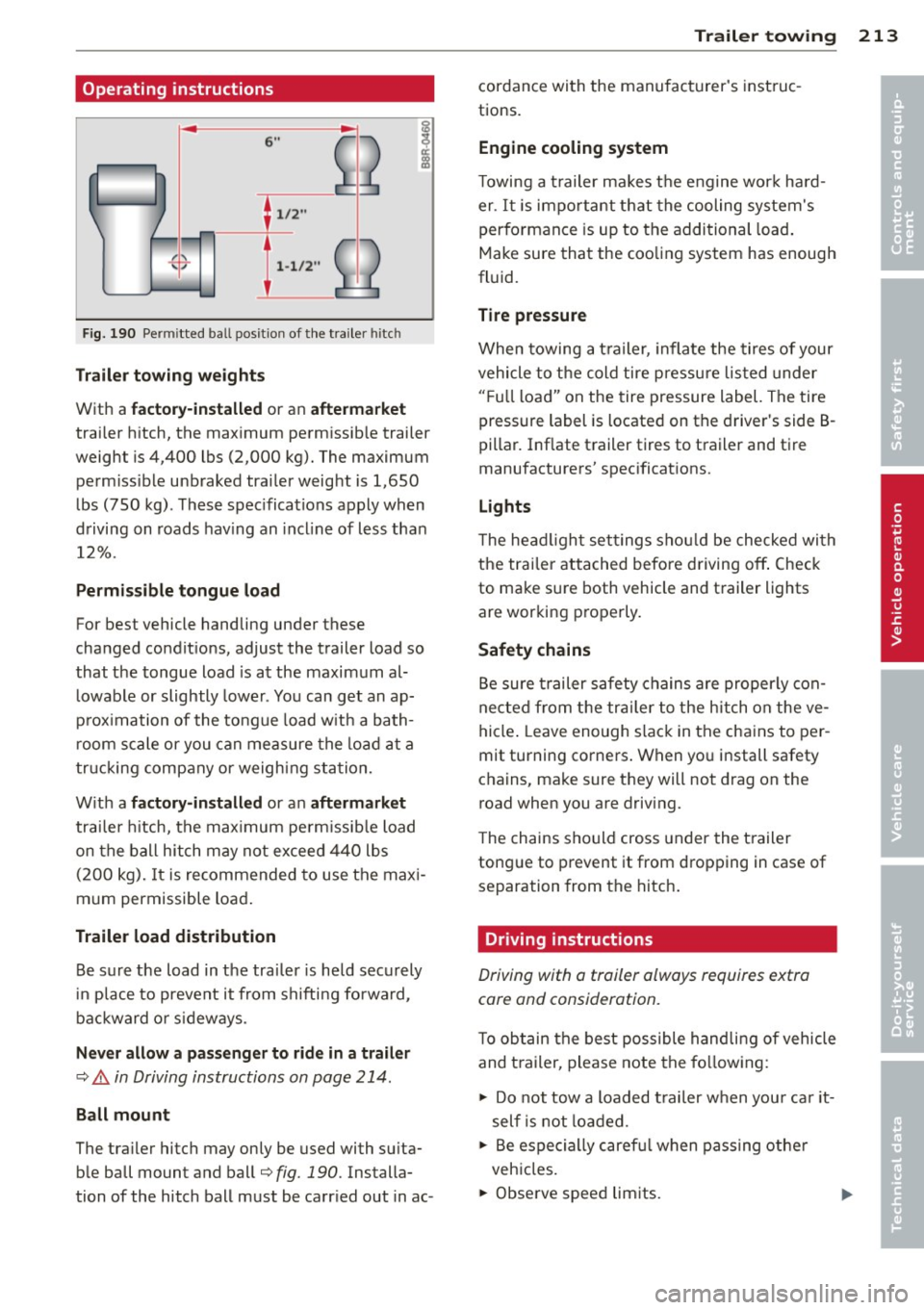
Fig. 190 Permit ted ball position of the trailer hitch
Trailer towing weights
With a factory-installed or an aftermarket
trailer hitch, the maximum permissible trailer
weight is 4,400 lbs (2,000 kg). The maximum permissible unbraked trailer weight is 1,650
lbs (750 kg) . These specifications apply when
driving on roads having an incline of less than
12%.
Permissible tongue load
For best vehicle handling under these
changed conditions, adjust the trailer load so
that the tongue load is at the maximum al
lowable or slightly lower . You can get an ap
proximation of the tongue load with a bath
room scale or you can measure the load at a
trucking company or weighing station.
With a
factory-installed or an aftermarket
trailer hitch, the maximum permissible load
on the ball hitch may not exceed 440 lbs
(200 kg).
It is recommended to use the maxi
mum permissible load.
Trailer load distribution
Be sure the load in the trailer is held securely
in place to prevent it from shifting forward,
backward or sideways.
Never allow a passenger to ride in a trailer
¢.&. in Driving instructions on page 214.
Ball mount
The trailer hitch may only be used with suita
ble ball mount and ball¢
fig. 190. Installa
tion of the hitch ball must be carried out in ac-
Trailer towing 213
cordance with the manufacturer's instruc
tions.
Engine cooling system
Towing a trailer makes the engine work hard
er .
It is important that the cooling system's
performance is up to the additional load.
Make sure that the cooling system has enough
fluid.
Tire pressure
When towing a trailer, inflate the tires of your
vehicle to the cold tire pressure listed under
"Full load" on the tire pressure label. The tire
pressure label is located on the driver's side B
pillar. Inflate trailer tires to trailer and tire
manufacturers' specifications.
Lights
The headlight settings should be checked with
the trailer attached before driving off. Check
to make sure both vehicle and trailer lights
are working properly.
Safety chains
Be sure trailer safety chains are properly con
nected from the trailer to the hitch on the ve
hicle. Leave enough slack in the chains to per
mit turning corners. When you install safety
chains, make sure they will not drag on the
road when you are driving.
The chains should cross under the trailer
tongue to prevent it from dropping in case of
separation from the hitch.
Driving instructions
Driving with a trailer always requires extra
care and consideration.
To obtain the best possible handling of vehicle
and trailer, please note the following :
.,. Do not tow a loaded trailer when your car it
self is not loaded .
.,. Be especially careful when passing other
vehicles.
.,. Observe speed limits.
•
•
Page 220 of 316
218 Clea ning and protec tio n
- Never use sp onges designed to remove
insects, or a ny kitchen scouring sponges
or similar products . They can dama ge
you r paint f inish.
- Never use a dry cloth or s ponge to clean
the headligh ts. On ly use wet clot hs or
sponges to prevent scratches.
It i s best
to use soapy water.
- You should rem ove debris (suc h as in
sects) from the headlight lenses on a
regular basis, fo r example when refuel
i ng your vehicle. Never clean the head
li ghts w ith a dry cloth or sponge. Use a
wet cloth or sponge.
It is best to use
soapy water.
@ For the sake of the environment
On ly wash the vehicle in facilit ies specially
designed for that pu rpose. This w ill reduce
t he risk of d irty water contami nated with
oil from en tering the sewer system. In
some areas, washing vehicles outside of
these facilities is prohibited .
Washing your vehicle with a power
washer
Cleaning the exterior of your car with a high
pressure power washer is safe as long as you
observe a few simple rules.
.. Before us ing the power washe r, make sure
you have read and understood the WARN
INGS¢
A in General information on
page 216 .
• Always follow the operating instructions for
the power washer .
• Make sure that the jet o n the spray hose
produces a "fan shaped sp ray ".
• Do
not ho ld the spray nozzle too close t o
soft materia ls.
Keep a d istance from soft mate rials such as
rubber hoses or insulat ing mater ial as well as
sensors and camera lenses .
When clea ning the veh icle w it h a power wash
e r
always fo llow the operating instructions.
This applies particul arly to the operating pres
sure and the spraying distance. Do not po int the spray di
rectly at the seals around the side
windows, around the doors, on the rear lid or
on the Panoram ic sliding sunroof* . Likewise,
do not po int it direct ly at tires, rubber hoses,
insulat ion material or sensors
¢ page 219.
Hold the spray nozz le at least 1.3 ft (0.4 m)
away from the vehicle.
Do not use a high-pressure power washer to
remove snow and ice .
Do not use a jet which sprays water in a direct
stream or one that has a rotating jet .
Water tempera ture sho uld no t exceed 140 ° F
(60 °().
_& WARNING
Neve r wash tires with a jet t hat sprays wa
ter in a direct stream . Th is could cause in
v is ible damage to the t ires and weaken
them, even if the spray is from a relative ly
l ong distance and for a short time. Dam
aged and weakened tires can fail and cause
accidents and personal in ju ry .
(D Note
To avoid damaging you r vehicle, always
make sure that there is suffic ient d istance
between the spray head and soft materia ls
l ike rubber hoses, plast ic pa rts and sound
deade ning mater ia ls as well as sensors
and camera lenses. Never a im the sp ray
head at the same point fo r a long time .
This also applies to cleaning headlights
and painted bumpers. Remembe r: the
closer the nozzle is to the surface of the
mater ia l, the greater the stress on the ma
terial.
Page 221 of 316
Caring for vehicles with matte finish
paint
Appl ies to vehicles: with matte finish pa in t
Vehicles with matte finish paint require spe
cial care due to the characteristics of the
paint.
Washing b y hand
To avo id damag ing the pa int when wash ing,
first remove dust and large particles from
your veh icle. Insects, g rease spots and finge r
p rints a re best removed with a
s pecial cleaner
for matt e fini sh paint .
Apply the product using a microfiber cloth . To
avoid damaging the paint su rface, do not use
too muc h press ure.
R inse the vehicle thoroughly w ith water . Clean
the vehicle starting at the top and working to
ward the bottom using a
neu tral shampoo
and a soft mi cro fiber cloth . Stop freque ntly to
rinse the clot h thorough ly.
Clean the wheels and sill panels last . Use a
clea n
sp o nge on these areas.
Rinse the vehicle thoroughly aga in and let it
air dry. If there are any water spots, they can
be removed us ing a
l e ath er cloth .
Clean again with the special cleaner for matte
finish paint
i f necessary.
Rem oving stubb orn dirt
B ird d ropping s or tree sap
are best removed
with p lenty of water and a m icrof iber cloth.
You sho uld r inse off
ga soline r esidue immedi
ately with plenty of water.
A WARNING
- Wash your vehicle only when the ignition
is switched off to reduce the risk of a
crash.
- Always read and heed all WARNINGS and
other information
¢ page 216.
(D Note
-Do no t treat vehicle parts painted w ith
matte finish paint using polish ing mate -
Cleaning and protec tion 219
ria ls or hard wax. These p rod ucts could
cause damage to the appearance or sur
face that cannot be repaired .
- Never use protective wax. It can destroy
the matte finish effect.
- Do not place any s tickers or magnetic
signs on vehicle pa rts painted with
matte finish paint. The paint could be
damaged when the stickers or magnets
are removed.
- To prevent paint damage, do not wash
the vehicle i n direct sunlight .
- To prevent damage to the paint surface,
do not use insect remova l sponges,
rough kitchen sponges or sim ilar items.
- Yo u should
remove debris (such as in
sects) from t he headlight lenses on a
regu lar bas is, for example when refuel
ing your veh icle. Only clea n the head
lights us ing a wet cloth or sponge,
neve r
a dry one. Cleaning with soapy wate r is
recommended.
(D Tips
Fo r more informat ion on special clean ing
products desig ned fo r matte f inish paint,
see your Aud i dea le r.
Sensors and camera lenses
- Remove snow w ith a hand br ush an d remove
ice with a de -icing spray that does not con
tain so lvents.
- Clean the senso rs (adap tive c ruise control *,
parking system *) with a cleaning so lution
that does not contain so lvents and a soft
cloth.
- Dampen the camera lens with a household
alcoho l-based g lass cleaner, and then wipe
the lens clean w ith a dry cloth.
Q) Note
- If you wash your vehicle with a press ure
washer,
- make sure there is eno ugh distance to
sensors in th e re ar bumper.
•
•
Page 246 of 316
244 Checking and filling
Vehicles not driven for long periods
If you do not drive you r vehicle over a pe riod
of severa l days or weeks, electrical compo
nents are gradually cut back or switched off.
This reduces energy consumption and main
tains starting capability over a longer period
¢page 203.
Take into consideration that when yo u un lock
your vehicle, some convenience functions, such as the interior lights or the power seat
adjustment, may not be available. The con
venience funct ions w ill be available again
when you turn on the ignition and start the
engine .
Winter operation
During the winter months, battery capacity
tends to decrease as temperatures drop . This
is because more power is also consumed while
start ing, and the headl ights, rear window de
fogger, etc., are used more often .
Avoid unnecessary power consumption, par
ticularly in city traffic or when traveling only
short distances . Let your authorized Audi
dealer check the capacity of the vehicle bat
tery before winter sets in¢
page 245. A well
cha rged battery w ill not only prevent starting
prob lems when the weather is cold , but will
a lso last longer .
Working on the battery
Be especially careful when working on or near
the battery.
The battery is located in the luggage compart
ment under the floor. Before you check any
thing in the luggage compartment,
read and
heed all WARNINGS
¢ _&..
Hybr id drive*: you can find impo rtant informa
tion about the high voltage battery under
¢page 97 .
Always heed the safety warnings , when work
ing on the vehicle battery or the vehicle elec
trical system to prevent injury.
The following WARNINGS are very
important when working on the battery:
Always heed the following WARNING SYM BOLS and safety precaution s when working
on the battery.
@) Always wear eye protection .
I>. Battery acid contains sulfuric acid_-Al
~ ways wear gloves and eye protection.
~ No
\!=51 -sparks
-flames
-smoking.
A When a battery is charged, it produces
~ hydrogen gas which is explosive and
could cause personal injury.
/G Always keep the battery well out of
V!!JI reach of children.
A WARNING "--
Whenever working on the battery or on
the electrical system, there is the risk of
in jury, accident and even fi re. Read and
heed the following WARNINGS :
- Always wear eye protection. Do not let
battery ac id or any lead particles get on
your skin or clothing. Shield your eyes .
Exp losive gases can cause blindness or
other injury .
- Ba ttery acid contains sulfuric acid. Sulfu
ric acid can ca use blindness and severe
burns .
- Always wear gloves and eye protection .
Do not tilt the battery because acid
could leak out of the ventilat ion open
i ngs.
- If you get battery ac id in your eyes or
on your skin, immediately rinse with
cold water fo r several minutes and get
med ical attention .
-If you should ingest any battery acid,
seek medical attention immediately.
- Do not expose the battery to an open
flame, electr ic sparks or an open light.
- Do not smoke.
-
1
I
Page 247 of 316

-Do not interchange the positive and neg
ative cables .
- When working on the battery , be sure
not to short-circuit the terminals with
tools or other metal objects. This would cause the battery to heat up very quickly,
which could lead to damage or explosion
and personal injury.
- When a battery is charged, it produces
hydrogen gas which is explosive and
could cause personal injury .
- Always keep the battery well out of the
reach of children .
- Before work is done on the electrical sys
tem, disconnect the negative ground ca
ble .
- Before performing any work on the elec
trical system , switch off the engine and
ignition as well as any electrical equip
ment. The negative cable on the battery
must be disconnected. If you are just go
ing to replace a light bulb, then it is
enough to switch off the lights.
- Before disconnecting the battery , switch
off the anti-theft alarm system! Other
wise you will set off the alarm.
- When disconnecting the battery, first
disconnect the negative cable and then
the positive cable.
- Before reconnecting the battery, make
sure all electrical consumers are switch
ed off. Reconnect the positive cable first
and then the negative cable. Never inter
change the cables - this could start a fire!
- Never charge a fro zen or a thawed-out
battery. It could explode! If a battery has
frozen, then it must be replaced. A dis
charged battery can freeze over at 32°F
(OOC) .
-Make sure the vent hose is always attach
ed to the opening on the side of the bat
tery.
- Never use batteries which are damaged.
There is the danger of an explosion! Al
ways replace a damaged battery.
Checking and filling 245
A WARNING
California Proposition 65 Warning:
- Battery posts, terminals and related ac cessories contain lead and lead com
pounds, chemicals known to the State of
California to cause cancer and reproduc
tive problems . Wash hands after han
dling.
Q) Note
- Do not disconnect the vehicle battery
when the ignition is switched on or when
the engine is running, otherwise , you will
damage electronic components in the
electrical system.
- If your vehicle is going to stand for a
long period of time without being driven,
protect the battery from "freezing", oth
erwise it will be damaged and will then
have to be replaced.
Battery charging
Starting the engine requires a well charged
battery.
Fig. 201 Engin e compart ment: Co nn ectors for charger
and j umper cab les
Always read and heed all WARNINGS below
¢ .&. and ¢,&. in Working on the battery on
page 244.
~ Hybrid drive*: read the important informa
tion concerning a dead high voltage battery
under
¢ page 105.
~ Turn off the ignition and all electrical con
sumers.
~ Make sur e the area is well ventilated when
you charge the battery . ..,.
Page 283 of 316
I
I
I
-No. Consumer
6
Headlights range control sys-
tern/Co rnering light
7 Headligh t (corner ing l ight)
Control modules (electrome-
8
chanical parking brake, shock
absorber, quattro Sport, trailer
hitch), DCDC converter
9 Adaptive cruise contro
l or high
voltage battery (hybrid drive)
12 Headlight range contro
l, park
ing system
13 Airbag
14 Rear wiper
15 Auxiliary fuse (ins
trument pan
el)
Auxilia ry fuse terminal 15 (en-
16 gine area)
Fuse panel
@ (brown )
1 E lectric exhaust door
2
3
4
5
6
7 Brake light sensor or brake ped
al movement sensor (hybrid
drive)
Fuel pump
Brake booster (hybrid drive)
Left seat heating with/without
seat venti
lation
ESC
Horn
Left fron t door (window regula -
8 tor, central locking, mirror,
sw itch, lighting)
-9 Wiper motor
10 ESC
Left rear door (window regula
l l tor, sw itch, light ing)
12 Rain and light sensor
Fuse panel © (red)
3 Lumbar support
4 Dynam ic ste ering
5 Climatized cupholder
-Amps
5/ 7,5
7,5
5
5/7,5
5
5
5
15
10
40
5/10
5
25
25
1 5/30
5
15
30
30
2 5
30
5
10
35 10
-
Fu se s and bulb s 281
No. Consumer
6 W
indshield washer system,
headlamp washer system 35
7
Vehicle electrical system control
module 1 20
8
Vehicle electrical system control
module 1 30
9 Panorama su
nroof
10 Vehicle elec
trical system control
30
mod ule 1
11 Sun shade (panorama sunroof)
20
12 Anti-theft alarm warning sys-
tern 5
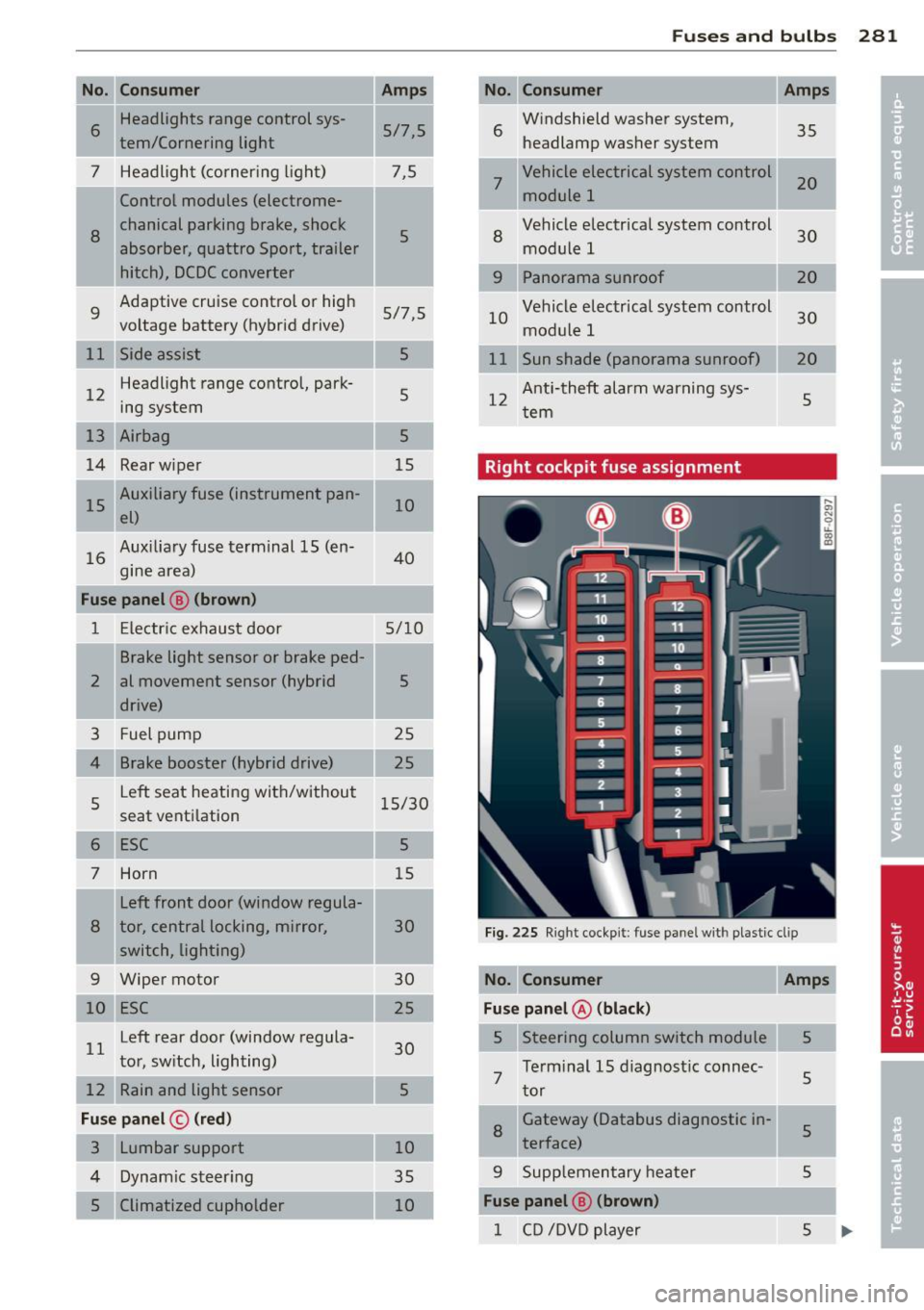
Right cockpit fuse assignment
Fi g. 22 5 Right cockp it : fuse panel wit h plast ic cl ip
No. Consumer Amps
Fuse panel @ (black )
5 Steering column switch module 5
7 Te
rm inal 15 d iagnost ic connec-
tor
5
8 Gateway (Databus diagnostic in-5 terface)
-..
9 Supp
lementary heater 5
Fuse panel @ (brown)
1 CD /D V D p layer 5
Page 285 of 316
Bulbs
Replacing light bulbs
For your safety, we recommend that you have
your authorized Audi dealer replace burned
out bulbs for you .
It is becoming increasingly more and more
difficult to replace vehicle light bulbs since in many cases, other parts of the car must first
be removed before you are able to get to the
bu lb. This appl ies especially to the light bu lbs
in the front of your car which you can on ly
reach through the engine compartment .
Sheet metal and bulb ho lde rs can have sharp
edges that can cause ser ious cuts, and parts
must be correctly taken apart and then prop
erly put back together to help prevent break
age of parts and long term damage from wa
ter that can enter housings that have not been
properly resealed.
F or your safety, we recommend that you have
your authorized Audi dealer replace any bulbs
for you, since your dealer has the proper tools,
the correct bu lbs and the expertise.
G as disc harge la mp s (X enon li ght s)*:
Due to the high electrical voltage, have the
bu lbs rep laced by a qualified technician.
H eadlights with Xenon l ight can be ident ified
by the high voltage sticker .
A WARNING
Contact with hig h-voltage components of
the electrica l system and improper re
placement of gas discharge (Xenon) head
light bulbs can cause serious personal in
jury and death .
- Xenon bulbs are pressurized and can ex plode when be ing changed.
- Chang ing Xenon lamps requires the spe
c ial train ing, instructions and equip
ment.
- Only an authorized Aud i dea ler or other
qualified workshop should change the
bulbs in gas discharge lamps .
Fuses and bulb s 28 3
A WARNING
There are parts with sharp edges on the
openings and on the bulb holders that can
cause ser ious cuts.
- If you are uncertain about what to do,
have the work performed by an author
ized Audi dealer or other qualified work
shop. Ser ious personal i nju ry may result
from imprope rly perfo rmed wo rk.
(D Tips
- If you must replace the light bulbs your
self, always remember that the eng ine
compartment of any vehicle is a hazard
ous area to work in. A lways read and
heed a ll WARN INGS
~ page 226, Engine
compartment
q & .
-It is best to ask your authorized Audi
dealer whenever yo u need to change a
bulb .
• -
•