air condition AUDI Q5 2016 User Guide
[x] Cancel search | Manufacturer: AUDI, Model Year: 2016, Model line: Q5, Model: AUDI Q5 2016Pages: 300, PDF Size: 75.02 MB
Page 164 of 300
Airbag system
The PASSENGER AIR BAG OFF light is located in
the center of the instrument panel
r::;,fig. 168.
The PASSENGER AIR BAG OFF light will come on
and stay on to tell you when the front Advanced
Airbag on the passenger side has been turned off
by the electronic control unit. Each time you turn
on the ignition, the
PASSENGER AIR BAG OFF
light will flash for a few seconds and:
- will stay on if the front passenger seat is not
occupied,
-will stay on if there is a small child or child re
straint on the front passenger seat,
- will go out if the front passenger seat is occu
pied by an adult as registered by the weight
sensing mat.
The
PASSENGER AIR BAG OFF light must come
on and stay on
if the ignition is on and
- a car bed has been installed on the front seat,
or
- a rearward-facing child restraint has been in
stalled on the front passenger seat, or
- a forward-facing child restraint has been instal
led on the front passenger seat, or
- the weight registered on the front passenger
seat is equal to or less than the combined
weight of a typical 1 year-old restrained in one
of the rear-facing or forward-facing infant re
straints listed in Federal Motor Vehicle Safety
Standard 208 with which the Advanced Airbag
System in your vehicle was certified.
If the front passenger seat is not occupied, the
front airbag will not deploy, and the
PASSENGER
AIR BAG OFF
light will stay on. Never install a
rearward-facing child restraint on the front pas
senger seat, the safest place for a child in any
kind of child restraint is at one of the seating po
sitions on the rear seat
r::;, page 152, Child re
straints on the front seat -some important
things to know
and <=> page 171, Child safety.
If the PASSENGER AIR BAG OFF light comes on
when one of the conditions listed above is met,
be sure to check the light regularly to make cer
tain that the
PASSENGER AIR BAG OFF light
stays on continuously whenever the ignition is
on. If the
PASSENGER AIR BAG OFF light does
162
not appear and not stay on all the time, stop as
soon as it is safe to do so and
- reactivate the system by turning the ignition
off and then turning it on again ;
- remove and reinstall the child restraint. Make
sure that the child restraint is properly instal
led and that the safety belt for the front pas
senger seat has been correctly routed around
the child restraint as described in the child re
straint manufacturer's instructions;
- make sure that the convertible locking feature
on the safety belt for the front passenger seat
has been activated and that the safety belt has
been pulled tight. The belt must not be loose or
have loops of slack so that the sensor below the
safety belt latch on the seat can do its job
c:::;,page 180.
-make sure that things that may increase the
weight of the child and child safety seat are not
being transported on the front passenger seat;
- make sure that the safety belt tension sensor is
not blocked. Shake the safety belt latch on the
front passenger seatback and forth;
- If a strap or tether is being used to tie the child
safety seat to the front passenger seat, make
sure that it is not so tight that it causes the
weight-sensing mat to measure more weight
than is actually on the seat.
If the PASSENGER AIR BAG OFF light still does
not come on
and does not stay on continuously
(when the ignition is switched on),
- take the child restraint off the front passenger
seat and install it properly at one of the rear
seat positions. Have the airbag system inspect
ed by your authorized Audi dealer immediately .
- move the child to a rear seat position and make
sure that the child is properly restrained in a
child restraint that is appropriate for its size
and age.
The
PASSENGER AIR BAG OFF light should NOT
come on when the ignition is on and an adult is
sitting in a proper seating position on the front
passenger seat.
If the PASSENGER AIR BAG OFF
light comes on and stays on or flashes for about
5 seconds while driving, under these circumstan-
ces, make sure that:
1111>
Page 173 of 300
,....,
N
co
er::
co
,....,
Important information
Introduction
The rear seat is generally the safest place in a
collision .
The physical principles of what happens when
your vehicle is in a crash apply also to children
c:> page 144, What happens to occupants not
wearing safety belts? .
But unlike adults and
teenagers, their muscles and bones are not fully
developed. In many respects children are at
greater r isk of serious injury in crashes than
adults .
Because children's bodies are not fu lly devel
oped, they requ ire restraint systems especially
des igned for their size, we ight, and body struc
ture. Many countr ies and all states of the United
States and provinces of Canada have laws requir
ing the use of approved child restraint systems
for infants and small children .
In a frontal crash at a speed of 20-3 5 mph
(30-56 km/h) the forces acting on a 13-pound
(6 kg) infant will be more than 20 times the
weight of the child . This means the weight of the
child would suddenly be more than 260 pounds
(120 kg) . Under these conditions, only an appro
priate child restraint properly used can reduce
the risk of serious injury . Child restra ints, like
adult safety belts, must be used properly to be
effect ive. Used improperly, they can increase the
risk of serious injury in an accident .
Consult the child safety seat manufacturer's in
structions in order to be sure the seat is right for
your child's size
c:> page 174, Important safety
instructions for using child safety seats .
Please
be sure to read and heed all of the important in
formation and WARNINGS about child safety,
Advanced Airbags, and the installation of child restraints in this chapter.
There is a lot you need to know about the Ad
vanced Airbags in your vehicle and how they work
when infants and children in chi ld restraints are
on the front passenger seat . Because of the large
amount of important information, we cannot re-
Ch ild safety
peat it all here. We urge you to read the detailed
information in this owner's manual about airbags
and the Advanced Airbag System in your vehicle
and the very important information about trans
porting children on the front passenger seat.
Please be sure to heed the WARNINGS -they are
extremely important for your safety and the safe
ty of your passengers, especially infants and small chi ldren.
_& WARNING
- Accident statistics have shown that children
are generally safer in the rear seat area than in the front seating position . Always restrain
any child age 12 and under in the rear.
- All vehicle occupants and especially children must be restrained properly whenever riding
in a vehicle. An unrestrained or improperly restrained child cou ld be injured by striking
the inter ior or by being ejected from the ve
h icle during a sudden maneuver or impact .
An unrestrained or improperly restrained
child is a lso at greater risk of injury or death
through contact w ith an inflating a irbag.
-A suitable ch ild restraint properly installed
and used at one of the rear seating positions
provides the h ighest degree of protect ion
for infants and small children in most acci
dent situat ions .
_& WARNING
f"-"----
Children on the front seat of any car even with
Advanced Airbags can be seriously injured or
even killed when an airbag inflates . A child in
a rearward-facing chi ld safety seat installed
on the front passenger seat will be seriously i njured and can be killed if the front airbag in
flates .
- The inflating airbag will h it the ch ild safety
seat or infant carr ier with great force and
will smash the child safety seat and child aga inst the backrest, center armrest, or
door.
- Always install rear-fac ing child safety seats
on the rear seat .
- If you must install a rearward facing child
safety seat on the front passenger seat in
171
Page 191 of 300
,....,
N
co
er::
co
,....,
recorded by the Event
Data Recorder and
vehicle control modules
E ve nt Dat a Record er
This vehicle is equipped wi th an Event Data Re
corder (EDR) . The main purpose of an EDR is to
record, in certain crash or near crash-like situa
tions, such as an a irbag deployment or hitting a
road obstacle, data that will assist in understand
ing how a vehicle's systems performed. The EDR
is designed to record data related to vehicle dy
namics and safety systems for a short period of
time, typically 30 seconds or less. The EDR in this
ve hicle is designed to reco rd such data as:
- How various systems in your vehicle were oper
at ing;
- Whether or not the driver and passenger safety
belts were buckled/fastened;
- How far (if at all) the dr iver was depressing the
accelerator and/or brake pedal; and,
- How fast the vehicle was traveling.
These data can he lp provide a better understand
ing of the c ircumstances in which crashes and in
juries occur. NOTE: EDR data are recorded by your
veh icle only if a non-trivia l crash situation occurs;
no data are recorded by the EDR under normal
driving conditions and no personal data (e .g .,
name, gender, age, and crash location) are re
corded . H owever, other parties, such as law en
forcement, cou ld combine the EDR data w ith the
type of personally identifying data routine ly ac
quired during a crash investigation.
To read data recorded by an EDR, specia l equip
ment is req uired, a nd access to the ve hicle or the
E DR is needed. In add it ion to the vehicle manu
facturer, other parties, such as law enforcement,
that have the specia l equipment, can read the in
formation if they have access to the vehicle or the EDR .
Some state laws restrict the retr ieval or down
l oading of data stored by ED Rs insta lled in a vehi
cle for the express purpose of retrieving data af-
Intellig ent Technology
ter an accident or crash event without the own
er 's consent.
Audi will not ac cess the EDR and/or sim ilar data
o r give it to others -
- unless the vehicle owne r (or lessee if the vehi
cle has been leased) agrees; o r
- upon the official request by the police; or
- upon the order of a court of law or a govern-
ment agency; or
- for the defense of a lawsuit through the jud ic ial
discovery process.
- Aud i may a lso use the data for research about
veh icle operation and safety performance or
prov ide the data to a third party for research
purposes without identify ing the specific veh i
cle or info rmat io n about the ident ity of its own
er or lessee and only afte r the reco rded veh icle
data has been accessed.
Vehicle control modules
Your vehicle is also equ ipped w ith a number of
electronic control modules for va rious vehicle
systems, such as engine management, emiss io n
contro l, airbags , and s afety be lts .
These electronic control modules record data dur ing norma l vehicle operation that may be
needed by trained tech nicians for diagnost ic and
r epa ir purposes. The re cording capab il ity of these
modules is lim ited to data (no sound is record
ed). Only a sma ll amount of data is actua lly re
corded over a very limited period of time, or stor
ed when a system fault is detected by a control
module . Some of the data stored may relate to
vehicle speed, direction, or braking, as well as re
straint system use and performance in the event
of a crash . Stored data can also on ly be read a nd
down loaded w ith specia l equipment that is d i
rectly connected to the vehicle.
(D Tips
Your vehicle may be equipped w ith Aud i con
nect. Your use of certain Aud i connect fea
tures requi res wire less serv ices that are pro
v ided by a third party wireless telecomm uni
cations provi der. For de tails regarding how in
formation obtained through Aud i connect is
collected, processed, transmitted, used, and ..,.
189
Page 196 of 300
Intelligent Technology
brake. This may cause the brakes to over
heat, premature wear and increased stop
ping distance.
- Under certain climatic and operating condi
tions such as passing through water, driving
in heavy rain or after washing the vehicle,
the effectiveness of the brakes can be re duced . In winter, ice can accumulate on the
brake pads, linings, discs and drums. Care
fully apply brakes for a test. Brakes will dry
and ice coatings will be cleaned off after a
few careful brake applications.
- Driving for an extended period of time on
salt-covered roads without using your
brakes can also affect braking efficiency.
Clean off accumulated salt coating from
brake discs and pads with a few carefu l
brake app lications .
-If you damage the front spoiler, or if you in
stall a different spoiler, be sure the air flow
to the front brakes is not obstructed. Other
wise the brake system could overheat reduc ing the effectiveness of the entire brake sys
tem .
- Failure of one brake circuit will impair the
braking capability resulting in an increased
stopping distance. Avoid driving the vehicle and have it towed to the nearest author ized
Audi dealer or qualified workshop.
- Never let the vehicle roll to a stop with the
engine shut off.
- If the brake booster is not working, the
brake pedal must be pressed considerably
harder to make up for the lack of booster
assista nee.
Electromechanical power
assist, Dynamic steering
The electromechanical power assist helps the
driver when steering.
Power steering adapts electronically based on
the vehicle speed.
Indicator lights and messages
• Steering defective! Do not drive vehicle!
194 If
this indicator light turns on and stays on and
this message appears, the power steering may
have failed.
Stop the vehicle in a safe location as soon as pos
sible. Do
not continue driving . See your author
ized Audi dealer or other qualified repair facility
for ass istance .
'-r, ij Dynamic steering: System fault! You can
continue driving
If the indicator l ight turns on and the message
appears, the steering may be more difficult to
move or more sensitive than usual. The steering
may also be at an angle when driving straight.
Drive slowly to your authorized Audi dealer or
qualified workshop to have the malfunct ion cor
rected.
1 :r- ij Dynamic steering: Initializing
Audi drive select* : if the indicator light blinks and
the driver message appears, the dynamic steer i ng* is reinitial ized. After start ing the engine, the
steering wheel will move slightly . Re-initial iza
tion might be necessary if the steering wheel was
moved hard to the left and right while the vehicle
was not moving. The display turns off if the initi
alization was successful.
(D Tips
- If the . or 1:r- ij in dicato r light only stays on
for a short time, you may continue driving.
- T he dynamic steering* stab ility systems
¢ page 190 are not available in the event of
a system malfunction.
- For additional information on dynamic
steering*
¢page 119.
Driving with your
quattro
With all-wheel drive, all four wheels are driven .
General information
With all-wheel drive, power is distributed to all
four wheels. This happens automatically depend
ing on your driving style and the road conditions
at the time. See also
c> page 190. ..,.
Page 200 of 300
Driving and th e en vironm ent
- Do not apply additional undercoating or
rustproofing on or near the exhaust mani
fold, exhaust pipes, catalytic converter or heat sh ields . During dr iv ing, the substance
used for undercoating could overheat and
cause a fire .
{U) Note
-Be aware that just one tank filling with
leaded fuel will already seriously degrade
the performance of the catalytic co nverter .
- Do not exceed the correct engine oil level
c:>page224 .
-Do not drive until the fuel tank becomes
completely empty . The engine could mis
fire. Unburned fuel could also get into the
exhaust system and this could cause the
catalytic converte r to overheat.
- Do not turn off the ignition while the vehicle
. . 1s moving.
- Do not continue to operate your vehicle un
der these cond itions, as otherwise fuel can
r each the catalytic converte r. This could re
su lt in overheating of the converter, requir
i ng its replacement .
- To assure efficient operation of the Emis
s ion Control System:
- Have your vehicle maintained properly and in accordance with the service recommen
dations in your Warranty
& Maintenance
booklet .
- Lack of proper maintenance as well as im
proper use of the vehicle will impair the
function of the em ission control system
and could lead to damage.
@ For the sake of the environment
Even when the Emission Control System is op
erat ing properly, the exhaust gas can have a
sulfur-like exhaust gas smell under some op
erat ing states . This depends on the su lfur
content of the fuel be ing used. Using a differ
ent brand of fue l may he lp, or filling the tank
with lead-free super grade gasoline.
198
Diesel particulate filter
Applies to vehicles: with diesel engine
The diese l particulate filter filters near ly all of
the soot particles out of th e exhaust. The filter
cleans itself automat ically under normal d riving
conditions. If the filter cannot clean itself (for ex
ample, because you are only driving shor t distan
ces), the filter becomes clogged with soot and
the
II symbol for the diesel part iculate filter il
luminates
c:> page 34 .
&_ WARNING
-Do not park your vehicle over flammable
materials such as grass or leaves because
the high temperature of the diesel particu
late filter could start a fire.
-
- Do not apply an underbody protectant in the
exhaust system area or a fire could start.
Avoid damaging the
vehicle
When you are driving on poor roads, or over
curbs, steep ramps, etc., make certain that low
lying parts such as spoilers and exhaust system
parts do no t bottom out and ge t damaged.
This is espec ially true for vehicles with low-s lung
chassis (sports chassis)* and fully loaded
vehicles.
Economical and environ
mentally-friendly driving
General
Your personal style of driving will determine the
economy of your vehicle, as well as exhaust and
noise levels.
Fuel economy, environmental impact, and wear
on your engine, brakes and tires largely depend
on three factors:
- your personal driving style
- operating conditions
- technical limitations
If you anticipate what you need to do next and
drive economically, you can easily cu t your fuel
Page 207 of 300
,....,
N
co
er::
co
,....,
Towing a loaded trailer with an empty car res ults
in a high ly unstable distribution of weight. If this
cannot be avoided, drive at very low speeds only
to avoid the risk of losing steering control.
A "balanced" rig is eas ier to operate and control.
This means that the tow vehicle should be loaded
to the extent possible and permissible, while
keeping the trailer as light as possible under the
circumstances. Whenever possible, transfer
some cargo to the luggage compartment of the
tow vehicle while observ ing tongue load require
ments and vehicle loading considerat ions.
Speed
The higher the speed, the more difficult it be
comes for the driver to contro l the rig. Do not
drive at the maximum permiss ible speed . Reduce
your speed even more if load, weather or wind
conditions are unfavorable - part icularly when
going downhill.
Reduce veh icle speed
immediately if the tra iler
shows the slightest sign of swaying .
Do not try
to stop the swaying by accelerating.
Observe speed lim its . In some areas, speeds for
veh icles towing trai lers are lower than for regular
veh icles.
Always apply brakes early. When driving down
h ill , shift into a lower gear to use the engine
braking effect to slow the veh icle. Use of the
brakes alone can cause them to overheat and fa il.
Coolant temperature
The coolant temperature gauge r=;, page 10 must
be observed carefully . If the needle moves close
to the upper end of the scale, reduce speed im mediately and/or turn off the air conditioner.
If the coolant temperature warning light in the
instrument cluster starts flashing., pull off
the road, stop and let the engine
idle for about
two minutes to prevent heat build-up.
A WARNING
Anyone not properly restrained in a moving
vehicle is at a much greater risk in an acci-
-
Trailer mode
dent. Never let anyone ride in your car who is
not properly wear ing the restraints provided
by Aud i.
Trailer mode notes
Important to know
Your vehicle handles differently when towing a
t railer because o f the additional weight and dif
ferent weight distribution. Safety, performance
and economy will greatly depend on how carefu l
ly you load your trai ler and operate your rig.
Before you actually tow your trailer, practice
tu rning, stopping and backing up in an area away
from traffic. Keep practicing until you have be
come comp lete ly familiar w ith the way your vehi
cle-tra iler combination behaves and responds.
Backing up is difficu lt and requires practice.
Backing up with a t railer generally requires steer
ing action opposite to that when backing up your
vehicle without a trailer.
Maintain a greater distance between your vehicle
and the one in front of you . You will need more
room to stop. To compensate for the trailer, you
will need a larger than normal turning radius.
When passing, remember that you cannot accel
erate as fast as you normally would because of
the added load. Make sure you have enough room
to pass. After passing, allow p lenty of room for
your trailer before c hanging lanes again.
Avoid jerky starts, sharp turns or rapid lane
changes.
(D Tips
- Do not tow a trailer during the break-in peri
od of your veh icle.
- If you tow a trailer, your Audi may requ ire
more frequent maintenance due to the ex
tra load
r=;, page 280.
205
Page 212 of 300
Care and cleaning
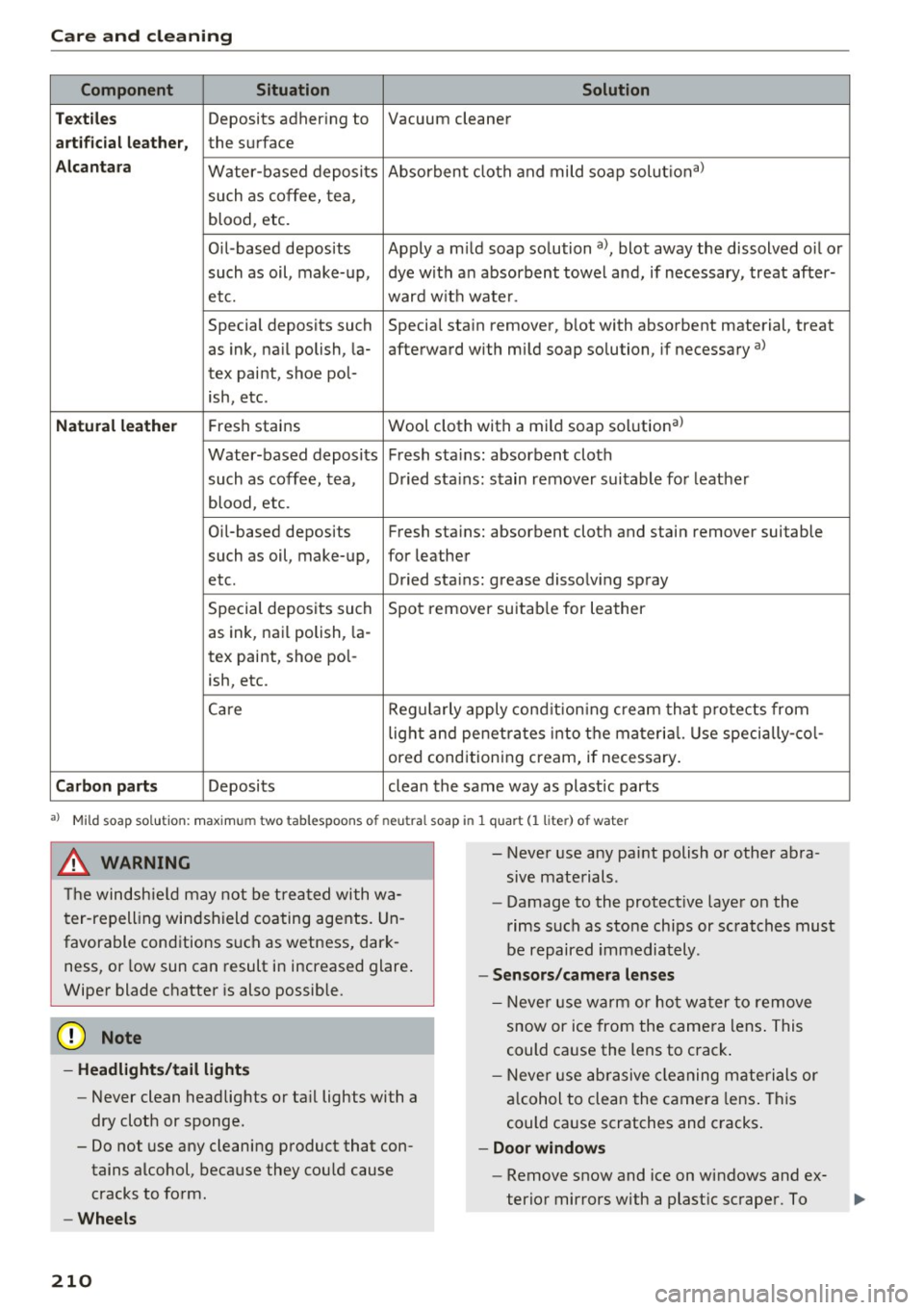
Component Situation Solution
Te xtil es
Deposits adhering to Vacuum cleaner
a rt ifici al le ather , the surface
Alcant ara Water-based deposits Absorben
t cloth and mild soap solutiona>
such as coffee, tea,
blood, etc.
O il-based deposits Apply a m ild soap solution a), blot away the dissolved oil or
such as oil, make-up, dye with an absorbent towel and, if necessary, treat after-
etc. ward wit h water.
Special deposits such Special stain remover, b lot with absorbent material, treat
as ink, na il polish, la- afterward with mild soap solution, if necessary a)
tex paint, shoe pol-
ish, etc.
Natural leather Fresh stains Wool cloth with a mild soap so
lutiona)
Water-based deposits Fresh sta ins : absorbent cloth
such as coffee, tea, Dried sta ins: stain remover suitable fo r leather
blood, etc.
Oil-based deposits Fresh stains: absorbent cloth and stain remover suitable
such as oil, make-up, for leather
etc. Dried sta ins : grease dissolv ing spray
Special deposits such Spot remover suitab le for leather
as ink, nai l polish, la -
tex paint, shoe pol-
ish, etc.
Ca re Regularly apply cond ition ing cream that protects from
light and penet rates into the materia l. Use specia lly-co l-
ored conditioning cream, if necessary.
Carbon parts Deposits clean the same way as plastic parts
a) Mild soap solution: maximum two tablespoons of neutral soap in 1 quart (l liter) of water
_& WARNING
The windshie ld may not be trea ted with wa
ter-repelling windshield coating agents. Un
favorable conditions s uch as wetness, dark
ness, or low sun can result in increased glare .
Wiper blade chatter is also possible.
(D Note
- Headlights/tail light s
-Never clean headlights or tail lights with a
dry cloth or sponge.
- Do not use any cleaning product that con
tains alcohol, because they could cause
cracks to form.
- Wheels
210
-
- Never use any paint polish or other abra
sive materials.
- Damage to the protect ive layer on the
rims such as stone chips or scratches must
be repaired immediately.
- Sensors /camera lenses
- Neve r use wa rm or ho t wa ter to remove
snow or ice from the camera lens . This
could cause the lens to crack .
- N eve r use ab rasive cleaning materials or
a lcohol to clea n the camera lens . This
could cause scratches and cracks .
-Doo r window s
-Remove snow and ice on windows and ex-
terior mirrors with a plast ic scraper. To
Page 228 of 300
Checking and Filling
areas, into open streams or down sewage
drains.
- Recycle used engine oil by taking it to a used
engine oil collection facility in your area, or
contact a service station .
Cooling system
Coolant
The engine coolant performs two functions: it
keeps the engine from overheating and it pro tects the engine from freezing in the winter.
The cooling system is sealed and generally re
qu ires little attention .
The cooling system has been filled at the factory
with a permanent coolant which does not need to
be changed. The coolant consists of
a mixture of
specially conditioned water and the manufactur
er's g lycol-basedcoo lant additive G 13 antifreeze
w ith anticorrosion addi tives (50% for USA mod
e ls· 60% for Canadian mode ls). This m ix ture
'
both ass ures the ne cess ary fros t protection and
p rotects metal com ponents in the engi ne's coo l
ing system from corrosion and scaling .
It also
raises the boiling point of the coolant.
Do not red uce the concent ra tion of the cool ant in
the s ummer by addi ng p la in water.
The propor
tion of coolant additive must be at lea st 50 %
but not more than 60 %
to maintain antifreeze
protection and cooling efficiency. If the coolant
frost protection is too low, the coo lant could
freeze and damage the vehicle heat ing and en
g ine cooling system .
For year -round driving, antifreeze is added at the
factory for temperatures down to:
- -3 1 °F
c -3s0c) usA
- -4 0° F ( -40°C) Canad a.
I f you must add coolant, use a m ixt ure of wa ter
and coolant add it ive. M ixing the coolant additive
with d istilled water is recommen ded.
_& WARNING
B efore you che ck anyt hing i n the engine com
partmen t, a lways read and heed all WARN -
226
INGS ~ & in Working in the engine compart
ment on page 220.
(D Note
- Be fore w inter sets in, have the coolan t
checked to see if the coo lant additive in your
vehicle is suff ic ient to meet the climate con
ditions. This is especially important if you
live in a region where the winter is extreme
ly cold. If necessary, increase the proportion
of coolant addi tive to 60% .
- Whe n adding coolant additive to your cool
ing system, remember:
- We re commend usin g on ly coo lant addi
tive G12++ o r G13 fo r yo ur vehicle. This
coolant ad dit ive is availab le at authorized
Audi dealers. Other types of antifreeze can
significantly reduce corrosion protection.
The resulting corrosion can cause a loss of
coolant and serio us engine damage.
- Do not add any type of radiato r leak sealant
to your vehicle's engine coolant. Adding ra
diator repair fluid may adversely affect the
function and perfo rmance of yo ur cooling
system and cou ld resu lt in damage not cov
ered by your New Ve hicle Li mited War ranty.
Checking the engine coolant level
The engine coolant level can be checked with a
quick glance.
Fi g. 20 0 Eng ine compartment: cover on the coo lant expan
s io n tank
Befo re yo u check anything in the engine compart
ment,
always read and heed all WARNINGS
~ ,& in Working in the engine compart,nen t on
page 220. ..,.
Page 252 of 300
Wheels
damage the ti res, and the chains w ill quickly be
destroyed .
A WARNING
Using incorrect snow chains or insta lling snow
chains incorrectly can result in loss of vehicle
control, which increases the risk of an acc i
dent .
(D Note
Snow chains can damage the rims/wheel cov
ers * if the chains come into d irect contact
w ith them. Remove the wheel covers* first .
Use coated snow chains.
(D Tips
When using snow cha ins, it may be useful to
sw itch the off road mode on
<=> page 191.
Low aspect ratio tires
Your Aud i is factory -equipped with low aspect ra
tio tires. These t ires have been tho roughly tested
a nd been se lected specifically fo r yo ur model fo r
thei r supe rb per fo rman ce , road feel and handling
un der a va riety of d riving conditions . As k yo ur au
thor ized Audi dealer for mo re details .
T he low aspect ratio of these t ires is in dicated by
a nume ral of
55 or less in the tire's size desig na
tion . The numera l rep resents the rat io o f th e
tire's sidewall he ight in relat ion to its tread width
expressed in pe rcentage. Conventional tires have
a height/w idt h rat io o f 60 o r more .
The performance of low-aspect -ra tio tires i s par
ticularly sensitive to improper inflation pres
sure . It is therefore important that low aspect
ratio tires are inflated to the specified pressure
and that the inflation pressure is regularly
checked and maintained . Tire pressures should
be checked at least once a month and always
before a long trip <=>
page 244.
What you can do to avoid tire and rim
damage
Low aspect rat io tires can be damaged more easi
ly by impact with potholes, cu rbs, gullies or
250
ridges on the road, particularly if the tire is un
derinflated.
I n orde r to mi nimize the occur rence o f imp act
dam age to the tires o f yo ur vehicle, we recom
mend that you observe the following preca u
tions:
- Always m aintain reco mmende d in fla tion pres
sures. Check yo ur tir e pressure eve ry 2,0 00
m iles (3,00 0 km) and add air if necessary .
- Dr ive c arefully on ro ads w ith potholes, deep
gu llies o r ridges . The impact from dr iving
through or over such obstacles can damage
your tires. Impact with a curb may a lso ca use
damage to your t ires.
- After any impact, immediate ly inspect you r
tires or have them inspected by the nearest au
thorized Aud i dealer. Replace a damaged tire as
soon as possible.
- Inspect your tires every 2,000 m iles (3,000 km)
for damage and wear . Damage is not always
easy to see . Damage can lead to loss of a ir and
unde rinflation, w hich could event ua lly cause
tire fa ilure . If you believe that a tire may have
be en damaged, replace the tire as soon as pos
sible .
- These tires may wear mo re quickly than o thers .
- Please also remember that, while these tires delive r responsive hand ling, they may ride less
comfortab ly and make mo re noise than o ther
choi ces.
Reduced performance in winter/cold season
conditions
A ll tires are des igned for certain purposes. The
l ow aspect ratio, ultra h igh performance tires
o rigin ally ins talle d on your veh icle are inten ded
for m aximum dry and wet road per forma nce and
handling . They a re not suitable for co ld, snowy or
i cy weather conditions . If you drive under those
c ir cumstances, you should equip yo ur vehicle
with all-season o r winter tires, which offer better
tract ion under t hose conditions. We suggest you
u se the recommended s now or all-season tires
spec ified for your vehicle, o r the ir equiva lent .
Refer to<=>
page 249 for more detailed informa
tion regard ing winter tires.
Page 282 of 300
Consumer information
Consumer information
Warranty coverages
Your Audi is covered by the following warran
ties:
- New Vehicle Limited Warranty
- Limited Warranty Against Corrosion Perfora-
tion
- Emissions Control System Warranty
- Emissions Performance Warranty
- California Emissions Control Warranty (USA
vehicles only)
- California Emissions Performance Warranty
(USA vehicles only)
Detailed information regarding your warranties
can be found in your
Warranty & Maintenance
booklet .
Operating your vehicle
outside the U.S.A. or
Canada
Government regulati ons in the United States and
Canada require that automobi les meet specific
emission regulations and safety standards.
Therefore, vehicles built for the U.S.A. and Cana
da differ from vehicles sold in other countries.
If you plan to take your vehicle outside the conti
nenta l limits of the United States or Canada,
there is the poss ibility that:
- un leaded fue ls for vehicles with catalytic con
verter may not be available;
- fuel may have a considerably lower octane rat
ing . Improper fuel may cause engine damage;
- service may be inadequate due to lack of proper
service facilities, tools or testing equipment;
- r eplacement parts may not be readily available.
- Nav igation systems for veh icles built for the
U.S .A . and Canada will not necessarily work in
Europe, and may not work in other countries
outside of North America.
280
(D Note
Audi cannot be responsib le for mechanical
damage that could result from inadequate
fuel, service or parts ava ilability.
Audi Service Repair
Manuals and Literature
Audi Official Factory Service Manuals and Litera
ture are published as soon as poss ible after mod
el introduction . Service Manuals and literature
are available to order from the Audi Technical Lit
erature Ordering Center at :
www.audi.techliterature .com
Maintenance
General '
Your vehicle has been designed to help keep
maintenance requirements to a minimum. How
ever, a certain amount of regular maintenance is
still necessary to assure your vehicle's safety,
economy and reliability . For detailed vehicle
maintenance consult your Warranty & Mainte
nance booklet .
Under difficult operating conditions, for exam
ple at extremely low outside temperatures, in
very dusty regions, when towing a trailer very fre
quently, etc., some service work should be per
formed between the intervals specified. This ap
plies particularly to:
- oil changes, and
- cleaning or replac ing the a ir filter .
'
@) For the sake of the environment
By regularly maintain ing your vehicle, you
help make sure that em iss ion standards are
maintained, thus minimizing adverse effects
on the environment .
Important considerations for you and your
vehicle
The increasing use of electronics, sophisticated
fuel injection and emission control systems, and
the generally increas ing technica l complexity of ..,_