lock AUDI Q5 2016 Manual PDF
[x] Cancel search | Manufacturer: AUDI, Model Year: 2016, Model line: Q5, Model: AUDI Q5 2016Pages: 300, PDF Size: 75.02 MB
Page 221 of 300
-A permitted refill bott le contains approxi
mately 0.5 gallons (1.9 liters) of Ad Blue.
Refilling Ad Blue with a canister
A pp lies to vehicles: with selective ca taly tic reduc tion
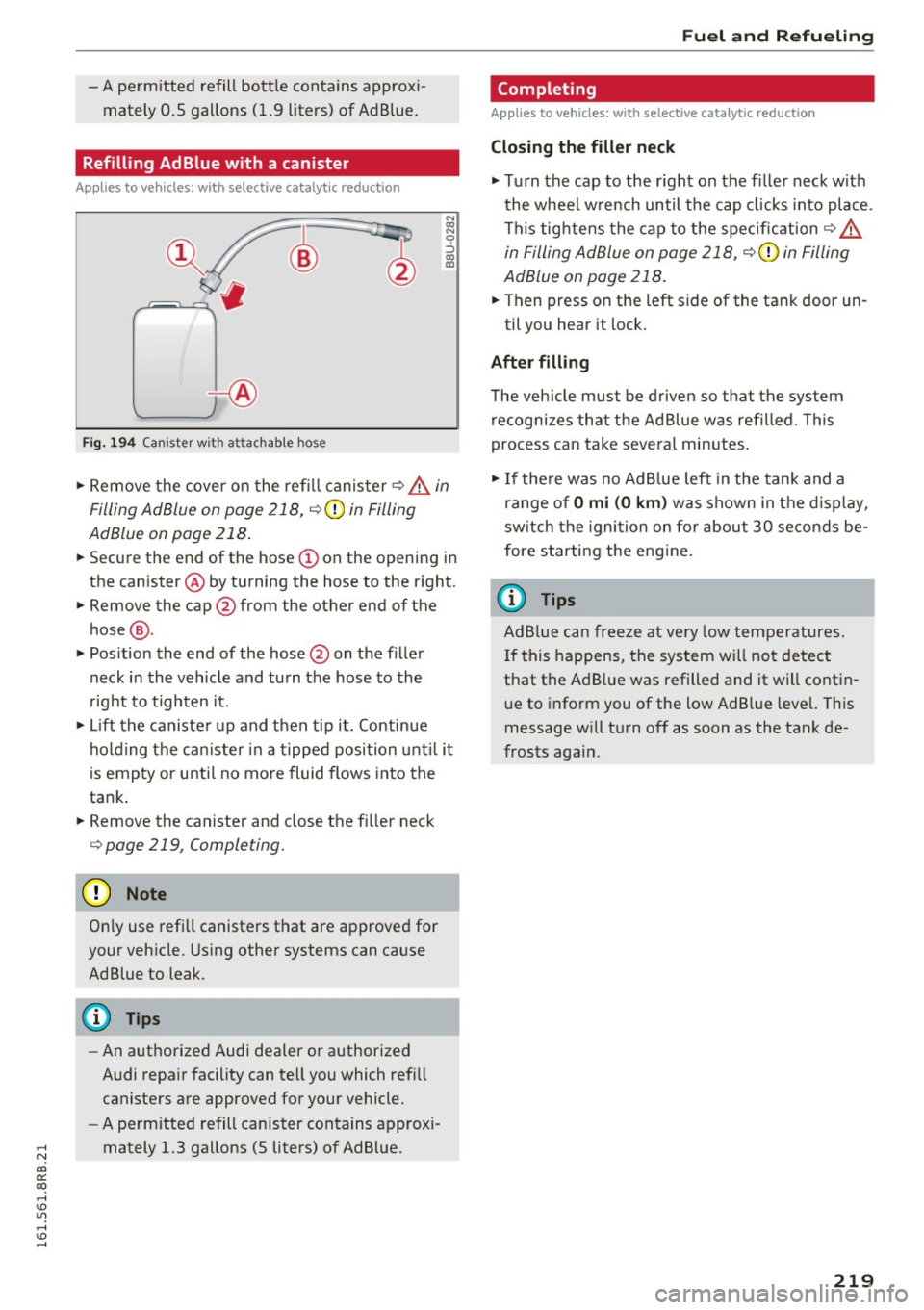
®
+®
F ig . 194 Ca nister wi th att ach ab le hose
.,. Remove the cover on the refi ll canis ter ¢.&. in
Filling AdBlue on page 218, ¢(Din Filling
AdBlue on page 218 .
.. Secure the end of the hose (I) on the opening in
the can ister @ by turning the hose to the right.
.. Remove the cap @from the other end of the
hose @.
.. Pos ition the end of the hose@on the f iller
neck in the vehicle and turn the hose to the
right to tighten it.
.,. Lift the caniste r up and then tip it. Continue
holding the ca nister in a tipped position unt il it
is empty or until no more fluid flows into the
tank .
.. Remove the canister and close the f iller neck
¢ page 219, Comple ting .
(D Note
On ly use refi ll canisters t hat are approved for
your veh icle. Using other systems can cause
Ad Blue to leak.
(D Tips
- An authorized Audi dealer or authorized
Audi repa ir facility can tell you which ref ill
canisters are approved for your vehicle.
- A pe rm itted refill canister contains approxi-
~ mately 1.3 gallons (5 liters) of AdBlue.
co
er::
co
,....,
Completing
App lies to vehicles : wi th selective cata lytic re du ctio n
Closing the filler neck
.. Turn the cap to the r ight on the fille r neck w ith
the wheel w rench until the cap clicks into place .
This tighte ns the cap to the specification ¢
&,
in Filling AdBlue on page 218 , ¢@ in Filling
AdBlue on page 218 .
.. Then press on the left side of the tank door un-
til you hear it lock.
Afte r filling
T he vehicle must be driven so that the system
recogni zes that the Ad Blue was refilled. This
process can take several minutes.
.,. If the re was no AdB lue left in the tank and a
range of
O mi (0 km ) was shown in the d isplay,
sw itch the ignition on for about 30 seconds be
fore starting the engine .
(D Tips
Ad B lue can freeze at very low temperatures .
If this happens, the system will not detect
that the Ad B lue was refilled and it will contin
ue to inform you of the low AdBl ue leve l. This
message w ill turn off as soon as the tank de
frosts aga in.
219
Page 222 of 300
Checking and Filling
Checking and Filling Hood
Releasing the engine hood
The engine hood is released from inside the vehi
cle .
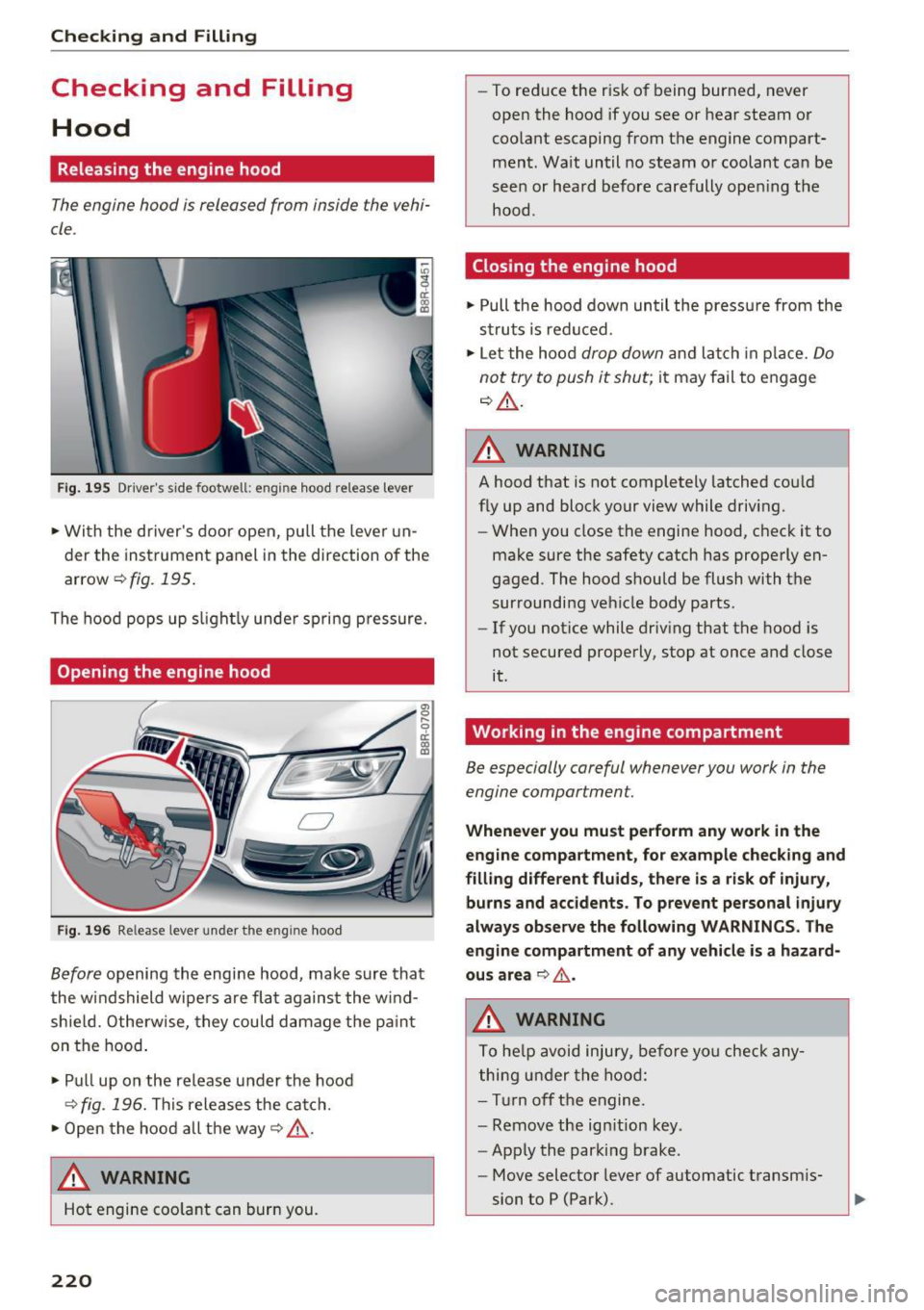
Fig. 195 Driver's side footwell : eng ine hood release lever
.. With the driver's door open, pull the lever un
der the instrument panel in the direction of the
arrow ¢
fig. 195.
The hood pops up slightly under spring pressure.
Opening the engine hood
CJ
Fig. 196 Release lever under t he e ngi ne hood
Before opening the engine hood, make sure that
the windshield wipers are flat against the w ind
shield. Otherwise, they could damage the paint
on the hood.
.,. Pull up on the release under the hood
¢
fig . 196. This releases the catch.
.,. Open the hood all the way ¢.&_ .
,& WARNING
Hot engine coo lant can burn you.
220
-To reduce the r isk of being burned, never
open the hood if you see or hear steam or
coo lant escaping from the engine compart
ment. Wait until no steam or coolant can be
seen or heard before carefully opening the
hood .
Closing the engine hood
.,. Pull the hood down until the pressu re from the
struts is reduced .
.. Let the hood
drop down and latch in place. Do
not try to push it shut;
it may fail to engage
~A -
A WARNING
A hood that is not completely latched could
fly up and block your view while driving.
- When you close the engine hood, check it to
make sure the safety catch has properly en
gaged . The hood should be flush with the
surrounding vehicle body parts .
- If you notice while driv ing that the hood is
not secured properly, stop at once and close
it .
Working in the engine compartment
Be especially careful whenever you work in the
engine compar tment.
-
Whenever you must perform any work in the
engine compartment , for example checking and
filling different fluids, there is a risk of injury,
burns and accidents. To prevent personal injury
always observe the following WARNINGS. The
engine compartment of any vehicle is a hazard
ous area ¢.&, .
A WARNING
To help avoid injury, before you check any
thing und er the hood:
- Turn off the engine.
- Remove the ign ition key .
- Apply the parking brake.
- Move selector lever of automatic transm is-
sion to P (Park).
-
Page 229 of 300
.... N
co
er::
co
....
.,. Turn
off the ignition.
.,. Read the engine coolant level from the coolant
expansion tank
c> fig . 200, c> page 222,
fig. 197. With a cold engine, the coolant level
should be between the "MIN" and "MAX" mark
i ngs . When the engine is warm, the level may
be s light ly above the
"MAX " marking .
T he location of the coolant expans ion tank can be
seen in the engine compartment illustrat ion
i=> page 222.
To obtain an accurate reading, the engine must
be sw itched
off.
The expansion tank in your vehicle is equipped
with an electric coolant level sensor.
When the coo lant level is too low, the warning
light in the Auto-Check System
c:> page 29 wi ll
blink until you add coolant and the level has been
restored to normal. Even though there is an e lec
tr ic coolant level sensor, we still recommend you
check the coolant level from time to time.
Coolant loss
Coolant loss may indicate a leak in the cooling
syst em. In the event of coolant loss, the cooling
system should be inspected immediately by your
authorized Audi dealer. It is not enough merely
to add coolant .
In a
sealed system, losses can occur only if the
boiling point of the coo lant is exceeded as a re
sult of overheat ing .
(D Note
Do not add any type of radiator leak sealant
to your veh icle's engine coolant. Adding radia
tor repair fluid may adversely affect the func
tion and performance of your cooling system
and could result in damage not covered by
your New Vehicle Limited Warranty .
Adding coolant
Be very careful when adding engine coolant.
Before you check anyth ing in the eng ine compart
ment,
always read and heed all WARNINGS
Checking and Filling
c> .&. in Working in the engine compartment on
page
220 .
Requirement: The re must be a residual amount
of coolant in the expans io n tank
c>@.
.,. Turn off the engine .
.,. Let the engine cool down.
.,. Place a thick rag over the coolant expansion
ta nk
c:> page 226 , fig. 200 and carefully turn
the cap counter-clockwise
c> _&. .
.,. Add coo lant mixed in the correct ratio
c:> page 226, Coolant up to the MAX marking .
.,. Make sure that the f luid level remains stable.
Add more coolan t if necessary .
.,. Twist the cap o n again
tightly.
Replacement engine coolant must conform to ex
act specifications
c:> page 226, Coolan t.
We recommend using only coolant addit ive Gl2 +
+ , Gl3
or in an emergency Gl2+. Do not use a
different additive . In an emergency use plain wa
ter until you can get the correct addit ive and can
restore the correct ratio. This should be done as
soon as possible.
If you have lost a considerable amount of coo l
ant, then you shou ld add cold antifreeze and cold
water only whe n the engine is cold.
Always use
new e ngine coolant when refilling.
Do not fill coolant above the "MAX " mark. Excess
coolant will be forced out through the pressure
relief valve in the cap when the engine becomes
hot.
A WARNING
-- The cooling system is under pressure and
can get very hot. Reduce the risk of scalding
from hot coolant by following these steps .
- Turn
off the eng ine an d allow it to cool
down.
- Protect your face, hands and arms from
escaping fluid and steam by covering the
cap with a large, thick rag.
- Tu rn the cap slowly and very carefully in a
counter-clockwise direction whil e applying
light, downward pressure on the top o f
the cap .
~
227
Page 231 of 300
,....,
N
co
er::
co
,....,
partition of the engine compartment on the left
side ¢
page 222.
The fl uid level may drop slightly after some time
due to the automatic adjustment of the brake
pads . This is not cause for alarm.
I f the b rake fl uid level fa lls
considerably be low
the "MIN" mark, the brake wa rning/ind icator
light (U .S. mode ls:
1111 , Canadian models:.)
will come on¢
page 18 and ¢ page 28 . Do not
continue to operate the vehicle. The complete brake system should be thoroughly checked by an
author ized Audi dealer or qualified workshop and
the cause corrected . If the brake fluid level is too
low, the brake warning/ind icator light will illumi
nate. Contact an authorized Audi dealer
immedi
a te ly.
Changing brake fluid
Have the brake fluid changed by an experienced technician.
Brake fluid absorbs mo isture from the air. If the
water conte nt in the brake fluid is too h igh, cor
ros ion in the brake system may resu lt after ape
riod of time. The boiling poi nt of the brake flu id
will also dec rease cons iderably and decrease
braking pe rformance.
Therefore, the b rake fluid must be changed
e ve ry
two year s.
Always use new b rake fluid wh ich con
forms to Fede ral Motor Veh icle St andard "FMVSS
116 DOT 4".
The brake fluid reservoir can be diff icult to reach,
therefore, we re commend that yo u have the
b rake fl uid changed by yo ur autho rized
Audi
deal er.
Your dealer has the cor rect too ls, the
right brake fluid and the know -how to do this for
you.
A WARNING
- Brake fluid is poisonous. It must be stored
only in the closed original container out of
the reach of chi ldren!
- B rake failure can resu lt from old or inappro
pr iate brake flu id. Observe these precau
t io ns:
Ch eck ing and Filling
-Use only brake fluid that meets SAE speci
ficat ion
J 1703 and conforms to Federal
Motor Vehicle Standard 116. Always check
with your authorized Aud i dealer to make
sure you are us ing the correct brake fluid .
The co rrect type of brake flu id is also i ndi
cated on the b rake fluid reservoir.
- The brake flu id must be new. Heavy use of
the b rakes can cause a vapo r lock if the
bra ke fluid is left in the system too long.
T his can se riously affe ct the efficiency of
t h e b rakes as we ll as you r safety . This
could resu lt in an accident.
(D Note
B rake flu id will damage the paint of your ve h i
cle.
@) For the sake of the environment
Because of the p roblem of proper d isposa l of
brake fluid as well as the spec ial too ls re
q uire d and the necessary expertise, we rec
ommend that yo u have the bra ke fluid
c hanged by yo ur authorize d Au di dealer.
Battery
General information
Under normal ope rat ing condit ions, the batte ry
in you r A udi does not need any mainte nance.
Wi th
high o utside temperatures or long daily
drives we recommend that yo u have the elec tro
lyte level checked by an authorized A udi dealer or
qualified workshop . The electro lyte level should
also be checked each time the battery is charged
~ page 231.
Have the batte ry checked when you take your ve
hicle in for service. You are we ll advised to re
place a battery that is older than S years.
Wi th certain types of airbag deployment, the
battery is d isconnected from the veh icle electri
ca l system for safety reasons¢.&.
in Repair, care
and disposal of the airbags on page 164.
Hyb rid dr ive *: yo u can find impo rtant informat ion
about the high voltage battery under ¢
page 97. .,.
229
Page 232 of 300
Checking and Filling
Disconnecting the battery terminals
Some vehicle functions (power window regula
tors, for example) are lost if the battery termi
na ls are disconnected. These functions have to be
relearned after the battery terminals are con
nected again. To prevent this, the battery should
only be disconnected from the vehicle e lectrical
system when absolutely necessary for repairs.
Vehicles not driven for long periods
If you do not drive your vehicle over a period of
several days or weeks, electrical components are
gradually cut back or sw itched off. This reduces
energy consumption and ma intains starting ca
pab ility over a longer period
c::> page 195 .
Take into consideration that when you unlock
your veh icle, some convenience functions, such
as the interior lights or the power seat adjust
ment, may not be available. The convenience
functions will be available again when you turn
on the ignition and start the engine.
Winter operation
During the winter months, battery capacity tends
to decrease as temperatures drop. This is be
cause more power is also consumed while start
ing, and the head lights, rear window defogger,
etc., are used more often.
Avoid unnecessary power consumption, particu
larly in city traffic or when traveling only short
d istances . Let your authorized Audi dealer check
the capacity of the vehicle battery befo re winter
sets inc::>
page 231. A well cha rged battery w ill
not only preven t starting problems when the
weather is cold, but will also last longer.
Working on the battery
Be especially careful when working on or near
the battery.
The batte ry is located in the luggage compart
ment under the floor. Before you check anything
in the luggage compartment,
read and heed all
WARNINGS
c::> & .
Hybr id drive*: you can find important information
about the high volta ge battery unde r
c::> page 97.
230
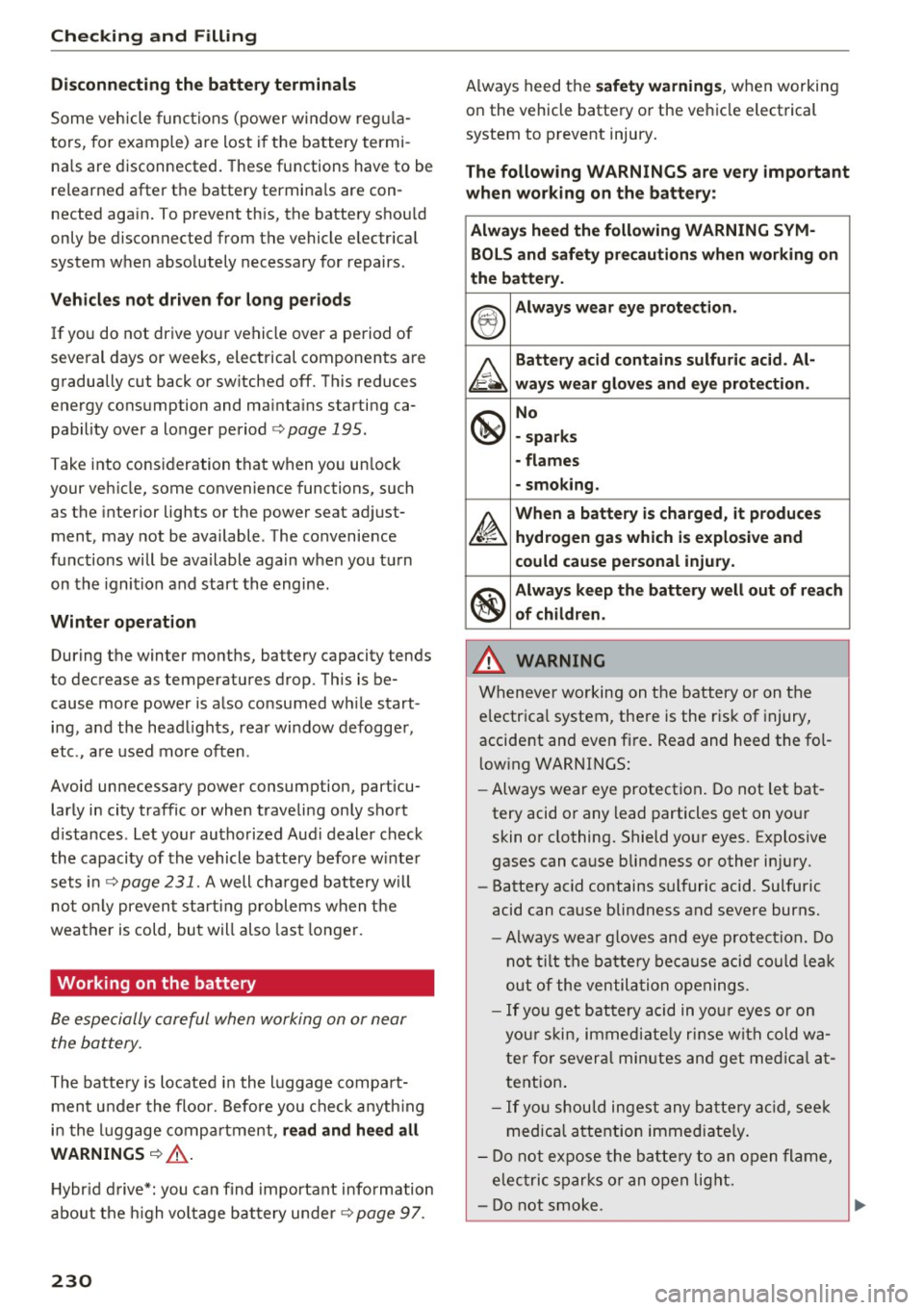
Always heed the safety warnings , when working
on the vehicle battery or the vehicle electrical system to prevent injury.
The following WARNINGS are very important
when working on the battery :
Always heed the following WARNING SYM· BOLS and safety precautions when working on
the battery .
®
Always wear eye protection .
A
Battery acid contains sulfuric acid. Al-
ways wear gloves and eye protection .
@
No
• sparks
• flames
- smoking.
~
When a battery is charged, it produces
hydrogen gas which is explosive and
could cause personal injury.
®
Always keep the battery well out of reach
of children .
.b WARNING
-
Whenever working on the battery or on the
e lectrica l system, there is the risk of injury,
accident and even fire. Read and heed the fol
lowing WARNINGS:
- Always wear eye protection . Do not let bat
tery acid or any lead particles get on your
skin or clothing. Shield your eyes. Explosive
gases can cause blindness or other injury.
- Battery acid contains sulfuric acid. Sulfuric
acid can cause blindness and severe burns.
-A lways wear glo ves and eye protection. Do
not tilt the battery because acid could leak
out of the ventilation openings.
- If you get battery acid in yo ur eyes or on
you r skin, immediate ly rinse with cold wa
ter for several minutes and get medical at
tention .
- If you should ingest any battery acid , seek
medical attention immediate ly.
- Do not expose the battery to an open flame,
elec tric sparks or an open light.
- Do not smoke.
~
Page 251 of 300
,....,
N
co
er::
co
,....,
disassemble them ¢.&. .
A WARNING
Wheel bolts that are tightened or repaired in
correctly can become loose and result in loss
of vehicle control, which increases the risk of
an acc ident. For the correct tightening specifi
cation, refer to ¢
page 260, After changing a
wheel .
- Always keep the wheel bolts and the
threads in the wheel hub clean and free of grease.
- Only use wheel bolts that fit the rim .
- Always have damaged r ims repa ired by an
authorized Audi dealer o r autho rized Aud i
Service Facility . Never repair or d isassemble
rims yourself, because this increases the risk
of an accident.
Winter tires
W inte r ti res s ignificantly improve the vehicle's
h andling when driving in win ter condit ions . Be
cause of the ir constr uction (width, compound,
tread pattern), summer tires provide less trac
tion on ice and snow .
"'U se winter t ires on all fo ur wheels .
.. Only use winter t ires that are approve d for your
v ehicl e.
"' Please note that the maximum permitted
speed may be lower with winter tires¢.&_ . An
authorized Aud i dealer or au thori zed Aud i Serv
ice Fac ility can inform you about the maximum
permitted speed fo r your tires .
"' Check the tire press ure after installing wheels
¢page 244.
The effectiveness of winter tires is reduced great
l y when the tread is worn down to a depth of
0 .1 57 inch (4 mm). The character ist ics of winter
tires a lso de crease great ly as the tire ages, re
ga rdless of the remain ing tread.
WARNING
- Never drive faster than the maxim um per
mitted speed for your t ires. This cou ld cause
the tires to heat up too much. Th is increases
Wh eel s
the risk of an accident because it can cause
the t ire to burst.
- Always adapt your driving to the road and
traffic cond itions . Drive carefully and reduce
your speed on icy or slippery roads . Even
winter t ires can lose tract io n on black ice.
@ For the sake of the environment
Reinsta ll summer tires at the app ropr iate
time, beca use they prov ide better handling
when roads are free of snow and ice. Summer
tires cause less road no ise, tire wear and fue l
consumpt io n.
(D Tips
You can also use all season tires instead of
winter tires. Please note that in some coun
tries where winter tires are required, on ly
winter tires w ith the
& symbo l may be per
mitted .
Snow chains
Snow chains improve traction in the snow.
"'On ly install snow chains on the rear wheels.
"' Check and correct the seating of the snow
chains if necessary after drivi ng a few feet. Fol
low the instructions from the manufacturer .
"' Note the maximum pe rmitted spe ed wh en dr iv
ing w it h snow cha ins. Do not excee d 30 mph
( SO km/h) .
S now c ha ins not o nly improve the
driving in win
te r road condit io ns, but also the
braking.
Use of snow chains is only permitted w ith certa in
r im/tire comb inat ions due to technical reasons .
Check with an author ized Audi dealer or author
ized Audi Service Facility to see if you may use
snow chains.
U se
fine-mesh snow chains . They must not add
more than 0 .53 inch (13 .5 mm) in heig ht, incl ud
ing the cha in lock.
You m ust remove the chai ns when driving on
r oads t hat are
free of snow . When roads are free
of snow, snow chai ns can impa ir han dling and .,.
249
Page 256 of 300
Emerg ency assis ta nce
Emergency assistance
Vehicle jack, vehicle tool kit and collapsible spare
tire
Onboard tool kit and vehicle jack
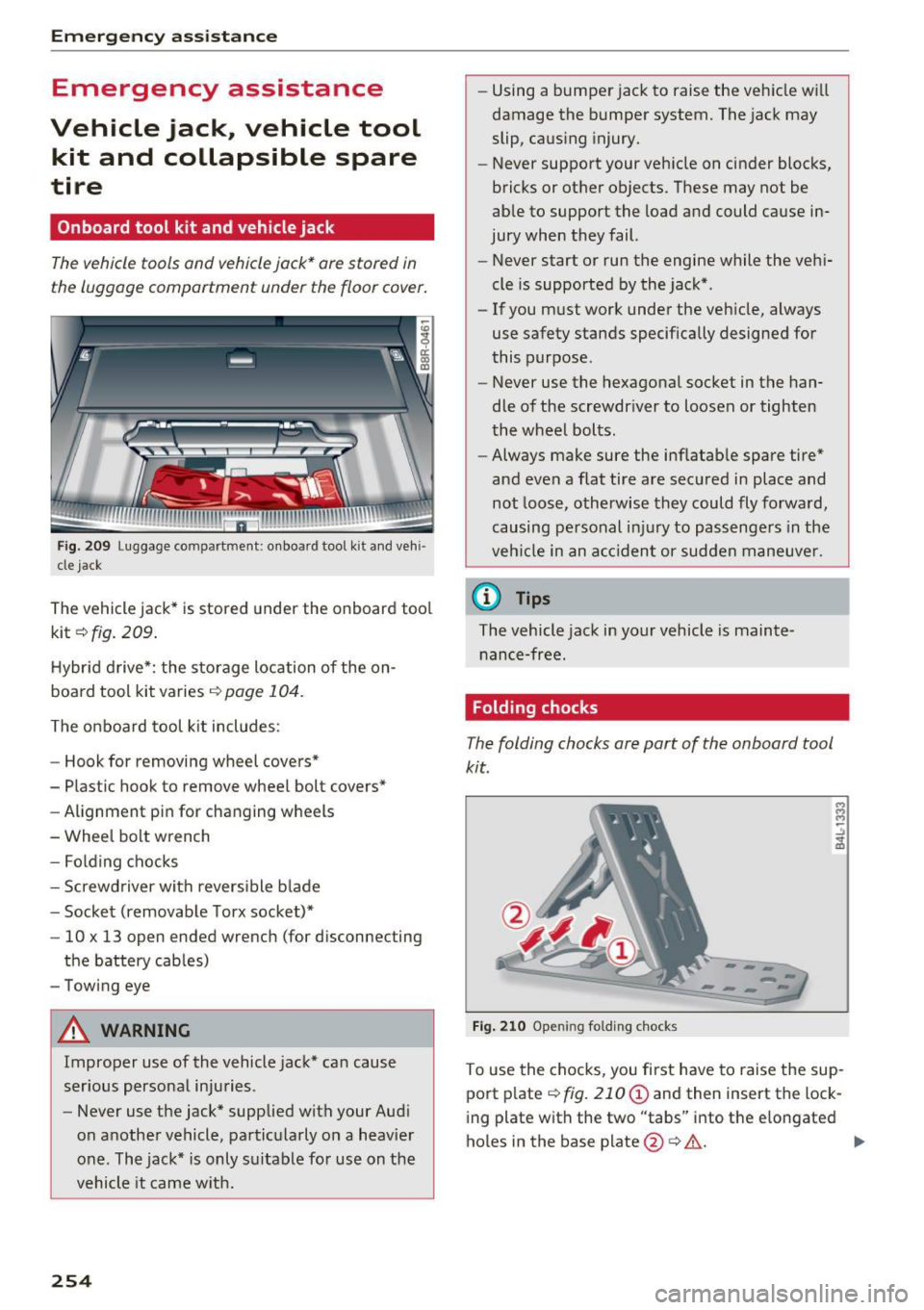
The vehicle tools and vehicle jock* ore stored in
the luggage comportment under the floor cover.
Fig. 209 Luggage compartment: on board tool kit and vehi
cle jack
The vehicle jack* is stored under the onboard tool
kit ¢ fig. 209.
Hybr id d rive*: the storage location of the on
board tool kit varies ¢ page 104.
The onboard tool k it includes:
- Hook for removing wheel covers*
- Plastic hook to
remove wheel bolt covers*
-Alignment pin for changing wheels
- Wheel bolt wrench
- Folding chocks
- Screwdriver with revers ible blade
- Socket (removable Torx socket)*
- 10 x 13 open ended wrench (for disconnecting
the battery cables)
- Towing eye
A WARNING
Improper use of the vehicle jack* can cause
ser ious personal injuries.
- Never use the jack* supplied with your Aud i
on another vehicle, particularly on a heavier
one. The jack* is only su itable for use on the
vehicle it came w ith.
254 -
Using a bumper jack to raise the vehicle will
damage the bumper system. The jack may
slip, caus ing injury.
- Never support your vehicle on cinder blocks,
bricks or other objects. These may not be
able to support the load and could cause in
jury when they fail.
- Never start or run the engine while the vehi
cle is supported by the jack* .
- If you must work under the vehicle, always
use safety stands specifically designed for
this purpose .
- Never use the hexagonal socket in the han
dle of the screwdr iver to loosen or tighten
the wheel bolts .
- Always make sure the inflatable spare tire*
and
even a flat tire are secu red in place and
not loose, otherwise they could fly forward,
causing personal inj ury to passenge rs in the
vehi cle in an a cc ident or sudden maneuve r.
@ Tips
The vehicle jack in your vehicle is mainte
nance-free.
Folding chocks
The folding chocks ore port of the on board tool
kit .
---
Fig . 210 Open ing fo lding chocks
To use the chocks, you fi rst have to raise the sup
port plate
¢ fig. 210 (D and then insert the lock
ing plate with the two "tabs" into the elongated
holes in the base plate
@ c> &.. .,,_
Page 257 of 300
..... N
co ~ CX)
..... I.Cl U"I
..... I.Cl .....
_& WARNING
-The chock cannot fulfil its function and may
lose its stability if the "tabs" on the support
plate a re not inserted correctly into the
elongated holes in the base plate. If th is
happens, the vehicle may sta rt to move
wh ile a wheel is being changed.
- Never use the fold ing chocks if they are
damaged or if they have not been assem
bled co rrectly.
Removing bass box
Appl ies to vehicles : wit h bass box
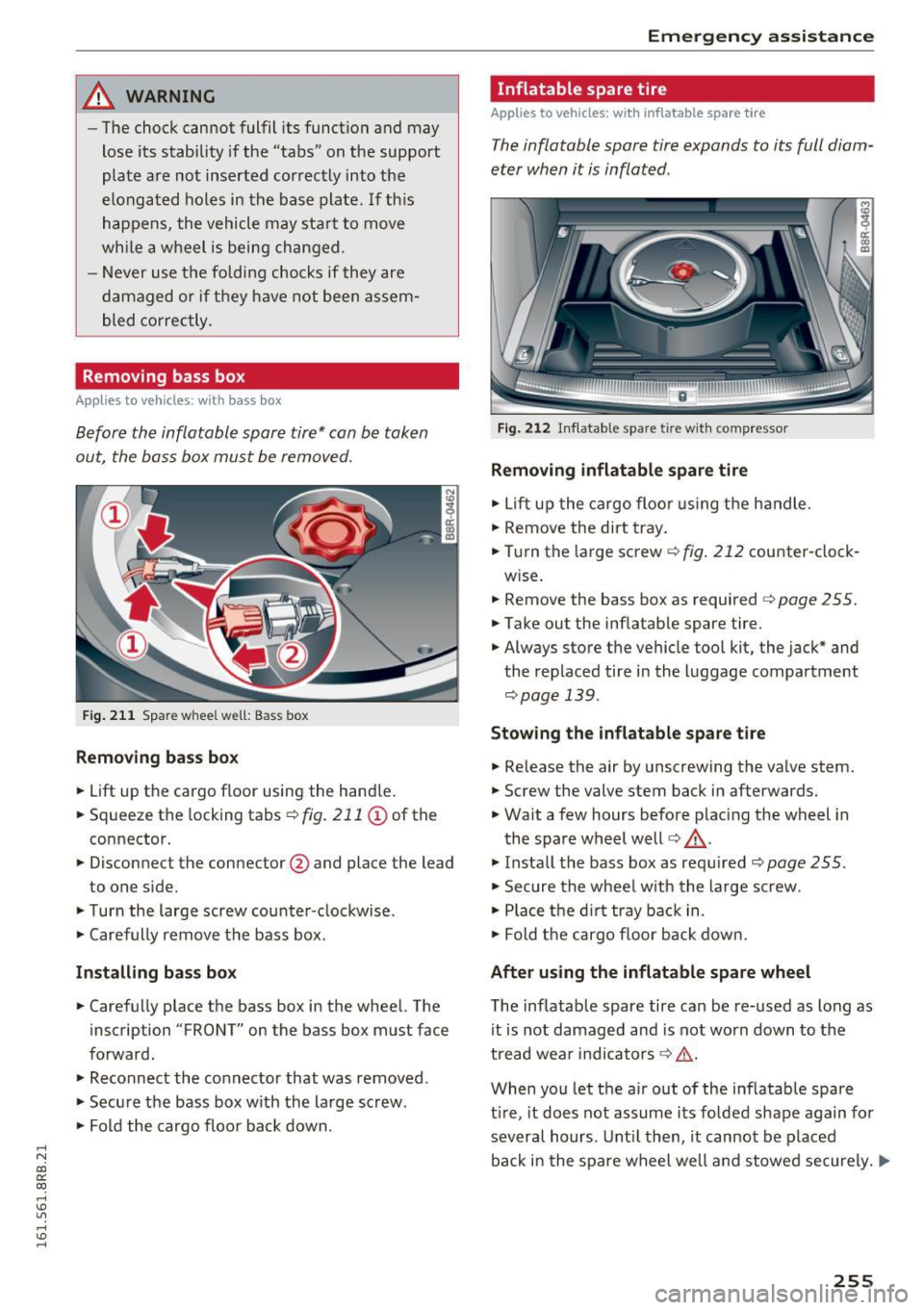
Before the inflatable spare tire* can be token
out, the bass box must be removed.
Fig . 21 1 Spare w heel well: Bass box
Removing ba ss box
"Lift up the cargo floor using the hand le .
" Squeeze the locking tabs
c:> fig . 211 (D of the
connector.
" Disconnect the connector @and place the lead
to one s ide.
"T urn the large screw counter -clockwise .
" Carefully remove t he bass box .
Installing bas s bo x
"Carefully place the bass box in the whee l. The
inscription "FRONT" on the bass box must face
forward.
" Reconnect the co nnector that was removed.
" Secu re the bass box w ith the la rge screw .
" Fold the cargo floo r bac k down.
Em ergen cy a ssis tanc e
Inflatable spare tire
Applies to vehicles: w ith inflatable spare tire
The inflatable spare tire expands to its full diam
eter when it is inflated .
Fig. 212 In flatable spare tire wit h comp ressor
Removing inflatabl e spare tire
"Lift up the cargo floo r us ing the handle.
" Remove the dirt tray .
" Turn the large screw <=:>
fig. 212 counter -clock-
w ise .
" Remove the bass box as required<=:>
page 255.
"Take out the inflatab le spare tire.
" Always store the vehicle too l kit, the jack* and
the replaced tire in the luggage compartment
<=:> page 139.
Stowing the inflatable spare t ire
.. Release the air by unscrewing the valve stem.
" Screw the valve stem back in afterwards.
" Wa it a few hours before plac ing the wheel in
the spare wheel well<=:>,& .
" Insta ll the bass box as required <=:>
page 255 .
" Secure the whee l w ith the la rge sc rew.
" Place t he d irt tray back in .
" Fold t he c argo floor back down .
After using the inflatable spare wheel
The inflatable spare tire can be re-used as long as
it is not damaged and is not worn down to the
tread wea r indicators
c:> .&, .
When you let the a ir out of the inf latab le spare
t ir e, it does not assume its folded shape again for
severa l hours . Unt il then, it cannot be placed
back i n the spare wheel well and stowed securely.
IJI>
255
Page 261 of 300
,....,
N
co
er::
co
,....,
Special care is required if you are repairing
the tire on a steep incline.
@ Tips
- Do not operate the compressor for more
than 12 minutes continuously, otherwise it
can overheat. Once the compressor has
cooled, you can continue to use it.
- If sealant has spi lled out, let it dry and then
you can remove it by peeling it away like a
foil.
- Remember to obtain a new bott le of sealant
from your authorized Audi dealer after re
pair ing a tire. After this, the functionality of
the tire repair set is restored .
- Obey all laws.
Replacing wheels
Before changing a wheel
Observe the following precautions for your own
and your passenger's safety when changing a
wheel.
""After you experience a tire failure, pull the car
well away from moving traff ic and try to reach
level ground before you stop¢_& .
.. All passengers sho uld
leave the car and move
to a safe location (fo r instance, behind the
guardrai l) ¢ .&_ .
.. Engage the
par king b rake to prevent yo ur vehi
cle from roll ing unintentionally ¢&_ .
.. Move
selecto r le ver to po sitio n P ¢ &_ .
"" If you are towing a trailer: unh itch the trailer
from your veh icle.
"" Block the diagonally opposite wheel with the
folding chocks o r other objects .
""T ake the
jac k* and the inflatable spa re tir e*
out of the luggage compartment ¢ page 254 .
A WARNING
You or your passengers cou ld be inj ured while
changing a wheel if you do not follow these
safety precautions:
- If you have a flat tire, move a safe distance
off the road. Turn off the engine, turn the
Em ergenc y ass is tanc e
emergency flashers on and use other wa rn
ing dev ices to alert other motorists.
- Make sure that passengers wait in a safe
place away from the vehicle and well away
from the road and traff ic.
- To help prevent the veh icle from moving
suddenly and possib ly slipping off the jack*,
always fully set the parking brake and block
the wheel diagonally opposite the wheel be i n g changed with the fold ing c hocks or oth
er objects . When one front whee l is lifted
off the ground, placing the Automatic
Transmission in P (Park) w ill
not prevent the
veh icle from moving.
- Before you change a wheel, be sure the
gro und is leve l and firm.
If necessary, use a
sturdy board under the jack*.
- Always s tore the vehicle too l kit, the jack*
and the replaced tire in the lugg age com
partment
¢ page 139.
Changing a wheel
When you change a wheel, follow the sequence
described below s tep-by -step and in exactly that
order.
1. Remove the de corative wheel cover* . For
more detai ls see also¢
page 260, Decaro-
tive wheel covers
o r¢ page 260, Wheels
with wheel bolt cops .
2. Loosen the w
heel bolt s ¢ page 260.
3 . Locate the proper mounting point for the
jack* and align the jack* below that point
¢ page 261.
4. Li ft the car with the jack*¢ page 261 .
s. Remove the wheel with th e flat tire and then
insta ll the
inflatable spar e tir e *
¢ page 262.
6. Tighte n all whee l bolts lightly.
7 .
Lo wer the vehicle wi th the jack *.
8 . Use the whee
l bolt wrench and
firml y tighten
all wheel bo lts ¢
page 260 .
9. Replace the decorat ive wheel co ver* .
259
...
Page 265 of 300
,....,
N
co
er::
co
,....,
handle to screw in and tighten all whee l bolts
slightly .
~ Remove the alignment pin and insert and tight
en the remaining wheel bolt slightly like the
rest .
~ Turn the jack handle* counter-clockwise to low
er the vehicle until the jack* is fully released .
~ Use the wheel bolt wrench to tighten all wheel
bolts firmly
Q page 260. Tighten them cross
wise,
from one bolt to the (approximately) op
posite one, to keep the wheel centered .
Q) Note
When removing or installing the whee l, the
rim could hit the brake rotor and damage the
rotor. Work carefu lly and have a second per
son help you.
(D Tips
Never use the hexagonal socket in the handle
of the screwdriver to loosen or tighten the
wheel bolts.
- Pull the reversible blade from the screwdriv
er before you use the hexagonal socket in
the handle to turn the wheel bolts.
- When mounting tires w ith
unidirectional
tread design
make sure the tread pattern is
pointed the right way
Q page 263.
- The wheel bolts should be clean and easy to
turn. Check for d irt and corrosion on the
mating surfaces of both the wheel and the
hub. Remove all dirt from these surfaces be
fore remount ing the wheel.
Tires with unidirectional tread design
Tires with unidirectional tread design must be
mounted with their tread pattern pointed in the
right direction .
Using a spare tire with a tread pattern
intended for use in a specific direction
When using a spare t ire with a tread pattern in
tended for use in a specific direction, please note
the following:
- The direct ion of rotat ion is marked by an arrow
on the side of the tire.
Emergency assistance
- If the spare tire has to be installed in the incor
rect direction, use the spare tire on ly tempora
r il y since the tire will not be able to ac hieve its
optimum performance characterist ics with re
gard to aquap lan ing, no ise and wear.
- We recommend that you pay part icu lar atten
tion to th is fact during wet weather and that
you adjust your speed to match road cond i
tions.
- Rep lace the flat tire w ith a new one and have it
installed on your veh icle as soon as possible to
restore the handling advantages of a un id irec
tional tire .
Notes on wheel changing
Please read the information Q page 241, New
tires or wheels
if you are going to use a spare tire
which is different from the tir es on your veh icle.
After you change a tire:
- Check the tire pressure on the spare immedi
ately after installation.
- Have the wheel bolt tightening torque
checked with a torque wrench as soon as pos
sible by your authorized Audi dealer or a
qualified workshop.
- With steel and alloy wheel rims, the wheel
bolts are correctly tightened at a torque of
105
ft lb (140 Nm).
- If you notice that the wheel bolts are corroded
and difficult to turn while changing a tire,
they should be replaced before you check the
tightening torque.
- Replace the flat tire with a new one and have
it installed on your vehicle as soon as possi
ble. Remount the wheel cover.
Until then, drive with extra care and at reduced
speeds.
.&_ WARNING
- If you are going to equip your vehicle with
tires or rims which differ from those which
were fac tory installed, then be sure to read
the information
Q page 241, New tires or
wheels.
-
263