weight AUDI Q5 2016 Owners Manual
[x] Cancel search | Manufacturer: AUDI, Model Year: 2016, Model line: Q5, Model: AUDI Q5 2016Pages: 300, PDF Size: 75.02 MB
Page 47 of 300
..... N
co ~ CX)
..... I.Cl U"I
..... I.Cl .....
-Always ensure that no one is within range of
the rear lid when it is moving, in particular
close to the hinges and the upper and lower
edges - fingers or hands can be pinched.
- To help prevent poisonous exhaust gas from
being drawn into the veh icle, always keep
the rear lid closed while driving . Never
transport objects larger than those which fit
completely into the luggage area, because
then the rear lid cannot be fully closed.
- Never leave your vehicle unattended espe cially w ith the rea r lid left open . A chi ld
cou ld crawl into t he car thro ugh the luggage
compartmen t and pull the lid shut, becom
ing trapped and unable to get out. To re
duce the risk of persona l injury, never let
children p lay in or around your veh icle. Al
ways keep the rear lid as well as the vehicle
doors closed when not in use.
- If there is a l uggage rack or bicycle rack
mounted on the rear lid, it may not be able
to open completely or an opened rear lid may close by itself because of the added
we ight. So the open rear lid must be sup
ported or the weight must be removed from
the luggage rack first.
(O} Tips
- As soon as the electrical connection to the
trailer socket is completed on vehicles with
a factory installed tow ing hitch, or a t railer
hitch that was instal led later ac co rding to
factory specifications, the a utomat ic rear lid
funct ion can only be ope rated via the handle
in the rear lid.
- If the vehicle battery charge drops below a ce rtain level, you can still open or close the
rear lid manually, however, you will need to
apply more force to close it .
- If the rear lid on a locked vehicle is unlocked
with the middle button
,c:$ on the remote
key, the rear lid is automatically locked
again immediately after closing. This is ind i
cated by the turn signals bli nking .
- The following applies to veh icles equipped
with the Convenience key* feature: if the re mote control key is left in the luggage com
partment, luggage compartment w ill auto-
Op enin g an d clos ing
matically unlock itse lf after you lock the ve
hicle. This prevents you from unintentiona l
ly locking yo ur key in the luggage compart
ment.
Emergency unlocking of
the luggage compartment lid
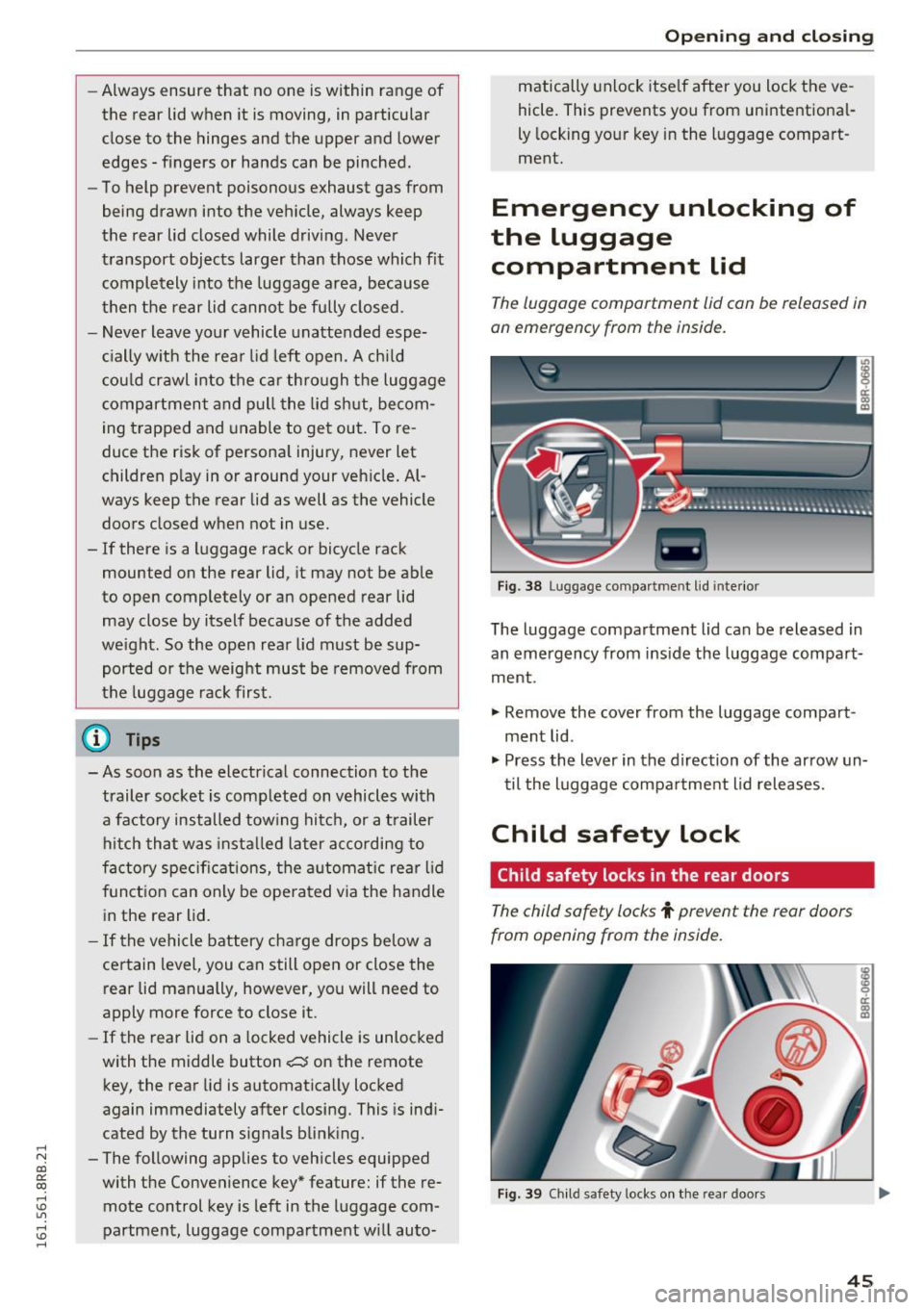
The luggage compartment lid can be released in
an emergency from the inside.
F ig . 3 8 Luggage compa rt me nt lid inte rior
The luggage compartment lid can be released in
an emergency from ins ide the luggage compart
ment .
.,. Remove the cover from the luggage compart
ment lid .
.,. Press the lever in the d irection of the ar row un
til the luggage compa rtme nt l id releases.
Child safety lock
Child safety locks in the rear doors
The child safety locks t prevent the rear doors
from opening from the inside.
F ig . 39 Ch ild safety locks on the rea r doors
45
Page 73 of 300
..... N
co ~ CX)
..... I.Cl U"I ,....,
I.Cl ,....,
the luggage compartment to help prevent
items from f lying fo rward into the passen
ger compartment.
- Never attach a child safety seat tether strap
to a tie-down.
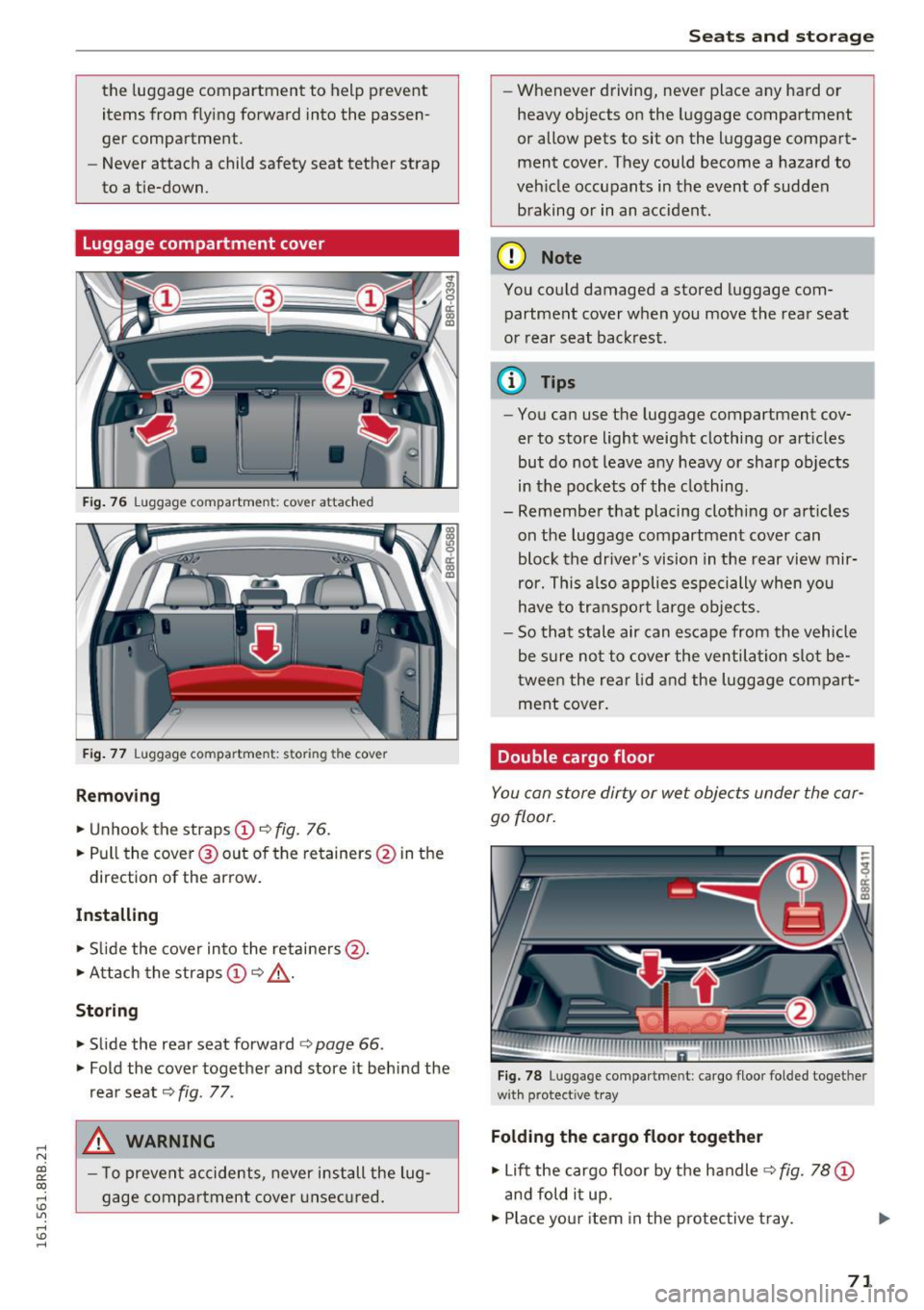
Luggage compartment cover
F ig. 76 Luggage compartment: cover attached
Fig. 77 Luggage compartme nt: storing the cover
Removing
"' Unhook the straps @ c:> fig. 76.
"' Pull the cove r@ out of the retainers @ in the
direction of the arrow .
Installing
"' Slide the cover in to the retainers @.
"' Attach the straps
(D c:> _&. .
Storing
"'Slide the rea r seat forward c:> page 66 .
"' Fold the cover together and store it behind the
rea r seat
c:> fig. 77 .
A WARNING
- T o prevent accidents, never install the Lug
gage compa rtment cove r unsec ured .
-
Seats and storag e
-Whenever driving, never place any ha rd or
heavy objects on the l uggage compartment
or allow pets to sit on the luggage compart
ment cover. They could become a hazard to
ve hicle occupants in the event of sudden
braking or in an accident .
(D Note
You could damaged a stored luggage com
partment cover when you move the rear seat
or rear seat back rest.
@ Tips
- You can use the luggage compartment cov
er to store light weight clothing or art icles
but do not leave any heavy or sharp objects
in the pockets of the clo thing.
- Remember that placing clothing or art icles
on the luggage compartment cover can
bloc k the drive r's vision in the rear view mir
ror. This a lso applies es pecially when you
have to transpo rt large obje cts.
- So that stale air can escape from the vehicle
be s ure no t to cover the ventilation slot be
t ween the rear lid and the luggage com pa rt
ment cover.
Double cargo floor
You can store dirty or wet objects under the car
go floor.
F ig . 7 8 Luggage compartme nt: ca rgo floor folded together
w it h protective tray
Folding the cargo floor together
"' Lift the cargo floor by the handle c:> fig. 78 (D
and fold i t up.
"' Place you r item in the protec tive t ray. ..,.
71
Page 76 of 300
Sea ts and stor age
Install ing the attachments
.. Remove the cap @~ fig. 84 .
.. Slide the attachment into the T-groove (2) .
.. Tighten the attachment according to the roof
rack installation instruct ions .
.. Close the cap.
Installing th e cover p rofile
.. Seal the openings in the T-groove (2) wi th the
cover profile @ after having installing the at
tachments.
.. If you not want to use the attachment, seal the
whole T-groove
0 with the cover profile @.
.. Cut the cover profile to the length needed, if
necessary.
Roof load
The cargo on the roof must be securely attached.
Handling characteristics change when cargo is
transported .
The permissible roof load for your vehicle is
1 65 lbs (75 kg ). The roof load is the total of the
weight of the roof rack, the attachments and the
cargo you are carrying .
_&. WARNING
-The cargo must be secu rely attached on the
roof rack, otherwise you risk an accide nt.
- Distribute the load as evenly as possible and
do not make the roof rack wider than the
maximum pe rmitted.
- You m ust under no circumstances exceed
the permiss ible roof load, the perm iss ible
axle loads a nd the permissib le overa ll
weight of your vehicle -risk of an accident.
- Mount the attachments to the roof rack only
after you have placed the roof rack on the
vehicle.
- Consider that when transpo rting heavy ob
jects or one wi th a large surface, the han
dling characteristics change due to shift in
the center of gravity or the greater surface
exposed to the wind. So adapt your driving
and your speed to prevailing conditions. We recommend that you do not dr ive faster
than 80 mph (130 km/h) .
74
-Mounting a roof rack changes the height of
your veh icle. Keep th is in m ind when parking
your veh icle in your garage, or when dr iving
through a tunnel or under an overpass .
(D Note
- Make sure the rear lid does not hit the cargo
on the roof rack when you open it. On
vehicles with automat ic rear lid/trunk lid
operation* you may have to adjust the open
posit ion of the rear lid
~ page 44 .
-Remove the roof rack and attachment be
fore taking your vehicle through an auto matic ca r wash to avoid damage .
@ For the sake of the environment
As a result of the increased wind resistance
created by a roof rack, your vehicle is using
fuel unnecessarily . So remove the roof rack
after using it.
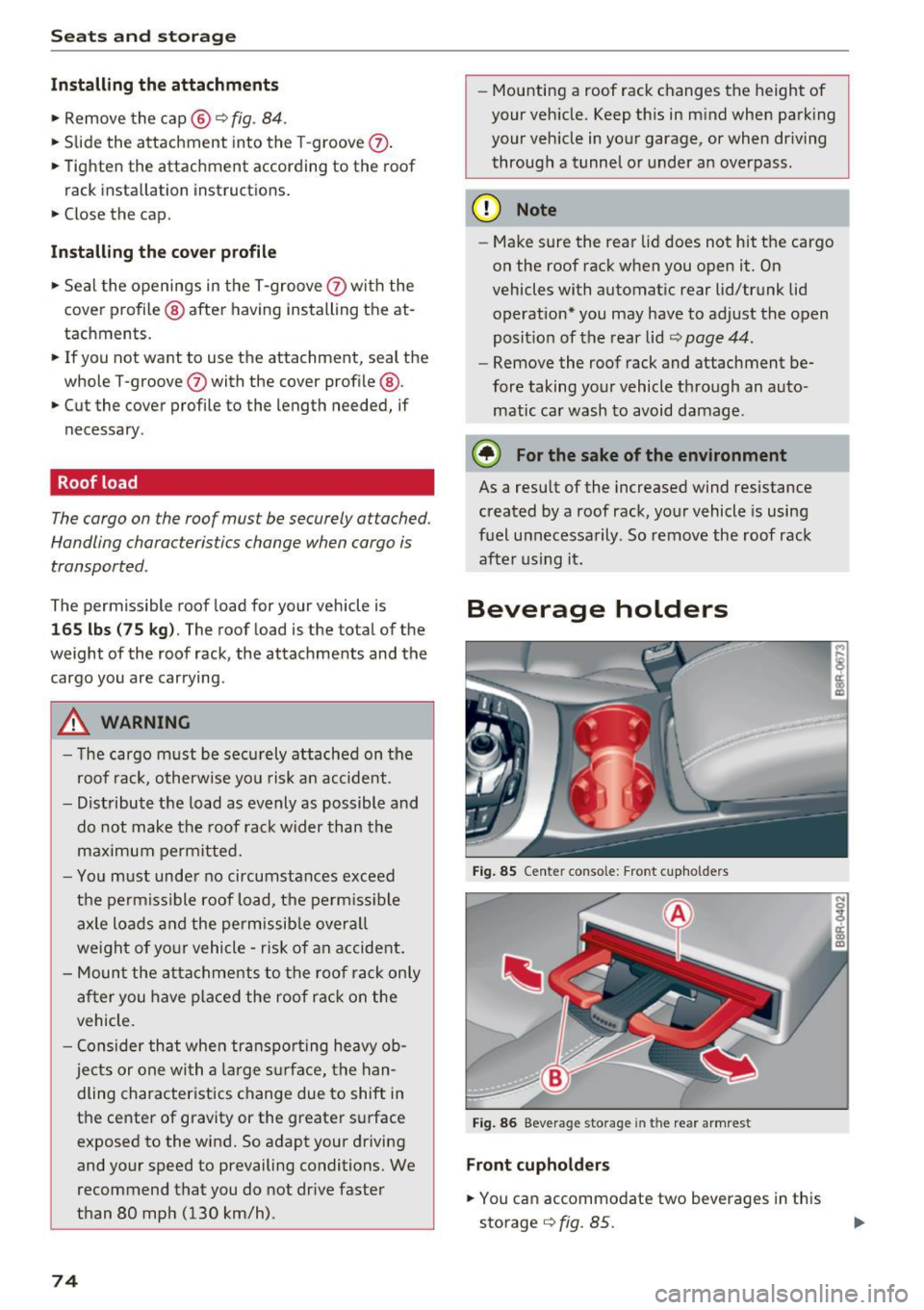
Beverage holders
Fig . 85 Cente r co nso le : F ro nt cupho lders
Fig . 86 Beverage storage in th e rea r armrest
Fr ont cuphold ers
.. You can accommodate two beverages in this
storage
q fig. 85.
Page 80 of 300
Sea ts and stor age
when accelerat ing or when app lying the
brakes or when driving around a corner.
- When you are driving make sure that any
thing you may have placed in the center con
so le or other storage locations cannot fall
out into the footwells. In case of sudden
braking you would not be able to brake or
acce le rate .
- Any pieces of cloth ing that you have hung
up must not interfere with the driver's view.
The coat hooks are designed only for light
weight cloth ing . Neve r hang any clothing
with hard , po inted or he avy objects in the
poc kets on the coat hooks . Dur ing s udden
braking or in an accident -especia lly i f the
airbag is dep loyed -these objects could in
jure any passengers inside the vehicle .
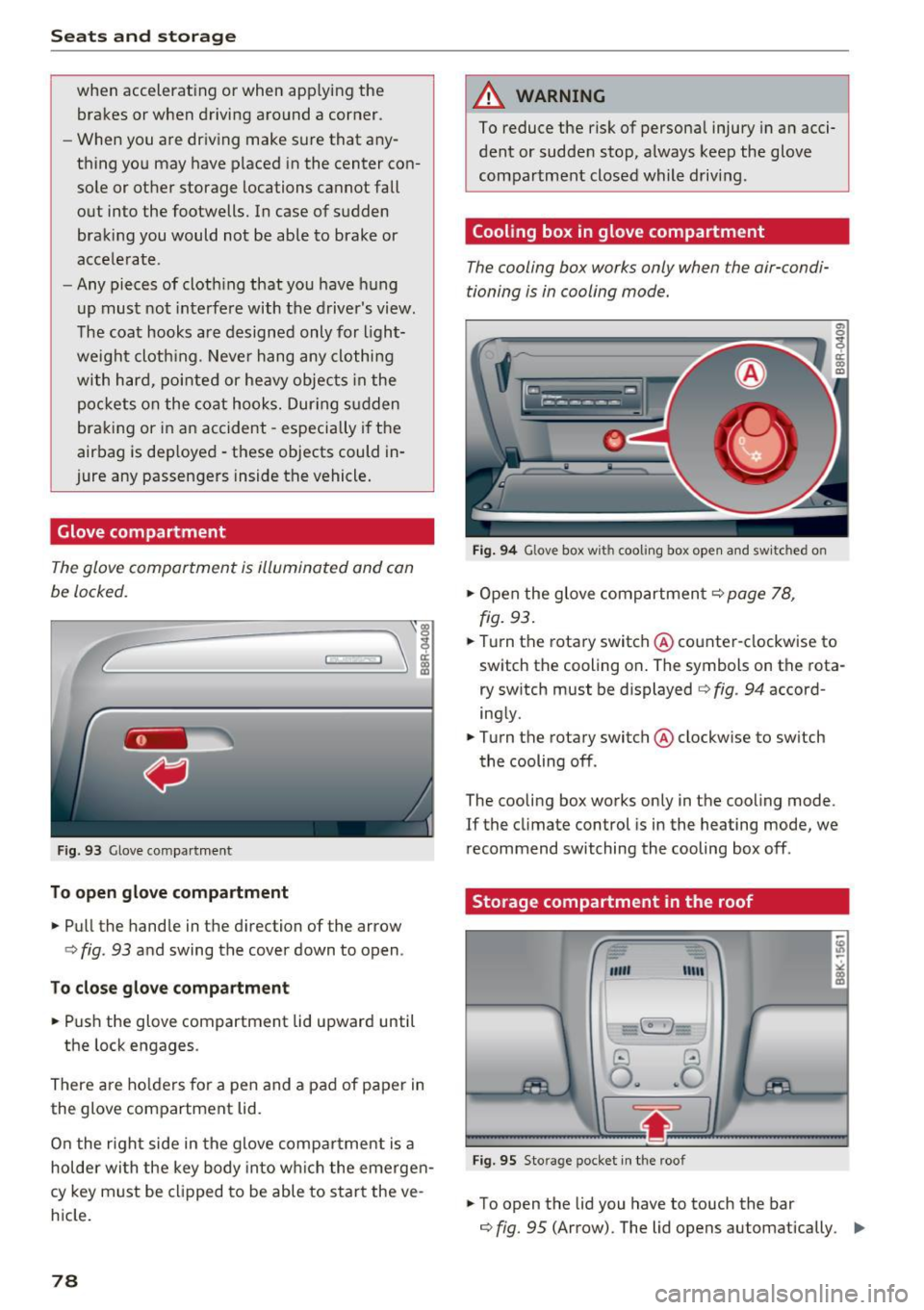
Glove compartment
The glov e comportm ent is illuminat ed and con
be locked.
F ig . 93 Glove co mpa rt men t
To open glove compartment
.. Pull the handle in the d irection of the arrow
c> fig . 93 and swing the cover down to open .
To clo se glove c omp artm ent
.. Push the glove compartment lid upward until
the lock engages .
There are ho lders for a pen and a pad of paper in
the glove compartment lid.
On the r ight side in the glove compa rtment is a
hol der wi th the key body into w hich the emerge n
cy key must be clipped to be able to star t the ve
h icle.
78
A WARNING
To reduce the risk of persona l injury in a n acci
dent or sudde n stop, a lways keep the glove
compartment closed while driving .
Cooling box in glove compartment
The cooling box works only when the air-condi
tioning i s in cooling mode.
Fig . 94 Glove box w ith cooli ng box ope n and sw itc hed on
.. Open the glove compartmen t c> page 78,
fig. 93 .
.. Tu rn the rotary switch @ counte r-clockwise to
switch th e cooling on . The symbols on th e rota
ry sw it c h must be displayed c> fig . 94 accord
ing ly .
.. Turn the rotary switch @ clockwise to sw itch
the cooling off .
The cooling box works only in the cooling mode.
If the climate con trol is in the heating mode, we
recommend switching the cooling box off .
Storage compartment in the roof
""' "'"
-~
@ ..!J
O .. ~O
Fig. 95 Sto ra g e pocket in t he roof
.. To open the lid you have to touch the bar
c> fig. 95 (Arrow). The lid open s automatically . ..,.
Page 81 of 300
..... N
co ~ CX)
..... I.O U"I
..... I.O .....
.. To close the lid, push it up until it engages .
A WARNING
Always keep the lid closed while driving to re
duce the risk of injury during a sudden brak
ing maneuver or in the event of an accident .
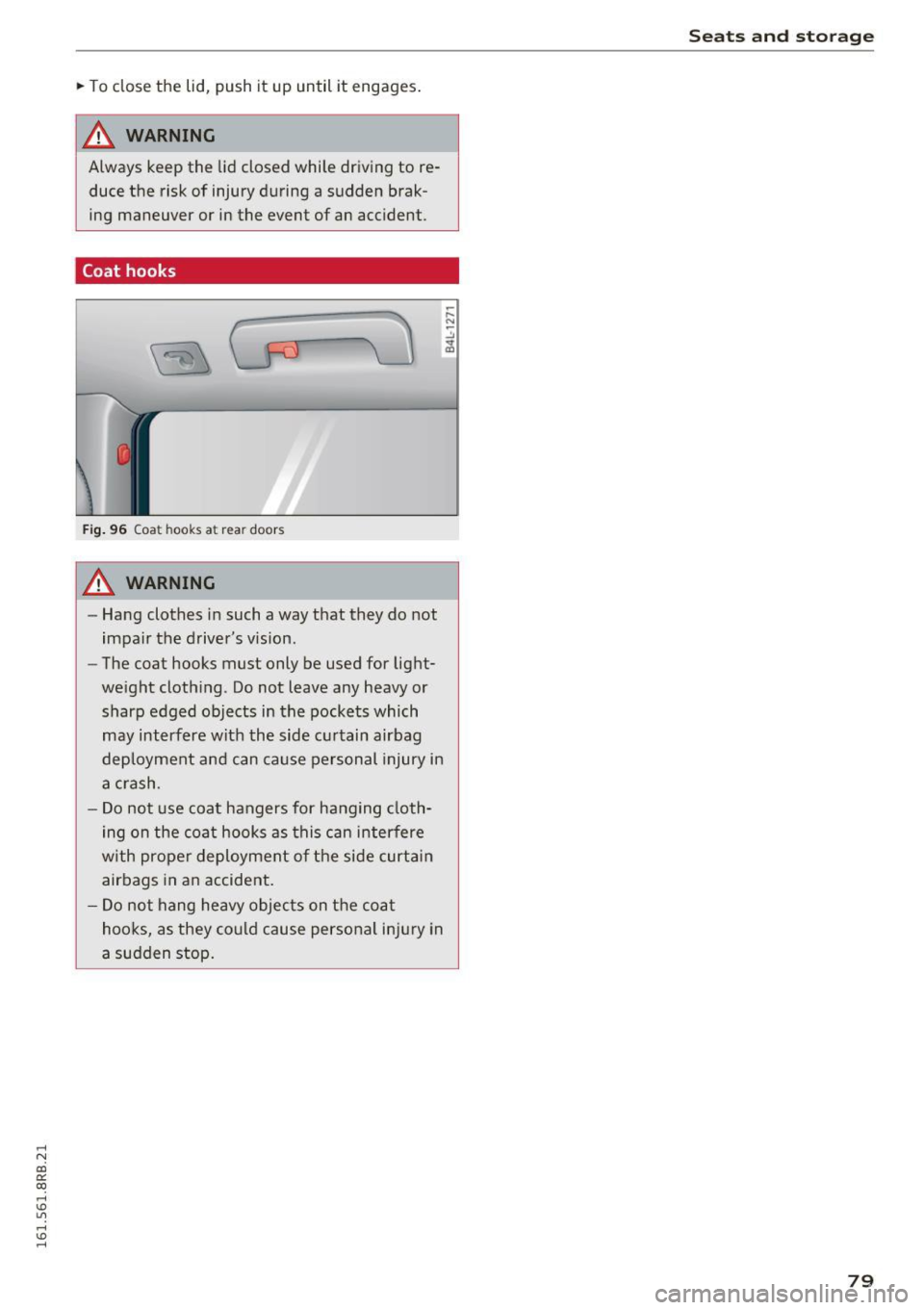
Coat hooks
Fig. 96 Coat hoo ks a t re ar doors
A WARNING
- Hang clothes in such a way that they do not
impair the driver 's vision.
- The coat hooks must only be used for light
weight clothing . Do not leave any heavy or
sharp edged objects in the pockets which
may interfere with the side curtain airbag
deployment and can cause personal injury in
a crash .
- Do not use coat hangers for hanging cloth
ing on the coat hooks as this can interfere
with proper deployment of the side curtain
airbags in an accident.
- Do not hang heavy objects on the coat
hooks, as they could cause personal injury in
a sudden stop .
Seats and storage
79
Page 93 of 300
,....,
N
co
er::
co
,....,
that you are developing enough driving force at
the wheels by depressing the accelerator .
Depending on the weight of the r ig (vehi cle and
tra iler) and the severity of the incline, you may
ro ll backwards as you start . You can prevent roll
ing backwards by holding the parking brake
switch pulled out and accelerating -just as you
wou ld when starting on a hill with a conventiona l
h and brake .
Emergency braking
In the event that the conven tional brake system
fails or locks .
~ In an emergency, pull the sw itch and cont inue
to pull it to slow your veh icle down with the
parking b rake.
~ As soon as you release the switch or accelerate,
the b raking process stops .
If you pull the sw itch and hold it above a speed of
about 5 mph (8 km/h) , the eme rgency braking
function is in it iated . The vehicle is braked at all
four wheels by activating the hydraulic brake sys
te m. T he b rake perfo rman ce is sim ila r t o making
an em ergen cy sto p ~ ,& .
In o rder not to activate the emergency brak ing by
mista ke, an audib le wa rn ing tone (buzze r)
sounds w hen the sw itch is p ulled. As soon as t he
sw itch is rele ased, or the acce le ra to r p edal is de
p ressed, eme rgency bra king stops.
A WARNING
Emergency bra king should only be use d in an
emergency, w hen the normal foot brake has
fai led or the bra ke pedal is obstructed . Using
the par king b rake to perfo rm emergency
brak ing will slow your vehicle down as if you
had made a full bra ke ap plication . The laws of
physics cannot be suspended even wi th ESC
a n d its associated components (A BS, ASR,
E DS). In c orn ers and when road or weath er
c ondi tions are bad, a full brake ap plication
c an ca use the vehicle to sk id or the rear end to
break away· r isking an accident .
Driving
Driver messages in the instrument cluster
Caution: Vehicle parked too steep
T h is message appears when the pa rking bra ke is
applie d on an in cl in e that exceeds about 30%.
In this case the braki ng power o f the pa rking
brake may not be adequate to prevent the ve hi
cle from roll ing uninten tionally.
Press b rake pedal to release park ing brake
This dr iver message appears when the sw itch to
re lease the par king brake was pressed. The park
ing brake can only be released if you step o n the
brake pedal and at the same time press the
switch or you automatica lly re lease the park ing
bra ke w ith the sta rting ass ist ~
page 90 .
r.lJ Parking brake malfunction!
This dr iver message appears together w ith the
yellow
rlJ symbol whe n there is a parki ng brake
malfu nction .
Start/Stop system
Description
Applies to vehicles: wit h Start-Stop-Syste m
The Start -Stop -System can he lp increase f uel
economy and reduce CO2 emissions.
In the Start -S top -mode, the engine sh uts off au
tomat ica lly when the vehicle is stoppe d, such as
at a t raff ic light. The ignition remains switched
on d uring this stop phase. The eng ine will be a u
tomat ically restarted when needed.
T he last Start-Stop -System setting (on/off usin g
the b utton
10~ 1) will be restored when the ign i
t ion is turned on. The LED in the
10'" 1 button turns
on when the Start-Stop-System is switched off
manua lly .
Ba sic requirements for the Start-Stop mode
- The d river 's door is closed.
- The driver 's sea t belt is latc hed.
- The hood is closed.
- The vehicle must have bee n driven fast er than
2.5 mph (4 km/h) s in ce the last s top.
- A t railer is not hitched to the vehicle . .,.
91
Page 142 of 300
Driving safety
-Always put objects, for example, luggage or
other heavy items in the luggage compart
ment.
- Always secure objects in the luggage com
partment using the tie-down eyelets and
suitable straps.
A WARNING
Heavy loads will influence the way your vehi
cle handles. To help reduce the risk of a loss
of control leading to serious personal injury:
- Always keep in mind when transporting
heavy objects, that a change in the center of
gravity can also cause changes in vehicle
handling:
- Always distribute the load as evenly as
possible.
- Place heavy objects as far forward in the
luggage compartment as possible.
- Never exceed the Gross Axle Weight Rating or the Gross Vehicle Weight Rating specified
on the safety compliance sticker on the left
door jamb. Exceeding permissible weight
standards can cause the vehicle to slide and handle differently .
- Please observe information on safe driving
¢page 134.
A WARNING
To help prevent poisonous exhaust gas from
being drawn into the vehicle, always keep the
rear lid closed while driving.
- Never transport objects larger than those fitting completely into the luggage area be
cause the rear lid cannot be fully closed .
- If you absolutely must drive with the rear lid open, observe the following notes to reduce
the risk of poisoning:
- Close all windows,
- Close the Panoramic sliding sunroof*,
- Open all air outlets in the instrument pan-
el,
- Switch off the air recirculation,
- Set the fresh air fan to the highest speed .
140
A WARNING
,--
Always make sure that the doors, all win
dows, the Panoramic sliding sunroof* and the
rear lid are securely closed and locked to re
duce the risk of injury when the vehicle is not
being used .
-After closing the rear lid, always make sure
that it is properly closed and locked.
- Never leave your vehicle unattended espe
cially with the rear lid left open. A child
could crawl into the vehicle through the lug
gage compartment and close the rear lid be
coming trapped and unable to get out. Be
ing trapped in a vehicle can lead to serious
personal injury.
- Never let children play in or around the vehi
cle.
- Never let passengers ride in the luggage
compartment. Vehicle occupants must al
ways be properly restrained in one of the ve
hicle's seating positions.
(D Tips
- Air circulation helps to reduce window fog
ging. Stale air escapes to the outside
through vents in the trim panel. Be sure to keep these slots free and open .
- The tire pressure must correspond to the
load. The tire pressure is shown on the tire
pressure label. The tire pressure label is lo
cated on the driver's side B-pillar . The tire
pressure label lists the recommended cold
tire inflation pressures for the vehicle at its
maximum capacity weight and the tires that
were on your vehicle at the time it was man
ufactured. For recommended tire pressures
for normal load conditions, please see chap
ter ¢
page 245.
Tie-downs
The luggage compartment is equipped with four
tie-downs to secure luggage and other items.
Use the tie-downs to secure your cargo properly
¢page 139, Loading the luggage compartment . ..,_
Page 143 of 300
,....,
N
In a collision, the laws of physics mean that even
smaller items that are loose in the vehicle will become heavy missiles that can cause serious in
jury. Items in the vehicle possess energy which vary with vehicle speed and the weight of the
item. Vehicle speed is the most significant factor .
For example, in a frontal collision at a speed of
30 mph (48 km/h), the forces acting on a 10-lb
(5 kg) object are about 20 times the normal
weight of the item . This means that the weight
of the item would suddenly be about
200 lbs . (90 kg). You can imagine the injuries
that a 200 lbs. (90 kg) item flying free ly through
the passenger compartment could cause in a col
l ision like this.
& WARNING ,___ -
Weak, damaged or improper straps used to
secure items to tie-downs can fail during hard
braking or in a collision and cause serious per
sonal injury.
- Always use suitable mounting straps and
properly secure items to the tie-downs in
the luggage compartment to help prevent
items from shifting or flying forward as dan
gerous missiles .
- When the rear seat backrest is folded down,
always use suitable mounting straps and
properly secure items to the tie-downs in
the luggage compartment to help prevent
items from flying forward as dangerous
missiles into the passenger compartment.
- Never attach a child safety seat tether strap
to a tie-down.
Reporting Safety Defects
Applicable to U.S.A.
If you believe that your vehicle
has a defect which could cause a
crash or could cause injury or
death, you should immediately in-
; form the National Highway Traffic
,....,
~ Safety Administration (NHTSA) in ,...., v:, ,....,
Driving safety
addition to notifying Audi of
America, Inc.
If NHTSA receives similar com
plaints, it may open an investiga
tion , and if it finds that a safety
defects exists in a group of
vehicles, it may order a recall and
remedy campaign. However,
NHTSA cannot become involved in
individual problems between you,
your dealer, or Audi of America, Inc.
To contact the N HTSA, you may
either call:
Tel.: 1-888-327-4236 (TTY: 1-800-424-9153) or
1-800-424-9393
or you may write to:
NHTSA
U.S. Department of Transporta
tion 1200 New Jersey Ave., S.E.
West Building
Washington, DC 20590
You can also obtain other infor
mation about motor vehicle safe
ty from:
http:/ /www.safercar.gov
141
Page 146 of 300
Safe ty belts
-Failure to pay attention to the warn ing light
that come on, could lead to personal injury.
Why use safety belts?
Frontal collisions and the law of physics
Frontal crashes create very strong forces for peo
ple riding in vehicles.
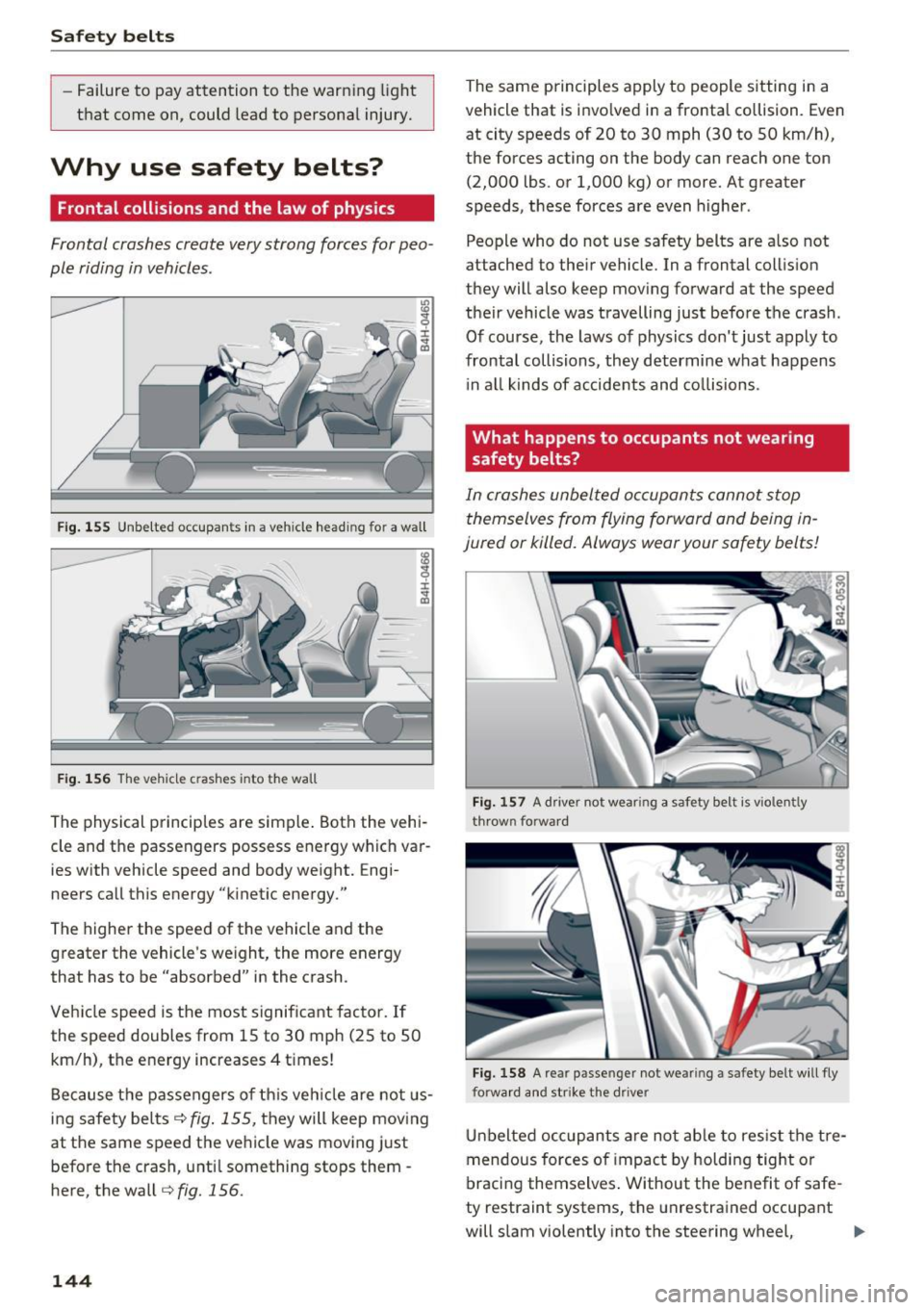
F ig . 1 55 Unbe lted occupants in a veh icle headi ng for a wall
F ig . 1 56 The veh icle c rashes into the wall
The physical principles are simple . Both the vehi
cle and the passengers possess energy wh ich var
ies with vehicle speed and body weight. Engi
neers call this energy "kinet ic energy."
The higher the speed of the vehicle and the greater the vehicle's we ight, the more energy
that has to be "absorbed" in the crash .
Vehicle speed is the most significant fac tor. If
the speed doubles from 15 to 30 mph (25 to 50
km/h), the energy increases 4 times!
Because t he passengers of th is veh icle are not us
ing safety belts<=>
fig. 155, they will keep mov ing
at the same speed the vehicle was moving just
befo re the crash , u nti l something stops them -
here, the wall
r=> fig. 156.
144
The same principles apply to people sitting in a
veh icle that is invo lved in a frontal collision . Even
at city speeds of 20 to 30 mph (30 to 50 km/h),
the forces acting on the body can reach one ton
(2,000 lbs . or 1,000 kg) or more. At greater
speeds, these forces are even higher .
People who do not use safety belts are a lso not
attached to their vehicle. In a frontal collis ion
they will also keep mov ing fo rward at the speed
their vehicle was travelling just before the crash .
Of course, the laws of physics don't just apply to
frontal collisions, they determine what happens
i n a ll kinds of accide nts and co llisions .
What happens to occupants not wearing
safety belts?
In crashes unbel ted occupants cannot stop
themselves from flying forward and being in
jured or killed. Always wear your safety belts!
Fi g. 1 57 A driver not wear ing a safety be lt is vio len tly
throw n forward
Fi g. 158 A rea r passe nge r not we arin g a sa fety be lt w ill fly
forwa rd and str ike the drive r
Unbelted occ upants are not ab le to res ist the tre
mendous forces of impact by holding tig ht or
braci ng themselves . Without the benefit of safe
ty restraint systems , the unrestra ined occupant
will slam violently into the steering wheel,
liJJ,-
Page 155 of 300
,....,
N
co
er::
co
,....,
an infant or a child in a rearward-facing seat .
The Advanced Airbag System i n your ve hicle has
been ce rtified to comply with the requi rements
of United States Federal Motor Vehicle Safety
Standard (FMVSS) 208, as well as Canada Motor
Veh icle Safety Standard (CMVSS) 208 as applica
b le at the time your veh icle was manufactured.
Accord ing to requ irements, the front Advanced
Airbag System o n the passenger s ide has been
cert ified for "suppression" for infants of about
12 month old and younger and fo r "low risk de
p loyment" for children aged 3 to 6 years o ld (as
defined in the standard).
The
PASSENGER AIR BAG OFF light in the instru
ment panel tells you when the front Advanced
A irbag on the passe nger side has been t urned off
by the ele ctronic con trol unit.
E ach t ime you tur n on the ignit ion, the
PASSEN
GER AIR BAG OFF
l ight will come on fo r a few
seconds and:
- wi ll stay on if the front passenger seat is not
occup ied,
- will stay on if there is a small c hild or child re
straint on the front passenger seat,
- will go off if the front passenger seat is occu
pied by an adult as reg istered by the weight
sensing mat¢
page 161, Monitoring the Ad
vanced Airbag System .
The PASSENGER AIR BAG OFF light comes on
when the control unit detects a total we ight on
the fro nt passenge r seat that requires the front
a ir bag to be tur ned off.
If the total weight on the front passenger seat is more than that of a typical 1 year -old child but
l ess t han the weight of a small adult, the front
a ir bag on the passenger side can deploy (the
PASSENGER AIR BAG OFF light does not come
on).
If t he PASSENGER AIR BAG OFF light does
not come on, the front airb ag on the passenge r
side has not been turned o ff by the e lectronic
control unit and can dep loy if the control unit
senses an impact that meets the condit ions stor
ed in its memory.
For example , the ai rbag may deploy if:
Airb ag sys tem
-a small ch ild that is heav ier than a typ ica l 1
year-o ld child is on the front passenger seat
(regardless of whether the child is in one of the
child safety seats listed
¢ page 173), or
- a child who has outgrown c hild restraints is on
the front passenger seat.
If t he front passenge r airbag is t urned off, the
PASSENGER AIR BAG OFF light comes on in the
inst rument cluste r and stays on.
T he front airbag on the p assenger s ide may
not
deploy (the PASSENGER AIR BAG OFF light does
not ill uminate and stay lit) even if a small adu lt
o r teenager, or a passenger who is not sitting up
rig ht w ith their back against a non-recl ined back
res t with the ir feet on the vehicle floor in front of
t h e seat is on the fron t passenger seat
¢ page 135, Proper seating position for the driv
er .
If the front passenger a irbag deploys, the Feder
al Standard requ ires the a irbag to meet the " low
risk" deployment criteria to reduce the r isk of in
jury through interaction w ith the airbag . "Low
risk" deployment occurs in th ose crashes that
t ak e place at lowe r decele rations as defined in
t h e e lectron ic co ntr ol unit¢
page 161, PASSEN
G ER A IR BAG O FF light.
Always re m embe r, a ch ild safety sea t or infant
ca rr ie r ins talled on the fro nt seat may be s truck
and knocked ou t of posit io n by the rapidly i nflat
ing passenge r's airbag in a fron tal coll is ion . The
airbag could great ly red uce the effectiveness of
t h e child restraint and even seriously in ju re the
child du ring inflation.
F or t his reason, an d beca use the back seat is the
safest p lace for children -when p roper ly restrain
ed according to their age and size -we strongly
recommend that children always sit in the back
seat ¢
page 171, Child safety .
A WARNING
-A child in a rearward-facing child safety seat
i nsta lled on the front passenger seat will be
se riously in ju red and can be k illed if the front
a ir bag inflates -even with an A dva nced Airbag
S ys tem.
~
153