lock AUDI Q5 2018 Repair Manual
[x] Cancel search | Manufacturer: AUDI, Model Year: 2018, Model line: Q5, Model: AUDI Q5 2018Pages: 392, PDF Size: 60.56 MB
Page 301 of 392
Convertible child safety seats
Properly used convertible child safety seats can
help protect toddlers and children over age one
who weigh between
20 and 40 lbs. (9 and 18 kg)
in a crash.
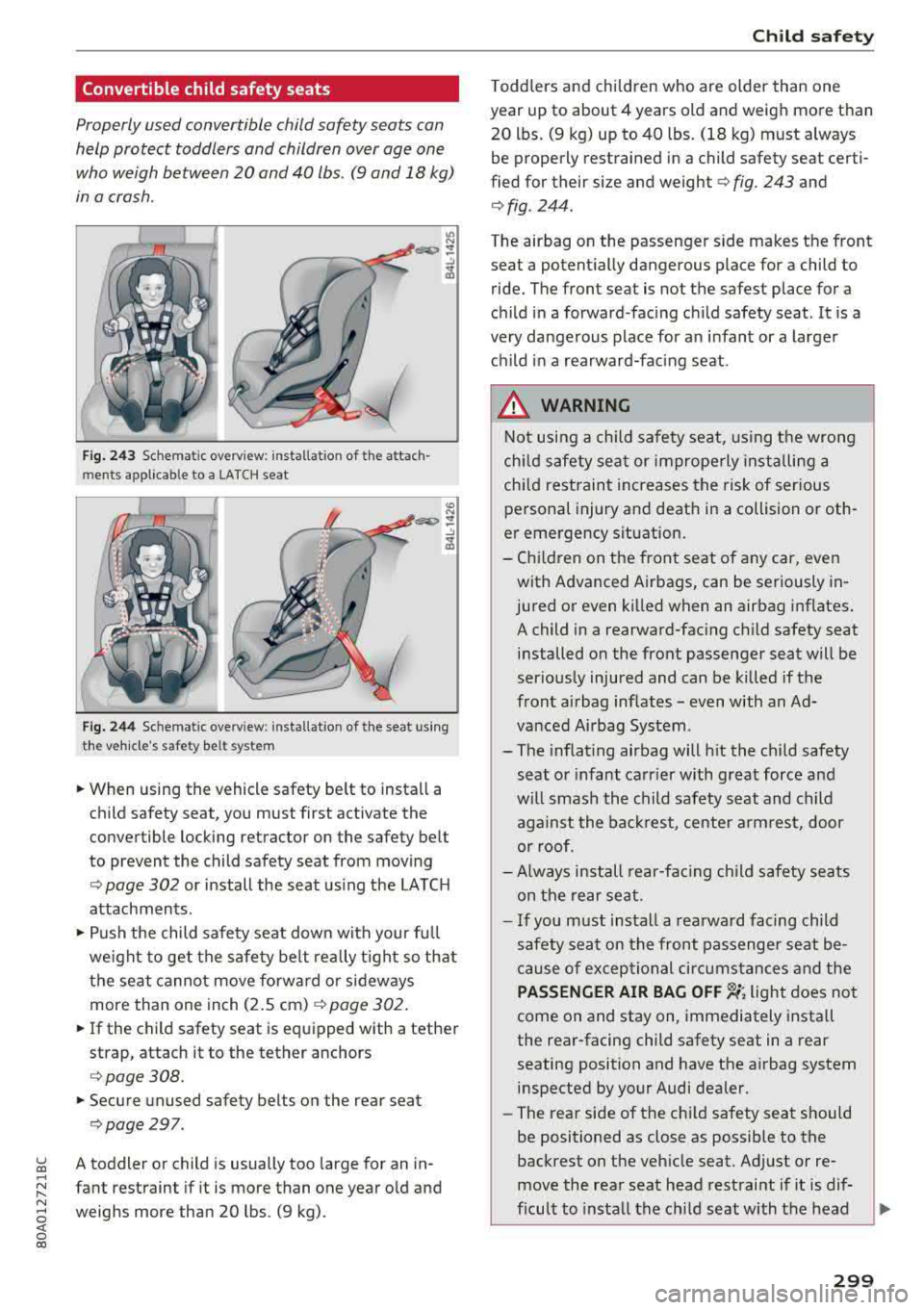
f ig . 243 Sche matic overview: installatio n of the attach
ments applica ble to
a LA TCH seat
Fig. 2 44 Schematic overview: installat ion of the seat using
the vehicle's safety belt system
~ When using the vehicle safety belt to install a
child safety seat, you must first activate the
convertible locking retractor on the safety belt
to prevent the child safety seat from moving
¢page 302 or install the seat us ing the LA TC H
attachments .
~ Push the child safety seat down with your fu ll
weight to get the safety be lt rea lly t ight so that
the seat cannot move forward o r sideways
more than one inch (2.5
cm)¢ page 302 .
~ If the child safety seat is equipped with a tether
strap, attach it to the tether anchors
¢page 308.
~ Secure unused safety belts on the rear seat
¢page 297.
~ A toddler or child is usually too large for an in-
~ fant restraint if it is more than one year old and r--
~ weighs more than 20 lbs. (9 kg).
~ 0 co
Child s afe ty
Todd lers and children who are older than one
year up to about 4 years old and weigh more than
20 lbs. (9 kg) up to 40 lbs . (18 kg) must always
be properly restrained in a child safety seat certi
fied for their size and
weight¢ fig. 243 and
¢ fig. 244.
The airbag on the passenger side makes the front
seat a potent ially dangerous place for a child to
ride. The front seat is not the safest place for a
child in a forward -fac ing child safety seat . It is a
very dangerous place for a n in fant or a larger
child in a rearward-facing seat .
_&. WARNING
Not using a child safety seat, using t he wrong
chi ld safety seat or imprope rly insta lling a
chi ld restraint increases the risk of ser ious
personal injury and death in a collision or oth
er emergency situation.
-Ch ildren on the front seat of any car, eve n
wit h Advanced Airbags, can be seriously in
jured or even killed when an airbag inflates .
A child in a rearward-fac ing ch ild safety seat
installed on the front passenger seat will be
serious ly injured and can be killed if the
front airbag inflates -even with an Ad
va nced Ai rbag System .
-The inflat ing airbag will h it the ch ild safety
seat or infant carr ier with great force and
will smash the child safety seat and child aga inst the backrest, ce nter a rmrest, door
or roof.
- Always ins tall rear-fa cing c hild safety seats
on the rear seat .
-If you m ust instal l a rea rwa rd facing child
safety seat on the front passenger seat be
cause of exceptional circ ums tan ces and the
PASSENGER AIR BAG OFF "1; light does not
come on and stay on, immediately insta ll
the rea r-facing child safety seat in a rear
seating position and have the a irbag system
inspected by your Audi dealer.
-The rear side of the ch ild safety seat shou ld
be positioned as close as possible to the
backrest on the veh icle seat. Adjust or re
move the rear seat head restraint if it is dif-
f icult to instal l the ch ild seat with the head ._.
299
Page 303 of 392
Booster seats and safety belts
Properly used booster seats can help protect
children weighing between about 40 lbs. and
80 lbs . (18 kg and 36 kg) who are less than 4
ft.
9 in. (57 inches/1.45 meters) tall.
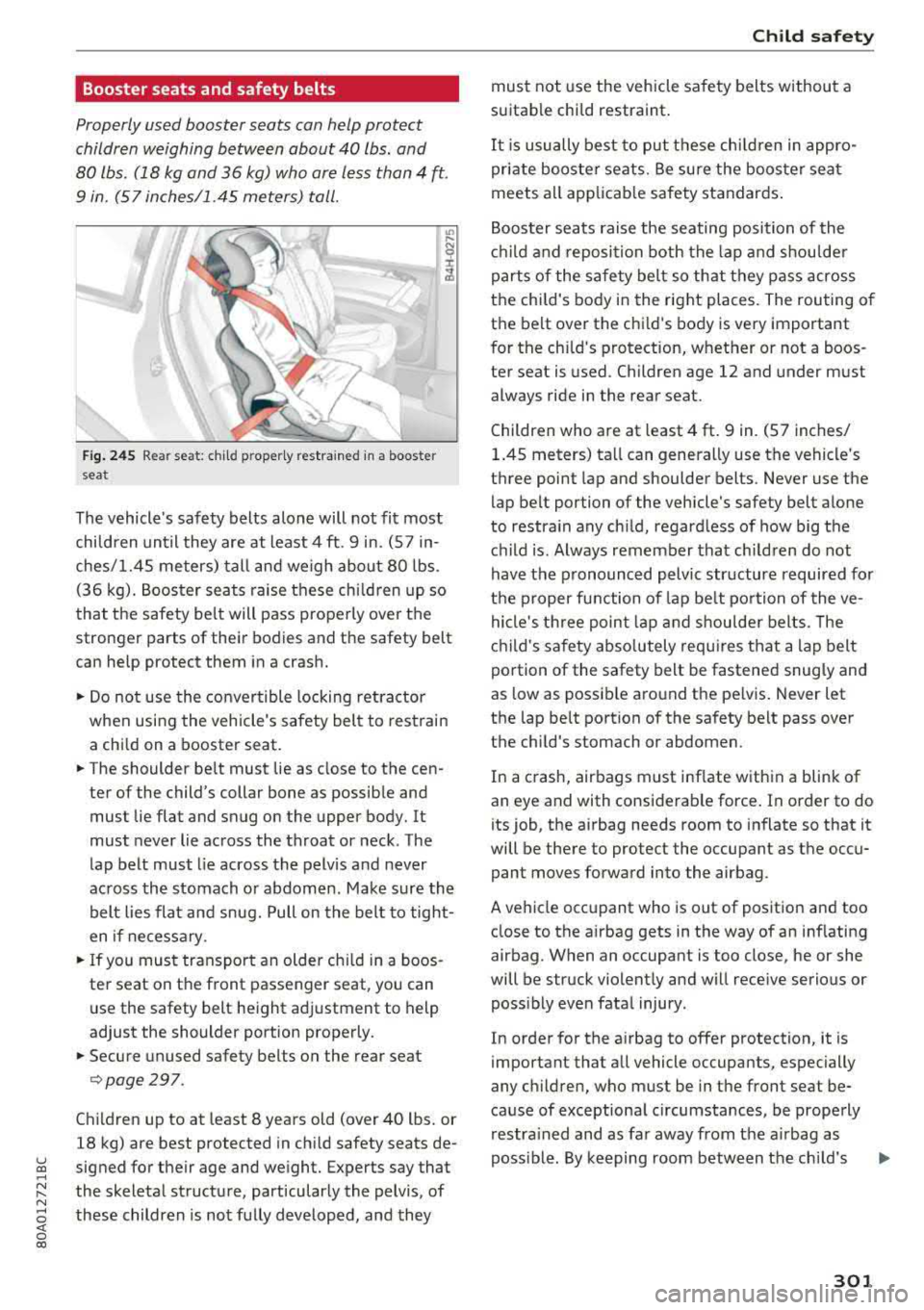
Fig . 245 Rea r seat: chi ld p roper ly restrained in a booster
sea t
The vehicle's safety belts alone will not fit most
children until they are at least 4
ft. 9 in. (57 in
ches/1.45 meters) tall and weigh about 80 lbs.
(36 kg). Booster seats raise these children up so
that the safety belt will pass properly over the
stronger parts of their bodies and the safety belt
can help protect them in a crash.
.,. Do not use the convertible locking retractor
when using the vehicle's safety belt to restrain
a chi ld on a booster seat .
.. The shoulder belt must lie as close to the cen
ter of the child's collar bone as possib le and
must lie fla t and snug on the upper body. It
must never lie across the throat or neck. The
lap belt must lie across the pelvis and never
across the stomach or abdomen . Make sure the
belt lies flat and snug. Pull on the belt to tight
en if necessary .
.,. If you must transport an older child in a boos
ter seat on the front passenger seat, you can
use the safety belt height adjustment to help
adjust the shoulder portion properly .
.. Secure unused safety belts on the rear seat
¢page 297.
Children up to at least 8 years old (over 40 lbs. or
18 kg) are best protected in chi ld safety seats de-
~ signed for their age and we ight. Experts say that .....
~ the skeletal structure, particularly the pelvis , of N
~ these children is not fully developed, and they
0 co
Child safety
must not use the vehicle safety belts without a
suitable child restraint .
It is usually best to put these children in appro
priate booster seats. Be sure the booster seat
meets all applicab le safety standards .
Booster seats raise the seating position of the
child and reposition both the lap and shoulder
parts of the safety belt so that they pass across
the chi ld's body in the right places. The routing of
the be lt over the chi ld's body is very important
for the ch ild's protection, whether or not a boos
ter seat is used. Children age 12 and under must
always ride in the rear seat.
Children who are at least 4
ft. 9 in. (57 inches/
1.45 meters) tall can generally use the vehicle 's
three point lap and shoulder belts. Never use the
lap belt portion of the vehicle 's safety belt alone
to restrain any ch ild, regard less of how big the
ch ild is. Always remember that child ren do not
have the pronounced pelvic structure required for
the proper function of lap belt portion of the ve
hicle's three point lap and shoulde r belts. The
child's safety absolutely requires that a lap belt
portion of the safety belt be fastened snugly and
as low as possible around the pe lvis . Never let
the lap belt portion of the safety belt pass over
the child 's stomach or abdomen .
In a crash, airbags must inflate within a blink of
an eye and with considerab le force. In order to do
its job, the airbag needs room to inflate so that it
will be there to protect the occupant as the occu pan t moves forward into the airbag .
A vehicle occ upant who is out of position and too
close to the a irbag gets in the way of an inf lating
airbag. When an occupant is too close , he or she
will be struck violent ly and w ill rece ive serious or
poss ibly even fata l injury .
In order for the airbag to offer protection, it is
important that all vehicle occupants, especially
any ch ildren, who must be in the front seat be
cause of exceptiona l circumstances, be properly
restrained and as far away from the airbag as
poss ible. By keeping room between the child's
..,_
301
Page 304 of 392
Child sa fety
body and the front of the passenger compart
ment, the air bag can inflate comp lete ly and pro
vide supp lemental protect ion in certain fronta l
coll is ions.
A WARNING
Not using a booster seat, us ing the booster
seat improperly, incorrectly installing a boos
ter seat or using the vehicle safety belt im
properly increases the risk of ser ious personal
injury and death in a collision or other eme r
gency sit uat ion. To help red uce the risk of se
rious persona l injury and/or death:
- The shoulder be lt mus t lie as close to the
center of the child's collar bone as possib le
and must lie flat and snug on the upper
body. It must never lie across the throat or
neck . The lap be lt must lie across the pelvis
and never across the stomach or abdomen.
Make sure the belt lies flat and snug. Pull on
the belt to tighten if necessary.
- Failure to proper ly route safety belts over a
child's body will cause severe injuries in an
acc ident or other emergency situation
¢ page 261.
- The rear side of the child safety seat should
be pos itioned as close as possible to the
backrest on the vehicle seat. Adjust or re
move the rear seat head restraint if it is d if
ficult to install the child seat with the he ad
restra int in place¢
page 58. Ins tall the
head restraint again immediately once the
child seat is removed . Driving without head
restra ints or w ith head rest raints that are
not properly adjusted increases the risk of
serious or fatal neck injury dramatically.
- Never let a child put the sho ulder belt under
the arm or beh ind the back, because it cou ld
cause severe injur ies in a crash.
- Children on the front seat of any car, even with Advanced Airbags, can be seriously in
jured or even killed when an airbag inflates .
- Never let a child stand or knee l on any seat,
for example the front seat.
- Never let a child ride in the ca rgo area o f
you r vehicle.
- Always remember that a child leaning for
ward, s itting sideways or out of position in
302
-
any way du ring an accident can be struck by
a deploying airbag. Th is w ill result in serious
personal injury or death.
- If you must install a booster seat on the
front passenger seat because of exceptiona l
circumstances the
PASSENGER AIR BAG
OFF
'1; light must come on and stay on,
wheneve r the ign it ion is swi tched on.
- If the
PASSENGER AIR BAG OFF '1; light
does not come on and stay on, perform the
checks desc ribed ¢
page 281, Monitoring
the Advanced Airbag System.
- Take the child res tra int off the front passen
ge r seat and install it prope rly at one of the
rear sea t positions if the
PASSENGER AIR
BAG OFF
'1; light does not st ay on whenever
the ignition is switched on .
- Always read and heed all WARNINGS when
eve r us ing a child restrained in a vehicle is
be ing used ¢
page 261, Safety belts,
¢ page 269, Airbag system and
¢ page 291 , Important information .
Securing child safety
seats
Securing a child safety seat using a safety belt
Safety belts for the rear seats and the front pas
senger can be locked with the convertible locking
retractor to properly secure child safety seats .
The safety belts for the rea r seats and for the
front passenge r's seat have a conve rtible locking
r etractor for child safety seats. The safety belt
must be locked so that be lt webb ing cannot un
r eel. The retractor can be act ivated to lock the
safety belt and prevent the safety belt webbing
from loosening up dur ing norma l dr iving . A ch ild
safety seat can o nly be prope rly installed when
t h e safety be lt is locked so that the c hild and
c hi ld s afety seat will stay in place.
Always remember : Even though your veh icle is
equipped with an Advanced Airbag system, all
c hi ld re n, especially those 12 yea rs and you nger,
sho uld always ride in t he b ack seat p roperly re-
strained for their age and s ize.
II>-
Page 305 of 392
u co ..... N r--N ..... 0 <( 0 00
A WARNING
-
Improperly in stalled chi ld safety seats in
crease the risk of serious personal injury and
death in a collision.
- Always make sure that the safety belt re
tractor is locked when installing a child safety seat. An unlocked safety belt retrac
tor cannot hold the child safety seat in place dur ing normal driving or in a crash.
- Always buckle the child safety seat firmly in
place even if a child is not sitting in it. A
loose child safety seat can fly around during
a sudden stop or in a collision.
- Always make sure that the rear seat back
rest to wh ich the center rear safety belt* is
attached is secure ly latched whenever the
rea r cente r safety belt is being used to se
cur e a ch ild rest raint.
- If the backrest is not securely latched, the
child and the child restraint will be thrown
forwar d toge ther w it h the backrest and will
st rike parts of the vehicle interior. The ch ild
can be se riously in jured or killed .
- Never ins tall rear-f acing chi ld safety sea ts
or infant carriers on the front passen ger
seat . A child will be serious ly inju red and
can be killed when the passenger airbag in
flates.
- The inflating airbag will hit the child safety
seat or infant carrier with great force and
will smash the ch ild safety seat and chi ld
against the backrest, center armrest, door
or roof .
- Always install rear-facing child safety seats
o r infant carriers on the rear seat.
- Forward-fac ing ch ild safety seats or infant
carriers installed on the front passenger's
seat may interfere with the deployment of
the a irbag and cause serious injury to the
child.
- It is safe r to install a forward-fac ing ch ild
safety seat on the rear seat.
- Always read and heed all WARNINGS when
ever using a child res trained in a veh icle is
being
used~ page 291 . Specia l precaut ions
apply when installing a child safety seat on
t h e fron t passenger
sea t~ page 2 70, Child
Ch ild saf ety
restraints on the front seat -some impor
tant things to know.
A WARNING
--
A lways take special precautions if you must
i nstall a forward or rearward-facing child re
stra int on the front passenger's seat in excep
tional s ituations:
- Whenever a forward or rearward-fac ing
child restraint is installed on the front pas
senger sea t, the
PASSENGER AIR BAG OFF
~; lig ht must come on and stay on whenev
er the ign ition is swi tched on.
- I f the
PASSENGER AIR BAG OFF ~; light
does not come on and stay on, perform the
checks desc ribe d
~ page 281, Monito ring
t he Advanced Airbag System.
- T ake the child res tra int off the front passen
ge r seat and inst all it prope rly at one of the
rear sea t positions i f the
PASSENGER AIR
BAG
OFF ~; light does not stay on whenever
the ignition is switched on .
- Imp roper installat ion of child restra ints can
reduce the ir effectiveness or even prevent
them from providing any protect ion .
- An imprope rly installed child restra int can
interfere with the airbag as it deploys and
serio usly injure or even kill the chi ld.
- Always carefully follow the manufacturer's
instr uctions provided with the child sa fety
seat or ca rr ie r.
- After checking to make su re that the child
rest raint is proper ly installed, make ce rtain
that the child restraint is co rrectly recog
n ized by the capacitive passenger detection
system in the front passenger seat and that
the
PASSENGER AIR BAG OFF ~; light sig
na ls the correct front passenger fronta l air
b ag sta tus.
A WARNING
F orw ard-facing child restra int s:
- Always make sure the forward-facing sea t
has been des igned and certified by its man
ufa cturer for use on a fron t sea t with a pa s
senger front and side air bag.
303
Page 306 of 392
Child sa fety
- Never put the forward -facing child restraint
up, against or very near the instrument pan
el.
- Always move the front passenger seat to
the h ighest position in the up and down ad
justment range and move it back to the
rearmost position in the seat's fore and aft
adjustment range, as far away from the air
bag as possib le, before insta lli ng the for
wa rd-facing child restra int.
- Always make sure that the safety belt upper
anchorage is beh ind the child restra int and
not next to or in front of t he ch ild restraint
so tha t the safety belt w ill be properly pos i
tioned.
- Make s ure tha t the
PASSENGER AIR BAG
OFF ~; light comes on and stays on a ll the
time whenever the ignition is switched on.
A WARNING
Rearward-facing child restraints:
- A ch ild in a rea rw ar d-facing child safety seat
insta lled on the front passenger seat wi ll be
seriously injured and can be killed if the
front airbag inflates
-even with an Ad
vanced Airbag System.
- The inflating airbag wi ll hit the child safety
seat or infant carrier with great force and
will smash the chi ld safety seat and child
against the backrest , center armrest, door
or roof.
- Always be especially careful if you must in
sta ll a rearward facing child safety seat on
the front passenger seat in exceptional c ir
c u mstances.
- Make sure that the
PAS SENGER AIR BAG
OFF ~; light comes on and stays on all the
t ime whenever the ignition is switched on.
- If the PASSENGER AIR BAG OFF ~; light
does not come o n and stay o n, immed iate ly
install the rea r-fa cing child safety seat in a
re ar seat ing pos ition and have the airbag
system inspe cte d by your Aud i de aler.
304
Activating the convertible locking retractor
Use the convertible locking retractor to secure a
child restraint.
Always heed the child safety seat manufacturer's
i nstruct ions when installing a child restra int in
your vehicle. To activate the convertible locking r etractor:
.,. Place the child restraint on a seat, preferably
on the rear seat .
.,. Slowly pull the belt all th e w ay out .
.,. Route it around or through the child restra int
be lt
path~ .,&..
.,. Push the ch ild safety sea t down with yo ur full
weigh t to ge t the safety belt rea lly tigh t.
.,. Insert t he be lt tong ue into the b uck le for that
seating position .
.,. Guide the safety be lt back into the retractor un
til the belt lies flat and snug on the ch ild safety
seat.
.,. You shou ld hear a "cl icking" noise as the belt
w inds back into the inertia reel. Test the con
vert ib le lock ing retractor by pull ing on the belt.
You s hou ld no lo nge r be able to pull the belt
out of the retracto r. T he convertib le lock ing re
tracto r is now activa ted .
.,. Make sure that the red release button is facing
away from the chi ld restraint so that it can be
unb uc kled quickly .
.,. Pull on the belt to make sure the safety belt is
properly t ight and fastened so that the seat
cannot move forward or s ideways more than
one inch (2 .5 cm) .
A WARNING
Using the wrong ch ild rest raint or an improp
e rly insta lled child restra int can ca use se rio us
pe rsonal injury or death in a crash.
- Always make sure that the safety be lt re
tr actor is locked whe n in stalling a c hild
safety seat . An un lo cked sa fety be lt retr ac
tor cannot hold the chi ld safety seat in p lace
during normal driving or in a crash.
- Always buckle t he chi ld safety seat fi rm ly in
p lace even if a chi ld is not sitting in it. A
loose chi ld safety seat can fly a round during
a sudden stop or in a crash.
Page 307 of 392
u co ..... N ,..._
N ..... 0 <( 0 00
-Always make sure the seat backrest to w hich
t h e ch ild restraint is installed is in an up
rig ht position and securely latched into
place a nd ca nnot f old forward. Otherwise,
t h e sea tback with the ch ild safe ty s eat at
tach ed to it could fly forward in the event of
an acc ident or o ther emergency situation.
- Always read and heed all WARNINGS when
ever using a child restrained in a veh icle is
being
used¢ page 291. Spec ia l pre caut ions
apply when ins talling a child s afety seat on
the front passenger
seat¢ page 2 70, Child
restraints on the front seat -some impor
tant things to know.
Deactivating the convertible locking
retractor
The convertible locking retractor for child re
straints will be deactivated automatically when
the belt is wound all the way back into the re
tractor .
~ Press the red button on the safety be lt b uck le.
The belt tongue w ill pop out of the buckle.
~ Gu ide the safety be lt all the way back into its
stowed pos ition .
Always let the safety belt retract complete ly into
its stowed position. The safety belt can now be
used as an ordinary safety belt without the con
vert ible lock ing retractor for child restra ints .
If the convert ible lock ing retractor should be ac
tivated inadve rtently, the safety belt must be un
fastened and guided completely back into its
stowed position to deact ivate this feature .
If the
convert ib le lock ing re tractor is not deact ivated,
the safety belt w ill gradually become tighte r and
u ncomfo rtable to we ar.
_& WARNING
-
Improperly ins talled chi ld safety seats in
crease the risk of serio us personal injury and
death in a collision.
- Never unfasten the sa fe ty belt to deactivate
the conve rt ible locking retractor for child re
straints while the ve hicle is moving . You
Ch ild saf ety
wou ld not be rest rained and could be seri
ously injured in an accident.
- Always read and heed all WARNINGS when
ever using a child restrained in a vehicle is
be ing
used¢ page 291. Special p recautions
apply when install ing a child safety seat on
the front passenge r seat
¢ page 2 70, Child
restraints on the front seat -some impor
tant things to know.
LATCH system (lower
anchorages and tethers
for children)
Child Restraint System anchors and how
are they related to child safety
T o p rovide a simp ler and more practicab le way to
attach the ch ild rest raint on the vehicle seat,
Federal regulations require spec ia l lower ancho
rages in vehicles and devices o n new c hild re
straints to attach to the vehicle anc horages .
In the United States, the combination of the
tethe r anchorages and the lower anchorages is
now generally called t he LATCH system for
" Lower Anchorages and Tethers for Childre n". In
Canada, the terms "top tether" with "lower un i
versa l anchorages" (o r "lowe r universa l anchor
age bars") a re used to descr ibe the system .
In other co untries the term "ISOFIX" is used to
desc ribe the lower anchorages .
Forward-facing chi ld restraints manufactured af
ter September 1, 1999, are requ ired by U.S . fed
era l regulations to comply with new child head
movement pe rformance requ iremen ts. These
new pe rformance req uir ements make a tether
necessary on most new ch ild seats.
Installing a c hild restraint t hat requires a top
tethe r withou t one can se riously impa ir the per
fo rmance of the ch ild rest rai nt and its ab ility to
pro tect the ch ild in a co llision. I nstalling a ch ild
r estr aint tha t requi res a top tether wi tho ut the
top tether may be a vio lat ion o f state law.
Child restra int manufactu rers offe r LATCH lowe r
an chorages on t heir child sea ts w it h hook-on or
..,
305
Page 309 of 392
u co ..... N r-N .....
~ 0 co
A WARNING
Improper use of LATCH lower anchorages can
cause serious personal injury in an accident.
- Always carefu lly follow the child restra ints
manufacturer's instructions for proper in
sta llation of the child restraint and proper
use of the lower anchorages or safety belts
in your vehicle.
- Never secure or attach any luggage or other
items to the
LATCH lower anchorages .
- Always read and heed the important infor
mation about child restraints in this chapter
and
WARNINGS ¢ page 291, Child safety.
Installing a child restraint with LATCH
lower anchorages
Whenever you install a child restraint always fol
low the child restraint manufacturer's instruc
tions .
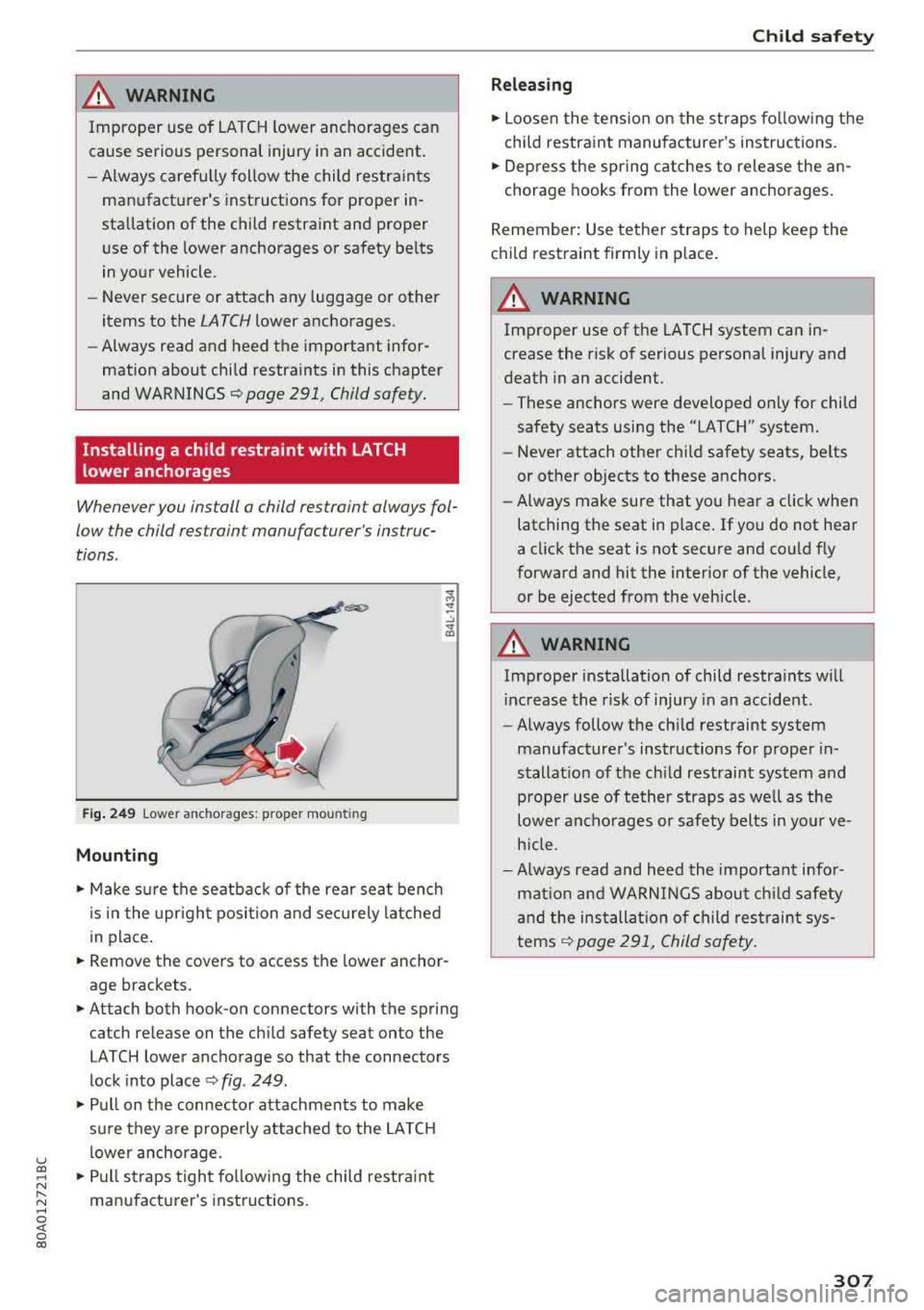
Fig . 2 4 9 Lower anchorages: p roper mount ing
Mounting
.,. Make sure the seatback of the rear seat bench
i s in the upr igh t position and securely latched
in place .
.,. Remove the covers to access the lower anchor
age brackets .
.,. Attach both hook -on connectors with the spring
catch release on the ch ild safety seat onto the
LATCH lower anchorage so that the connectors
lock into place
¢ fig . 249 .
.,. Pull on the connector attachments to make
s ur e they a re prope rly attached to the LA TC H
lower anchorage.
.,. Pull straps tight fo llowing the child restra int
manufacturer's instructions.
Ch ild s afe ty
Re leas ing
.,. Loosen the tension on the straps fo llow ing the
child restraint manufacturer's instructions.
.,. Depress the spring catches to release the an
chorage hooks from the lower anchorages.
Remember: Use tethe r straps to help keep the
child restraint firmly in p lace .
A WARNING
-
Improper use of the LATCH system can in
crease the risk of serious personal injury and
death in an accident.
- These anchors were developed only for child
safety seats using the "LATCH" system.
- Never attach other child safety seats, be lts
or other objects to these anchors.
- Always make sure that you hear a click when
latching the seat in place. If you do not hear
a cl ick the seat is not secure and co uld f ly
forward and hit the interior of the vehicle,
or be ejected from the vehicle .
A WARNING
Improper installation of child restraints wi ll
i ncrease the risk of injury in an accident.
- Always follow the child restraint system
manufacturer's instructions for proper in
stallat ion of the chi ld restraint system and
proper use of tether straps as well as the
lowe r ancho rages or safety belts in yo ur ve
h icle.
- Always read and heed the important info r
mat ion a nd WARN INGS abou t ch ild safety
a nd the ins tallat ion of ch ild restraint sys
tems ~ page 291 , Child safety.
307
Page 313 of 392
u co ..... N r-N .....
~ 0 co
-If you are unable to determine whether or
not a particular fuel blend meets the speci
fications, ask your service station or its fuel
supplier.
- Do not use fuel for which the contents can
not be identified.
- Fuel system damage and performance prob
lems resulting from the use of fuels differ
ent from those specified are not the respon
sibility of Audi and are not covered under
the New Vehicle or the Emission Control
System Warranties .
- If you experience a loss of fuel economy or
driveability and performance problems due
to the use of one of these fuel blends, we
recommend that you switch to unblended
fuel.
Gasoline additives
A major concern among many auto manufactur
ers is carbon deposit build-up caused by the type
of gasoline you use.
Although gasoline grades differ from one manu
facturer to another, they have certain things in
common. All gasoline grades contain substances
that can cause deposits to collect on vital engine
parts, such as fuel injectors and intake valves.
Al
though most gasoline brands include additives to keep engine and fuel systems clean, they are not
equally effective .
Audi recommends using TOP TIER Detergent Gas
oline. For more information on TOP TIER Deter
gent Gasoline, please go to the official website
(www.toptiergas .com) .
After an extended period of using inadequate
fuels, carbon deposit build-ups can rob your
en
gine of peak performance.
(D Note
Damage or malfunction due to poor fuel qual
ity is not covered by the Audi New Vehicle
Limited Warranty.
Checking and Filling
Refueling
Fueling procedure
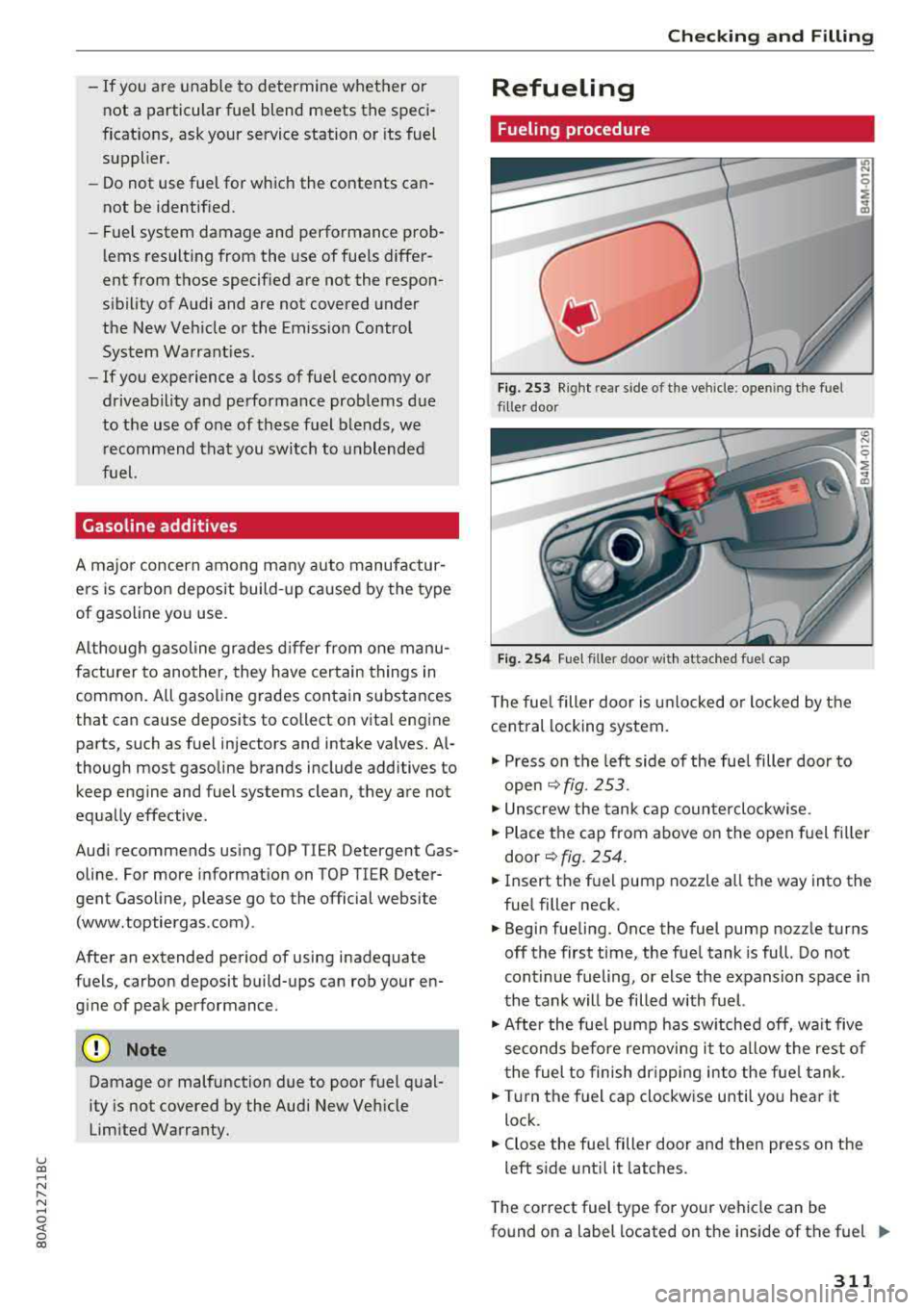
Fig. 253 Right rear s ide o f th e ve hicle : ope ning the fuel
filler door
Fig. 254 Fuel filler door with attached fue l cap
The fuel filler door is unlocked or locked by the
central locking system.
"' Press on the left side of the fuel filler door to
open
r::::>fig. 253.
"' Unscrew the tank cap counterclockwise.
"'Place the cap from above on the open fuel filler
door
r::::> fig. 254.
"'Insert the fuel pump nozzle all the way into the
fuel filler neck.
.,. Begin fueling. Once the fuel pump nozzle turns
off the first time, the fuel tank is full. Do not
continue fueling, or else the expansion space in
the tank will be filled with fuel.
"'After the fuel pump has switched off, wait five
seconds before removing it to allow the rest of
the fuel to finish dripping into the fuel tank.
"'Turn the fuel cap clockwise until you hear it
lock.
"' Close the fuel filler door and then press on the
left side until it latches .
The correct fuel type for your vehicle can be
found on a label located on the inside of the fuel
Iii>
311
Page 314 of 392
Check ing and F illing
fi ller door . For additional information on fuel,
see
r=> poge 310.
For the tank capac ity in yo ur vehicle , refer to the
Technical Data
r:!> pog e 369.
To reduce the r isk of fuel leak ing out or vapors
escap ing , make sure that the fuel tank is closed
correct ly. Otherwise
thP ¢'4 i ndicato r light will
t ur n on.
I f the central lock ing system malfunct ions, the
fue l filler door may emergency release
r=> poge 313.
_& WARNING
An improper f ueli ng p rocedure and improper
hand ling of fue l can lead to exp losions, fires,
severe b urns and other injuries .
- Do not smoke and keep away from open
flames .
- T he ign it ion m ust be switched off when re
f ueling .
- Cell p hones, radio devices and other radio
equipment s hou ld always be switched off
when refueling . Electromagnetic rays cou ld
cause sparks and start a fire .
- If you do not insert the fue l pump nozzle a ll
the way into the filler tube, then fue l can
l eak out . Spi lled fue l can ignite and start a
fire.
- Never get into the vehicle when refueling. If
there is an exceptional situation where the
vehicle must be entered, close the door and
touch a metal surface before touching the
fuel pump nozzle again . This will reduce the
risk of electrostat ic discharge that can cause
flying sparks . Sparks can start a fire when
r efuel ing .
_& WARNING
We recommend that you do not t ransport any
fue l conta iners in t he ve hicle. Fue l cou ld leak
out of the container and ignite, espec ially dur
ing an accident. This can cause exp losions,
fires and injuries .
- If you must transport fuel in a fuel contain
er, please note the following:
312
- Always place a fue l container on the
ground before fill ing . Never fill the fuel
container with fuel while it is in or on the
vehicle . Electrostatic charge can occur
while refueling and the fuel vapors could i gnite .
- For fuel containers made of metal, the fuel pump nozzle must always maintai n
contact with the conta iner to reduce the
r isk of s tat ic charge.
- Insert the fuel pump nozz le as far as pos
s ible into the fi lle r opening w hile refuel
ing .
-Fo llow lega l requ irements when using,
stor ing and t ransporti ng f uel con ta iners.
- Make su re that the fuel containe r meets
t h e i nd ust ry standa rds, fo r example ANS I
o r ASTM F852 -86.
@ Note
- Remove fuel that has overflowed onto any
vehicle components immediately to reduce
the risk of damage to the vehicle.
- Never dr ive unt il the fuel tank is completely
empty . T he irregula r supply of fue l that re
s u lts from that can cause eng ine misfi res.
Uncombus ted fuel will ente r th e exhaus t
system and increase the risk of damage to
the cata lytic converter .
@ For the sake of the environment
Do not overfill the fuel t ank, o therwise f uel
can leak o ut w hen the veh icle is warming up.
(D Tips
The fuel fille r doo r on your veh icle does not
l ock if you lock t he ve hicle from t he i nside us
i ng the centra l locking switc h.
Page 315 of 392
u co ..... N r-N .....
~ 0 co
Fuel filler door emergency release
If the central locking system is faulty, the fuel filler door can be unlocked manually.
Fig . 255 Right side trim j)anel in the luggage compart
ment: opening the trim panel
Fig. 256 Luggage compartment: fuel filler door emergency
release
The emergency opening mechanism is located
behind the right side trim panel in the luggage
compartme nt.
.,. Open the cover in the side pane l¢ fig. 255.
.,. Loosen the loop from the retainer and then pull
on the loop
carefully¢ fig . 256 ¢ Q) . The filler
door is released .
.,. Press on the left side of the fuel filler door to
open it
¢page 311, fig. 253.
(D Note
On ly pull on the loop until you feel resistance.
You will not hear it release. Otherwise you could damage the emergency release mecha
nism.
Chec king and Filling
Emissions control
system
Cat alytic con verter
The vehicle may only be driven with unleaded
gasoline, otherwise the catalytic converter will be
destroyed.
Never drive until the tank is completely empty .
The irregu lar supply of fuel that results from that
can cause engine misfires. Uncombusted fuel will
enter the exhaust system, which can cause over
heating and damage to the catalytic converter .
A WARNING
The temperature of the exhaust system is
hi gh, both when driv ing and after stopping
the eng ine.
-
- Never touch the exhaust tail pipes once they
have be come hot. This cou ld resu lt in burns.
- Do not park your veh icle over flammable
mate ria ls such as grass or leaves because
the high temperature of the emissions con
trol system could start a fire.
- Do not app ly unde rbody protectant in the
exhaust sys tem area, beca use this increases
the risk of f ire.
On Board Diagnostic
System (OBD)
The On-Board Diagnostic System monitors the
engine and transmission components that influ
ence emissions .
Fig. 257 Footwell on left s ide of th e veh icle: conn ect io n
port fo r the O n-Board D iagnost ic System (08D)
313