engine coolant AUDI Q7 2010 Owner´s Manual
[x] Cancel search | Manufacturer: AUDI, Model Year: 2010, Model line: Q7, Model: AUDI Q7 2010Pages: 390, PDF Size: 93.04 MB
Page 273 of 390

pressure label is located o n the dr iver's side B-pillar. Inflate trailer
t ires to tra ile r and t ire ma nufacturers' spec ifications.
Lights
T he headl ight settings shou ld be chec ked with the tr ailer attached
before driving off. Check to make sure both vehicle and trailer lights
are wo rking properly.
Safety chains
Be sure tra ile r safety cha ins are p roperly connected from the t rai ler
to the hitch on the vehicle. Leave enough slack in the chains to perm it
tu rning corners . When you install sa fe ty ch ains, ma ke sure they will
not drag on the road when you are driving.
T he chains should cross under the trai ler tongue to prevent it from
dropping in case of separation from the h itch .
0 Note
If you are goi ng to tow a trai ler , you must activate the trai ler opera
tion mode =>
page 180, "Towing a trailer". •
Driving instructior,s
Driving with a trailer always requires e xtra care and
consideration.
To obtain the best possib le handling of ve hicle a nd trailer ,
please note the following :
- Do not tow a loaded trailer when your car itself is not
loaded.
- Be especia lly careful when pass ing other vehicles .
- Observe speed limi ts.
- Do not drive at the maximum pe rmissible speed.
Controls and equip
ment Safety first Vehicle operation
- Always apply brakes early.
- Mo
nitor the temperature gauge.
Weight distri but ion
T owing a loaded trailer with an empty car results in a highly unstable
distribution of we ight . If t his cannot be avoided , drive at very low
speeds only to avoid the risk of losing steering control.
A "balanced" rig is easier to operate and control. This means that the
tow veh icle shou ld be loaded to the extent poss ible and permissib le,
wh ile keeping the tra ile r as lig ht as poss ible unde r the ci rc u mstances.
Whe never possible, transfer some cargo to the luggage compart
me nt o f the tow vehicle while observing tongue load requirements
and vehicle loading considerations.
Speed
The higher the speed, the more d ifficult it becomes for the driver to
control the r ig . Do not dr ive at the maxim um permiss ible speed .
Reduce your speed eve n more if load, weather or w ind conditions are
unfavorable -particular ly when going downhill.
Reduce vehicle speed
immed iately if the tra ile r shows the slightest
sign of swaying.
Do not tr y to stop the s wayi ng by a ccele rating .
Observe speed lim its. In some areas, speeds for veh icles towing
trailers are lowe r than for regular veh icles .
Always apply brakes early. When driving downhi ll, shift into a lower
gear to use the engine brak ing effect to slow t he ve hicle . Use of the
brakes alone can cause them to overheat and fa il.
Coolant temperatur e
The coo lant temperature gauge=> page 10 must be observed care
fu lly. If the needle moves close to the upper end of the sca le, reduce
speed immediately and/or turn off the air conditioner.
If the coo lant temperature warning light in the instrument clus ter
starts flash ing
- F- , pull off the road, stop and let the engine idle for
about two m inutes to prevent hea t buil d-up.
Vehicle care Do-it-yourself service Technical data
Page 298 of 390
___ C_h_ e_c _k _i_n -=g :a,__ a_n_ d_ f_ i_ l _li _n _,g;._ __________________________________________ _
Checking and filling
Engine hood
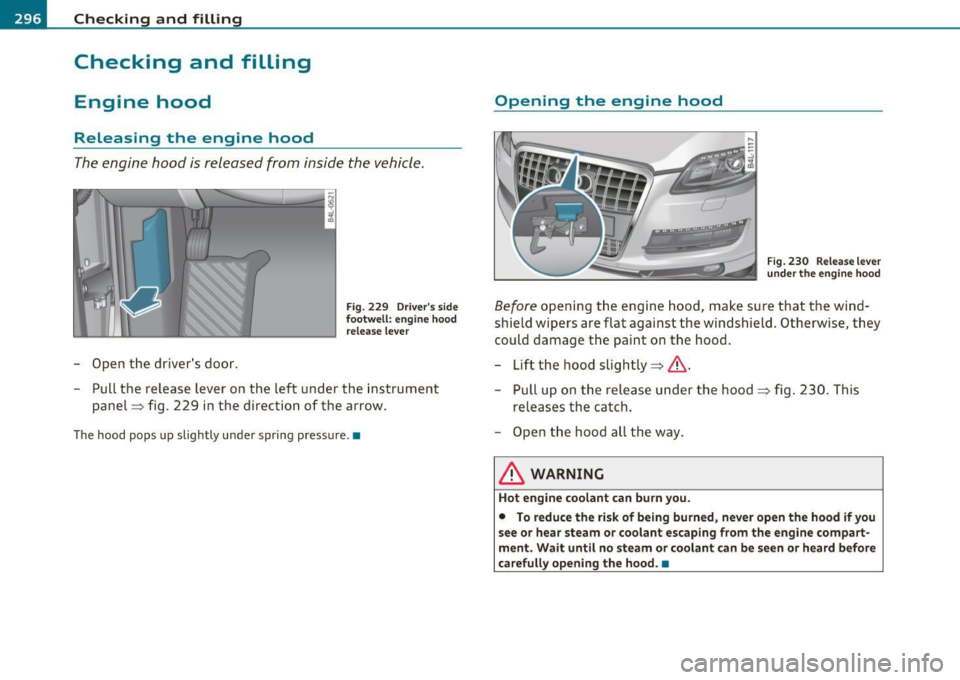
Releasing the engine hood
The engine hood is released from inside the vehicle.
-Open the driver's door.
Fig. 229 Driver's side
footwell: engine hood
release lever
-Pull the release lever on the left under the instrument
panel => fig . 229 in the direction of the arrow .
The hood pops up slightly under spring pressure .•
Opening the engine hood
Fig. 230 Release lever
under the engine hood
Before opening the engine hood, make sure that the wind
shield wipers are flat against the windshield. Otherwise, they
could damage the paint on the hood.
- Lift the hood slightly =>& .
- Pull up on the release under the hood => fig. 230. This
releases the catch.
- Open the hood all the way.
& WARNING
Hot engine coolant can burn you.
• To reduce the risk of being burned, never open the hood if you
see or hear steam or coolant escaping from the engine compart
ment. Wait until no steam or coolant can be seen or heard before
carefully opening the hood. •
Page 299 of 390
___________________________________________ C..:...._ h:....:e :....:c:..:. k.::..: i..:.. n .:..:g:!:....:: a....:. n..:.. d~ f:....:. i.:..ll :.:.i:....:n :.:g !....- _1!'11
Closing the engine hood
- Pull the hood down until the pressure from the struts is
reduced.
- Let the hood
drop down and latch in place. Do not try to
push it shut;
it may fail to engage=:> &.
& WARNING
A hood that is not completely latched could fly up and block your
view while driving.
• When you close the engine hood, check it to make sure the
safety catch has properly engaged. The hood should be flush with
the surrounding vehicle body parts.
• If you notice while driving that the hood is not secured prop
erly, stop at once and close it. •
Working in the engine compartment
Be especially careful whenever you work in the engine
compartment.
Whenever you must perform any work in the engine compartment,
for example checking and filling different fluids, there is a risk of injury, burns and accidents. To prevent personal injury always
observe the following WARNINGS. The engine compartment of any
vehicle is a hazardous area=>& .
& WARNING
To help avoid injury, before you check anything under the hood:
• Turn off the engine.
• Remove the ignition key.
• Apply the parking brake.
Safety first
& WARNING (continued)
• Move selector lever to "P" (Park).
• Always let the engine cool down. Hot components will burn
skin on contact.
• To reduce the risk of being burned, never open the hood if you
see or hear steam or coolant escaping from the engine compart
ment. Wait until no steam or coolant can be seen or heard before
carefully opening the hood.
• Keep children away from the engine compartment.
• Never spill fluids on hot engine components. They can cause a
fire. • Never touch the radiator fan. The auxiliary electric fan is
temperature controlled and can switch on suddenly.
• Never open the coolant reservoir cap when the engine is still
warm. The coolant system is pressurized and hot coolant could
spray out.
• Protect your face, hands and arm from steam or hot engine
coolant by placing a thick rag over the cap when you open the
coolant reservoir.
• If work on the fuel system or the electrical system is necessary:
- Always disconnect the battery.
- Never smoke or work near heaters or open flames. Fluids in
the engine compartment could start a fire.
- Keep an approved fire extinguisher immediately available.
• To avoid electrical shock and personal injury while the engine is
running or being started, never touch:
-Ignition cables
- Other components of the high voltage electronic ignition
system.
• If you must perform a check or repair with the engine running:
- First, fully apply the parking brake, move selector lever to
"P" (Park). .,
Vehicle care Technical data
Page 300 of 390

___ C_h_ e_c _k _i_n -=g :a,__ a_n_ d_ f_ i_ l _li _n _,g;._ __________________________________________ _
& WARNING (continued)
-Always use extreme caution to prevent clothing, jewelry, or
long hair from getting caught in the radiator fan, V-belts or
other moving parts, or from contacting hot parts. Tie back hair
before starting, and do not wear clothing that will hang or
droop into the engine.
• Minimize exposure to emission and chemical hazards=:>
/1::..
& WARNING
California Proposition 65 Warning:
• Engine exhaust, some of its constituents, and certain vehicle
components contain or emit chemicals known to the State of Cali
fornia to cause cancer and birth defects and reproductive harm. In
addition, certain fluids contained in vehicles and certain products
of component wear contain or emit chemicals known to the State
of California to cause cancer and birth defects or other reproduc
tive harm.
• Battery posts, terminals and related accessories contain lead
and lead compounds, chemicals known to the State of California
to cause cancer and reproductive harms. Wash hands after
handling.
0 Note
When adding fluids, a lways make sure that they are poured into the
proper container or filler open ing , otherwise serious damage to
vehicle systems wi ll occur.
ci> For the sake of the environment
To detect leaks in time, inspect the vehicle floor pan from underneath
reg ular ly. If yo u see spots from oil or other vehicle fl uids, have your
vehicle inspected by an authorized Audi dea ler .•
Engine compartment
These are the most important items that you can check.
Fig. 231 Typical layout for containers, engine oil dipstick and engine oil filler
cap
© Windshield/headlight washer container ( q ) . . . . . . . . 312
@ Coolant expansion tank (- L ) . . . . . . . . . . . . . . . . . . . . . 305
® Engine oil f iller cap
("l!::r.) . . . . . . . . . . . . . . . . . . . . . . . . 302
© Engine oil dipstick (orange) . . . . . . . . . . . . . . . . . . . . . . 301
® Brake fluid reservoir ( ) . . . . . . . . . . . . . . . . . . . . . . . . 307
© Power steering reservoir . . . . . . . . . . . . . . . . . . . . . . . . 257
0 Jump start connector( +) u nder a cover,(-) with hex head
screw .. ... ... ...... ........ ......... .... .. .. 311,352
The position of the engine oil filling hole and the engine oil dipstick
=:> fig. 231 (position ® and ©> can vary according to the type of
eng ine. .,_
Page 306 of 390
lffll __ C_ h_ e_c _k _i _ n _g ~ a_n _d_ f_il _l_in _ g _________________________________________ _
& WARNING (conti nu ed )
• Engine oil is poisonous . Keep it well out of the reach of chil
dren .
• Continuous contact with u sed engine oil is harmful to your
skin . Alway s protect your skin by wa shing thoroughly with soap
and water.
0 Note
Never mix oi l additives wit h your engine oil. These additives can
damage your engine and adverse ly affect your Audi Limited New
Vehicle Warranty.
~ For the sake of the environment
• Before chang ing the oil, first make sure you know where you can
prope rly d is p ose of the o ld oil.
• Always dispose of used oi l proper ly. Never dump it o n garden soi l,
in wooded areas, i nto streams o r down sewage d rains.
• Recycle used oi l by taking it to a used engine oil co llection facility
in yo ur area, or contact a se rvice station .
• We st rongly recommend t hat you have you r oi l changed by an
authorized Audi dealer or a qualified workshop with the specia l tools
and expertise required, and proper means of disposa l.•
Engine cooling system
Coolant
The e ngine co o la nt per form s two functio ns: it keeps the
engine from ove rh eati ng and it protects t he engine from
free zing in the winter .
The cooling system is sealed an d genera lly req uir es little attention. The cooling system has been f
illed at the factory wit h a permanent
c oo lant whi ch does no t need to be c hanged . Th e coolan t cons ists o f a
mixt ure of water and the manufacturer's glycol-basedcoolant addi
tive G12+ + antifreeze with anticorrosion ad dit ives (50% for USA
mode ls; 60% for Ca nadian models) . This mixture both ass ures the
necessary frost protection and protects meta l components in the
eng ine's cooling system from co rrosion and scaling. It also raise s the
boiling point of the coo lant .
Do not re du ce the co ncent ration of the coo lant in the summer by
add ing p la in water .
The proportion of coolant add itive must be at
least 50% but not more than 60%
to mai ntain an tifreeze pro tection
and coo ling efficiency . If the coolant frost p rotect io n i s too low, the
coo lant co uld freeze an d damage t he veh icle heating and engine
coo ling system .
For year-round driving, antifree ze is added at the factory for temper
a tures dow n to:
• -31°F(-35°C)USA
• - 4 0 °F ( -40 °C) Canad a.
You can mix the G12 ++ coo lant addit ive w ith other additives (G12+ or
G 12). A lways check with yo ur autho rize d Audi dea ler.
& WARNING
Before you che ck anything in the engine compartment, always
read and heed all WARNINGS~
& in "Work ing in the engine
compartment" on
page 297 .
0 Note
• Before w inter sets in, have the coolan t checked to see i f the
coo lant add itive in yo ur vehicle is s uff ic ient to meet the cl ima te
conditions. This is especially important if yo u live in a region where
the winter is ext reme ly cold . If necessa ry, increase the proport ion of
coo lant add itive to 60%.
• When ad ding coolant add itive to you r cooling sys tem, remembe r:_.,
Page 307 of 390
_____________________________________________ C_h _ e_ c_ k_in --= g:-. a_n _d_ f_i _ll _i_n -=g =-- ____.•
- We recommend using only coolant additive Gl2 ++ (check the
l a bel) for yo ur vehicle. This coolant ad dit ive is available at au tho·
r ized Audi dealers . Other types of antifreeze can s ignificantly
reduce corrosion protection. The resulting corrosion can cause a
loss of coolant and serious engine damage .
• Do not add any type of radiator leak sealant to your vehicle's
eng ine coo lant . Adding radiator repa ir fluid may adversely affect the
function and performance of your cooling system and could result in
damage not covered by your New Vehicle Limited Warranty .•
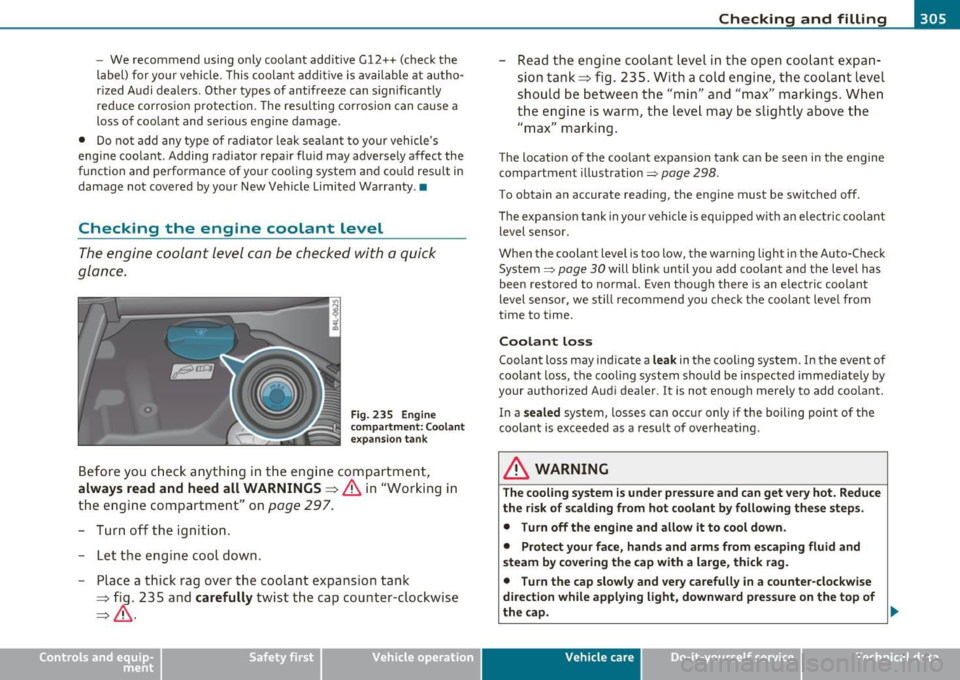
Checking the engine coolant Level
The engine coolant level can be checked with a quick
glance .
Fig. 2 35 En gin e
c o mpar tmen t: C oolant
ex pansion tank
Before you c heck anything in the eng ine compartment,
always read and heed all WARNINGS~ & in "Working in
the e ngine compartment" on
page 297.
- Turn off the ignit ion .
- Let t he eng ine cool down .
- Place a thick rag over the coolant expans ion tank
~ fig . 235 and carefully twist the cap counter ·clockwise
~ & -
Vehicle OP-eration
-Read the engine coolant level in th e open coo lant expan ·
sion tank ~ fig . 235 . With a cold engine, the coolant level
should be between the "min" and "max" ma rkings . Whe n
the engine is warm , the level may be slight ly above the
"max" marking .
The location o f the coo lant expansion tank can be seen in the engine
compartment illustration=>
page 298 .
To obt ain an accurate reading , the engine must be sw itched off.
Th e expans ion t an k in your vehicle is equippe d with an electric coolant
level sensor.
When the coolant lev el is too low, the warning light in the Auto·Check
System=>
page 30 will blink until you add coolant and t he level has
been resto red to normal. Even though there is an electric coolant
level sensor, we st ill recommend you check the coolant leve l from
time to time.
Coolant loss
Coolant loss may indicate a leak in the coo ling system . In the event of
coo lant loss , the cooling system sho uld be inspected immed iate ly by
your authorized Aud i dea ler . It is not enough mere ly to add coolant.
In a
s ealed system, losses can occu r only if the boiling point of the
coolant is exceeded as a result of ove rheating .
& WARNING
The cooling system is under pressure and can get ve ry hot. Reduce
the ri sk of scalding from hot coolant by following the se steps.
• Turn off the engine and allow it to cool down .
• Protect your face, hand s and arms from e scaping fluid and
s team b y co ve ring the cap with a large, thi ck r ag.
• Turn the cap slowly and ver y carefully in a counter-clo ckwise
direction whil e applying light , downward pre ssure on the top of
thecap .
~
Vehicle care Do-it-yourselt service iTechnical data
Page 308 of 390

___ C_ h_ e_c _k _i _ n _g ~ a_n _d_ f_il _l_in _ g _________________________________________ _
& WARNING (conti nu ed )
• To avoid being burned, do not spill antifreeze or coolant on the
exhaust system or hot engine part s. Under certain condit ion s, the
ethylene glycol in engine coolant can catch fire.
0 Note
Do not add any type of radiator leak sealant to yo ur vehicle's engine
c oo lant. Addi ng radia tor repa ir fluid m ay adverse ly affe ct the func
tion and performance of your cooling system and could result in
damage not cove red by y our New Vehicle Lim ited Warr anty. •
Adding coolant
Be very careful when adding engine coolant.
Before you check anyt hing in th e eng ine co mpart ment ,
always read and heed all WARNINGS => & in "Wor king i n
t h e e ngine compa rtment" on
page 297.
- Tur n off the eng ine.
- Let t he engi ne c ool d ow n.
- Place a thic k rag over th e coolan t expans ion tank
=> pag e 305, fig. 235 and carefully twist t he cap cou nter
cl ockwi se
=> &.
- Add coo lant.
- Tw ist the ca p on aga in
tightly .
Replacement eng ine coolant must conform to exact specifications
=>
page 304, "Coolant". Even in a n emergency, if coolant addi tive
Gl2 ++, Gl2 + or Gl2 is not available, do not use a different addit ive.
Use plain wate r in st ead until you can get the cor rec t additive an d can
restore the correct ratio. This shou ld be done as soon as possible. If
you have lost a considerable amount of coolant, then you sho uld
a d d c old an tifr ee ze and cold wa ter only when the e ngine is cold.
Always use
new engine coo la nt when refilling.
Do not fill coolant above the "MAX" mark. Excess coolant will be
fo rced o ut thr ough the p re ssur e relief v alve in the c ap w hen the
eng ine becomes hot.
& WARNING
• The cooling system is under pressure and can get very hot.
Reduce the risk of scalding from hot coolant by following these
steps.
-Turn off the engine and allow it to cool down.
- Protect your face , hands and arms from escaping fluid and
s team by covering the cap with a large, thi ck rag .
- Turn the cap slowly and very carefully in a counter-clockwise
direction while applying light, downward pre ssure on the top
of the cap.
- To avoid being burned, do not spill antifreeze or coolant on
the exh aust system or hot engine parts . Under certain condi
tions , the ethylene glycol in engine coolant can catch fire.
• Antifreeze is poisonous. Always store antifreeze in its original
container and well out of the reach of children.
• If you drain the coolant , it mu st be caught and safely stored in
a proper container clearly marked "poison ".
0 Note
• Coolant poll utes the environment and could cause an engine fire.
Excess coolant w ill be forced o ut thro ugh the pressure relief va lve in
t he c ap when t he e ngine becomes hot.
• If, i n an emergency, only water can be added, the co rrect ratio
between wate r and an tifreeze=>
page 304 mus t be res to red as soo n
as possib le. _..
Page 309 of 390

___________________________________________ C_ h _ e_c _k _ i_n -=g .._ a_n _ d_ f_i _ll _i _ n -=g '-- ....... JIII
<£> For the sake of the environment
Dra ined coolant sho uld not be reused. A lways dispose of used coolan t
w hile observing a ll enviro nmental regulations .•
Radiator fan
T he radia tor fa n switc hes on a utoma tically by itself
The radiator fan is driven by the engine via the V-belt. The v iscous
cl utch reg ulates the spee d of t he fan accord ing to t he tem pera ture o f
the coolant.
An aux ili ar y e lec tric r adi ator fan* sw itches on and o ff depend ing o n
coo la nt temperat ure and other vehicle operating conditions.
After you switch the engine off, the auxiliary fan can continue r unning
for up to 10 minutes -eve n w it h t he igni tion o ff.
It can even swit ch on
again later by itse lf => & , if
• t he tem pera ture of the e ngi ne coola nt rises due to the hea t build
up from the eng ine in the engine compa rtment, o r
• th e engine compar tmen t heats up because the ve hicl e is parked in
intense s unlight.
& WARNING
• To reduce the risk of personal injury never touch the radiator
fan .
• The auxiliary electric fan is temperature cont rolled and can
switch on suddenly even when the engine i s not running.
• The auxiliary radiator fan switche s on automatically when the
engine coolant reaches a certain temperatu re and will continue to
run until the coolant temperature drops. •
~ehicle OP-eration
Brake fluid
Checking brake fluid level
The brake flu id l eve l can be checke d with a quick gl ance .
Fig . 236 Engine
compa rtment : Brake
fluid rese rvoir
Before you check a nyt hin g i n th e eng ine compa rtment ,
always read and heed all WARNINGS~ & in " Working in
the e ng ine co mpartmen t" on
page 297.
- Read the brake fluid level f rom t he bra ke flu id reservoir
~ fig. 2 36 . The bra ke fluid leve l must be between the
" MIN " and "MAX" markings.
Th e brake fl uid rese rvoir is located at the rear partition of t he engine
compartment on the left side=>
page 298.
The fluid level may drop slightly after some time due to the auto
m atic adjus tmen t of th e br ake pads. This is no t ca use for alarm .
If the brake fluid level falls
considerably below the "MIN" mark, t he
brake warn ing/i nd icator lig ht ( U.S. models :
BRAKE, Canadian mode ls:
ill ) will come on=> page 20 and=> page 29 . Do not continue to
operate the vehicle . The complete brake system s hould be thorough ly
che cked by an au thori zed Aud i dea le r o r q ua lified wor kshop a nd the
cause corrected.
If t h e brake fl uid leve l is too low, the brake .,,_
Vehicle care Do-it-yourselt service iTechnical data
Page 315 of 390
Checking and filling --------------~--EMI
- Lift the filler cap tongue to add washer fluid . You can fill
the container to the top .
- Press the cap back onto the filler neck after filling the container.
You can find the reservoir capacit y in the table in=:> page 363.
To prevent lime residue from bu ilding up on the spray jets, use
distilled water when refilling. Always add a g lass cleaner so lution
(with frost protection in the w inter) .
0 Note
Do not mix engine coolant antifreeze or any other additives to fill up
the windshie ld washer reservo ir .•
Safety first Vehicle care Technical data
Page 370 of 390
___ C_ o_n_ s _ u_m_ e_ r_ I_ n_ f_o _r_ m_ a_ t_io _ n _____________________________________________ _
& WARNING (conti nu ed )
• The engine compartment of any motor veh icle is a potentially
hazardous area . Never reach into th e area around or touch the
radiator fa n. It is temperature controlled and can switch on
s uddenly -even when the engine is off and the ignition key has
been remo ved. The radiator fan switches on autom atically when
the coolant rea ches a certain temperature and will continue to run
until the coolant tempe rature drops.
• Always remove the ignition key before anyone gets under the
vehicle.
• Always support your vehicle with safety stands if it i s neces sary
to work unde rne ath the vehicle. The jac k supplied with the vehicle
is not adequate for thi s purpose and could collap se cau sing
serious personal injury.
• If you must work underneath the vehicle w ith the wheels on
the ground , always ma ke sure the vehicle is on level ground , th at
the whe els are alway s securely blocked and that the engine cannot
be started .
• Always make sure the transmi ssion selector l ever (automatic
tran smission) is in "P" (Park position ) and the par k brake is firmly
applied.
W For the sake of the environment
• Changing the engine settings will adversely affect e miss io n levels.
Th is is detrimenta l to the environment and increases fuel consump
ti on.
• Always observe enviro nmental regulations when disposing of old
eng ine o il, use d brake fl uid, dirt y engine coo lant, s pent ba tt er ies or
worn out t ires.
• Undep loyed a irbag modules and pretens ioners migh t be classified
as Perchlorate Mater ia l -spec ial handling may apply, see
www.dts c.ca .g ov/h azar douswas te/pe rchlo ra te . When the veh icle or
parts of the rest raint system including a irbag modu les sa fety belts
w ith pretens ioners are sc rapped, all applicable laws and regulat io ns must be observed
. Your authorized Aud i dealer is familiar with these
re qui remen ts and we recomme nd that you have your dealer perfo rm
this serv ice for you .•
Additional accessories,
modifications and parts
replacement
Additional accessories and parts
replacement
A lway s con sul t an autho rized Audi dealer before
purchasi ng a ccess ories.
Your vehicle incorporates the latest safety design feat ures ens uring a
hig h stand ard of active and passive s afe ty.
T hi s safety co uld be compromised by no n-app roved changes to the
vehicle. Fo r this reason, if parts have to be replace d, p lease observe
the following points when installing addit ional accessories :
Approved Audi accessories and genuine Aud i parts are available from
a u thor ized Aud i deal ers.
T hese dea lers a lso have the necessary fac ilities, tools and tra ined
speci alists to inst all the parts and ac cessor ies p ro p er ly.
& WARNING
Using the wrong spar e parts or u sing non-approved ac ce ss ories
can cause damage to the vehicle and serious personal injury .
• Use only acces sories expressly approved by Audi and genuine
Audi spare parts
• The se parts and acces sorie s have been specially designed to be
used on your vehicle . _,.