towing AUDI Q7 2010 Owner´s Manual
[x] Cancel search | Manufacturer: AUDI, Model Year: 2010, Model line: Q7, Model: AUDI Q7 2010Pages: 390, PDF Size: 93.04 MB
Page 197 of 390
________________________________________________ D_ r_ i_ v _i_n ""'g "-- S_a_ f_ e_ l _,,y'-- __
Use only floor mats that leave the pedal area unobstructed and that
are firmly secured so that they cannot slip out of position . You can
obtain suitable floor mats from your authorized Audi dealer.
Floor mat fasteners are installed in your Audi.
Floor mats used in your vehicle must be attached to these fasteners.
Properly securing the floor mats will prevent them from sliding into
positions that could interfere with the pedals or impair safe opera
tion of your vehicle in other ways .
& WARNING
Pedals that cannot move freely can result in a loss of vehicle
control and increase the risk of serious personal injury.
• Always make sure that floor mats are properly secured.
• Never place or install floor mats or other floor coverings in the
vehicle that cannot be properly secured in place to prevent them
from slipping and interfering with the pedals or the ability to
control the vehicle.
• Never place or install floor mats or other floor coverings on top
of already installed floor mats. Additional floor mats and other
coverings will reduce the size of the pedal area and interfere with
the pedals.
• Always properly reinstall and secure floor mats that have been
taken out for cleaning.
• Always make sure that objects cannot fall into the driver foot
well while the vehicle is moving. Objects can become trapped under the brake pedal and accelerator pedal causing a loss of
vehicle control. •
Controls and equip ment Safety first Vehicle operation
Stowing luggage
Loading the luggage compartment
All
luggage and other objects must be properly stowed
and secured in the luggage compartment.
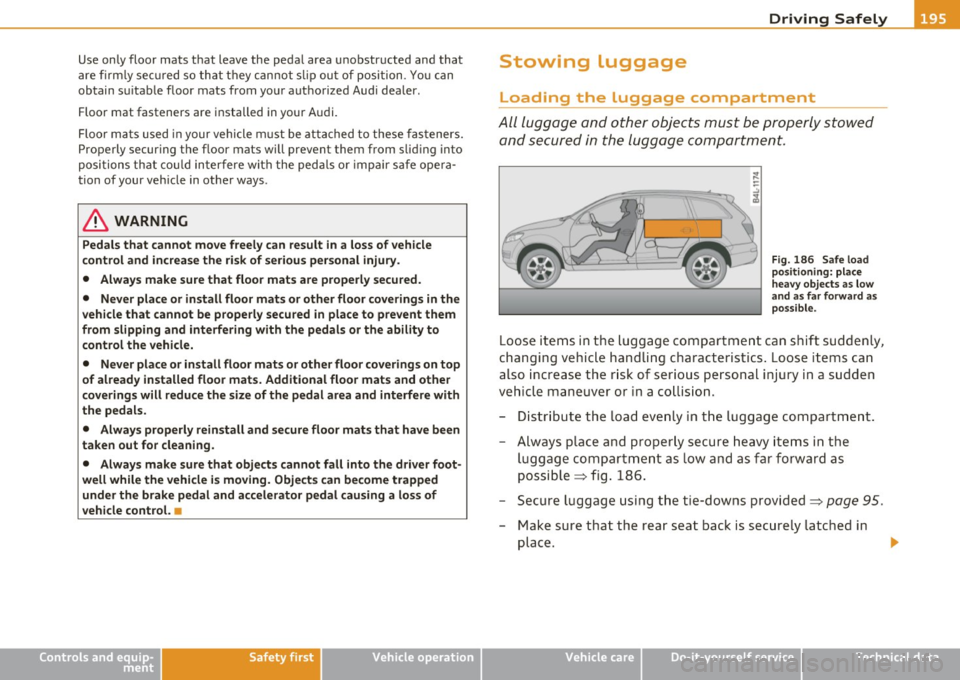
Fig . 186 Safe load
positioning: place
heavy objects as low
and as far forward as
possible.
Loose items in the luggage compartment can shift suddenly,
changing vehicle handling characteristics. Loose items can
also increase the risk of serious personal injury in a sudden
vehicle maneuver or in a collision.
- Distribute the load evenly in the luggage compartment.
- Always place and properly secure heavy items in the
luggage compartment as low and as far forward as
possible => fig. 186.
- Secure luggage using the tie-downs provided=>
page 95.
- Make sure that the rear seat back is securely latched in
place .
Vehicle care Do-it-yourself service Technical data
Page 258 of 390
lillill.a._...:I:..: n~ t .::.e::::..::.: ll~igent technology ,_ _______________________________________ _
in. WARNING
• You should perform braking maneuvers for the purpose of
cleaning the brake system only if road condition s permit. Other
road u sers must not b e put at r isk - you may cau se an ac cident!
• Before d esc ending a steep gr ade , redu ce speed and shift t ran s
mission into a lower gear or lower driving range. Do not ride the
brakes or hold the pedal down too long or too often . This could
c ause the brake s to get hot and diminish braking efficiency.
• Do not "ride the brakes " by re sting your foot on the pedal when
you do not intend to brake. Thi s may caus e the brakes to overheat ,
premature wear and increa sed stopping di stance.
• Under certain climatic and operating conditions such as
pas sing through water, driving in heavy rain or after washing the
vehicle, the effectiveness of the brake s can be reduced . In winter,
ice can accumulate on the brake pads , linings , disc s and drums .
Carefully apply brakes for a test. Brake s will dry and ice coatings
will be cleaned off after a few careful brake applications.
• Driving for an extended period of time on salt -cov ered roads
without using your brakes can al so affect braking efficiency. Clean
off accumulated salt coating from brake d iscs and pads with a few
careful brake applications.
• If you damage the front spoiler , or if you install a different
s poiler , be sure the air flow to the front brakes is not obstructed.
Otherwise the brake system could overheat reducing the effective
ness of the entire brake system.
• Failure of one brake circuit will impair the braking capability
resulting in an increased stopping distance. Avoid driving the
vehicle and have it towed to the nearest authorized Audi dealer or
qualified wo rkshop. •
Brake booster
The brake booster adds e xtra brakin g pow er .
The brake booster wor ks with vacuum pressure which is created on ly
w hen the en gine is ru nning =>& .
in. WARNING
• Never let the vehicle roll to a stop with the engine shut off .
• If the brake booster i s not working , for example when towing
your vehicle , or because the brake booster has somehow been
damaged , the b rake pedal must be p ressed considerably harder to
make up for the lack of booster assistan ce.
Functioning of Anti-Lock Brake System
(ABS)
AB S prevents the wheels from locking up under br aking.
T he ABS co ntribu tes effectively to vehicle co ntrol s ince it prevents t he
w hee ls from
locking when the b rakes are a pplied. This means t hat t he
veh icle rema ins steerable and is less likely to s kid .
W ith ABS you do not need to
pump the brake. Just hold the brake
pedal down .
However, do not expect the ABS to shorten braking distance u nder
all
circums tances. When driving on grave l or on newly fa llen snow on top
of icy su rfaces, braking dis tance may be even longer, therefore, under
these c irc umstances, it is especially important that you dr ive slowly
and w it h great care .
How the ABS system works
An automatic check is made when a speed of about 12 mph (20 km/h)
is reached . When this happens, a p umping noise can be hea rd. ._
Page 271 of 390
Trailer towing
Driving with a trailer
General information Your Audi was design ed primarily for passenger transpor
tation .
If you plan to tow a t rai ler, p lease rem emb er that the add itiona l load
wi ll affect durab ility, economy and performance.
T railer tow ing not on ly p laces mo re s tress on the vehicle, it a lso calls
for more concentrat ion from the driver.
For this reason, a lways follow the ope rating and dr iv ing instr uctions
prov ided and use common sense .
(D Note
If you are going to tow a t ra iler , you must ac tivate the tra ile r ope ra
tion mode ::::;,
page 180, "Towing a trailer". •
Technical requirements
Trailer hitch
Use a we igh t-car rying hit ch confo rm ing to the g ross tra ile r weig ht.
The hitch must be suitable for your vehicle and tra iler and must be
mou nted secure ly o n th e veh icle's chassis a t a
te chnically sound loca
tion. Use only a trailer hitch with a removab le ba ll mount. Always
check w ith the tra iler h itch manufacturer to ma ke sure tha t you are
using the correct hitch .
Do not use a bumper hitch .
The hitch must be i nstalled in such a way t hat i t does not interfe re
w ith the impact-absorbing bumper system. No mod ificat ions should
Controls and equip
ment Safety first Vehicle operation
be made to the vehicle exhaust and b
rake systems. From time to
time, check that all hitc h mounting bo lts rema in securely fastened.
Whe n you are no t towing a trai ler, remove the trailer hi tch ba ll
mount. This prevents the hitch from caus ing damage should your
vehicle be s truck from behind::::;,& .
Trailer brakes
If your trailer i s eq uipped w ith a b raking system, che ck to be s ure that
it conforms to all regulat ions.
T he tra iler hyd raulic brake system must not be directly connected to
the vehi cle's hydraul ic brake system ::::;, & .
Safety chains
Always use safety chains betwee n your vehicle and t he tra iler .
Trailer lights
Trailer lights must meet all regulat ions. Be sure to check w ith your
au thor ized A udi deale r for co rrect wi ring, switc hes, and re lays.
Mirrors
If you are unab le to see the traff ic beh ind you us ing t he regular
outside m irro rs, then you
must install extended mirro rs. It is impor
t an t th at yo u
always have cle ar vision to the re a r.
& WARNING
• If a trailer has electrical brakes please note that these brakes
are not activated by the factory-fitted control unit -ri sk of acci ·
dent!
• Afte r removing the trailer hitch, do not store it in your vehicle .
In case of sudden braking, the hitch could fly forward and injure
you or your passengers .
Vehicle care Do-it-yourself service Technical data
Page 272 of 390
Trailer towing
~-----------------------------------------
& WARNING (cont inued)
• The Gro ss Vehicle Weight Rating for your Audi Q7 vehicle,
found on the safety compliance label on the driver's side B-pillar, must never be exceeded under any circumstances . Exceeding the
Gross Vehicle Weight Rating of your vehicle is likely to damage
your vehicle, and such damage will not be covered by your Limited
New Vehicle Warranty. Exceeding the Gross Vehicle Weight
Rating will also change the performance and handling character
istics of your vehicle, whi ch could cause a crash resulting in serious
injury or death.
• The Gro ss Vehicle Weight Rating for your Audi Q7 would be
exceeded if your vehicle is simultaneously equipped with
Panoramic sliding sunroof; third-row seating ; trailer towing
equipment (factory or dealer-installed ), and running boards
(dealer-installed) . UNDER NO CIRCUMSTANCES MAY ALL SUCH
ITEMS BE INSTALLED ON THE SAME VEHICLE .•
Operating instructions
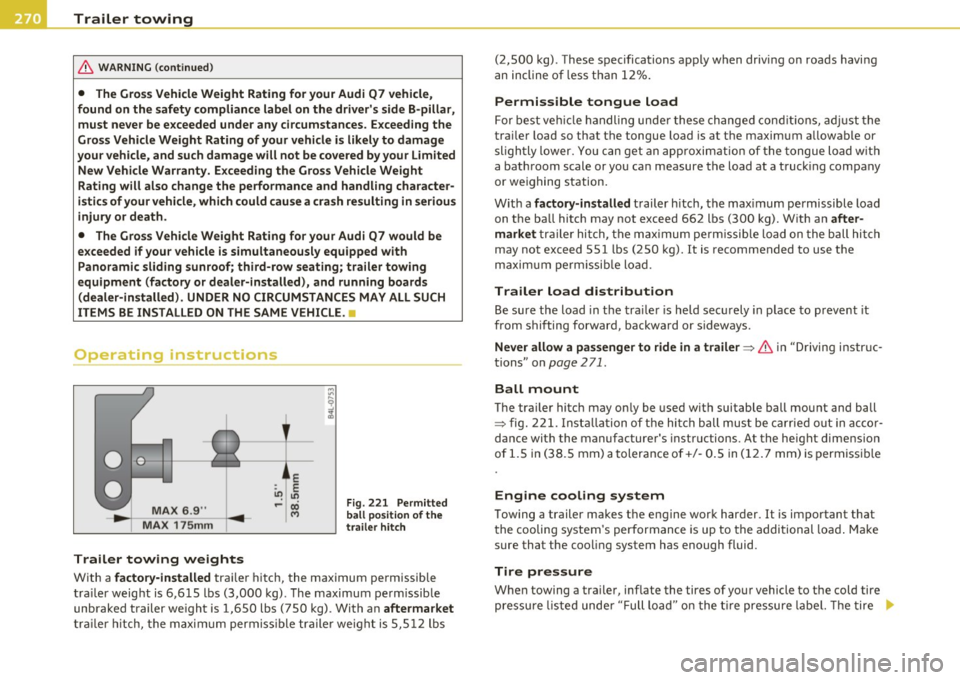
M AX 6 .9"
MA X
175mm
Trailer towing weights
Fig. 221 Permitted
ball position of the
tra iler hit ch
With a factory -installed tra ile r hi tch, the maximum pe rmissib le
t ra iler weig ht is 6,615 lbs (3,000 kg). The maximum pe rmissib le
unbraked trailer we igh t is 1,650 lbs (750 kg) . With an
aftermarket
trail er hi tch, the m axi mum permissibl e traile r weig ht i s 5,5 12 lbs (2,500
kg) . These specifications app ly when driv ing on roads havi ng
an in cline o f less t han 12%.
Permissible tongue load
For best ve hicle handl ing un der t hese ch ange d co ndition s, adju st the
tra ile r l oad so that the tongue load is at the maxim um a llowab le or
sligh tly lower. You can get an app roxim atio n of the tongue load w it h
a bat hroom scale or you ca n measure the load at a t ruc king company
or we ighing st ation.
W it h a
factory-installed trailer h itch, the max imum pe rmissible load
on t he ba ll hitc h may not exceed 662 lbs (300 kg). W it h an
after
market
tra ile r hi tc h, t he ma ximum pe rm issi ble loa d on the b all hi tch
may not exceed 551 lbs (250 kg). It is recommended to use the
maxim um permi ssible loa d.
Trailer load distribution
Be su re the load in t he tra ile r i s held se curely in p lace to p revent it
from shi fting forward, backwa rd or sideways.
Never allow a passenger to ride in a trailer=> & in "Dr ivin g in struc
t ions" on
page 2 71.
Ball mount
The tra ile r hitch may on ly be used w ith suitable ball mount and ball
=> fi g. 221. I nstallat ion of the hi tch b all mus t be c arrie d out in acco r
dance with the manufacturer's instructions . At the height d imension
of 1. 5 in (38 .5 mm) a toler ance of+/- 0.5 in ( 12. 7 mm ) is per miss ible
Engine cooling system
Towing a trailer makes t he eng ine work harder. It is impo rtant that
t he cooling system 's performan ce is up to the addi tional loa d. Mak e
sure that the coo ling system has enough fluid .
Tire pressure
When towing a trailer, inf late the tires ofyourvehicle to the cold tire
pre ssure listed unde r "Full lo ad" on t he tire pre ssu re lab el. Th e tire ...
Page 273 of 390

pressure label is located o n the dr iver's side B-pillar. Inflate trailer
t ires to tra ile r and t ire ma nufacturers' spec ifications.
Lights
T he headl ight settings shou ld be chec ked with the tr ailer attached
before driving off. Check to make sure both vehicle and trailer lights
are wo rking properly.
Safety chains
Be sure tra ile r safety cha ins are p roperly connected from the t rai ler
to the hitch on the vehicle. Leave enough slack in the chains to perm it
tu rning corners . When you install sa fe ty ch ains, ma ke sure they will
not drag on the road when you are driving.
T he chains should cross under the trai ler tongue to prevent it from
dropping in case of separation from the h itch .
0 Note
If you are goi ng to tow a trai ler , you must activate the trai ler opera
tion mode =>
page 180, "Towing a trailer". •
Driving instructior,s
Driving with a trailer always requires e xtra care and
consideration.
To obtain the best possib le handling of ve hicle a nd trailer ,
please note the following :
- Do not tow a loaded trailer when your car itself is not
loaded.
- Be especia lly careful when pass ing other vehicles .
- Observe speed limi ts.
- Do not drive at the maximum pe rmissible speed.
Controls and equip
ment Safety first Vehicle operation
- Always apply brakes early.
- Mo
nitor the temperature gauge.
Weight distri but ion
T owing a loaded trailer with an empty car results in a highly unstable
distribution of we ight . If t his cannot be avoided , drive at very low
speeds only to avoid the risk of losing steering control.
A "balanced" rig is easier to operate and control. This means that the
tow veh icle shou ld be loaded to the extent poss ible and permissib le,
wh ile keeping the tra ile r as lig ht as poss ible unde r the ci rc u mstances.
Whe never possible, transfer some cargo to the luggage compart
me nt o f the tow vehicle while observing tongue load requirements
and vehicle loading considerations.
Speed
The higher the speed, the more d ifficult it becomes for the driver to
control the r ig . Do not dr ive at the maxim um permiss ible speed .
Reduce your speed eve n more if load, weather or w ind conditions are
unfavorable -particular ly when going downhill.
Reduce vehicle speed
immed iately if the tra ile r shows the slightest
sign of swaying.
Do not tr y to stop the s wayi ng by a ccele rating .
Observe speed lim its. In some areas, speeds for veh icles towing
trailers are lowe r than for regular veh icles .
Always apply brakes early. When driving downhi ll, shift into a lower
gear to use the engine brak ing effect to slow t he ve hicle . Use of the
brakes alone can cause them to overheat and fa il.
Coolant temperatur e
The coo lant temperature gauge=> page 10 must be observed care
fu lly. If the needle moves close to the upper end of the sca le, reduce
speed immediately and/or turn off the air conditioner.
If the coo lant temperature warning light in the instrument clus ter
starts flash ing
- F- , pull off the road, stop and let the engine idle for
about two m inutes to prevent hea t buil d-up.
Vehicle care Do-it-yourself service Technical data
Page 274 of 390
Trailer towing
"---------------------------------------------------
in. WARNING
Anyone not properly restrained in a moving vehicle is at a much
greater risk in an a ccident . Never let an yone ride in y our car who i s
not prop erly wearing the re straints provided by Audi. •
Trailer towing tips
Important to know
Your vehicle handles differe ntly when tow ing a tra iler because of the
additiona l weight and different we ight distribution. Safety, perfor
man ce and economy w ill greatly depend on how ca refu lly yo u load
your trailer and operate your rig.
Be fore you actua lly tow your tra ile r, prac tice turning, stopp ing and
back ing u p in a n area away from traffic. Keep pract ic in g until you have
become completely familiar with the way your vehicle -trailer combi
nation behaves and responds .
Backing up is diff icult and requ ires pract ice. Backing up w ith a trailer
gene rally requires s teer ing a ction opposi te to th at when ba cki ng up
your vehicle witho ut a trailer.
Maintain a greate r d istance between your ve hicl e and the one in front
of yo u. You will need more room to stop . T o compensate fo r the
trai ler, you will need a larger than normal turning radius .
W hen p assing, remember that you c annot acceler ate as fast as yo u
normally wou ld because of the added load. Make sure yo u have
enoug h room to pass. After passi ng, allow plen ty of room fo r yo ur
tra iler before changing lanes again .
Avoid jerky starts, sharp turns or rapid lane changes .
[ i ] Tips
• Do not tow a trai ler d uring the brea k-in perio d of your vehicle. •
If you tow a tra iler, your Aud i may require more frequent mai nte
n an ce due to the ex tra load:::::>
page 366. •
Parking on a slope
Do not park on a slope with a trailer. If it cannot be
av oided, do so only after doing the following:
When parking:
- Apply the foot brak e.
- Have someone p lac e chocks un der bo th the vehicle and t he
traile r w he els .
- With c hoc ks i n place, slowly release the brakes u ntil the
wheel c hoc ks absorb t he load.
- Turn the w hee ls towards t he curb .
- A pply the parking brake.
- M ove th e selector le v er to
P.
When restarting after parking:
- A pply the foot brake .
- Start the engine .
- Mov e th e s elector lever to
D .
- Release the par king brake a nd s low ly pull o ut and away
fro m the w heel chocks.
- Stop a nd have someone retr ieve the w heel chocks .
(I) Tips
If you move the se lector lever of the a utomat ic t ransmiss ion to P
befo re applying t he par king br ake an d befo re blo cking the w heels, II-
Page 326 of 390

-Tires and wheels
5. Determine the combined weight of
luggage and cargo being loaded on the
vehicle. That weight may not safely
exceed the available cargo and luggage
load capacity calculated in Step 4.
6. If your vehicle will be towing a trailer,
load from your trailer will be transferred
to your vehicle. Consult this manual to
determine how this reduces the available
cargo and luggage load capacity of your
vehicle.
Check the tire sidewall(=>
page 3267
fig. 243) to determine the designated
load rating for a specific tire .•
Tire service life
The service life of tires depends on a lot of different
things including proper installation and balancing,
correct tire pressure and driving style.
~------------~
Tread Wear Indicator (TWI)
Fig. 241 Tire tread:
tread wear indicators
(TWI)
Fig. 242 Rotating
tires for more even
wear
Th e original tires on your vehicle have 1/16 inch (1. 6 mm) high "wear
ind icators"~ fig. 241 ru nning across the tread . Depend ing on the
make, there will be six to eight of them even ly placed around the tire.
Marks on the tire sidewall (for example "TWI" or other symbols) indi
cate the positions of the tread wear indicators. Worn tires must be
replaced. Different figures may apply in other countries ~& . ._,.
Page 338 of 390
lffll.,___W_ h_ a_t _ d_ o_ I_d_ o_ n_o _w_ ? ___________________________________________ _
What do I do now?
Jack, tools and inflatable spare tire
Tools
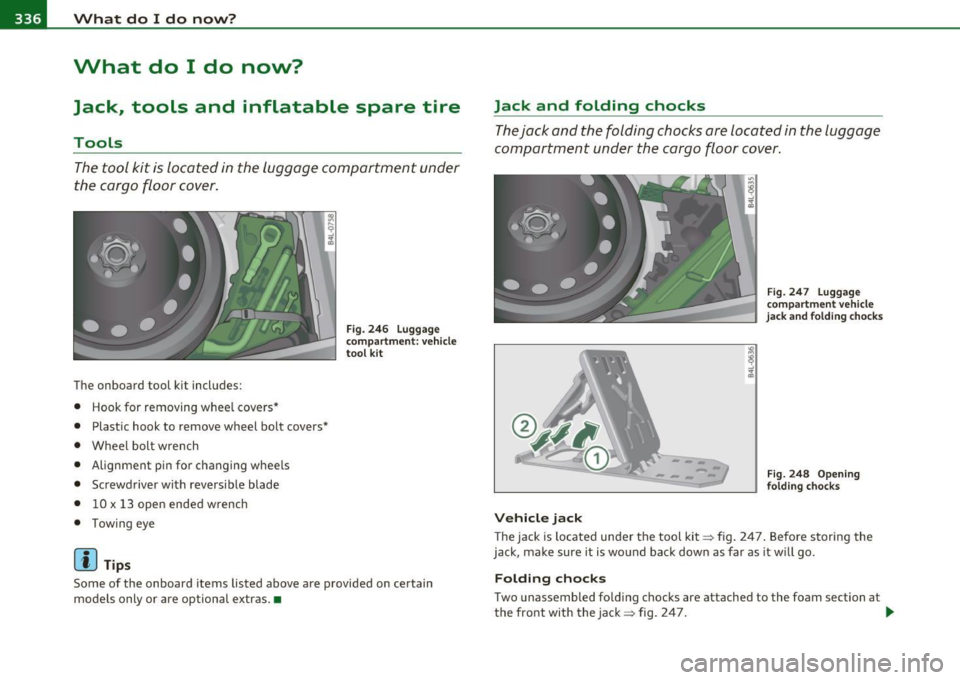
The tool kit is located in the luggage compartment under
the cargo floor cover .
The onboard tool kit includes:
• Hook for removing wheel covers*
• Plastic hook to remove wheel bolt covers*
• Wheel bolt wrench
• Alignment pin for changing wheels
• Screwdriver with reversible blade
• 10 x 13 open ended wrench
• Towing eye
[ i J Tips
F ig. 2 46 Luggage
compart ment : ve hicle
t ool kit
Some of the onboard items listed above are provided on certain
models only or are optiona l extras. •
Jack and folding chock s
The jack and the folding chocks are located in the luggage
compartment under the cargo floor cover.
---
----~ -
Vehicle jack
F ig . 247 Luggage
compartment vehicle
jack and folding chocks
F ig. 248 Open ing
fo lding chocks
The jack is located under the tool kit=> fig. 247 . Before storing the
jack, make sure it is wound back down as far as it will go.
F o ld ing ch ocks
Two unassembled folding chocks are attached to the foam section at
the front with the jack => fig. 247.
~
Page 340 of 390

111...__W_ h_ a_t _ d_ o_ I_d_ o_ n_o _w_ ? ___________________________________________ _
Inflatable spare tire
The inflatable spare tire expands to its full diameter
when it is infl ated.
Removing inflatable spare tire
Fig. 250 I nfl ata ble
sp are tir e wi th
c ompr essor
- Lift up the cargo floor using the handle.
- Turn the large screw=> fig. 250 counter -clockwise .
- Remove the bass box as required==>
page 337.
Take out the in flatab le spare tire .
Stowing the inflatable spare tire
- Release the air by unscrewing the valve stem .
- Screw the valve stem back in afterwards.
- Wa it a few hou rs before placing the w hee l in the spare
wheel well=>
&-
- Install the bass box as required=> page 33 7.
- Secure the whee l with the large screw .
- Fold the cargo floor bac k down .
After using the inflatable spare wheel
The inflatable spare t ire can be re -used as long as it is not damaged
and is not worn down to the tread wear indica tors=>
& -
When you let the air out of the inflatab le spare tire, it does not
assume its folded shape again for severa l hours. Until then, it cannot
be placed back in t he spare wheel well and stowed secure ly.
& WARNING
• Never use the spare tire if it is d amaged or if it is worn down to
the tread wear indicators.
• If the infl atable spare tire is more than 6 years old , use it only
in an emergency and with extreme caution and careful driving.
• The inflatable spa re tire is intended only for temporary and
short-term use. It should be replaced a s soon as possible with the
n o rmal wheel and tire .
• Ma ximum inflation pressure for the inflatable spare tire is
50 PSI (3.5 bar ).
• Ma ximum permiss ible speed is 50 mph (80 km /h ).
• Avo id full-throttle a cceleration, heavy braking, and fast
corne ring .
• When the air is let out of the infl atable spare wheel, it d oes not
assume its folded shape for se veral hours . Until then , it cannot be
pla ced back in the spare wheel w ell and stowed securel y.
• Never drive with more than one inflatable spare tire.
• For technical r easons , the use of tir e chains on the inflatabl e
spare tire i s not permitted. If it i s necessary to dri ve with tire
c ha in s, the inflatabl e spare whe el must be mounted on the front
axle in the event of a flat in a rea r tire. The newly a vailable front
whee l mu st then be installed in place of the re ar wheel with the
flat tire. Ins talling the tire chain before mounting the wheel and
tir e is recomm ended.
• Loo se items in the passenger compartment can cause serious
per sonal injury during hard braking or in an accident . .,,.
Page 354 of 390

Ill Emergency situations 1..--=---=;..._ ____________ _
Emergency situations
General
This chapter is intended for trained emergency crew s and working
pe rsonnel who have the necessary tool s and equipment to perform
the se operation s. •
Starting by pushing or towing
0 Note
Yo ur vehicle is equipped with an automatic t ransmission . Conse
quently, the engine ca nnot be started by push ing or tow ing .•
Starting with jumper cables
I f necessary, the engine can be started by connectin g it to
the bat tery of another vehicle.
If the eng ine shou ld fa il to start because of a discharged or weak
battery, the battery can be connected to t he battery of
another
veh icle, us ing a pair of jumper cables to start the eng ine .
Jumper cables
Use only jumper cables of sufficiently large cro ss section to carry the
sta rter cur rent safely . Refer to the m an ufa ct ur er's specificat ions.
Use only j umpe r cab les with
insulated te rm inal clamps wh ich are
distinct ly marked :
plus(+) cable in most cases colored red
minus (-) cable
in most cases colored b lack .
& WARNING
Batterie s contain el ectricity, acid, and gas . Any of the se can cause
very serious or fatal injury. Follow the inst ructions below for safe
handling of your vehicle 's battery.
• Always shield your eyes and avoid leaning over the battery
whenev er po ssible .
• A discharged battery can freeze at temperatures just below
32 °F (0 °C ). Before connecting a jumper cable, you must thaw the
frozen battery completely, otherwise it could explode.
• Do not allow battery acid to contact eyes or sk in . Flush any
contacted area with water immedi ately .
• Improper use of a booste r battery to start a vehicle may cause
an explosion .
• Vehicle batteries generate e xplosive gases. Keep sparks, flame
and lighted cigarettes away from batterie s.
• Do not try to jump start any vehicle with a low acid level in the
battery.
• The voltage of the booster battery must also have a 12-Volt
rating. The capacity (Ah) of the booster battery should not be
lower than that of the discharged battery . Use of batteries of
different voltage or substantially different "Ah " rating may cau se
an e xplosion and personal injury.
• Never charge a frozen battery . Gas trapped in the ice may cause
an explosion.
• Never charge or use a battery that has been frozen. The battery
case may have be weakened .
• Use of batteries of different voltage or substantially different
capacity (Ah) rating may cause an explosion and injury . The
capacity (Ah) of the booster battery should not be lower than that
of the discharged battery. .,_