fuel AUDI Q7 2010 Owner´s Manual
[x] Cancel search | Manufacturer: AUDI, Model Year: 2010, Model line: Q7, Model: AUDI Q7 2010Pages: 390, PDF Size: 93.04 MB
Page 167 of 390
______________________________________________ A_ u_ t_ o_ m_ a_ t_ ic_ t_r _a _n_ s_m _ i_s _s_ i_o _n _ ___.1111
driver presses the brake pedal on a downhill gradient . This makes use
of the braking effect of the engine without the need to shift down
manually .•
Manual shift program
Using the manual shift program you can manually select
gears.
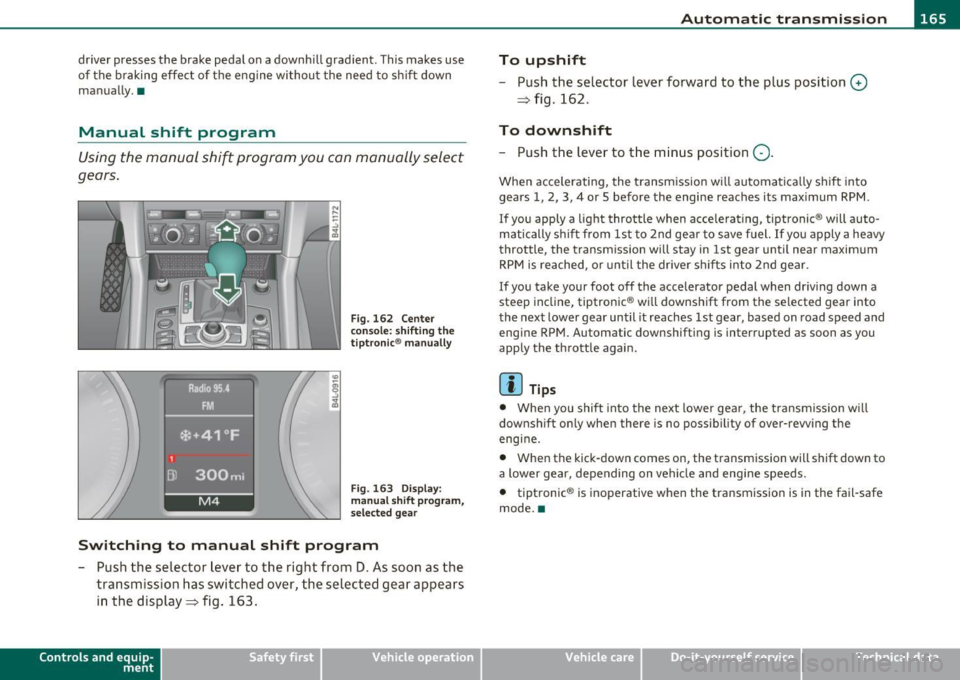
Fig. 162 Center
console : shifting the
tiptronic ® manually
Fig . 163 Display:
manual shift program,
selec ted gear
Switching to manual shift program
-Push the selector lever to the right from D. As soon as the
transmission has switched over, the selected gear appears
in the display => fig . 163.
Con tro ls a nd e quip
m en t Vehicle
OP-eration
To upshift
-Push the selector lever forward to the plus position 0
=> fig . 162.
To downshift
- Push the lever to the minus position Q.
When accelerating, the transm ission w ill automatically shift into
gears 1, 2, 3, 4 or 5 before the engine reaches its maximum RPM .
I f you apply a light throttle when accelerating, tiptronic ® will auto
matically shift from 1st to 2nd gea r to save fuel. If you apply a heavy
throttle, the transmission will stay in 1st gear until near maximum
RPM is reached, or until the driver shifts into 2nd gear.
If you take your foot off the accelerator pedal when driv ing down a
st eep incline, tiptronic ® will downshift from the selected gear into
the next lower gear until it reaches 1st gear, based on road speed and
e ngine RPM. Automatic downsh ifting is interrupted as soon as you
apply the throttle again.
[ i ] Tips
• When you shift into the next lower gear, the transmission will
downshift on ly when there is no possibility of over-rewing the
engine.
• When the kick -down comes on, the transmission will shift down to
a lower gear, depending on vehicle and engine speeds.
• tiptronic ® is inoperative when the transmission is in the fail-safe
mode. •
Vehicle care Do-it-yourselt service iTechnical data
Page 179 of 390
____________________________________________ A_ d_a_ p ,_ t_iv _ e_ A _ i_ r _ S_ u_s_, p __ e_n _ s_ i _o_ n __ ffllll
A pp lies to ve hicles : with A dap tive Air Su spen sion
Chassis controls
Five different driving modes can be set by the driver.
The automatic control processes are speed- and time-dependent. For
example, it is not possible to raise the suspension to a high level
above certain speeds.
When a speed of about 75 mph (120 km/h) is exceeded for more than
30 seconds, the vehicle is automatically lowered to
low level when in
comfort and automatic mode. Ground clearance is about 0.6 inch (15
mm) less, compared to the
normal level.
When a speed of about 100 mph (160 km/h) is exceeded for more
than 20 seconds, the vehicle is automatically lowered to
highway
level
when in automatic and dynamic mode . Ground clearance is
about 1.4 inches (35 mm) less, compared to the
normal level. Road
holding is optimized as a resu lt of the lower center of gravity, and fuel
consumption is reduced as a result of reduced wind resistance .
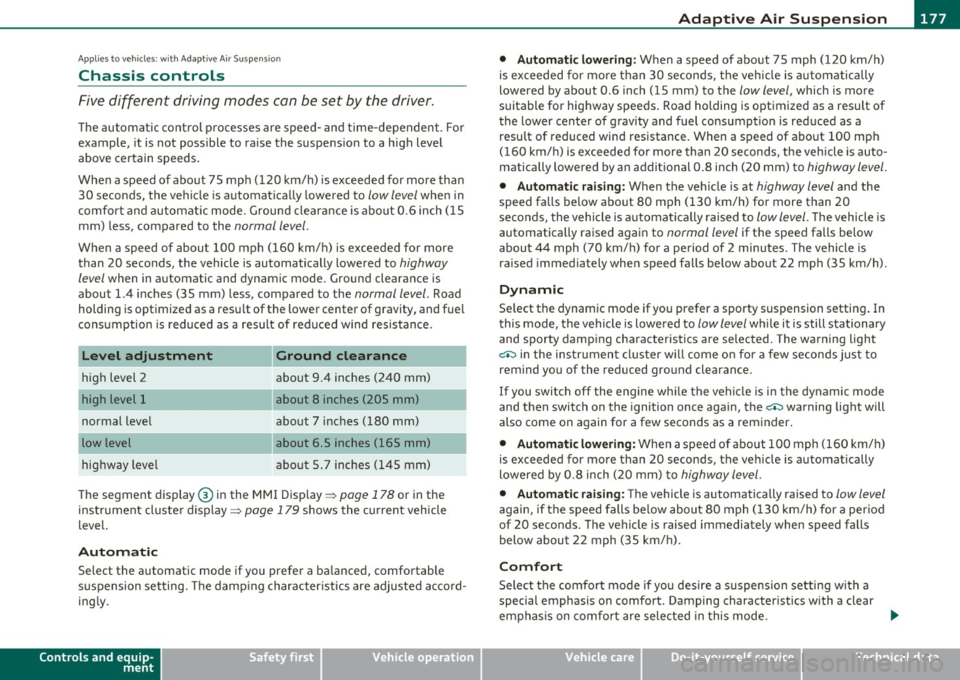
Level adjustment
high level 2
normal level
highway level
Ground clearance
about 9.4 inches (240 mm)
about 8 inches (205 mm)
about 7 inches (180 mm)
about 6.5 inches (165 mm)
about 5. 7 inches (145 mm)
The segment display @ in the MMI Display =>
page 178 or in the
instrument cluste r display =>
page 179 shows the current vehicle
level.
Automatic
Select the automatic mode if you prefer a balanced, comfortable
suspension setting. The damp ing characteristics are adjusted accord
ing ly .
Controls and equip
ment Safety first •
Automatic lowering: When a speed of about 75 mph (120 km/h)
is exceeded for more than 30 seconds, the veh icle is automatically
lowered by about 0 .6 inch (15 mm) to the
low level, which is more
suitable for highway speeds. Road holding is optimized as a result of
the lower center of gravity and fuel consumpt ion is reduced as a
result of reduced wind resistance . When a speed of about 100 mph
(160 km/h) is exceeded fo r more than 20 seconds, the vehicle is auto
matically lowered by an additional 0.8 inch (20 mm) to
highway level.
• Automatic raising: When the vehicle is at highway level and the
speed falls below about 80 mph (130 km/h) for more than 20
seconds, the vehicle is automat ically raised to
low level. The vehicle is
automatically raised again to
normal level if the speed falls below
about 44 mph (70 km/h) for a period of 2 minutes. The vehicle is
raised immediately when speed falls below about 22 mph (35 km/h).
Dynamic
Select the dynamic mode if you prefer a sporty suspension setting . In
this mode, the vehi cle is lowe red to
low level wh ile it is still stationary
and sporty damp ing characteristics a re selected . The warning light
c.:> in the instrument cluster wi ll come on for a few seconds just to
remind you of the reduced ground clearance.
If you switch off the engine whi le the vehicle is in the dynamic mode
and then switch on the ignition once again, the
c.:> warning light will
also come on again for a few seconds as a reminder .
• Automatic lowering : When a speed of about 100 mph (160 km/h)
is exceeded fo r more than 20 seconds, the vehicle is automatically
lowered by 0.8 inch (20 mm) to
highway level.
• Automatic raising: The vehicle is automatically raised to low level
again, if the speed falls below about 80 mph (1 30 km/h) for a per iod
of 20 seconds. The vehicle is raised immediately when speed falls
below about 22 mph (35 km/h).
Comfort
Select the comfort mode if you desire a suspension setting with a
special emphasis on comfort. Damping characteristics with a clear
emphasis on comfort are selected in this mode.
~
Vehicle care Technical data
Page 264 of 390
Driving and environment
New brake pads
Remember that new brake pads do not have a f ull braki ng
e ff e ct during the first 250 miles (400 kilometers) after they
are i nsta lle d.
New bra ke pads have to be "b urnished in" before they have opt ima l
grab=> &.
Dur ing the break -in period, you sho uld avoid putting severe loads on
the brakes. Severe loads incl ude, for example, sudden hard braki ng,
in particu lar at very high s peeds or, for examp le, on mountai n passes.
& WARNING
New brake pads don 't have the be st stopping power and must be
" broken -in " during the initial 100 to 150 miles (150 to 200 kilo
meters ) of normal cit y driving. You can compensate for thi s by
pressing th e brak e pedal more firmly. This also applies lat er wh en
new pad s are installed. n
Appli es to ve hicles : w it h g aso line eng ine
Catalytic converter
--
I t is very important th at your emission control system
(ca talytic co n verter) i s func tioning properly to e nsure
that you r vehicle is running in an environmentally sou nd
manner.
- Always us e lead-fr ee gasoli ne ~ page 287, "Gaso line" .
- Never run the tan k down a ll the way to empty.
- Never put too m uch motor oil in your engine~
page 302,
"Add ing e ngi ne o il "t::r.11
•
-Nev er try to p ush- or tow-sta rt yo ur veh icle.
The catalytic converter is an efficient "clean- up" device b uilt into the
exha ust sys te m of the ve hicle. The cat alytic converte r burns many of
t he polluta nts in the exhaust gas before they are released into the
atmosphe re.
Th e e xcl usive use of unleaded fuel is cr itic ally important for the life of
the catalytic converte r and proper f unction ing of the engine.
& WARNING
• Do not park or operate the vehicle in areas where the hot
exhaust system may come in contact with dry grass, brush, fuel
spill or other material which can cause a fire .
• Do not apply additional undercoating or rustproofing on or
near the exhaust manifold , exhaust pipes, catalytic conve rter or
heat shields. During driving, the substance used for undercoating
could overheat and cause a fire .
0 Note
• Be aware that just one tank fi lling wit h leaded fu el wi ll alrea dy
ser iou sly degrade the performan ce of the ca talyt ic co nve rter.
• Do not excee d the correct engine oil leve l=>
page 302 .
• Do not dr ive unti l the f uel tank becomes complete ly empty. The
eng ine could misfire . Unburned fuel could a lso get into the exha ust
system and th is could cause the catalytic converter to overheat.
• Do not t urn o ff the igni tion whi le the ve hicl e is moving.
• Do not contin ue to operate your vehicle under these conditions, as
o therwi se fuel c an reach the cat alytic c onve rter. Th is cou ld resu lt in
over heating of t he converte r, requir ing its rep lacement.
• T o ass ure eff ic ient opera tion of the Emi ssion C ontro l Sy stem:
- Have your vehicle maintaine d properly and in accordance with
t h e se rvice recommenda tions in your Warranty
& M ain tenance
booklet. •
Page 265 of 390
Driving and environment
------------------------------------------------'
- Lack of proper maintena nce as well as improper use of the
vehicle w ill imp air t he funct io n of t he emission con trol system and
could lead to damage.
<£> For the sake of the environment
Even when the Emiss ion Contro l System is operating properly, the
exhaust gas can have a sulfur-like exhaust gas sme ll under some
operat ing states. This depends on the s ulfur content of the fue l being
used. Using a differe nt brand of fuel may help, or filling the tank with
lead-free supe r grade gasoline. •
Applies to vehicles: w ith diesel eng ine
Diesel particulate filter
The d iese l part iculate filter fi lters nearly all of the soot particles out
of the exhaus t. T he filte r cleans i tself automa ticall y unde r no rm al
driving con dit io ns. If the f ilter cannot clea n itself (for example,
because yo u are on ly driving short dis tances), the f ilter becomes
clogged w it h soot and the symbo l for the diesel particulate fi lter
illuminates ~
page 35.
& WARNING
• Do not park your vehicle over flammable materials such as
grass or leaves because the high temperature of the diese l partic
ulate filter could start a fire .
• Do not apply an underbody protectant in the exhaust system
area or a fire could start .•
Controls and equip ment Safety first Vehicle operation
Avoid damaging the vehicle
Whe
n you are driving on poor roads, or over curbs, steep ramps, etc.,
m ake ce rtain that low-lying p art s s uch as spoilers and e xhaust system
parts do not bottom out and get damaged.
Thi s is espec ia lly t rue for vehicles with low-s lung chassis (sports
chass is) * and f ully loaded vehicles. •
Operate your vehicle economically
and minimize pollution
General
Your personal style of driving will det ermine the economy
of your vehicle, as well as exhaust and noise levels.
Fuel economy, env ironmenta l im pact , and wea r on your e ng ine,
brakes and tires largely depend on t hree factors:
• your person al driv in g style
• operating conditions
• techni cal lim itations
If you anticipate what you need to do next and drive economically,
you can e asily cut you r fu el consum ptio n by 10- 15 pe rcen t. T his
sect io n w ill give you some tips on how you can help the environment
and yo ur po cketbook.
rn Tips
Th e consumption est ima tes as published by E NVIRO NMEN TAL
PROT ECTION AGENCY ( EPA) and Transport Canada may not corre
spond to your act ual consumption on the roa d, which will vary
depend ing upon vehicle load and speed, road and weather co ndit ions,
trip length, etc.•
Vehicle care Do-it-yourself service Technical data
Page 266 of 390
Driving and environment
Drive smoothly and keep a lookout ahead
Vehicles use the most fuel when they are accelerating.
- Avo id unnecessary acce lerating and braking .
Vehicles use the most fuel when they are accelerati ng. If you antici
pate what is going to happen next, you will need to brake less and,
thus , accelerate less. Let the vehicle coast whenever possible - for
example when you see that the next traffic light is red. •
Avoid full throttle
Driving at moderate speeds saves fuel and improves your
mileage.
- Try and keep well below your car's maximum speed.
Accelerating gently reduces fuel consumption, engine wear, and does
not disturb the environment.
Fuel consumption , exhaust emiss ions and eng ine no ise increase
disproportionately at high speeds. If you drive at approximately three
quarters of top speed, fuel consumption w ill be reduced by one ha lf.
Never drive faster than the posted speed limit and weather condi
tions pe rm it. •
Reducing unnecessary idling
Even when your car is just idling it burns up fuel.
- Shut the eng ine off when you are not driving the vehicle.
- Do not warm up the vehicle by letting the eng ine run at
idle .
It makes sense to shu t off t he eng ine in traffic jams, when wa it ing for
tra ins to pass at railroad crossings, or at traffic lights that have long waits on red
. Turning the eng ine off for just 30-40 seconds saves
more f uel than is burned start ing the engine aga in.
It takes a long t ime for the engine to warm up fully when it is ru nning
at idle . However, wear and noxious emissions are especia lly high
when the eng ine is wa rming up. So you shou ld drive away as soon as
you start the engine and avoid running at high rpms while the engine
is still warming up .
0 Note
Do not leave engine idling unattended afte r start ing. If warning
lights should come on to indicate improper operation, they would go
unheeded. Extended idling also produces heat, which cou ld result in
overhea ting or other damage to the vehicle or other property. •
Regular maintenance
A badly tuned engine unnecessarily wastes a lot of fuel.
- Have your vehicle serviced at regular intervals.
By having your vehicle regularly serv iced by an authorized Aud i dealer
helps to ensure that it runs properly and economically. The condition
of your vehicle not only affects its safe ty and ability to hold its value,
it a lso affects fuel con sumption .
Che ck your o il e ach time you fill your t ank.
T he amo unt of oil used is related to engine load and speed.
It is normal for the o il consumption of a new engine to reach its
lowest val ue afte r a certa in m ileage has been d riven.
You must drive your veh icle about 3,000 m iles (5,000 kilometers)
before you can properly assess oi l consumption .
T his also app lies to f uel consumption and engine ou tput. ._
Page 267 of 390
Driving and environment
---------------------------------------------------'
0
Note
• Have you r vehicle ma intained properly and in acco rdance w ith t he
service recommendations in your Warranty
& Maintenance booklet .
Lac k of p roper ma inte nan ce as well as imprope r use of the vehicle wi ll
impair the funct ion of the em ission control system and cou ld lead to
damage.
• Do not alter o r remove any component of the Emission Control
System u nless approved by the manufa ct ur er.
• Do not a lter or remove any device, such as heat shie lds, switches,
ign ition w ires , va lves, which are desig ned to protec t your ve hicle's
Emission Contro l System and other important veh icle components .•
Fewer short trips
F uel consumptio n will always be relatively high on short
trips .
-Try to avoi d drivi ng s ho rt dis tances wit h a cold engine .
The engine and catalytic converter have to reach their optima l oper
ating temperature
t o reduce f uel consum ptio n a nd noxio us em is
sions effectively.
Just after starting, a cold engine in a mid -s ize car on ly achieves a fuel
economy of 6-8 m iles per gallon (30- 40 l/l00km) . After about a ha lf
a mile, fuel economy climbs to 12 mpg (20 l/100 km). After abo ut
2 .5 m iles ( 4 km), t he engine i s at its p rop er operat ing temper ature
and fue l economy has reached a normal level. So yo u can see that you
sho uld avoi d short t rips whenever possible.
T he
out side temperature is a lso c ritical in this regard. Your car
cons umes mo re fue l in the winter than in the summer. •
Controls and equip·
ment Safety first Vehicle operation
Vehicle care Do-it-yourself service Technical data
Page 276 of 390
-~_C_ le_ a_n_ i_ n_ g=- a_ n_d___. p_ ro_ t_e _c_ t_ i_o _n ___________________________________________ _
Cleaning and protection
General information
Regular care preserves vehicl e val ue.
Any automobile is exposed to industria l fumes, co rrosive road salt,
m ud dy dog fee t, e tc. A well c ared for Audi can look like new many
years after p urchase . Regular and correct care will contribute to
m aint aining the bea uty and val ue of your Audi.
Furthermore, good care may be a condition for substantiating a
warranty claim should corrosion damage or paint defects occur.
Y ou r au thor ized Audi d eale r h as a var iety of dedicated vehicle-care
products
and can advise w hich ones to use for clea ning the exterior
a n d inter io r of your ve hicle.
W het her you use products recommended by Aud i or o ther comme r
cia lly availab le cleaning agents , please ma ke sure yo u appl y them
co rrectly .
& WARNING
• Cleaning agents may be poisonous . Keep them out of the reach
of children.
• Heed all caution labels .
• Always read directions on the container before using any
product. Follow the directions carefully.
• Most chemical cleaners are concentrated and have to be
diluted .
• Use spot removing fluids only in well ventilated areas.
• Do not use gasoline, kero sene , diesel fuel , nail polish remover
or other volatile fluids . They may be toxic, flammable or
hazardous in other ways. Do not wash, wax or dry the vehicle with
the ignition on or the engine running.
& WARNING (co ntinued)
• Do not clean the under sides of chassi s, fenders , wheel covers,
etc. without protecting your hands and arms. You may cut your
self on sharp-edged metal parts.
• Moisture and ice on brakes may impair braking efficiency
~ page 255, "General information ". Test the brakes carefully
each time you wash the vehicle .
'£> For the sake of the environment
Select only envir onmenta lly fr iendly clea ning produc ts . Leftover
cleaning pro ducts sho uld not dis posed of i n the household waste .•
Care of exterior
Washing
F re qu ent w ashin g protec ts th e vehicl e.
T he best protection aga inst env ironmental influences is frequent
w ashi ng and w ax ing. How o ften t his is requ ired depen ds on:
• How m uch the vehicle is use d
• Whe re the ve hicle is parke d (gar age, in the o pen un der tr ees, e tc.)
• The seasona l and weather conditions
• E nviron mental influences
T he longer bi rd droppings , insects , tree resin, road and industria l
gr ime, t ar, soo t, road sa lt and o ther ma ter ia ls remain on the veh icle
body, the more lasti ng their destructive effects w ill be. H igh temper
atu res cause d by ex pos ure to intense s unlight int ensify the co rrosive
effect, part icu larly when humid ity is high as we ll.
~
Page 288 of 390
-~_C_ le_ a_n_ i_ n_ g=- a_ n_d___. p_ ro_ t_e _c_ t_ i_o _n ___________________________________________ _
Engine compartment
Be especially careful when cleaning the engine compa rt
men t.
Always switch off the ignition before cleaning the engine=:>& .
Plenum panel
Remove leaves from the plenum panel in front of the win dshi eld
unde r th e eng ine hood . T hi s prevents the water d rain holes from
becoming b locked, and it prevents debris from entering the vehicle
inter io r th rough the heat ing and vent ilation ducts .
Corrosion protection
The eng ine compartment and transmission have been cor rosion
protected at the factory.
Good ant i-cor rosion treatment is very impo rtant , pa rtic ular ly in the
w inter . If the vehicle is frequently driven on sa lt treated roads, the
en tire eng ine compar tment and plenum p anel sho uld be thoroug hly
cleaned at the end of winter and retreated to prevent salt damage. At
t he same t ime, the underside of the vehi cle should be washed as well.
If the e ng ine compartment is clea ned at any t ime with grease
removing so lutions
2l , or i f you have the engine washed , the anti
co rros io n treatment is a lmost a lways removed as w ell.
It is t herefore
essential to have a long-last ing corrosion p rotect ion reapplied to all
surfa ces, seams, jo ints and compo nents in the engi ne co mpa rt ment .
& WARNING
Be aware: The engine compartment of any motor vehicle is a
potentially hazardous area .
• Before working in the engine compartment, be sur e to read the
information =:>
page 286.
2
l Use on ly th e co rr ect clean ing so lut ions. Never use gaso line or diese l fuel.
& WARNING (c on tinued )
• Before reaching into the front plenum panel , alway s remove
the ignition key. Otherwise, the windshield wiper system could unintentionally be switched on , possibly causing personal injury
from the moving wiper linkage.
• Never reach into the area around or touch the radiator fan. The
auxiliary fan is temperature controlled and can switch on suddenly
· ev en when the ignition is off.
• Do not wash, wax or dry the engine with th e engine running.
Moving or hot pa rts could injure you.
• Do not clean the underside of the chass is, fenders, wheel
covers, or other hard to reach part s without protecting your hands
and arm s. You may cut yourself on sharp-edged metal parts.
• Always read and heed all WARNINGS and other information
=:> page 274. •
Page 289 of 390
Fuel supply and filling your fuel tank
Fuel supply and filling your fuel tank
Fuel supply
Applies to vehicles : w ith gasoline eng in e
Gasoline
Using the right fuel helps keep the environment clean and
prevents engine damage.
Fuel recommendation
The fuel recommended for you r vehicle is unleaded premium grade
gasoline . See also~
page 363, "Data". Audi recommends using TOP
TIE R Detergent Gasoline with a minimum octane rating of 91 AKI (95
RON) . For more information on TOP TIER Detergent Gasoline, please
go to the official website (www.toptiergas .com).
Th e recommended gasoline octane rating for your engine can also be
found on a labe l located on the inside of the fue l filler flap. This rating
may be specified as AK I o r RON.
Your vehicle may also be operated using unleaded regular gasoline
with a minim um octane rating of 87 AKl/91 RON . However, using 87
AKl/91 RON octane fuel will slightly reduce engine performance .
Use unleaded gasoline only. Unleaded gasoline is available
throughout the USA, Canada, and in most European countries. We
recommend that you do not take your vehicle to areas or countries
where unleaded gasoline may not be availab le.
For more information on refueling your vehicle, see~
page 289.
Octane rating
Octane rating indicates a gasoline's ability to resist engine damag ing
" kno ck" caused by prematu re ignition and detonation. Therefore,
buying the correct grade of gasoline is very important to help prevent
possible engine damage and a loss of engine performance.
Safety first
Gaso line most commonly used in the United States and Canada has
the following octane ratings that can usually be found on the filler
pump:
• Premium Grade: 91 - 96 AKI
• Regular Grade: 87 - 90 AKI
E xplanation of the abb reviations :
AKI= Anti Knock Index= (R +M)/2 = (RON+MON)/2
RON= Research Octane Number
MON= Moto r Octane Number.
0 Note
• Do not use any fuel with octane ratings lower than 87 AKI or 91
RON otherwise expens ive engine damage will occur.
• Do
not use leaded gasoline . T he use of leaded gasoline w ill
seve rely damage your veh icle's cata lytic converter and its ability to
control exhaust emiss io ns. •
Ap plies t o vehicl es: w ith gasoline eng in e
Blended gasoline
Use of gasoline containing alcohol or MTBE (methyl
tert iary butyl ether)
You may use unleaded gasoline blended w ith alcohol or MTBE
(common ly referred to as oxygenates) if the blended mixture meets
the following criteria:
Blend of gasoline methanol (wood alcohol or methyl alcohol)
• Anti-knock index must be 87 AKI o r higher.
• Blend must contain no more than 3% methanol.
• Blend must contain more than 2% co-solvents .
Vehicle care Technical data
Page 290 of 390
Fuel supply and filling your fuel tank
Blend of g asoline and ethanol (grain alcohol or ethyl alcohol )
• Anti-knock index must be 8 7 AKI o r higher .
• Blend must not conta in more than 10% ethanol.
Blend of gasoline and M TBE
• Anti-knoc k index must be 87 AKI o r highe r.
• Blend must conta in not more than 15% MTB E.
Sea sonally adjusted ga soline
Many gasoline grades are b lended to perform especially well for
w inte r or summer d riving. Duri ng seasonal change-ove r, we s uggest
that you fill up at busy gas stat ions where the seasonal adjus tment is
mor e likely to be made in time.
0 Note
• Methano l fuels which do not meet these requirements may cause
co rrosion and damage to plast ic and rubber component s in the fue l
system .
• Do not use fuels that fail to meet the specified c riteria in this
chapter.
• If you are unable to dete rm ine whether or not a part icu lar fuel
blend meets the specifications, ask your service stat ion or its fuel
supplier .
• Do not use f uel fo r which t he con tents cannot be iden tifie d.
• Fuel system damage and performance problems result ing from
t he use o f fuels differe nt from t hose s pecifie d are not t he responsi
bility of Aud i and are not covered u nder the New Ve hicle o r th e Em is
sion Cont ro l System Warranties .
• If you experience a loss of fuel economy or drivea b i lity and perfor
m ance problems d ue to the use o f one of these fue l blends , we
recommend that you switch to unblended fuel. •
App lies to veh ic les: with gaso line eng ine
Gasoline additives
A m ajor concer n amo ng many a uto m anufa ctu rers i s ca rb o n deposi t
build-up caused by the type of gasoline you use .
Altho ugh gaso line g rades differ from one manufacturer to another,
they have certain t hings in common . All gaso line grades contai n
substances that can cause deposits to collect on vita l engine pa rts,
su ch as fue l injecto rs an d inta ke valves. A lthough mos t gaso line
brands include additives to keep eng ine and fue l systems clean, they
are not equ ally effec tive.
Audi recommends us ing TOP TIER Detergent Gasoline . Fo r more
info rmation on TOP TI ER Detergent Gasoline, p lease go to t he off ic ia l
webs ite (www .toptiergas .com) .
After an extended period of using inadequate f uels, ca rbon deposit
build -ups ca n rob your e ngine of peak perfo rma nce .
0 Note
Damage o r malfunct ion d ue to p oo r fu e l quali ty is not covered by the
Audi New Vehicle Lim ited Warranty. •
Appli es to veh icles : with diesel e ngine
Diesel fuel
A lw ays us e ULS D (U ltra Low Sulfur Di esel) sulfur content
1 5 ppm or less .
The U LSD (Ul tra Low Sulfu r Die sel) meets t he AS TM- D-97S (grade 2) .
Diesel fuel w ith a higher concentration than ULSD-Diesel No. 2
ASTM D975 and Bio-die sel with a higher concentration than 5
%
like B11, B20 or B100 are strictly prohibited .
Serv ice station fue l pumps are labe led w it h the co rrect fuel informa
ti on fo r easy recogni tion by the user. If the diese l fuel pump is not ..,_