fuel AUDI Q7 2010 Owner´s Manual
[x] Cancel search | Manufacturer: AUDI, Model Year: 2010, Model line: Q7, Model: AUDI Q7 2010Pages: 390, PDF Size: 93.04 MB
Page 335 of 390

Tires and wheels -________________ fWII
• After any impact, immediately inspect your tires or have them
inspected by the nearest authorized Audi dealer. Replace a damaged
tire as soon as possible.
• Inspect your tires every 2,000 miles (3,000 km) for damage and
wear . Damage is not always easy to see . Damage can lead to loss of
air and underinflation, wh ich could eventually cause tire failure. If
you believe that a tire may have been damaged, replace the tire as
soon as possible.
• These tires may wear more quickly than others .
• Please also remember that, while these tires deliver responsive
handling, they may ride less comfortably and make more noise than
other choices.
Reduced performance in winter/cold season
conditions
All tires are designed for certain purposes. The low aspect ratio, ultra high performance tires originally installed on your vehicle are
intended for maximum dry and wet road performance and handling.
Th ey are not su itable for cold, snowy or icy weather conditions. If you
drive under those circumstances, you should equip your vehicle with
all -season or winter tires, which offer better traction under those
conditions. We suggest you use the recommended snow or all-season
tires specified for your vehicle, or their equiva lent.
Refer to~
page 330 for more detailed i nformat ion regard ing w inter
tires. •
Tire pressure monitoring system
General notes I)
Each tire, including the spare (if prov ided), should be checked
month ly when cold and inflated to the inflation pressure recom
mended by the vehicle manufacturer on the vehicle placard or tire
inf lation pressure label. (If your vehicle has tires of a different size
than the size ind icated o n the vehicle p lacard o r tire inflation pressure
Safety first
label, you should determine the proper tire inflation pressure for
t hose tires.)
As an added safety feature, your vehicle has been equipped with a t ire
pressure monitoring system ( TPMS) that illuminates a low tire pres
s ur e telltale when one or more of your tires is significantly under
inflated. According ly, when the low tire pressure te lltale illuminates,
you should stop and check your tires as soon as possible, and inflate
them to the proper pressure. Driving on a sign ificantly under- inflated
tire causes the tire to overheat and can lead to tire failure. Unde r
inflation also reduces fuel efficiency and tire tread life, and may
affect the vehicle's handling and stopping ability.
Please note that the TPMS is not a substitute for proper t ire ma inte
nance, and it is the driver's responsibility to maintain correct tire
pressure, even if unde r-inflation has not reached the level to trigge r
illumination of the TPMS low tire pressure telltale.
Your vehicle has also been eq uipped with a TPMS mal function indi
cator to indicate when the system is not operating properly . The
TPM S malfunction indicator is combined with the low tire pressure
telltale . When the system detects a ma lfunct ion, the telltale will
flash for approximately one minute and then remain continuously
illuminated . T his sequence will continue upon subsequent vehicle
start-ups as long as the malfunction exists.
When the malfunction indica tor is illum inated, the system may not
be able to detect or signal low tire pressure as intended. TPMS
ma lfunctions may occur fo r a variety of reasons, including the instal
lat ion of replacement or alternate tires or wheels on the veh icle that
prevent the TPMS from functioning properly. Always check the TPMS
malfunction telltale after replac ing one or more tires or wheels on
your vehicle to ensure that the rep lacement or a lternate tires and
wheels allow the TPMS to continue to function properly .•
Vehicle care Technical data
Page 365 of 390
____________________________________________________ D_ a_t_ a __ _
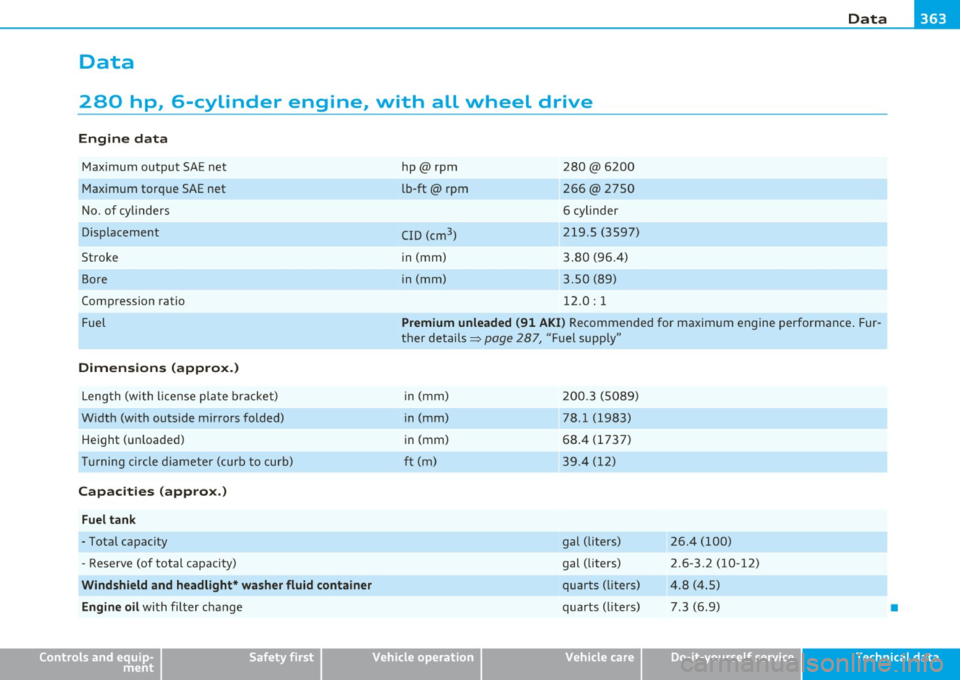
Data
280 hp, 6-cylinder engine, with all wheel drive
Engin e data
Maximum output SAE net
Maximum torque SAE net
No. of cy linders
Displacement
Stroke Bore
Compression ratio
Fuel
Dimensions (approx.)
Leng th (wi th l ice nse p la te br acke t)
W idth (w ith outs ide mir rors folded)
He ight (un loaded)
Tu rning circle diameter (curb to curb)
Capacities (approx.)
Fuel tank
- Tota l capacity
- Reserve (of total capacity)
Windshield and headlight* wa sher fluid container
Engine oil
with filter change
Safety first
hp@rpm
lb-ft@ rpm
CID (cm
3 )
in (mm)
in (mm) 280@ 6200
266@2750
6 cylinder
219.5 (3597)
3
.80 (96.4)
3 .50 (89)
12.0: 1
Premium unleaded (91 AKI) Recommended for maximum engine perfo rmance . Fur
th er details~ pag e 287, "Fuel supply"
in (mm)
i n (mm)
in (mm)
f t (m) 2
00 .3 (5089)
78 .1 (1983)
68.4 (1737)
39. 4 (12)
gal (liters)
gal (liters)
quarts (l ite rs)
quarts ( lite rs) 26
.4 (100)
2.6-3.2 (10-12)
4.8 (4. 5)
7.3 (6 .9)
•
Do-it,yourself service Technical data
Page 366 of 390
___ D_ a_t _a _____________________________________________________ _
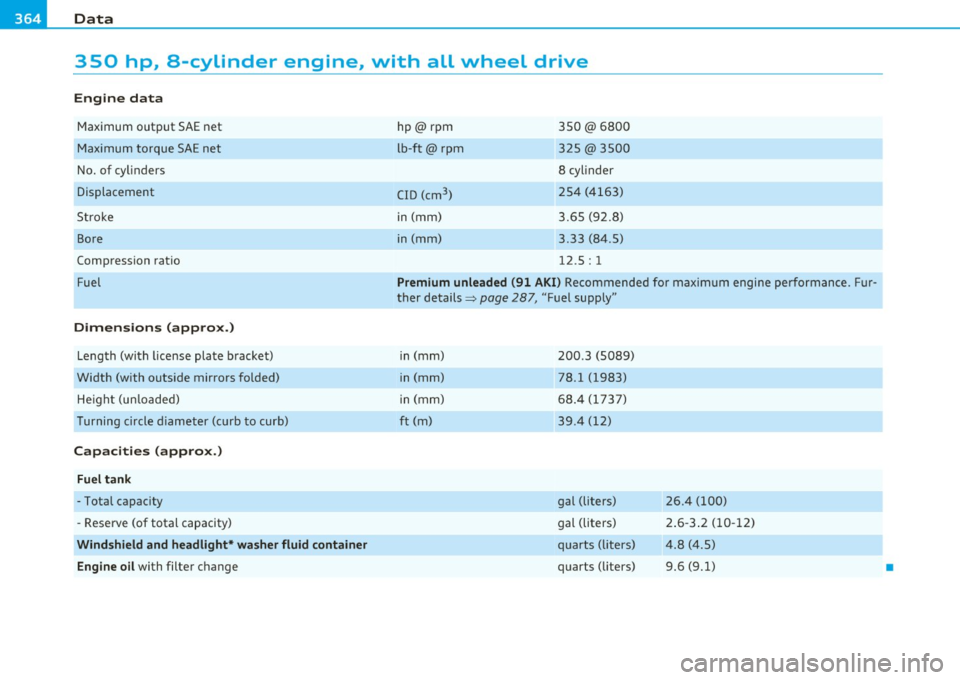
350 hp, a-cylinder engine, with all wheel drive
Engine data
Maximum output SAE net
Maximum torque SAE net
No. of cylinders
Displacement
Stroke
Bore
Compression ratio
Fuel
Dimensions (approx.)
Length (with license plate bracket)
Width (with outside mirrors folded) He ight (unloaded)
Turning circle diameter (curb to curb)
Capacities (approx.)
Fuel tank
-Total capacity
- Reserve (of total capacity)
Windshield and headlight* washer fluid container
Engine oil
with filter change hp @rpm
lb-ft@
rpm
CID (cm
3 )
in (mm)
in (mm) 350@ 6800
325
@3500
8 cylinder
254 (4163)
3.65 (92.8)
3 .33 (84 .5)
12.5: 1
Premium unleaded (91 AKI) Recommended for maximum engine pe rformance . Fur
ther details~
page 287, "Fuel supply"
in (mm)
in (mm)
in (mm)
ft (m) 200
.3 (5089)
78.1 (1983)
68.4 (1737)
39 .4 (12)
gal (liters)
gal (liters)
quarts ( liters)
quarts (liters) 26.4 (100)
2.6-3.2
(10-12)
4 .8 (4.5)
9.6 (9.1)
•
Page 367 of 390
____________________________________________________ D_ a_t_ a __ _
App lies to veh icles : with di esel e ngine
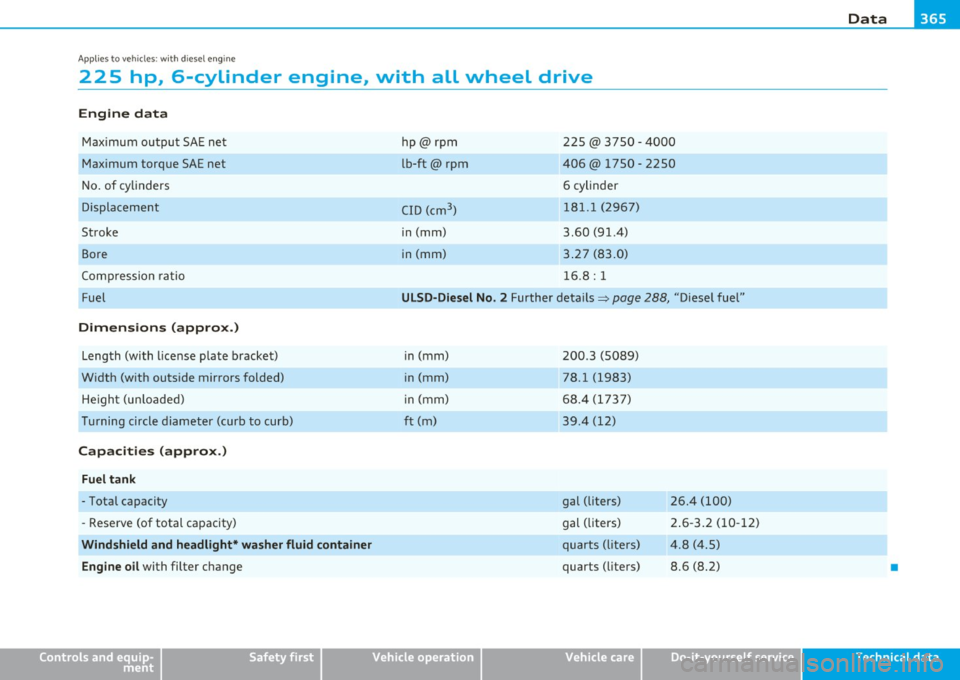
225 hp, 6-cylinder engine, with all wheel drive
Engine data
Max imum outpu t SA E net
Maximum torque SAE net
N o. of cy linders
Displaceme nt
Stroke Bore
Com pression ra tio
Fuel
Dimensions (approx.)
Leng th (with license p late bracke t)
W idth (w ith outs ide mirrors folded)
He igh t (u nloade d)
Turning circle diameter (curb to curb)
Capacities (approx.)
Fuel tank
- Tota l capacity
- R eserve (of total capacity)
Windshield and headlight* washer fluid container
Engine oil
with filter c hange
Safety first
hp@rpm
lb-ft@ rpm
C ID (cm
3
)
in (mm)
in (mm) 22
5@ 3750 - 4000
406@ 1750 - 2250
6 cylinder
181. 1 (2967)
3 .60 (91.4)
3 .27 (83.0)
16 .8: 1
ULSD-Diesel No . 2 Further details=> page 288, "Diese l fuel"
i n (mm)
in (mm)
i n (mm)
ft (m) 200
.3 (5089)
78 .l (1983)
68 .4 (17 37)
39 .4 (12)
gal (liters)
gal ( liters)
qu arts (lite rs)
quarts (liters) 26.4 (100)
2
.6- 3.2 (10 -12)
4.8 (4.5)
8.6 (8.2)
Do-it,yourself service
•
Technical data
Page 369 of 390
_____________________________________________ C_o_ n_s _u_ m __ e_r _ I_ n_ f_o _r_ m_ a_ t_ i _o_ n __ __
reliab ility. For deta iled vehicle maintenance cons ult your Warra nty &
Main tenan ce bookle t.
Under difficult operating conditions, for example at extremely low
outside temperatures, in very dusty regions, when towing a trailer
very frequently, etc., some service wo rk shou ld be performed
between the intervals specified. This app lies particu larly to:
• oil changes, and
• cleaning or rep lacing the air fi lter.
<£> For the sake of the environment
By regular ly maintaining your vehicle, you help make sure that emis
sion standards are mainta ined, t hus mi nimizing adve rse e ffects o n
the environment. •
Important considerations for you and your
vehicle
T he increasing use of electronics, sophisticated fuel injection and
em ission cont rol systems, and t he generally increasing techni cal
complex ity of today's automobiles, have stead ily reduced the scope
of mai ntenan ce and repairs w hich can be ca rried out by ve hicle
owners.
Also , safety and environm ental concerns p lace very strict
limits on the nature of repairs and adjustments to engine and trans
mission parts wh ich an owner can perform.
Maintenance, adj ustments and repairs usua lly req uire specia l tools,
test ing devices and other eq uipment available to specially t rained
workshop personnel in order to assure proper performance, re li
ability and safety of the vehicle and its many systems.
Improper maintenance, adjustments and repairs can impair the oper
ation and reliabili ty of your ve hicle and even void you r vehicle
warranty. Therefore, p roof of servicing in accordance with the main
t enance schedu le may be a condit ion fo r uphold ing a possible
warranty cla im made w it h in the warranty period .
Safety first
Above all, operational safety can be adversely affected, creating
unnecessary r is ks for you and you r passe ngers.
If in doubt about a ny servic ing, have it done by your authorized Audi
dealer or any other properly eq uipped and qualified works hop. We
st rongly urge you to give you r a utho rized Aud i dealer the opportunity
to perform a ll scheduled maintenance and necessary repairs. Your
dealer has t he facilities, o rigina l part s and trained spe ciali sts to keep
your vehicle running properly.
Performing limit ed maint enance yourself
The following pages describe a lim ited number of procedures which
can be perfo rmed on your vehicle w it h ordi na ry tools, should t he need
ar ise and trained personnel be unava ilab le. Before performing any of
t hese p rocedures, always tho roughly read all of the applicable text
and carefu lly follow the instructions given. Always rigorous ly observe
t he
WARNINGS p rov ided .
Before you ch eck anyth ing in the eng ine compartment, alwa ys read
and heed all WARNINGS~
& and~ & in "Working in the engine
compartmen t" on
page 297.
& WARNING
• Seriou s pe rs onal injury may occ ur as a result of improperly
perform ed maintenan ce, adju stments or repair s.
• Always be extremely careful when work ing on the vehicle.
Alway s foll ow commonly acc epted safety practic es and general
c ommon sense . N ever ri sk per son al injury .
• Do not attempt any of the maint enance, che cks or repair s
de scrib ed on the following p ages if you are not fully familiar with
the se or ot her procedure s with re spect to the vehicle , or are uncer
tain how to proceed .
• Do not do any work without the prop er tool s and equipment .
Ha ve the ne cessary work done by your authorized Audi dealer or
an other properly equipped and qu alified workshop. _,.
Do-it,yourself service Technical data
Page 370 of 390
___ C_ o_n_ s _ u_m_ e_ r_ I_ n_ f_o _r_ m_ a_ t_io _ n _____________________________________________ _
& WARNING (conti nu ed )
• The engine compartment of any motor veh icle is a potentially
hazardous area . Never reach into th e area around or touch the
radiator fa n. It is temperature controlled and can switch on
s uddenly -even when the engine is off and the ignition key has
been remo ved. The radiator fan switches on autom atically when
the coolant rea ches a certain temperature and will continue to run
until the coolant tempe rature drops.
• Always remove the ignition key before anyone gets under the
vehicle.
• Always support your vehicle with safety stands if it i s neces sary
to work unde rne ath the vehicle. The jac k supplied with the vehicle
is not adequate for thi s purpose and could collap se cau sing
serious personal injury.
• If you must work underneath the vehicle w ith the wheels on
the ground , always ma ke sure the vehicle is on level ground , th at
the whe els are alway s securely blocked and that the engine cannot
be started .
• Always make sure the transmi ssion selector l ever (automatic
tran smission) is in "P" (Park position ) and the par k brake is firmly
applied.
W For the sake of the environment
• Changing the engine settings will adversely affect e miss io n levels.
Th is is detrimenta l to the environment and increases fuel consump
ti on.
• Always observe enviro nmental regulations when disposing of old
eng ine o il, use d brake fl uid, dirt y engine coo lant, s pent ba tt er ies or
worn out t ires.
• Undep loyed a irbag modules and pretens ioners migh t be classified
as Perchlorate Mater ia l -spec ial handling may apply, see
www.dts c.ca .g ov/h azar douswas te/pe rchlo ra te . When the veh icle or
parts of the rest raint system including a irbag modu les sa fety belts
w ith pretens ioners are sc rapped, all applicable laws and regulat io ns must be observed
. Your authorized Aud i dealer is familiar with these
re qui remen ts and we recomme nd that you have your dealer perfo rm
this serv ice for you .•
Additional accessories,
modifications and parts
replacement
Additional accessories and parts
replacement
A lway s con sul t an autho rized Audi dealer before
purchasi ng a ccess ories.
Your vehicle incorporates the latest safety design feat ures ens uring a
hig h stand ard of active and passive s afe ty.
T hi s safety co uld be compromised by no n-app roved changes to the
vehicle. Fo r this reason, if parts have to be replace d, p lease observe
the following points when installing addit ional accessories :
Approved Audi accessories and genuine Aud i parts are available from
a u thor ized Aud i deal ers.
T hese dea lers a lso have the necessary fac ilities, tools and tra ined
speci alists to inst all the parts and ac cessor ies p ro p er ly.
& WARNING
Using the wrong spar e parts or u sing non-approved ac ce ss ories
can cause damage to the vehicle and serious personal injury .
• Use only acces sories expressly approved by Audi and genuine
Audi spare parts
• The se parts and acces sorie s have been specially designed to be
used on your vehicle . _,.
Page 377 of 390
Alphabetical index -________________ fWI
Plastic and vinyl .............. ... . 278
Plast ic parts ........... .......... 282
Safety belts ..................... 285
Trim strips ...................... 277
trim strips ... ...... .. ... ........ 278
Cleaning and protection .............. 274
Climate control ........ ........ .. .. . 109
Synchroniz ing ... .. .......... .... 110
Warm and co ld .............. .... 109
Climate controls
Air conditioner on/off .......... .. .
112
Air distr ibution .................. 113
Air outlets ........ ... .. .. .. ..... 114
Air outlets (rear) ........ .... .. .. . 115
Air recirculation .............. ... . 113
AUTO (standard setting) ... ... ..... 112
Basic settings ............. .. ..... 118
Controls ..................... .. . 110
Defrosting/defogging ... .......... 113
Description ............. .. ....... 109
Energy management .............. 109
Fan .. .. ... ....... .. ... .. .. .. .. . 112
Front seat ventilat ion ... .......... 119
Heated seats, front ............ .. . 119
Key coded setting ................ 109
Recirculation mode (automatic) ..... 118
Recommended settings ... ... .. .. . 109
Residual heat ...... ... .. .. .. ..... 111
Setting the temperature ... ... .. .. . 112
Supplementary heater .......... ... 119
Synchronization .................. 118
Turning on and off ................ 111
Using climate control economically .. 115
Clock .................... .......... 11
Controls and equip
ment Safety first
Closing
Panoramic sliding sunroof ..........
60
Coat hooks .. .................... ... 107
Cold tire inflation pressure ... ......... 318
Compass mirror ..................... 81
Compliance ........................ 369
Consumer Information ... .. .. .. . 197, 366
Contacting NH TSA .................. 197
Convenience key ....... ....... .. .. .. . 53
Dr iver messages ................. 129
Locking vehicle .. ............. .... . 54
START button ................. ... 127
Starting engine .. .. . .. ........... 127
STOP button ..................... 128
Switching engine off ... .. ..... .... 128
Switching on ignition ........ .. ... 127
Unlocking vehicle .................. 54
Convertible child safety seats ....... ..
23 7
Convertible locking retractor
Activating .......... .. .. .........
243
Deactivating ..................... 244
Using to secure a chi ld safety seat .. 241,
243
Coolant system .................. ... 304
Cooling box in glove compartment ... .. 106
Cooling System
Expansion tank ..... .. .. .........
305
Cornering light ...................... 68
Cruise control
Changing speed ..... .. .. .. .. .....
132
Presetting your speed ............. 133
Switching off .................... 133
Switching on . ........... ........ 132
Warning/indicator lights ... .. .. .. .. 19
See also Adaptive Cruise Control .... 134
Cruising range ... .... ................ 37
(upholder ............... .. 93, 102, 103
D
Damp ing
See Adapt ive A ir Suspens ion ........ 176
Data ........ .... ... ... ... ...... ... 363
Data recorder .. .. .... ............ .. 252
Date display .... .................... 11
Daytime running lights . . . . . . . . . . . . 65, 66
Declaration of compl iance
Adaptive Cru ise Control ............
369
Audi side assist ................ .. 369
Cell phone package ............... 369
Convenience key ................ . 369
Electronic immobilizer .... ........ 369
Homelink ® universal remote control . 369
Remote control key .. .. .. .. .. . ... . 369
def
What does this mean when it appears in the trip odometer display? .........
12
Defective light bulb warning ........... 24
Defrosting/defogging the windows .. .. . 113
Defrosting/defogging windows ........ 114
Determining correct load limit ....... .. 323
Diesel fuel ...... ........... ... .. .. . 288
Diesel particulate filter . . . . . . . . . . 35, 263
Digital clock ......... ............... 11
Digital compass ..................... 81
Digital speedometer .................. 24
Vehicle operation Vehicle care Do-it-yourself service Technical data
Page 379 of 390
___________________________________________ A_ l::.. p _h _a_ b_ e_t _ic _a_ l_ in_ d _ e_x __ __
Engine oil level .... ........ .. .. .. .. .. 34
Engine oil pressure
Malfunction .............. .. .. ... . 30
Engine oil sensor defective ............. 34
Engine speed limitation ........... .. .. 34
Entry assist
Rear seats ........ .. ..... .. .. .. .. 89
Environment Break-in per iod .. .. .............. 261
Catalytic converter ... .. .... .. ..... 262
Diesel particulate filter ... .. .. .. .. . 263
Disposing of your vehicle battery . .. . 312
Driv ing at high speeds .......... .. . 264
Driving to minimize pollution and noise .
263
Fuel ....... ...... ... .... ... .. .. . 290
Fuel economy .................... 263
Leaks under your vehicle ........ .. . 297
Letting the vehicle stand and warm up ..
264
Proper disposal of drained brake fluid 308
Proper disposal of dra ined engine coo lant
306
Proper disposal of drained engine oil 302,
303
Recycl ing used engine o il .......... 302
Unleaded fuel . ............... ... 287
What should I do with an old battery? ...
312
EPC
See E lectronic power control ........ 16
ESP
See Electronic stabilizat ion program ( ESP)
16
Controls and equip ment Safety first
Event
Data Recorder (EDR) ........ .... 252
Exhaust tail pipes
Cleaning ........................ 281
Expansion tank .................. ... 305
Exp lana tion of some technica l terms ... 266
Exterior lighting in the mirror housing .. . 68
Eyeglasses compartment .. .. .. .. .. ... 107
F
Fall line ........... ... .. .. ......... 266
Fan Four-zone automatic comfort air conditioning ........... ...... .. 117
Radiator ................ .. .. .. .. 307
Fastening Booster seats ............... ... .. 239
Convertib le child safety seats ....... 23 7
Infant seats .. ................... 236
Filler flap . .. .. .. .. ................. 294
Flat tire Changing .. .. .. ................. 339
Floor mats .................... ..... 194
Fog lights .................. ... .. .. . 67
Folding chocks .. .... ...... ...... ... 336
Folding master key with remote con trol . . 40
Foot pedals .... .................... 194
For the sake of the environment
Gasoline fumes and the env ironment 290
Letting you r engine warm up .. .. .. . 125
Reducing eng ine noise by early upshifting
10
Refueling .. ... ..... .. .. .. ... .... 290 Saving fuel by early upshifting
....... 10
Us ing the rear window defogger . ... 113
Four-zone automatic comfort air conditioning 116
Automatic mode in rear ........... 117
Heated rear seats ................ 120
Rear air distribution ....... .... .. . 117
Rear controls .......... ... .... .. . 116
R ear fan ............ .... ..... ... 117
Rear operation ........ .... .... ... 119
Rear temperature ................ 117
Synchronization .................. 118
Turning on/off ...... .. .. .. .... .. . 116
Front airbags
Description ........ ............ .. 213
How they work ................ .. . 218
Front fog lights ................ ...... 67
Front seats ......................... 83
Adjusting ....................... 191
Child restraints in the front seat .... 211
Fronta l co llisions and the laws of physics 200
Fuel Add itives ....... ........ ... . ... . 287
Blended gasoline . .. .... ......... . 287
Consumption ..................... 37
Filler neck . .. .................... 289
Fu el gauge ...... .. ............... 12
Gasoline ............ ... .. .... ... 287
Gasoline additives . ............... 288
Low fuel leve l . . . . . . . . . . . . . . . . . 12, 33
Octane rating .................... 287
Recommendation .. .............. 287
Refuelling .. ... ... .............. 290
Vehicle operation Vehicle care Do-it-yourself service Technical data
Page 380 of 390
__ _:._A..:. l:.! p:.. h ::....:..:: a:.:b:.. e=-= t.:..:ic :.:a:.. l:.....:..: in~ d:...:e :..: x.:...._ ___________________________________________ _
Reserve ..... .... ........ .... ... . 12
Tank capacity . .. .. .. ...... ... .. .. 363
Unlocking the fuel filler flap by hand 292
Fuse arrangement ... ............... 346
G
Garage door opener (Homelink®) ...... 183
Gas d ischarge lamps ........ .. .... .. 350
Gauges Engine coolant temperature . ... .... 10
Fuel gauge . .... .. .... .. .. .. .. .... 12
Speedometer ... .. .. ........ .. . ... 12
T achometer ...................... 11
Tr ip odometer ............. .... .. . 12
General illustration Instruments and controls ............ 9
General rules and driving tips ......... 266
Before driving offroad ........ .... 266
Driving offroad .................. 266
Glossa ry of tire and loading terminology 315
Glove compartment ........ ......... 105
Cooling box ..... ........ .... .. .. 106
Valet key function ......... ... .. .. . 43
Glove compartment -emergency unlocking ..
106
Glow plug system
Indicator light ............. .... .. . 16
Gradient angle .................. ... 266
Gross Vehicle We ight Rating (GVWR) ... 361
Ground clearance .. .. ............ ... 266
H
Head restraints ............... .... .. 193
Adjusting .. .. .... .. .... .. .. .. ... 193
Front seats . . . . . . . . . . . . . . . . . . . . . . 90
Rear seats .. .. ........... ..... 91, 92
Headlight washer reservoir ........... 312
Headlights ............ ... .. .. ... ... 65
Adaptive Light ............. .... .. . 68
Defective . . . . . . . . . . . . . . . . . . . . . . . . 24
Front fog lights ............ ... .. .. 67
Headlight range control . ........... 34
Switching
off ......... .. .. .. .. .. .. 65
Switching on ......... .... .. ...... 65
Washer system . ..... ... . ... .. .. .. 75
Xenon headlights .... ............. 65
Heated outside mirrors
79
Heated seats Front ................... .. .... . 119
Rear ............... ..... .. .. .. . 120
Rear (four-zone automatic comfort air
conditioning) ..... ...... .. .. .. . 120
Heated steering wheel ... ..... ....... 121
Heated washer jets
Wiper and washer system .... .. .. .. 72
Heating Climate controls ............... .. 109
Heavy clothing and safety belts ....... 202
H igh beam ......... .... .... .. .. . 65 , 69
Warning/indicator lights ..... .. .. .. 19
High voltage warning label .... .... ... 360
Hi ll descent control ..... ............ 252 Hill hold
Starting on hills 131
Homelink ® universal remote control ... 183
Hood Opening ............ .... .... .. .. 296
Release lever ... .. .. ..... .. .. .. .. 296
Horn .................. .... ... ... ... 9
How are child restraint system anchors related to child safety .... ....... ... .. .. 244
How many airbags does my vehicle have? ...
216
How often should I check my tire pressures? . 321
How safety belt pretensioners work .... 207
Hydroplaning ......... ............. 325
I
Ignition key ................ ..... .. 124
Ignition lock .. .. ............. .. .. .. 124
Ma lfunct ion .... .. .. .... ....... 31, 35
Ignition lock positions ... .. .. .. .... .. 124
Important things to do before driving .. 189
Improperly worn safety belts ... .. .. .. 207
Indicator lights . . . . . . . . . . . . . . . . . . . . . . 14
Airbag system ....... .. .. .. .. 220,221
PASSENGER AIR BAG OFF .... .... .. 221
Infant seats ................ ... .. .. 236
Inflatable spare tire .. .. .. .. .. .... ... 338
Inflating ........... .. .... .... .. 339
Inside rear view mirror .. ........... 77, 78
Installing child safety seats Safety belts ............... .. .. .. 241
Page 385 of 390
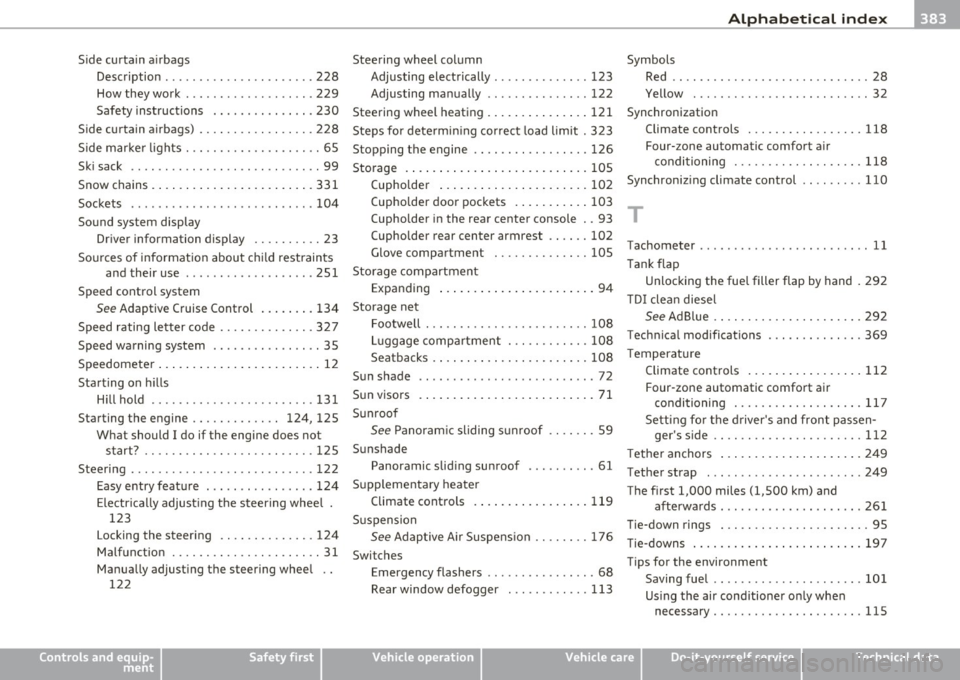
_____________________________________________ A_ L .... p_ h _ a_b_ e_ t_ ic_a_ l_ in_ d_e _ x __ _
Side curtain airbags
Description ............ ... ... .... 228
How they work ............... .... 229
Safety instructions .. .......... .. . 230
Side curtain airbags) .......... ... ... . 228
Side marke r lights ................ ... . 65
Sk i sack ......... ... ... ... .. .. ... ... 99
Snow chains .... ................ ... . 331
Sockets ..................... ... ... 104
Sound sys tem display
Driver information display .......... 23
Sources of information about child restraints
and their use ........... ... .. .. . 251
Speed control system
See Adaptive Cruise Control ........ 134
Speed rating letter code ........... .. . 327
Speed warning system ........... ... .. 35
Speedometer ... ... ............. ..... 12
Starting on hills
H ill hold ...... ...... ... ... ..... . 131
Starting the engine ........... .. 124, 125
What should I do if the engine does not start? ...... .. .... .. .... .. .... . 125
Steering . ............ .... ... ... .... 122
Easy entry feature . .. .. ........... 124
Electrically adjusting the steering whee l .
123
Locking the steering .... .. ... ..... 124
Malfunction .............. .. .. .. .. 31
Manually adjusting the steering wheel
122
Controls and equip ment Safety first
Steering wheel colum
n Symbols
Adjusting electrically ............ .. 123 Red ..... ........................ 28
Adjusting manually ............... 122 Yellow ................... .... ... 32
Steering wheel heating ........ ..... .. 121 Synchronization
Steps for determining correct load limit . 323 Climate controls ...
.............. 118
Stopping the engine .... .. .. .. .. .. .. . 126
Storage ...... .. ... ... ... .......... 105
(upholder .. . .. .... ... .......... 102 Four-
zone automatic comfort air
conditioning ............ .... .. . 118
Synchronizing climate control . ... .. .. . 110
(upholder door pockets ........... 103
(upholder in the rear center console . . 93
T
(upholder rear center armrest .... .. 102
Glove compartment ...... ...... .. 105
Storage compartment
Expanding ... ..... ............... 94
TOI clean diesel
See Ad Blue .. .. .. .. ............. . 292
Storage net
Footwell . .. .. .... ............... 108 Tachometer
.................. .... ... 11
T ank flap
Unlocking the fuel filler flap by hand . 292
Luggage compartment . .. .. .. ..... 108 Technical modifications
, , , .. , ..... ... 369
Seatbacks .... .. .... ............. 108 T
emperature
Sun shade .. ................ ... .. ... 72 Climate controls
................. 112
Sun visors . ................ .. .... ... 71
Sunroof
See Panoramic sliding sunroof .. .. .. . 59 Four-zone automatic comfort air
conditioning ............ .. .. .. . 117
Setting fo r the driver's and front passen-
ger's side .. .. .. .. .............. 112
Sunshade Tethe r anchors ... ................ .. 249
Panoramic sliding sunroof ......... . 61
Supplementary heater
Climate controls . ..... ........... 119 Tether strap
... .. ... ... ........ .... 249
The first
1,000 miles (1,500 km) and
afterwards ... ......... .. ... ... . 261
Suspension
See Adaptive A ir Suspension ...... .. 176 Tie-down rings
... .. .. .... ........... 95
T ie-downs ......................... 197
Switches
Emergency flashers ... ......... ... . 68
Rear window defogger . ...... ..... 113 Tips for the environment
Saving fuel .. .. .. ................
101
Using the air conditioner on ly when
necessary ............... ...... .
115
Vehicle operation Vehicle care Do-it-yourself service Technical data