child seat AUDI Q7 2011 Owner´s Manual
[x] Cancel search | Manufacturer: AUDI, Model Year: 2011, Model line: Q7, Model: AUDI Q7 2011Pages: 392, PDF Size: 93.29 MB
Page 4 of 392
Table of contents
Table of contents
Vehicle literature ..... .
About this Owner's Manual .......... ....... .. .
Controls and
equipment .............. .
Instruments and controls ... .
General illustration ........... .
Instruments and
warning/indicator Lights ..... .
Instruments ... ... .......... .
Warning/indicator ligh ts ..... . .
Driver information display ... .
Introduction ...... ......... . .
T rip comput er . .... .......... .
E fficiency program ........... .
On-Board D iagnostic system
(OBD) .. .... ..... ............ .
Elec tronic speed limiter ....... .
Speed warning system ........ .
Auto Check Control ........... .
Opening and closing ......... .
Keys ....... ..... ............ .
Powe r locking sys tem ....... . .
Rear lid .... ................. .
Child safe ty lock ............. .
Conve nience key . ............ .
Anti -theft alarm system .. .... .
P o w er wind ow s ......... ..... .
Panoram ic sliding sunroof . .... .
5
6
8
9
9
10
10
14
22
22
26
28
30
30
31
32
42
42
46
51
54
55
57
58
61
Clear vision . .... ... .......... .
Lights ... ................... .
Int erior ligh ts ......... ...... .
V ision .. ..... ............... .
W iper and washer sys tem .... .
Mirrors ... ..... ... .......... .
D igital compass ............. .
Seats and storage ........... .
General recommendations .... .
Pow er fron t seat adju stm ent .. .
Adjusting fron t passenger's sea t
manually ........ .... ....... .
S eat m emory . ............... .
Rear seats ........ .......... .
Head res train ts .............. .
Armrest ...... .............. .
L ong cente r con so le ... .. ..... .
L uggage compar tment ....... .
Roof rack ................... .
Cupholder .................. .
Rear ash tray ......... ....... .
Outl et ..... ................. .
Storage ..... ............... .
Warm and cold .... ....... ... .
Climate con tro l .............. .
Rear Air Condition ing ...... ... .
Basic settings ............... .
Hea ted Sea ts ... ... ...... .... .
On the road ... .... .......... .
Steering .. ...... ..... ....... .
Ignition lock and igni tion switch
S tar ting and s topp ing the engin e
Start ing and stopping the engine
with Conv eni ence key ... ...... .
Parking brake ............... . 67
67
72
73
74
79
83
85
85
86
88
89
90
92
94
95
96
102
104
105
106
107
111
111
118
120
121
124
124
126
127
129
132 S
tar ting on hill s ............... 133
Cruise control ........... ..... . 134
Adaptive Cruise Control ....... 136
Sp eed and di stan ce con trol
system ....... ...... ...... .... 136
Driv er information . . . . . . . . . . . . . 144
Sys tem limi tations ............ 149
A udi braking guard ............ lSl
Audi side assist ............... 1S4
L ane Change Assistant ......... 154
Notes ..... ................... 161
Automatic transmission
tiptronic ® 163
163
Parking system .............
.. 170
General informa tion . . . . . . . . . . . 170
Rear park assist . . . . . . . . . . . . . . . 17 0
Parking system advanced .... ... 171
Adjusting th e di splay and warning
tones ................ ..... .. . 176
T rail er hi tch . . . . . . . . . . . . . . . . . . 177
E rror messages . . . . . . . . . . . . . . . 1 77
Adaptive Air Suspension 178
Air su sp en sio n and dam ping . . . . 178
Homelink ® ............. .... .. 185
Univ ersal remote control 18S
Safety first . . . . . . . . . . . . . . . 190
Driving Safely ................. 190
G eneral not es . . . . . . . . . . . . . . . . . 190
Proper occupant seating
p os itions . . . . . . . . . . . . . . . . . . . . . 192
Pedal area ................. ... 196
Page 5 of 392
Stowing Luggage ........... ... 197
Repo rting Safe ty Defects ....... 199
Safety be lts ................... 201
General no tes ........ ......... 201
Why safety belts? . . . . . . . . . . . . . 202
Safety belts . . . . . . . . . . . . . . . . . . 205
Safety belt pretensioners . . . . . . . 209
Airbag system ................ 211
Important th ings to know ...... 211
Front airbags ................. 215
Mon ito ring the Advanced A irbag
System ...................... 222
Side airbags .................. 227
Side curtain a irbags . . . . . . . . . . . . 230
Child Safety . . . . . . . . . . . . . . . . . . . 233
Impor tant th ings to know . . . . . . 233
Child safety seats . . . . . . . . . . . . . 238
Installing a child safety seat . . . . 243
LATCH Lowe r ancho rages and
tethers for children . . . . . . . . . . . . 246
Addit ional Information 254
Vehicle operation ...... 2s6
Intelligent techno logy ........ 256
Notice abou t data recorded by
vehicle control modules . . . . . . . . 256
E lectronic S tab ili z ati on Program
(ESP) ........................ 256
Braking . . . . . . . . . . . . . . . . . . . . . . 259
Se rvo tron ic ® -advanced power
steer ing system ....... ........ 261
Dr iving wi th your qua ttro ® . . . . . . 262
Energy management . . . . . . . . . . . 263
Driving and environment . ..... 265
The firs t 1,000 miles (1,500 km)
and af terwards . . . . . . . . . . . . . . . 265
Ca talytic conve rte r . . . . . . . . . . . . 266
Controls and equip
ment Safety first
Diesel pa
rticulate filter . . . . . . . . 267
Avoid damaging the veh icle 267
Operate your vehicle economically
and minimize pollution . . . . . . . . 267
Driving of f road ....... ........ 270
Dr ivi ng in diffic ult road cond itions
and offroad ................. .
Trailer towing
Driving with a trailer .......... .
Trailer tow ing t ips ......... ... . 270
273
273
276
Vehicle care
.............. 278
Clean ing and protection ...... 278
General informa tion . . . . . . . . . . . 278
Care of exterior . . . . . . . . . . . . . . . 278
Care of interior . . . . . . . . . . . . . . . 285
Fuel supply and filling your fuel
tank . . . . . . . . . . . . . . . . . . . . . . . . . . 291
Fuel supply . . . . . . . . . . . . . . . . . . . 291
Diesel fuel . . . . . . . . . . . . . . . . . . . 292
F u el tank . . . . . . . . . . . . . . . . . . . . . 293
T DI clean diesel . . . . . . . . . . . . . . . 296
Checking and filling . . . . . . . . . . . 300
Engine hood . . . . . . . . . . . . . . . . . . 300
Engine oil . . . . . . . . . . . . . . . . . . . . 303
Engine cooling system . . . . . . . . . 308
Brake fluid ................... 311
Bat tery ......... .... ......... 312
W indshie ld/head ligh t washer
containe r ....... .... ......... 316
Tires and wheels . . . . . . . . . . . . . . 318
Tires 318
Ti re pressure monitor ing system 337
Table of contents
Do-it-yourself service
What do I do now? .......... .
Jack, tools and infla table spare
tire ........................ .
Changing a wheel .... ........ .
Fuses and bulbs ............. .
Electrical fuses .............. .
Bulbs ......... ............ . .
Emergency situations ....... .
General ..................... .
S tarting by pushing or towing ..
Starting with jumper cables ... .
Use of jumper cables ......... .
Emergency towing with
commercial tow truck ........ .
Lifting vehicle ............... .
Technical data
General information
340
340
340
34 3
350
350
354
355
3SS
3SS
355
356
358
360
362
362
Explana tion of technical da ta . . . 362
Veh icle iden tification ......... .
We ig hts .................... .
Dimensions ................. .
Data .... ....... ........ ...... .
272 hp, 6 -cylinder engine, with all
whee l d rive ................. .
333 hp, 6-cylinder engine, with all
whee l dr ive ................. .
225 hp, 6 -cylinder engine, with all
wheel dr ive ................. .
Consumer Information ...... .
Warranty cove rages ......... . .
Ope rating your vehicle o utside the
U.S .A. or Canada ......... .... .
Aud i Se rvice Repair Ma nuals and
Li terature . .................. . 362
363
364
365
365
366
367
368
368
368
368
Ma intenance . . . . . . . . . . . . . . . . . 368
Vehicle operation Vehicle care Do-it-yourself service Technical data
Page 56 of 392
Open ing and closing
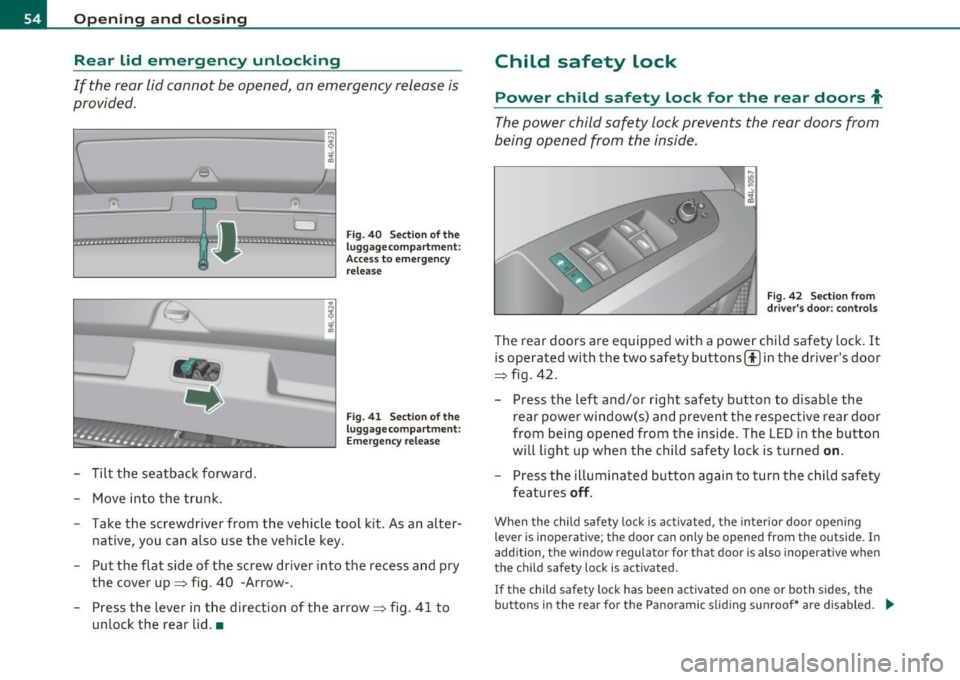
Rear lid emergency unlocking
If the rear lid cannot be opened, an emergency release is
provided.
-------------------! ~ ~ -;[,
D
~ ................... -.. -.. -
- Tilt the seatback forward.
- Move into the trunk.
Fig. 40 Sect ion of the
luggage compartment:
Access to eme rgency
release
Fig. 41 Section of the
luggage compartment :
Emergency re lease
- Take the screwdriver from the vehicle tool kit. As an alter-
native, you can also use the vehicle key.
- Put the flat side of the screw driver into the recess and pry
the cover up=> fig. 40 -Arrow-.
- Press the lever in the direction of the arrow~ fig. 41 to
unlock the rear lid .•
Child safety lock
Power child safety lock for the rear doors t
The power child safety lock prevents the rear doors from
being opened from the inside .
Fig. 42 Sect ion from
drive r's door: controls
The rear doors are equipped with a power child safety lock . It
is operated with the two safety buttons(!) in the driver's door
~fig. 42.
- Press the left and/or r ight safety button to d isable the
rear power window(s) and prevent the respective rear door
from being opened from the inside . The LED in the button
will light up when the child safety lock is turned
on.
Press the illuminated button again to turn the child safety
features
off.
When the child safety lock is activated, the interior door open ing
lever is inoperative; the door can only be opened from the outside. In
add ition, the window regulator fo r that door is also inoperative when
the child safety lock is activated.
If the child safety lock has been activated on one or both sides, the
buttons in the rear for the Pa noramic slid ing sunroof* are disabled. .,
Page 66 of 392

Opening and closing
from heating up, you should close both sunshades when you
park your vehicle in the sun.
Opening and closing front sunshade
Tap the rear -:c;"J" of the rocker switch~ page 63, fig. 50 or
the rocker switch for rear-seat passengers~
page 63,
fig. 51 briefly to open the sunshade fully.
- Tap the front
·'J.rT of the rocker switch briefly to close the
sunshade fully~& .
- To set an intermediate position manually, press the front or rear of the rocker switch (depending on the position of
the shade)
until the desired position is reached ~ & .
Opening and closing rear sunshade
-Hold the sunshade by the grip and push it to the desired
position.
& WARNING
Never close the sunshade without paying attention or checking -
danger of injury! •
Applies to vehicles : w ith Panoram ic s liding sunroof
Emergency closing
In an emergency, the Panoramic sliding sunroof can be
closed electrically.
If the Panoramic sliding sunroof detects an object in its path
when it is closing, it will open again automatically. In this
case, you can close the roof with the power emergency
closing function .
Emergency closing of front roof segment
- Turn the switch~ page 61 , fig. 48 @ to the normal posi
tion @.
- Within five seconds after the sunroof opens automati
cally, pull the switch until the roof segment closes.~&.
The driver's and front passenger's doors must be closed.
- If the power emergency closing function is not possible, you must close the roof manually~
page 65.
Emergency closing of rear roof segment
-Within five seconds after the sunroof opens automati
cally, press the front
e:> of the rocker switch~ page 61,
fig. 48 ® until the roof segment closes~&. The driver's
and front passenger's doors must be closed.
- If the power emergency closing function is not possible,
you must close the roof manually ~
page 66.
& WARNING
Improper use of the Panoramic sliding sunroof can cause serious
personal injury.
• Be careful when closing the Panoramic sliding sunroof. Not
paying attention could cause you or others to be trapped and
injured as the Panoramic sliding sunroof closes.
• Always take the key with you when you leave the vehicle to
prevent injuries caused by the Panoramic sliding sunroof closing
• Never leave children or persons requiring assistance alone in
the vehicle, especially when they could access the vehicle keys.
Unsupervised use of the keys can result in the engine being started
or use of vehicle systems such as the power windows, etc. which
could result in serious injury. The doors could be locked with the
remote key, delaying help in an emergency. .,,.
Page 87 of 392
Seats and storage
General recommendations
Why is your seat adjustment so important?
The safety belts and the airbag system can only provide
maximum protection if the front seats are correctly
adju sted.
Th ere a re various ways of adjusting t he front seats to provide safe and
comfortable support for the driver and the front passenger . Ad just
your seat properly so that :
• you can easily and quickly reach a ll the switc hes and contro ls in the
ins trumen t pa nel
• your body is properly supported thus reducing phys ica l stress and
fatigue
• the safety be lts and airbag system can offer maximum protection
===> page 211 .
In the following sections, you w ill see exact ly how you can best ad just
your sea ts .
Th ere are special regulations a nd instr uctions for install ing a child
safety seat on the front passenger's sea t. Always follow the informa
tion regarding child safety p rovided in===>
page 233, "Child Safety ".
& WARNING
Incorrect seating posit ion of the dri ver and all other passengers
can result in seriou s personal injury.
• Always keep your feet on the floor when the vehicle is in
motion -never put your feet on top of the instrument panel, out
of the window o r on top of the seat cush ion. This applies especially
to the passengers.
If your seating po sition is incorrect, you
increase the ri sk of injury in the case of sudden braking or an acci-
Controls and equip
ment Safety first
Seats and storage
& WARNING
(con tinu ed)
dent . If the airbag inflates and the seating position is incorrect ,
this could result in per sonal injury or even death .
• It is important for both the dri ver and front passenger to keep
a distan ce of at least 10 inche s (25 cm) between themselves and
the steering wheel and /or instrument panel. If you 're sitting any
closer than this , the airbag system cannot protect you properly. In
addition, the front seats and head restraints must be adjusted to
your body height so that they can give you maximum protection .
• Always try to keep as much distance as possible between your
self and the steering wheel or instrument panel.
• Do not adjust the driver's or front passenger 's seat while the
vehicle is moving. You r seat may move unexpectedly , causing
sudden loss of vehicle control and personal injury . If you adjust
your seat while the vehicle is moving , you are out of position. •
Driver's seat
The correct seat position is important for saf e and
re lax ed driving.
W e recomme nd that you a djust the drive r's sea t in the
f ollowing man ner :
- Ad just the seat in fore and aft direction so that you can
easily pus h the pedals to the floor w hile keeping your
knees slightly bent=>
& in "Why is yo ur seat a djus tme nt
so importa nt?" .
- Adjust the seatback so that when yo u sit with yo ur back
agai nst t he seatback , you can st ill grasp t he top of the
steering w heel. ..,
Vehicle care Technical data
Page 89 of 392
Fore-and-aft adjustment
- Push the switch@forward or backward~ page 86,
fig. 77.
Adjusting seat height
- Pull or push the switch © up or down.
Front seat cushion up/ down
- Press the switch © at the front up or down.
Rear seat cushion up/ down
- Press the switch © at the rear up or down.
Adjusting seatback angle
- Push the switch @ forward or backward.
Adjusting the curvature of the lumbar
support
- Push the switch plate © forward or backward to increase
or reduce the curvature.
Adjusting the height of the lumbar support
- Push the switch plate © up or down to position the curva
ture higher or lower.
& WARNING
• Adjust the driver's seat only when the vehicle is stationary. You
risk an accident otherwise.
• The power adjustment for the front seats also works with the
ignition switched off or with the ignition key removed. For this
reason, children should never be left unattended in the vehicle -
they could be injured!
Controls and equip
ment Safety first
Seats and storage
& WARNING
(continued)
• Exercise caution when adjusting the seat height. Unsupervised
or careless seat adjustment can pinch fingers or hands causing
injuries.
• While the vehicle is moving, the seatbacks of the front seats
must not be inclined too far to the rear because the effectiveness
of the safety belts and the airbag system is severely compromised
- there is a risk of injury.
• To reduce the risk of injury in the case of sudden braking or
accident, front passengers must never ride in a moving vehicle
with the seatback reclined. Safety belts and the airbag system
only offer maximum protection when the seatback is upright and
the safety belts are properly positioned on the body. The more the seatback is reclined, the greater the risk of personal injury from an
incorrect seating position and improperly positioned safety
belts. •
Vehicle care Technical data
Page 96 of 392
Seats and storage
Adjusting the center head restraint
- To move t he head rest rai nt up, hold it at the sides with
both ha nds and slide it u pwa rd un til yo u feel it click into
p lace => fig. 87 .
- To move the head restraint down, press the button -arrow-
and slide the head restraint downward.
Removing the center head restraint
- Move the head restra int upwa rd as far as it can go .
- Press th e butt on -arrow- and pull the head rest raint out of
the backres t=> & .
Installing the center head restraint
-Slide the posts on the head restraint down into the gu ides
unti l you feel the posts click into place .
- Press the button -arrow- and slide the hea d res traint all
the way down . You shou ld not be able to pull t he head
restra int out of the bac krest.
& WARNING
• Only remove the rea r seat head restraint when necessar y in
order to in stall a child seat . In stall the head restraint again imme
diately once the chi ld seat is removed. Driving w ithout head
restraint s or with head restraints that are not properly adjusted
increases the risk of serious or fatal neck injury dramatically .
• The h ead res traints for the outer seats
in th e s econd row mu st
be folded up whe n persons a re being carried in the third row
seating* -danger of injury!
• Read and heed all WARNINGS~
page 194 •
Appli es to veh icles : wi th conven ience center a rmrest
Armrest
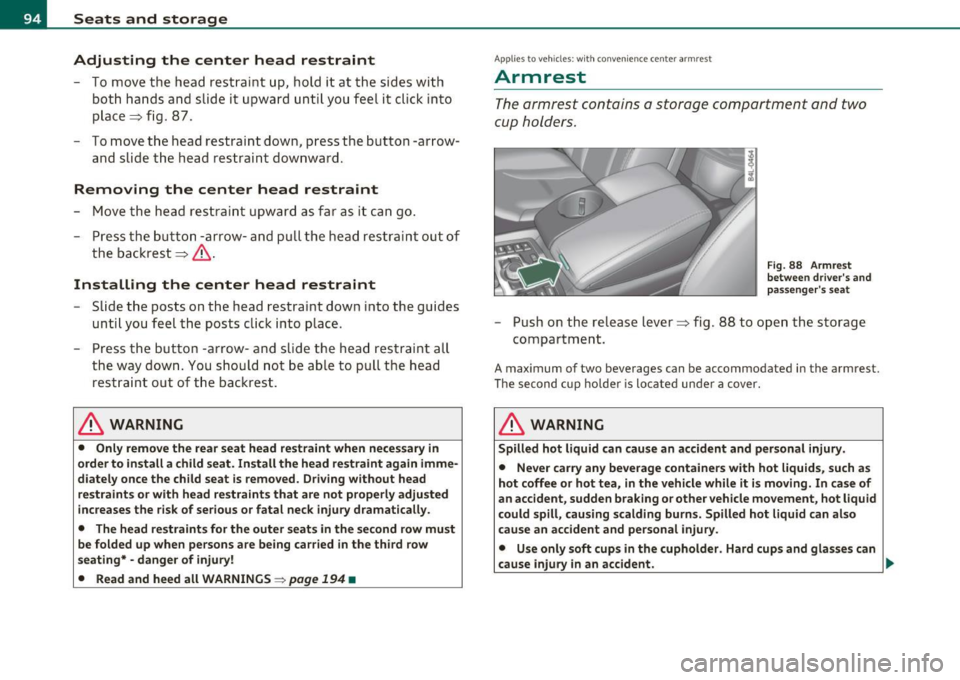
The armrest contains a storage compartment and two
cup holders.
Fig. 88 Arm re st
b etw een driver's a nd
pa ssenge r's se at
-Push on the re lease lever=> fig. 88 to ope n the storage
compar tment.
A max imum of two beverages can be accommodated in the armrest.
T he second c up holde r is lo cated un de r a cover.
& WARNING
Sp illed hot liquid can cau se an accident and per sonal injury.
• Never c arry any beverage container s with h ot liquid s, such a s
hot coffee or hot tea, in the vehicle while it i s moving . In ca se of
an accident , sudden braking or other vehicle mo vement, hot liquid
could spill, causing scalding burns. Spilled hot liquid can al so
cause an accident and pe rsonal injury.
• Use only soft cups in the cupholder . Hard cup s and glas se s can
c ause injury in an accident . .,_
Page 99 of 392
& WARNING (cont inued )
damage to webbing, bindings , buckles, or retractors must be
replaced.
& WARNING
Always read and heed WARNINGS=> & in "Loading the luggage
compartment " on
page 197.
0 Note
• When fo lding the backrest back i nto place, ma ke sure the safety
bel t does no t ge t ca ugh t, b ec ause i t can be damaged .
A damaged bel t
can fail to provide safe rest raint.
• Th e heating wires in th e rear w indow ca n be damaged by abrasive
objects on t he parcel s he lf . •
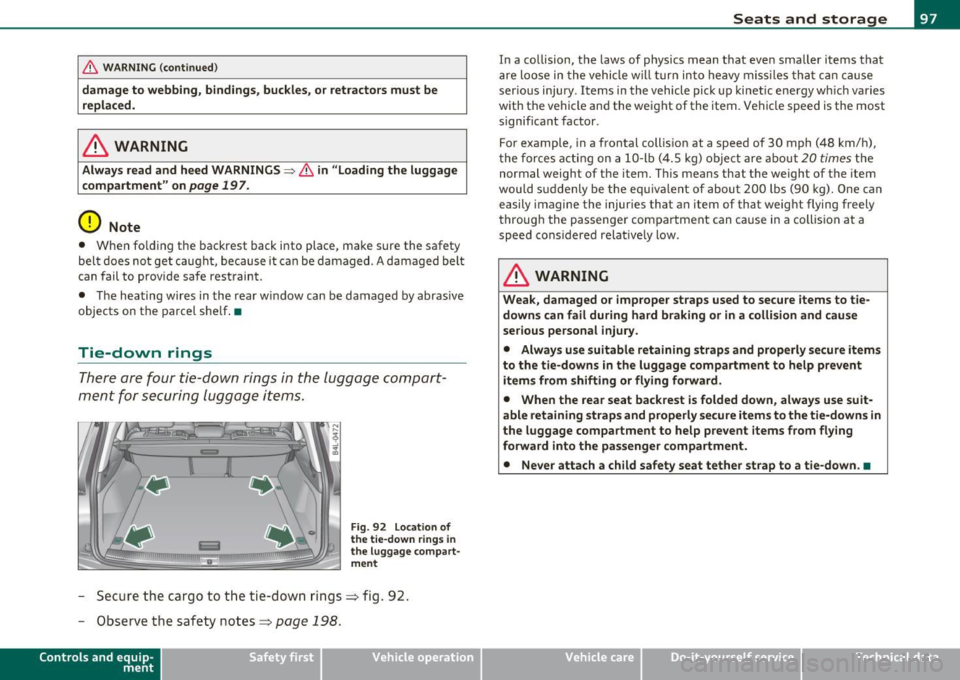
Tie-down rings
Th er e a re f our tie-d own rings in the lu ggage com part
m en t for s ecuring lugg age items.
Fig . 92 Loca tion of
the tie-down rings in
the lug gag e c ompa rt ·
ment
- Sec ure the c argo to the tie-dow n rings => fig. 9 2.
- O bserve the safety notes=:> p age 19 8.
Con tro ls a nd e quip
m en t Vehicle
OP-eration
Seats and storage
In a co llision, the laws of physics mean that eve n smaller items that
a re lo ose in the vehicle w ill turn in to heavy mis siles th at can c ause
ser ious injury. Items in the vehicle pick up kinet ic en ergy w hich varies
with the ve hicle an d th e we ight of the item. Vehi cle speed is the most
signif ica nt factor .
For example, in a frontal collis ion at a speed of 30 mph (48 km/ h),
t he force s acti ng on a 10- lb
(4 .5 kg) object a re a bout 20 times the
normal weight of t he item. T his means that t he weight of t he item
wou ld su ddenly be t he e quiva le nt of abou t 200 lbs (9 0 k g). One can
easily imagine the injur ies that an item of that weight flying freely
t hroug h the passenger com par tment can cause in a collis ion at a
speed considered relative ly low .
& WARNING
Weak , damaged or improper straps used to secure items to tie
downs can fail during hard braking or in a collision and cause
serious personal injury.
• Always use suitable r etaining straps and properly secure items
to the tie -downs
in the luggage compartment to help prevent
items from shifting or flying forward .
• When the rear seat backrest is folded down, always use suit·
able retaining straps and properly secure items to the tie-downs in
the luggage compartment to help prevent items from flying
forward into the passenger compartment.
• Never attach a child safety seat tether strap to a tie-down .•
Vehicle care Do-it-yourselt service iTechnical data
Page 120 of 392
llffl..__w __ a _r _m __ a_n _ d_ c_ o_ ld ________________________________________________ _
Rear Air Conditioning
Applies to veh icles: with fou r-zone automat ic co mfort air condit ioning
Rear air conditioning -controls
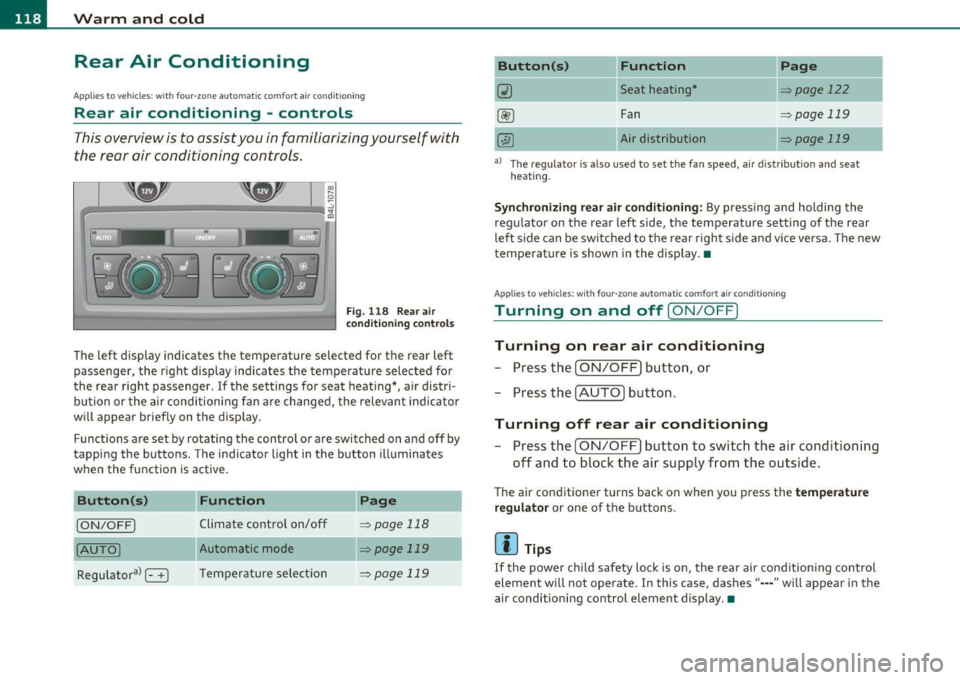
This overview is to assist you in familiarizing yourself with
the rear air conditioning controls.
F ig. 1 18 Rear air
con diti on in g con trol s
The left display indicates the temperature selected for the rear left
passenger, the right display indicates the tempe rature selected fo r
the rear right passenger. If the settings for seat heat ing *, air distr i
bu tion or the a ir conditioni ng fan are changed, the relev ant indicator
w ill appear briefly on the disp lay.
Func tions are set by rotating the contro l o r are swi tched o n and
off by
tapping the butto ns. The indicator light in the button illuminates
when the function is active .
Button(s)
Function Page
[ON/OFF) Climate control on/off => page 118
(AU TO ) Automa tic mode => page 119
Regulatora> G T emper ature se lec tion => page 119
Button(s) Function
~ Seat heating*
-
Fan
Air dis tribution
Page
::!> page 122
-
=> page 119
::!> page 119
al T he regulator is also used to set the fan speed, a ir d istr ibut ion and seat
heating.
-
Synchronizing r ear air conditioning: By pressing and holding the
regu lator on the rear left side, the temperature setting of the rear
left side can be switched to the rear right s ide a nd v ice versa. The new
temperature is shown in the display. •
Appli es to vehicles : with four -zone auto matic co mfort air condition ing
Turning on and off [ ON/OFF ]
Turning on rear air conditioning
-Press th e I ON/OFF) butt on, o r
- Press the !A UTO] button .
Turning off rear air conditioning
- Press the [ O N/OFF] but ton to sw itch the air condition ing
off and to bloc k th e air supply from the outs ide .
The air conditioner turns back on when yo u press the temperature
regu lator
or one of t he buttons .
[ i ] Tips
If the power child safety loc k is o n, the rear ai r cond ition ing contro l
element wi ll not operate. In this case, dashes" ••• " will appear in the
a ir conditioning con trol element display. •
Page 192 of 392
........ _D_ r_iv _i_ n .... g=-- S_ a_f _e _Ly :,.._ ______________________________________________ _
Driving Safely
General notes
Safe driving habits
Please remember -safety first!
Th is chapter contains important information, t ips, instructions and
warnings that you need to read an d observe fo r you r own safe ty, the
safety of you r passengers and others . We have summarized here
w hat you need to know about sa fety belts, airbags, child restra ints as
we ll as child safety . You r safety is for us
priority number 1. Always
observe the information and warnings in this section -for your own
safety as well as t hat of your passengers.
The informat ion in this section applies to all mode l versions of yo ur
veh icle . Some of the fe atures des cribed in this se ctions m ay be st an
dard equ ipment on some models, or may be optional eq uipment on
others. If you a re not sure, ask your a uth o rized Audi dealer.
& WARNING
• Always make sure that you follow the instructions and heed
the WARNINGS in th is Manual. It is in your interest and in the
intere st of your passengers.
• Always keep the complete Owner's Literatu re in your Audi
when you lend or sell your vehicle so that this important informa
tion will always be available to the driver and passengers .
• Always keep the Owner's literature handy so that you can find
it easily if you have questions . •
Safety equipment
The safety features are part of the occupant restraint
s y stem and wor k together to he lp reduce the ris k of injury
in a wide variety of accident situations.
Your sa fety and t he safety o f yo ur passenge rs shou ld no t be left to
chance . Adva nces in technology have made a variety of features avai l
a b le to help re duce the risk of injury in an a cc ident . The fo llow ing is a
list of jus t a few of the safety features in your Audi:
• sophisticated safety belts for driver and a ll passenger seating
p osi tion s,
• belt tens ioners for the front seats and the outer seating positions
in the second row seating,
• belt heigh t adj ustmen t for the front seats and the oute r seating
posi tions i n the seco nd row seati ng,
• head restraint s fo r ea ch seating posi tion,
• front airbags,
• side airbags in the fro nt sea ts a nd the oute r seat ing pos itions in
the second row seating *,
• side cu rtain airbags,
• specia l LATCH anchorages fo r chi ld restraints,
• adjustable steering co lumn.
Th ese in dividual safety feat ures, can work together as a system to
help protect you and yo ur passengers in a wide range of accide nts .
Th ese feat ures cannot work as a system if they are not a lways
c o rrect ly adjusted a nd cor rect ly used.
Safety is everybody's responsibility! •