turn AUDI Q7 2013 Owner´s Manual
[x] Cancel search | Manufacturer: AUDI, Model Year: 2013, Model line: Q7, Model: AUDI Q7 2013Pages: 348, PDF Size: 87.72 MB
Page 195 of 348
first and second stages deploy almost at the
same time.
On the passenger side, regard less of safety
be lt use, the airbag will be turned off if the
weight on the passenger seat is less than the
amo unt programmed in the electronic control
un it. The front airbag on the passenger side
w ill also be turned off if one of the child safe
ty seats that has been certified under Federal
Motor Vehicle Safety Standard 208 has been
recog nized on the seat . The
PASSENGER AIR
BAG OFF
light comes on and stays on to tell
you when the front Advanced Airbag on the passenger side has been t urned off
Q page 186, Child restraints on the front seat
- some important things to know .
_&. WARNING
To reduce the risk of injury when an airbag
inf lates, a lways wear safety belts properly.
- If you are unrestrained, lean ing forward,
sitting sideways or out of position in any
way, yo ur risk of inj ury is much higher.
- You w ill also receive serio us injuries and
cou ld even be killed if you are up against
the a irbag or too close to it when it in
flates -even with an Advanced Airbag
Q page 184.
More important things to know about
front airbags
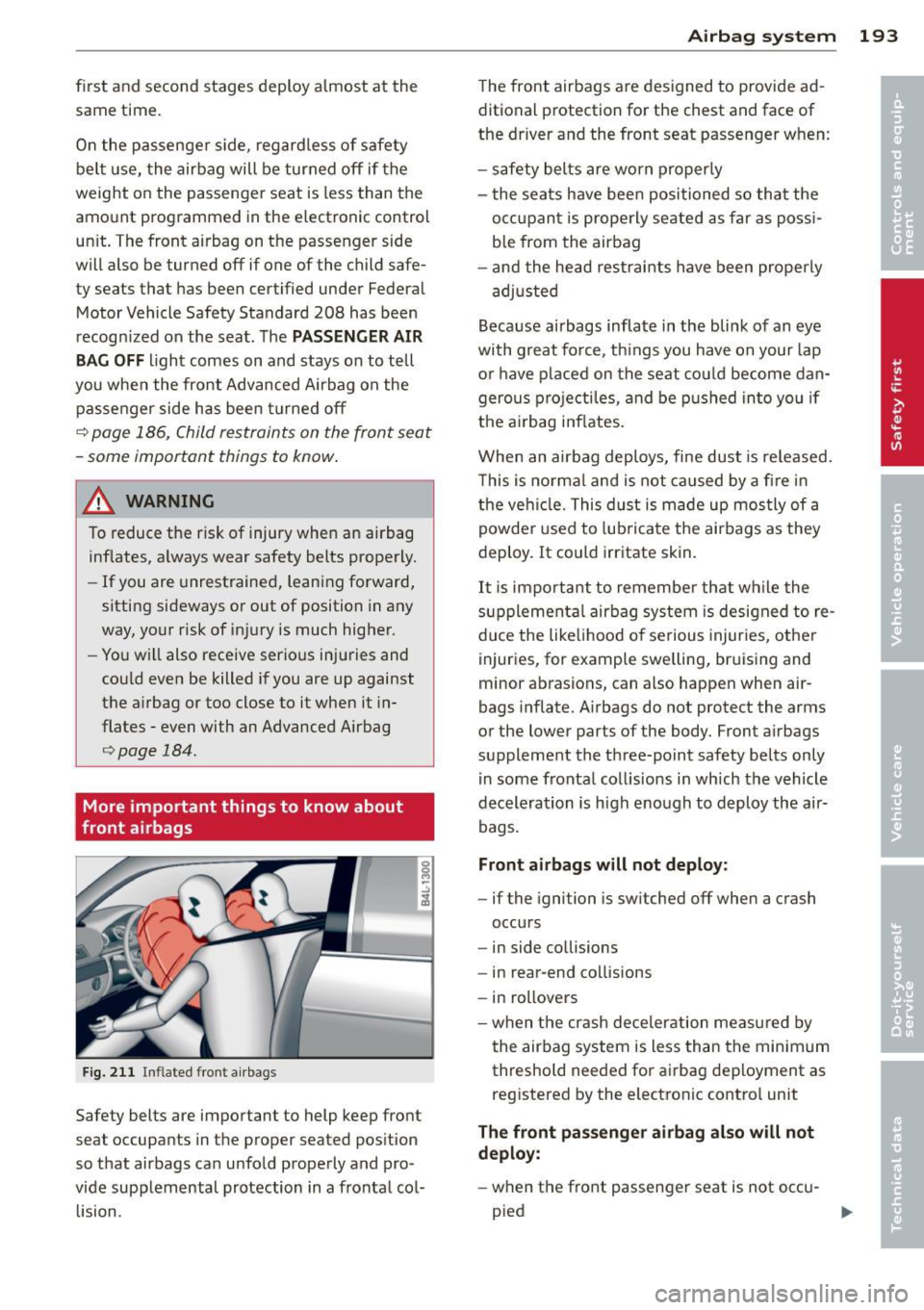
F ig. 2 11 Inflated front airbags
Safety belts are important to help keep front
seat occupants in the proper seated pos ition
so that airbags can unfo ld properly and pro
vide supplemental protection in a fronta l col
l ision.
A irba g sy stem 193
The front airbags are designed to provide ad
ditional protection for the chest and face of
the driver and the front seat passenger when:
- safety belts are worn properly
- t he seats have bee n positioned so that the
occ upan t is properly seated as far as poss i
b le from the airbag
- and the head restraints have been properly
adj usted
Because airbags inflate in the blink of an eye
with great force, t hings you have on your lap
or have placed on the seat co uld become dan
gerous projecti les, and be p ushed in to you if
the a irbag inf lates.
When an airbag deploys, fine dust is re leased.
T his is no rma l and is not caused by a fi re in
the vehi cle. This dust is made up mos tly of a
powder used to lub ricate the airbags as they
deploy. It could irritate skin.
It is important to remembe r that wh ile the
s u pplementa l airbag system is designed to re
duce the like lihood o f serious injuries, other
injuries, for example swelling, bruising and
minor abrasions, can a lso happen when air
bags inflate . A irbags do not protect the arms
or the lower parts of the body. Front airbags
supplement the th ree-point safety belts only
i n some frontal co llisions in which the vehicle
deceleration is high enough to deploy the air
bags.
Front a irbags will not deploy :
-if the ignition is sw itched off when a crash
occurs
- in side collisions
- in rear-end co llisions
- in rollovers
- when the crash dece leration meas ured by
the air bag system is less than the minimum
threshold needed for airbag deployment as
reg istered by the electronic cont ro l unit
The front passenger airbag also will not
deploy:
- when the front passenger seat is not occu-
pied ..,.
Page 196 of 348
194 Airbag sys te m
- when the weight on the front passenger
seat as sensed by the Advanced Airbag Sys
tem indicates that the front airbag on the
passenger side has to be turned off by the
electron ic control unit (the
PA SSEN GER AIR
BAG OFF
light comes on and stays on)
A WARNING
Sitting in the wrong position can increase
the risk of serious injury in crashes.
- To reduce the r isk of injury when the air
bags inflate, the driver and passengers
must always sit in an upright position,
must not lean against o r place any pa rt
of the ir body too close to the area where
the airbags are located .
- Occ upants who are unbelted, out of posi
t ion or too close to the airbag can be se
riously injured by an airbag as it unfolds
with great force in the blink of an eye
¢page 186.
A WARNING -
A child in a rearward-facing child safety
seat installed on the front passenger seat
w ill be seriously injured and can be k illed if
the front a irbag inflates -even with an Ad
vanced Airbag System.
- The inflating a irbag will hit the child
safety seat or infant carrier with great
force and w ill smash the ch ild safety seat
and child against the backrest, center
armres t, door or roof.
- Always install rear-facing child safety
seats on the rear seat.
- If you must install a rearward-fac ing
child safety seat on the front passenger
seat because of excep tional circ umstan
ces and the
PASSENGER AIR BAG OFF
light does not come on and stay on, im
mediately install the rear-facing child
safety seat in a rear seating position and
have the airbag system inspected by your
authorized Audi dealer.
A WARNING
Objects between you and the airbag will
i nc rease the r isk of injury in a crash by in
terfering with the way the airbag unfolds
or by be ing pushed into you as the airbag
i n flates.
- Never hold things in yo ur hands or on
your lap when the veh icle is in use.
- Never transpo rt items on or in the area
of the front passenger seat. Objects
could move into the a rea of the front air
b ags du ring bra king or other sudden ma
neuvers and become dangero us projec
tiles that can cause serious personal in
jury if the ai rbags inflate.
- Never p lace or attach accessories or oth
er objects (such as cupholde rs, tele
phone brackets, large, heavy or bulky ob
jects) on the doors, ove r or near the area
marked "AIRBAG" on the steer ing whee l,
instrument panel , seat backrests or be
tween those areas and yourself . These
objects could ca use in jury in a c rash, es
pecially when the airbags infla te.
- Never recline the front passenger 's seat
to transpo rt objects . Items can a lso
move into the a rea of the s ide airbag or
the front airb ag d uring bra king or in a
sudden maneuve r. Objects nea r the air
bags can become projectiles and cause
in ju ry, partic ularly when the seat is re
clined.
- Never tilt the front passenger seat back
rest forward when the vehicle is moving .
An inflating a irbag w ill force the back
rest backward and can injure rear seat oc
cupants.
A WARNING
The fine dust created when airbags deploy
can cause breathing prob lems for people
with a history of asthma or other breath i ng cond itions.
-
- To reduce the risk of breath ing problems,
those with asthma o r othe r respiratory
....__ c_ o_ n_ d_ it_ i_o _ ns_ s_ ho _u_ l_ d ....:g:_ e_ t_ f_re _s_ h _ a_ i_r _ri ..::g :....h _t __
_J .,.
Page 197 of 348
away by getting out of the vehicle or
opening windows or doors.
-If you are in a collision in which airbags
deploy, wash your hands and face with
mild soap and water before eating.
- Be careful not to get the dust into you r
eyes, or into any cuts or scratches.
- If the residue should get into your eyes,
flush them with water.
Monitoring the
Advanced Airbag
System
Airbag monitoring indicator light
Two separate indicators monitor the function
of the Advanced Airbag System: the airbag
monitoring indicator light and the
PA SSEN ·
GER AIR BAG OFF
light.
The Advanced Airbag System (including the
e lectronic control unit, sensor circuits and sys
tem wiring) is monitored cont inuously to
make sure that it is functioning properly
whenever the ignit ion is on . Each t ime you
turn on the ignition, the airbag monitoring in
d icator light
I will come on for a few seconds
(sel f diagnos tics) .
The system must be inspected when the
indicato r light
I:
- does not come on when the ignit ion is
switched on
- does not go out a few seconds after you
have swi tched o n the ignition, o r
- comes on w hile driving
If an airbag system malfunct ion is detected,
the indicator light will first start flashing to
catch the driver's attention and then stay on
continuously to serve as a constant reminde r
to have the system inspected immediately.
If a malfunction occurs that tur ns the front
a irbag on the passenger side off, the
PAS SEN
GER AIR BAG OFF
light w ill come on and stay
on w henever the ignition is on.
A irbag system 195
A WARNING
An airbag system that is not functioning
p roperly cannot provide supplemental pro
tection in a frontal crash.
- If the airbag ind icator light comes on, it
means that there may be something
wrong with the Advanced Airbag System .
I t is poss ible that the ai rbag w ill inflate
when it is not supposed to, or will not in
fla te when it sho uld.
- Have the airbag system inspe cted imme
diate ly by yo ur aut ho rized Aud i dea ler.
PASSENGER AIR BAG OFF light
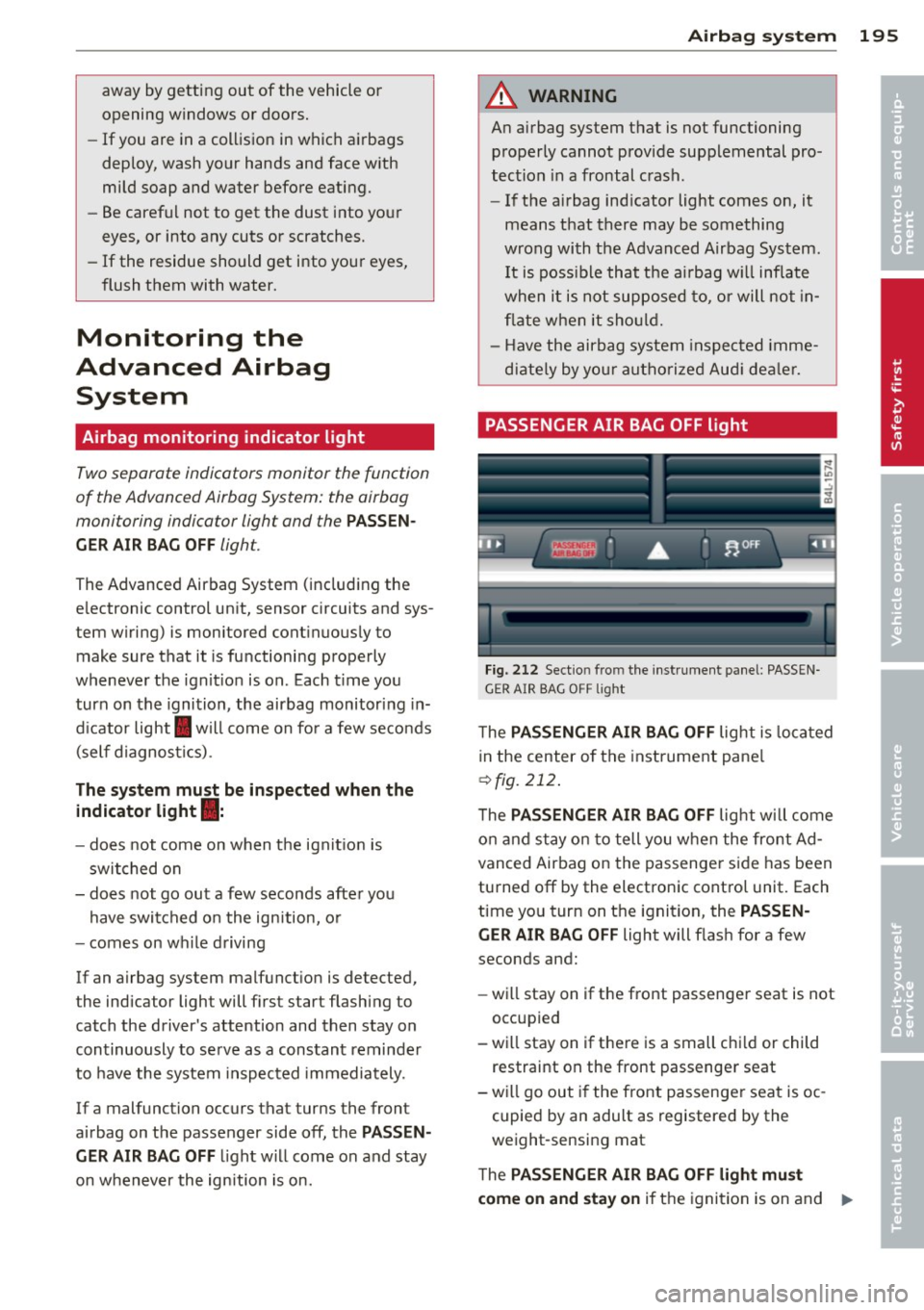
Fi g. 212 Sec tion fro m th e in str um ent pa nel: PASSEN
GER AIR BAG O FF light
-
T he PASSENGER AIR BAG OFF light is loca ted
i n the center of the instrument pa ne l
¢ fig. 212 .
The PAS SENGER AIR BAG OFF lig ht will come
o n and stay on to tell you when the front Ad
vanced Airbag on the passenger side has been
turned off by the electronic control unit. Each
t ime yo u turn on the ignition, the
PASSEN·
GER AIR BAG OFF
light will flash for a few
seconds and:
- w ill stay on if the front passenger seat is not
occupied
- w ill stay on if there is a small chi ld or child
restraint on the front passenger seat
- w ill go out if the front passenger seat is oc
cupied by an adult as registered by the
weight-sensing mat
T he
PASSENGER AIR BAG OFF light must
come on and sta y on
if the ignition is on and ..,.
•
•
Page 198 of 348
196 Airbag sys te m
- a car bed has been insta lled on the front
seat, or
- a rearward-facing chi ld restraint has been
installed on the front passenger seat, or
- a fo rward -facing child restraint has been in
sta lled on the front passenger seat, or
- the weight registered on the front passen
ger seat is equa l to or less than the com
bined weight of a typical 1 year -old restrain
ed in one of the rear-facing or forward-fac
ing infant restraints listed in Federal Motor
Vehicle Safety Standard 208 with which the
Advanced Airbag System in your veh icle was
certified.
If the front passenger seat is not occupied,
the front airbag will not deploy, and the
PAS
SENGER AIR BAG OFF
li ght will stay on. Nev
er install a rearward-fac ing c hild restra int on
the front passenger seat, the safest place fo r
a child in any kind of child restraint is at one
of the seat ing positions on the rea r seat
~ page 186, Child restraints on the front seat
- some important things to know
and
~ page 205, Child Safety.
If the PASSENGER AIR BAG OFF light c om es
on
when one of the conditions listed above is
met, be sure to check the light regularly to
make certain that the
PASSENGER AIR BAG
OF F
light stays on cont inuo usly whenever the
ignit ion is on. If the
PA SSENGER AIR BAG
OFF
light does not appear on and does not
stay on all the time, stop as soon as it is safe
to do so and
- react ivate the system by turning the ignition
off and then turning it on again;
- remove and re insta ll the chi ld restraint .
Make sure that the child restraint is properly
installed and that the safety be lt for the
front passenger seat has been correct ly
routed through the child restra int as descri
bed in the chi ld restrai nt manufacturer's in
stru ct ions;
- make sure that the convert ible locking fea
tu re on the safety belt fo r the front passen
ger seat has been a ctivated and that the
sa fe ty belt has been pulled tight. The belt
must not be loose or have loops of slack so that the sensor be
low the sa fe ty belt latch
on the seat can do its job~
page 215.
-ma ke sure that things tha t may increase the
weight of the ch ild and chi ld safety seat a re
not being t ransported on the front passen
ger seat;
- make sure that the safety belt tension sen
sor is not blocked. S hake the safety belt
latch on the front passenger seatback and
forth;
- If a strap or tether is be ing used to tie the
child safety seat to the front passenger
seat, make sure that it is not so tight that it
causes the weight-sensing mat to measure more weight than is act ually on the seat .
If the PAS SENGER AIR BAG OFF light still
does not come on
and does not stay on con
t in uous ly (when the ignition is switched on),
- take the child restraint off the front passen-
ger seat and install it properly at one of the
rear seat positions. Have the airbag system
inspected by your authorized Aud i dealer
immed iately.
- move the child to a rear seat position and
make sure that the ch ild is properly restra in
ed in a ch ild restra int that is app rop riate for
its s ize and age.
The
PASSENGER A IR BAG OFF light should
NOT come on when the ignit ion is on and an
adult is s itting in a proper seating position on
t h e front passenge r seat. If the
PASSENGER
AIR BAG OFF
light comes on and s tays on o r
f lashes fo r about 5 seconds w hile d riving, un
der these ci rcumstances, make sure tha t:
- the adult on the front passenge r seat is
prope rly seated on the cente r of the sea t
cushion wi th his or her back up aga inst the
backrest and the backrest is not recl ined
~ page 166 , Proper occupant seating posi
tions,
- the adult is not taking weight off the seat by
holding on to the passenger assist handle
above the front passenger door or support-
ing their weight on the armrest, .,.
Page 200 of 348
198 Airbag system
(D Tips
If the weight-sensing mat in the front pas
senger seat detects an empty seat, the
front airbag on the passenger side will be turned off, and the
PASSENGER AIR BAG
OFF
light will stay on.
Repair, care and disposal of the airbags
Parts of the airbag system are installed at
many different places on your Audi . Installing,
removing, servicing or repairing a part in an
area of the vehicle can damage a part of an
airbag system and prevent that system from
working p roperly in a collision.
There are some important things you have to know to make sure that the effectiveness of
the system will not be impaired and that dis
carded components do not cause injury or pol
lute the environment.
A WARNING
Improper care, servicing and repair proce
dures can increase the risk of personal in
jury and death by preventing an airbag from deploying when needed or deploying
an airbag unexpectedly:
- Never cover, obstruct, or change the steering wheel horn pad or airbag cover
or the instrument panel or modify them
in any way .
- Never attach any objects such as cu
pholders or telephone mountings to the
surfaces covering the airbag units.
- For cleaning the horn pad or instrument
panel, use only a soft, dry cloth or one
moistened with plain water. Solvents or
cleaners could damage the airbag cover
or change the stiffness or strength of the material so that the airbag cannot de
ploy and protect properly.
- Never repair , adjust, or change any parts
of the airbag system.
- All work on the steering wheel, instru
ment panel, front seats or electrical sys
tem (including the installation of audio
equipment, cellular telephones and CB radios, etc.) must be performed by a
qualified technician who has the training
and special equipment necessary.
- For any work on the airbag system, we
strongly recommend that you see your
authorized Audi dealer or qualified work
shop.
- Never modify the front bumper or parts
of the vehicle body.
- Always make sure that the side airbag
can inflate without interference:
- Never install seat covers or replace
ment upholstery over the front seat
backs that have not been specifically
approved by Audi.
- Never use additional seat cushions that
cover the areas where the side airbags
inflate.
- Damage to the original seat covers or
to the seam in the area of the side air
bag module must always be repaired
immediately by an authorized Audi
dealer. - The airbag system can be activated only
once. After an airbag has inflated, it
must be replaced by an authorized Audi
dealer or qualified technician who has
the technical information, training and
special equipment necessary.
- The airbag system can be deployed only once . After an airbag has been deployed,
it must be replaced with new replace
ment parts designed and approved espe
cially for your Audi model version . Re
placement of complete airbag systems
or airbag components must be per
formed by qualified workshops only. Make sure that any airbag service action
is entered in your Audi Warranty
& Main
tenance booklet under
AIRBAG REPLACE
MENT RECORD .
-For safety reasons in severe accidents,
the alternator and starter are separated
from the vehicle battery with a pyrotech
nic circuit interrupter.
- Work on the pyrotechnic circuit inter
rupter must only be performed by a
qualified dealer - risk of an accident!
Page 202 of 348
200 Airbag system
The side airbags are located in the sides of the
front seat backrests ¢
fig. 213 and the rear
backrest* facing the doors. They are ident ified
by the word "AIRBAG".
The side airbag system basically consists of:
-the e lectronic control module and external
side impact sensors
- the two side airbags located in the sides of
the front backrests
- two rear side airbags (as an ordered
option)
-the a irbag warn ing light in the instrument
cluster .
The airbag system is monitored electron ically
to make certain that it is functioning properly
at all times. Each time you turn on the igni
tion, the airbag system indicator light will
come on for a few seconds (self diagnostics) .
The s ide airbag system supplements the safe
ty belts and can help to reduce the risk of in
jury to the driver's, front and rear* passeng
er's upper torso on the side of the veh icle that
i s struck in a side collision . Th e airbag deploys
on ly in side impacts and only when the veh icle
acceleration registered by the control unit is
high enough . If this rate is below the refer
ence value programmed into the control unit,
the side airbags will not be triggered, even
though the car may be badly damaged as a re
sult of the collision. It is not possible to de
f in e an a irbag tr igger ing range that will cover
every possible angle of impact, since the cir
cumstances will vary considerably between
one collision and another. Important factors
include, for examp le, the nature (hard or soft)
of the impacting object, the angle of impact ,
vehicle speed, etc . ¢
page 201, Important
safety instructions on the side airbag system .
Aside from their normal safety function , safe
ty belts work to help keep the driver or front
passenger in position in the event of a side
coll ision so that th e side airbags can provide
protection.
The airbag system is
not a substitute for your
safety be lt. Rather, it is part of the overall oc
cupant restraint system in your vehicle . Al
ways remember that the side airbag system can
only help to protect you if you are wearing
your safety belt and wearing it properly. This
is another reason why you should a lways wear
your safety belts, not just because the law re
quires you to do so¢
page 175, General
notes .
It is important to remember that wh ile the
s u pplementa l side airbag system is designed
to reduce the likelihood of serious injuries,
other injur ies, for example, swelling, bru is in g,
and minor abrasions can also be assoc iated
with deployed side airbags . Remember too,
s ide airbags will dep loy only once and only in
certain kinds of accidents - your safety belts
are always there to offer protection.
Vehicle damage , repair costs or even the lack
of vehicl e damage are not necessarily an indi
cation of over-sensitive or failed airbag activa
t ion. In some coll is ions, both front and side
airbags may inflate . Remember too, that air
bags will deploy only once and only in certain
k inds of co llisions -yo ur safety belts are al
ways there to offer protection in those acc i
den ts in which airbags are no t supposed to
deploy or when they have already deployed .
The side airbag system will not deploy:
-when the ignition is t urned off
- in side collisions when the acceleration
measured by the sensor is too low
- in front -end collisions
- in rea r-end collisions
- in rollovers .
In some types of accidents the front airbags ,
s ide curtain airbags and s ide a irbags may be
triggered together .
A WARNING
-
-Safety belts and the airbag system will
only provide protection when occupants
ar e in the proper seating position
¢page 201.
- If the airbag indicator light comes on
when the vehicle is being used, have the
system inspected immediately by your
authorized Audi dealer. The airbag may
Page 205 of 348
inflates in side impacts and only when the ve
hicle acceleration registered by the control
un it is high enough. If this rate is below the
reference value programmed into the contro l
unit, the side airbags will not be triggered,
even though the car may be badly damaged as
a result of the coll ision.
It is not possible to
define an airbag triggering range that will
cover eve ry possible angle of impact, since the
circumstances w ill vary considerably be tween
one co llision and another . Important factors
include, for examp le, the natu re (hard or soft)
of the impacting object, the angle of impact,
veh icle speed, etc. c::>
page 203, How side cur
tain airbags work.
Aside from the ir normal safety function, safe
ty belts work to he lp keep the driver or front
passenger in posit ion in the event of a co lli
sion so that the side curtain airbags can pro
vide protection.
The airbag system is not a s ubstitute for your
safety belt. Rather, it is part of the overall oc
cupant restraint system in your vehicle. Al
ways remember that the airbag system can
only help to protect you if you are wearing
your safety belt and wear ing it prope rly. Thi s
i s another reason why you sho uld always wear
your safety bel ts, not just beca use the law re
q ui res you to do soc::>
page 175, General
notes.
It is important to rememb er that while the
side curta in a irbag sys tem is designed to he lp
r educe the like lihood of se rious injur ies, other
in ju ries, for example, swell ing, bruising, and
minor abrasions can also be associated with
these airbags upon deployment. Remember
too, these a irbags w ill dep loy on ly once and
only in certain kinds of accidents - your safety be lts are a lways there to offer protection.
The side curtain airbag sy stem ba sicall y
consi sts of:
- The electronic control mod ule and external
s ide impact sensors
- The side curtain airbags above the front and rear side windows
A irba g sy stem 203
- The airbag indicator light in the instrument
panel
T he airbag system is mon itored e lec tronically
to make ce rtain i t is func tioning prope rly at all
times . Each time you turn on the ignit ion, the
airbag system indicator light will come on for
a few seconds (self diagnostics).
The side curtain airbag i s not activat ed :
- if the ignition is turned off
- in side co llisions whe n the acceleration
measured by the sensor is too low
- in rea r-end collisions.
A WARNING
- Safety belts and the airbag system will
only provide pro te ction when occup ants
are in the proper seating posi tion
c::>
page 71, General recommendations.
- If th e air bag ind icator light comes on
when the vehicle is being used, have the
system inspected immediately by your
authorized A udi dealer . The side curtain
airbag may not work properly even when
the vehicle acce lerat ion in a side collision
is high enough to activate the airbag.
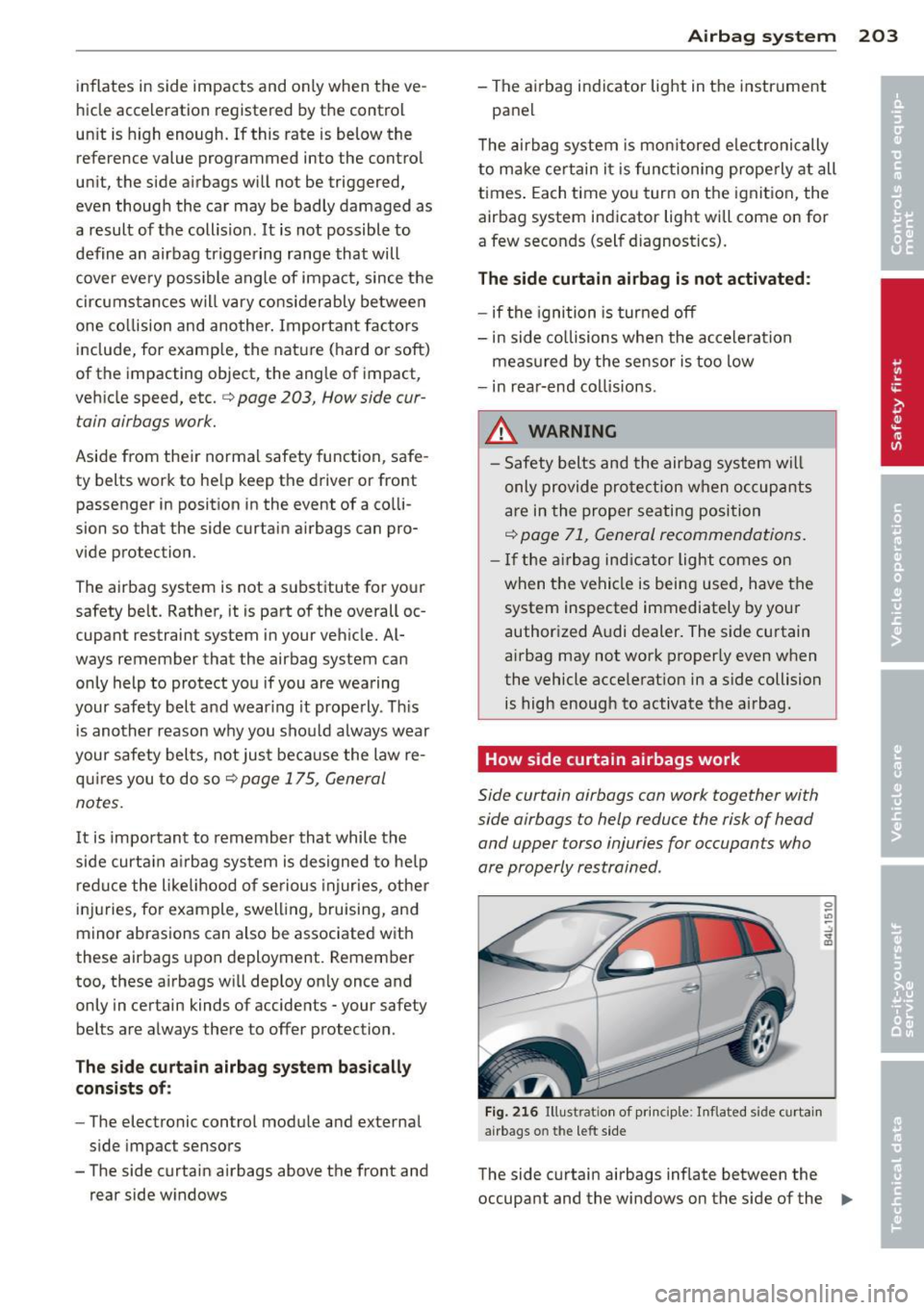
How side curtain airbags work
Side curtain airbags con work together with
side airbags to help reduce the risk of head
and upper torso injuries for occupants who
ore properly restrained.
Fi g. 216 Illustrat io n of pr incip le: Inflated side curtai n
a irbags on the left s ide
-
The side curtain airbags inflate between the
occupant and the windows on the s ide of the
IIJ,,
Page 209 of 348
seat. The weight of a child restraint and its
"footprint" vary for different kinds of child re
straints and for the different models of the
same kind of child restraint offered by child restra int manufacturers.
The weight ranges for the individual types, makes and mode ls of ch ild restra ints that the
NHTSA has specified in the Safety Standard
together with the we ight ranges of typical in
fants and typical 1 year -old child have been
stored in the control unit of the Advanced A ir
bag System . When a chi ld restraint is being
used on the front passenge r seat with a typi
cal 1 year -old ch ild, the Advanced Airbag Sys
tem compares the we ight measured by the
weight sensing mat with the information stor
ed in the electronic control unit.
The electron ic contro l unit al so registers the
tension on the front passenger safety be lt.
The tension on the safety be lt for the front
passenger seat will be different for an adult
who is properly using the safety belt as com
pared to the tension on the be lt when it is
used to attach a child restraint to the seat.
T he sensor below the latch for the safety belt
for the front seat passenger measures the
tension on the belt . T he input from this sen
sor is t hen used w ith the we ight to "decide",
whether there is a ch ild restraint with a typ ica l
1 year-o ld child on the front passenger seat
and whether or not the airbag must be turned
off .
Child restraints and Advanced Airbags
Regard less of the child restraint that you use,
make sure that it has been certified to meet
United States Federal Motor Vehicle Safety
Standards and has been certified by its manu
facturer for use with an airbag . Always be sure
that the chi ld restraint is p roperly instal led at
one of the rear seat ing pos itions . If in excep
tional ci rcumstances you must use it on the
front passenger seat, carefu lly read all of the
information on child safety and Advanced Air
bags and heed a ll of the app licable WARN
INGS. Make certain that the child restraint is
correctly recognized by the weight-sensing
Child Sa fet y 207
mat inside the front passenger seat, that the
front passenger airbag is turned off and that
the a irbag status is always correct ly signaled
by the
PAS SENGE R AIR BAG OFF light.
Many types and models of child restraints
have been available over t he years, new mod
els are introduced regu larly incorporating new
and improved des igns and o lder models are
taken out of product ion. Ch ild restraints are
not standard ized . Child restraints of the same
type typ ically have d ifferent weights and sizes
and different 'footpr ints,' the size and shape
of the bottom of the ch ild restrai nt that sits
o n the seat, when they a re insta lled on a veh i
cle seat. These diffe rences make it v irtually
impossible to certify compliance with the re
quirements for advanced airbags with each
and every ch ild restraint that has ever been
sold in the past or will be sold over the course
of the useful life of your veh icle.
For this reason, the United States National
Highway Traffic Safety Adm inistrat ion has
published a list of spec ific type, makes and
models of child restraints that must be used
to certify comp liance of the Advanced Airbag
System in your veh icle with the suppression
requirements of Federal Motor Vehicle Safety
Standa rd 208. These chi ld restraints are :
Subpart A - Car bed child restraints
Model
Angel Guard Angel Ride AA 2403FOF
Manufactured on or
after
September 25, 2007
Subpart B - Rear-facing child restraints
Model Manufactured on or
after
Century SmartF it December 1, 1999
4543
Cosco Arriva September 25, 2007
22-013PAW and base
22-999WHO
Evenf lo Discovery Ad- December 1, 1999
just Right 212
I
j
•
•
....
Page 228 of 348
226 Intellig ent technol ogy
The vehicle is then stabilized by the forces act
ing on the whee l during braking. If the vehicle
is
oversteering (rear tends to sk id out of the
turn), the brakes are ma inly applied on the
wheel that is on the outside of the curve. In
the case of a vehicle that is
understeering
(tendency to slide out of the curve), the
brakes are applied as needed on the whee l
that is on the ins ide of the curve or addit ional
l y on the o ther wheels. An acoustic s ignal indi
cates when ESC b rake app lication cuts in
¢ A .
The system operates across the entire speed
range in combination with the ABS system
¢ page 229. If the Anti-Lock Brake System
(ABS) malfunctions, the ESC wi ll be out of ac
tion as well .
Activating
When you turn on the engine, ESC w ill auto
mat ica lly be act ivated and will perform a se lf
test. As soon as the test is comp leted, the sys
tem is in normal operating mode.
Offroad mod e
ESC should normally be ope rated in normal
mode because this ensures maximum vehicle
stability. If necessary, you can act ivate the
ESC offroad mode by pressing the but to n
¢ fig . 232 to obtain maximum traction and
braking ability when driving
off paved roads at
l ow speeds. In ESC offroad mode, the indica
tor light
Ii) ill uminates and the message Sta
b ilization control (E S C): Offr oad . Wa rning !
R estric te d stabilit y
appears br iefly in the dis
p lay .
The ESC offroad mode can be useful in the fo l
low ing except ional situations when slip or a
h ighly effective differential locking function is
des irable . Examp les:
- when driving with tire chains,
- when driving in deep snow or on loose
ground,
- when driving on uneven surfaces with the
whee ls severe ly unloaded (articulation), and
- when rocking the vehicle loose after it has
become stuck . When the
unusual situation is past, you
sho uld shift back to the norma l ESC operating
mode by pushing the button again . The mes
sage
S ta b ilizat ion cont rol (ES C): O n then ap
pears briefly in the display.
H ill desc ent control
The hill descent control is switched on in ESC
offroad mode . When slowly descending steep
gradients on loose ground or when the axles
are articulated, hill descent control provides ass istance by automatically apply ing the
brakes to keep vehicle speed constant. The ve
hicle is also rendered easier to steer by selec
t ive d istr ibut ion of braking force. Hill descent
control intervenes when:
- the acce lerator pedal is not pressed,
- the vehicle is travelling less than 12 mph
(20 km/h),
- a steep gradient is detected,
- wheel behavior indicates loose ground or
conditions with poor adhesion (e .g. also axle
art iculation).
Hill descent contro l operates both d riving for
ward and in reverse. Active hill descent con
tro l is deactivated by pressing the accelerator
pedal until the condit ions for activation al
ready listed are met again .
A WARNING
--
- The Electronic Stabilization Contro l is
neverthe less s ubject to the laws of phys
ics. It is part icularly important to pay at
tention to this fact on wet and slippe ry
roads . It i s therefore important that you
always adapt your dr iving to the cond i
tion of the road and traffic conditions . Do
not a llow the increased safety provided
by the E lectronic Stabilization Contro l
system to lull you into accepting addi
tional safety risks .
- Please be aware that in ESC offroad
mode, particularly on a smooth and s lip
pe ry road, the wheels may have an in
creased tendency to sp in and the vehicle
may b reak away - dange r of skidding!
~
Page 232 of 348
230 Intellig ent technol ogy
8_ WARNING
Although the ABS is very effective, always
remember that bra king capability is limit
ed by t ire traction . Always adjust your dr iv
ing spee d according to the road and t raffic
co nditions. Do no t let t he extra sa fety af
forded by the ABS tempt you into ta king
extra risks. The ABS cannot overcome the
laws of physics.
@ Tips
- If ABS is not functioning prope rly, a
warning light will come on. See
¢page 18 .
-If a fault occurs in the ABS, the EDL is al
so not functioning. This is indicated by
the ABS warning light .
Brake assistant
The brake assistant is designed to achieve the
optimum braking effect .
The brake assistant helps to increase the ef
fective b rak ing power and thus to achieve a
shorter stopp ing distance. If the driver
presses the brake pedal very quickly, the brake
assistant automatica lly boosts the braking
force to the maximum level, up to the point where the anti-lock brake function (ABS) inter
venes to stop the wheels from locking. You
should then keep the brake pedal pressed un
til the veh icle has braked to the required
speed . The brake assistant sw itches itself off
as soo n as you re lease the brake pedal.
Automatic full braking a ssist
This funct ion allows full brak ing in spite of
h igh brake pedal forces (e .g . when the brakes
a re severely stressed because the vehicle is
fully loaded) . The driver notices th is function
throug h a reduction of pedal force and in
creased pedal trave l. When the brake peda l is
r e leased, fu ll braking assis t switc hes off again
automatically.
I f the re is an ABS fa il ur e, the brake ass ista nt
and automatic full b rak ing ass ist are not avai l
ab le . The brake assistant wi
ll not be operative if
there is a ma lfunction in the ABS .
8_ WARNING
-Please remember that the accident risk a l-
ways increases if you drive too fast, espe
cially in corners or on a slippery road, or if
you follow the veh icle ahead of you too
closely. Increased r isk of an accident can
not be compensated for even by the brake
assistant, so always maintain a safe speed.
Servotronic ® -
advanced power
steering system
The power steering systems uses the power of
the running engine to allow precise steering
with little effort.
The advanced Servotronic ® power steering
system senses the road speed and electron i
cally adjusts power assistance to provide com
fortab le and safe steering response exact ly
matched to the vehicle speed .
Power steer ing will not work if the engine is
off . As a result, the steering wheel will be hard
to turn .
The power steering fluid level is checked dur
ing the scheduled maintenance services .
d) Note
If there is an electronic malfunction, ser
votronic
will still function like a conven
tiona l powe r steering system, providing a
constant steering support force that is no
l onger proportionate to the vehicle speed .
This is most not iceable when turning the
stee ring wheel at low speeds (fo r example
when pa rking), - more effort w ill be re
q uired than us ua l.
- Be aware o f the different than usual
steering response and adjust your steer
ing force accordingly.
- Have the problem checked and set r ight
by an Audi dealer as soon as possible .