ignition AUDI Q7 2013 Owner´s Manual
[x] Cancel search | Manufacturer: AUDI, Model Year: 2013, Model line: Q7, Model: AUDI Q7 2013Pages: 348, PDF Size: 87.72 MB
Page 202 of 348
200 Airbag system
The side airbags are located in the sides of the
front seat backrests ¢
fig. 213 and the rear
backrest* facing the doors. They are ident ified
by the word "AIRBAG".
The side airbag system basically consists of:
-the e lectronic control module and external
side impact sensors
- the two side airbags located in the sides of
the front backrests
- two rear side airbags (as an ordered
option)
-the a irbag warn ing light in the instrument
cluster .
The airbag system is monitored electron ically
to make certain that it is functioning properly
at all times. Each time you turn on the igni
tion, the airbag system indicator light will
come on for a few seconds (self diagnostics) .
The s ide airbag system supplements the safe
ty belts and can help to reduce the risk of in
jury to the driver's, front and rear* passeng
er's upper torso on the side of the veh icle that
i s struck in a side collision . Th e airbag deploys
on ly in side impacts and only when the veh icle
acceleration registered by the control unit is
high enough . If this rate is below the refer
ence value programmed into the control unit,
the side airbags will not be triggered, even
though the car may be badly damaged as a re
sult of the collision. It is not possible to de
f in e an a irbag tr igger ing range that will cover
every possible angle of impact, since the cir
cumstances will vary considerably between
one collision and another. Important factors
include, for examp le, the nature (hard or soft)
of the impacting object, the angle of impact ,
vehicle speed, etc . ¢
page 201, Important
safety instructions on the side airbag system .
Aside from their normal safety function , safe
ty belts work to help keep the driver or front
passenger in position in the event of a side
coll ision so that th e side airbags can provide
protection.
The airbag system is
not a substitute for your
safety be lt. Rather, it is part of the overall oc
cupant restraint system in your vehicle . Al
ways remember that the side airbag system can
only help to protect you if you are wearing
your safety belt and wearing it properly. This
is another reason why you should a lways wear
your safety belts, not just because the law re
quires you to do so¢
page 175, General
notes .
It is important to remember that wh ile the
s u pplementa l side airbag system is designed
to reduce the likelihood of serious injuries,
other injur ies, for example, swelling, bru is in g,
and minor abrasions can also be assoc iated
with deployed side airbags . Remember too,
s ide airbags will dep loy only once and only in
certain kinds of accidents - your safety belts
are always there to offer protection.
Vehicle damage , repair costs or even the lack
of vehicl e damage are not necessarily an indi
cation of over-sensitive or failed airbag activa
t ion. In some coll is ions, both front and side
airbags may inflate . Remember too, that air
bags will deploy only once and only in certain
k inds of co llisions -yo ur safety belts are al
ways there to offer protection in those acc i
den ts in which airbags are no t supposed to
deploy or when they have already deployed .
The side airbag system will not deploy:
-when the ignition is t urned off
- in side collisions when the acceleration
measured by the sensor is too low
- in front -end collisions
- in rea r-end collisions
- in rollovers .
In some types of accidents the front airbags ,
s ide curtain airbags and s ide a irbags may be
triggered together .
A WARNING
-
-Safety belts and the airbag system will
only provide protection when occupants
ar e in the proper seating position
¢page 201.
- If the airbag indicator light comes on
when the vehicle is being used, have the
system inspected immediately by your
authorized Audi dealer. The airbag may
Page 205 of 348
inflates in side impacts and only when the ve
hicle acceleration registered by the control
un it is high enough. If this rate is below the
reference value programmed into the contro l
unit, the side airbags will not be triggered,
even though the car may be badly damaged as
a result of the coll ision.
It is not possible to
define an airbag triggering range that will
cover eve ry possible angle of impact, since the
circumstances w ill vary considerably be tween
one co llision and another . Important factors
include, for examp le, the natu re (hard or soft)
of the impacting object, the angle of impact,
veh icle speed, etc. c::>
page 203, How side cur
tain airbags work.
Aside from the ir normal safety function, safe
ty belts work to he lp keep the driver or front
passenger in posit ion in the event of a co lli
sion so that the side curtain airbags can pro
vide protection.
The airbag system is not a s ubstitute for your
safety belt. Rather, it is part of the overall oc
cupant restraint system in your vehicle. Al
ways remember that the airbag system can
only help to protect you if you are wearing
your safety belt and wear ing it prope rly. Thi s
i s another reason why you sho uld always wear
your safety bel ts, not just beca use the law re
q ui res you to do soc::>
page 175, General
notes.
It is important to rememb er that while the
side curta in a irbag sys tem is designed to he lp
r educe the like lihood of se rious injur ies, other
in ju ries, for example, swell ing, bruising, and
minor abrasions can also be associated with
these airbags upon deployment. Remember
too, these a irbags w ill dep loy on ly once and
only in certain kinds of accidents - your safety be lts are a lways there to offer protection.
The side curtain airbag sy stem ba sicall y
consi sts of:
- The electronic control mod ule and external
s ide impact sensors
- The side curtain airbags above the front and rear side windows
A irba g sy stem 203
- The airbag indicator light in the instrument
panel
T he airbag system is mon itored e lec tronically
to make ce rtain i t is func tioning prope rly at all
times . Each time you turn on the ignit ion, the
airbag system indicator light will come on for
a few seconds (self diagnostics).
The side curtain airbag i s not activat ed :
- if the ignition is turned off
- in side co llisions whe n the acceleration
measured by the sensor is too low
- in rea r-end collisions.
A WARNING
- Safety belts and the airbag system will
only provide pro te ction when occup ants
are in the proper seating posi tion
c::>
page 71, General recommendations.
- If th e air bag ind icator light comes on
when the vehicle is being used, have the
system inspected immediately by your
authorized A udi dealer . The side curtain
airbag may not work properly even when
the vehicle acce lerat ion in a side collision
is high enough to activate the airbag.
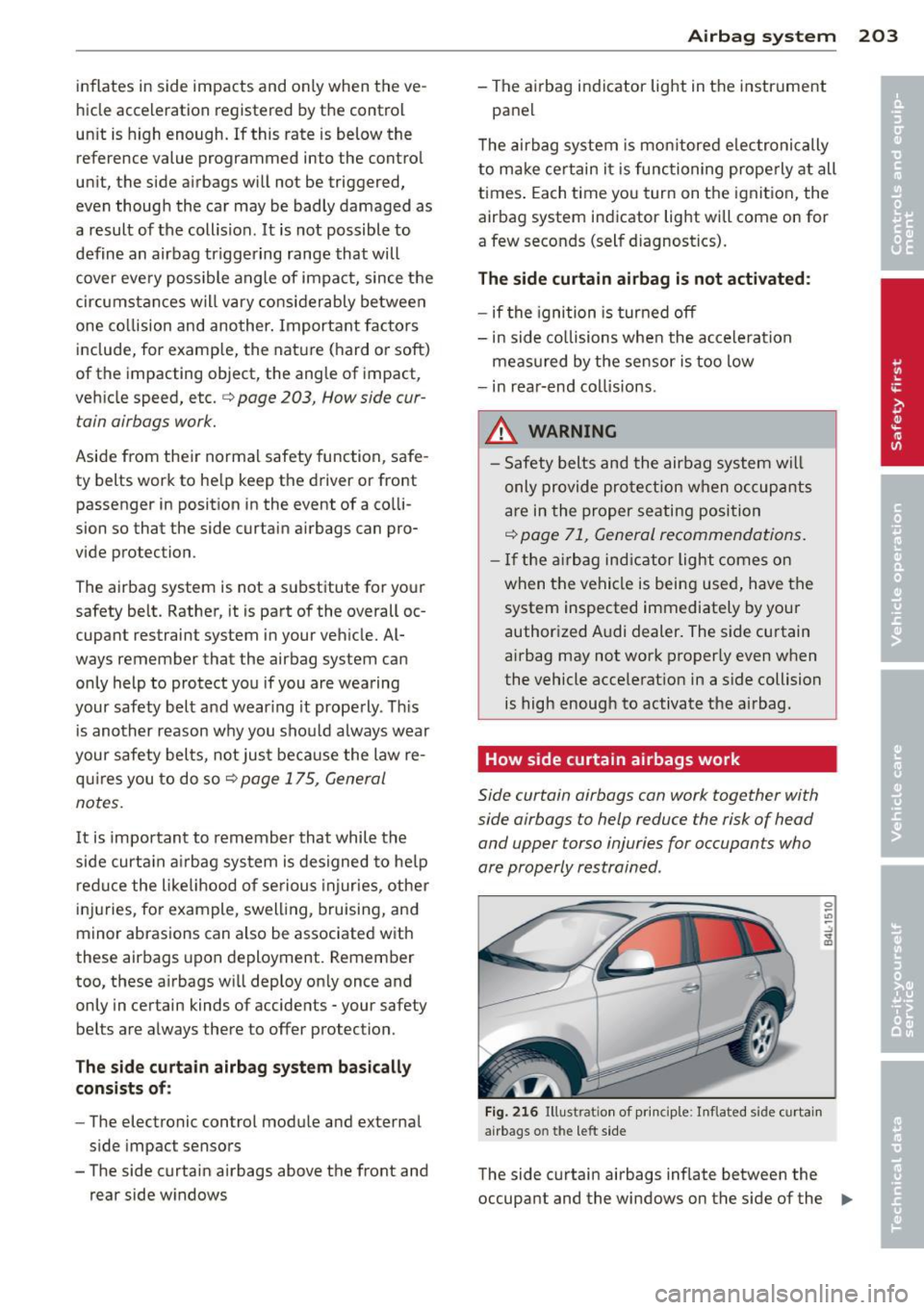
How side curtain airbags work
Side curtain airbags con work together with
side airbags to help reduce the risk of head
and upper torso injuries for occupants who
ore properly restrained.
Fi g. 216 Illustrat io n of pr incip le: Inflated side curtai n
a irbags on the left s ide
-
The side curtain airbags inflate between the
occupant and the windows on the s ide of the
IIJ,,
Page 208 of 348
206 Child Saf ety
- Always install rear-facing child safety
seats on the rear seat.
- If you must install a rearward facing
ch ild safety seat on the front passenger
seat in exceptiona l circumstances and
the
PAS SENGER AIR BA G OFF light does
not come on and stay on, immed iately
install the rear-facing child safety seat in
a rear seating posit ion and have the air
bag system inspec ted immediately by
yo ur Audi dealer.
_& WARNING
If, in exceptional c ircumstances, you mus t
install a forward -facing child restra int on
the front passenger's seat:
- Always make su re the forward-fac ing
seat has been designed and certified by
its manufacturer for use on a front seat
with a passenger front and side airbag.
- Always follow the man ufacturer's in
struct ions provided with the child safety
seat or carrier.
- Always move t he passenger seat into its
rearmost position in the seat 's fore and
aft adjustment range, as far away from
the a irbag as poss ible before installing
the ch ild restraint. The backrest must be
adjusted to an upr ight position .
- Always make sure that the
PASSENGER
AIR BAG OFF
light comes on and stays
on all the time whenever the ignition is
switched on.
(D Tips
Always rep lace child rest raints that were
installed in a vehicle during a crash. Dam
age to a child rest raint that is not visible
could cause i t to fail i n another collisio n
si tua tion.
Advanced front airbag system and
children
Your veh icle is equipped with an "Advanced
A irbag System" in compliance w ith United
States Federal Motor Vehicle Safety Standard (FMVSS) 208 as applicable at the time you
r
vehicle was manufacture d.
T he Adv anced Airbag system in yo ur vehicle
has been certified to mee t the "low-risk" re
quirements for 3-and 6-year old children on
the passenger side and sma ll adults on the
drive r side. The low r is k dep loyment cr iteria
are intended to red uce the risk of in jury
through interact ion w it h the airbag that can
occur, for example, by being too close to the
steering wheel and instrument panel when
the a irbag inflates . In addition, the syst em
has been ce rtified to comply wit h the "sup
pression" re quirements o f th e Safety Sta nd
ard, to t urn off the fron t airbag for infan ts up
to 12 months who are res trained on the front
passenger seat in child restraints that a re list
ed in the Standard.
E ven though your veh icle is eq uipped wit h an
Advanced Airbag system , a ll children, espe
cia lly those 12 years and yo unger, should a l
ways ride in the back seat properly restrained
for their age and size. The airbag on the pas
senger side makes the front seat a potentially
dangerous place for a ch ild to ride . The front
seat is not the safest p lace for a ch ild in a for
ward-fac ing ch ild safety seat. It can be a ve ry
dange rous place fo r an infan t or a large r child
i n a rea rward-f acing se at.
Advanced Airbags and the weight
sensing mat in the front seat
The Advanced A irbag System in your vehicle
detects the presence of an infant or child in a
c h ild restra int on the front passenge r seat us
i ng the weig ht-sens ing mat in the seat cush
ion and the sensor be low th e safe ty belt latch
o n the front passenge r seat that measures t he
tens ion on the s afety be lt.
T he we ight -sensi ng mat measures total
we ight of t he chi ld and the ch ild safety seat
and a c hild b la nk et on the front passenger
seat. The we igh t on the fron t pa sse nger se at
is re late d t o the desig n of the ch ild res trai nt
and its "f ootprint", the s ize and shape o f the
bottom of the chi ld restraint as it sits on the .,..
Page 210 of 348
208 Child Safety
-Model Manufactured on or
after
Evenflo First Choice December 1, 1999
204
Graco Infant 8457 December 1, 1999
Graco Snugride September 25, 2007
Peg Perego Primo Vi-September 25, 2007
aggio SIP IMUN00US
Subpart C -Forward-facing and
convertible child restraints
Model Manufactured on or
after
Britax Roundabout September 25, 2007
E9L02xx
Cosco Touriva 02519 December 1, 1999
Cosco Summit Deluxe September 25, 2007
High Back Booster
22-262
Cosco High Back September 25, 2007
l sooster 22-209
Evenflo Tribute V September 25, 2007
379xxxx
Evenflo Medallion December 1, 1999
1 254
Evenflo Generations September 25, 2007
352xxxx
Graco ComfortSport September 25, 2007
Graco Toddler Safety September 25, 2007
Seat Step 2
Graco Platinum Cargo
A WARNING
To reduce the risk of serious injury, make
sure that the
PASSENGER AIR BAG OFF
light comes on and stays on whenever a
child restraint is installed on the front pas
senger seat and the ignition is switched
on .
- Take the child restraint off the front pas
senger seat and install it properly at one
of the rear seat positions if the
PASSEN
GER AIR BAG OFF
light does not stay on. -
Have the airbag system inspected by
your authorized Audi dealer immed iate
ly .
@ Tips
The child seats listed in categories A to C
have been statically tested by Audi only for
the Advanced A irbag function.
Important safety instructions for using
child safety seats
Correct use of child safety seats substantially
reduces the risk of injury in an accident!
As the driver, you are responsib le for the safe
ty of everybody in the veh icle, especially chil
dren:
... Always use the right chi ld safety seat for
each child and always use it properly
c::;,page 211.
.,. Always carefully follow the child safety seat
manufacturer's instruct ions on how to route
the safety belt properly through the child
safety seat .
.,. When using the vehicle safety belt to install
a child safety seat, you must first activate
the convertible locking retractor on the
safety belt to prevent the child safety seat
from moving
¢ page 215 .
.,. Push the ch ild safety seat down with your
full weight to get the safety belt really tight
so that the seat cannot move forward or
sideways more than one inch (2 .5 cm) .
.,. If a strap or tether is be ing used to tie the
child safety seat to the front passenger
seat , make sure that it is not so tight that it
causes the weight-sensing mat to measure
more weight than is actually on the seat.
... Secure unused safety belts on the rear seat
c::;, page 210.
Always remember: Even though your vehicle is
equipped with an Advanced Airbag system, all
children, especially those 12 years and young
er, shou ld always ride in the back seat proper-
ly restrained for their age and size . .,.
Page 212 of 348
210 Child Safety
as possible before installing the child
restra int.
-A lways make sure that nothing pre
vents the front passenger's seat from being moved to the rearmost position
in its fore and aft adjustment range.
- Always make sure that the backrest is
in the upright position.
- Always buck le the child safety seat firmly
in place even if a child is not sitting in it.
A loose child safety seat can fly around
dur ing a sudden stop or in a coll is ion.
- Always read and heed all WARNINGS
whenever using a child restrained in ave
hicle is being used
c::> page 175, Safety
belts,
c::> page 184, Airbag system and
c::> page 205, Child Safety.
A WARNING
To reduce the risk of serious injury, make
sure that the
PASSENGER AIR BAG OFF
light comes on and stays on whenever a
child restraint is installed on the front pas
senger seat and the ignition is switched
on.
- Take the child restraint off the front pas
senger seat and install it properly at one
of the rear seat positions if the
PASSEN
GER AIR BAG OFF
light does not stay on.
- Have the airbag system inspected by
your authorized Audi dealer immediate
ly.
Secure unused safety belts on the rear
seat
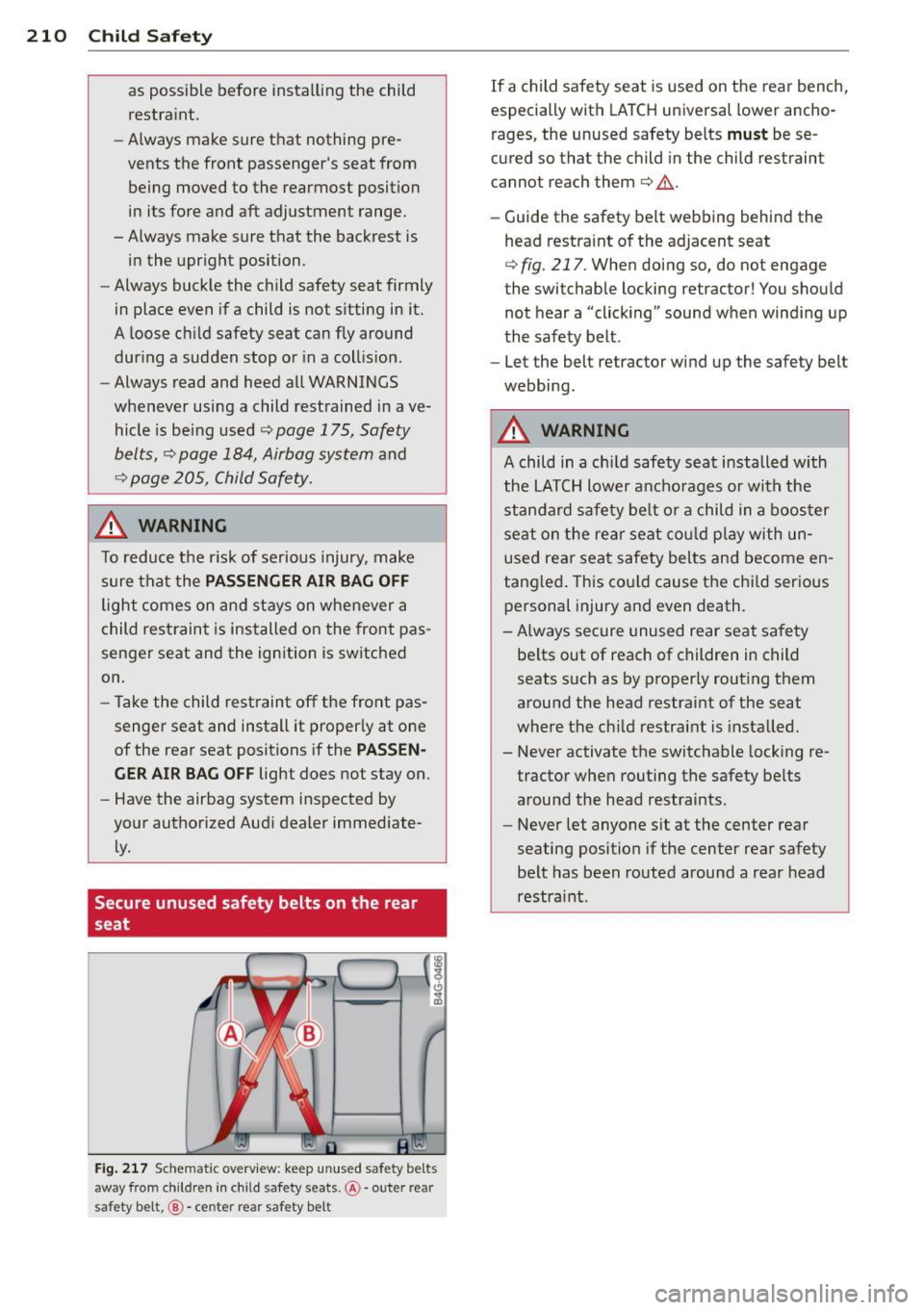
Fig. 217 Schematic overview: keep unused safety belts
away from ch ildren in child sa fety seats. @· oute r rear
safety belt,@· center rear safety belt
If a child safety seat is used on the rear bench,
especially with LATCH universal lower ancho
rages, the unused safety belts
must be se
cured so that the child in the child restraint
cannot reach them
c::> & .
-Guide the safety belt webbing behind the
head restraint of the adjacent seat
c::>fig. 217. When doing so, do not engage
the switchable locking retractor! You should not hear a "clicking" sound when wind ing up
the safety belt.
- Let the belt retractor wind up the safety belt
webbing.
A WARNING ,-
A child in a chi ld safety seat installed with
the LATCH lower a nchorages or with the
standard safety belt or a child in a booster
seat on the rear seat could play with un
used rear seat safety belts and become en
tang led . This could cause the chi ld ser ious
personal injury and even death.
-Always secure unused rear seat sa fety
be lts out of reach of children in child
seats such as by properly routing them
around the head restraint of the seat
where the ch ild restraint is installed.
- Never activate the switchable locking re
tractor when routing the safety belts
around the head restraints.
- Never let anyone sit at the center rear
seating position if the center rear safety
be lt has been routed around a rear head
restraint.
Page 215 of 348
to the backrest on the vehicle seat. Ad
just or remove the rear seat head restraint if it is diff icult to install the
child seat w ith the head restraint in place
¢ page 77. Install the head restraint
again immed iate ly once the child seat is
removed. Driving without head rest raints
o r with he ad restraints that are not prop
erly adjusted increases the risk of serious
or fatal neck injury dramatically.
- Always read and heed all WARNINGS
whenever using a child rest rained in ave
hicle is being used
¢page 175, Safety
belts,¢ page 184, Airbag system
and
¢ page 205, Important things to know.
A WARNING
If except ional circumstances requ ire the
use of a forward-facing child restra int on
the front passenger's seat, the ch ild's safe
ty and well-being require that the follow
ing special precautions be taken:
- Make sure the forward-fac ing seat has
been designed and certified by its manu
factur er for use on a front seat with a
passenge r fron t and side airbag.
- Always follow the manufacturer's in
st ruct ions provided with the child sa fety
sea t or infan t carrier.
- Always mov e the front passenge r seat in
to the rearmost posit ion of the passen
ger seat's fore and aft ad justment r ange,
and as far away from the airbag as possi
ble before instal ling the child restraint.
- Always m ake sure that noth ing prevents
the front passenger's seat from bei ng
moved to the rearmost position in its
fore and aft adjustment range .
- Always make sure the backrest is in an upright position.
- Make su re that the
PASSENGER AIR BAG
OFF
light comes on and stays on all the
time whenever the ignition is switched
on.
- If the light does not stay on, perform the
checks¢
page 195, Monitoring the Ad
vanced Airbag System.
-
Child S afety 213
-Take the chi ld restraint off the front pas
senger seat and install it properly at one
of the rear seat positions if the
PASSEN
GER AIR BA G OF F
light does not stay on
whenever the ignit ion is switched on.
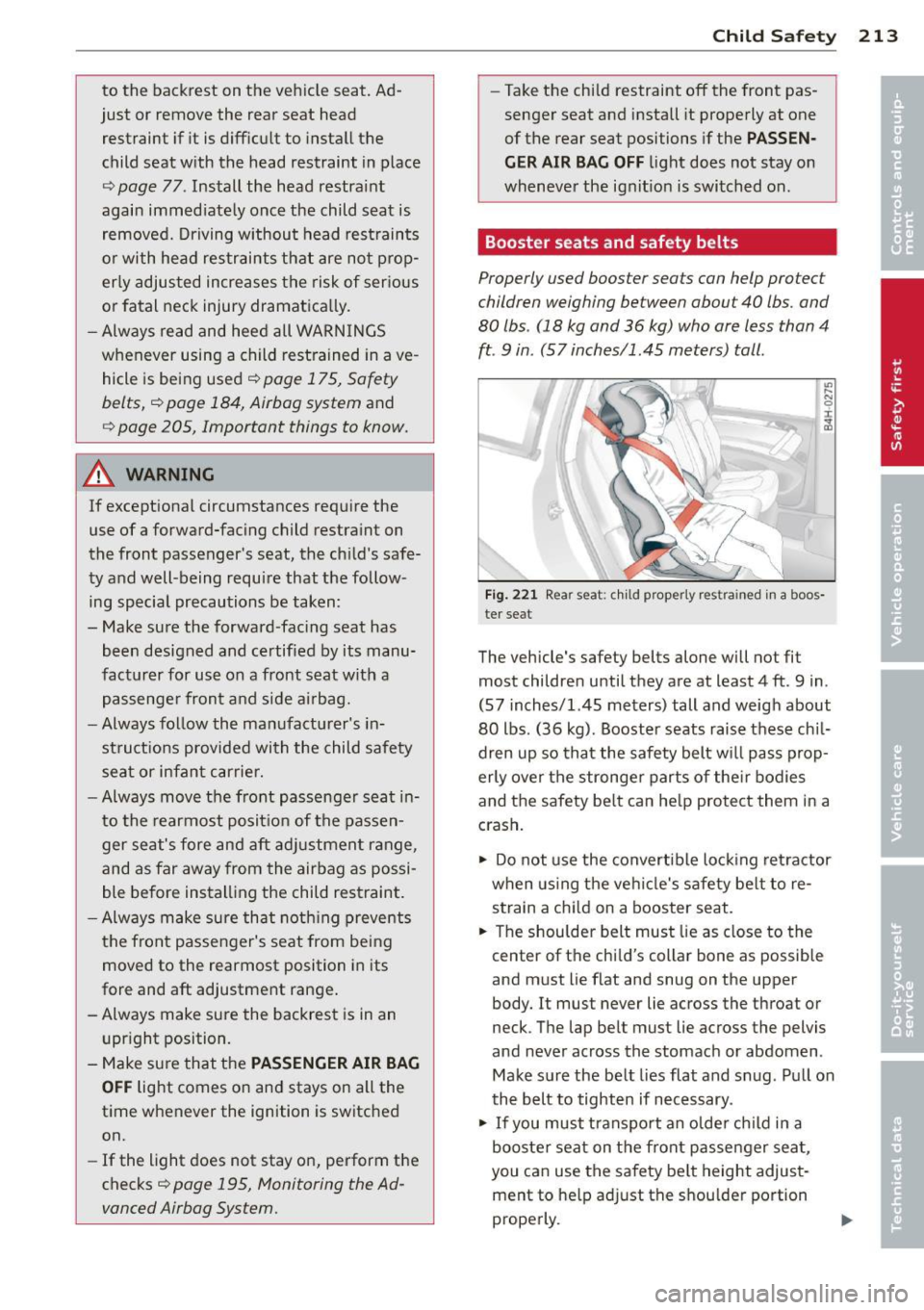
Booster seats and safety belts
Properly used booster seats con help protect
children weighing between about 40 lbs. and
80 lbs . (18 kg and 36 kg) who are less than 4
ft. 9 in . (57 inches/1 .45 meters) tall.
In .... N 0 ±
~
Fig . 221 Rear seat: ch ild properly res trained in a boos
ter seat
The vehicle's safety belts alone will not fit most children until they are at least 4
ft. 9 in .
(57 inches/1.45 me ters) tall and weigh about
80 lbs . (36 kg) . Booster seats raise these chi l
dren up so tha t the safety belt w ill pass p rop
erly over the stronger parts of the ir bodies
and the safety be lt can he lp protect them in a
crash.
.,. Do not use the conver tible locking ret ra ctor
when using the ve hicl e's s afety be lt to re
s train a ch ild on a booster seat.
... The shoulder belt must lie as close to the
center of the ch ild's collar bone as possible
and must lie flat and snug on the upper
body. It must never lie across the throat or
neck . The lap belt must lie across the pelvis
and never across the stomach or abdomen .
Make s ure the belt lies flat and snug. Pull on
th e belt to tighten if necessary.
.,. If you must transport an o lder ch ild in a
booster seat on the front passenger sea t,
you can use the safety be lt height adjust
ment to he lp ad just the shou lder portion
properly.
Page 217 of 348
-Children on the front seat of any car,
even with Advanced A irbags, can be seri
ous ly injured or even killed when an a ir
bag inflates.
- Never let a child stand or kneel on any
seat, for examp le the front seat.
- Never let a child ride in the cargo area of
your vehicle .
- Always remember that a ch ild lean ing
forward, sitt ing sideways or out of posi
t ion in any way during an acc ident can be
struck by a deploying airbag . This will re
sult in se rious personal injury or death .
- If you must install a booster seat on the
front passenger seat because of excep
t ional circumstances the
PASSENGER
AIR BAG OFF
light must come on and
stay on, whenever the ignition is switch
ed on.
- If the
PASSENGER AIR BAG OFF light
does not come on and stay on, perform
the checks described¢
page 195, Moni
toring the Advanced Airbag System.
- Ta ke the child restrain t off the front pas
senger seat and install it properly at one
of the rear seat positions if the
PASSEN
GER AIR BAG OFF
light does not stay on
whenever the ignition is switched on.
- Always read and heed all WARNINGS
whenever using a child restrained in ave
hicle is being used¢
page 175, Safety
belts,¢ page 184, Airbag system
and
c:> page 205, Important things to know.
Installing a child safety
seat
Securing a child safety seat using a
safety belt
Safety belts for the rear sea ts and the fron t
passenger can be locked wi th the convertible
locking retractor to properly secure child
safety seats .
The safety belts emergency lock ing retractors
for the rear seats safety belts and for the
front passenger's seat safety belt have a con
ve rtible locking retractor for child restraints.
Child Sa fet y 215
The safety belt must be locked so that be lt
webbing cannot unree l. The retractor can be
activated to lock the safety belt and prevent
the safety belt webbing from loosening up
during normal dr iving . A child safety seat can
only be properly installed when the safety belt
i s locked so that the chi ld and child safety
seat w ill stay in place .
Always remember: Even though your vehicle is equipped with an Advanced Airbag system, all
ch ildren, especially those 12 years and young
er, shou ld always r ide in the back seat proper
ly restrai ned fo r the ir age and size.
A WARNING
Improperly installed chi ld safety seats in
crease the risk of serious personal injury
and death in a collision.
- Always ma ke sure that the safety belt re
tracto r is loc ked when installing a child
safety seat . An unlocked safety belt re
tractor cannot hold the child safety seat
in place during normal dr iving or in a
crash.
- Always buckle the child safety seat firmly
in place even if a ch ild is not sitt ing in it.
A loose child safety seat can fly around during a sudden stop or in a collision .
- Always make sure that the rear seat
backrest to which the center rear safety
be lt is attached is securely latched when
eve r the rea r center safety belt is being
used to secure a ch ild restra int.
- If the backrest is not securely latched,
the child and the child restraint will be
thrown forward together with the back rest and will strike parts of the vehicle
interior. The child can be seriously in
jured or killed.
- Never install rear-fa cing child safety
seats or infant carrie rs on the front pas
senger seat . A child will be serio usly in
jured and can be killed when the passen ger airbag inflates.
- The inflating airbag will h it the ch ild
safety seat or infant carrier with great
force and will smash the child safety seat
~
•
•
Page 218 of 348
216 Child Safety
and child against the backrest, center
armrest, door or roof.
- Always install rear-facing child safety
seats or infant carriers on the rear seat.
- Forward-facing child safety seats or in
fant carriers installed on the front pas
senger's seat may interfere with the de
ployment of the airbag and cause serious
injury to the child.
- It is safer to install a forward-facing
child safety seat on the rear seat.
- Always read and heed all WARNINGS whenever using a child restrained in ave
hicle is being used
c::> page 205 . Special
precautions apply when installing a child
safety seat on the front passenger seat
c::> page 186, Child restraints on the front
seat -some important things to know.
A WARNING
Always take special precautions if you
must install a forward or rearward-facing
child restraint on the front passenger's
seat in exceptional situations:
- Whenever a forward or rearward-facing
child restraint is installed on the front
passenger seat, the
PASSENGER AIR
BAG OFF
light must come on and stay on
whenever the ignition is switched on.
- If the
PASSENGER AIR BAG OFF light
does not come on and stay on, perform
the checks described
<=:> page 195, Moni
toring the Advanced Airbag System.
- Take the child restraint off the front pas
senger seat and install it properly at one
of the rear seat positions if the
PASSEN
GER AIR BAG OFF
light does not stay on
whenever the ignition is switched on.
- Improper installation of child restraints
can reduce their effectiveness or even
prevent them from providing any protec
tion.
- An improperly installed child restraint
can interfere with the airbag as it de
ploys and seriously injure or even kill the
child. -
Always carefully follow the manufactur
er's instructions provided with the child
safety seat or carrier.
- Never place additional items on the seat
that can increase the total weight regis
tered by the weight-sensing mat and can
cause injury in a crash .
A WARNING
-Forward-facing child restraints:
- Always make sure the forward-facing
seat has been designed and certified by its manufacturer for use on a front seat
with a passenger front and side airbag .
- Never put the forward-facing child re straint up, against or very near the in
strument panel.
- Always move the passenger seat into its
rearmost position in the seat's fore and
aft adjustment range, as far away from
the airbag as possible before installing
the forward-facing child restraint. The
backrest must be adjusted to an upright
position.
- Make sure that the PASSENGER AIR BAG
OFF
light comes on and stays on all the
time whenever the ignition is switched
on .
A WARNING
Rearward-facing child restraints:
- A child in a rearward-facing child safety
seat installed on the front passenger
seat will be seriously injured and can be killed if the front airbag inflates -even
with an Advanced Airbag System .
- The inflating airbag will hit the child
safety seat or infant carrier with great
force and will smash the child safety seat
and child against the backrest, center
armrest, door or roof.
- Always be especially careful if you must
install a rearward facing child safety seat
on the front passenger seat in exception-
al circumstances.
~
Page 219 of 348
-A tight tether strap on a rearward-facing
child restraint attached to the front pas
senger seat can put too much pressure on the weight-mat in the seat and regis
ter a heavier weight in the Advanced Air
bag System . The heavier weight regis
tered can make the system work as
though an adult were on the seat and de
ploy the Advanced Airbag when it must
be suppressed causing serious or even
fatal injury to the child .
- Make sure that the
PASSENGER AIR BAG
OFF
light comes on and stays on all the
time whenever the ignition is switched
on.
- If the
PASSENGER AIR BAG OFF light
does not come on and stay on, immedi
ately install the rear-facing child safety
seat in a rear seating position and have
the airbag system inspected by your Audi dealer.
Activating the convertible locking
retractor
Use the convertible locking retractor to se
cure a child restraint.
Always heed the child safety seat manufactur
er's instructions when installing a child re
straint in your vehicle . To activate the conver
tible locking retractor :
.. Place the child restraint on a seat, prefera
bly on the rear seat.
.. Slowly pull the belt
all the way out .
.. Route it around or through the child re
straint belt path~&_ .
.. Push the child safety seat down with your
full weight to get the safety belt really tight.
.. Insert the belt tongue into the buckle for
that seating position .
.. Guide the safety belt back into the retractor
until the belt lies flat and snug on the child
safety seat .
.. You should hear a "clicking " noise as the
belt winds back into the inertia reel. Test the
convertible locking retractor by pulling on
the belt . You should no longer be able to
Child Safety 21 7
pull the belt out of the retractor. The con
vertible locking retractor is now activated.
.. Make sure that the red release button is fac
ing away from the child restraint so that it
can be unbuckled quickly.
.. Pull on the belt to make sure the safety belt
is properly tight and fastened so that the
seat cannot move forward or sideways more
than one inch (2.5 cm).
_&. WARNING
Using the wrong child restraint or an im
properly installed child restraint can cause
serious personal injury or death in a crash.
- Always make sure that the safety belt re-
tractor is locked when installing a child
safety seat. An unlocked safety belt re
tractor cannot hold the child safety seat
in place during normal driving or in a
crash.
-Always buckle the child safety seat firmly in place even if a child is not sitting in it.
A loose child safety seat can fly around
during a sudden stop or in a crash.
- Always make sure the seat backrest to
which the child restraint is installed is in
an upright position and securely latched
into place and cannot fold forward . Oth
erwise, the seatback with the child safety
seat attached to it could fly forward in
the event of an accident or other emer
gency situation .
- Always read and heed all WARNINGS
whenever using a child restrained in ave
hicle is being used¢
page 205. Special
precautions apply when installing a child
safety seat on the front passenger seat
¢ page 186, Child restraints on the front
seat -some important things to know .
-
•
•
Page 234 of 348
232 Intelligent technology
can result in there being insufficient energy
avai lab le to start the engine .
I ntell igent energy management in your vehi
cle handles the distribution of electrical ener
gy . Starting abi lity is markedly improved and
the life of the battery is extended .
Basically , energy management consists of
battery diagnosis , idling current manage
ment
and dynamic energy management.
Battery diagnosis
Battery diagnosis continuously determines
the state of the battery. Sensors determine
battery volta ge, battery current and battery
temperature. This determines the current
state of charge and the power of the battery.
Idling current management
Idling current management reduces energy
consumption while the vehicle is stand ing.
With the ignition switched off, it contro ls the
energy supply to the various e lectrica l compo
nents. Data from battery diagnosis is consid
ered.
Depending on the battery's state of charge,
individua l consumers are gradually turned off
to prevent excessive discharge of the battery
and thus maintain starting capability.
Dynamic energy management
While the vehicle is being dr iven , dynamic en
e rg y management distributes the energy gen
erated according to the needs of the individu
a l components. It regulates consumption, so
that more ele ctrical energy is not being used
than is being generated and ensures an opti mal state of cha rge for the battery.
{D) Tips
- But even energy management cannot
negate the limits of physics. Consider
that the power and life of a battery are
limited .
- If starting ab ility is threatened, you are
i nformed by a warn ing
c> page 233,
Driver notification in the instrument
cluster display .
What you should know
The highest priority is given to maintaining
starting capability .
The battery is seve rely taxed in shor t-distance
driving, in city tra ffic and dur ing the cold time
of year . Abundant electrical energy is re
quired, but only a little is generated . It is also
critical if the engine is not running and e lectri
ca l components are turned on . In this in
stance energy is being consumed but none is
being generated.
It i s in precisely these situations that you will
notice energy management actively regulat
ing the distribution of energy.
Vehicle stands for an extended period
If you do not drive your vehicle over a period
of several days or weeks , e lectr ica l compo
nents are gradually cut back or sw itched off.
T his reduces energy consumption and main
ta ins start ing capability over a longer period .
Take into consideration that when you unlock
your vehicle , some conven ience functions ,
s uc h as the inte rior lights or the power seat
adjustment, may not be available. The con
venience functions will be available again
when you turn on the ignition and start the e ngine .
With the engine turned off
If you listen to the radio, for example, w ith
the engine turned off or use other MMI func
tions, the battery is being discharged .
If starting capability is jeopardized due to en
ergy consumption , the following warning ap
pears in the MMI display:
Please start engine, otherwise system will
switch off in 3 minutes .
The warning indicates that the system will be
turned off automatically after 3 minutes . If
you w ish to continue using the funct ions, you
have to sta rt the eng ine.
1111>