ignition AUDI Q7 2013 Owner´s Manual
[x] Cancel search | Manufacturer: AUDI, Model Year: 2013, Model line: Q7, Model: AUDI Q7 2013Pages: 348, PDF Size: 87.72 MB
Page 144 of 348
142 Automatic transmission
(D Note
If the transmission switches to emergency
mode, you should take the vehicle to an
authorized Audi dealership as soon as pos
sible to have the condition corrected.
Emergency release for selector lever
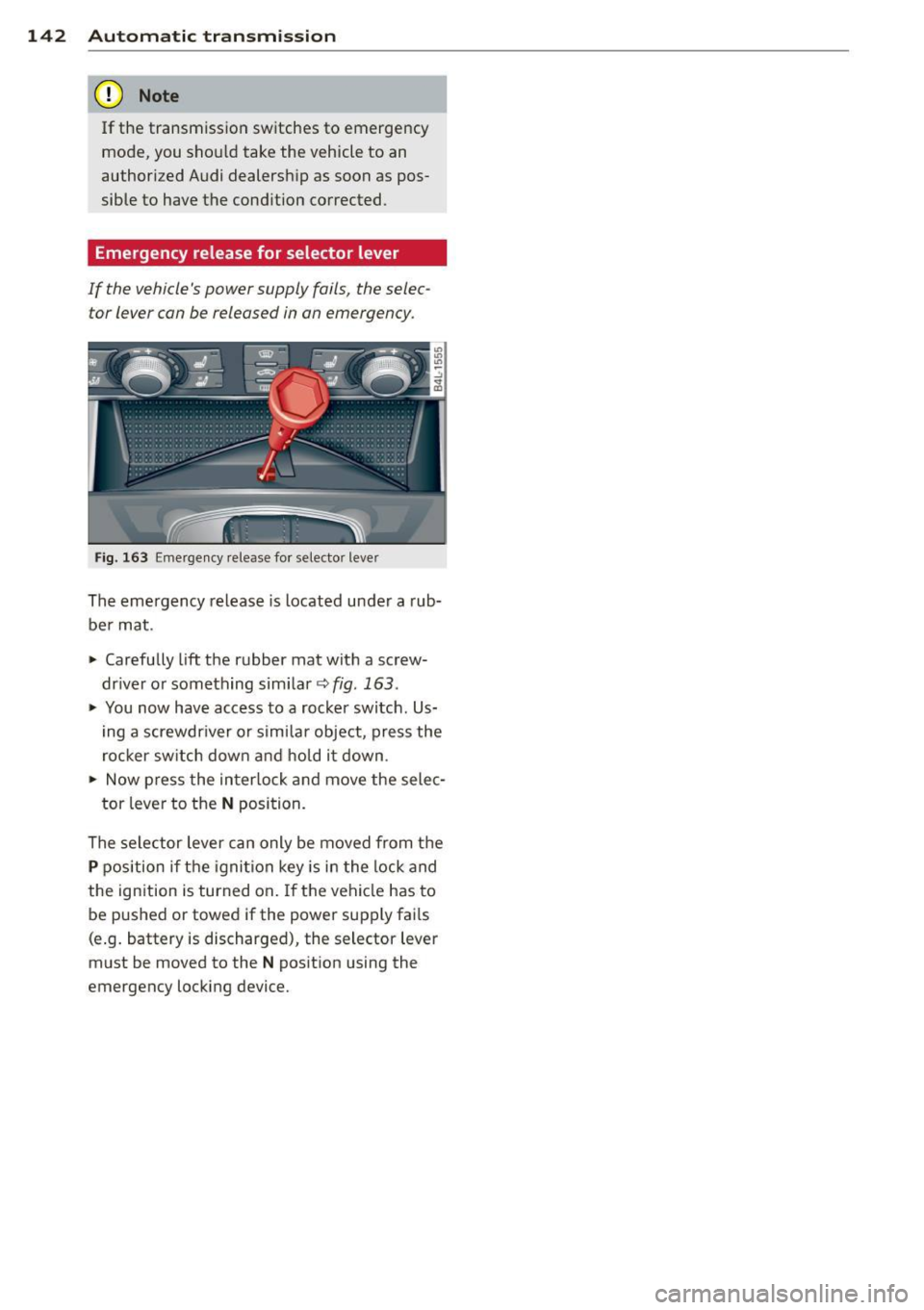
If the vehicle's power supply fails, the selec tor lever can be released in an emergency .
Fig. 163 Emergency release fo r selecto r lever
The emergency release is located under a rub
be r mat .
.,. Carefully
lift the rubber mat with a screw
driver or something similar~
fig. 163 .
.,. You now have access to a rocker switch . Us
ing a screwdr iver or similar object, press the
rocker switch down and hold it down .
.,. Now press the interlock and move the selec-
tor lever to the
N position.
The selector lever can only be moved from the
P position if the ignition key is in the lock and
the ignition is turned on . If the vehicle has to
be pushed or towed if the power supply fai ls
(e .g. battery is discharged), the selector lever
must be moved to the
N position using the
emergency locking device.
Page 148 of 348
146 Parking systems
-The camera lens en larges and disto rts
the field of vision. The object appears
both altered and inaccurate on the
screen.
- In certain situations, people or objects in
the display appear closer or further
away:
- objects that do not touch the ground,
such as the bumper of a parked vehicle,
a trailer hitch or the rear of a truck. Do
not use the help lines in this case.
- If driven from a leve l surface onto an
incline, or a downward slope.
- If driven toward protruding objects.
- If the vehicle is carrying too much load
in the rear.
(D Note
-Always read and follow the applicable
warnings
¢ (D in General information on
page 143 .
-The orange colored orientation lines in
the MMI display show the vehicle path
depending on the steering wheel angle .
The front of the vehicle front swings out more than the rear of the vehicle. Main
tain plenty of distance so that your out
side mirror or a corner of your vehicle does not collide with any obstacles.
Switching on and off
Applies to vehicles: with Audi parking system p lus w ith
rearview camera
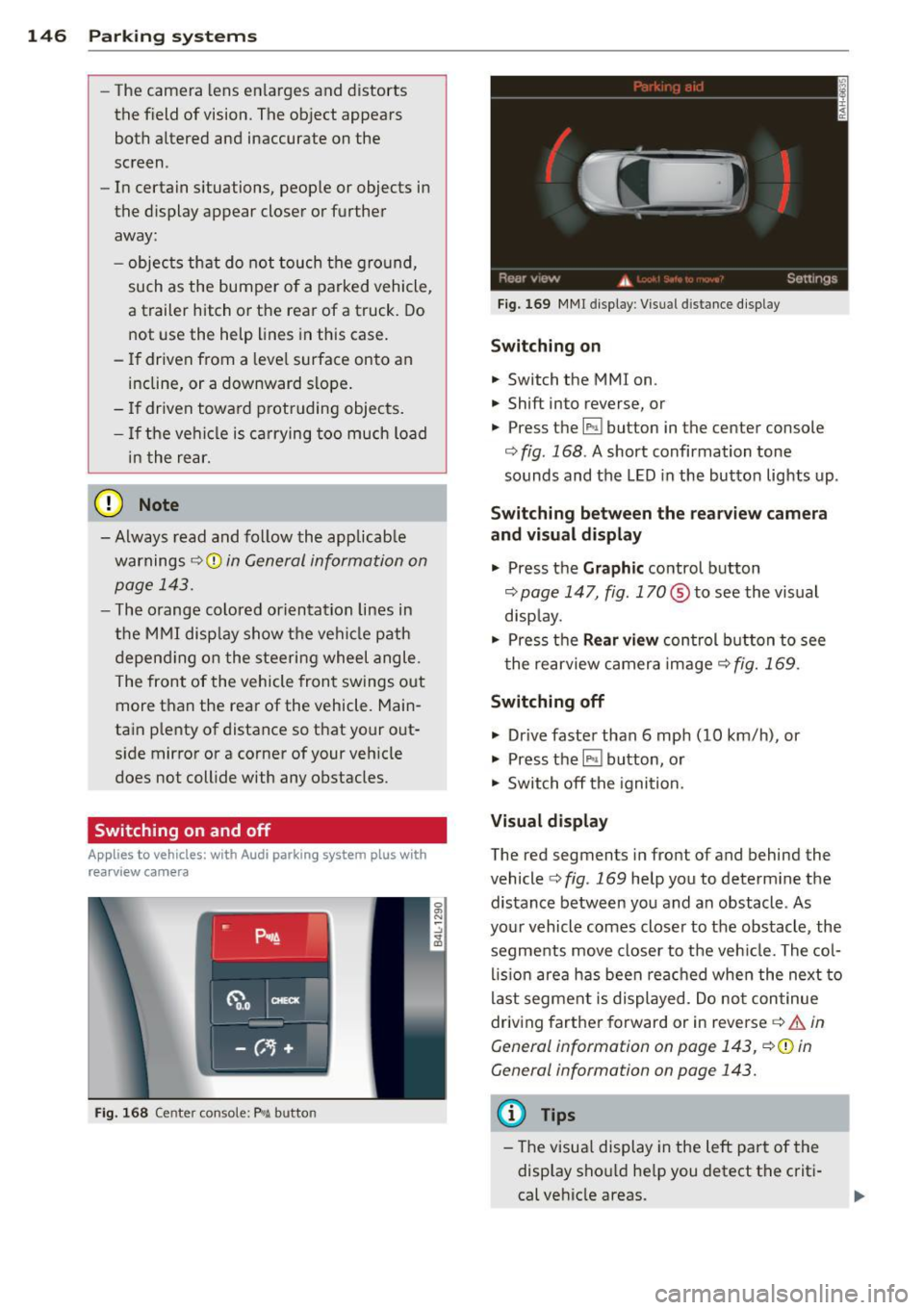
Fig. 168 Center co nsole: P"A button
Fig. 169 MMI display: Visual distance display
Switching on
.. Switch the MMI on .
.,. Shift into reverse, or
.,. Press t he[!;] button in the center console
¢ fig. 168. A short confirmation tone
sounds and the LED in the button lights up .
Switching between the rearview camera
and visual display
.,. Press the Graphic control button
¢ page 147, fig. 170 ® to see the visual
display.
.,. Press the
Rear view control button to see
the rearview camera image
c> fig. 169.
Switching off
.,. Drive faster than 6 mph (10 km/h), or
.,. Press the [!;] button, or
.,. Switch off the ignition.
Visual display
The red segments in front of and behind the
vehicle
c> fig. 169 help you to determine the
distance between you and an obstacle . As
your vehicle comes closer to the obstacle , the
segments move closer to the vehicle. The col
lision area has been reached when the next to
last segment is displayed . Do not continue
driving farther forward or in reverse
c> .&. in
General information on page 143,
c> @ in
General information on page 143.
(D Tips
-The visual display in the left part of the
display should help you detect the criti
cal vehicle areas .
Page 151 of 348
-If the position or the installation angle
of a camera was changed, after a colli
sion for example, do not continue to use
the system for safety reasons . Have it
checked by your authorized Audi dealer
ship .
- Use the
Rear mode and the Corner view
(rear)
mode only when the rear lid is
completely closed, otherwise the image
in the display will be inaccurate.
- Objects and obstacles
above the camera
are not displayed.
- Camera lenses enlarge and distort the
field of vision. The objects appear both
altered and inaccurate on the screen.
(0 Note
- Always read and follow the applicable
warnings
o0 in General information on
page 143 .
-The MMI display shows the direction in
which the rear of the vehicle is traveling
based on the steering wheel angle. The
vehicle front swings out more than the
vehicle rear. Maintain plenty of distance
so that your outside mirror or a corner of
your vehicle does not collide with any ob
stacles .
@ Tips
If the rear lid is open, the image in the
rearview camera is displayed without ori
entation lines and without blue surfac es.
Switching on or off
Applies to vehicles: with Audi parking system plus w ith
fro nt- and rearv iew ca mera
Fig. 175 Center console : P,•A but ton
Parking systems 149
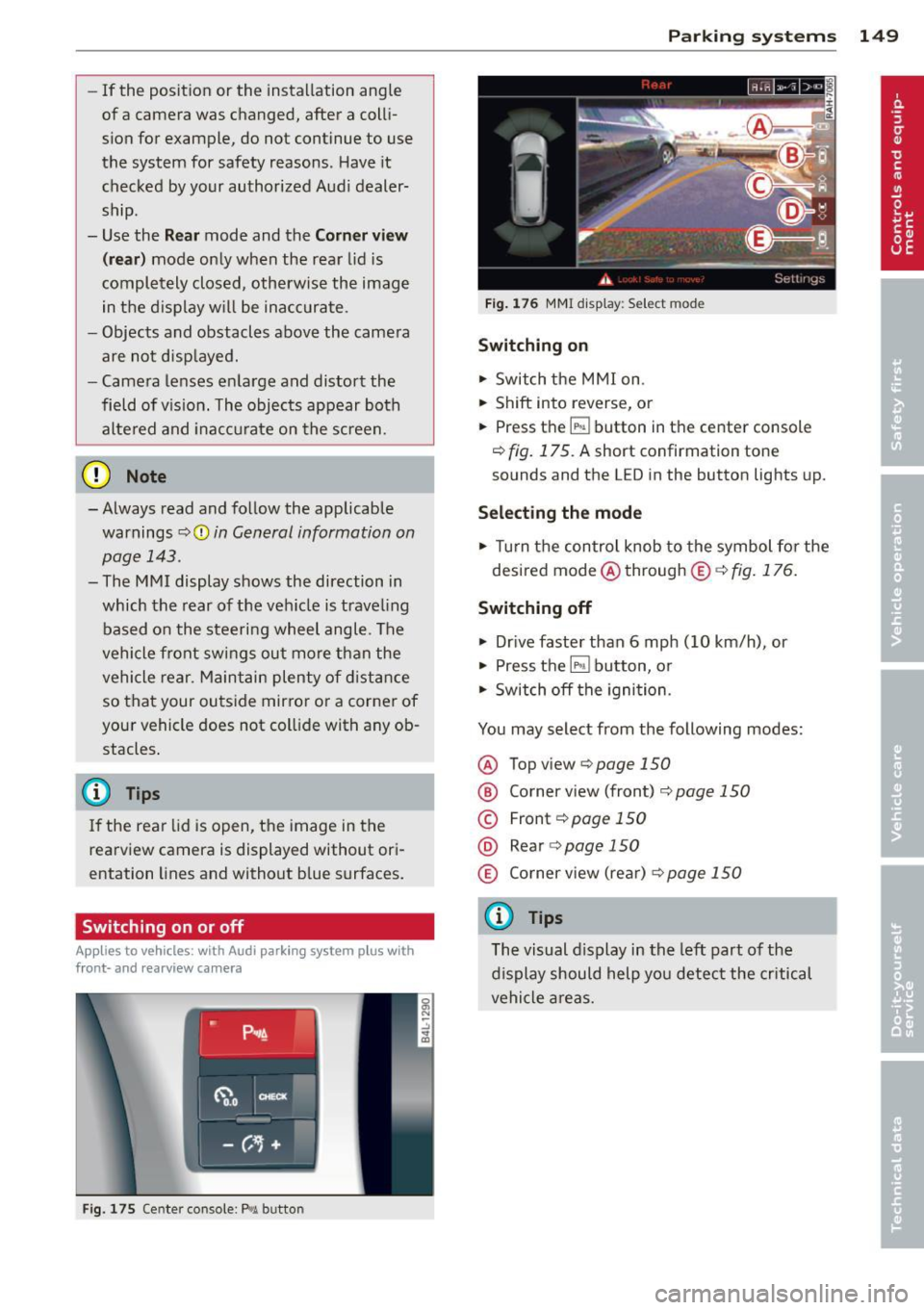
Fig. 176 MMI display: Select mode
Switching on
.,. Switch the MMI on.
.,. Shift into reverse, or
.,. Press the~ button in the center console
o fig. 175. A short confirmation tone
sounds and the LED in the button lights up.
Selecting the mode
.,. Turn the control knob to the symbol for the
desired mode @through
® o fig. 176.
Switching off
.,. Drive faster than 6 mph (10 km/h), or
.,. Press the
IP>11 button, or
.,. Switch off the ignition.
You may select from the following modes:
@ Topview opage150
@ Corner view (front) ¢ page 150
© Front¢ page 150
@ Rear o page 150
® Corner view (rear) o page 150
(D Tips
The visual display in the left part of the
display should help you detect the critical
vehicle areas.
Page 164 of 348
162 Homelink®
Programming the Homelink ®
transmitter
Applies to vehicles: with Homelink® unive rsal remote
control
The transmitter is programmed in two phas
es. For rolling code transmitters, a third
phase is also necessary .
-
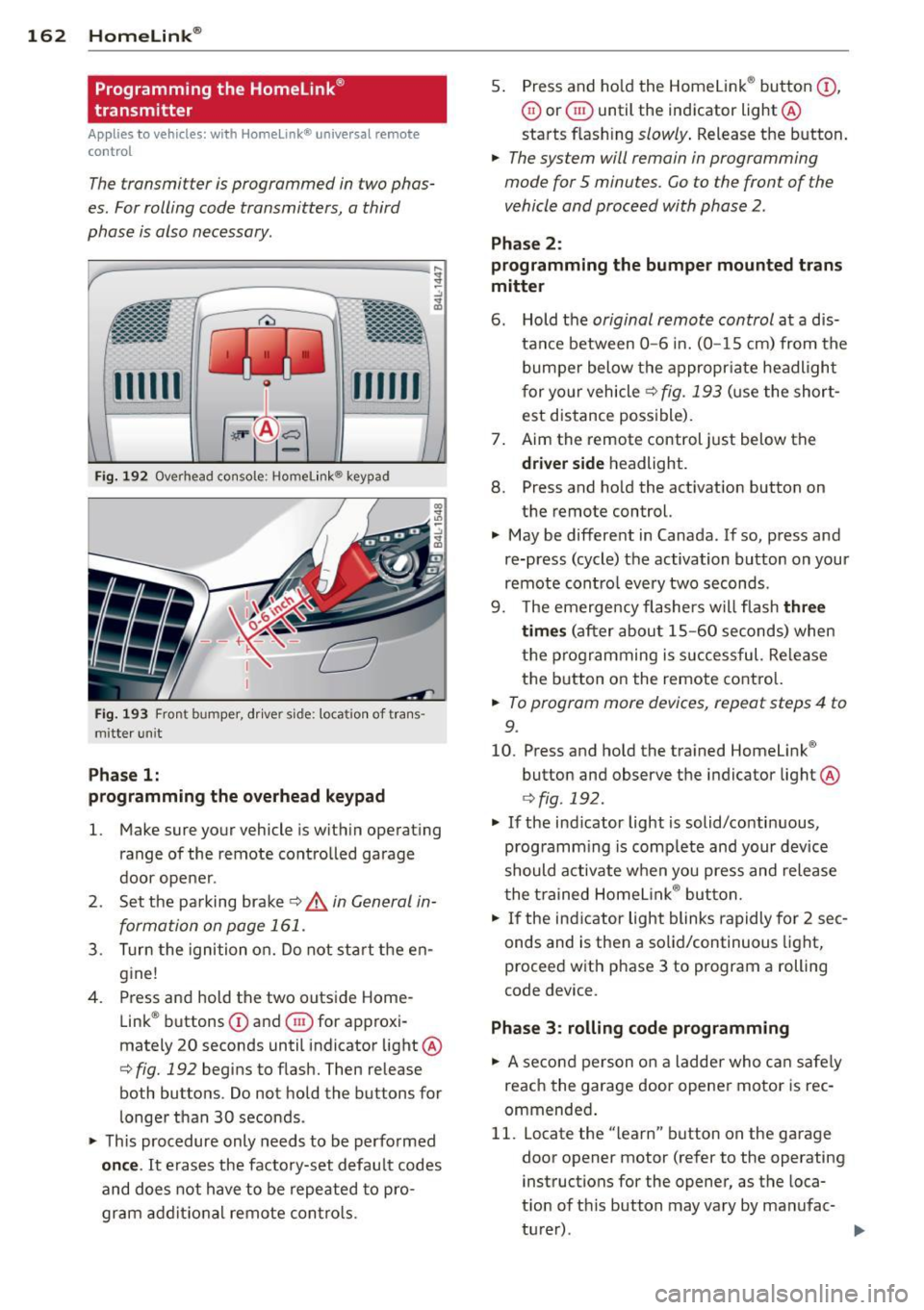
Fig. 192 Overhead co nsole ; Homelink ® keypad
Fig. 193 Front bumper, d rive r side: loca tion of trans ·
m itterun it
Pha se 1:
programming the o verhead k eypad
1. Make sure your vehicle is w ithin operat ing
range of the remote controlled garage
door ope ner .
2 . Set the parking brake~,&.
in General in
formation on page 161.
3 . Turn the ignition on. Do not start the en
g ine!
4 . Press and hold the two outside Home
Link ® buttons
CD and @for approxi
mately 20 seconds until indicator light ®
c::> fig. 192 begins to flash. Then release
both buttons . Do not hold the buttons for
l onger than 30 seconds .
.,. This procedure only needs to be performed
on ce . It erases the factory-set defau lt codes
and does not have to be repeated to pro
gram addit ional remote contro ls. 5
. Press and ho ld the Homelink ® button
(D ,
@ or @ until the indicator light®
starts flashing
slowly . Release the b utton.
.,. The system will remain in programming
mode for 5 minutes. Co to the front of the
vehicle and proceed with phase 2 .
Phase 2:
programming the bum per mounted trans
mitte r
6. Hold the original remote control at a dis
tance between
0 -6 in. (0 -15 cm) from the
bumper below the appropr iate headlight
f or yo ur vehicle
~ fig. 193 (u se the short
est distance possible) .
7 . Aim the remote control just below the
dri ver s ide headlight.
8. Press and hold the act ivat ion button on
the remote control.
.,. May be different in Canada . If so, press and
re-press (cycle) the activation button on your
remote cont ro l every two seconds .
9. The emerge ncy flashers will flash
thre e
tim es
(after about 15-60 seconds) when
t h e programming is successful. Re lease
the b utton o n the remote control.
.,. To program more devices, repeat steps 4 to
9.
10. Press and hold the trained Homelink ®
button and observe the indicator light ®
¢fig . 192 .
.,. If the ind icator light is solid/co nti nuous,
programm ing is comp lete and your device
should a ctivate w hen you press and release
t he t rained Homelink ® button.
.,. If the ind icator light blinks rapidly fo r 2 sec
onds and is then a solid/continuous light,
proceed w ith phase 3 to program a rolling
code device.
Phase 3 : rolling code programming
.,. A second person on a ladder who ca n safe ly
reach the garage door opener motor is rec
ommended .
11. Locate the "learn" button on the garage
door opener motor (refer to the operating instructions for the opener, as the loca
t ion of t his button may vary by manufac-
turer) .
~
Page 188 of 348
186 Airbag sys tem
Child restraints on the front seat - some
important things to know
• Be sure to read the impo rtant in forma tion
and heed the WARNINGS for important de
ta ils about ch ildren and Advanced Airbags
Q page 205.
Even though yo ur vehicle is equipped with an
Advanced Airbag System, make certain that
all children, especially those 12 years and
younger, a lways ride in the back seat properly
restra ined for their age and size. The airbag
on the passenger side makes the front seat a potentially dangerous place for a child to r ide .
The front seat is not the safest place fo r a
ch ild in a fo rward-faci ng ch ild safety seat. It
can be a very da ngerous place for a n infan t or
a child in a rearward -facing seat.
The Advanced Airbag System i n your veh icle
has been cer tified to comply with the require
men ts of Uni ted States Federa l Mo to r Veh icle
Safety Standard 208 as applicable at the time
your ve hicle was manufact ured.
The Standa rd requires the fron t air bag on t he
passenger side to be turned off ("sup
p ressed") if a c hild up to about one yea r of
age restrained in one of the rear-facing or for
ward-facing infant restra ints listed in Federal
Motor Vehicle Safety Standard 208 with which
the Advanced A irbag System in your vehicle
was certified has been installed on the front passenger seat . For a listing of the child re
straints that we re used to certi fy complia nce
with the US Safety Sta ndard
Q page 207.
The PASSENGER AIR BAG OFF light in the in
strument panel te lls you when the front Ad
vanced A irbag on t he passenger side has been
turned off by t he e lectronic control unit.
Each t ime you tur n on the ignition, the
PAS
SENGER AIR BAG OFF
li ght w ill come on for a
few seconds a nd:
- will stay on if the front passenger seat is not
occupied
- will stay on if there is a small child or child
rest raint on the front passenger seat -
w ill go off i f the front passenge r seat is oc
cupied by an adult as registere d by the
weight -sensing mat
r::!) page 195, Monitor
ing the Advanced Airbag System.
T he PASSENGER AIR BAG OFF light comes on
whe n the contro l unit detects a tota l weight
on the front passenger seat that req uires the
front a irbag to be turned off.
If the total weight on the front passenge r
seat is more than that of a typica l 1 year -old
c hi ld b ut less than the we ight of a small
adult, the front airbag on the passenger side
can deploy (the
PASSENGER AIR BAG OFF
li ght does not come on). If the PASSENGER
AIR BAG OFF
light does not come on , the
front a irbag on the passenger side has not
bee n tur ned off by the elec tronic con trol unit
and can deploy if the control uni t se nses an
impact that meets the con ditions stored i n its
memo ry .
For exampl e, the airbag may deploy if:
- a small ch ild that is heav ie r th an a typical 1
year-old ch ild is on the front passenger seat
( r egard less of whethe r the child is in one of
t he child safety seats listed
<:!) page 207), or
- a child who has outgrown ch ild restraints is
on t he front passenge r seat.
If the front passenger airbag is turned off, the
PASSENGER AIR BAG OFF light comes on in
the instr ume nt cluster and stays on.
The front airbag on the passenger side may
not deploy (the PASSENGER AIR BAG OFF
li gh t does not illum inate and stay lit) even if a
small ad ult o r teenager, or a passenger who is
not sitt ing up rig ht w ith their back against a
non- re cli ned ba ck res t w it h thei r feet on the
vehicle f loor in front of the sea t is on the front
passenge r seat
c::> page 1 66, Proper sea ting
position for the driver.
If t he fron t passenger a irbag dep loys, the
F ede ral Standard req uires the airbag to meet
t h e "low risk" dep loyment criteria to red uce
the risk of injury t hro ugh interactio n wit h the
airbag. "Low risk" dep loyment occ urs in those
crashes that take place at lower dece lerat ions ..,_
Page 189 of 348
as defined in the electronic control unit
¢ page 195, PASSENGER AIR BAG OFF light .
Always remember, a chi ld safety seat or infant
carrier installed on the front seat may be
struck and knocked out of position by the rap
id ly inflating passenger's airbag in a frontal
coll is ion . The airbag cou ld greatly reduce the
effectiveness of the child restraint and even
seriously injure the child during inflat ion.
F or this reason, and because the back seat is
the safest p lace for children -when properly
restra ined accord ing to their age and si ze - we
strongly recommend that children always sit in the back seat¢
page 205, Child Safety.
A WARNING
A child in a rearward-facing child safety
seat insta lled on the front passenger seat
w ill be seriously injured and can be k illed if
t he fron t airbag inf lates - even with an Ad
vanced Airbag System .
- The inflating a irbag w ill hit the child
sa fety seat or infant carrier w it h great
f orce and w ill smash the ch ild safety seat
and child against the backrest, center
armrest, door or roof.
- Always install rear -facing child sa fety
seats on the rear seat.
- If you mus t install a rearward facing
child safety seat on the front passenger
seat because of exceptional circ umstan
ces and the
PASSENGER AIR BAG O FF
light does not come on and stay on, im
med iately install the rear-facing child
safety seat in a rear seating posit ion and
have the a irbag system inspected by you r
authori zed Aud i dealer.
- Forward-fac ing ch ild safety seats instal
led on the front passenger's seat may in
terfere with the deployment of the air
b ag and cause serious person al injury to
the ch ild .
WARNING
If, in exceptional c ir c umstances, you mus t
install a forwa rd -facing child restra int on
the front passenger's seat:
A irbag system 187
-Always ma ke sure the forward-facing
seat has been designed and certified by its manufacturer for use on a front seat
with a passenger front and s ide a irbag.
- Never put the forward-facing child re
straint up against or very near the instru ment panel.
- Always move the passenger seat into its
rearmost position in t he seat's fore and
aft adj ustment range, as fa r away from
the airbag as possible before installing
the forward-fa cing ch ild restra int. The
backrest mu st be a dju ste d to an upright
posi tion.
- Ma ke sure that the
PASSENGER AIR BAG
OFF
li ght comes on and stays on all the
time wheneve r the ignit ion is swi tched
on.
A WARNING
To reduce the risk of serious injury, make
sure that the
PASSENGER AIR BAG OFF
light wi ll be displayed whenever a child re
straint is installed on the front passenger
seat and the ignition is sw itched on.
- If the
PASSENGER AIR BAG OFF light
does not stay on, perform the checks de
scribed ¢
page 195, Monitoring the Ad
vanced Airbag System .
-Take t he chi ld restraint off the front pas
senger seat and install it properly at one
of the rear seat positions if the
PASSEN
GER AIR BAG OFF
li g ht does not stay on.
- Have the airbag system inspected by
your author ized Audi dealer immed iate
ly.
- Always carefully follow instr uctions from
child r estraint manufa cture rs when in
s tall ing c hild restra ints.
A WARNING
If, in exce ptiona l circumstan ces, you must
ins tall a forward or rearw ard-facing c hild
restra int on the front passenger's seat:
- Imp roper ins tal lation o f ch ild restraints
can reduce their effec tiveness or even
•
•
Page 193 of 348
-Always make sure the forward-facing
seat has been des igned and certified by
its manufacturer for use on a front seat
with a passenger front and side airbag .
- Never put the forward-facing child re
straint up aga inst or very near the instru
ment panel.
- Always move the passenger seat into its
rearmost position in the seat's fore and
aft adjustment range, as far away from
the a irbag as poss ible, before insta lling
the fo rward-facing child restraint . The
b ackres t m ust be adjus ted to an upr ight
posit ion.
- Make su re that the
PASSENGER AIR BAG
OFF
light comes on and s tays on all the
t ime whenever the ignition is switched
on .
Advanced Airbag System components
The front passenger seat in your vehicle has a
l ot of very important parts of the Advanced
Airbag System in it. These parts include the
weight-sens ing mat, sensors, wiring, brack
ets, and more . The function of the system in
the front passenger seat is checked by the
e lectronic control un it when the ignit ion is on .
The control un it mon itors the Advanced Air
bag Sys tem and turn s the a irbag in dica tor
light on when a ma lfunction in t he system
components is detected . The function of the
airbag indicator light is described in greater
deta il below. Because the front passenger
seat contains important parts of the Ad
vanced A irbag System, you must take care to
prevent it from being damaged . Damage to
the seat may p revent the Advanced A irbag for
the front passenger seat from doing its job in
a crash .
The front Advanced Airb ag System
consists of the following:
- Crash sensors in the front of the veh icle that
measu re ve hicle accelera tion/decele ra ti on
to provide inform ation to the Advanced Air
bag System about the severity of the crash.
A irbag system 19 1
-An elect ron ic cont ro l unit, with integrated
crash sensors for front and side impacts .
The control un it "decides" whether to f ire
the front a irbags based on the informat ion
received from the crash sensors. The control
unit also "decides" whether the safety belt
prete nsioners shou ld be act iva ted.
- An Advanced A irbag w it h gas generator for
the driver inside the steering wheel hub .
- An Advanced A irbag w ith gas generator in
side the instrument pa nel for the front pas
senge r.
- A weight-sensing mat under the upholstery
padding of the front passenge r seat cushion
that measures the to tal weight o n the seat.
The informat ion reg iste red is sent continu
ously to the elect ronic con trol u nit to regu
la te deployment of the front Adv anced Air
bag on the passenger side .
- An airbag moni tori ng sys tem and ind ic a tor
light in the instr ument cluster
q page 195.
- The PASSENGER AIR BAG OFF ligh t comes
on and st ays on in the cen ter o f th e instr u
ment panel
q page 195, fig . 212 and tells
you whe n the front Advanced Airbag on the
passenger side has been tu rned
off .
-A sensor below the safety be lt latch fo r the
front seat passenger to measure the tension on the safety be lt . The tension on the safety
be lt and the weight registered by the
weight-sensing mat he lp the control unit
"decide" whether the front a irbag for the
front passenge r seat should be turned
off or
not
q pag e 186, Child restraints on the
front seat -some important things to
know.
- A senso r in the safety belt latch fo r the d riv
er a nd fo r the fro nt sea t passenger tha t
senses w hethe r that safe ty belt is latched or
no t and transmi ts this informa tion to the
electronic control unit.
.&_ WARNING
Damage to the front passenger seat can
prevent the front airbag from work ing
properly.
-
•
•
Page 195 of 348
first and second stages deploy almost at the
same time.
On the passenger side, regard less of safety
be lt use, the airbag will be turned off if the
weight on the passenger seat is less than the
amo unt programmed in the electronic control
un it. The front airbag on the passenger side
w ill also be turned off if one of the child safe
ty seats that has been certified under Federal
Motor Vehicle Safety Standard 208 has been
recog nized on the seat . The
PASSENGER AIR
BAG OFF
light comes on and stays on to tell
you when the front Advanced Airbag on the passenger side has been t urned off
Q page 186, Child restraints on the front seat
- some important things to know .
_&. WARNING
To reduce the risk of injury when an airbag
inf lates, a lways wear safety belts properly.
- If you are unrestrained, lean ing forward,
sitting sideways or out of position in any
way, yo ur risk of inj ury is much higher.
- You w ill also receive serio us injuries and
cou ld even be killed if you are up against
the a irbag or too close to it when it in
flates -even with an Advanced Airbag
Q page 184.
More important things to know about
front airbags
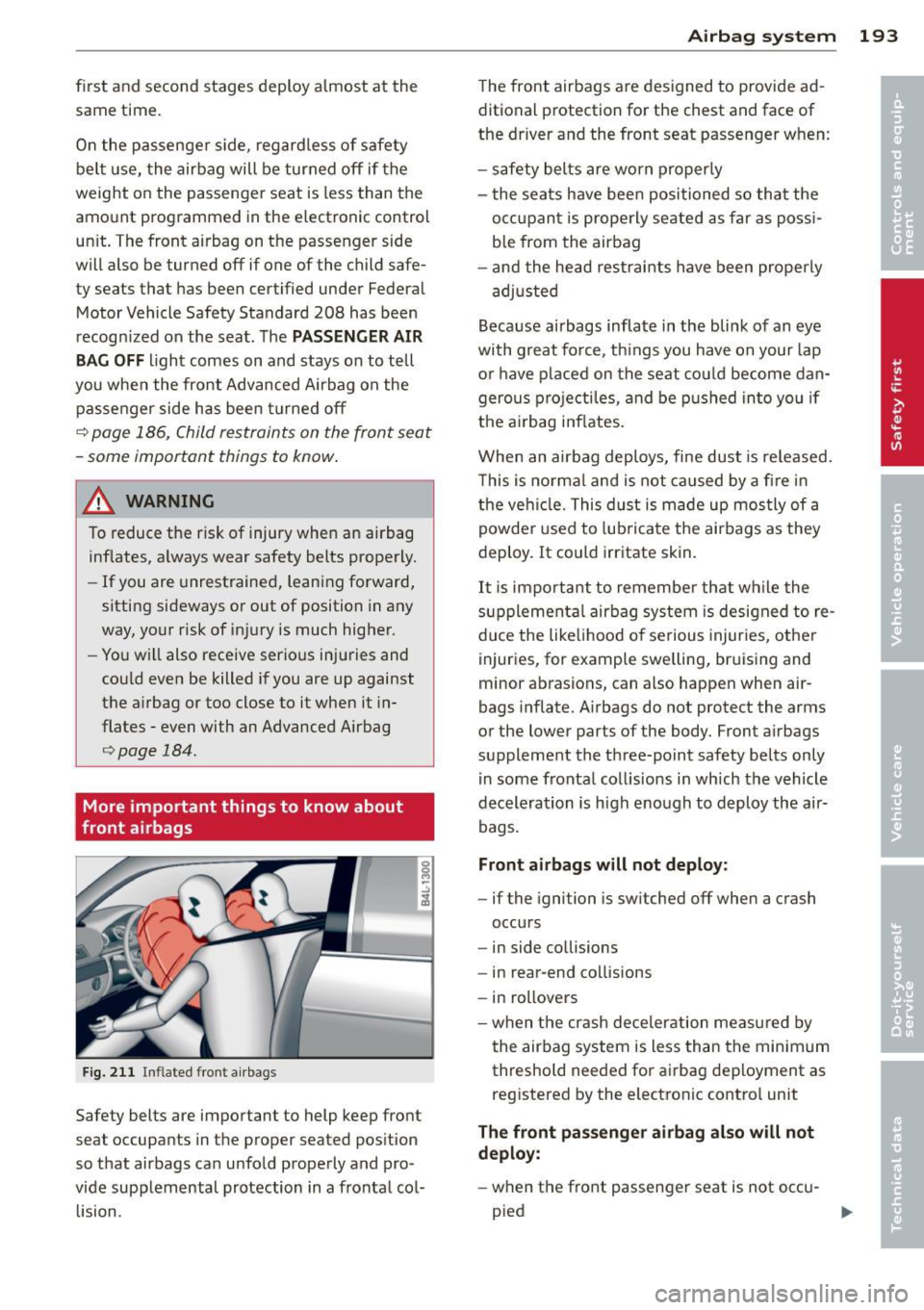
F ig. 2 11 Inflated front airbags
Safety belts are important to help keep front
seat occupants in the proper seated pos ition
so that airbags can unfo ld properly and pro
vide supplemental protection in a fronta l col
l ision.
A irba g sy stem 193
The front airbags are designed to provide ad
ditional protection for the chest and face of
the driver and the front seat passenger when:
- safety belts are worn properly
- t he seats have bee n positioned so that the
occ upan t is properly seated as far as poss i
b le from the airbag
- and the head restraints have been properly
adj usted
Because airbags inflate in the blink of an eye
with great force, t hings you have on your lap
or have placed on the seat co uld become dan
gerous projecti les, and be p ushed in to you if
the a irbag inf lates.
When an airbag deploys, fine dust is re leased.
T his is no rma l and is not caused by a fi re in
the vehi cle. This dust is made up mos tly of a
powder used to lub ricate the airbags as they
deploy. It could irritate skin.
It is important to remembe r that wh ile the
s u pplementa l airbag system is designed to re
duce the like lihood o f serious injuries, other
injuries, for example swelling, bruising and
minor abrasions, can a lso happen when air
bags inflate . A irbags do not protect the arms
or the lower parts of the body. Front airbags
supplement the th ree-point safety belts only
i n some frontal co llisions in which the vehicle
deceleration is high enough to deploy the air
bags.
Front a irbags will not deploy :
-if the ignition is sw itched off when a crash
occurs
- in side collisions
- in rear-end co llisions
- in rollovers
- when the crash dece leration meas ured by
the air bag system is less than the minimum
threshold needed for airbag deployment as
reg istered by the electronic cont ro l unit
The front passenger airbag also will not
deploy:
- when the front passenger seat is not occu-
pied ..,.
Page 197 of 348
away by getting out of the vehicle or
opening windows or doors.
-If you are in a collision in which airbags
deploy, wash your hands and face with
mild soap and water before eating.
- Be careful not to get the dust into you r
eyes, or into any cuts or scratches.
- If the residue should get into your eyes,
flush them with water.
Monitoring the
Advanced Airbag
System
Airbag monitoring indicator light
Two separate indicators monitor the function
of the Advanced Airbag System: the airbag
monitoring indicator light and the
PA SSEN ·
GER AIR BAG OFF
light.
The Advanced Airbag System (including the
e lectronic control unit, sensor circuits and sys
tem wiring) is monitored cont inuously to
make sure that it is functioning properly
whenever the ignit ion is on . Each t ime you
turn on the ignition, the airbag monitoring in
d icator light
I will come on for a few seconds
(sel f diagnos tics) .
The system must be inspected when the
indicato r light
I:
- does not come on when the ignit ion is
switched on
- does not go out a few seconds after you
have swi tched o n the ignition, o r
- comes on w hile driving
If an airbag system malfunct ion is detected,
the indicator light will first start flashing to
catch the driver's attention and then stay on
continuously to serve as a constant reminde r
to have the system inspected immediately.
If a malfunction occurs that tur ns the front
a irbag on the passenger side off, the
PAS SEN
GER AIR BAG OFF
light w ill come on and stay
on w henever the ignition is on.
A irbag system 195
A WARNING
An airbag system that is not functioning
p roperly cannot provide supplemental pro
tection in a frontal crash.
- If the airbag ind icator light comes on, it
means that there may be something
wrong with the Advanced Airbag System .
I t is poss ible that the ai rbag w ill inflate
when it is not supposed to, or will not in
fla te when it sho uld.
- Have the airbag system inspe cted imme
diate ly by yo ur aut ho rized Aud i dea ler.
PASSENGER AIR BAG OFF light
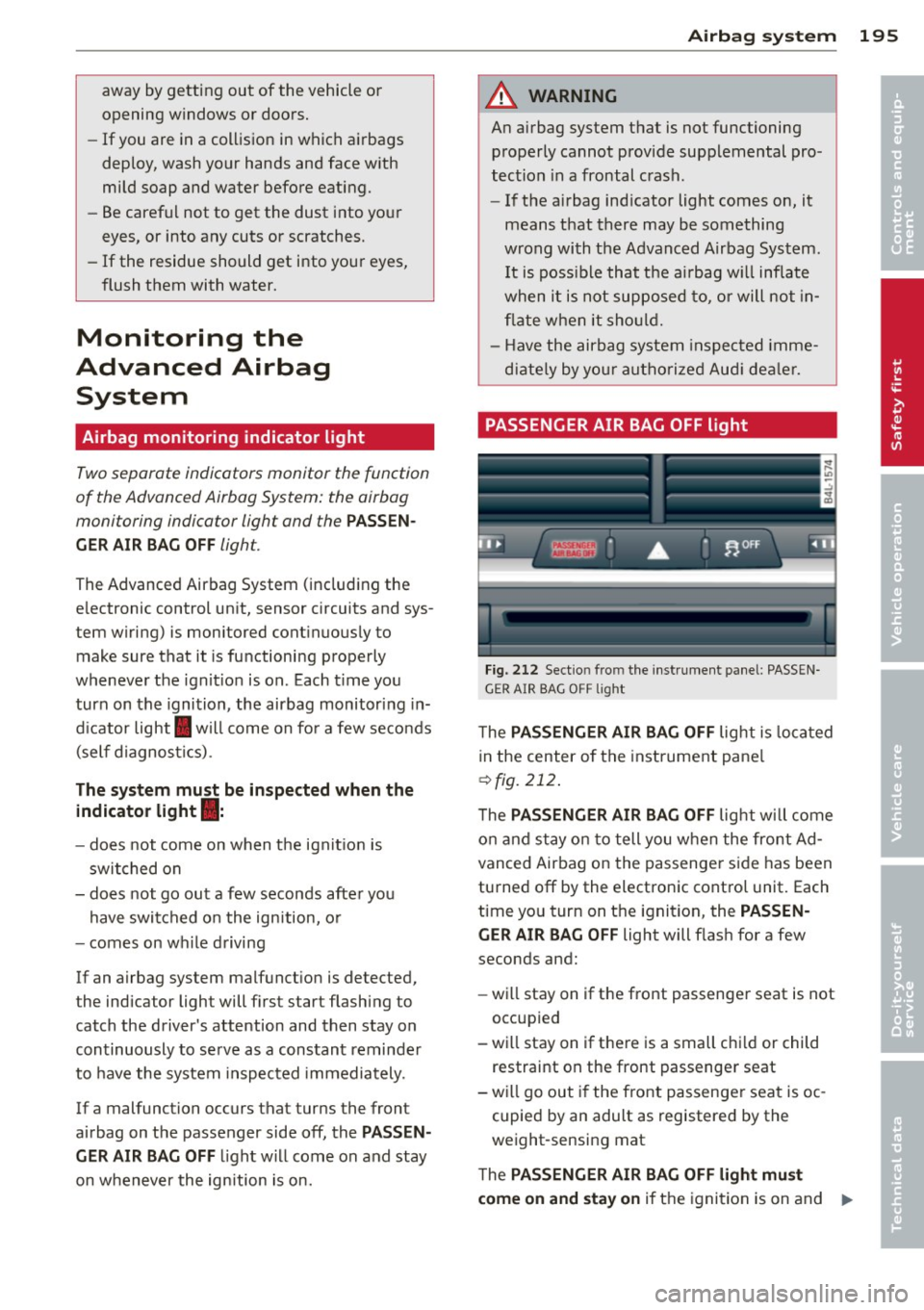
Fi g. 212 Sec tion fro m th e in str um ent pa nel: PASSEN
GER AIR BAG O FF light
-
T he PASSENGER AIR BAG OFF light is loca ted
i n the center of the instrument pa ne l
¢ fig. 212 .
The PAS SENGER AIR BAG OFF lig ht will come
o n and stay on to tell you when the front Ad
vanced Airbag on the passenger side has been
turned off by the electronic control unit. Each
t ime yo u turn on the ignition, the
PASSEN·
GER AIR BAG OFF
light will flash for a few
seconds and:
- w ill stay on if the front passenger seat is not
occupied
- w ill stay on if there is a small chi ld or child
restraint on the front passenger seat
- w ill go out if the front passenger seat is oc
cupied by an adult as registered by the
weight-sensing mat
T he
PASSENGER AIR BAG OFF light must
come on and sta y on
if the ignition is on and ..,.
•
•
Page 198 of 348
196 Airbag sys te m
- a car bed has been insta lled on the front
seat, or
- a rearward-facing chi ld restraint has been
installed on the front passenger seat, or
- a fo rward -facing child restraint has been in
sta lled on the front passenger seat, or
- the weight registered on the front passen
ger seat is equa l to or less than the com
bined weight of a typical 1 year -old restrain
ed in one of the rear-facing or forward-fac
ing infant restraints listed in Federal Motor
Vehicle Safety Standard 208 with which the
Advanced Airbag System in your veh icle was
certified.
If the front passenger seat is not occupied,
the front airbag will not deploy, and the
PAS
SENGER AIR BAG OFF
li ght will stay on. Nev
er install a rearward-fac ing c hild restra int on
the front passenger seat, the safest place fo r
a child in any kind of child restraint is at one
of the seat ing positions on the rea r seat
~ page 186, Child restraints on the front seat
- some important things to know
and
~ page 205, Child Safety.
If the PASSENGER AIR BAG OFF light c om es
on
when one of the conditions listed above is
met, be sure to check the light regularly to
make certain that the
PASSENGER AIR BAG
OF F
light stays on cont inuo usly whenever the
ignit ion is on. If the
PA SSENGER AIR BAG
OFF
light does not appear on and does not
stay on all the time, stop as soon as it is safe
to do so and
- react ivate the system by turning the ignition
off and then turning it on again;
- remove and re insta ll the chi ld restraint .
Make sure that the child restraint is properly
installed and that the safety be lt for the
front passenger seat has been correct ly
routed through the child restra int as descri
bed in the chi ld restrai nt manufacturer's in
stru ct ions;
- make sure that the convert ible locking fea
tu re on the safety belt fo r the front passen
ger seat has been a ctivated and that the
sa fe ty belt has been pulled tight. The belt
must not be loose or have loops of slack so that the sensor be
low the sa fe ty belt latch
on the seat can do its job~
page 215.
-ma ke sure that things tha t may increase the
weight of the ch ild and chi ld safety seat a re
not being t ransported on the front passen
ger seat;
- make sure that the safety belt tension sen
sor is not blocked. S hake the safety belt
latch on the front passenger seatback and
forth;
- If a strap or tether is be ing used to tie the
child safety seat to the front passenger
seat, make sure that it is not so tight that it
causes the weight-sensing mat to measure more weight than is act ually on the seat .
If the PAS SENGER AIR BAG OFF light still
does not come on
and does not stay on con
t in uous ly (when the ignition is switched on),
- take the child restraint off the front passen-
ger seat and install it properly at one of the
rear seat positions. Have the airbag system
inspected by your authorized Aud i dealer
immed iately.
- move the child to a rear seat position and
make sure that the ch ild is properly restra in
ed in a ch ild restra int that is app rop riate for
its s ize and age.
The
PASSENGER A IR BAG OFF light should
NOT come on when the ignit ion is on and an
adult is s itting in a proper seating position on
t h e front passenge r seat. If the
PASSENGER
AIR BAG OFF
light comes on and s tays on o r
f lashes fo r about 5 seconds w hile d riving, un
der these ci rcumstances, make sure tha t:
- the adult on the front passenge r seat is
prope rly seated on the cente r of the sea t
cushion wi th his or her back up aga inst the
backrest and the backrest is not recl ined
~ page 166 , Proper occupant seating posi
tions,
- the adult is not taking weight off the seat by
holding on to the passenger assist handle
above the front passenger door or support-
ing their weight on the armrest, .,.