service AUDI Q7 2017 Owner´s Manual
[x] Cancel search | Manufacturer: AUDI, Model Year: 2017, Model line: Q7, Model: AUDI Q7 2017Pages: 402, PDF Size: 100.39 MB
Page 355 of 402
u co ...... N r-... N ...... 0
0
:E: '
working .
I f it is no longer possib le to continue dr iv ing de
spite having run-flat tires, see an authori zed Aud i
dea ler or autho rized Aud i Service Facility for as
sistance.
A WARNING
Run-flat tires may only be used on vehicles
that were equ ipped with them at the factory.
- The veh icle must have suspension designed
for run-f lat tires and a factory- installed tire
pressure monitoring system.
- Incorrect use of run-flat tires can lead to ve
hicle damage or accidents . Contact an a u
thorized Aud i dea ler or authorized Audi
Service Facility to learn if run-flat tires may be used on your veh icle and if so, which
ones.
- If run-flat tires are used, they must be in
stalled on all four wheels. Mixing tire types
is not permi tted.
- If you have to dr ive when the tire pressure is
too low or there is no t ire pressure, note the
following:
- Do not drive faster than 50 mph (80 km/
h) because this increases the risk of an ac
cident. Observe any laws spec ific to the
country where you are driv ing.
- Avoid full-throttle acceleration, heavy
braking, and fast cornering, because this
increases the risk of an accident.
- The vehicle may become more difficult to
control.
- See an authorized Aud i dealer or author
ized Audi Service Fac ility for assistance if
the t ire is too heavily damaged.
- Have the faulty tires replaced and the rims
checked for damage by an author ized Audi
dealer or author ized Audi Se rvice Facility.
- The driver is responsib le for the vehicle, for
correcting the t ire pressure and for rep lac
ing faulty parts . Therefore, always adjust
yo ur dr iv ing to the g iven s ituation .
Wheel s
(D Tips
-Audi Original run-flat tires can be ident ified
by the "AOE" labeling on the t ire s idewa ll.
- You can use the tire mobility kit
~ page 360 on r un-flat tires.
353
Page 356 of 402

Care and cleaning
Care and cleaning
General information
Regular, proper care helps to maintain your vehi
cle's value.
It can also be a requirement when
submitting warranty claims for corrosion damage
and paint defects on the body.
The required cleaning and care products can be
obtained from an authorized Audi dealer or au
thorized Service Facility. Read and follow the in
structions for use on the packaging .
A WARNING
-Using cleaning and care products incorrectly
can be dangerous to your health .
- Always store cleaning and care products out
of reach of children to reduce the risk of poi
soning .
@ For the sake of the environment
- Preferably purchase environmentally-friend
ly cleaning products.
- Do not dispose of leftover cleaning and care
products with household trash.
Car washes
The longer that deposits such as insects, bird
droppings, tree sap or road salt remain on the ve hicle, the more the surface can be damaged. High
temperatures such as those caused by sunlight
increase the damaging effect .
Before washing, rinse off heavy deposits with
plenty of water.
Stubborn deposits such as bird droppings or tree
sap are best removed with plenty of water and a microfiber cloth.
Also, wash the underside of your vehicle once road salt stops being used for the season .
Pressure washers
When washing your veh icle w ith a pressure wash
er, always follow the operating instructions pro
vided with the pressure washer. This is especially
important in regard to the pressure and spraying
distance. Do not aim the spray directly at the
354
seals on the side windows, doors, lids or the sun
roof* or at tires, rubber hoses, insulating materi
al, sensors* or camera lenses* . Keep a distance of
at least 16 in (40 cm).
Do not remove snow and ice with a pressure
washer.
Never use cone nozzles or high pressure nozzles.
The water temperature must not be above 140 °F
(60 °().
Automatic car washes
Spray off the vehicle before washing.
Make sure that the windows and roof* are closed
and the windshield wipers are off . Follow instruc
tions from the car wash operator, especially if
there are accessories attached to your vehicle.
If possible, use car washes that do not have
brushes.
Washing by hand
Clean the vehicle starting from the top and work
ing down using a soft sponge or cleaning brush.
Use solvent-free cleaning products.
Washing vehicles with matte finish paint by
hand
To avoid damaging the paint when washing, first
remove dust and large particles from your vehi
cle. Insects, grease spots and fingerprints are
best removed with a special cleaner for matte
finish paint .
Apply the product using a microfiber cloth. To
avoid damaging the paint surface, do not use too
much pressure.
Rinse the vehicle thoroughly with water. Then
clean using a neutral shampoo and a soft micro
fiber cloth .
Rinse the vehicle thoroughly again and let it air
dry. Remove any water residue using a chamois .
A WARNING
-
- Only wash the vehicle when the ignition is
off and follow the instructions from the car
Page 358 of 402
Care and cleaning
Component Situation Solution
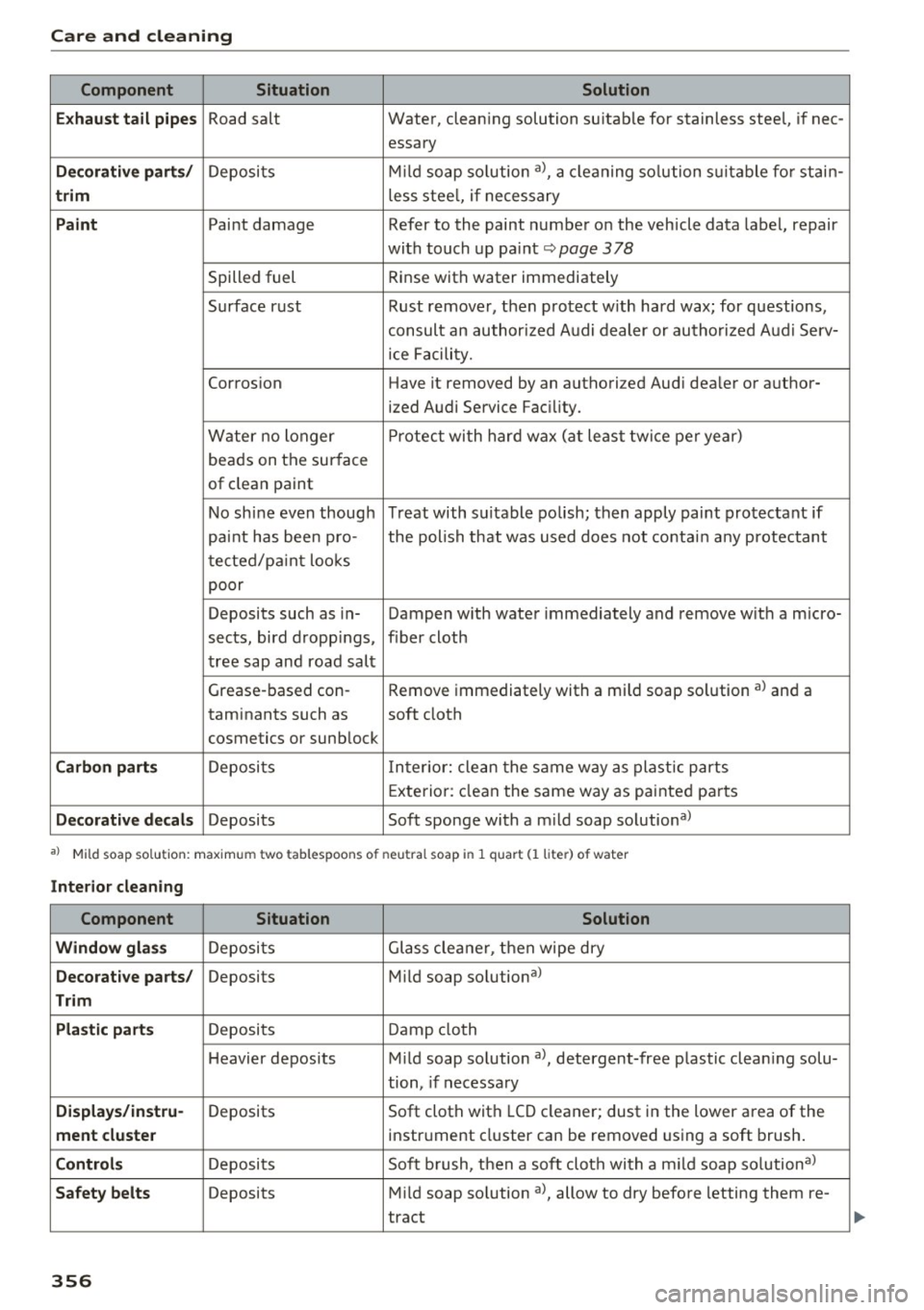
E x haust tail p ipe s
Road salt Water, cleaning solution suitab le for stainless steel, if nee-
essary
D eco ra tiv e part s/ Deposits M
ild soap so lution a), a cleaning so lution s uitable fo r stain-
trim less stee l, if necessary
Paint Paint damage Refer to t he paint number on the vehicle data label, repair
with touch up paint ~
page 378
Spilled fuel Rinse with water
immediately
Surface rust Rust remover, then protect w ith hard wax; for questions,
consult an author ized A udi dealer or authorized Aud i Serv-
ice Facility.
Corros ion Have it removed by an authorized Audi dea ler or author-
ized Audi Service Facil ity.
Water no longer P
rotect wi th hard wax (at least tw ice per year)
beads on the sur face
of clean paint
No shine even though Treat wit h su itable polish; then apply paint protectant if
paint has been pro- the polish that was used does not conta in any protectant
tected/pa int looks
poor
Deposits such as in- Dampen w ith water immediately and remove w it h a micro-
sects, bird dropp ings, f iber cloth
tree sap and road salt
Grease-based con- Remove immediately with a mi ld soap so lution a) and a
taminants such as soft cloth
cosmetics or sunblock
Carbon parts Deposi ts Inter ior: clean the same way as plastic parts
E xterior : clean the same way as painted pa rts
Decorat iv e decal s Deposits Soft sponge with a mild soap solutiona l
a) Mi ld soap solution: maximum two tablespoons of neutral soap in 1 quar t Cl liter) of water
Interior cle aning
Component Situation Solution
Window gla ss
Deposits Glass cleaner, then wipe dry
Decorative parts / Deposits Mild soap solutiona>
Trim
Pla sti c parts
Deposits Damp cloth
Heavier deposits M ild soap solution al, detergent-free p lastic clean ing solu-
tion, if necessary
Di splay s/instru-Deposits Soft cloth with
LCD cleaner; dust in the lower area of the
ment cluste r instrument cluster can be removed using a soft brush .
Controls Deposits Soft brush, then a soft cloth with a m ild soap solutiona >
Safety belts Deposits Mild soap solution al, allow to dry before letting them re-
tract
356
Page 360 of 402
Care and cleaning
avoid scratches, move the scraper only in
one direction and not back and forth.
- Never remove snow or ice from door win
dows and mirrors using warm or hot water
because this could cause cracks to form.
- To avoid damage to the rear window de fogger, do not apply any stickers on the
heating wires on the inside of the window.
- Decorative parts/trim
- Never use chrome care or cleaning prod-
ucts.
- Paint
-To reduce the risk of scratches, the vehicle
must be free of dirt and dust before pol
ishing or waxing.
- To prevent paint damage, do not polish or
wax the vehicle in direct sunlight.
- To reduce the risk of paint damage, do not
polish away rust spots.
- Remove cosmetics and sunscreen immedi
ately -these could damage the paint.
- Displays/instrument cluster
- Make sure that the instrument cluster is
switched off and has cooled off before
cleaning it.
- Displays, the instrument cluster and the
trim surrounding it must not be cleaned
with dry cleaning methods because they could become scratched.
- Make sure no fluids enter the spaces be
tween the instrument cluster and the
trim, because that could cause damage.
- Controls
- Make sure that no fluids enter the con-
trols, because this could cause damage.
-Safety belts
- Do not remove the safety belts to clean
them.
- Never clean safety belts or their compo
nents chemically or with corrosive fluids
or solvents and never allow sharp objects
to come into contact with the safety belts.
This could cause damage to the belt web bing.
- If there is damage to the webbing, the
connections, the retractors or the buckles,
358
have them replaced by an authorized Audi
dealer or authorized Audi Service Facility.
-Textiles/artificial leather/ Alcantara
- Never treat artificial leather/ Alcantara
with leather care products, solvents, floor
polish, shoe polish, spot remove or similar
products .
- Have a specialist remove stubborn stains
to prevent damage.
- Never use steam cleaners, brushes, hard
sponges, etc. when cleaning .
- Do not turn on the seat heating* to dry the
seat .
- Objects with sharp edges, such as zippers
or rivets on clothing or belts, can cause
damage to the surface.
- Open hook and loop fasteners, for exam
ple on clothing, can damage seat covers .
Make sure hook and loop fasteners are
closed.
- Natural leather
- Never treat leather with solvents, floor
polish, shoe polish, spot remover or simi
lar products.
- Objects with sharp edges, such as zippers
or rivets on clothing or belts, can cause
damage to the surface.
- Never use steam cleaners, brushes, hard
sponges, etc. when cleaning.
- Do not turn on the seat heating* to dry the
seat.
- To help prevent the leather from fading,
do not leave the vehicle in direct sunlight
for long periods of time. If leaving the ve
hicle parked for long periods of time, you
should cover the leather to protect it from
direct sunlight.
{D Tips
- Insects are easier to remove from paint that
has been freshly waxed.
- Regular waxing can prevent rust spots from
forming.
Page 361 of 402
u co ...... N r-... N ...... 0
0
:E: '
of service
If you would like to take your vehicle out of serv
ice for a longer period of time, contact an author
i zed Audi dealer or authorized Audi Service Fac ili
ty . They w ill advise you of important measures,
such as corros ion p rotection, service and storage
p rocedures. Also follow the i nfo rmation about
the vehicle batte ry¢
page 330 .
Care and cleaning
359
Page 363 of 402
u (0 ...... N r--. N ...... 0
0
:E
Service Facility for assistance in these situations.
A WARNING
- Please note that the tire mob ility kit cannot
be used in all situations, and that it may on
ly be used temporarily.
- The tire sealant must not come in contact
with sk in, eyes, or clothes.
- If tire sealant gets in your eyes or on your
sk in, thoroughly rinse the affected area im
med iately w ith clean water.
- Do not inhale the fumes.
- If you swallow any of the t i re sealant, thor-
o ughly rinse yo ur mouth immediately and
drink a lot of water. Do not induce vomiting .
Seek medical attention immediately.
- Change your clothes immed iate ly if they get
t ire sealant on them.
- If an allergic reaction occurs , seek immedi
ate medical attention.
- Keep the tire sea lant away from children .
@ Tips
-If sealant lea ks, allow it to dry in pl ace. Yo u
ca n the n pee l it off like a sticker.
- Note the e xpiration date on the sealant bot
t le . Repl ace the tire sea lant a t an author
i zed Audi dealer or author ized Audi Se rvice
Facility .
- Radio reception can be interrupted when
operating the compressor.
- Obey all laws.
Repairing tires
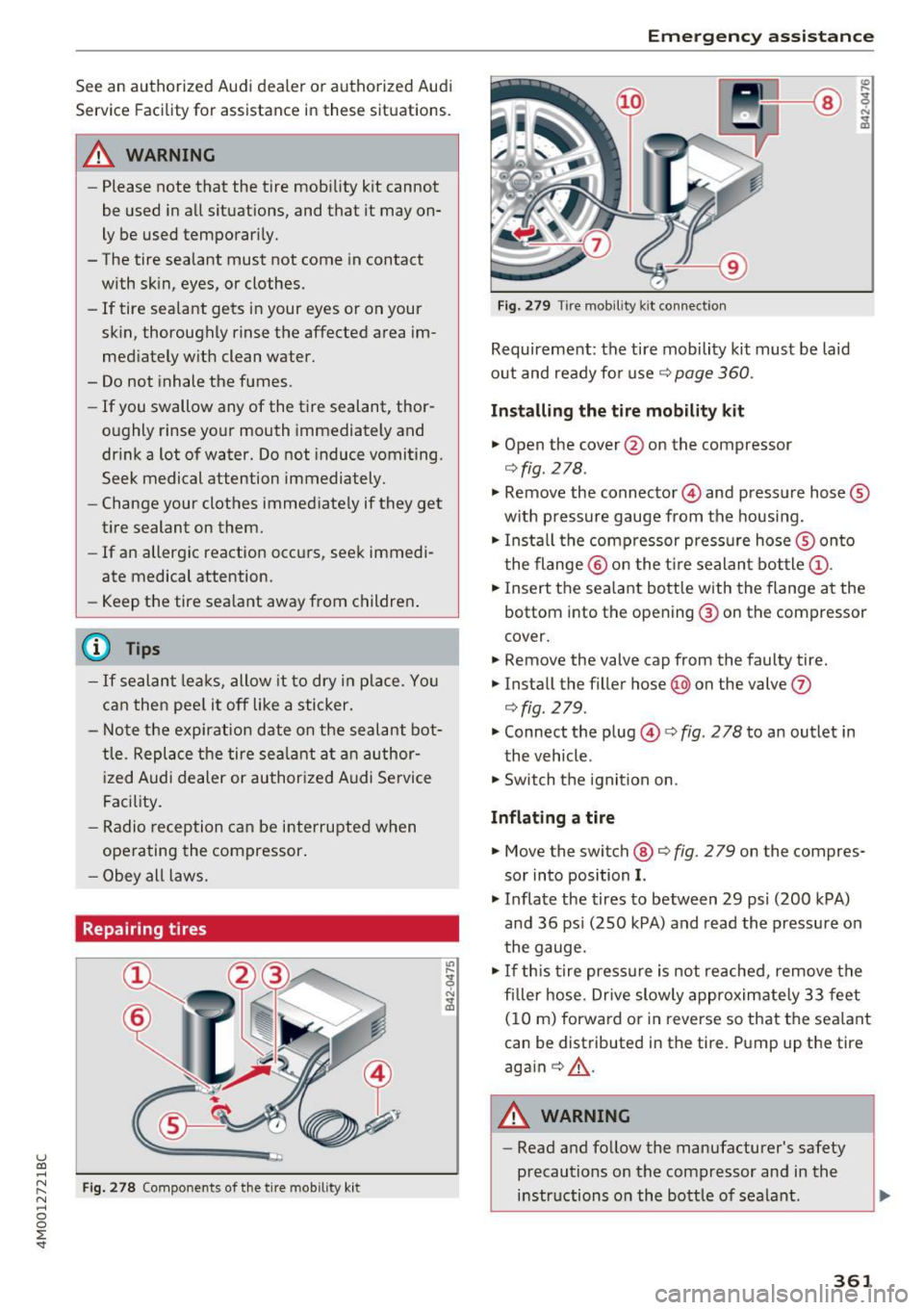
Fig . 278 Co mponents of t he t ire mobility k it
Em ergen cy a ssis tanc e
Fig. 279 Tire mobil ity k it connect ion
Requirement: the tire mobility kit must be laid
out and ready fo r use ¢
page 360 .
Installing the tire mobility k it
.,. Open the cover @ on the compressor
¢fig . 2 78 .
.,. Remove the connector © and pressure hose ®
w ith pressure gauge from the housing.
.,. Insta ll the compressor press ure hose ® onto
t he flange @ on the t ire sealan t bot tle (!) .
.,. Insert the sea lant bottle with the flange at the
bottom into the opening ® on t he compressor
cover .
.. Remove the valve cap from the faulty t ire.
.. Install the filler hose@on the valve
0
¢fig. 279.
.,. Connect the plug©¢
fig. 2 78 to a n outlet in
the vehicle.
.,. Switch the ignit ion on .
Inflating a tire
.. Move the switch@¢ fig. 2 79 on the compres
sor into position
I.
.,. Inflate the tires to between 29 psi (200 k PA)
and 36 ps i (250 kPA) and read the pressure on
the gauge .
.,. If th is tire press ure is not re ached, remove the
fi ller hose. Drive slowly appro ximately 33 feet
( 1 0 m) forward or in reverse so that the sea lant
can be distr ibuted in the tire. Pump up the tire
aga in ¢ ,& .
A WARNING
--Read and follow the manufacturer's safety
precautions on the compressor and in the instr uctions on the bottle of sealant .
361
Page 364 of 402
Emergency assistance
-If a tire pressure of 29 psi (200 kPA) cannot
reached after inflating for 6 minutes, then
the tire is too severely damaged. Do not
continue driving.
- If the tire cannot be repaired with the tire
sealant, see an authorized Audi dealer or au
thorized Audi Service Facility for ass istance.
(D} Tips
Do not operate the compressor for more than
six minutes continuously, or it can overheat.
Once the compressor has cooled, you can con
tinue to use it .
Completing
"' Adhere the sticke r that says "max . SO mph
(max. 80 km/h)" that is provided w ith the tir e
mobility kit within the driver's fie ld of vision.
"'S top the vehicle after driving for about 10 mi
nutes and check the tire pressure .
"' If the tire pressure is lower than 19 psi (130
kPA), then the tire is too severely damaged. Do
not continue driving.
A WARNING
Pay attention to the following after repairing
the tire :
- Do not drive faster than SO mph (80 km/h).
- Avoid hard acceleration, braking sharply, and fast cornering.
- The vehicle may become more difficult to
control.
- If the tire is too severely damaged, see an
authorized Audi dealer or authorized Aud i
Service Facility for assistance .
@ For the sake of the environment
You can give the used tire sealant bottle to an
authorized Audi dealer or authorized Audi
Service Facility for disposal.
@ Tips
Remember to obtain a new bottle of sealant
from an authorized Audi dea ler or authorized
Audi Service Facility after repairing a tire.
362
Replacing a wheel
' Preparation
You must complete the preparation before
changing a tire .
"'Read and follow the important safety precau-
tions¢
page 360.
"' Set the park ing brake.
"' Select the P selector lever posit ion.
"' When towing a trailer: disconnect the trailer
from your vehicle.
"' Lay out the vehicle tool kit¢
page 360 and the
spare tire.
"' Switch on wheel change mode* in the Infotain
ment system:
! MENUI button> Vehicle> left
control button >
Service & checks > Air suspen
sion: wheel change.
"'Switch the ignition off.
The vehicle jack mode* switches off automatical ly at speeds above 6 mph (10 km/h).
A WARNING
When using the ve hicle jack* on a road with a
steep hill or offroad, you must take extra pre
cautions to prevent the vehicle from rolling. Use suitable objects to block the front and
back of the wheel that is diagonal from the
wheel with the flat tire.
A WARNING
You or your passengers could be injured while
changing a whee l if you do not follow these
safety precautions:
- If you have a flat tire, move a safe distance
off the road. Turn off the engine, turn the
emergency f lashers on and use other warn
ing devices to alert other motorists.
- Make sure that passengers wait in a safe
place away from the vehicle and well away
from the road and traffic.
- To help prevent the vehicle from moving
suddenly and possibly slipping off the jack*,
always fully set the parking brake and block
the front and back of the wheel diagonally opposite the wheel being changed. When
one front wheel is lifted off the ground,
~
Page 370 of 402
Fuses and bulbs
Fuse color identification
Color Current rating
in amps
Black 1
Purple 3
Light brown 5
Brown 7.5
Red 10
Blue 15
Yellow 20
White or transparent 25
Green 30
Orange 40
A WARNING
Do not repair fuses and never replace a blown
fuse with one that has a higher amp rating.
This can cause damage to the electrical sys
tem and increases the risk of fire.
(D Note
If a new fuse burns out again shortly after you
have installed it, have the electrical system
checked as soon as possible by an authorized
Audi dealer or authorized Audi Service Facili
ty .
Q) Tips
-The following table does not list fuse loca
tions that are not used.
- Some of the equipment listed in the follow
ing tables applies only to certain model ver
sions or certain optional equipment.
368
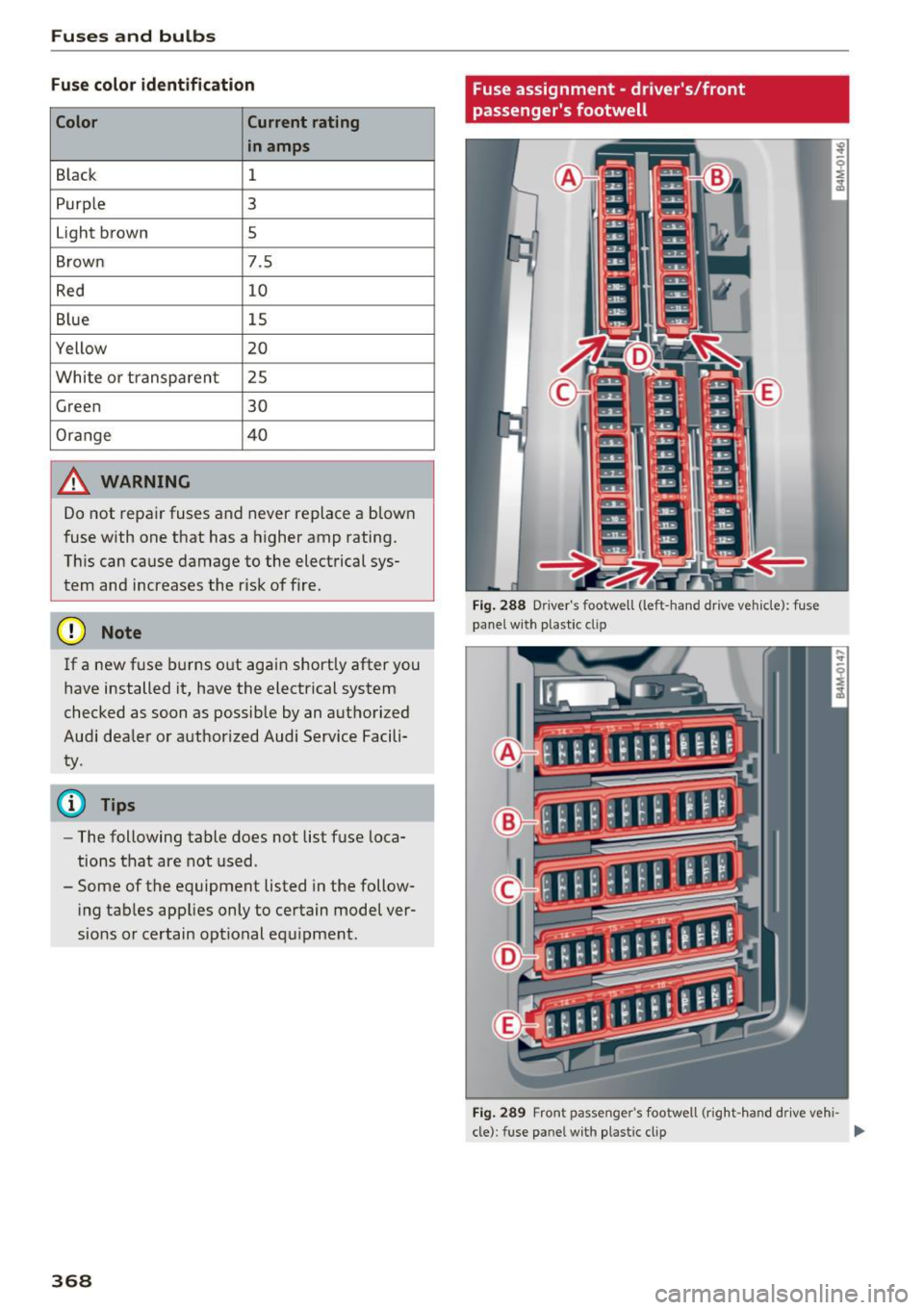
Fuse assignment - driver's/front
passenger's footwell
Fig. 288 Driver's footwell (left-hand drive vehicle): fuse
panel with plas tic clip
Fig. 289 Front passe nger's footwell (right -hand drive vehi-
cle): fuse panel with plastic clip
Ill>
Page 374 of 402
Emergency situations
Emergency situations
General
This chapter is intended for trained emergency crews and working personnel who have the nec
essary tools and equipment to perform these
operations.
Starting by pushing or
towing
(D Note
Vehicles with an automatic transmission
cannot be started by pushing or towing.
Starting with jumper
cables
If necessary, the engine con be started by con
necting it to the battery of another vehicle.
If the engine should fail to start because of a dis
charged or weak battery, the battery can be con
nected to the battery of
another vehicle, using a
pair of jumper cables to start the engine.
Jumper cables
Use only jumper cables of sufficiently large cross
section
to carry the starter current safely. Refer
to the manufacturer's specifications.
Use only jumper cables with
insulated terminal
clamps which are distinctly marked :
plus(+) cable in most cases colored red
minus(-) cable
in most cases colored black.
A WARNING
Batteries contain electricity, acid, and gas.
Any of these can cause very serious or fatal in
jury. Follow the instructions below for
safe
handling of your vehicle's battery.
-Always shield your eyes and avoid leaning
over the battery whenever possible.
-A dead battery can freeze at temperatures
around 32 °F (0 °C) . If the vehicle battery is
frozen, you must thaw it before connecting
the jump start cables.
If you do not, this in-
372
creases the risk of an explosion and chemi
cal burns. After jump starting the vehicle,
drive to an authorized Audi dealer or author
ized Audi Service Facility immediately to
have the vehicle battery checked.
- Do not allow battery acid to contact eyes or
skin . Flush any contacted area with water
immediately.
- Improper use of a booster battery to start a
vehicle may cause an explosion .
- Vehicle batteries generate explosive gases.
Keep sparks, flame and lighted cigarettes
away from batteries.
- Do not try to jump start any vehicle with a
low acid level in the battery.
- The voltage of the booster battery must also
have a 12-Volt rating. The capacity (Ah) of
the booster battery should not be lower
than that of the discharged battery. Use of
batteries of different voltage or substantial
ly different "Ah" rating may cause an explo
sion and personal injury.
- Never charge a frozen battery. Gas trapped
in the ice may cause an explosion.
- Never charge or use a battery that has been
frozen. The battery case may have be weak
ened.
- Use of batteries of different voltage or sub
stantially different capacity (Ah) rating may
cause an explosion and injury. The capacity (Ah) of the booster battery should not be
lower than that of the discharged battery.
- Before you check anything in the engine
compartment, always read and heed all
WARNINGS
r=:> poge 322.
([) Note
-Applying a higher voltage booster battery
will cause expensive damage to sensitive electronic components, such as control
units, relays, radio, etc.
- There must be no electrical contact between
the vehicles as otherwise current could al
ready start to flow as soon as the positive
(+) terminals are connected.
Page 375 of 402
u (0 ...... N r--. N ...... 0
0
:E
The discharged battery must be properly con
nected to the vehicle's electrical system .
When jump starting or charg ing the battery,
never connect the negative ground cable to
the battery negative post because the battery
manager system must be able to detect the
battery's state of charge. Always connect the
negative ground cable to the negative ground
post of the battery manager control unit.
Using the jump start
cable
Both jump start cables must be connected in the
correct order!
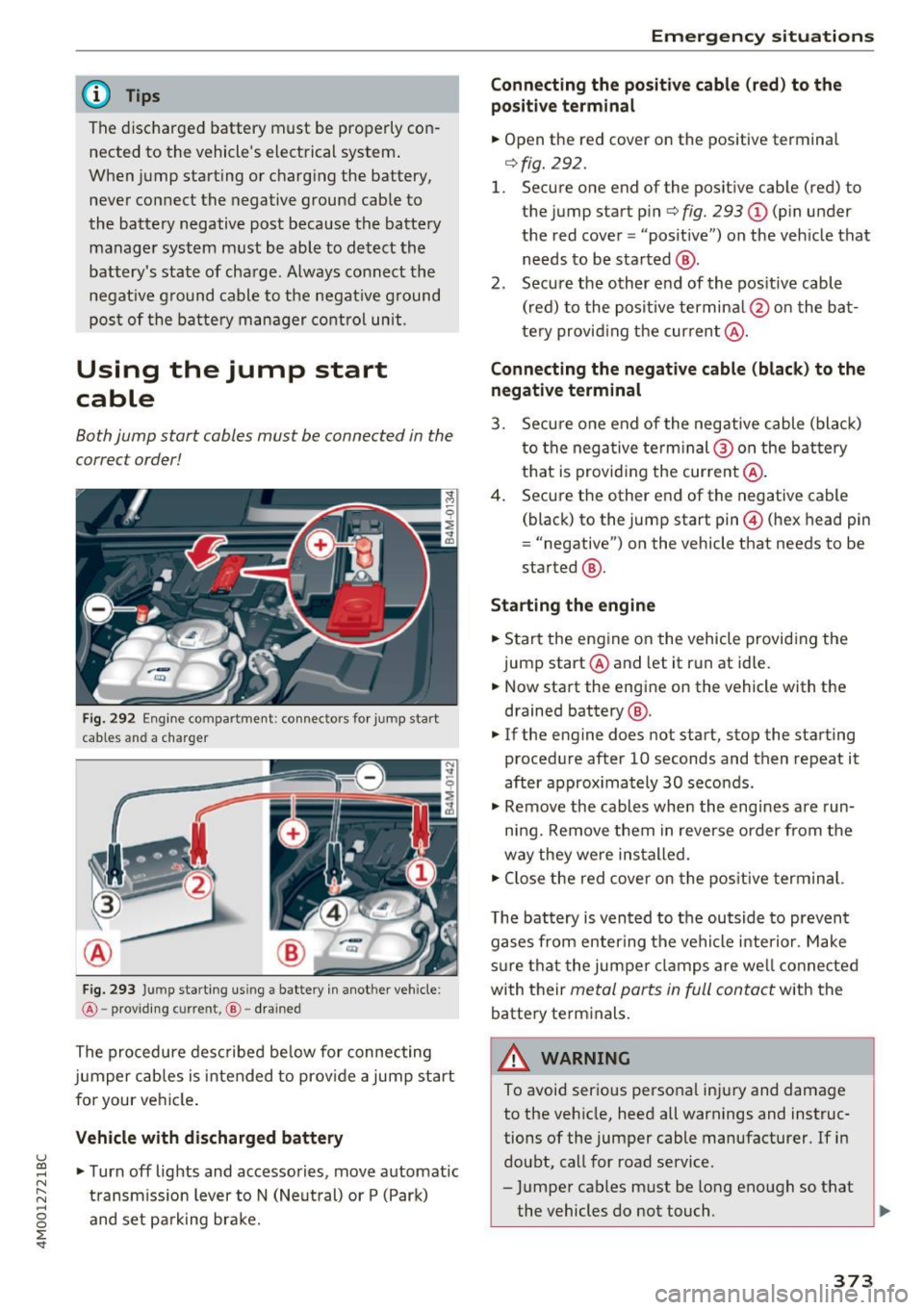
Fig. 292 Engine compartment: connect ors for jump start
cables and a charger
Fig. 293 Ju mp starting us ing a battery in another vehicle:
@ -providing current, @-drained
The procedure described below for connecting
jumper cables is intended to prov ide a jump start
for your vehicle .
Vehicle with discharged battery
•Turnoff lights and accessories, move automatic
transmission lever to N (Neutral) or P (Park)
and set parking brake.
Emergency situations
Connecting the positive cable (red) to the
positive terminal
• Open the red cover on the positive terminal
r=>fig. 292 .
1. Secure one end of the positive cable (red) to
the jump start pin
r=> fig. 293 (D (pin under
the red cover = "posit ive") on the vehicle that
needs to be started @.
2. Secure the other end of the positive cable
(red) to the positive termina l@ on the bat
tery provid ing the current @.
Connecting the negative cable (black) to the
negative terminal
3. Secure one end of the negative cable (black)
to the nega tive term inal @ on the battery
that is providing the current @.
4. Secure the other end of the negative cable
(black) to the jump start pin@ (hex head pin
= "negative") on the vehicle that needs to be
started @.
Starting the engine
• Start the engine on the vehicle providing the
jump start @and let it run at idle.
• Now start the engine on the vehicle with the
drained battery @.
• If the engine does not start, stop the starting
procedure after 10 seconds and then repeat it
after approx imately 30 seconds.
• Remove the cables when the engines are run
ning. Remove them in reverse order from the
way they were installed.
• Close the red cover on the positive terminal.
T he battery is vented to the outside to prevent
gases from enter ing the vehicle interior . Make
sure that the jumper clamps are well connected
with their
metal parts in full contact with the
battery terminals.
_& WARNING
-To avoid serious personal injury and damage to the vehicle, heed all warnings and instruc
tions of the jumper cable manufacturer. If in
doubt, call for road service.
- Jumper cables must be long enough so that
the vehicles do not touch . ..,_
373