lock AUDI Q7 2017 Owner´s Manual
[x] Cancel search | Manufacturer: AUDI, Model Year: 2017, Model line: Q7, Model: AUDI Q7 2017Pages: 402, PDF Size: 100.39 MB
Page 244 of 402
Media
Show DVD menu
The DVD main menu opens in the Info tainmen t
sys tem display.
-Selecting a menu item : select and confirm a
menu i tem.
Or : move yo ur finger on the M MI
t ouch contro l pa d* and press the contro l kno b.
Audio trackll
You can manually set the a udio track (language
and aud io format). The language and aud io for
mat op tions depend on t he v ideo DVD.
Subtitles1l
You can set subt itles for playback manua lly. The
languages available depend on t he DVD.
A spect
Aud i recommends the Automatic setting for the
p icture format. You can set the pict ure format
depending on the active fi le or source (for exam
p le video file*, DVD*).
Picture for- Description
mat
Automatic
The MMI detects the p icture for-
mat of the source and d isp lays the
i mage in the optim um ratio. Black
ba rs may appea r on the s id es of
the disp lay, depe nding on the
source forma t and the Infotain -
ment sys tem disp lay tha t is instal-
l ed .
Zoom The image is enlarged to fill the
enti re Infotai nment system d is-
pl ay. Switch the f un ction off i f th e
i mage is distorte d.
l) Depend ing o n the DVD, this may not be possib le during
playback.
242
Picture for- Description
mat
Cinema -
Use this setting for fi lms in cinema
scope format 21:9. B lack bars w ill appear
on the upper/ lower edge in the In-
fota inment system display .
Original The image is displayed in the rat io
of the so urce format . Select this
opt ion if the image is disto rted or a
section of the image is cut off
when
Auto is selected.
4 :3 Th e image is f ixed in the 4:3 pie -
tu re format . Black bars are s hown
on the sides of the In fota inment
system display.
16:9 Th e image is fixed in the 1 6:9 pie -
t u re fo rmat. Bla ck bars a re s hown
in t he upper and lower e dges of the
Infotai nment system display .
(D Tips
-Not all video D VDs have parenta l cont rol.
- T he secur ity leve ls fo r the
Parental control
are based on the US standar ds from the Mo
t ion Picture Associat ion of Ame rica (MPAA).
N ote that the a ge levels fo r video DVDs in
E uropean countries may differ.
- Password ent ry fo r
Parental control will be
locked for approximately one m inute if you
enter the inco rrect password three t imes in
a row. The passwo rd can on ly be reset by an
authorized Audi dealer.
Page 251 of 402

u co ...... N r-... N ...... 0
0
:E: '
Setting the date and
time
You can set the clock time manually or using the
CPS*.
.,. Select : I MENU I button> Settings> left control
button >
MMI settings> Date & t ime .
.,. Or:
select : IMENUI button> Vehicle > left con-
trol button >
Vehicle settings> Date & time.
Automatic setting
When this function is switched on~. the time
and date are automatically set.
Time
Requirement: the Automatic setting must be
switched
off .
Press the control knob. You can set the Time
manually by turning and pressing the control
knob.
Date
Requirement: the Automatic setting must be
switched
off.
Press the control knob . You can set the Date
manually by turning and press ing the cont rol
knob.
Time zone
When selecting the appropriate time zone, a
sampling of countr ies in this zone will be listed .
Automatic time zone*
When this function is switched on~. the time
will automatically adjust to the corresponding
time zone.
Automatic daylight saving time*
When this function is switched on~. the time
will automatically switch to daylight saving time .
Time format
If you select 24h, the clock will disp lay, for ex
ample ,
13:00 . If you se lect AM/PM , the clock
will disp lay, for example,
1:00 PM .
System settings
Date format
If you select DD.MM .YYYY , the date display will
show, for example,
31.08.2018. If you select
MM/DD/YYYY , the date display will show, for ex
ample,
08/31/2018. If you select YYYY-MM
DD ,
the date display will show, for example,
2018-08-31 .
MMI settings
.,. Select: !MENUI button> Settings> left control
button >
MMI settings .
Language
You can change the display language as well as
the language for the voice guidance* and voice
recognition system*.
T he number of languages available depends on
the market.
Measurement units
The following measurement units can be set de
pending on availab ility:
Speed , Distance , Tem
perature , Fuel consumption , Volume , Pressure.
Tool tips
When this function is switched on~' your MMI
shows you tips for input . The frequency of how
often it displays decreases with time.
Speech dialog system
Applies to: vehicles wit h voice recognition system
Depending on vehicle equipment, the following
functions may be available:
Command display : when this function is switch
ed on ~, the MMI will show you the possible
commands for voice input in the respective
menu.
Short dialog : when this function is switched on
~. a shorter form of the prompts is used .
Command during voice output*: this function is
switched on at the factory . When this function is
switched on~. you can say new commands dur-
ing announcements. You do not need to wait for
the signal tone (beep) during an announcement.
When the funct ion is switched off
0, you need to .,,.
249
Page 259 of 402
u (0 ...... N r--. N ...... 0
0
:E
weather conditions .
.. Take frequent breaks on long trips. Do not drive
for more than two hours at a stretch.
.. Do NOT drive when you are tired, under pres
sure or when you are stressed .
A WARNING
Impaired driving safety increases the risk of
ser ious personal inj ury and death whenever a
vehicle is being used .
Correct passenger
seating positions
Proper seating position for the driver
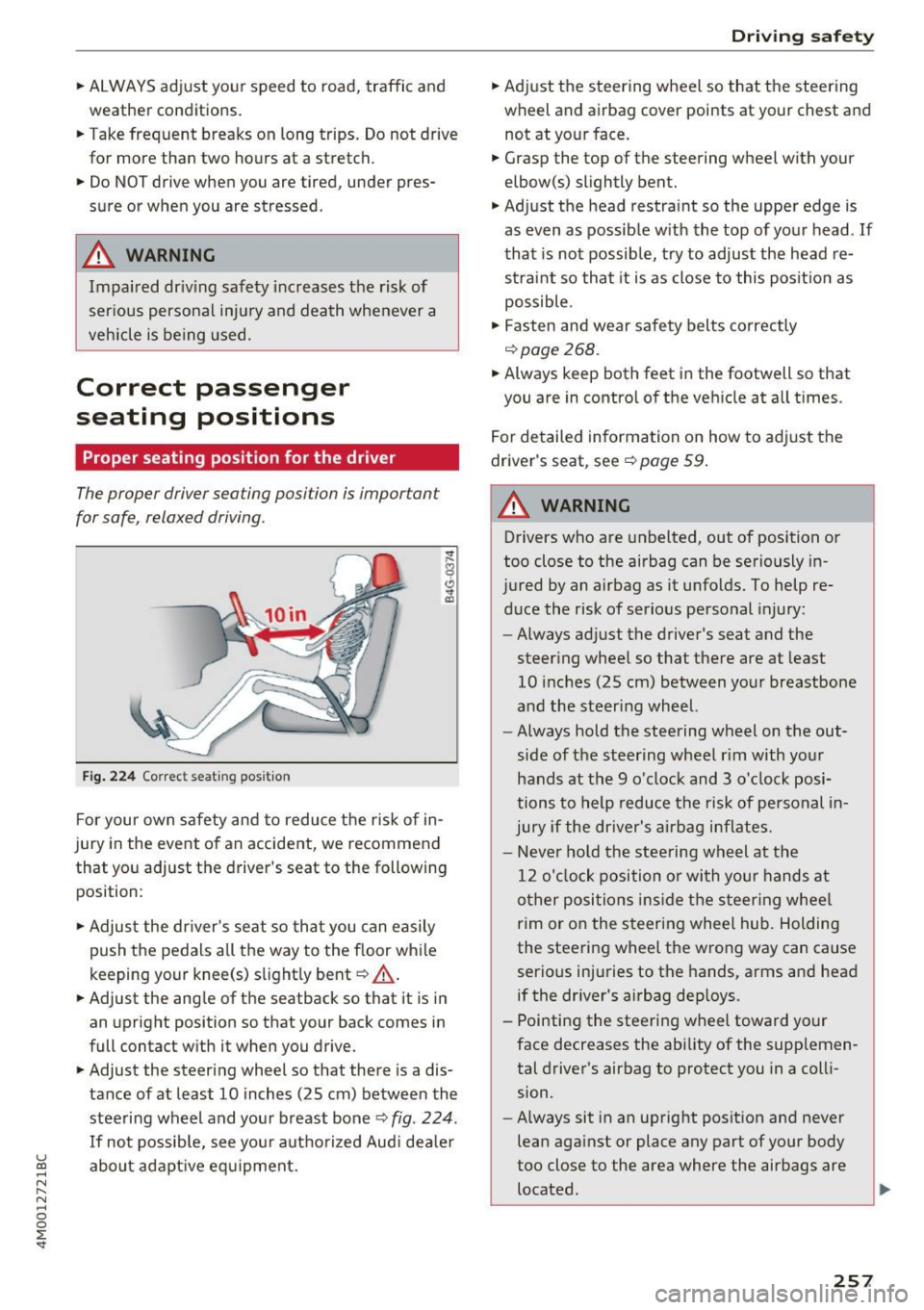
The proper driver seating position is important
for safe, relaxed driving .
Fig . 2 24 Co rrec t seating position
F or your own safety and to reduce the risk of in
jury in the event of an accident,
we recommend
that you adjust the driver 's seat to the following
position:
.. Adjust the dr iver's seat so that you can easily
push the pedals all the way to the f loor wh ile
keeping your knee(s) s lightly bent~
_A.
.. Adjust the ang le of the seatback so that it is in
an upright position so that your back comes in
full contact w ith it when you drive.
.. Adjust the steering wheel so that there is a dis
tance of at least 10 inches (25 cm) between the
steering wheel and you r breast bone~
fig. 224 .
If not possib le, see your autho rized Aud i dea le r
abo ut adapt ive eq uipment.
Dr iving safety
.. Adjust the steering wheel so that the steering
wheel and airbag cover points at your chest and
not at your face.
.. Grasp the top of the steering wheel with your
elbow(s) slightly bent .
.,. Adjust the head restra int so the upper edge is
as even as possible w ith the top of your head . If
that is not possible, t ry to adjust the head re
straint so that it is as close to this posit ion as
possible .
.. Fasten and wear safety belts correctly
~page 268 .
.. Always keep both feet in the footwell so that
you are in control of the veh icle at a ll times.
For detailed information on how to adj ust the
driver's seat, see
~page 59.
A WARNING
-
Drivers who are unbelted, out of position or
too close to the airbag can be seriously in
jured by an airbag as it unfolds. To help re d uce the risk of serious personal injury:
- Always ad just the driver's seat and the
steer ing wheel so that there are at least
10 inc hes (25 cm) between you r breastbone
and the steering wheel.
- Always hold the steering wheel on the out
side of the steering wheel r im with your
hands at the 9 o'clock and 3 o'clock posi
tions to help reduce the risk of personal in
jury if the driver's airbag inflates.
- Never ho ld the stee ring wheel at the
12 o'clock position o r with yo ur hands at
o ther posi tions ins ide the s teer ing whee l
rim or on the steering wheel hub. Holding
the steering wheel the wrong way can cause
serio us injuries to the hands, arms and head
if the dr iver's airbag dep loys .
- Pointing the steering wheel toward your
face decreases the ability of the supplemen tal driver's airbag to protect you in a colli
sion.
- Always sit in an upright position and never
lean aga inst or place any part of your body
too close to the area where the airbags are located .
.,
257
Page 264 of 402
Driving sa fe ty
Loose items in the luggage compartment can
shift s udden ly, changing vehicle handling charac
ter istics . Loose items can also increase the risk of
serious personal in jury in a sudden vehicle ma
neuver or in a coll is ion.
.,. Distribute the load evenly in the luggage com
partment .
.,. Always place and properly secure heavy items in
the luggage compartment as low and as far for
ward as possible
c> fig . 226 .
.,. Secure luggage us ing the tie-downs provided
¢ page 69 .
.,. Make su re that the rea r seatbac k is securely
latched in place .
A WARNING
Improperly stored luggage or othe r items can
fly through the vehicle causing serious per
sonal injury in the event of hard braking or an
accident . To help reduce the risk of serious
personal injury :
- Always put objects, for example, luggage or
other heavy items in the luggage compart
ment.
- Always sec ure objects in the luggage com
partment using the tie-down eyelets and
s u itable straps.
A WARNING
Heavy loads will influence the way your vehi
cle handles . To he lp reduce the r isk of a loss
of contro l leading to serious pe rsonal i njury:
- Always keep in mind when transporting heavy objects, that a change i n the center of
grav ity can also cause changes in vehicle
hand ling:
- Always distr ibute the load as even ly as
possible.
- Place heavy objects as far forward in the
luggage compartment as poss ible.
- Never exceed the Gross Axle Weight Rating
o r the Gross Vehicle Weight Rating specified
on the safety compliance sticker on the driv
er's side B-pillar. Exceeding permiss ible
weight standards can cause the vehicle to
s lide and handle differently .
262
-Please observe info rmation on safe driving
¢page 256 .
A WARNING
To he lp prevent po isonous exhaust gas from
being drawn into the vehicle, always keep the
rear lid closed while driving.
- Never transport objects larger than those
fitting completely into the luggage area be
cause the rear lid cannot be fully closed .
- If you absolutely must dr ive with the rear lid
open, observe the following notes to reduce
the risk of poisoning :
- C lose all windows,
- Close the s unroof*,
- Open all a ir outlets in the instrument pan-
el,
- Switc h off the air reci rculat ion,
- Set the fresh air fan to the highest speed .
A WARNING
-
Always make sure that the doo rs, all win
dows, the sunroof * an d the rear lid are se
curely closed and locked to red uce the risk of
i n jury when the veh icle is not being used.
- After closing the rear lid, always make sure
that it is properly closed and locked .
- Never leave your ve hicle unattended espe
cially with the rear lid left open. A child
co uld crawl into the vehicle th rough the lug
g age com partment an d close the rea r lid be
comi ng tr apped and unab le to ge t out . Be
ing trapped in a vehicle can lead to ser ious
pe rsonal i nju ry.
- Never let c hild ren p lay in or around the vehi
cle.
- Never let passengers ride in the luggage
compa rtment. Vehicle occupants mus t al
ways be p roperly restrained in one of the ve
hicle's seat ing pos itions.
(D Tips
- Air circul ation helps to reduce w indow fog
ging . Stale ai r escapes to the o uts ide
t h roug h vents in the trim panel. Be sure to
keep these slots free and open.
Page 271 of 402
u (0 ...... N r--. N ...... 0
0
:E
is in an upright position and securely latched in
place before using the belt¢.&_ .
.. Pull the safety belt evenly across the chest and
pelvis ¢
fig. 233, ¢ .&_ .
.. Insert the tongue into the correct buckle of
your seat until you hear it latch securely.
.. Pull on the belt to make sure that it is securely
latched in the buckle.
Automatic safety belt retractors
Every safety belt is equipped with an automatic
belt retractor on the shoulder belt. This feature
locks the belt when the belt is pulled out fast,
during hard braking and in an accident . The belt
may also lock when you drive up or down a steep
hill or through a sharp curve. During normal driv
ing the belt lets you move freely.
Safety belt pretensioners
The safety belts are equipped with a belt preten
sioner that helps to tighten the safety belt and
remove slack when the pretensioner is activated
¢
page 2 71 . The function of the pretensioner is
monitored by a warning light
q page 29.
Convertible locking retractor
Every safety belt except the one on the driver
seat is equipped with a convertible locking retrac
tor that
must be used when the safety belt is
used to attach a child safety seat. Be sure to read
the important information about this feature
¢page 306.
.&._ WARNING
Improperly positioned safety belts can cause
serious injury in an accident
q page 269,
Safety belt position.
- Safety belts offer optimum protection only
when the seatback is upright and belts are
properly positioned on the body.
-Always make sure that the rear seat back rest to which the center rear safety belt is
attached is securely latched whenever the
rear center safety belt is being used .
If the
backrest is not securely latched, the passen
ger will move forward with the backrest dur-
Safety belts
ing sudden braking, in a sudden maneuver
and especially in a crash.
- Never attach the safety belt to the buckle
for another seat. Attaching the belt to the
wrong buckle will reduce safety belt effec
tiveness and can cause serious personal in
jury .
- A passenger who is not properly restrained
can be seriously injured by the safety belt it
self when it moves from the stronger parts
of the body into critical areas like the abdo
men .
- Always lock the convertible locking retractor
when you are securing a child safety seat in
the vehicle
¢ page 308.
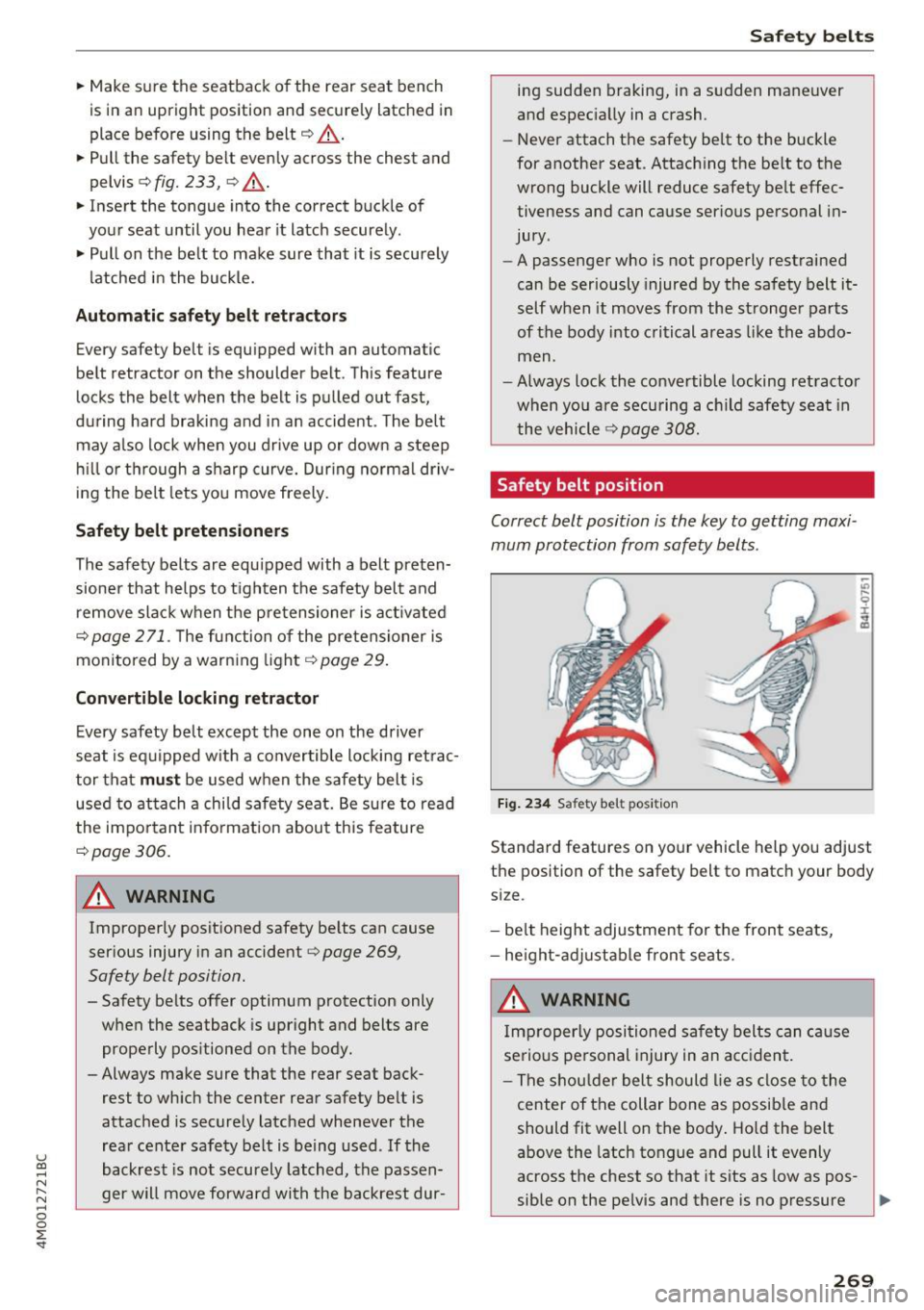
Safety belt position
Correct belt position is the key to getting maxi
mum protection from safety belts .
Fig. 234 Safety belt position
Standard features on your vehicle help you adjust
the position of the safety belt to match your body
size .
- belt height adjustment for the front seats,
- height-adjustable front seats.
.&_ WARNING
Improperly positioned safety belts can cause
serious personal injury in an accident.
- The shoulder belt should lie as close to the
center of the collar bone as possible and
should fit well on the body. Hold the belt
above the latch tongue and pull it evenly
across the chest so that it sits as low as pos-
sible on the pelvis and there is no pressure
~
269
Page 279 of 402
u (0 .... N r--. N .... 0
0
:E
reduce their effect iveness or even prevent
them from providing any protection.
- An improper ly installed ch ild restraint can
interfere w ith the airbag as it deploys and
seriously injure or even kill the child -even
with an Advanced Airbag System .
- Always carefu lly follow the manufacturer's
instructions provided with the child safety
seat or carrier.
- Always make sure that there is nothing on
the front passenger seat that will cause the
capacit ive passenger detection system in
the seat to signa l to the Airbag System that
the seat is occupied by a person when it is
not, or to signa l tha t it is occ upied by some
one who is heavier than the person actua lly
sitting on the seat. The p resence of addi
t ional objects could cause the passenge r
front airbag to be turned on when it shou ld
be off, or could cause the airbag to work in a
way that is different from the way it would have worked without the object on the seat .
Front airbags
Description of front airbags
The airbag system can provide supplemental
protection to properly restrained front seat occu
pants.
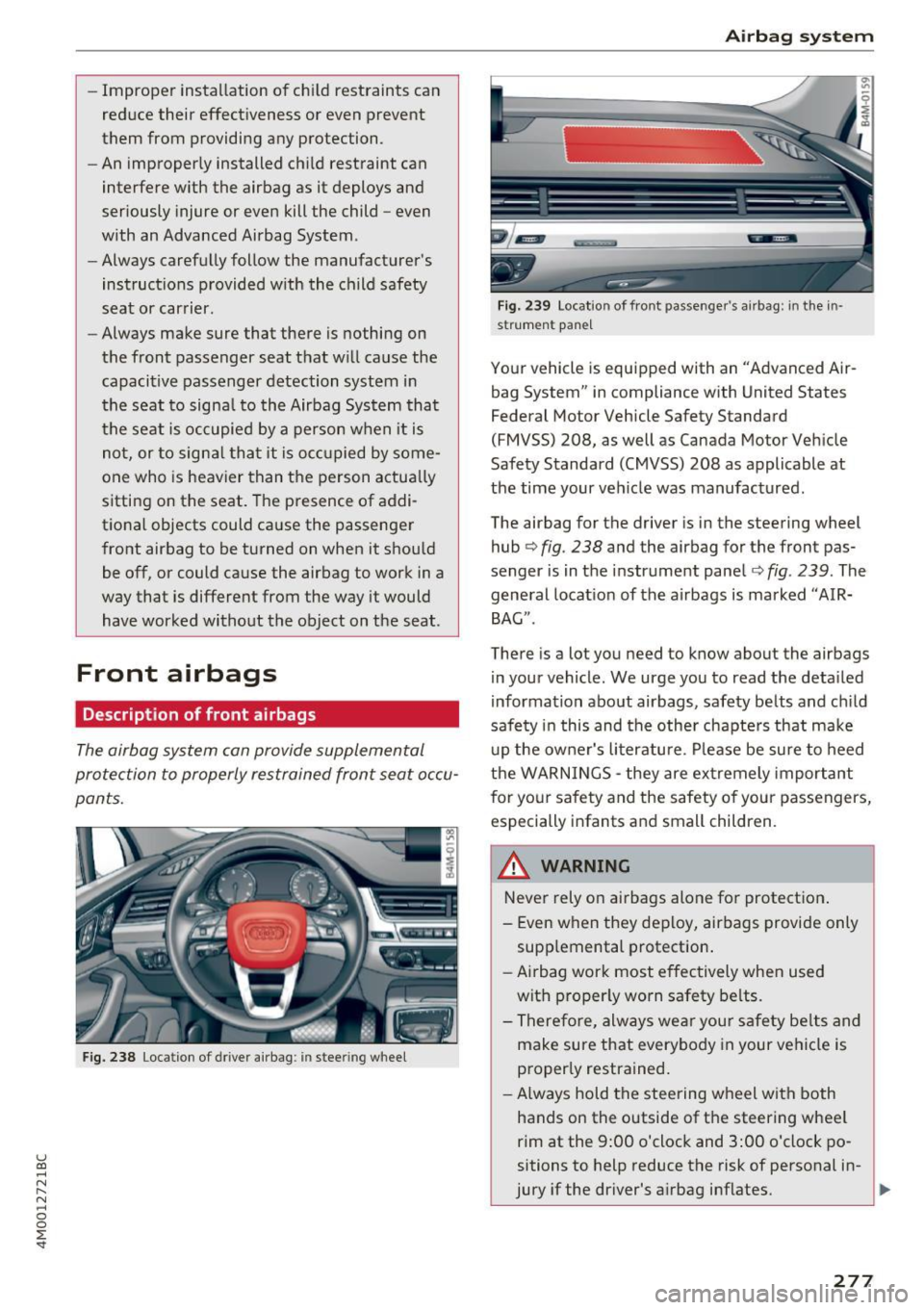
F ig. 238 Location of driver airbag: in steering whee l
Airb ag sys tem
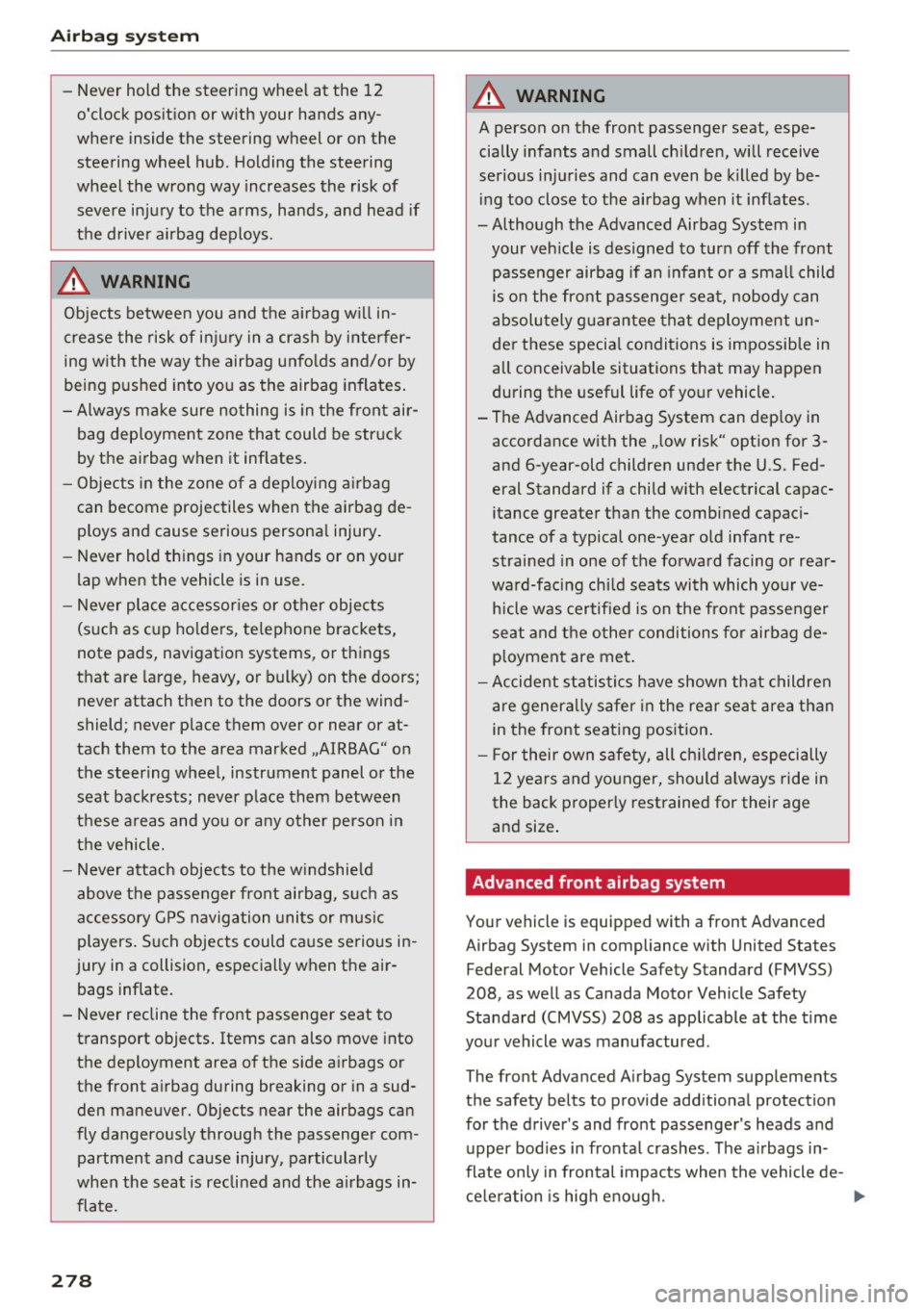
Fig. 239 Location of front passenger's airbag: in the in·
st rument pane l
Your vehicle is equipped with an "Advanced Air
bag System" in compliance with United States
Federal Motor Vehicle Safety Standard
(FMVSS) 208, as well as Canada Motor Veh icle
Safety Standard (CMVSS) 208 as applicable at
the time your veh icle was manufactured.
The airbag for the driver is in the steering wheel
hub
¢ fig. 238 and the airbag for the front pas
senger is in the instrument panel
~ fig . 239. The
general locat ion of the airbags is marked ''AIR·
BAG".
There is a lot you need to know about the airbags
i n your vehicle. We urge you to read the deta iled
information abo ut airbags, safety belts and child
safe ty in this and the othe r chapte rs that make
u p the owner's li terature . Please be sure to heed
the WARNINGS -they are ex tremely important
for your sa fety and the safety of your passengers,
especially infants and small children.
A WARNING
-
Never rely on ai rbags alone for protection .
- Even w hen they deploy, airbags provide only
supp lemental protection .
- Airbag wor k most effec tively when used
with p roper ly worn safety be lts.
- Therefo re, always wea r you r safety be lts and
make sure that everybody in your ve hicl e is
p roper ly restrained.
- Always hold the steering w heel with both
hands on the outside of the steering wheel
rim at the 9:00 o'clock and 3:00 o'clock po
sitions to help reduce the risk of personal in-
jury if the driver's a irbag inflates.
~
277
Page 280 of 402
Airbag system
-Never hold the steering wheel at the 12
o'clock position or with your hands any
where inside the steering wheel or on the
steering wheel hub. Holding the steering
wheel the wrong way increases the risk of
severe injury to the arms, hands, and head if
the driver airbag deploys.
,& WARNING
Objects between you and the airbag will in
crease the risk of injury in a crash by interfer
ing with the way the airbag unfolds and/or by
being pushed into you as the airbag inflates.
- Always make sure nothing is in the front air-
bag deployment zone that could be struck
by the airbag when it inflates.
-
- Objects in the zone of a deploying airbag
can become projectiles when the airbag de
ploys and cause serious personal injury.
- Never hold things in your hands or on your
lap when the vehicle is in use.
- Never place accessories or other objects
(such as cup holders, telephone brackets,
note pads, navigation systems, or things
that are large, heavy, or bulky) on the doors;
never attach then to the doors or the wind
shield; never place them over or near or at
tach them to the area marked ,,AIRBAG" on
the steering wheel, instrument panel or the
seat backrests; never place them between
these areas and you or any other person in
the vehicle.
- Never attach objects to the windshield
above the passenger front airbag, such as
accessory GPS navigation units or music
players. Such objects could cause serious in
jury in a collision, especially when the air bags inflate.
- Never recline the front passenger seat to transport objects. Items can also move into
the deployment area of the side airbags or
the front airbag during breaking or in a sud
den maneuver. Objects near the airbags can
fly dangerously through the passenger com partment and cause injury, particularly
when the seat is reclined and the airbags in
flate.
278
,& WARNING
, -
A person on the front passenger seat, espe
cially infants and small children, will receive
serious injuries and can even be killed by be ing too close to the airbag when it inflates .
- Although the Advanced Airbag System in your vehicle is designed to turn off the front passenger airbag if an infant or a small child
is on the front passenger seat, nobody can
absolutely guarantee that deployment un
der these special conditions is impossible in
all conceivable situations that may happen
during the useful life of your vehicle.
- The Advanced Airbag System can deploy in accordance with the ,.low risk" option for 3-
and 6-year-old children under the U.S. Fed
eral Standard if a child with electrical capac
itance greater than the combined capaci
tance of a typical one-year old infant re
strained in one of the forward facing or rear
ward-facing child seats with which your ve hicle was certified is on the front passenger
seat and the other conditions for airbag de
ployment are met.
- Accident statistics have shown that children
are generally safer in the rear seat area than
in the front seating position.
- For their own safety, all children, especially
12 years and younger, should always ride in
the back properly restrained for their age
and size.
Advanced front airbag system
Your vehicle is equipped with a front Advanced
Airbag System in compliance with United States
Federal Motor Vehicle Safety Standard (FMVSS)
208, as well as Canada Motor Vehicle Safety
Standard (CMVSS) 208 as applicable at the time
your vehicle was manufactured .
-
The front Advanced Airbag System supplements
the safety belts to provide additional protection
for the driver's and front passenger's heads and upper bodies in frontal crashes. The airbags in
flate only in frontal impacts when the vehicle de-
celeration is high enough.
ll>
Page 301 of 402
-Take the chi ld restraint off the front passen
ger seat and install it properly at one of the
rear seat positions if the
P ASS ENGER A IR
BA G OFF~;
light does not stay on .
- Have the airbag system inspected by your
authorized Audi dealer immediately .
The child seats listed in categories A to C have been statically tested by Audi only for the Ad
vanced Airbag function.
Important safety instructions for using
child safety seats
Correc t use of child safety sea ts substan tially re
duces the risk of injury in an accident!
As the driver, you are responsible for the safety
of everybody in the vehicle, especially children:
~ Always use the right child safety seat for each
child and a lways use it properly~
page 301.
~ Always carefully follow the child safety seat
manufacturer 's instructions on how to route
the safety belt properly through the child safe
ty seat .
~ When using the vehicle safety be lt to install a
child safety seat , you must first activate the
convertible locking retractor on the safety be lt
to prevent the child safety seat from moving
¢ page 306.
~ Push the child safety seat down with your fu ll
weight to get the safety be lt really tight so that
the seat cannot move forward or sideways
more than one inch (2.5 cm).
~ Secure unused safety belts on the rear seat
¢ page 301 .
Always remember: Even though your vehicle is
equipped with an Advanced Airbag system, all
children, especially those 12 years and younger,
should always ride in the back seat properly re
strained fo r their age and size.
_& WARNING
~ Not using a ch ild safety seat, using the wrong
~ child safety seat or improper ly installing a N .... 0
0
:E: '
child restraint increases the risk of serious
personal injury and death.
- All vehicle occupants and especially children
must be restrained properly whenever riding
in a vehicle. An unrestra ined or improperly
restrained child could be injured by striking
the inter ior or by being ejected from the ve
hicle dur ing a sudden maneuve r or impact .
An unrest rained or improperly restrained
child is a lso at greater r is k of injury or death
through contact w ith an inflating a irbag.
- Commerc ially availab le child safe ty seats
are requi red to comply with U.S . Federal
Motor Vehicle Safety Standard (FMVSS) 213
(in Canada CMVSS 213).
- When buying a child restra int, select one
that fits your ch ild and the vehicle .
- Only use child restraint systems that fully
contact the flat portion of the seat cush
ion. The ch ild restraint must not t ip or
lean to either side . Audi does not recom
mend using child safety seats that rest on
legs or tube-like frames. They do not pro
vide adequate contact with the seat.
- Always heed all lega l requirements per
ta ining to the insta llation and use of child
safety seats and carefu lly follow the in
structions provided by the manufacturer
of the seat you are using .
- Never a llow children under 57 inches
(1.45 mete rs) to wear a normal safety be lt.
They must a lways be restrained by a proper
child restraint system. Otherwise, they
could sustain injuries to the abdomen and
neck areas during sudden braking maneu
vers or accidents .
- Never let more than one child occupy a child
safety seat.
- Never let babies or o lder children ride in a
vehicle while sitting on the lap of another
passenger .
- Holding a child in your arms is never a sub
stitute for a chi ld restrain t system .
- The strongest person cou ld not ho ld the
ch ild with the forces that exist in an acci
dent. The child will strike the interior of
the vehicle and can also be struck by the passenger.
299
Page 303 of 402
u (0 ...... N r--. N ...... 0
0
:E
ger seat and install it properly at one of the
rear seat positions if the
PASSENGER AIR
BAG OFF ~;
light does not stay on .
- Have the airbag system inspected by your
authorized Audi dealer immediately.
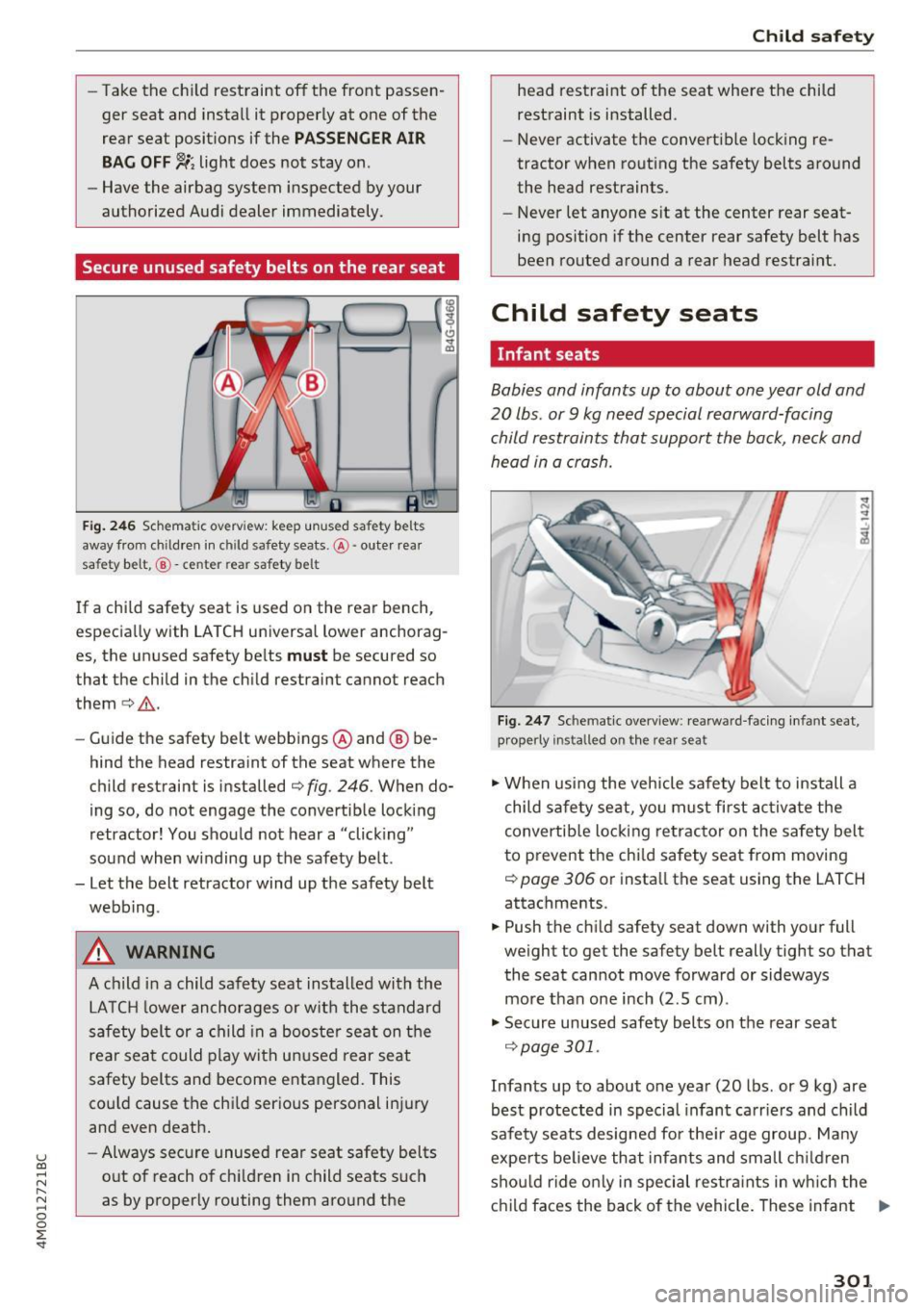
Secure unused safety belts on the rear seat
Fig. 246 Schema tic ove rv ie w: k eep unu sed s-a fety belts
away from chil dren in chil d safety seats .@ · oute r rear
sa fety belt,
@ -cente r rea r sa fety bel t
If a chi ld safety seat is used on the rear bench,
especia lly with LA TCH univ ersal lower anchorag
es, the unused safety belts
must be secured so
that the child in the child restraint cannot reach
them
c::> ,& .
-Gui de the safety belt webbings @ and @ be
hind the head restra int of the seat where the
child restraint is installed
c::> fig. 246 . When do
ing so, do not engage the convertible lock ing
retractor! You should not hear a "click ing"
sound when w inding up the safety belt.
- Let the belt retractor wind up the safety belt
webbing .
A WARNING
A child in a child safety seat installed with the
LATCH lower anchorages or with the standard
safety belt or a child in a booste r seat on the
rear seat could play with unused rear seat
safety belts and become entangled. This
cou ld cause the chi ld serious personal injury
and even death.
- Always secure unused rear seat safety belts
out of reach of children in child seats such
as by proper ly routing them aro und the
Child safety
head restraint of the seat where the child
restraint is installed .
- Never activate the convertible locking re
tractor when routing the safety belts around
the head restraints.
- Never let anyone sit at the center rear seat
ing position if the center rear safety belt has
been routed around a rear head restraint.
Child safety seats
Infant seats
Babies and infants up to about one year old and
20 lbs. or
9 kg need special rearward-facing
child restraints that support the back , neck and
head in a crash.
Fig. 247 Schema tic ove rview: rearw ard -fac ing in fan t seat ,
proper ly i nsta ll ed o n the rear sea t
., When using the vehicle safety belt to install a
child safety seat, you must first activate the
convertib le locking retractor on the safety belt
to prevent the chi ld safety seat from moving
c::> page 306 or install the seat using the LATCH
attachments .
.. Push the child safety seat down with your full
weight to get the safe ty belt really tight so that
the seat cannot move forward or sideways
more than one inch (2 .5 cm) .
., Sec ure unused safety belts on the rear seat
c::>page301.
Infants up to about one year (20 lbs . or 9 kg) are
best protected in special infant carriers and child
safety seats designed for the ir age group. Many
expe rts be lieve that infants and small children
shou ld ride only in special res tra ints in wh ich the
child faces the back of the vehicle. These infant ..,.
301
Page 305 of 402
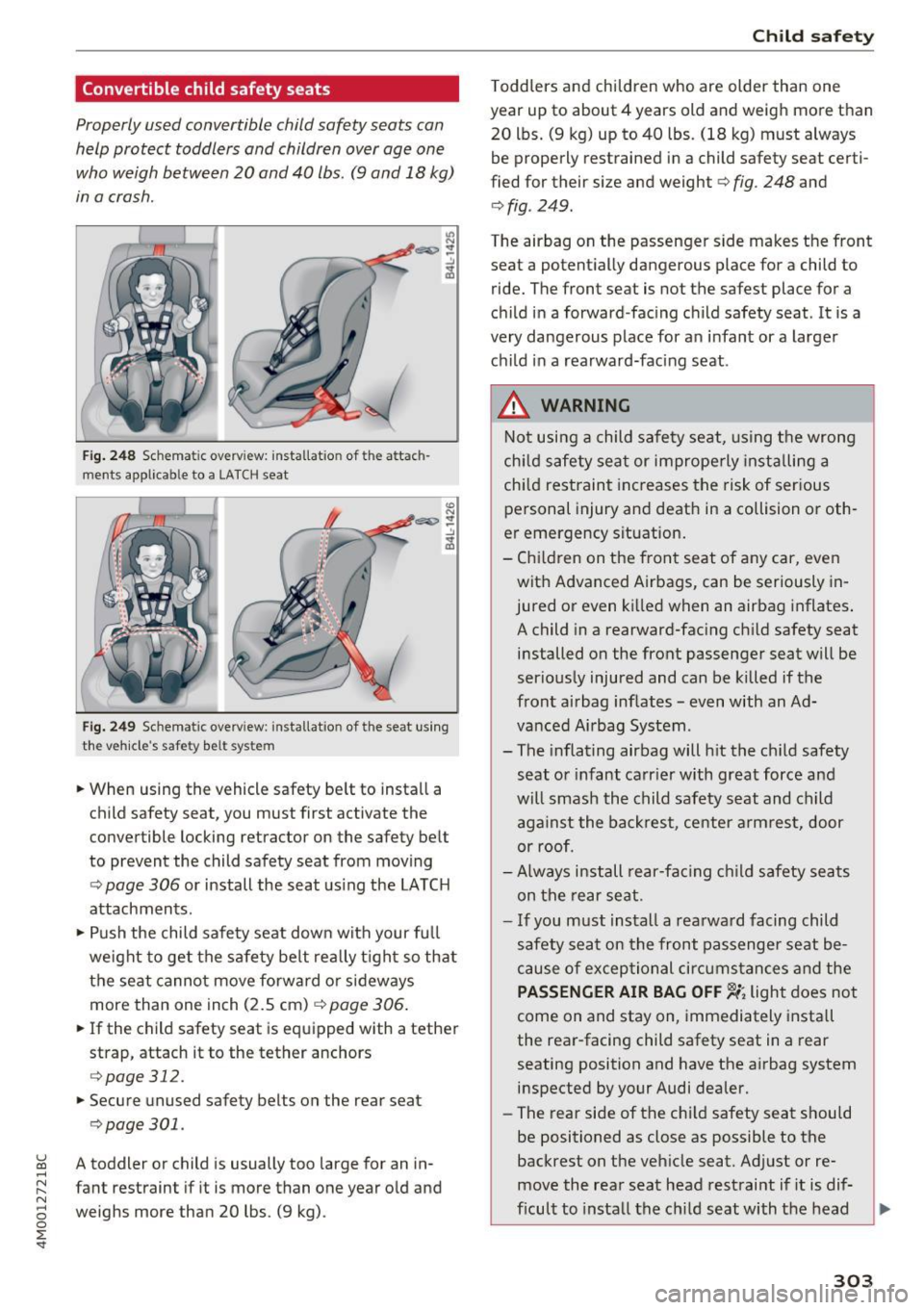
Convertible child safety seats
Properly used convertible child safety seats can
help protect toddlers and children over age one
who weigh between
20 and 40 lbs. (9 and 18 kg)
in a crash.
Fig. 248 Schemat ic overv iew: installatio n of the attac h
ments app lica ble to a LA TCH seat
Fig. 249 Schematic overv iew : installat io n of the seat using
the vehicle 's safe ty be lt syste m
.. When using the vehicle safety belt to install a
child safety seat, you must first activate the
convertible locking retractor on the safety belt
to prevent the child safety seat from moving
Q page 306 or install the seat us ing the LATC H
attachments .
.. Push the child safety seat down with your fu ll
weight to get the safety belt really tight so that
the seat cannot move forward o r sideways
more than one inch (2.5 cm)
Q page 306.
.. If the child safety seat is equipped with a tether
strap, attach it to the tether anchors
Q page 312.
.. Secure unused safety belts on the rear seat
Q page 301.
~ A toddler or child is usually too large for an in-
~ fant restraint if it is more than one year old and
8 weighs more than 20 lbs . (9 kg) . 0 :E
Toddlers and children who are older than one
year up to about 4 years old and weigh more than
20 lbs. (9 kg) up to 40 lbs. (18 kg) must always
be properly restrained in a child safety seat certi
fied for their size and weight
Q fig . 248 and
q fig . 249.
The airbag on the passenger side makes the front
seat a potentially dangerous place for a child to
ride. The front seat is not the safest place for a
child in a forward -facing child safety seat. It is a
very dangerous place for an infant or a larger
child in a rearward-facing seat .
_&. WARNING
Not using a child safety seat, us ing the wrong
child safety seat or improperly instal ling a
chi ld restraint increases the risk of serious
personal injury and death in a collision or oth
er emergency situation.
- Children on the front seat of any car, even
with Advanced Airbags, can be seriously in
jured or even killed when an airbag inflates.
A child in a rearward-facing ch ild safety seat
installed on the front passenger seat will be
seriously injured and can be killed if the
front airbag inflates -even with an Ad
vanced Airbag System .
- The inflating airbag will hit the child safety
seat or infant carr ier with great force and
will smash the child safety seat and child
against the backrest, center armrest, door
or roof.
-Al ways install rear-fa cing child safety seats
on the rear seat .
- If you must insta ll a rearward facing child
safety seat on the front passenger seat be
cause of excep tional circumstances and the
PASSENGER AIR BAG OFF '-I; light does not
come on and stay on, immediately insta ll
the rear-facing child safety seat in a rear
seating position and have the a irbag system
inspected by your Audi dealer .
- The rear side of the ch ild safety seat shou ld
be positioned as close as possible to the
backrest on the veh icle seat. Adjust or re
move the rear seat head restraint if it is dif-
f icult to install the child seat with the head
~
303