warning AUDI R8 SPYDER 2011 Manual Online
[x] Cancel search | Manufacturer: AUDI, Model Year: 2011, Model line: R8 SPYDER, Model: AUDI R8 SPYDER 2011Pages: 244, PDF Size: 59.74 MB
Page 112 of 244
110 Safety belts
-Failure to pay attention to the warning
light that comes on could lead to person
al injury.
Why safety belts?
Safety belts protect
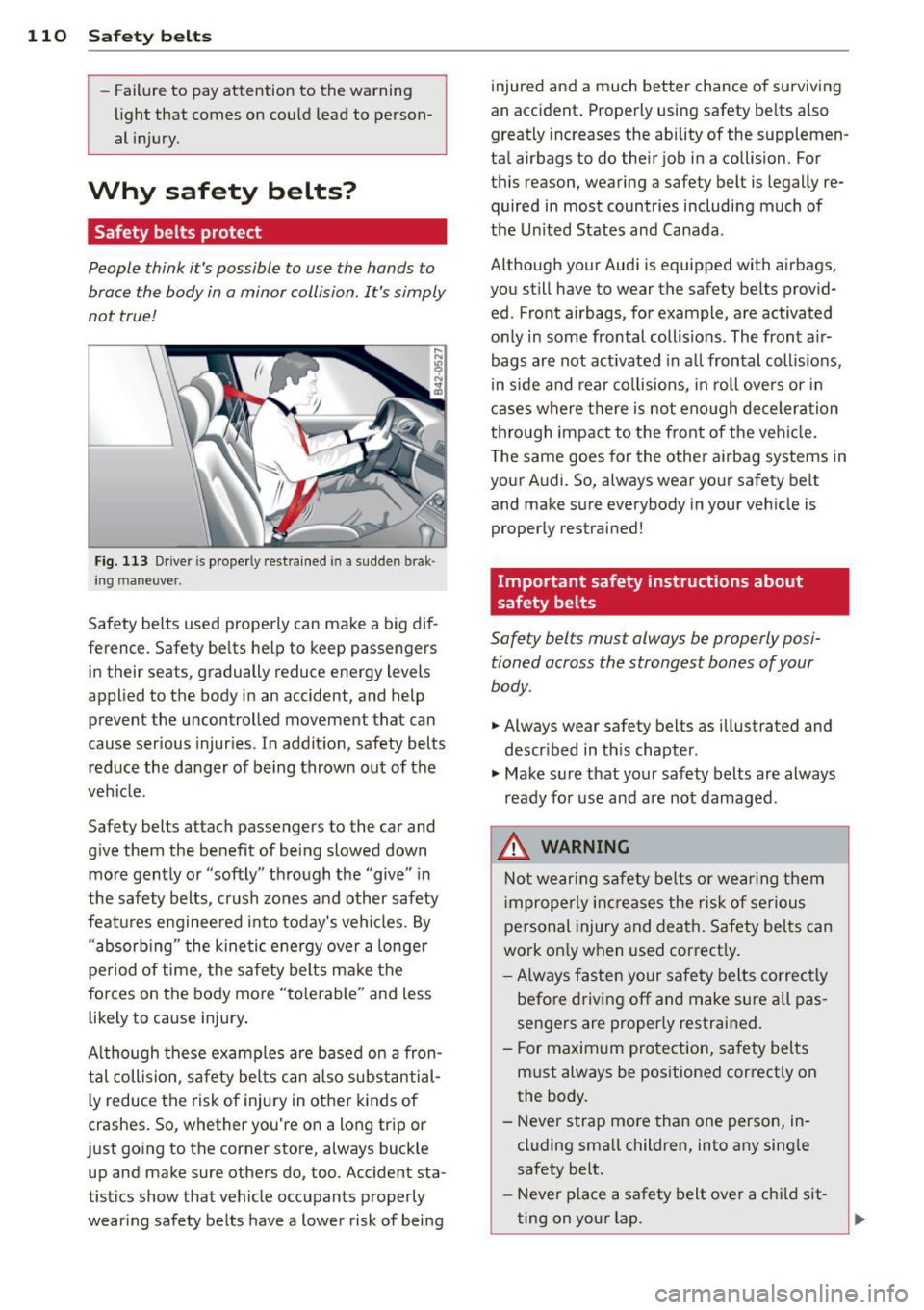
People think it's possible to use the hands to
brace the body in a minor collision. It's simply
not true!
Fig. 113 D river is proper ly restrai ned in a sudden brak
ing maneuver .
Safety belts used properly can make a big dif
ference. Safety belts help to keep passengers
in their seats, gradually reduce energy levels
applied to the body in an accident, and help prevent the uncontrolled movement that can
cause serious injuries. In addit ion, safety belts
reduce the danger of being thrown out of the
vehicle.
Safety belts attach passengers to the car and
give them the benefit of being slowed down
more gently or "softly" through the "give" in
the safety belts, crush zones and other safety
features engineered into today's vehicles. By
"absorb ing" the kine tic energy over a longer
period of time, the safety belts make the
forces on the body more "tolerable" and less
likely to cause injury.
A lthough these examples are based on a fron
tal collision, safety belts can also substantial
ly reduce the risk of injury in other kinds of
crashes. So, whether you're on a long trip or
just going to the corner store, always buckle up and make sure others do, too. Accident sta
tistics show that vehicle occupants properly
wear ing safety be lts have a lower risk of being injured and a much better chance of surviving
an accident . Prope rly using safety be lts a lso
greatly increases the ability of the supplemen
ta l airbags to do their job in a collision. For
th is reason, wearing a safety belt is legally re
quired in most countries including much of
the Un ited States and Canada.
Although your Audi is equipped with a irbags,
you still have to wear the safety belts provid ed. Front airbags, for example, are activated
only in some frontal collisions . The front air
bags are not act ivated in all frontal coll is ions,
in sid e and rear collisions , in roll overs or in
cases where there is not enough deceleration
through impact to the front of the vehicle.
T he same goes for the other airbag systems in
your Audi. So, always wear yo ur safety belt
and make sure everybody in your veh icle is
proper ly restrained!
Important safety instructions about
safety belts
Safety belts must always be properly posi
tioned across the strongest bones of your
body .
.,. Always wear safety belts as illustrated and
descr ibed in th is chapter .
.,. Make sure that your safety belts are always
ready for use and are not damaged .
_&. WARNING
Not wearing safety belts or wearing them
imprope rly increases the risk of serious
personal injury and death. Safety belts can
work only when used correctly.
- Always fasten your safety belts correctly
before driving off and make sure all pas
sengers are properly restrained.
- For maximum protection, safety belts
must always be positioned correctly on
the body.
- Never strap more than one person, in
cluding sma ll children, into a ny sing le
safety belt.
- Never place a safety belt over a child sit
ting on your lap.
Page 115 of 244
.. Hold the be lt by the tongue and pull it even
l y across the chest and pelvis
c::> &_.
.. Insert the tongue into the correct buckle of
your seat until you hear it latch securely
c::>fig. 118.
.. Pull on the belt to make sure that it is se-
c u rely latched in the buckle.
Automatic safety belt retracto rs
Every safety belt is equipped with an automat
ic belt retractor on the shoulder belt. This fea
ture locks the belt when the belt is pulled out
fast, dur ing hard braking and in an accident.
The belt may also lock when you drive up or
down a steep hill or through a sharp curve.
During normal driving the belt let s you move
freely.
Switchable locking feature
Every safety belt except the one on the driver
seat is equ ipped w ith a switchable locking fea
ture that
must be used w hen the safety belt is
used to atta ch a chi ld seat. Be sure to read the
i mportant information about this fea ture
c::> page 146.
A WARNING
Imprope rly positioned safety belts can
cause serious injury in an accident
c::> page 113, Safety belt position.
- Safety belts offer optimum protection
only when the seatback is upright and
belts are properly positioned on the
body.
-
- Never attach the safety belt to the buck
le for another seat. Attach ing the belt to
the wrong buckle w ill reduce safety belt
effect iveness and can cause serious per
sonal inj ury.
- A passenger who is not properly restrain
ed can be seriously in jured by the safety
belt itself whe n it moves from the stron
ger parts of the body into c ritical a reas
like the abdomen.
- Always lock the convert ible lock ing re
tra ctor when yo u are secur ing a chi ld
sea t in the vehicle
c::> page 148.
Safety belts 113
@ Tips
Depending on veh icle equipment, micro
phones * are located on the safety be lt to
i mprove hands-free call quality. For addi
tional information about safety belt m icro
phones, refer to the infotainment system
owner's manual.
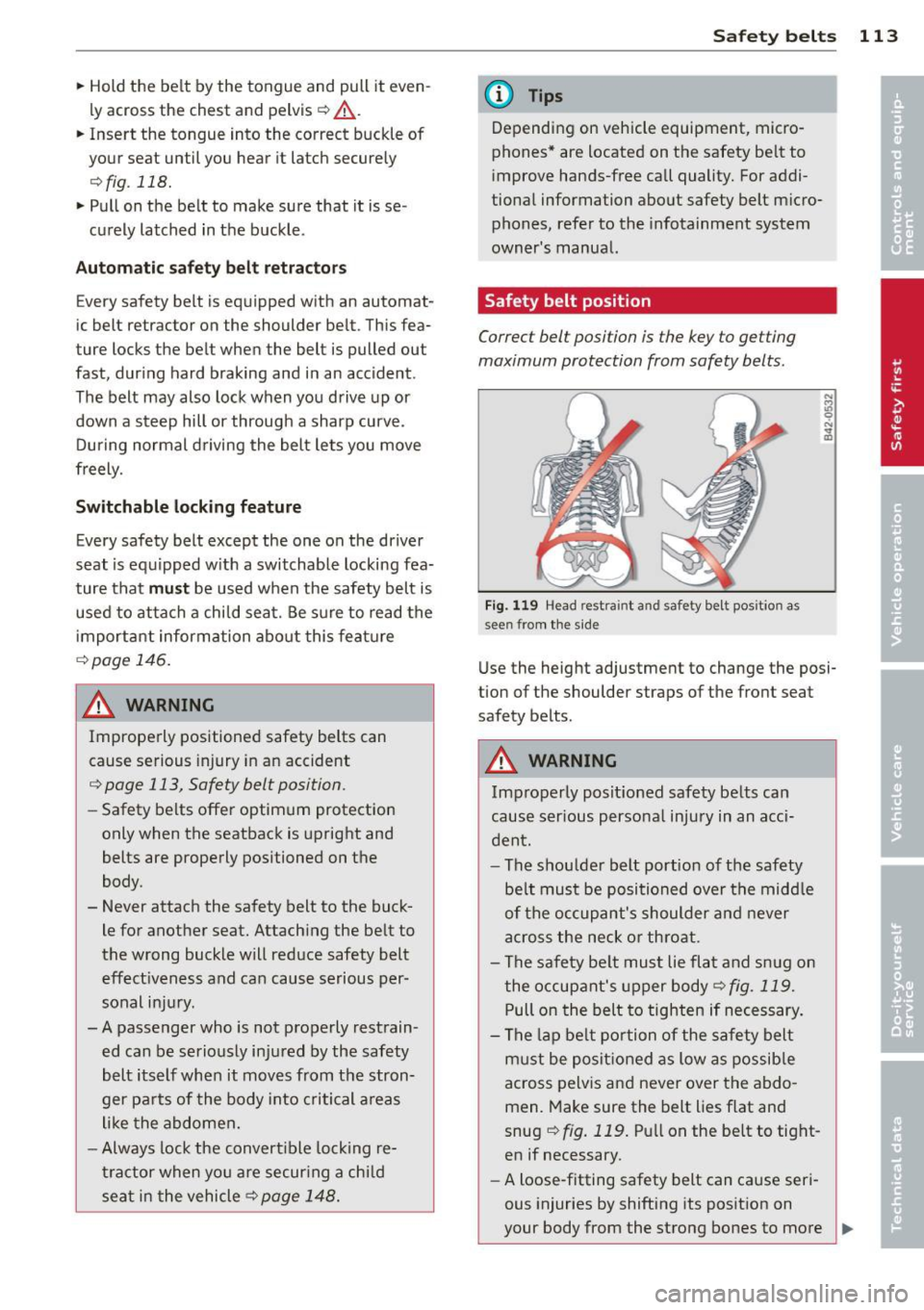
Safety belt position
Correct belt position is the key to getting
maximum protection from safety belts.
Fi g. 119 Head restraint and safety belt position as
seen from the side
"' ra q
"' ., m
Use the height adjustment to change the posi
tion of the shoulder straps of the front seat
safety belts.
A WARNING
Imp roperly posit ioned safety belts can
cause ser ious persona l inju ry in an acci-
dent.
- The s houlder belt portion of the safety
be lt must be positioned over the midd le
of the occupant's shoulder and never
across the neck o r throat.
- The safe ty be lt mus t lie flat and snug on
the occupant's upper body
c::>fig. 119.
Pull on the belt to tighten if necessary.
-
- The lap be lt po rtion of the safety belt
m ust be posit ioned as low as possib le
across pelvis and never over the abdo
men. Make sure the belt lies flat and
snug
r:!) fig. 119. Pu ll on the belt to tight
en if necessary.
- A loose-f itting safety belt can ca use seri
ous injuries by shifting its posit ion on
your body from the strong bones to more
~
Page 116 of 244
114 Safety belts
vulnerable, soft tissue and cause serious injury.
- Always read and heed all WARNINGS and
other important information
¢page 110.
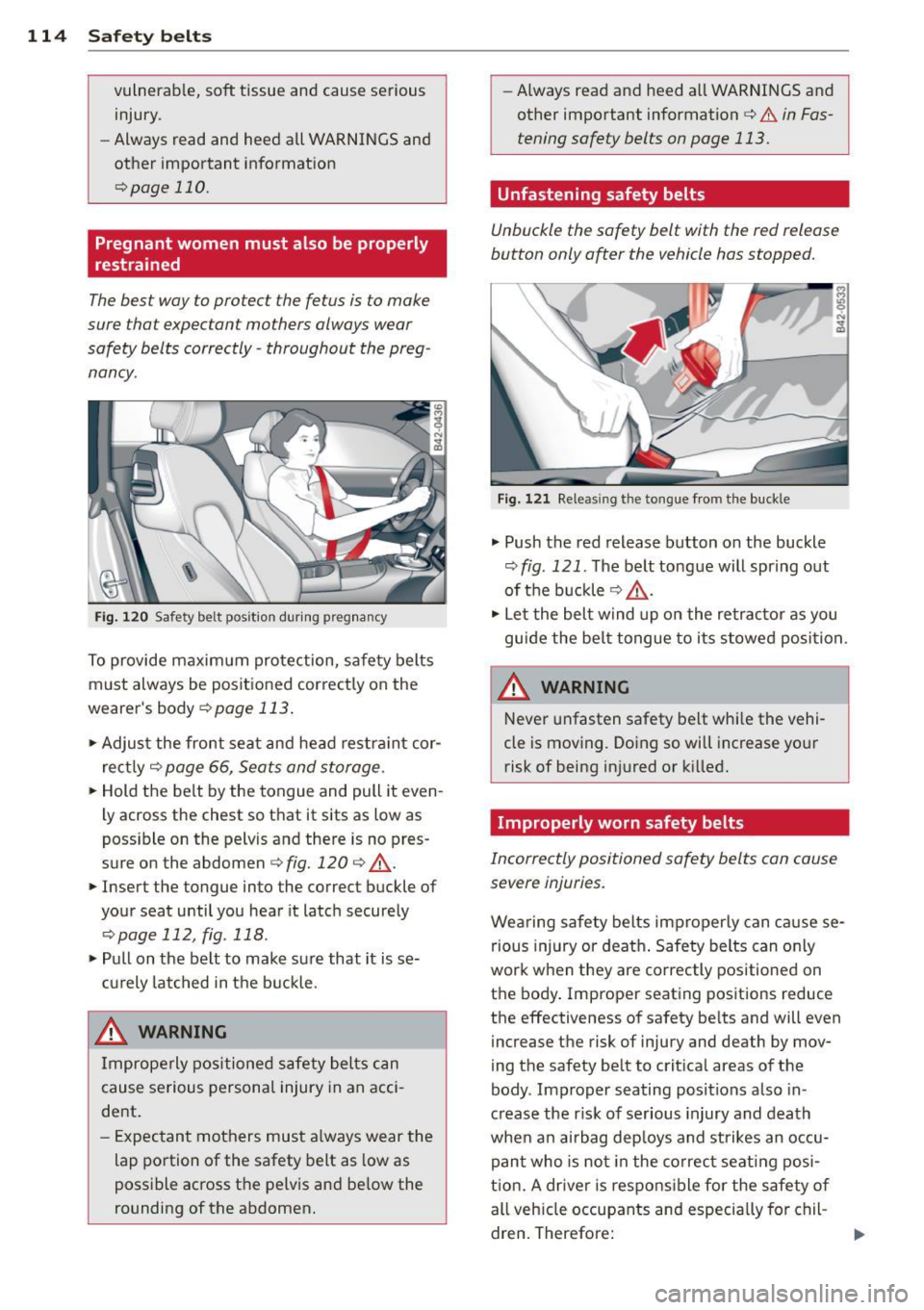
Pregnant women must also be properly
restrained
The best way to protect the fetus is to make
sure that expectant mothers always wear
safety belts correctly -throughout the preg
nancy .
Fig. 120 Safety belt position during p regnancy
To provide maximum protection, safety belts
must always be positioned correctly on the
wearer's body
¢ page 113.
.,. Adjust the front seat and head restraint cor
rectly¢
page 66, Seats and storage .
.,. Hold the belt by the tongue and pull it even
ly across the chest so that it sits as low as
possible on the pelvis and there is no pres
sure on the abdomen
c> fig. 120 c> ,& .
.,. Insert the tongue into the correct buckle of
your seat until you hear it latch securely
¢page 112, fig. 118.
.,. Pull on the belt to make sure that it is se
curely latched in the buckle.
_& WARNING
Improperly positioned safety belts can
cause serious personal injury in an acci
dent.
- Expectant mothers must always wear the
lap portion of the safety belt as low as
possible across the pelvis and below the
rounding of the abdomen. -
Always read and heed all WARNINGS and
other important information
c> & in Fas
tening safety belts on page 113.
Unfastening safety belts
Unbuckle the safety belt with the red release
button only a~er the vehicle has stopped.
Fig. 121 Releasing the tongue from the buck le
.,. Push the red release button on the buckle
c> fig . 121 . The belt tongue will spring out
of the buckle
c> ,& .
.,. Let the belt wind up on the retractor as you
guide the belt tongue to its stowed position .
_& WARNING
Never unfasten safety belt while the vehi
cle is moving. Doing so will increase your
risk of being injured or killed.
Improperly worn safety belts
Incorrectly positioned safety belts can cause
severe injuries .
Wearing safety belts improperly can cause se rious injury or death. Safety belts can only
work when they are correctly positioned on
the body. Improper seating positions reduce
the effectiveness of safety belts and will even
increase the risk of injury and death by mov
ing the safety belt to critical areas of the
body . Improper seating positions also in
crease the risk of serious injury and death
when an airbag deploys and strikes an occu pant who is not in the correct seating posi
tion. A driver is responsible for the safety of all vehicle occupants and especially for chil
dren. Therefore:
Page 117 of 244
~ Never permit anyone to assume an incorrect
sitting position in the vehicle while traveling
¢A .
A WARNING
Improperly worn safety belts increase the
risk of serious personal injury and death
whenever a vehicle is being used .
- Always make sure that all vehicle occu
pants are correctly restrained and stay in
a correct seating position whenever the
vehicle is being used .
- Always read and heed all WARNINGS and other important information
¢page 110.
Safety belt preten
sioners
How safety belt pretensioners work
In front, side and rear end collisions and in a
rollover above a particular severity, safety
belts in use are tensioned automatically.
The safety belts for the front seating positions
are equipped with safety belt pretensioners.
The system is activated by sensors in front,
side and rear-end collisions and in a rollover of
great severity . This tightens the belt and takes
up be lt slack ¢&.
in Service and disposal of
safety belt pretensioner on page 115.
Taking
up the slack helps to reduce forward occupant
movement during a collision .
(D Tips
The safety belt pretensioner can only be
activated once.
- In minor frontal and side collisions in
,
rear-end collisions and in accidents in
volving very little impact force, the safe
ty belt pretensioners are not activated.
- When the safety be lt pretensioner is ac
tivated, a fine dust is released . This is
normal and is not caused by a fire in the
vehicle.
- The relevant safety requirements must
be observed when the vehicle or compo-
Safety belts 115
nents of the system are scrapped. An au
thorized Audi dealer is familiar with
these regulations and will be pleased to
pass on the information to you.
- Be sure to observe all safety, environ
mental and other regulations if the vehi
cle or individual parts of the system, par
ticularly the safety belt or airbag, are to
be disposed . We recommend you have
your authorized Audi dealer perform this
service for you.
Service and disposal of safety belt
pretensioner
The safety belt pretensioners are parts of the
safety belts on your Audi. Installing, remov
ing, servicing or repairing of be lt pretension
ers can damage the safe ty belt system and
prevent it from working correctly in a colli
sion .
There are some important things you have to know to make sure that the effectiveness of
the system will not be impaired and that dis
carded components do not cause injury or pol
lute the environment.
A WARNING
Improper care, servicing and repair proce
dures can increase the risk of personal in
jury and death by preventing a safety belt
pretensioner from activating when needed
or activating it unexpectedly :
- The belt pretensioner system can be acti
vated only once. If belt pretensioners
have been activated, the system must be
replaced.
- Never repair, adjust, or change any parts
of the safety belt system.
- Safety belt systems including safety belt
pretensioners cannot be repaired. Spe
cial procedures are required for removal,
installation and disposal of this system.
- For any work on the safety be lt system,
we strongly recommend that you see
your authorized Audi dealer or qualified
~
•
•
Page 120 of 244
118 Airbag sys te m
Since the cir cumstances will vary considerab ly
between one collision and anot her, it is not
possib le to def ine a range of vehicle speeds
that will cover every possible k ind and angle
of impact that will always trigger the airbags.
Important factors include, for example, the
nature (hard or soft) of the object which the
car h its, the ang le of impact, vehicle speed,
etc. The front airbags will also not inflate in
side or rea r collisions, or in ro ll-overs .
Always remember : Airbags will deploy only
once, and only in certa in kinds of co llisions.
Your safety belts are always there to offer pro
tection in those s ituations in which airbags
are not supposed to deploy, or when they have
a lready deployed; for example, when your ve
hicle strikes or is struck by another vehic le af
ter the first co llision.
This is just one of the reasons why an airbag is
a supplementary restraint and is not a substi
tute for a safety belt . The airbag system
works most effect ively when used with the
safety belts. Therefore, always wear your safe
ty belts properly
c;, page 109.
A WARNING
Sitting too close to the steer ing wheel or
instrument panel will dec rease the effec
tiveness of the airbags and will increase
t he risk of personal injury in a co llision .
- Never sit closer than 10 inches (2S cm)
to the stee ring wheel or instrument pan
el.
- If you cannot sit more than 10 inches
( 2 5 cm) from the steer ing whee l, investi
ga te whethe r adaptive equipmen t may
be available to help you reach the pedals
and increase your seating distance from
the steering wheel.
- If you are unrestrained, lean ing fo rward,
sitting sideways or out of position in any
way, your risk of in jury is much higher.
- You will also receive serio us inj uries and
cou ld even be killed if you are up against
the airbag or too close to it when it in
flates - even with an Advanced Airbag. -
To reduce the risk of injury when an a ir
bag inflates, always wear safety be lts
properly ¢
page 112, How are safety
belts worn correctly? .
-Never let children ride unrestrained or
improperly restrained in the vehicle. Ad
just the front seats properly . If children
are not p roperly restrained, they may be
seve rely in ju red or killed when an a irbag
infla tes.
- Never ride with the back rest reclined.
-Always sit as far as possible from the steer ing whee l or the instrument pane l
c;, page 100, Prop er occupant seating
positions.
- Always sit up right with your back against
the backres t of your seat.
- Never p lace your feet on the instrument
panel or on the seat. Always keep both
feet on the f loor in front of the sea t to
he lp preven t serio us in juries to the legs
and h ips if the airbag infla tes .
- Never re cline the front passenger's sea t
to tr anspor t ob jec ts. Items c an al so
move into the a rea of the s ide airbag or
the front airbag during braking or in a
sudden maneuver . Objects near the air
bags can become projectiles and cause
in ju ry when an airbag inflates.
A WARNING
Airbags that have deployed in a crash must
be replaced.
- Use on ly orig inal equipment airbags ap
proved by Aud i and installed by a trained
technician who has the necessary tools and d iagnost ic equipment to properly re
p lace any airbag in your vehicle and as
sure sy stem effe ctive ness in a crash.
- Never permit salvaged or recycled air
bags to be installed in you r vehicle.
Page 121 of 244
Child restraints on the front seat - some
important things to know
.. Be sure to read the important informat ion
and heed the WARNINGS for important de
tai ls about chi ldren and Advanced Airbags
i=> page 138.
Even though your vehicle is equipped with an
Advanced Airbag System, make certain that
a ll chi ldren, especially those 12 years and
younger, are properly restrained for their age and s ize. The airbag on the passenger side
makes the front seat a potentially dangerous
p lace for a child to ride . The front seat is not
the safest place for a child in a forward-facing
chi ld safety seat. It can be a very dangerous
p lace for an infant or a c hild in a rearward-fac
ing seat.
The Advanced Airbag System i n your veh icle
h as been cert ified to comp ly with the require
men ts of Uni ted States Federa l Mo to r Veh icle
Safety Standard
208 as applicable at the time
your ve hicle was manufactured.
The Standard requires the fron t air bag on the
passenger side to be turne d off ("sup
p ressed") if a chi ld up to about one year of
age restrained in one of the rear -facing or for
ward -facing infant restraints listed i n Federal
Motor Vehicle Safety Standard
208 with wh ich
the Advanced Airbag System in your vehicle
was certified has been installed o n the front
passenger seat . For a listing of the child re
straints that we re used to certify compliance
w ith the US Safety Sta ndard
c> page 140.
T he PASSENGER AIR BAG OFF light in the in
strument panel te lls you when the front Ad
vanced A irbag on the passenger side has been
turned off by the e lectronic control u nit.
Each t ime you tur n on the ignition, the
PAS
SENGER AIR BAG OFF
l ight w ill come on for a
few seconds a nd:
- will stay on if the front passenger seat is not
occup ied ,
- will stay on if there is a small child or ch ild
restraint on the front passenger seat,
A irbag sys tem 119
- will go off if the front passenger seat is oc
cupied by an adult as registered by the
weight -sensing mat
c> page 128, Monitor
ing the Advanced Airbag System.
T he PASSENGER AIR BAG OFF light comes on
whe n the contro l unit detects a tota l weight
on the front passenger seat that req uires the
front a irbag to be turned off.
If the total weight on the front passenge r
seat is more than that of a typical
1 year-o ld
c h il d but less than the weight of a small
adult, the front airbag on the passenger side can deploy (the
PASSENGER AIR BAG OFF
li ght does not come on). If the PASSENGER
AIR BAG OFF
light does not come on, the
front a irbag on the passenger side has not
been turned off by the elect roni c con trol unit
and can deploy if the control unit se nses an
impact that meets the cond it ions stored i n its
memory .
For example, th e airb ag may deplo y if:
- a small ch ild that is heav ie r than a typical 1
year-old ch ild is o n the front passenger seat
(regard less of whether the child is in one of
the ch ild safety seats listed
c> page 140), or
- a child who has outgrown chi ld restraints is
on the front passenge r seat.
If the front passenger airbag is turned off, the
PASSENGER AIR BAG OFF light in the center
of the instrument panel will come on and stay
o n.
The front airbag on the passenger side may
not deploy (t he PASSENGER AIR BAG OFF
light does not illum inate and stay lit) ev en if a
small ad ult o r teenager, or a passenge r who is
not si tt ing upr ight w ith their b ack against a
non -recli ned ba ck rest w ith their feet on the
vehicle floor in front of the sea t is on t he front
passenger seat
c> page 100, Proper seating
position for the driver.
If t he fron t passenger airbag dep loys, the
Federa l Standar d requ ires the airbag to meet
the "low risk" dep loyment criteria to red uce
the risk of injury th ro ugh interaction with the
airbag. "Low risk" dep loyment occurs in those .,.. •
•
Page 122 of 244
120 Airbag sys te m
cr ashes that take place a t lower decelerations
as defined in the electronic control u nit
c:::> page 12 8, PASSENGER AIR BAG OFF light.
A lways remember, a chi ld safety seat or infant
carrier insta lled on the front seat may be
struck and knocked o ut of position by the rap
id ly inf lating passenger's a irbag in a frontal
coll is ion. The airbag cou ld greatly reduce the
effectiveness of the child restraint and even
seriously injure the child during inflat ion .
A WARNING
A child in a rearward-facing child safety
seat insta lled on the front passenger seat
w ill be seriously injured and can be k illed if
t he front a irbag infla tes -even with an Ad
vanced Airbag System.
- T he inflating a irbag will hit the child
safety seat or infant car rier wit h great
f orce and w ill smash the ch ild safety seat
and child against the backrest, door or
roof .
- Never install a rearward facing child
safety seat on the front passenger seat
unless the PASSENGER AIR BAG OFF
light comes on and stays on. If the PAS
SENGER AIR BAG OFF
light does not
come o n and stay on the inflating airbag
wi ll hit the child safe ty seat or infant car
rie r with great fo rce and will smash the
c hild safety seat and child against the
backres t, door or roo f. Have the airbag
system inspe cted immedia tely by your
authorized Audi dealer.
- F orward-fac ing ch ild safety sea ts instal
led on the front passenger 's seat may in
terfere with the deployment of the air
bag and cause serious personal injury to
the ch ild.
A WARNING
If, in exceptional c ircumstances, you must
install a forward-facing child restra int on
the front passenger's seat:
- Always make sure the forward-fac ing
seat has been des igned and certified by its manufacturer fo
r use on a front seat
wit h a passenger front and s ide a irbag.
- Never put t he fo rward-facing child re
straint up against or very near the instru
ment panel.
- Always move the passenge r seat into its
rearmost pos ition in the seat's fore and
aft ad justment range, as far away from
the airbag as possible before installing
the forward-fac ing ch ild restra int. The
backrest must be ad justed to an up right
position .
- Make sure that the
PASSENGER AIR BAG
OFF
li ght comes on and stays on all the
time wheneve r the ig nit ion is switched
on.
A WARNING
To reduce the risk of serio us inju ry, ma ke
sure that the
PASSENGER AIR BAG OFF
light wi ll be displayed whenever a child re
straint is insta lled on the front passenger
seat and the ignition is sw itched on.
- If the
PASSENGER AIR BAG OFF light
does not stay on, per form the checks de
scribed
c:::> page 128 , Monitoring the Ad
vanced Airbag System.
- Never install a rearward facing child
safety seat on the front passenger seat
un less t he
PASSENGER AIR BAG OFF
lig ht comes on and stays on. If the PAS
SENGER AIR BAG OFF
li ght does not
come on and stay on, the inf lating ai rbag
will hit the child safety seat or in fant car
rier w ith great force and w ill sm ash the
child safety seat and child against the
backrest, door or roof. Have the a irbag
system inspected immediately by your
author ized Audi dealer.
- Always carefu lly follow instr uctions from
child restraint manufacturers when in
stalling ch ild restra ints .
A WARNING
-If, in except iona l circumstances, you m ust
in stall a forward or rearward-facing child
restra int on the front passenger 's seat : "'
Page 123 of 244
-Improper installation of child restraints
can reduce their effectiveness or even
prevent them from providing any protec
tion .
- An improperly installed child restraint
can interfere with the airbag as it de
ploys and seriously injure or even kill the
child -even with an Advanced Airbag
System.
-Always follow the manufacturer's in
structions provided with the child safety
seat or carrier carefully.
- Never place additional items on the seat
that can increase the total weight regis
tered by the weight-sens ing mat and can
cause injury in a crash .
Front airbags
Description of front airbags
The airbag system con provide supplemental
protection to properly restrained front seat occupants.
Fig. 122 Location of drive r airbag : in steerin g wheel
Fig. 123 Locat ion of front passenger 's a irbag: in the in
s trum ent panel
Your vehicle is equipped with an "Advanced
Airbag System" in compliance with United
States Federal Motor Vehicle Safety Standard
Airbag system 121
(FMVSS) 208 as applicable at the time your
vehicle was manufactured . The safety belts
for the front seats have "pretensioners" that help to take slack out of the belt system. The
pretensioners are also activated by the elec
tronic control unit for the airbag system .
The front safety belts also have load limiters
to help reduce the forces applied to the body
in a crash.
The a irbag for the driver is in the steer ing
wheel hub<=)
fig. 122 and the airbag for the
front passenger is in the instrument panel
r:::> fig . 123. The general location of the airbags
is marked '' AIRBAG" .
There is a lot you need to know about the air
bags in your vehicle. We urge you to read the
detailed information about airbags, safety
belts and child safety in this and the other
chapters that make up the owner's literature.
Please be sure to heed the WARNINGS - they
are extremely important for your safety and
the safety of your passengers, especially in
fants and small children.
& WARNING
=
Never rely on airbags alone for protection.
- Even when they deploy, airbags provide
only supplementa l protection .
- Airbag work most effectively when used
with properly worn safety belts.
- Therefore, always wear your safety belts
and make sure that everybody in your
ve
hicle is properly restrained .
A WARNING
A person on the front passenger seat, es
pecially infants and small children, will re
ceive serious injuries and can even be kil
led by being too close to the airbag when
it inflates.
- Although the Advanced Airbag System in
your vehicle is designed to turn off the
front passenger airbag if an infant or a
small child is on the front passenger
seat, nobody can absolutely guarantee
-
-
that deployment under these special 11-
Page 125 of 244
but less than the weight of a small adult, the
front airbag on the passenger side may deploy (the
PASSENG ER AIR BAG OF F light does not
come on).
For example, the a irb ag may depl oy if:
- a small child that is heavier than a typical 1
year-o ld child is on the front passenger seat
(regardless of whether the child is in one of
the chi ld safety seats listed
¢ page 140),
-a ch ild who has outgrown child rest raints is
on the front passenger seat.
I f the front passenger airbag is turned off, the
PA SSENGER AIR BAG OFF light in the center
of the inst rument panel w il l come on and stay
on.
The front a irbag on the passenger side may
not deploy (the PASSENGER AIR BAG OFF
light does not illuminate and stay lit) if:
- a small adult or teenager is on the front pas
senger seat
- a passenger who is not sitt ing upr ight w ith
their back against a non-reclined backrest
with their feet on the veh icle floo r in front
of the sea t is on the front passenge r seat.
If the front passenger airbag deploys, the
Federal Standard requires the airbag to meet
the " low risk " deployment criteria to help re
duce the risk of inj ury through interaction
with the airbag . "Low risk" deployment occurs
in those crashes that take place at lower de
celerations as defined in the electronic control un it
¢ page 128.
Please be sure to read the important informa
tion in the sections that fo llow and be sure to
heed a ll of the WARNINGS.
_& WARNING
To reduce the risk of injury when an airbag
inf lates, a lways wear safety belts properly.
- If you are unrestrained, leaning forward,
sitting sideways or out of position in any
way, your risk of injury is much higher.
- You w ill also receive serio us injuries and
cou ld even be killed if you are up against
the a irbag or too close to it when it in-
A irbag system 123
flates - even with an Advanced Ai rbag
¢page 117.
_& WARNING
A child in a rearward-fac ing ch ild safety
seat installed on the front passenger seat
will be ser ious ly injured and can be killed if
the front airbag inflates - even with an Ad
vanced A irbag System .
-Although the Advanced Airbag System in your veh icle is designed to turn
off the
front airbag when a rearward-facing child restraint has been instal led on the
front passenger seat, nobody can abso lutely guarantee that dep loymen t is im
possible in all conceivable situations that
may happen during the usefu l life of your
veh icle.
- The inflating airbag will hit the child
safety seat or infant carrier with great
force and will smash the child safety seat
and child against the backrest, door, or roof.
- Never install a rearward facing child
safety seat on the front passenger seat
un less the
PA SSENGER AIR BAG OFF
light comes on and stays on . If the PAS
SENGER AIR BAG OFF
light does not
come on and stay on the inflating a irbag
will hit the child safety seat or infant car rier w ith great force and w ill smash the
child safety seat and child against the
backrest, door or roof. Have the a irbag
system inspected immediately by your
author ized Audi dealer.
_& WARNING
If, in except iona l circumstances, you must
install a forward-facing child restraint on
the front passenger's seat:
- Always make sure the forward-facing
seat has been designed and certified by
its manufacturer fo r use on a front seat
with a passenger front and s ide a irbag.
- Never put the forward-facing child re
straint up against or ve ry near the instru-
ment panel.
~
•
•
Page 126 of 244
124 Airbag sys te m
- Always move the passenger seat into its
rearmost position in the seat's fore and
aft adjustment range, as far away from
the a irbag as poss ible, before insta lling
the forward-facing child restraint. The backrest must be adjusted to an upr ight
posit io n.
- Make sure that the
PASSENGER AIR BAG
OFF
light comes on and stays on all the
t ime w henever the ignition is switched
on.
Advanced Airbag System components
The fron t passenger sea t in your vehicle h as a
lot of very important par ts of the Advanced
Airbag System in it. These parts include t he
weight -sensing mat, sensors, wiring, brack
ets, and more. The function of the system in
the front passenger seat is checked by the
e lectronic control u nit when the ignit ion is on.
The control unit mon itors the Advanced Air
bag System and turns the airbag indicator
l ight on when a ma lfunction in t he system
components is detected. The func tion of the
a ir bag ind icator light is described in greater
detai l be low . Because the fro nt passenger
seat contains important parts of the Ad
vanced A irbag System, you m ust take care to
prevent it from be ing damaged. Damage to
the seat may prevent the Advanced Airbag for
the front passenger seat from doing its job in
a crash .
The front Advanced Airb ag System
consists of the following:
- Crash sensors in the front of the veh icle that
measure veh icle acceleration/decele ration
to provide information to the Advanced Air
bag System abou t the seve rity of the crash.
- An e lectron ic co ntrol unit, with integ rated
c rash sensors for front and side impacts .
T he cont rol unit "dec ides " w het her to fire
the front airbags based on the information
received from the crash senso rs . The contro l
unit a lso "decides" whethe r the safety be lt
pretensioners should be activated . -
An Advanced Ai rbag w ith gas generator for
the driver inside the steering w heel hub.
- An Advanced A irbag w ith gas gene rato r in
side the inst rument panel for the front pas
senger.
- A we ight -sensing mat unde r th e upho lstery
pa dding of the front passenger seat cushion
that measures the total weight on the seat .
The informat ion registered is sent continu
ously to the electronic control unit to regu late deployment of the front Advanced Air
bag on the passenger side .
- An airbag monitoring sys tem and indicator
light in t he instrument cluster
c:> page 128 .
-The PASSENGER AIR BAG OFF light comes
on and stays on in the center of the instru
ment panel
c::> page 128, fig. 125 and tells
you when the front Advanced Airbag on the passe nger side has been tu rned off.
- A sensor below the safety be lt latch fo r the
front seat passenger to measure the t ension
on t he safety be lt. T he tension o n the safety
be lt a nd the weight regis tered by the
weigh t-sensing mat he lp the cont rol uni t
"decide" whether the front airbag for the
front passenger seat should be turned off or
not
c:> page 119, Child restraints on the
front seat -some important things to
know.
-A sensor in the safety belt latch for the driv er and for the front seat passenger that
senses whether t hat safety belt is latched or
not and transmits this information to the
electronic control un it .
_&. WARNING
D amage to the fron t passenger seat can
p revent t he fro nt airbag from wor king
proper ly.
- I mp roper repai r or d isassembly of the
front passenge r and dr ive r sea t w ill pre
vent the Advanced Air bag System from
functioning p roperly.
- Repairs to the front passenge r seat m ust
be pe rformed by qualifie d and p roperly
trained workshop person nel.
- Never remove the front passenger o r
d river seat from t he vehicle .
-