ignition AUDI R8 SPYDER 2012 Workshop Manual
[x] Cancel search | Manufacturer: AUDI, Model Year: 2012, Model line: R8 SPYDER, Model: AUDI R8 SPYDER 2012Pages: 236, PDF Size: 59.24 MB
Page 135 of 236
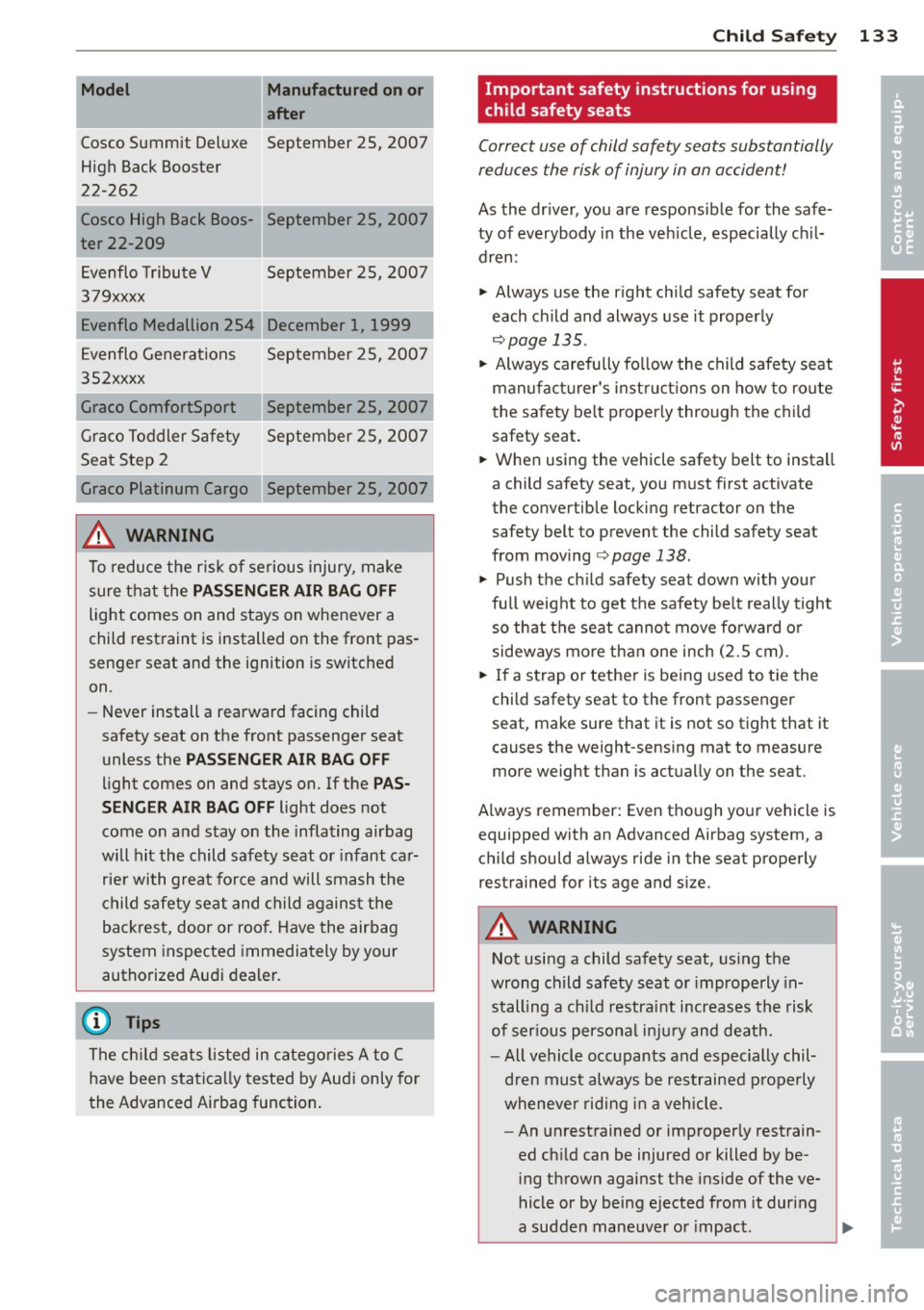
Model Manufactured on or
after
Cosco Summit Deluxe September 25, 2007
H igh Back Bo oste r
22-262
Co sco High Bac k Boos -September 2S, 2007
ter 22- 209
Evenfl o Tribut e V
379xxxx September 25, 2007
December 1, 1999
E
venflo Genera tions September 25, 2007
35 2xxxx
Grace ComfortSport September 2S, 2007
Grace Toddler Sa fety September 25, 200 7
Seat Step 2
Graco Platinum Cargo September 25, 2007
A WARNING
T o reduce the risk of serious injury, make
sure that the
PASSENGER AIR BAG OFF
light comes on and stays on whenever a
child rest raint is installed on the front pas
senger seat and the ignition is switched
on.
- Never install a rearward facing child
safety seat on the front passenger seat
unless the
PASSENGER AIR BAG OFF
light comes on and stays on. If the PAS
SENGER AIR BAG OFF
light does not
come on a nd stay on the inflating airbag
will hit the child safety seat o r infant ca r
rie r wi th great fo rce and will smash the
c hild s afety seat and child agains t the
backrest, door or roof . Have the airbag
system inspected immedia tely by your
authorized Audi dealer.
(D Tips
The ch ild seats listed in catego ries A to C
have been sta tica lly tested by Au di only for
the Advanced Airbag function.
.
Child Sa fet y 133
Important safety instructions for us ing
child safety seats
Correct use of child safety seats substantially
reduces the risk of injury in an accident!
As the dr iver, you are respons ible for the safe
ty of everybody in the veh icle , especially ch il
dren:
"' Always use the r ight ch ild safety seat for
each child and always use it properly
r=;, page 135.
"' Always carefully fo llow the child safe ty seat
manufac turer's inst ruct io ns on how to ro ute
the sa fe ty be lt properly through the c hild
safety seat .
.. When using the vehicle safety belt to install
a child safety seat, you m ust first activate
the convertible locking retractor on the
safety belt to prevent the child safety seat
from mov ing
¢ page 138 .
"' Push the ch ild safety seat down with you r
full weight to get the safety be lt really tight
so that the seat cannot
move fo rwa rd o r
sideways more th an one inch
(2.5 cm).
"' If a st rap or tethe r is be ing used to tie the
child safety seat to the front passenger
seat, make sure that it is not so tight that it
causes the weight-sensing mat to measure
more weight than is act ually on the seat.
A lways remember : Even tho ugh yo ur vehicle is
equipped with an Advanced Airbag system, a
c hi ld should always ride in the seat properly
restrained for its age and s ize.
A WARNING
N ot using a child safety seat, using the
wrong ch ild safety seat o r imprope rly in
stalling a ch ild restraint increases the risk
of ser ious persona l inju ry and death.
- All vehicle occupants and especially chil
dren must always be restrained p rope rly
wheneve r riding in a vehicle.
-
- An unrest rained or improper ly restrain
ed ch ild can be injured or killed by be
i ng t hrown against the ins ide of the
ve
hicle or by being e jected from it dur ing
a sudden maneuve r o r i mpact .
•
•
Page 136 of 236
134 Child Safety
-An unrestrained or improperly restrain
ed child is at much greater risk of injury
or death by being struck by an inflating
airbag .
- Commercially available child safety seats
are required to comply with U.S. Federal
Motor Vehicle Safety Standard (FMVSS)
213 (in Canada CMVSS 213).
- When buying a child restraint, select
one that fits your child and the vehicle.
- Only use child restraint systems that
fully contact the flat portion of the
seat cushion. The child restraint must
not tip or lean to either side. Audi does
not recommend using child safety
seats that rest on legs or tube-like
frames . They do not provide adequate
contact with the seat .
- Always heed all legal requirements per
taining to the installation and use of
child safety seats and carefully follow
the instructions provided by the manu
facturer of the seat you are using.
- Never let more than one child occupy a
child safety seat.
- Never let babies or older children ride in
a vehicle while sitting on the lap of an
other passenger.
- Holding a child in your arms is never a
substitute for a child restraint system.
- The strongest person could not hold
the child with the forces that exist in
an accident. The child will strike the in
terior of the vehicle and can also be
struck by the passenger .
- The child and the passenger can also
injure each another in an accident.
- Never install a rearward facing child
safety seat on the front passenger seat
unless the
PASSENGER AIR BAG OFF
light comes on and stays on. If the PAS
SENGER AIR BAG OFF
light does not
come on and stay on the inflating airbag
will hit the child safety seat or infant car
rier with great force and will smash the
child safety seat and child against the
backrest, door or roof. Have the airbag system inspected immediately by your
authorized Audi dealer.
- Forward-facing child safety seats instal
led on the front passenger's seat can in
terfere with the airbag when it inflates
and cause serious injury to the child.
- If exceptional circumstances require the
use of a forward-facing child restraint on
the front passenger's seat, the child's
safety and well -being require that the
following special precautions be taken :
- Make sure the forward-facing seat has
been designed and certified by its man
ufacturer for use on a front seat with a
passenger front and side airbag.
- Always carefully follow the manufac
turer's instructions provided with the
child safety seat or carrier.
- Always move the front passenger seat
into the rearmost position of the pas
senger seat 's fore and aft adjustment
range, and as far away from the airbag
as possible before installing the child
restraint.
- Always make sure that nothing pre
vents the front passenger's seat from
being moved to the rearmost position
in its fore and aft adjustment range.
- Always make sure that the backrest is
in the upright position.
- Always buckle the child safety seat firmly
in place even if a child is not sitting in it.
A loose child safety seat can fly around
during a sudden stop or in a collision.
- Always read and heed all WARNINGS
whenever using a child restrained in ave
hicle is being used¢
page 101, Safety
belts,
¢ page 109, Airbag system and
~ page 130, Child Safety .
A WARNING ~
To reduce the risk of serious injury, make
sure that the
PASSENGER AIR BAG OFF
light comes on and stays on whenever a
child restraint is installed on the front pas
senger seat and the ignition is switched
on.
Page 139 of 236
-Always make sure the backrest 1s in an
upr ight position.
- Make sure that the
PASSENGER AIR BAG
O FF
light comes on and stays on all the
t ime whenever the ignition is switched
on.
- If the light does not stay on, perform the checks¢
page 120, Monitoring the Ad
vanced Airbag System.
- If the PAS SEN GER AIR BAG OFF light
does not come on and stay on have the
airbag system inspected immed iately by
your authorized Aud i dealer.
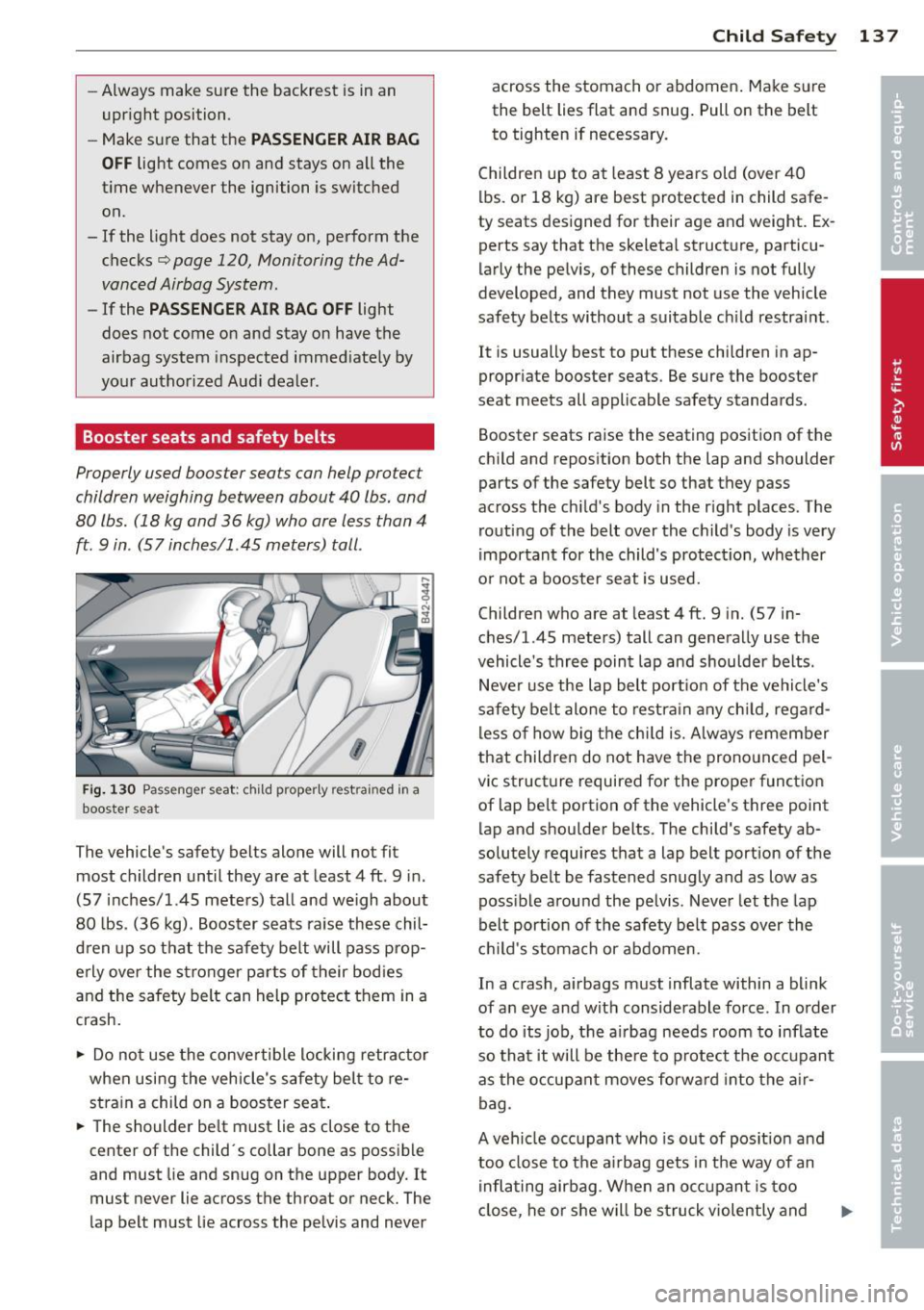
Booster seats and safety belts
Properly used booster seats can help protect
children weighing between about 40 lbs. and
80 lbs. (18 kg and 36 kg) who are less than 4
ft. 9 in . (57 inches/1 .45 meters) tall .
Fig. 130 Passenger seat : child proper ly rest ra in ed in a
booster seat
The vehicle's safety belts alone will not fit
most children until they are at least 4
ft . 9 in .
(57 inches/1.45 meters) tal l and weigh about
80 lbs. (36 kg). Booster seats raise these chil
d ren up so that the safety belt will pass prop
erly over the stronger parts of their bod ies
and the safety belt can help protect them in a
crash .
• Do no t use the convertible locking retractor
when using the vehicle's safety belt to re
strain a child on a booster seat.
• The shoulder be lt must lie as close to the
center of the child · s collar bone as possible
and must lie and snug on the upper body.
It
must never lie across the throat or neck. The
lap belt must lie across the pelvis and never
Child S afety 13 7
across the stomach or abdomen . Make s ure
the belt lies flat and snug . Pull on the belt
to tighten if necessary.
Children up to at least 8 yea rs old (over 40
lbs. or 18 kg) are best protected in child safe
ty seats des igned for their age and weight. Ex
perts say that the skeletal structure, particu
larly the pelvis, of these children is not fully
developed, and they must not use the vehicle
safety belts without a suitable ch ild restra int .
It is usually best to put these chi ldren in ap
propriate booster seats. Be sure the booster
seat meets all applicable safety standards .
Booster seats raise the seating position of the
child and reposition both the lap and shoulder
parts of the safety belt so that they pass
across the ch ild's body in the r ight places . The
rout ing of the belt over the child's body is very
important for the child's protect ion, whether
o r not a booster seat is used.
Children who are at least 4
ft. 9 in. (57 in
ches/1.45 meters) tall can generally use the
vehicle's three point lap and shoulder belts .
Never use the lap belt port ion of the vehicle's
safety belt alo ne to rest ra in any ch ild, regard
l ess of how big the ch ild is. Always remember
that children do not have the prono unced pel
vic structure required for the prope r funct ion
of lap belt portion of the vehicle's three point lap and shou lder belts. The child's safety ab
solutely requires that a lap belt portion of the
safety belt be fastened snugly and as low as poss ible around the pelvis. Never let the lap
belt portion of the safety belt pass over the
c hi ld's stoma ch or abdomen.
In a crash, a irbags must inflate within a blink
of an eye and with considerable force . In order
to do its job, the a irbag needs room to inflate
so that it will be the re to protect the occupant
as the o ccupant moves forwa rd into the a ir
bag .
A vehicle occ upant who is out of posit io n and
too close to the a irbag gets in the way of an
inflating airbag . When an occ upant is too
cl ose, he or she will be struck violently and
Ill>
Page 140 of 236
138 Child Saf ety
will receive serious or possibly even fata l
injury .
I n o rder for the airbag to offe r protection, it is
important that all vehicle occ upants, especia l
l y any children, who must be in the front seat
because of exceptional circ umstances, be
properly restrained and as far away from the
a irbag as poss ible. By keep ing room between
the child's body and the front of the passen
ger compartment, the airbag can inflate com
p letely and provide supplemental protection
in certain frontal col lisions.
_& WARNING
Not using a booster seat, using the boos
t er sea t imprope rly, incorre ct ly ins talling a
booste r seat or using the vehicle safety
belt improperly increases the risk of se ri
ous personal injury and death in a collision
or other eme rgency s ituation. To help re
duce the risk of ser ious persona l injury
and/or death:
- The shoulder be lt must lie as close to the
center of the child 's collar bone as poss i
ble and must lie and snug on the upper
body. It mus t never lie across the throat
o r neck . The lap belt must lie across the
pelvis and never across the stomach o r
abdomen. Make sure the belt lies flat
and snug. Pull on the be lt to t igh ten if
necessary.
- F ailure to properly route sa fety belts
over a ch ild' s body will cause severe inju
ries in an acc ident or other emergency
situation
<:!;,page 101.
- Children on the front seat of any car,
even w ith Advanced A irbags, can be seri
o usly injured or even killed when an a ir
bag inflates.
- Never let a child stand or knee l on the
seat.
- Never let a child ride in the ca rgo a rea of
yo ur vehicle.
- Always remember that a chi ld leaning
forward, sitt ing s ideways or out of posi
t ion in any way during an acc ident can be
-
struck by a dep loying a irbag . This will re
sult in ser ious personal injury or death .
- If you must install a booster seat on the
front passenger seat because o f excep
tional circ umstances the
PASSENGER
AIR BAG OFF
li ght must come on and
stay on , whenever the ignition is switch
ed on .
-If the PASSENGER AIR BAG OFF light
does not come on and stay on, pe rform
the ch ecks descr ibed ¢
page 120, Moni
toring the Advanced Airbag System .
-If the PASSENGER AIR BAG OFF light
does not come on and stay on whenever
the ig nit ion is switched on the infla ting
ai rb ag w ill hi t the child sa fe ty seat or in
fant car rier with g reat force an d will
smash the child sa fety seat and child
aga inst the backrest, door or roof . Have
the airbag system inspected immed iately
by your Audi dea ler.
- Always read and heed all WAR NIN GS
whenever using a child restrained in ave
h icle is being used
¢ page 101, Safety
belts,
¢ page 109 , Airbag system and
r:!;, page 130, Important things to know.
Installing a child safety
seat
Securing a child safety seat using a
safety belt
Safety belts for the front passenger con be
locked with the convertible locking retractor
to properly secure child safety seats .
The safety belts emergency locking retracto rs
for the front passenger's seat safety belt have
a convertible locking retracto r for child re
stra ints . The safety be lt must be loc ked so
that be lt webb ing cannot unree l. The r etrac
tor can be a ctivated to lock the safety belt and
prevent the s afety be lt webb ing from loosen
ing up d uring norma l dr iv ing. A child safety
seat can only be properly insta lled when t he
safety belt is locked so that the chi ld and child
safety seat will stay in place. ..,.
Page 141 of 236
Always remember: Even though your vehicle is
equipped with an Advanced Airbag system, a
child should always ride in the seat properly
restrained for its age and size.
_&. WARNING
Improperly installed child safety seats in
crease the risk of serious personal injury
and death in a collision.
- Always make sure that the safety belt re
tractor is locked when installing a child
safety seat. An unlocked safety belt re
tractor cannot hold the child safety seat
in place during normal driving or in a
crash .
- Always buckle the child safety seat firmly
in place even if a child is not sitting in it.
A loose child safety seat can fly around
during a sudden stop or in a collision.
- The inflating airbag will hit the child
safety seat or infant carrier with great
force and will smash the child safety seat
and child against the backrest, door or
roof.
- Forward-facing child safety seats or in
fant carriers installed on the front pas
senger's seat may interfere with the de ployment of the airbag and cause serious
injury to the child.
- Always read and heed all WARNINGS
whenever using a child restrained in ave
hicle is being used
c:::;, page 130. Special
precautions apply when installing a child
safety seat on the front passenger seat
c:::;, page 111, Child restraints on the front
seat -some important things to know.
_&. WARNING
-
Always take special precautions if you
must install a forward or rearward-facing
child restraint on the front passenger's
seat in exceptional situations:
- Whenever a forward or rearward-facing child restra int is installed on the front
passenger seat, the
PASSENGER AIR
BAG OFF
light must come on and stay on
whenever the ignition is switched on.
Child Safety 139
-If the PASSENGER AIR BAG OFF light
does not come on and stay on, perform
the checks described
c:::;, page 120, Moni
toring the Advanced Airbag System.
- If the PASSENGER AIR BAG OFF light
does not come on and stay on whenever
the ignition is switched on the inflating
airbag will hit the child safety seat or in
fant carrier with great force and will
smash the child safety seat and child
against the backrest, door or roof. Have
the airbag system inspected immediately
by your Audi dealer.
- Improper installation of child restraints
can reduce their effectiveness or even prevent them from providing any protec
tion.
- An improperly installed child restraint
can interfere with the airbag as it de
ploys and seriously injure or even kill the
child.
- Always carefully follow the manufactur
er's instructions provided with the child
safety seat or carrier.
- Never place additional items on the seat
that can increase the total weight regis
tered by the weight-sensing mat and can
cause injury in a crash.
_&. WARNING
Forward-facing child restraints:
- Always make sure the forward-facing
seat has been designed and certified by
its manufacturer for use on a front seat
with a passenger front and side airbag.
- Never put the forward-facing child re straint up, against or very near the in
strument panel.
- Always move the passenger seat into its
rearmost position in the seat's fore and
aft adjustment range, as far away from
the airbag as possible before installing
the forward-facing child restraint. The
backrest must be adjusted to an upright
position. •
•
Page 142 of 236
140 Child Saf ety
- Make sure that the PASSENGER AIR BAG
OFF
light comes on and stays on all the
time whenever the ignition is switched on .
A WARNING
Rearward -fac ing c hild restra ints:
- A ch ild in a rearward-facing child safety
seat installed on the front passenger
seat will be ser iously injured and can be
killed if the front airbag inflates - even
with an Advanced Airbag System.
- The inflating a irbag will hit the child
safety seat or infant carrier wit h great
force and w ill smash the ch ild safety seat
and child against the b ackrest , door or
roof.
- Alway s be espe cially caref ul if you must
ins tall a re arwa rd fa cing child s afety seat
on the front passenge r seat in exception
al circumstances .
- A tight tet her strap on a rearward-facing
child rest raint attached to the front pas
senger seat can put too much pressu re
on the weight-mat in the seat and reg is
ter a heavier weight in the Advanced A ir
bag System. The heav ier we ight regis
tered can make the system work as
though an adult were on the seat and de
ploy the Advanced Ai rbag when it must
be s uppressed causing ser ious o r even
f a tal injury to the child .
- Make su re that the
PASSENGER AIR BAG
OFF
light comes on and stays on all the
t ime whenever the ignition is switched
on.
- Never install a rearward facing child
safety seat on the front passenger seat
unless the
PASSENGER AIR BAG OFF
light comes on and stays on . If t he PAS·
SENGER AIR BAG OFF
light does not
come on and stay on the inflating airbag
will hit the child safety seat or infant car
rie r with great fo rce and will smash the
child safety seat and child against the
backrest, door or roof. Have the airbag
system inspected immedia tely by your
au thori zed Au di d ealer .
Activating the convertible locking
retractor
Use the convertible locking retractor to se
cu re a child re strain t.
Always heed the ch ild safety sea t manufactur
er's instr uctions when installing a child re
st ra in t in your veh icle . To a ctivate the conve r
t ible lo cking re tractor:
" Place t he child res traint o n a seat .
" Slowly pu ll the belt
all the way out .
" Route it a round or throug h the child re
s train t belt pa th
~ ,& .
" Push the ch ild safety sea t down wi th yo ur
full weight to get t he safety be lt really tight.
" Insert the belt tong ue into the b uckl e for
that seating position .
" Guide the safety be lt back into the retractor
until the be lt lies flat and snug o n the child
safety seat.
" You should hear a "cl icking " noise as the
be lt winds back into the inertia ree l. Test the
convert ible lo cki ng re tr actor by pulling on
t he belt. You s hould no longer be ab le to
pull t he be lt out of the retrac to r. T he con
vertible locking retracto r is now activated .
" Ma ke s ure that the red release b utton is fac
ing away from the child restraint so that it
can be unbuckled quick ly.
" Pull on the belt to make sure the safety belt
is properly tight and fastened so that the
s e at ca nnot move forwa rd or sideways more
than one inch ( 2.S cm).
A WARNING
Using the wrong child res traint o r an i m
pr operly ins talled chi ld restraint can cause
se rious pe rsonal injury or deat h in a c rash.
- Always ma ke sure tha t t he safe ty belt re-
trac to r i s loc ked when insta lling a child
safety seat. An un locke d safety belt re
tracto r cannot hold the child safety seat
in place dur ing norma l dr iving o r in a
crash.
- Always buckle the child sa fety seat firmly
-
in place even if a ch ild is not sitt ing in it. ~
Page 150 of 236
148 Intelligent technology
Dynamic energy management
While th e veh icle is be ing dr iven , dynamic en
e rgy management distributes the energy gen
erated according to the needs of the individu
a l components . It reg ulates cons umption, so
that more electrical energy is not being used
t han is being generated and ensures an opti
mal state of charge for the battery .
(D Tips
- But even energy management cannot
negate the limits of physics. Consider
that the power and life of a battery are li mited .
- If starting ab ility is threatened, you are
i nformed by a warn ing
<=> page 148,
Driver notification in the instrument
cluster display .
What you should know
The highest priority is given to maintaining
starting capability.
The battery is severely taxed in short-distance
d riving, in city traffic and duri ng the co ld time
of year. Abu ndant e lectr ica l energy is re
qu ired, but only a little is g ene rated . It is also
cr itica l if t he engine is not run ning and ele ct ri
cal componen ts ar e turned on. In th is in
stance energy is being consumed but none is
being generate d.
It is in precisely these si tua tions that you w ill
notice energy management actively regula t
ing the distrib ution o f energy .
Vehicle stands for an extended period
If you do not drive you r vehicle over a period
of severa l days or weeks, elect rical compo
n ents are grad ually cu t back o r swi tched off .
This redu ce s energy cons umption and mai n
tains s ta rting cap abili ty over a longer period .
T a ke into considerat ion tha t when you u nlock
your ve hicle, some co nvenience func tions,
such as the remote key or power sea t adj ust
men t, may not be available. The convenience
f u nctions will be avai lable again when you
turn on th e ignition and start the engine. With the engine turned off
If you
listen to the radio, for examp le, w it h
t h e engine t urned off, the battery is being dis
c h arged .
If starti ng capab il ity is jeopard ized d ue to en
ergy consu mptio n, a mess age a ppea rs in the
drive r informa tion d isplay .
You have to start t he engine to charge the
ba tte ry.
With the engine running
Althoug h electrical energy is generated when
the vehicle is being d riven, the battery can be
come discharged. This happens mostly when
li ttle energy is being ge ne rated and a g reat
deal consumed a nd t he battery's state of
c h arge is not opt imal.
To b ring the energy bala nce back into equ ili
br iu m , consume rs wh ich req uire espe cially
l ar ge amounts of ene rgy a re temporar ily cu t
ba ck or sw itched o ff. H ea ting systems in par
t icu lar require a grea t deal of energy . If you
not ice, for examp le, that the heated seatsat or
the heated rear window are not heating, they have been temporarily cut back or switched
off . These systems w ill be available again as
soon as the e ne rgy balance has been restored.
You w ill also notice that engine id le speed has
been increased slightly . T hi s is normal and not
a cause for concern. By increasing engine id le
speed the additional energy required is gener
ated and the battery is charged .
Driver notification in the instrument
cluster display
If bat tery power drops in to the range where i t
can limit the ability of the engi ne to start, this
is shown in the instrument cluster display
with the following driver message:
(•] Low battery charge: battery will be
charged while driving
T h is not ifi cat io n r eminds yo u that t he start ing
ca pabili ty of the engi ne may be lim ite d. As
soon as you s tart dr iv ing again, the battery .,..
Page 154 of 236
152 Driving and en vironm ent
- Have your vehicle maintained properly
and in accordance with the service rec
ommendations in your Warranty
& Main
tenance booklet. Lack of proper mainte
nance as well as improper use of the ve
hicle will impair the funct ion of the
emission control system and could lead
to damage.
- Do not a lter or remove any component of
t h e Em ission Cont rol System unless ap
proved by the manufacturer.
- Do not a lter or remove any dev ice, such
as heat shields, switc hes, ignition wires,
va lves, wh ich are designed to pro tect
you r vehicle's Emiss ion Con trol Sys tem
and other important vehicle compo
nents .
@ Tips
The consumpt ion es tima tes as p ublished
by the ENV IRONMENTAL PRO TECTION
AGENCY (EPA) and Transport Canada may
not correspond to yo ur actua l cons ump
tion on the road, which will vary depend· ing upon vehicle load and speed, road and
weather conditions, trip length, etc.
Trailer towing
Your Audi RB is not designed to tow a trailer.
Towing a tra iler with your Audi R8 is not rec
ommended and can cause damage to the vehi
cle . Damage caused by tow ing a tra iler is not
covered under warranty .
Page 156 of 236
154 Cleaning and protection
Hand washing
When washing your vehicle by hand, first soft
en the dirt with copious amounts of water and rinse it
off as best you can.
Then clean the vehicle using a soft
sponge, an
auto glove or a low-pressure wash brush.
Work from the top down to the bottom, start
ing with the convertible top
¢ page 156. Use
a
shampoo only for very stubborn dirt.
Rinse the sponge or auto glove thoroughly at
frequent intervals.
Clean the wheels, door sills and similar areas last . Use a separate sponge for this.
_& WARNING
- Car washes with conveyors can damage
the vehicle tires, which could cause the tire to lose pressure suddenly while driv
ing and put you at risk for an accident.
Do not use car washes with conveyors.
- Switch
off the ignition when you wash
your vehicle to avoid an accident.
- Protect your hands and arms from sharp
metal edges when you clean the under
body, the inside of the wheel wells or the
wheel covers to avoid cutting yourself.
- When washing your vehicle in the winter:
Moisture and ice in the brake system can
affect the brakes.
- Never wash tires with a jet that sprays
water in a direct stream. This could cause invisible damage to the tires and weaken
them, even if the spray is from a relative ly long distance and for a short time.
Damaged and weakened tires can fail
and cause accidents and personal injury.
(D Note
- Never drive your vehicle through any au tomatic car wash that fails to provide ei
ther sufficient clearance for your vehicle
or sufficient track width for your tires. Risk of expensive damage to the vehicle's
underbody , tires, and rims!
- As described in your Warranty
& Mainte
nance booklet, damage or malfunction due to misuse of the vehicle or failure to
operate the vehicle in accordance with
the
instructions of this Owner's Manual
will not be covered under warranty.
- Fold the exterior mirrors flat - there is a
risk of damaging the exterior mirrors.
Power folding exterior mirrors must not
be folded in or out by hand. Use the pow
er function!
- Do not wash the vehicle in direct sun
light. You may damage the paint.
- Do not use sponges designed to remove
insects, rough kitchen sponges, or simi
lar products. You risk damaging the
paint surface.
- You should remove debris (such as in
sects) from the headlight lenses on a
regular basis, for example when refuel
ing your vehicle. Never clean the head
lights with a dry cloth or sponge . Use a
wet cloth or sponge.
It is best to use
soapy water.
- Never clean tires using a nozzle that
sprays water in a direct stream. Damage
can occur even with a relatively long
spraying distance and for a very short
time.
- To avoid damaging your vehicle, always
make sure that there is sufficient dis
tance between the spray head and soft materials like rubber hoses, plastic parts
and sound-deadening materials. Never
aim the spray head at the same point for
a long time. This also applies to cleaning
headlights and painted bumpers. Re
member: the closer the nozzle is to the
surface of the material, the greater the
stress on the material.
- Never clean the convertible top using a
power washer.
@) For the sake of the environment
Wash your vehicle only at specially de
signed facilities. They can prevent any dirty
water contaminated by oil from entering
the waste water. In certain areas washing
a car outside of such facilities is not per mitted.
Page 157 of 236
Caring for vehicles with matte finish
paint
Applies to vehicles: with matte finish paint
Vehicles with matte finish paint require spe
cial care due to the characteristics of the
paint.
Automatic car washes
You must take the necessary precautions such
as closi ng the windows before us ing an auto
mat ic car wash. See the ca r wash attendant if
the re is special eq uipment on yo ur vehicle
such as a spoiler or remote cont ro l an tenna
¢ 0 .
Only use ca r was hes where t he vehicle re
mains stationary and the washing eq uipment
moves around the vehicle when washing and
d rying.
It is not possible to use ca r washes
that move the ve hicle through the ca r wash
using a chain
~ .&. .
Only use car w ashes tha t use cloth cleaning
eq uipment, not brushes .
Washing with pressure washers
When washing your ve hicles w ith a pressure
washer, always follow the operating instruc
tions provided w ith the pressure washer. This
i s especially important in rega rd to t he
pre s
sure
and s praying di stance. Be su re to keep
enough distance from soft materials such as
rubber hoses or insulat ing mater ial as we ll as
from the parking system sensors*, wh ich are
loca ted in the front or rear bumper.
Never use
rotary nozzle s or high pre ssure
nozzles .
Washing by hand
To avo id damag ing t he pa int when w ash ing ,
firs t remove d ust and large pa rticles from
your vehicle . Insects, grease spots and finger
p rints a re best removed with a
special cleaner
for matte finish pa int .
Apply the produc t using a mi crofiber cloth . To
avoid damaging the paint surface, do not use
too m uch press ure.
Cleaning and protec tion 155
Rinse the ve hicle thoroughly wi th water. Clean
the ve hicle starting at t he top and working to
ward the bottom using a
neutral shampoo
and a soft microfiber cloth . Stop frequent ly to
rinse the cloth thoroughly.
Clean the wheels and si ll pane ls last. Use a
clean
sponge on these areas.
R inse t he ve hicle thoroughly again and le t it
air dry. If there are any water spots, they can
be removed using a
leathe r cloth.
Clean again with the spe cial cleaner for matte
finish paint
if necessary .
Removing stubborn dirt
Bird droppings or tre e sap
are best remov ed
with plenty of wate r and a microfiber cloth .
You should rinse off
gasoline res idue immed i
ate ly w ith plenty of water .
_& WARNING
-Wash your vehicle only whe n the ignition
is switched off to red uce the risk of a
cras h.
- To reduce the risk of c utting yourse lf,
protect your hands and a rms fro m meta l
pa rt s wi th sha rp edges when clea ning
the underbody, the ins ide of the whee l
housings or the whee l covers .
- If washing your ve hicle dur ing the win
ter, mois ture and i ce in the brake system
can affect the vehicle 's braking ab ility .
(D Note
-Do not treat veh icle parts pain te d wi th
m att e fini sh paint u sing pol ishing m ate
r ia ls or hard wax. These p rod ucts cou ld
cause damage to the appearance o r sur
face that cannot be repaired .
- N ever use protective wax . It ca n destroy
the matte finish effect.
- Do not pla ce an y s tickers or magnetic
signs on vehi cle pa rts painted with
matte finish paint. The paint could be
damaged when the stickers or magnets
are removed.
•
•