lock AUDI R8 SPYDER 2014 Service Manual
[x] Cancel search | Manufacturer: AUDI, Model Year: 2014, Model line: R8 SPYDER, Model: AUDI R8 SPYDER 2014Pages: 244, PDF Size: 61.06 MB
Page 101 of 244
In a collision, the laws of physics mean that
even smaller items that are loose in the ve hi
cle will become heavy missiles that can cause
serious injury. Items in the vehicle possess en
ergy which vary with vehicle speed and the
weight of the item . Vehicle speed is the most
sig nificant factor.
For examp le, in a frontal coll is ion at a speed
of 30 mph (48 km/h), the forces acting on a
10 -lb (4 .5 kg) object are about 20 times the
norma l we ight of the item. Th is means that
the we ight of the item would suddenly be
about 200 lbs. (90 kg). You can imag ine the
in ju ries that a 200 lbs. (90 kg) item flyi ng
freely th roug h the passenge r compartment
could cause in a collision like this.
~ WARNING
Improperly stored luggage or other items
can fly through the vehicle ca us ing serious
personal in jury in the event of hard brak
ing or an acc ident. To help reduce the risk
of serious personal injury :
-Always put objects, for examp le, luggage
or other heavy items in the luggage com
partment .
A WARNING
Heavy loads will influence the way your ve
hicle handles . T o help reduce the r is k of a
loss of control leading to ser ious personal
injury:
- Always keep i n m ind whe n transporting
heavy objects, that a c hange in t he cen
t er of g ravity c an also cause c hanges in
vehicle handling .
- Never exceed the G ross Ax le Weight R at
ing or the Gross Veh icle Weight R ating
specified on t he safety compliance s tic k
er on the left door jamb. Exceeding pe r
missib le we ight standa rds can cause the
vehicle to s lide and handle differently.
- Please obse rve info rmation on safe driv
ing
c:;, page 93 .
Dr iving S afel y 99
A WARNING
Always make sure that the doors, all win
dows a nd the front lid are secure ly closed
and locked to reduce the r is k of injury
when the vehicle is not be ing used .
- After closing the front lid, always make sure that it is p rope rly closed and locked .
- Never leave your veh icle unattended es
pecially with the front lid left open . A
child co uld craw l into the luggage com
pa rtment and close the front lid becom
ing tr apped and unable to ge t out. Being
trapped in a veh icle can lead to se rious
pe rsonal injury .
- Never let c hild ren play i n or aroun d the
veh icle .
- Never let p assenger s ride in the luggage
comp artment. Vehicle oc cupants mus t
always be prope rly restrained in one of
the vehicle's seating pos it ions .
(D Tips
The t ire press ure mu st cor respond to t he
l oad. The t ire p ress ure is shown on the tire
pressure label. The tire pressure labe l is lo
cated on the d river's side B-pi llar . The t ire
pressure label lists the recommended cold
tire inflation pressures for the vehicle at i ts maximum capac ity we ight and the tires
that we re on your vehicle at the t ime it
was manufactured. For recommended tire
p ressures fo r no rma l load cond it ions,
please see chapter
c:;, page 193.
Reporting Safety
Defects
Applicable to U.S.A.
If you belie ve that your vehi cle
has a d efe ct which could cau se
a crash or could caus e injur y or
d eath, you should immediat ely
inform th e National High way
Tr affi c Safet y Administration
•
•
Page 108 of 244
106 Safety belts
-For maximum protection, safety belts
must always be positioned correctly on
the body.
- Never strap more than one person, in
cluding small children, into any single
safety belt.
- Never place a safety belt over a child sit
ting on your lap.
- Always keep feet in the footwell in front
of the seat while the vehicle is being driv
en .
- Never let any person ride with feet on
the instrument panel or sticking out the
window or on the seat.
- Never remove a safety belt while the ve
hicle is moving. Doing so will increase
your risk of be ing injured or killed.
- Never wear belts twisted.
- Never wear belts over rigid or breakable
objects in or on your clothing, such as
eye glasses, pens, keys, etc., as these
may cause injury.
- Never wear the shoulder part of the belt
under your arm or otherwise out of posi
t ion .
- Several layers of heavy clothing may in
terfere with correct positioning of belts and reduce their effectiveness .
- Always keep belt buckles free of anything
that may prevent the buckle from latch
ing securely .
- Never use comfort clips or devices that
create slack in the shoulder belt. Howev
er, special clips may be required for the
correct use of some child restraint sys
tems.
- Never allow safety belts to become dam
aged by being caught in door or seat hardware.
- Torn or frayed safety bel ts can tear and
damaged belt hardware can break in an
accident. Inspect belts regularly. If web
bing, bindings, buckles, or retractors are
damaged, have belts replaced by an au
thorized Audi dealer or qualified work shop.
- Safety belts that have been worn and
loaded in an accident must be replaced with the correct replacement safety belt
by an authorized Audi dealer or qualified
workshop. Replacement may be necessa
ry even if damage cannot be clearly seen .
Anchorages that were loaded must also
be inspected .
- Never remove, modify, disassemble, or
try to repair the safety belts yourself.
- Always keep the belts clean. Dirty belts
may not work properly and can impair
the function of the inertia reel
¢ page 165, Safety belts.
Safety belts
· Fastening safety belts
Seat first -everybody buckle up!
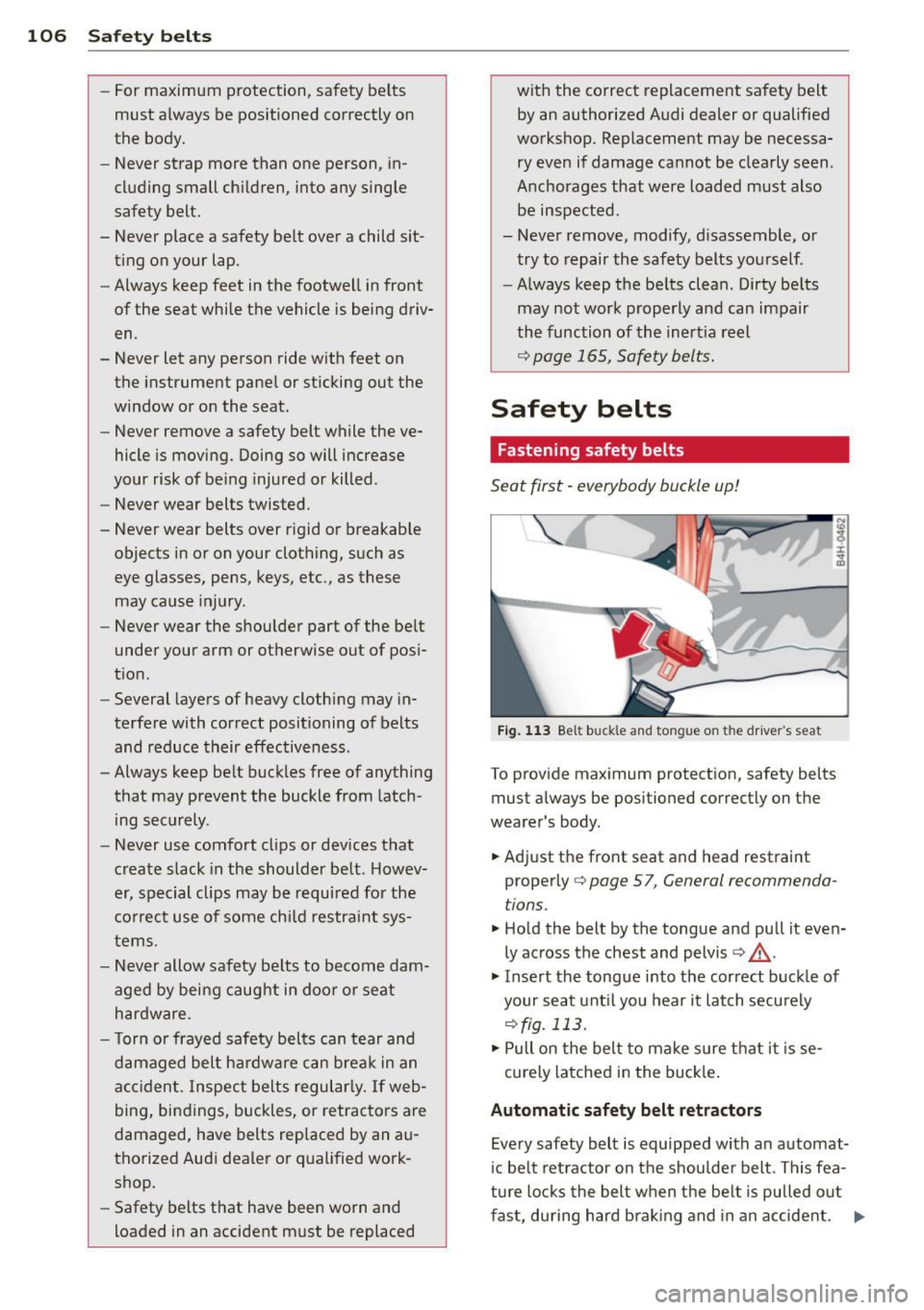
Fig. 113 Be lt buck le and to ngue o n th e drive r's se at
To provide maximum protection, safety belts
must always be positioned correctly on the
wearer 's body.
.. Adjust the front seat and head restraint
properly ¢
page 5 7, General recommenda
t ions .
.. Hold the belt by the tongue and pull it even
ly across the chest and pelvis ¢
_&..
.. Insert the tongue into the correct buckle of
your seat until you hear it latch securely
¢fig. 113 .
.. Pull on the belt to make sure that it is se-
curely latched in the buckle.
Automatic safety belt retractors
Every safety belt is equipped with an automat-
ic belt retractor on the shoulder belt. This fea
ture locks the belt when the belt is pulled out
fast, during hard braking and in an accident. ..,.
Page 109 of 244
The belt may also lock when you drive up or
down a steep hill or through a sharp curve.
During normal driving the belt lets you move
freely .
Safety be lt pretensioners
The safety belts are equipped with a belt pre
tensioner that helps to tighten the safety belt
and remove slack when the pretensioner is ac
tivated . The function of the pretensione r is
monitored by a warning light ¢
page 14.
Switchable locking feature
Every safety belt except the one on the driver
seat is equipped with a switchable locking fea
ture that
must be used when the safety belt is
used to attach a child seat. Be sure to read the important information about this feature
¢page 140.
A WARNING
Improperly positioned safety belts can
cause serious injury in an accident
¢ page 107, Safety belt position .
-Safety belts offer optimum protection
only when the seatback is upright and
belts are properly positioned on the
body.
-
- Never attach the safety belt to the buck
le for another seat. Attaching the belt to
the wrong buckle will reduce safety belt
effect iveness and can cause serious per
sonal injury.
- A passenger who is not properly restrain
ed can be seriously injured by the safety
belt itself when it moves from the stron
ger parts of the body into critical areas
like the abdomen.
- Always lock the convertible locking re
tractor when you are securing a child
seat in the vehicle
r:::> page 142.
Safety belts 107
Safety belt position
Correct belt position is the key to getting
maximum protection from safety belts .
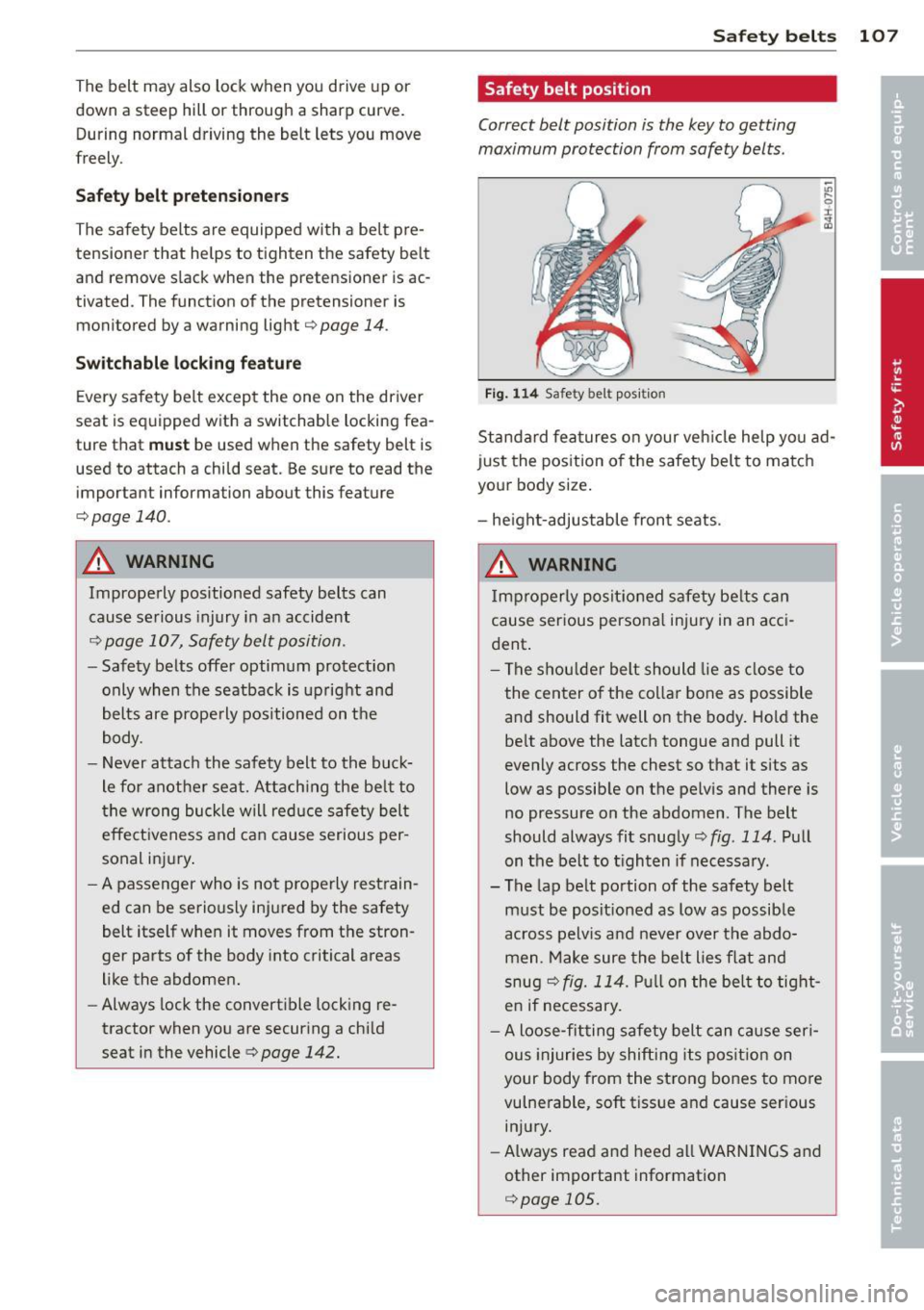
Fig. 114 Safety belt position
;;;
9 r ., a,
Standard features on your vehicle help you ad
just the position of the safety belt to match
your body size.
- height-adjustable front seats.
A WARNING
Improperly positioned safety belts can
cause serious personal injury in an acci
dent.
-
- The shoulder belt should lie as close to
the center of the collar bone as possible
and should fit well on the body. Hold the
belt above the latch tongue and pull it
evenly across the chest so that it sits as
low as possible on the pelvis and there is
no pressure on the abdomen . The belt
should always fit snugly
r:::> fig . 114. Pull
on the belt to tighten if necessary.
- The lap belt portion of the safety belt
must be positioned as low as possible
across pelvis and never over the abdo
men . Make sure the belt lies flat and
snug ¢
fig. 114. Pull on the belt to tight
en if necessary.
- A loose-fitting safety belt can cause seri
ous injuries by shifting its position on
your body from the strong bones to more
vulnerable, soft tissue and cause serious injury.
- Always read and heed all WARNINGS and
other important information
r:::> page 105.
Page 125 of 244

described in the child restraint manufactur
er 's instructions;
- make sure that the convertible locking fea
ture on the safety be lt for the front passen
ger seat has been activated and that the
safety belt has been pulled tight. The belt
must not be loose or have loops of slack so
that the sensor below the safety belt latch
on the seat can do its job<=>
page 140 .
-make sure that th ings that may increase the
weight of the child and child safety seat are
not being transported on the front passen
ger seat;
- make sure that the safety belt tension sen
sor is not blocked . Shake the safety belt
latch on the front passenge r seat back and
forth;
- If a st rap or tether is being used to tie the
ch ild safety seat to the front passenger
seat, make sure t hat it is not so tigh t that it
ca uses the we ight-sensing mat to meas ure
more weight than is actua lly on the seat .
If the PASSENGER AIR BAG OFF light still
does not com e on and does not stay on con
tinuously (when the igni tion is sw itched on),
- take the ch ild restraint off the front passen·
ger seat and install it p roperly at one of the
rear seat pos itions. Have the a irbag system
i nspec ted by your A udi dealer immediately.
- move the ch ild to a rea r seat posit io n and
make su re th at the chi ld is proper ly res train
ed in a chi ld restraint that is appropriate fo r
its size and age .
The
PASSENGER AIR BAG OFF light shou ld
NO T come on when the ign ition is on and an
ad ult is sitting in a p rope r seat ing pos ition on
the front passenger seat. If the
PASSENGER
AIR BAG OFF
li ght comes on and stays on or
flashes for about 5 seconds while driving, un
der these circumstances, make sure that:
- the ad ult on the front passenger seat is
proper ly seated on the center of the seat
cushion with his or her back up against the
backrest and the backrest is not reclined
<=> page 94, Proper occupant seating posi
tions,
A irbag system 123
- the adult is not tak ing weight off the seat by
holding on to the passenger assist handle
above the front passenger door,
- the safety be lt is being properly worn and
that there is not a lot of s lack in the safety
be lt webbing,
- accesso ry seat covers or cushions or other
things that may cause an incorrect reading
or impression on the weight-sensing mat
under the upho lstery of the seat have been
removed from the front passenger seat,
- a safety belt extender has not been left in
the safety belt latch for the front passenger
seat .
In add ition to the
PASSENGER AIR BAG O FF
light in the center of the instrument panel,
the message
PASSENGER AIR BAG O FF or
PASSENGER AIR BAG ON w ill briefly appear
in the instrument cluster display. This is to in
form the dr iver of the current front passenge r
a irbag status.
Important safety instructions on
monitoring the Advanced Airbag System
A WARNING
An airbag system that is not functioning
p roperly cannot provide supplemental pro
tection in a frontal c rash.
- If the airbag ind icator light comes on, it
means that there may b e something
wrong with the Advan ced Airbag Sys tem.
It is poss ible that the air bag w ill inflate
when it is not supposed to, or will not in
f late when it sho uld .
- Have the airbag system inspe cted imme
diate ly by your Audi dealer.
A WARNING
If the front airbag inflates, a child without
a child restraint, in a rea rward-facing child
safety seat or in a forward-facing child re
straint that has not been proper ly installed
will be ser ious ly injured and can be killed.
- Even tho ugh your vehicle is equipped
with an Advanced A irbag System, make
certain that all children, espec ially 12
-
•
•
Page 137 of 244
Model Manufactured on or
after
Cosco Summit Deluxe September 25, 2007
H igh Back Bo oste r
22-262
Co sco High Bac k Boos -September 2S, 2007
ter 22- 209
Evenfl o Tribut e V
379xxxx September 25, 2007
December 1, 1999
E
venflo Genera tions September 25, 2007
35 2xxxx
Grace ComfortSport September 2S, 2007
Grace Toddler Sa fety September 25, 200 7
Seat Step 2
Graco Platinum Cargo September 25, 2007
A WARNING
T o reduce the risk of serious injury, make
sure that the
PASSENGER AIR BAG OFF
light comes on and stays on whenever a
child rest raint is installed on the front pas
senger seat and the ignition is switched
on.
- Never install a rearward facing child
safety seat on the front passenger seat
unless the
PASSENGER AIR BAG OFF
light comes on and stays on. If the PAS
SENGER AIR BAG OFF
light does not
come on a nd stay on the inflating airbag
will hit the child safety seat o r infant ca r
rie r wi th great fo rce and will smash the
c hild s afety seat and child agains t the
backrest, door or roof . Have the airbag
system inspected immedia tely by your
authorized Audi dealer.
(D Tips
The ch ild seats listed in catego ries A to C
have been sta tica lly tested by Au di only for
the Advanced Airbag function.
.
Child Sa fet y 135
Important safety instructions for us ing
child safety seats
Correct use of child safety seats substantially
reduces the risk of injury in an accident!
As the dr iver, you are respons ible for the safe
ty of everybody in the veh icle , especially ch il
dren:
.. Always use the right ch ild safety seat for
each child and always use it properly
r=;, page 137.
.. Always carefully fo llow the child safe ty seat
manufac turer's inst ruct io ns on how to ro ute
the sa fe ty be lt properly through the c hild
safety seat .
.. When using the vehicle safety belt to install
a child safety seat, you m ust first activate
the convertible locking retractor on the
safety belt to prevent the child safety seat
from mov ing
¢ page 140 .
.. Push the ch ild safety seat down with yo ur
full weight to get the safety be lt really tight
so that the seat cannot
move fo rwa rd o r
sideways more th an one inch
(2.5 cm).
.. If a s trap or tet her is be ing used to tie the
child safety seat to the front passenger
seat, make sure that it is not so tight that it
causes the weight-sensing mat to measure
more weight than is act ually on the seat.
A lways remember : Even tho ugh yo ur vehicle is
equipped with an Advanced Airbag system, a
c hi ld should always ride in the seat properly
restrained for its age and s ize.
A WARNING
N ot using a child safety seat, using the
wrong ch ild safety seat o r imprope rly in
stalling a ch ild restraint increases the risk
of ser ious persona l inju ry and death.
- All vehicle occupants and especially chil
dren must always be restrained p rope rly
wheneve r riding in a vehicle.
-
- An unrest rained or improper ly restrain
ed ch ild can be injured or killed by be
i ng t hrown against the ins ide of the
ve
hicle or by being e jected from it dur ing
a sudden maneuve r o r i mpact .
•
•
Page 139 of 244
-Never install a rearward facing child
safety seat on the front passenger seat
unless the
PAS SENGER AIR BA G OFF
light comes on and stays on . If the PA S
SEN GER AI R BAG OFF
light does not
come on and stay on the inflating airbag
will hit the child safety seat o r infant car
r ie r with great fo rce and will smash the
child safety seat and child against the
backrest, door or roof . Have the airbag
system inspected immediately by your authorized Audi dealer .
Child safety seats
Infant seats
Babies and infants up to abou t one year old
and 20 lbs . or 9 kg need special rearward -fac
ing child restraints that support the back,
neck and head in a crash.
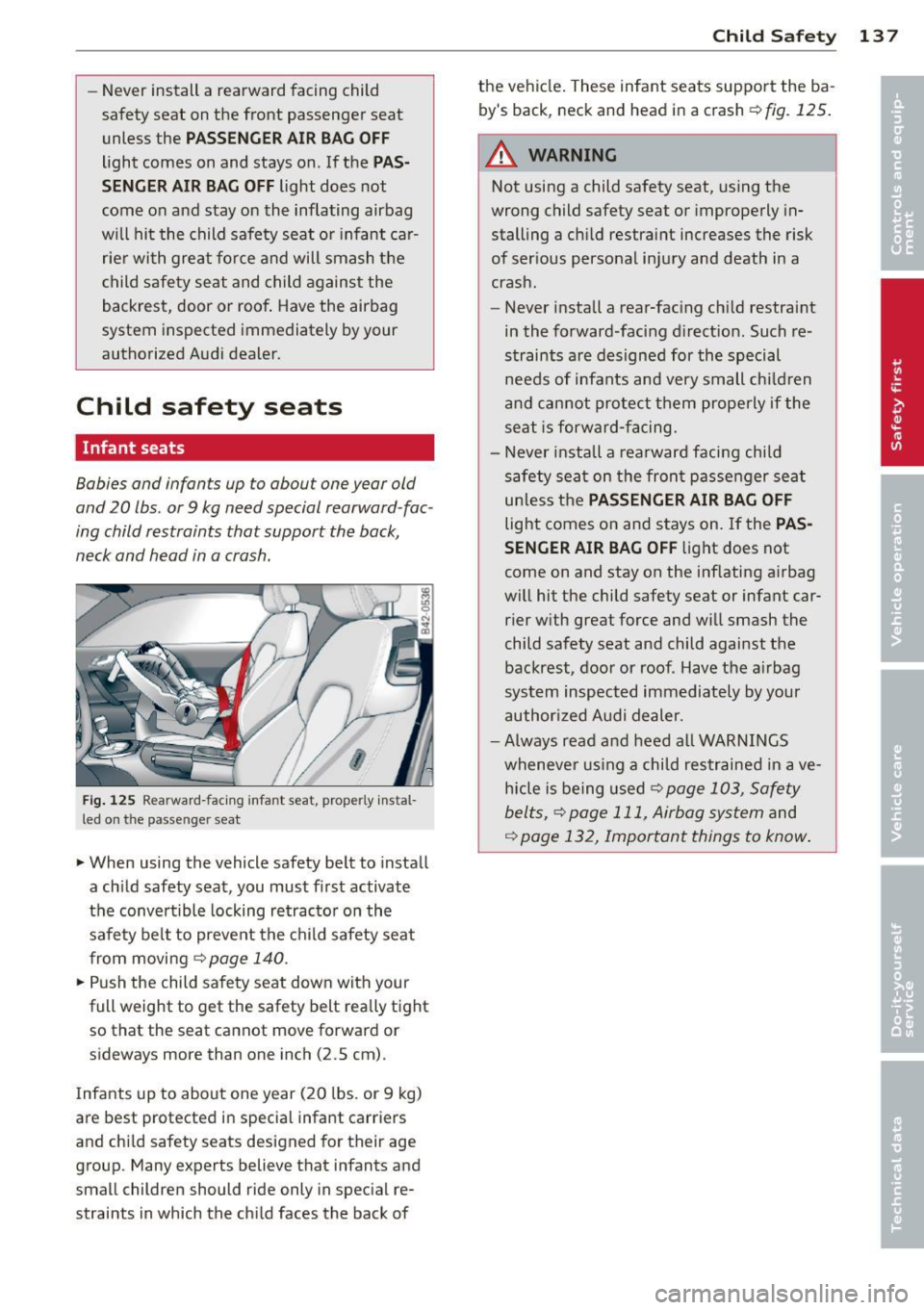
Fig . 125 Re arwar d-fa cing infan t sea t, pr operly instal
le d on t he p asseng er se at
"' When using the vehicle safety belt to in stall
a ch ild safety seat , you must first activate
the convertible locking retractor on the
safety belt to prevent the ch ild safety seat
from moving
r::!v page 140 .
"' Push the child sa fety seat dow n with your
full weight to get the safety bel t rea lly tight
so that the seat cannot move forward or
sideways more than one inch (2 .5 cm) .
I nfants up to about one year (20 lbs. or 9 kg)
are best prot ected in special infant carriers
and chi ld safety seats design ed for their age
group . Many experts believe that infants and
sm all ch ildren should ride only in spec ia l re
straints in which the ch ild faces the back of
Child S afety 13 7
the vehicle. These infant seats support the ba
by 's back, neck and head in a crash~
fig. 125.
A WARNING
Not using a child safety seat, using the
wrong child safety seat or improperly in
stalling a child restraint increases the risk
of ser ious personal injury and death in a
crash.
- Never install a rear-fac ing ch ild restraint
in the forward -facing d irect ion . Such re
straints are designed for the special needs of infants and very small chi ld ren
and cannot protect them properly if the
seat is forward-facing.
- Never install a rearward facing child
safety sea t on the fron t passenger seat
un less t he
PASSENGER AIR BAG OFF
light comes on and stays on. If the PAS·
SENGER A IR BAG OFF
light does not
come on and stay on the inf lating a irbag
will hit the child safety seat or infant car
rier w ith great f orce and w ill smash the
child safety seat and child against the backrest, door or roof . Have the a irbag
sys tem inspected immediately by your
author ized Audi dealer.
- Always read and heed al l WARNINGS
whenever us ing a child restrained in ave
hicle is being used
r::!v page 103, Safety
belts, r::!vpage 111, Airbag system
and
r::!v page 132, Important things to know .
Page 140 of 244
138 Child Safet y
Convertible child safety seats
Properly used convertible child safety seats
can help protect toddlers and children over
age one who weigh between
20 and 40 lbs. (9
and 18 kg) in a crash.
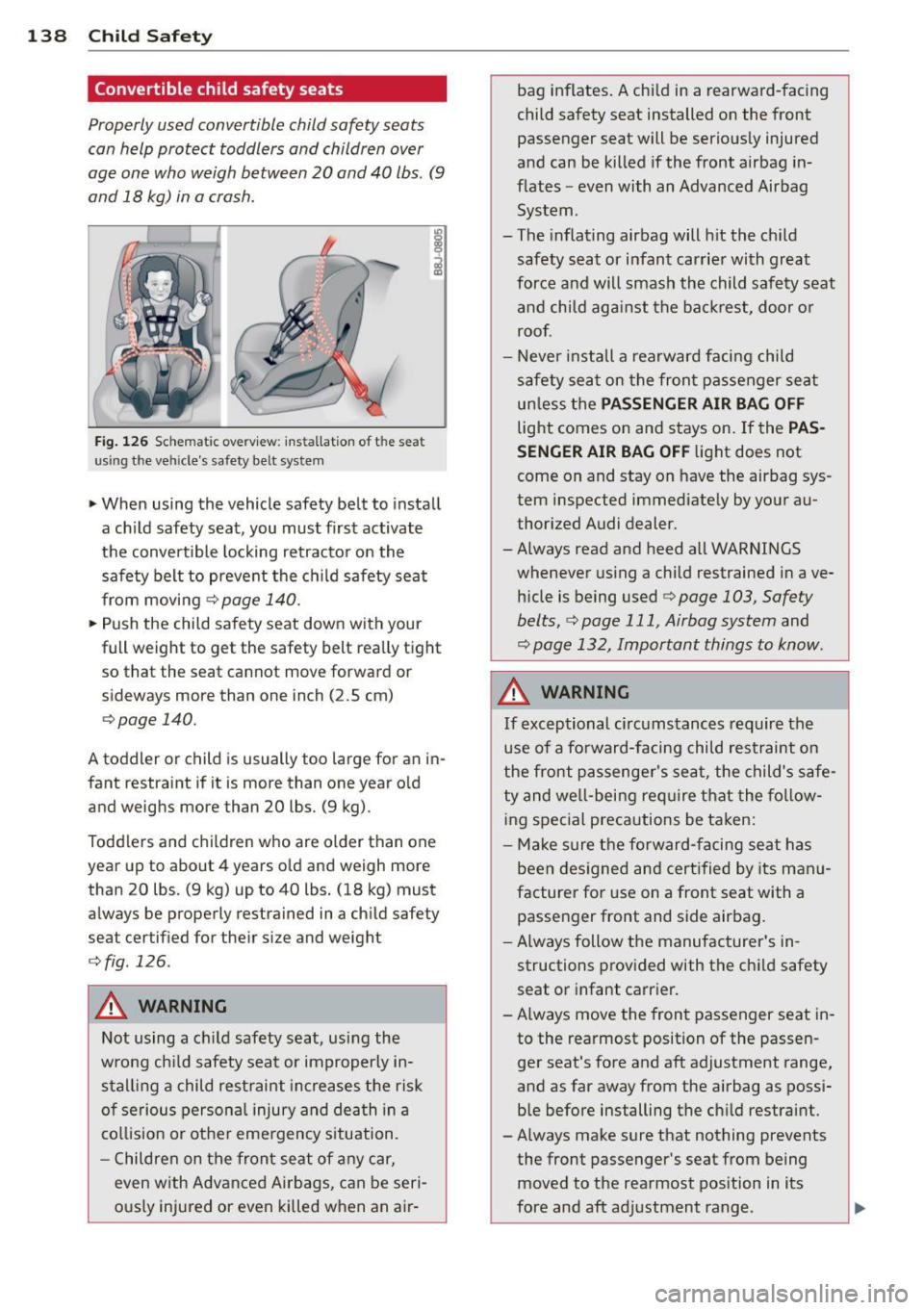
Fig . 126 Schematic overv iew: installat ion of the seat
usin g the vehicle's safety belt system
~ When using the vehicle safety belt to install
a ch ild safety seat, you must first activate
the convertible locking retractor on the safety belt to prevent the c hild safety seat
from movi ng
Q page 140.
~ Push the child safety seat down with your
full weight to get the safety belt rea lly tight
so that the seat cannot move forward or
sideways more than one inch (2.5 cm)
Qpage 140.
A toddler or child is usually too large for an in
fant restraint if it is more than one year old
and weighs more than 20 lbs. (9 kg) .
Toddlers and ch ildren who are o lder than one
year up to about 4 years o ld and weigh more
than 20 lbs . (9 kg) up to 40 lbs. (18 kg) must
always be properly restrained in a child safety
seat certi fied for the ir size and weight
Qfig. 126.
&_ WARNING
Not using a ch ild safety seat, us ing the
w rong ch ild safety seat or improperly in
stal ling a child restraint increases the risk
o f se rious persona l injury and death in a
co llision or othe r eme rgency s ituation.
- Children on t he front seat of a ny car,
even w ith Advanced A irbags, can be seri
ous ly injured or even killed when an air- bag inflates. A chi
ld in a rearward-facing
child safety seat installed on the front
passenger seat will be seriously injured
and can be killed if the front airbag in
flates -even with an Advanced Airbag
System .
- The inflating airbag will h it the ch ild
safety seat or infant carrie r with great
for ce and will smash the child safety seat
and child aga inst the ba ckrest, door or
roof .
- Neve r install a rearward facing child
safety sea t on the fron t passenger seat
un less the
PASSENGER AIR BAG OFF
light comes on and stays on. If the PAS
SENGER AIR BAG OF F
light does not
come on and stay on have the airbag sys
tem inspected immediately by your au
thorized Audi dealer.
- Always read and heed all WARNINGS
whenever us ing a child restrained in ave
h icle is being used
¢ page 103, Safety
belts,
Q page 111, Airbag system and
Q page 132, Important things to know .
&_ WARNING
--
If exceptional circumstances require the
use of a fo rward-facing child restraint on
the front passenger 's seat , the child's safe
ty and well-bei ng req uire t hat the fo llow
i ng spec ial precautions be taken:
- Make sure the forward- facing seat has
been designed and cert ified by its man u
facturer for use on a front seat with a
passenger front and side airbag.
- Always follow the manufacturer 's in
structions p rovided with the chi ld safety
seat or infant carrier.
- A lways move the front passenger seat in
to the rearmost position of the passen ger seat's fore and aft adjustment range,
and as far away from the airbag as possi
b le before installing the child restraint.
- Always make sure that nothing prevents
the front passenger 's seat from being
moved to the rearmost position in its
fore and aft adjustment range .
Page 141 of 244
-Always make sure the backrest 1s in an
upr ight position.
- Make sure that the
PASSENGER AIR BAG
O FF
light comes on and stays on all the
t ime whenever the ignition is switched
on.
- If the light does not stay on, perform the checks.
- If the
PASSENGER AIR BAG O FF light
does not come on and stay on have the
airbag system inspected immed iately by
your Audi dealer.
Booster seats and safety belts
Properly used booster seats con help protect
children weighing between about 40 lbs. and
80 lbs. (18 kg and 36 kg) who ore less than 4
ft. 9 in . (57 inches/1 .45 meters) toll.
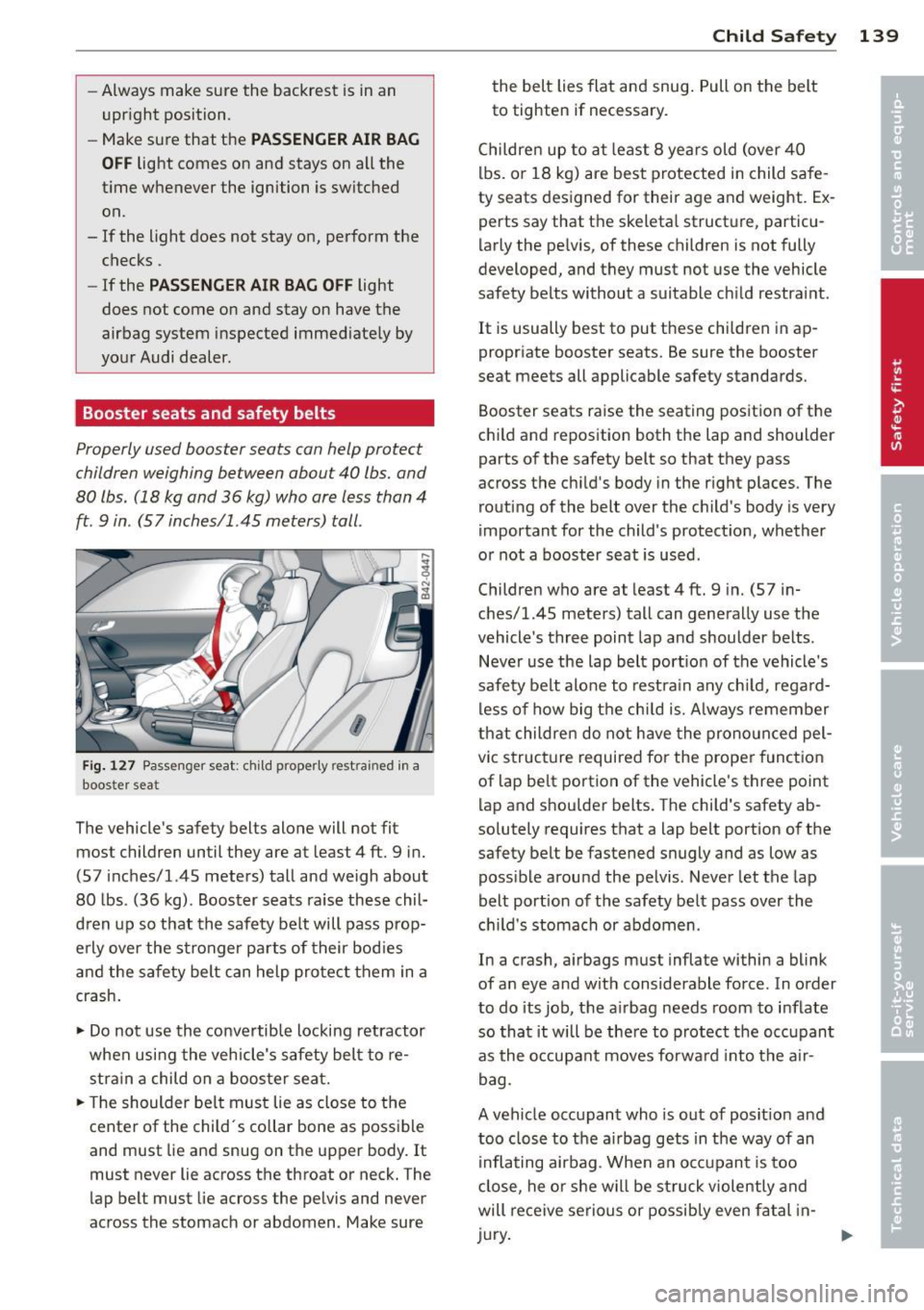
F ig. 12 7 Passenger seat: child proper ly restrained in a
booster seat
The vehicle's safety belts alone will not fit
most children until they are at least 4
ft. 9 in.
(57 inches/1.45 meters) tall and weigh about
80 lbs. (36 kg). Booster seats ra ise these chil
d ren up so that the safety belt will pass prop
erly over the stronger parts of their bod ies
and the safety belt can help protect them in a
crash .
~ Do not use the convertible locking retractor
when usi ng the veh icle's safety belt to re
stra in a child on a booster seat.
~ The shoulder be lt must lie as close to the
cente r of the child· s collar bone as possible
and must lie and snug on the upper body. It must never lie across the throat or neck. The
lap belt must lie across the pelvis and never
across the stomach or abdomen. Make sure
Child S afety 139
the belt lies flat and snug . Pull on the belt
to tighten if necessary.
Childre n up to at least 8 yea rs old (over 40
lbs. o r
18 kg) are best protected in child safe
ty seats designed for their age and weight.
Ex
perts say that the skeletal structure, particu
larly the pe lvis, of these children is not fully
developed, and they must not use the vehicle
safety belts without a suitable ch ild restrai nt.
It is usually best to put these children in ap
propriate booster seats. Be sure the booster
seat meets all applicable safety standards.
Booster seats raise the seating pos ition of the
ch ild and repos ition both the lap and shoulder
parts of the safety belt so that they pass
across the ch ild's body in the r ight places. The
routing of the belt over the child's body is very
important for the child's protect ion, whether
or not a booster seat is used.
Children who are at least 4
ft. 9 in. (57 in
ches/1.45 meters) tall can generally use the
vehicle 's three point lap and shoulder belts.
Never use the lap belt port io n of the vehicle's
safety belt alone to restra in any ch ild, rega rd
less of how big the chi ld is. A lways remember
that children do not have the prono unced pel
vic structure required for the prope r function
of lap belt portion of the vehicle's three point
lap and shoulder belts. The child's safety ab
solutely requires that a lap belt portion of the
safety belt be fastened snugly and as low as poss ible around the pelvis. Never let the lap
belt portion of the safety belt pass over the
ch ild's stomach or abdomen.
In a crash, a irbags must inflate within a blink
of an eye and with considerable force . In order
to do its job, the a irbag needs room to inflate
so that it will be there to p rotect the occupant
as the occupant moves forward into the a ir
bag.
A vehicle occupant who is out of posit ion and
too close to the a irbag gets in the way of an
i nflating airbag. When a n occupant is too
close, he or she will be st ruck violently and
will re ceive se rious or possibly even fatal in -
jury .
ll-
Page 142 of 244
140 Child Safety
In order for the airbag to offer protection, it is
important that all vehicle occupants, especial
ly any children, who must be in the front seat
because of exceptional circumstances, be
properly restrained and as far away from the
airbag as possible. By keeping room between
the child's body and the front of the passen
ger compartment, the airbag can inflate com
pletely and provide supplemental protection
in certain frontal collisions .
& WARNING
Not using a booster seat, using the boos
ter seat improperly , incorrectly installing a
booster seat or using the vehicle safety
belt improperly increases the risk of seri
ous personal injury and death in a collision
or other emergency situation. To help re
duce the risk of serious personal injury
and/or death:
- The shoulder belt must lie as close to the
center of the child's collar bone as possi
ble and must lie and snug on the upper
body .
It must never lie across the throat
or neck. The lap belt must lie across the
pelvis and never across the stomach or
abdomen. Make sure the belt lies flat
and snug. Pull on the belt to tighten if
necessary.
- Failure to properly route safety belts
over a child's body will cause severe inju
ries in an accident or other emergency
situation
c::;,poge 103.
-Children on the front seat of any car,
even with Advanced Airbags, can be seri
ously injured or even killed when an air
bag inflates.
- Never let a child stand or kneel on the
seat.
- Never let a child ride in the cargo area of
your vehicle.
- Always remember that a child leaning
forward, sitting sideways or out of posi
tion in any way during an accident can be
struck by a deploying airbag. This will re
sult in serious personal injury or death.
- If you must install a booster seat on the
front passenger seat because of excep -
-
tional circumstances the PASSENGER
AIR BAG OFF
light must come on and
stay on, whenever the ignition is switch
ed on.
- If the
PASSENGER AIR BAG OFF light
does not come on and stay on, perform
the checks described .
- If the
PASSENGER AIR BAG OFF light
does not come on and stay on whenever
the ignition is switched on the inflating
airbag will hit the child safety seat or in
fant carrier with great force and will
smash the child safety seat and child
against the backrest, door or roof. Have
the airbag system inspected immediately
by your Audi dealer.
- Always read and heed all WARNINGS
whenever using a child restrained in ave
hicle is being used
¢page 103, Safety
belts,
c::;, page 111 , Airbag system and
c::;, page 132, Important things to know.
Installing a child safety
seat
Securing a child safety seat using a
safety belt
Safety belts for the front passenger con be
locked with the convertible locking retractor
to properly secure child safety sea ts.
The safety belts emergency locking retractors
for the front passenger's seat safety belt have
a convertible locking retractor for child re
straints . The safety belt must be locked so
that belt webbing cannot unreel. The retrac
tor can be activated to lock the safety belt and
prevent the safety belt webbing from loosen
ing up during normal driving. A child safety
seat can only be properly installed when the
safety belt is locked so that the child and child
safety seat will stay in place.
Always remember: Even though your vehicle is
equipped with an Advanced Airbag system, a
child should always ride in the seat properly
restrained for its age and size.
II>-
Page 143 of 244
A WARNING
Improperly installed child safety seats in
crease the risk of serious personal injury
and death in a collision.
- Always make sure that the safety belt re
tractor is locked when installing a child
safety seat. An unlocked safety belt re
tractor cannot hold the child safety seat
in place during normal driving or in a
crash .
- Always buckle the child safety seat firmly
in place even if a child is not sitting in it .
A loose child safety seat can fly around
during a sudden stop or in a collision.
- The inflating airbag will hit the child
safety seat or infant carrier with great
force and will smash the child safety seat
and child against the backrest, door or
roof.
- Forward-facing child safety seats or in
fant carriers installed on the front pas
senger's seat may interfere with the de
ployment of the airbag and cause serious
injury to the child.
- Always read and heed all WARNINGS
whenever using a child restrained in ave
hicle is being used
Qpage 132. Special
precautions apply when installing a child
safety seat on the front passenger seat
Q page 112, Child restraints on the front
seat -some important things to know.
A WARNING
Always take special precautions if you
must install a forward or rearward-facing
child restraint on the front passenger's
seat in exceptional situations:
- Whenever a forward or rearward-facing
child restraint is installed on the front
passenger seat, the
PASSENGER AIR
BAG OFF
light must come on and stay on
whenever the ignition is switched on.
- If the PASSENGER AIR BAG OFF light
does not come on and stay on, perform
the checks described .
- If the PASSENGER AIR BAG OFF light
does not come on and stay on whenever
Child Safety 141
the ignition is switched on the inflating
airbag will hit the child safety seat or in
fant carrier with great force and will smash the child safety seat and child
against the backrest, door or roof. Have
the airbag system inspected immediately
by your Audi dealer.
- Improper installation of child restraints
can reduce their effectiveness or even
prevent them from providing any protec
tion.
-An improperly installed child restraint
can interfere with the airbag as it de
ploys and seriously injure or even kill the
child.
-Always carefully follow the manufactur
er's instructions provided with the child
safety seat or carrier.
- Never place additional items on the seat
that can increase the total weight regis
tered by the weight-sensing mat and can
cause injury in a crash.
A WARNING
Forward-facing child restraints:
- Always make sure the forward-facing
seat has been designed and certified by
its manufacturer for use on a front seat
with a passenger front and side airbag.
- Never put the forward-facing child re
straint up, against or very near the in
strument panel.
- Always move the passenger seat into its
rearmost position in the seat's fore and
aft adjustment range, as far away from
the airbag as possible before installing the forward-facing child restraint. The
backrest must be adjusted to an upright
position.
- Make sure that the
PASSENGER AIR BAG
OFF
light comes on and stays on all the
time whenever the ignition is switched
on.
A WARNING
Rearward-facing child restraints: •
•