seat adjustment AUDI RS5 COUPE 2015 User Guide
[x] Cancel search | Manufacturer: AUDI, Model Year: 2015, Model line: RS5 COUPE, Model: AUDI RS5 COUPE 2015Pages: 254, PDF Size: 64.12 MB
Page 153 of 254

M N
0:: loo ,...., \!) er,
N er, ,....,
exceptional circumstances and the PASSEN
GER AIR BAG OFF
light does not come on
and stay on, immediately install the rear
ward-facing child safety seat in a rear seat
ing position and have the airbag system in
spected immediately by your authorized
Audi dealer.
A WARNING
If, in exceptional circumstances, you must in
stall a forward-facing child restraint on the
front passenger's seat:
- Always make sure the forward-facing seat
has been designed and certified by its man
ufacturer for use on a front seat with a pas
senger front and side airbag.
- Always follow the manufacturer's instruc
tions provided with the child safety seat or carrier.
- Always
move the passenger seat into its
rearmost position in the seat's fore and aft
adjustment range, as far away from the air
bag as possible before installing the child
restraint. The backrest must be adjusted to
an upright position.
- Always make sure that the
PASSENGER AIR
BAG OFF
light comes on and stays on all the
time whenever the ignition is switched on.
Always replace child restraints that were in
stalled in a vehicle during a crash. Damage to
a child restraint that is not visible could cause
it to fail in another collision situation.
Advanced front airbag system and children
Your vehicle is equipped with a front "Advanced
Airbag System" in compliance with United States
Federal Motor Vehicle Safety Standard (FMVSS)
208 as applicable at the time your vehicle was
manufactured.
The Advanced Airbag system in your vehicle has
been certified to meet the "low-risk" require
ments for 3- and 6-year old children on the pas
senger side and small adults on the driver side.
The low risk deployment criteria are intended to
Child safety
reduce the risk of injury through interaction with
the airbag that can occur, for example, by being
too close to the steering wheel and instrument
panel when the ai rbag inflates. In addition, the
system has been certified to comply with the "suppression" requirements of the Safety Stand
ard, to turn off the front airbag for infants up to
12 months who are restrained on the front pas
senger seat in child restraints that are listed in
the Standard.
Even though your vehicle is equipped with an Ad
vanced Airbag system, all children, especially
those 12 years and younger, should always ride in
the back seat properly restrained for their age
and size. The airbag on the passenger side makes
the front seat a potentially dangerous place for a
child to ride. The front seat is not the safest place
for a child in a forward-facing child safety seat. It
can be a
very dangerous place for an infant or a
larger child in a rearward-facing seat.
Advanced Airbags and the weight-sensing
mat in the front seat
The Advanced Airbag System in your vehicle de
tects the presence of an infant or child in a child
restraint on the front passenger seat using the
weight-sensing mat in the seat cushion and the sensor below the safety belt latch on the front
passenger seat that measures the tension on the
safety belt .
The weight-sensing mat measures total weight of
the child and the child safety seat and a child blanket on the front passenger seat. The weight
on the front passenger seat is related to the de
sign of the child restraint and its "footprint", the
size and shape of the bottom of the child re
straint as it sits on the seat. The weight of a child
restraint and its "footprint" vary for different
kinds of child restraints and for the different
models of the same kind of child restraint offered
by child restraint manufacturers.
The weight ranges for the individual types, makes
and models of child restraints that the NHTSA
has specified in the Safety Standard together
with the weight ranges of typical infants and typ-
ical 1 year-old child have been stored in the ...,
151
Page 156 of 254

Child safet y
-When b uying a ch ild restraint, select one
that fits your child and the vehicle.
- On ly use child restraint systems that fully
contact the flat port ion of the seat cush
ion. The ch ild restra int must not tip or
lean to either s ide. Audi does not recom
mend using child safety seats that rest on
legs o r tube-like frames . They do not pro
vide adequate contact with the seat.
- Always heed all legal requirements pe r
taining to the installat ion and use of ch ild
safety seats and carefully follow the in
struc tions prov ided by the manufacturer
of the seat you are using.
- Never allow ch ildren under 57 inches
(1.45 me ters) to wear a normal sa fety belt .
They m ust always be rest rained by a proper
child restra int system. Otherwise, they
could sustain injuries to the abdomen and
neck areas during sudden braking maneu
vers or acc idents.
- Never let more than one child occupy a chi ld
safety seat.
- Never let babies or older children ride in a
vehicle while sitting on the lap of another
passenger.
- Ho ld ing a child in your arms is neve r a sub
stit ute for a child rest raint sys tem.
- The strongest person co uld not hold the
child with the fo rces that ex ist in an acci
dent. The child will s tri ke the inte rior of
the vehicle and can a lso be str uck by the
passenger.
- The ch ild and the passenger can a lso in
jure each other in an acc ident .
- Never ins tall rea rward-facing child safety
seats or infant carriers on the front passen
ger seat. A child w ill be seriously injured and
can be killed when the passenger airbag in
flates -even with an Advanced Airbag Sys
tem .
- The inflating airbag will h it the ch ild safe
ty seat or infant carrier w ith g reat force
and will smash the child safety seat and
child against the bac krest, center arm
rest, door or roof.
- Always install rearward-facing chi ld safety
seats or in fant ca rr ie rs on the rear seat .
154
-Forwa rd-facing child safety seats insta lled
on the front passenger's seat can interfere
w ith the airbag when it inflates and cause
serious injury to the child. Always install fo r
ward-facing child safety seats on the rear seat .
- If except ional circumstances require the use
of a fo rward-facing child restraint on the
front passenge r's seat, the child's safety
and well-be ing require that the following
speci al precautions be taken:
- Make sure the forward-facing seat has been designed and certified by its manu
factu rer for use on a front seat w ith a pas
senger front and side airbag .
- Always carefully follow the manufacturer's
i nst ructions provided with the child safety
seat or carrier .
- Always move the front passenger seat into
the rea rmost pos ition of the passenger
seat's fore and aft adjustment range, and
as fa r away from the a irbag as poss ible be
fo re insta lling the child rest raint.
- Always make sure that nothing p revents
the front passenge r's seat from being
moved to the rearmost posit ion in its fo re
and aft adjus tment range .
- Always make sure tha t the backres t is in
the up right pos ition.
- Always buckle the child sa fety seat firmly in
place even if a ch ild is not si tting in it. A
loose child safety seat can fly around d uring
a sudden stop or in a collision.
- Always read and heed a ll WARNI NGS when
eve r us ing a child restrained in a vehicle is
be ing used¢
page 120, Safety belts,
¢page 128, Airbag system
and
¢ page 150, Child safety.
A WARNING
To reduce the risk of ser ious injury, make sure
that the
PASSENGER AIR BAG OFF li ght
comes on and stays on whenever a ch ild re
straint is installed on the front passenge r seat
and the ign ition is switched on . ..,.
Page 159 of 254

M N
0:: loo ,...., \!) 1.1'1
N 1.1'1 ,....,
Toddlers and children who are older than one
year up to about 4 years old and weigh more than
20 lbs. (9 kg) up to 40 lbs. (18 kg) must always
be properly restrained in a child safety seat certi
fied for their si ze and weight¢
fig. 143 and
¢fig. 144 .
The airbag on the passenger side makes the front
seat a potentially dangerous place for a child to ride . The front seat is not the safest place for a
child in a forward-facing child safety seat. It is a
very dangerous place for an infant or a larger
child in a rearward-facing seat.
.8, WARNING
Not using a child safety seat, using the wrong
child safety seat or improperly installing a
child restraint increases the risk of serious
personal injury and death in a collision or oth
er emergency situation.
- Children on the front seat of any car, even
with Advanced Airbags, can be seriously in
jured or even killed when an airbag inflates.
A child in a rearward-facing child safety seat
installed on the front passenger seat will be
seriously injured and can be killed if the
front airbag inflates -even with an Ad·
vanced Airbag System .
- The inflating airbag will hit the child safety seat or infant carrier with great force and
will smash the child safety seat and child against the backrest, center armrest, door
or roof.
- Always install rearward-facing child safety
seats on the rear seat.
- If you must install a rearward facing child
safety seat on the front passenger seat be
cause of exceptional circumstances and the
PASSENGER AIR BAG OFF light does not
come on and stay on, immediately install
the rearward-facing child safety seat in a
rear seating position and have the airbag
system inspected by your authorized Audi
dealer.
- The rear side of the child safety seat should be positioned as close as possible to the
backrest on the vehicle seat . Adjust or re
move the rear seat head restraint if it is dif-
Child safety
ficult to install the child seat with the head
restraint in place
¢ page 56. Install the
head restraint again immediately once the
child seat is removed . Driving without head
restraints or with head restraints that are
not properly adjusted increases the risk of
serious or fatal neck injury dramatically.
- Always read and heed all WARNINGS when
ever using a child restrained in a vehicle is
being used¢
page 120, Safety belts,
¢ page 128, Airbag system and
¢page 150, Important information.
.8, WARNING
= -
If exceptional circumstances require the use
of a forward-facing child restraint on the front
passenger's seat, the child's safety and well
being require that the following special pre
cautions be taken:
- Make sure the forward-facing seat has been
designed and certified by its manufacturer
for use on a front seat with a passenger
front and side airbag .
-Always follow the manufacturer's instruc tions provided with the child safety seat or
infant carrier.
- Always move the front passenger seat into
the rearmost position of the passenger
seat's fore and aft adjustment range, and as
far away from the airbag as possible before
installing the child restraint.
- Always make sure that nothing prevents the
front passenger's seat from being moved to
the rearmost position in its fore and aft ad
justment range.
- Always make sure the backrest is in an up
right position.
- Make sure that the
PASSENGER AIR BAG
OFF
light comes on and stays on all the time
whenever the ignition is switched on.
- If the light does not stay on, perform the
checks ¢
page 138, Monitoring the Ad
vanced Airbag System.
- Take the child restraint off the front passen
ger seat and install it properly at one of the
rear seat positions if the
PASSENGER AIR
157
Page 163 of 254
M N
0:: loo ,...., \!) ..,.,
N ..,., ,....,
adjustment range, as far away from the air
bag as possible before installing the for
ward-facing child restraint. The backrest must be adjusted to an upright position .
- Make sure that the
PASSENGER AIR BAG
OFF
light comes on and stays on all the time
whenever the ignition is switched on .
A WARNING
Rearward-facing child restraints:
- A child in a rearward-facing child safety seat
installed on the front passenger seat will be
seriously injured and can be killed if the
front airbag inflates -even with an Ad
vanced Airbag System.
- The inflating airbag will hit the child safety
seat or infant carrier with great force and
will smash the child safety seat and child
against the backrest, center armrest, door
or roof.
- Always be especially careful if you must in
stall a rearward facing child safety seat on
the front passenger seat in exceptional cir
cumstances.
- A tight tether strap on a rearward-facing
child restraint attached to the front passen
ger seat can put too much pressure on the
weight-mat in the seat and register a heavi er weight in the Advanced Airbag System .
The heavier weight registered can make the
system work as though an adult were on the
seat and deploy the Advanced Airbag when
it must be suppressed causing serious or
even fatal injury to the child.
- Make sure that the
PASSENGER AIR BAG
OFF
light comes on and stays on all the time
whenever the ignition is switched on.
- If the PASSENGER AIR BAG OFF light does
not come on and stay on, immediately in
stall the rearward-facing child safety seat in
a rear seating position and have the airbag
system inspected by your authorized Audi
dealer.
Child safety
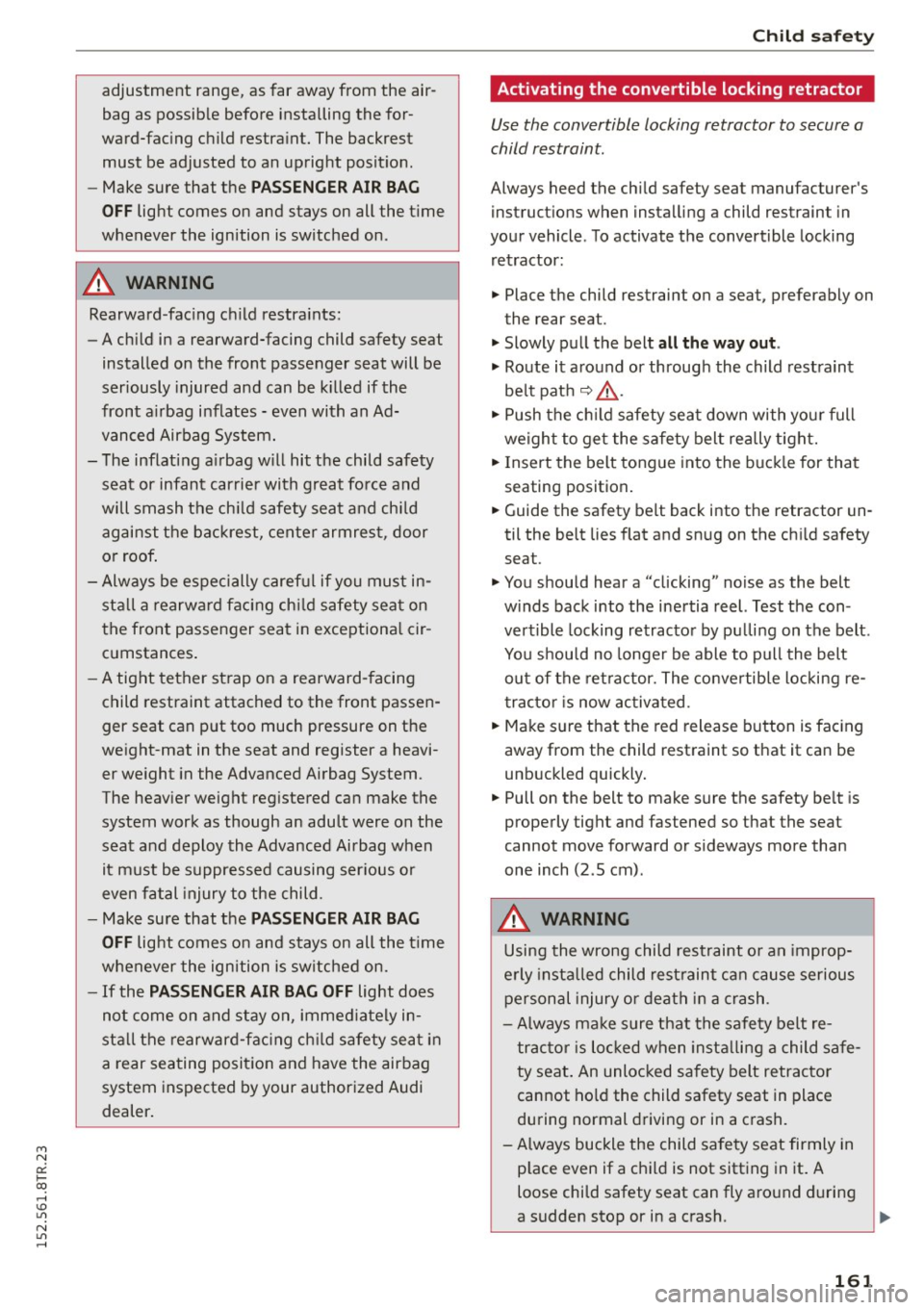
Activating the convertible locking retractor
Use the convertible locking retractor to secure a
child restraint .
Always heed the child safety seat manufacturer's
instruc tions when installing a child restrain t in
your vehicle . To activate the convertible locking
retractor:
.. Place the child restraint on a sea t, preferably on
the rear seat.
.. Slowly pull the belt
all the way out .
.. Route it around or through the child restraint
belt path
~ . & .
.. Push the child safety seat down with your full
weight to get the safety belt really tight.
.. Insert the belt tongue into the buckle for that
seating posit ion.
.. Guide the saf ety belt back into the retractor un
til the belt lies flat and snug on the child safety
seat .
.. You should hear a "clicking" noise as the belt
winds back into the inertia reel. Test the con
vertible locking retractor by pulling on the belt .
You should no longer be able to pull the belt
out of the retractor. The convertible locking re
tractor is now activated .
.. Make sure that the red release button is facing
away from the child restraint so that it can be
unbuckled quickly.
.. Pull on the belt to make sure the safety belt is
properly tight and fastened so that the seat
cannot move forward or sideways more than
one inch (2 .5 cm) .
A WARNING
Using the wrong child restraint or an improp
erly installed child restraint can cause serious
personal injury or death in a crash .
- Always make sure that the safety belt re
tractor is locked when installing a child safe
ty seat. An unlocked safety belt retractor
cannot hold the child safety seat in place
during normal driving or in a crash.
- Always buckle the child safety seat firmly in place even if a child is not sitting in it. A
loose child safety seat can fly around during
a sudden stop or in a crash. ..,.
161
Page 178 of 254

Smart Technolog y
(D Tips
-But even energy management cannot neg
ate the limits of physics. Consider that the power and life of a battery are limited.
- If starting ability is threatened, the indica
tor light (•)appears
Qpage 16.
What you should know
The highest priority is given to maintaining start
ing capability.
The battery is severely taxed in short-distance
driving, in city traffic and during the co ld time of
year . Ab undant electrical energy is required, but
only a little is generated. It is also critical if the
engine is not runn ing and electrical components
are turned on. In this instance energy is being
consumed but none is being generated.
It is in precisely these situat ions that you wi ll no
tice energy management actively regulating the
d istr ibut io n of energy.
Vehicle s tand s for an exte nded p eriod
If you do not drive your vehicle over a period of
several days or weeks, e lectrica l components are
gradually cut back or switched off. This reduces
energy consumption and maintains starting ca
pability over a longer period. Some of the con
ven ience funct ions may not operate, such as the
interior lights or the powe r seat adjustment. The
conven ience functions will be ava ilable again
when you sw itch on the ign it io n and start the en
g ine.
With th e engine turned off
If you listen to the radio, for example, with the
engine turned off or use other MMI funct ions,
the battery is being discha rged .
If starting capability is jeopardized due to energy
consumption, a message appears in the MMI dis p lay . The message ind icates that the system will
be sw itched off automat ica lly in a moment. If
you wish to cont inue using the functions , you
have to start the engine .
176 With the en
gine running
Although elec trical energy is generated when the
vehicle is being d riven, the battery can become
discharged . This happens mostly when litt le en
ergy is being generated and a great deal con
sumed and the battery's state of charge is not
optimal.
T o bring the energy ba lance back into equilibri
u m, consumers whic h req uire especially large
amounts of energy are temporari ly cut back or
switched off. Heating systems in part icular re
quire a great deal of energy. If you notice, for ex
ample, that the heated seats* o r the heated rear
window are not heating, they have been tempo
r ari ly cut back o r switched off . Th ese systems w ill
be ava ilable again as soon as the ene rgy ba lance
has been res tored.
You w ill also notice that engine id le speed has
been increased slightly . Thi s is normal and not a
ca use for concer n. By increasing eng ine idle
speed the addi tional energy required is gene rated
and the battery is charged.
Page 249 of 254
M N
0:: loo ,...., \!) ..,.,
N ..,., ,....,
Parking system p lus with rear view camera
Parking mode
1 . . . . . . . . . . . . . . . . . . . . . 108
Park ing mode 2 . . . . . . . . . . . . . . . . . . . . . 109
Safety p recautions . . . . . . . . . . . . . . . . . . . 106
Switching on/off . . . . . . . . . . . . . . . . . . . . 107
Switching rear view camera on/off . . . . . . 110
Parts replacement . . . . . . . . . . . . . . . . . . . . 238
Pass-through . . . . . . . . . . . . . . . . . . . . . . . . . . 64
PASS ENGER AIR BAG OFF light . . . . . . . . . . 138
Pedals . . . . . . . . . . . . . . . . . . . . . . . . . . . . . . 116
Physical principles of a frontal collision 121
Pollutant filter (automatic A/C system) . . . . 67
Power
seat adjustment . . . . . . . . . . . . . . . . . . . . . .
54
Windows . . . . . . . . . . . . . . . . . . . . . . . . . . . 37
Power locking system
Emergency locking . . . . . . . . . . . . . . . . . . . .
35
Panoramic tilting sunroof . . . . . . . . . . . . . . 38
Power windows . . . . . . . . . . . . . . . . . . . . . . 38
Rear lid . . . . . . . . . . . . . . . . . . . . . . . . . . . . . 36
Selective unlock feature . . . . . . . . . . . . . . . 35
Settings . . . . . . . . . . . . . . . . . . . . . . . . . . . . 35
Power steering
refer to Electro-mechanical power assist 174
Power window
Conven ience opening/closing . . . . . . . . . . .
38
Power windows
Malfunctions . . . . . . . . . . . . . . . . . . . . . . . .
38
Pregnant women
Special considerations when wearing a safe-
ty belt . . . . . . . . . . . . . . . . . . . . . . . . . . . . .
125
Pressure (tires) . . . . . . . . . . . . . . . . . . . . . . . 214
Proper occupant seating positions . . . . . . . 112
Proper safety belt position . . . . . . . . . . . . . . 124
Proper seating position
Front passenger . . . . . . . . . . . . . . . . . . . . .
113
Occupants .. .... ........... .. .. .. .. . 112
Rear passengers . . . . . . . . . . . . . . . . . . . . . 114
Q
Quartz clock . . . . . . . . . . . . . . . . . . . . . . . . . . 12
quattro
refer to all-wheel drive . . . . . . . . . . . . . . . 174
Question
What happens to unbelted occupants? . .
121
Index
R
Radiator fan . . . . . . . . . . . . . . . . . . . . . . . . . 195
Rain/light sensor
Headlights . . . . . . . . . . . . . . . . . . . . . . . . . .
43
Intermittent (w indshield w ipers) . . . . . . . . 49
Sensor defective . . . . . . . . . . . . . . . . . . . . . . 21
Raising the vehicle . . . . . . . . . . . . . . . . . . . . 232
Reading lights . . . . . . . . . . . . . . . . . . . . . . . . . 46
Rear fog lights . . . . . . . . . . . . . . . . . . . . . . . . 43
Rear lid
Escape handle ..... .... .... ... .. .. .. .
37
Opening and closing . . . . . . . . . . . . . . . . . . 36
Rear light
Defective . . . . . . . . . . . . . . . . . . . . . . . . . . .
21
Rear spo iler . .. .. .. ......... .... .. .. .. 171
Rear view camera
Parking mode 1
Parking mode 2
108
109
Rear view mirror . . . . . . . . . . . . . . . . . . . . . . . 47
Rear window heating . . . . . . . . . . . . . . . . . . . 69
Rear window sun shade . . . . . . . . . . . . . . . . . 48
Recirculation mode (automatic climate con-
trol) . . . . . . . . . . . . . . . . . . . . . . . . . . . . . . . . . 69
Refuell ing . . . . . . . . . . . . . . . . . . . . . . . . . . .
185
Release lever for hood . . . . . . . . . . . . . . . . . 187
Remote control
Garage door op ener (Homelink) . . . . . . . . .
40
Remote control key . . . . . . . . . . . . . . . . . . . . . 31
Personalizing . . . . . . . . . . . . . . . . . . . . . . . . 31
unlocking/locking . . . . . . . . . . . . . . . . . . . . 33
Remote rear lid release . . . . . . . . . . . . . . . . . 36
Repair manuals . . . . . . . . . . . . . . . . . . . . . . . 236
Repairs
Airbag system . . . . . . . . . . . . . . . . . . . . . .
141
Replacement key . . . . . . . . . . . . . . . . . . . . . . 31
Replacing bulbs . . . . . . . . . . . . . . . . . . . . . . 227
Replacing wiper blades . . . . . . . . . . . . . . . . . SO
Reporting Safety Defec ts ......... ..
118, 119
Reset button . . . . . . . . . . . . . . . . . . . . . . . . . . 12
Retractor . . . . . . . . . . . . . . . . . . . . . . . . . . . . 123
Right hand drive . . . . . . . . . . . . . . . . . . . . . . . 45
Rims . . . . . . . . . . . . . . . . . . . . . . . . . . . . . . . 210
Roof rack . . . . . . . . . . . . . . . . . . . . . . . . . . . . . 6 1
Roof load . . . . . . . . . . . . . . . . . . . . . . . . . . . 62
Roof weight . . . . . . . . . . . . . . . . . . . . . . . . . 62
247
Page 250 of 254
Index
s
SAFE . . . . . . . . . . . . . . . . . . . . . . . . . . . . . . . . 12
Safe driving habits . . . . . . . . . . . . . . . . . . . . 111
Safe lock . . . . . . . . . . . . . . . . . . . . . . . . . . . . . . 30
Safety Airbag system . . . . . . . . . . . . . . . . . . . . . . 128
B elts . . . . . . . . . . . . . . . . . . . . . . . . . . . . . . 120
Cargo . . . . . . . . . . . . . . . . . . . . . . . . . . . . . 117
Correct seat ing posit ion . . . . . . . . . . . . . . 1 12
Peda larea .. .. ............... .. .. .. . 116
Safety belt posi tion . . . . . . . . . . . . . . . . . . . 124
Safety belts worn by pregnant women . . . 125
Safety belt prete nsioner
Service and disposal . . . . . . . . . . . . . . . . . 126
Safety belts . . . . . . . . . . . . . . . . . . . . . . 120, 123
Da nger to passengers who do not wear a
safety belt . . . . . . . . . . . . . . . . . . . . . . . . . 121
Fasten ing . . . . . . . . . . . . . . . . . . . . . . . . . . 123
I mp rope rly wor n . . . . . . . . . . . . . . . . . . . . 125
No t wo rn .......................... 121
Safety belt posi tion . . . . . . . . . . . . . . . . . . 124
Safety ins truc tions . . . . . . . . . . . . . . . . . . . 12 2
Securing chi ld safety seats . . . . . . . . . . . . 159
Specia l considerations for pregna nt wom-
en . . . . . . . . . . . . . . . . . . . . . . . . . . . . . . . . 125
Unfasten ing . . . . . . . . . . . . . . . . . . . . . . . . 125
Warn ing/ indicator light . . . . . . . . . . . . . . . 120
Warn ing l ight . . . . . . . . . . . . . . . . . . . . . . . . 16
Wo rn properly . . . . . . . . . . . . . . . . . . . . . . 122
Safety belt warning light . . . . . . . . . . . . . . . 120
Safety compli ance s ticker . . . . . . . . . . . . . . 233
Safety equipment . . . . . . . . . . . . . . . . . . . . . 111
Safety features for occupant restrai nt and
protection . . . . . . . . . . . . . . . . . . . . . . . . . . . 111
S afety guide lin es
Sea ts . . . . . . . . . . . . . . . . . . . . . . . . . . . . . . . 53
Safety inst ructions
E ng ine compartment . . . . . . . . . . . . . . . . . 187
for side curta in a irbags . . . . . . . . . . . . . . . 14 9
for usi ng ch ild safety seats . . . . . . . . . . . . 153
for usi ng safety bel ts . . . . . . . . . . . . . . . . . 122
M on itoring the Advanced Airbag System 1 40
Seat adjustment Head restraints . . . . . . . . . . . . . . . . . . . . . 114
Seat belts refer to Safety belts . . . . . . . . . . . . . . . . . . 120
248
Seat heating . . . . . . . . . . . . . . . . . . . . . . . . . . 69
Seating capac ity . . . . . . . . . . . . . . . . . . . . . . 120
Seating position Driver . . . . . . . . . . . . . . . . . . . . . . . . . . . . . 112
Front passenger . . . . . . . . . . . . . . . . . . . . . 113
How to ad just the front seats . . . . . . . . . . 113
Incor rect seat position . . . . . . . . . . . . . . . . 115
Occ upants... .. .. .. .... ......... .. .. 112
Rea r passengers . . . . . . . . . . . . . . . . . . . . . 114
Seats Adjus ting . . . . . . . . . . . . . . . . . . . . . . . . . . . 54
Adjusting in the MMI . . . . . . . . . . . . . . . . . . 55
Convenie nce side view . . . . . . . . . . . . . . . . . 55
C orrec t seating posi tion . . . . . . . . . . . . . . 112
Drive r's sea t . . . . . . . . . . . . . . . . . . . . . . . . . 53
Fo ld ing . . . . . . . . . . . . . . . . . . . . . . . . . . . . . 63
Front passenger's seat . . . . . . . . . . . . . . . . . 54
Number of seats . . . . . . . . . . . . . . . . . . . . 120
Power easy entry f unction . . . . . . . . . . . . . . 55
Safety gu idelines . . . . . . . . . . . . . . . . . . . . . 53
Seat symmetry . . . . . . . . . . . . . . . . . . . . . . . 55
Seat ventilation . . . . . . . . . . . . . . . . . . . . . . . 69
Se lective unlock feature . . . . . . . . . . . . . . . . . 35
Selector lever
Emergency release . . . . . . . . . . . . . . . . . . . . 87
S t ronic transmission . . . . . . . . . . . . . . . . . . 81
Se lector lever disp lay . . . . . . . . . . . . . . . . . . . 81
Se lector lever emergency release . . . . . . . . . 87
Serv ice and disposal
Safety belt pretensioner . . . . . . . . . . . . . . 126
Se rvice interval display. . . . . . . . . . . . . . . . . . 26
Se rv ice position
refer to Replacing w iper blades . . . . . . . . . SO
SET button . . . . . . . . . . . . . . . . . . . . . . . . . . . 11
Sh utting down vehi cle . . . . . . . . . . . . . . . . . 179
Side a irbags
Desc ription . . . . . . . . . . . . . . . . . . . . . . . . . 14 4
How they wor k . . . . . . . . . . . . . . . . . . . . . . 14 6
s ide ass ist
Adjusting the brig htness . . . . . . . . . . . . . . . 99
Sensor range . . . . . . . . . . . . . . . . . . . . . . . . 98
Side assist
Activating and deactivating . . . . . . . . . . . . . 99
Descrip tion . . . . . . . . . . . . . . . . . . . . . . . . . . 97