lock AUDI RS5 COUPE 2015 Workshop Manual
[x] Cancel search | Manufacturer: AUDI, Model Year: 2015, Model line: RS5 COUPE, Model: AUDI RS5 COUPE 2015Pages: 254, PDF Size: 64.12 MB
Page 160 of 254

Child safety
BAG OFF light does not stay on whenever
the ignition is switched on.
Booster seats and safety belts
Properly used booster seats can help protect
children weighing between about 40 lbs. and 80
lbs. (18 kg and 36 kg) who ore less than 4 ft .
9
in. (57 inches/1.45 meters) tall.
Fig . 14 5 Rear seat: ch ild p roperly restra ined in a booster
seat
The vehicle's safety belts alone will not fit most
children until they are at least 4
ft. 9 in . (57 in
ches/1.45 meters) tall and weigh about 80 lbs.
(36 kg) . Booster seats raise these c hildren up so
that the safety belt will pass properly over the
stronge r pa rts of their bod ies and the safety belt
can help protect them in a crash.
• Do not use the convertible locking retractor
when using the vehicle's safety belt to restrain
a chi ld on a booster seat .
• The shoulder be lt must lie as clo se to the cen
t er of the child's collar bone as poss ible and
must lie flat and sn ug on the upper body . It
must never lie across the throat or neck . The
lap belt must lie across the pelvis and never
across the stomach or abdomen . Make sure the
belt lies flat and snug. Pull on the belt to tight
en if necessary.
• Secu re unused safety belts on the rear seat
~ page 155.
Children up to about 40 lbs. (18 kg) are best pro
tected in child safety seats designed for their age
and weight . Experts say that the skeletal struc
ture, part icularly the pelvis, of these ch ildren is
not f ully deve loped, and they must not use the
158
vehicle safety be lts without a suitable child re
straint.
It i s usually best to put t hese chi ldren in appro
pr iate booste r seats . Be sure the boos ter seat
meets a ll applicab le safety standards.
Booster seats ra ise the sea ting pos ition of t he
ch ild an d repos ition bo th the lap and shoulder
parts o f the safety bel t so th at they pass across
the chi ld's body in the right places . The rout ing of
the be lt over the chi ld's body is very important
for t he chi ld's protection, whether or not a boos
ter seat is used. C hildren age 12 and under must
always ride in the rear seat.
Children who are at least 4
ft . 9 in . (57 inc hes/
1.45 meters) tall ca n generally use the vehicle's
three po int lap and shoulder be lts. Never use the
lap belt portion of the vehicle's safety belt alone
to rest rain any child, regardless of how b ig the
c hi ld is . A lways remember that ch ild ren do not
have the p ronounced pe lvic st ructure required for
the p roper func tion of lap belt port ion of the ve
h icle 's th ree po int lap and shoulder be lts. The
ch ild' s sa fety abso lutely requires tha t a lap belt
portion of the safety belt be fastened snug ly and
as low as possible around the pelvis . Never let
the lap be lt portion of the safety belt pass over
the child's stomach or abdomen.
In a crash, a irbags must inflate within a blink of
an eye and with considerable force . In order to do
i ts job, the airbag needs room to inflate so that it
will be there to protect the occ upant as the occu
pant moves forward into the airbag .
A ve hicle occupant who is out of pos ition and too
close to the a irbag gets in the way of an inflating
airbag. When an occupant is too close, he or she
will be struck vio lent ly and will receive serious or
possibly even fatal injury .
In order for the airbag to
offer protection, it is
important that all vehicle occupants, especially
any ch ildren, who must be in the front seat be
cause of exceptional circumstances, be prope rly
restrained and as far away from the airbag as
poss ible. By keep ing room betw een the ch ild 's ..,
Page 161 of 254
M N
0:: loo ,...., \!) ..,.,
N ..,., ,....,
body and the front of the passenger compart
ment, the airbag can inflate completely and pro
vide supplemental protection in certain frontal
collisions .
& WARNING
Not using a booster seat, using the booster
seat improperly, incorrectly installing a boos
ter seat or using the vehicle safety belt im properly increases the risk of serious personal
injury and death in a collision or other emer
gency situation. To help reduce the risk of se
rious personal injury and/or death:
- The shoulder belt must lie as close to the
center of the child's collar bone as possible
and must lie flat and snug on the upper
body.
It must never lie across the throat or
neck. The lap belt must lie across the pelvis
and never across the stomach or abdomen.
Make sure the belt lies flat and snug. Pull on
the belt to tighten if necessary.
- Failure to properly route safety belts over a
child's body will cause severe injuries in an
accident or other emergency situation
~ page 120.
-The rear side of the child safety seat should
be positioned as close as possible to the
backrest on the vehicle seat . Adjust or re
move the rear seat head restraint if it is dif
ficult to install the child seat with the head
restraint in place
~page 56. Install the
head restraint again immediately once the
child seat is removed. Driving without head
restraints or with head restraints that are
not properly adjusted increases the risk of
serious or fatal neck injury dramatically.
- Children on the front seat of any car, even
with Advanced Airbags, can be seriously in
jured or even killed when an airbag inflates.
- Never let a child stand or kneel on any seat.
- Never let a child ride in the cargo area of
your vehicle.
- Always remember that a child leaning for
ward, sitting sideways or out of position in any way during an accident can be struck by
a deploying airbag. This will result in serious
personal injury or death .
Child safety
-If you must install a booster seat on the
front passenger seat because of exceptional
circumstances the
PASSENGER AIR BAG
OFF
light must come on and stay on, when
ever the ignition is switched on .
- If the
PASSENGER AIR BAG OFF light does
not come on and stay on, perform the
checks described~
page 138, Monitoring
the Advanced Airbag System.
- Take the child restraint off the front passen
ger seat and install it properly at one of the
rear seat positions if the
PASSENGER AIR
BAG OFF
light does not stay on whenever
the ignition is switched on.
- Always read and heed all WARNINGS when
ever using a child restrained in a vehicle is
being used¢
page 120, Safety belts,
¢ page 128, Airbag system and
¢ page 150, Important information.
Securing child seats
Securing a child safety seat using a safety
belt
Safety belts for the rear seats and the front pas
senger's seat can be locked with the convertible
locking retractor to properly secure child safety
seats.
The safety belts emergency locking retractors for
the rear seats safety belts and for the front pas
senger 's seat safety belt have a convertible lock
ing retractor for child restraints. The safety belt
must be locked so that belt webbing cannot un
reel. The retractor can be activated to lock the
safety belt and prevent the safety belt webbing
from loosening up during normal driving. A child
safety seat can only be properly installed when
the safety belt is locked so that the child and child safety seat will stay in place .
Always remember: Even though your vehicle is
equipped with an Advanced Airbag system, all
children, especially those 12 years and younger,
should always ride in the back seat properly re-
strained for their age and weight . ..,_
159
Page 162 of 254
Child safety
A WARNING
Improperly installed child safety seats in
crease the risk of serious personal injury and
death in a collision .
- Always make sure that the safety belt re
tractor is locked when installing a child safe
ty seat . An unlocked safety belt retractor
cannot hold the child safety seat in place
during normal driving or in a crash.
- Always buckle the child safety seat firmly in
place even if a child is not sitting in it. A
loose child safety seat can fly around during
a sudden stop or in a collision.
- If the backrest is not securely latched, the
child and the child restraint will be thrown
forward together with the backrest and will
strike parts of the vehicle interior. The child
can be seriously injured or killed.
- Never install rearward-facing child safety seats or infant carriers on the front passen
ger seat . A child will be seriously injured and
can be killed when the passenger airbag in
flates.
- The inflating airbag will hit the child safety
seat or infant carrier with great force and
will smash the child safety seat and child
against the backrest, center armrest, door or roof.
- Always install rearward-facing child safety
seats or infant carriers on the rear seat.
- Forward-facing child safe ty seats or infant
carriers installed on the front passenger's
seat may interfere with the deployment of
the airbag and cause serious injury to the child.
- It is safer to install a forward-facing child
safety seat on the rear seat.
- Always read and heed all WARNINGS when
ever using a child restrained in a vehicle is
being used~
page 150 . Special precautions
apply when installing a child safety seat on
the front passenger seat~
page 129, Child
restraints on the front seat -some impor
tant things to know.
160
A WARNING
-
Always take special precautions if you must
install a forward or rearward-facing child re
straint on the front passenger's seat in excep
tional situations:
- Whenever a forward or rearward -facing
child restraint is installed on the front pas
senger seat, the
PASSENGER AIR BAG OFF
light must come on and stay on whenever
the ignition is switched on.
- If the PASSENGER AIR BAG OFF light does
not come on and stay on, perform the
checks described ~
page 138, Monitoring
the Advanced Airbag System.
- Take the child restraint off the front passen
ger seat and install it properly at one of the
rear seat positions if the
PASSENGER AIR
BAG OFF
light does not stay on whenever
the ignition is switched on.
- Improper installation of child restraints can
reduce their effectiveness or even prevent
them from providing any protection.
- An improperly installed child restraint can
interfere with the airbag as it deploys and
seriously injure or even kill the child .
- Always carefully follow the manufacturer 's
instructions provided with the child safety
seat or carrier.
- Never place additional items on the seat
that can increase the total weight registered
by the weight-sensing mat and can cause in
jury in a crash .
A WARNING
Forward-facing child restraints:
- Always make sure the forward-facing seat
has been designed and certified by its man
ufacturer for use on a front seat with a pas
senger front and side airbag .
- Never put the forward-facing child restraint up , against or very near the instrument pan
el.
-Always move the passenger seat into its
rearmost position in the seat's fore and aft
-
Page 163 of 254
M N
0:: loo ,...., \!) ..,.,
N ..,., ,....,
adjustment range, as far away from the air
bag as possible before installing the for
ward-facing child restraint. The backrest must be adjusted to an upright position .
- Make sure that the
PASSENGER AIR BAG
OFF
light comes on and stays on all the time
whenever the ignition is switched on .
A WARNING
Rearward-facing child restraints:
- A child in a rearward-facing child safety seat
installed on the front passenger seat will be
seriously injured and can be killed if the
front airbag inflates -even with an Ad
vanced Airbag System.
- The inflating airbag will hit the child safety
seat or infant carrier with great force and
will smash the child safety seat and child
against the backrest, center armrest, door
or roof.
- Always be especially careful if you must in
stall a rearward facing child safety seat on
the front passenger seat in exceptional cir
cumstances.
- A tight tether strap on a rearward-facing
child restraint attached to the front passen
ger seat can put too much pressure on the
weight-mat in the seat and register a heavi er weight in the Advanced Airbag System .
The heavier weight registered can make the
system work as though an adult were on the
seat and deploy the Advanced Airbag when
it must be suppressed causing serious or
even fatal injury to the child.
- Make sure that the
PASSENGER AIR BAG
OFF
light comes on and stays on all the time
whenever the ignition is switched on.
- If the PASSENGER AIR BAG OFF light does
not come on and stay on, immediately in
stall the rearward-facing child safety seat in
a rear seating position and have the airbag
system inspected by your authorized Audi
dealer.
Child safety
Activating the convertible locking retractor
Use the convertible locking retractor to secure a
child restraint .
Always heed the child safety seat manufacturer's
instruc tions when installing a child restrain t in
your vehicle . To activate the convertible locking
retractor:
.. Place the child restraint on a sea t, preferably on
the rear seat.
.. Slowly pull the belt
all the way out .
.. Route it around or through the child restraint
belt path
~ . & .
.. Push the child safety seat down with your full
weight to get the safety belt really tight.
.. Insert the belt tongue into the buckle for that
seating posit ion.
.. Guide the saf ety belt back into the retractor un
til the belt lies flat and snug on the child safety
seat .
.. You should hear a "clicking" noise as the belt
winds back into the inertia reel. Test the con
vertible locking retractor by pulling on the belt .
You should no longer be able to pull the belt
out of the retractor. The convertible locking re
tractor is now activated .
.. Make sure that the red release button is facing
away from the child restraint so that it can be
unbuckled quickly.
.. Pull on the belt to make sure the safety belt is
properly tight and fastened so that the seat
cannot move forward or sideways more than
one inch (2 .5 cm) .
A WARNING
Using the wrong child restraint or an improp
erly installed child restraint can cause serious
personal injury or death in a crash .
- Always make sure that the safety belt re
tractor is locked when installing a child safe
ty seat. An unlocked safety belt retractor
cannot hold the child safety seat in place
during normal driving or in a crash.
- Always buckle the child safety seat firmly in place even if a child is not sitting in it. A
loose child safety seat can fly around during
a sudden stop or in a crash. ..,.
161
Page 164 of 254
Child safety
-Always make sure the seat backrest to which
the child restraint is installed is in an up
right position and securely latched into
place and cannot fold forward. Otherwise,
the seatback with the child safety seat at
tached to it could fly forward in the event of
an accident or other emergency situation.
- Always read and heed all WARNINGS when
ever using a child restrained in a vehicle is
being used¢
page 150 . Special precautions
apply when installing a child safety seat on
the front passenger seat¢
page 129, Child
restraints on the front seat -some impor
tant things to know.
Deactivating the convertible locking
retractor
The convertible locking retractor for child re
straints will be deactivated automatically when
the belt is wound all the way back into the re
tractor .
~ Press the red button on the safety belt buckle.
Th@ belt tongue will pop out of the buckle.
~ Guide the safety belt all the way back into its
stowed position .
Always let the safety belt retract completely into its stowed position . The safety belt can now be
used as an ordinary safety belt without the con
vertible locking retractor for child restraints.
If the convertible locking retractor should be ac
tivated inadvertently, the safety belt must be un
fastened and guided completely back into its
stowed position to deactivate this feature .
If the
convertible locking retractor is not deactivated,
the safety belt will gradually become tighter and
uncomfortable to wear.
_& WARNING
Improperly installed child safety seats in
crease the risk of serious personal injury and
death in a collision.
-
- Never unfasten the safety belt to deactivate
the convertible locking retractor for child re
straints while the vehicle is moving. You
162
would not be restrained and could be seri ously injured in an accident.
- Always read and heed all WARNINGS when
ever using a child restrained in a vehicle is
being used¢
page 150. Special precautions
apply when installing a child safety seat on
the front passenger seat
c> page 129, Child
restraints on the front seat -some impor
tant things to know.
Page 166 of 254
Child safety
Description
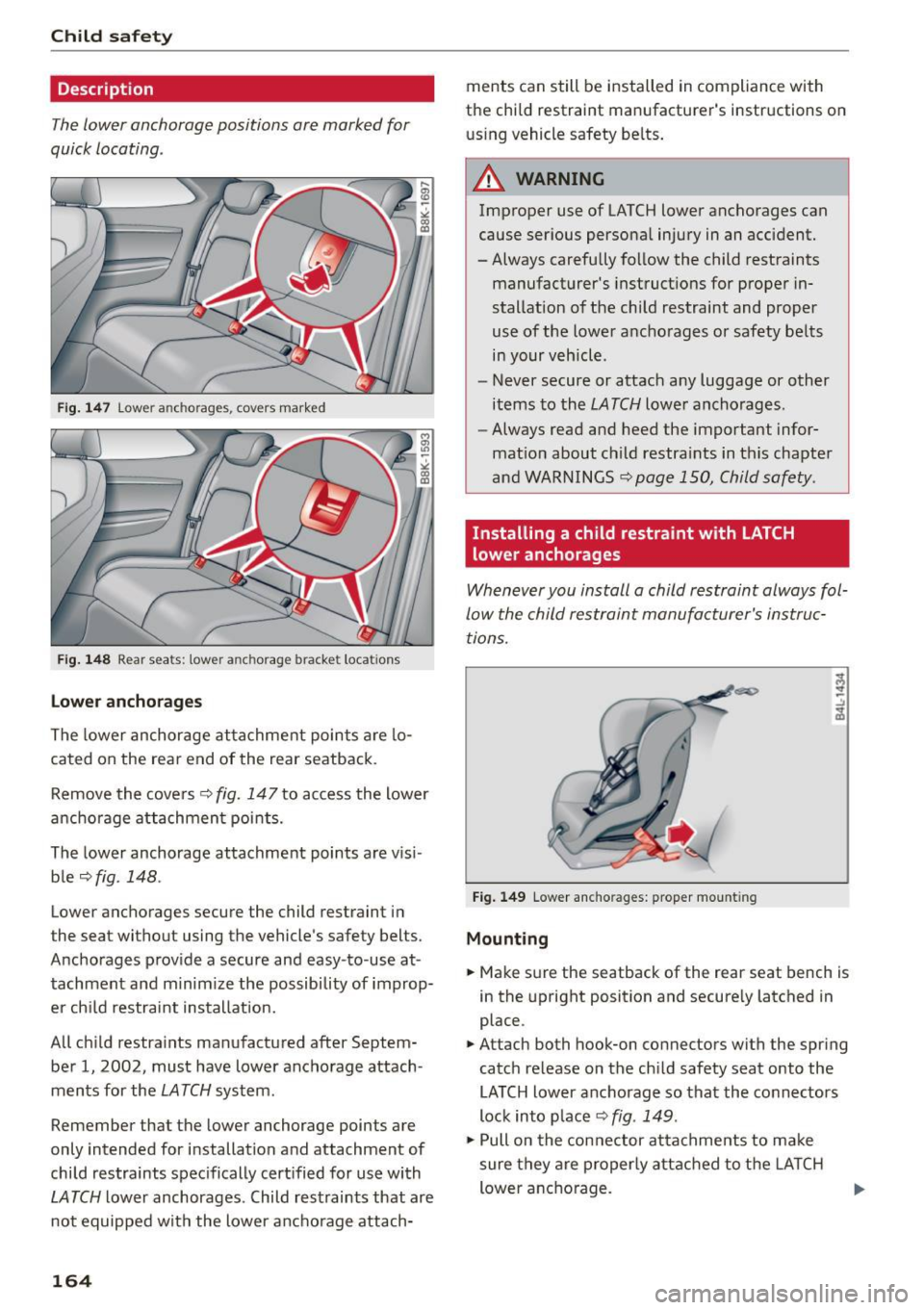
The lower anchorage positions are marked for
quick locating .
Fig . 14 7 Lowe r anchorages, covers marked
Fig. 14 8 Rear seats: lower anchorage bracket locat ions
Low er anchorages
The lower anchorage attachment poi nts a re lo
cated on the rear end of the rear seatback .
Remove the cove rs
9 fig. 147 to access the lower
anchorage attachmen t poi nts.
The lower anchorage attachment points a re v is i
ble
9 fig . 148 .
Lower anchorages secure the child restraint in
the seat without using the vehicle's safety belts.
Anchorages prov ide a secure and easy -to -use at
tachment and m inim ize the possibility of improp
er ch ild restraint installation.
All child restra ints manufactu red after Septem
ber 1, 2002, must have lower anchorage attach
men ts for the
LATCH system .
Remember that the lower anchorage points are
only intended for installation and attachment of
child restraints spec ifically cert ified for use with
LATCH lower anchorages . Child restraints that are
not equipped with the lower a nchorage attach-
164
ments can still be installed in compliance with
the child restraint manufacturer's instructions on
u sing vehicle safety belts .
_& WARNING
Improper use of LATCH lower anchorages can
cause serious perso na l injury in an accident.
-Always carefully fo ll ow the child rest raints
manufacturer's instruct ions for proper in
stallation of the child restraint and proper
use of the lower ancho rages or safety be lts
in your v ehicle .
- Never secure or attach any luggage or other
items to the
LATCH lowe r anchorages.
- Always read and heed the important infor
mat io n about ch ild restra ints in this chapter
and WARNINGS
~page 150, Child safety .
Installing a child restraint with LATCH
lower anchorages
Whenever you install a child restraint always fol
low the child restraint manufacturer's instruc
t ions.
Fi g. 14 9 Lower ancho rages: proper mount ing
Mounting
.,. Make s ure the seatback of the rear seat bench is
in the upright position and secure ly latched in
place.
.,. Att ach both hook-on connectors with the spring
catch re lease on the ch ild safety seat onto the
LA TCH lower a nch orage so that the connectors
lock into place ~
fig. 149 .
.,. Pull on the con nector a ttachments to ma ke
sure they are p roperly attached to the LA TC H
lower ancho rage.
Page 171 of 254

M N
0:: loo ,...., \!) 1.1"1
N 1.1"1 ,....,
shared, please see your contract with the
wireless telecommunications provider and the
"About Aud i connect" tab in your vehicle's
MMI*:
IMENU I button> Audi connect > About
Audi connect .
Electronic Stabilization
Control (ESC)
Description
ESC helps to improve road holding and vehicle
dynamics to help reduce the probability of skid
ding and loss of vehicle control. It works only
when the engine is running. ESC detects certain
d ifficu lt driving situations, including when the ve
hicle is beginn ing to spin (yaw) out of control and
helps you to get the vehicle back under control by
selectively braking the whee ls, and/or reducing
engine power and prov iding steer ing ass istance
to help hold the vehicle on the driver's intended
course. The indicator light
Bl in the instrument
cluster blinks when ESC is taking action to help
you control the veh icle.
ESC has limitations.
It is important to remember
that ESC cannot overcome the laws of physics. It
will not always be able to help out under all con
ditions you may come up against. For example, ESC may not always be able to help you master
situations where there is a sudden change in the
coefficient of frict ion of the road surface . Whe n
there is a section of dry road that is suddenly cov
ered with water, slush or snow, ESC cannot per
form the same way it wou ld on the dry surface. If
the vehicle hydroplanes (rides on a cushion of wa
ter instead of the road surface), ESC will not be
ab le to he lp you steer the vehicle because contact
with the pavement has been interrupted and the
vehicle cannot be braked or steered . During fast
cornering, particularly on winding roads, ESC
cannot always deal as effectively with difficult
driving situations than at lower speeds. Whe n
tow ing a trailer, ESC is not able to help you regain
con trol as it wou ld if you were no t towing a trail
er .
A lways adjust your speed and dr iving sty le to
road, traffic and weather conditions. ESC cannot
override the vehicle's physical limits, increase the
Smart Technology
available traction, or keep a vehicle on the road i f
road departure is a result of driver inattention.
Instead, ESC improves the possibility of keeping
the vehicle under control and on the road dur ing
extreme maneuvers by using the driver's steering
inputs to help keep the vehicle go ing in the in
tended direction. If you are traveling at a speed
that causes you to run off the road before ESC
can prov ide any assistance, you may not expe ri
ence the benefits of ESC.
ESC is switched on all the time . In certain situa
t ions when you need less traction, you can switch
off ASR by pressing the button
[ru ~ page 170,
fig. 152 or ~page 170, fig . 153. Be sure to
switch ASR on again when you no longer need
less traction.
T he following systems are integrated in the ESC:
Anti-lock braking system (ABS)
ABS prevents the wheels from locking up when braking. The vehicle can still be steered even dur
i ng hard braki ng. Apply steady pressure to the
brake pedal. Do not pump the pedal. A pulsing in
the brake pedal indicates that the system is he lp
ing you to brake the vehicle.
Brake assist system
The brake ass ist system can decrease braking dis
tance . It increases braking power when the driver
presses the brake peda l quickly in emergency sit
u at ions. You must press and hold the brake pedal
until t he situat ion is over. In vehicles with adap
tive cruise control*, the brake assist system is
more sensitive if the distance detected to the ve
hicle ahead is too sma ll.
Anti-slip regulation (ASR)
ASR red uces eng ine power when the drive wheels
begin to spin and adapts the force to the road
conditions. This makes it easier to start, acce le r
ate and drive up hills.
Electronic differential lock (EDL)
T he EDL brakes whee ls that are spinning and
transfers the drive power to the other wheels.
T his function is available up to about 60 mph
(100 km/h).
169
Page 186 of 254

Fuel and Refu elin g
CJ) Note
-Methanol fuels which do not meet these re
quirements may cause corros ion and dam
age to plastic and rubber components in the
fuel system.
- Do not use fuels that fail to meet the speci fied criteria in this chapter .
- If you are unable to determine whether or
not a particular fuel blend meets the speci
fications, ask your service station or its fuel supplier.
- Do not use fuel for which the contents can
not be identified.
- Fuel system damage and performance prob lems resulting from the use of fuels differ
ent from those specified are not the respon
s ibility of Audi and are not covered under
the New Vehicle or the Emission Contro l
System Warranties.
- If you experience a loss of fuel economy or
driveability and performance problems due
to the use of one of these fuel b lends, we
recommend that you sw itch to unb lended
fuel.
Gasoline additives
A major concern among many auto manufactur
ers is carbon deposit build-up caused by the type
of gasoline you use .
A lthough gasoline grades differ from one manu
facturer to another, they have certain things in
common. All gasoline grades contain substances
that can cause deposits to collect on vita l engine
parts, such as fuel injectors and intake valves. Al
though most gasoline brands include additives to
keep eng ine and fuel systems clean, they are not
equally effect ive .
Audi recommends using TOP TIER Detergent Gas
oline . For more information on TOP TIER Deter
gent Gasoline, please go to the official webs ite
(www .toptiergas .com).
After an extended period of using inadequate
fuels, built-up carbon deposits can rob your en
g ine of peak performance .
184
(D Note
Damage or malfunction due to poor fuel qual
ity is not covered by the Audi New Vehicle
Limited Warranty.
Refueling
Fuel filler neck
The fuel filler neck is located on the right rear
side panel behind the fuel filler flap .
If the power lock ing system should fail, you can
still open the flap manually - for detailed instruc
tions see
9 page 186.
You can find the fuel tank capacity of your vehicle
in 9 page234.
The label on the inside of the fuel filler flap tells
you the correct fuel for your vehicle . For more in
format ion about fuel specifications, see
9 page 183.
Your vehicle fuel tank has an on-board refuelling
vapor recovery system. This feature helps to pre
vent fuel vapors from escap ing from the tank and
po lluting the environment while you refuel your
vehicle. In order to fi ll the tank properly while
protecting the environment , p lease follow this
r efueling procedure carefully .
_& WARNING
Under normal operating conditions, never car
ry additional fuel containers in your car . Gas
can isters and other containers used to trans
port fuel can be dangerous . Such containers,
full or empty, may leak and could cause a fire in a co llision .
If you must transport fuel to
use for your lawn mower, snow blower, etc .,
be ve ry careful and always observe local and
state laws regarding the use, transportation
and storage of such fue l conta iners . Make cer
tain the container meets industry standa rds
(ANSI/ASTM F8S2 - 86).
@ Note
Neve r drive your veh icle until the fuel tank is
complete ly empty. The ir regular supply of
f u el can cause misfiring. Gasoline could enter ..,.
Page 187 of 254

"' N
0:: loo
rl I.O
"' N
"' rl
the exhaust system and damage the catalytic
converter.
Refuelling
Fig . 155 Rig ht re ar v ehicl e sid e: Op enin g the fuel fille r flap
Fig. 156 Fuel f ill er fla p with atta ched fuel cap
When activating the central locking, the fuel fi ll
er flap is automatically un locked or locked . Re
fuel the veh icle with the ignition turned
off.
Taking the fuel cap off
~T urnoff the ignition.
~ Press the left side of the fue l filler flap to open
it
q fig. 155 -arrow -.
~ Unscrew fuel cap count er-clockw ise and hang it
on the fuel filler flap~
fig. 156.
Refuelling procedure
~ Insert the fuel nozzle from the gasol ine pump
into the fuel filler neck as far as it will go.
~ Select a medium refuelling rate so that the
nozzle switches off automat ica lly when the
tank is full.
Putting the fuel cap back on
~ After filling your tank, tw ist the f uel cap clock
wise as far as it wi ll go.
~ Close the fuel filler flap.
Fuel and Refueling
To avoid fuel spilling or evaporating from the fuel
tank always close fue l cap proper ly and com
pletely .
A WARNING
--
Improper refueling or handling of fuel can
cause fire, explosion and severe burns.
- Fuel is highly flammable and can cause se
vere burns and other injuries.
- Failure to shut the engine off while refuel
ing and/or to insert the pump noz zle fully
into the fue l filler neck could cause fuel to
spray out of filler neck or to overflow . Fuel
spray and overflowing fuel can cause a fire.
- Never use a cellular telephone while refuel
ing. The electromagnetic radiation can
cause sparks that can ignite fuel vapors and
cause a fire .
- Never get back into your vehicle while refu
eling. If in exceptional circumstances you
must get back in your vehicle whi le refuel
ing, make certain that you close the door
and touch metal to discharge static electric
ity before touching the filler nozzle again.
Static electricity can cause sparks that can ignite fue l vapors re leased during refueling.
- Never smoke or have an open f lame any
where in or near your vehicle when refueling
or filling a portable fue l conta iner .
- For your safety, we strongly recommend
that you do not travel with a portable f uel
container in your vehicle. The container, full
or empty may leak and cou ld cause a fire,
especially in a crash.
- If, under exceptional circumstances, you
must transport a portable fuel container,
ple ase observe the following:
- Never fill a portable fuel container while it
is anywhere in or on the veh icle (for exam
ple, in the luggage compartment, or on
the trunk). Static e lectricity can build up
while filling and can ignite fuel vapors
causing a f ire.
- Always place a portab le fue l container on
the ground before filling .
185
Page 188 of 254

Fuel and Refueling
-Always keep the fi ller nozzle completely
inside the portable container before and
during filling.
- If filling a portable container made of
metal, the filler nozzle must always be in
contact with the container. This will help
prevent static electricity from discharging
and cause a fire .
-Never sp ill fuel inside the vehicle or lug
gage compartment. Fuel vapors are highly
flammab le.
-Always observe local and state/provincia l
laws regarding the use, storage and trans
portat ion of fuel containers.
- Make certain the fuel container meets in
dustry standards (ANSI/ ASTM F852 -86) .
(D Note
If any fuel has spilled onto the car, it should
be removed immediately to prevent damage
to the paint .
@ For the sake of the environment
As soon as the correctly operated nozzle
switches off automatically for the first time,
the tank is full. Do not try to add more fuel
because fuel may spill out . In addition, the
expansion space in the fuel tank will be filled·
causing the fuel to overflow when it becomes
warm and pollute the environment.
(j) Tips
- Running your engine while refuelling may
cause vapors to escape or even cause fuel to
sp il l out of the tank . This wo uld then shut
off the fuel nozzle before the tank is full.
- Do not refuel your veh icle with the ignition
turned on. The fuel gauge may otherwise
not indicate the correct fuel level after refu
elling.
- The fuel filler flap of your vehicle is not
l ocked when you lock the vehicle from the
inside .
186
Unlocking the fuel filler flap by hand
You can open the fuel filler flap by hand if the
power locking system should fail .
Fig. 157 Luggage compartme nt: ope ning the side trim
Fig. 158 Luggage compartment: Emer gency open ing of
fuel fil ler flap
The emergency opening mechanism is located
behind the right side trim panel in the luggage
compartment.
Opening the side trim
.. Insert a tool such as a screwdriver ¢page 216
or the emergency key into the right side of the
upper gap¢
fig. 157.
.. Pry upward to release the trim .
Fuel filler door emergency release
.. Loosen the strap from its bracket and pull on it
¢ fig. 158. You can now open the fuel filler flap
as usual
¢page 185.