weight AUDI RS5 COUPE 2015 Owners Manual
[x] Cancel search | Manufacturer: AUDI, Model Year: 2015, Model line: RS5 COUPE, Model: AUDI RS5 COUPE 2015Pages: 254, PDF Size: 64.12 MB
Page 5 of 254
M N
0:: loo ,....,
Airbag system . . . . . . . . . . . . . . . . . . . . 128
Important information . . . . . . . . . . . . . . . 128
Front ai rbags . . . . . . . . . . . . . . . . . . . . . . . 132
Mon ito ring the Advanced A irb ag Sys tem . 138
Knee airbags . . . . . . . . . . . . . . . . . . . . . . . . 142
Side airbags . . . . . . . . . . . . . . . . . . . . . . . . 144
Side curta in a irbags . . . . . . . . . . . . . . . . . . 1 47
Ch ild safety . . . . . . . . . . . . . . . . . . . . . . 150
Important informat ion . . . . . . . . . . . . . . . 150
Ch ild seats . . . . . . . . . . . . . . . . . . . . . . . . . 155
Secur ing c hild seats . . . . . . . . . . . . . . . . . . 159
L A TC H system (Lower anchorages and
tethers for chi ldren) . . . . . . . . . . . . . . . . . . 163
Addit ional info rmation
167
Driver messages . . . . . . . . . . . . . . . . . 168
Smart Technology . . . . . . . . . . . . . . . 16 8
N otice about data recorded by the Event
Data Recorder and vehicle cont rol
modules . . . . . . . . . . . . . . . . . . . . . . . . . . . 168
Electronic Stabili za tion Control (ESC) . . . . 169
Rear spoiler . . . . . . . . . . . . . . . . . . . . . . . . 171
Braking . . . . . . . . . . . . . . . . . . . . . . . . . . . . 172
Elect ro-mechanical power assist , dynamic
steer ing . . . . . . . . . . . . . . . . . . . . . . . . . . . 174
Dr iving w ith your quat tro . . . . . . . . . . . . . 17 4
E ne rgy management . . . . . . . . . . . . . . . . . 17 5
Driving and the environment . . . . 177
B rea kin g in . . . . . . . . . . . . . . . . . . . . . . . . . 177
Avoid damaging the vehi cle . . . . . . . . . . . . 17 7
D riving through water on roads . . . . . . . . 177
Warming up and cooling down . . . . . . . . . 178
Cata lytic converter........ .... .. .. .. . 17 8
Shutt ing down veh icle . . . . . . . . . . . . . . . . 179
Economical and environmentally-friend ly
driving . . . . . . . . . . . . . . . . . . . . . . . . . . . . 179
Operating instructions . . . . . . . . . . . 181
Care and cleaning . . . . . . . . . . . . . . . . 181
Ge ne ral i nfo rmat ion . . . . . . . . . . . . . . . . . 181
Ca r washes ............... ...... ... .
Pl acing your veh icle out of se rv ice 18
1
18 2
Fuel and Refueling . . . . . . . . . . . . . . . 183
F ue l... .. .. ................. .. .... . 183
~ Refue ling . . . . . . . . . . . . . . . . . . . . . . . . . . 184
N l/'I ,....,
Tab le of conten ts
Checking and Filling . . . . . . . . . . . . .
187
Hood . . . . . . . . . . . . . . . . . . . . . . . . . . . . . . 187
Engine compartment . . . . . . . . . . . . . . . . . 189
Engine oil . . . . . . . . . . . . . . . . . . . . . . . . . . 189
Cooling system . . . . . . . . . . . . . . . . . . . . . . 192
Brake fluid . . . . . . . . . . . . . . . . . . . . . . . . . 195
Battery . . . . . . . . . . . . . . . . . . . . . . . . . . . . 196
Windsh ie ld/headlight* washer conta iner. 200
Wheels .. .. .. .. .. ... .. ... ..... .. .. 201
Whee ls and T ires . . . . . . . . . . . . . . . . . . . . 201
T ire pressu re monito ring system 213
Troubleshoot ing .............. ... 216
Emergency assistance ... .. .. ... . 216
Vehicle tool kit . . . . . . . . . . . . . . . . . . . . . . 216
T ire repa ir set .. . .. .......... .... .. . . 216
Rep lac ing whee ls . . . . . . . . . . . . . . . . . . . . 2 18
Fuses and bulbs . . . . . . . . . . . . . . . . . . 224
F uses ... .. .. .. .. .. .... .... ... .. .. .. 224
B ul bs . . . . . . . . . . . . . . . . . . . . . . . . . . . . . . 2 27
Emergency situations . . . . . . . . . . . . 228
Genera l . . . . . . . . . . . . . . . . . . . . . . . . . . . . 2 28
Starting by pushing or towing . . . . . . . . . . 228
Starting with jumper cabl es . . . . . . . . . . . 228
U se of jumper cables . . . . . . . . . . . . . . . . . 229
Towing with a tow truck . . . . . . . . . . . . . . . 230
Raising the vehicle . . . . . . . . . . . . . . . . . . . 232
Technical data . . . . . . . . . . . . . . . . . . . . 233
Technical data . . . . . . . . . . . . . . . . . . . . 233
Vehicle identification . . . . . . . . . . . . . . . . . 233
Weights . . . . . . . . . . . . . . . . . . . . . . . . . . . 233
D imens io ns . . . . . . . . . . . . . . . . . . . . . . . . . 234
Capaci ties . . . . . . . . . . . . . . . . . . . . . . . . . . 234
Gasoli ne engines . . . . . . . . . . . . . . . . . . . . 235
Consumer information . . . . . . . . . . 236
W arranty cove rages . . . . . . . . . . . . . . . . . . 236
Operatin g your ve hicl e outs ide the U.S.A.
o r Canada . . . . . . . . . . . . . . . . . . . . . . . . . . 236
Audi Se rvice Repair Manuals and
Literature . . . . . . . . . . . . . . . . . . . . . . . . . . 236
Maintenance . . . . . . . . . . . . . . . . . . . . . . . . 236
3
Page 61 of 254
"' N
0:: loo
rl I.O
"' N
"' rl
_& WARNING
The cigarette lighter only works when the ignition is switched on. Incorrect usage can lead
to serious injuries or burns . For this reason,
children should never be left unattended in
the vehicle because this increases the risk of
injury .
Storing
General overview
_& WARNING
-Always remove objects from the instrument
panel. Any items not put away could slide
around inside the vehicle while driving or
when accelerating or when applying the
brakes or when driving around a corner .
- When you are driving make sure that any
thing you may have placed in the center con
sole or other storage locations cannot fall
out into the footwells. In case of sudden
braking you would not be able to brake or
accelerate.
-Any pieces of clothing that you have hung up must not interfere with the driver's view.
The coat hooks are designed only for light
weight clothing . Never hang any clothing
with hard, pointed or heavy objects in the pockets on the coat hooks. During sudden
braking or in an accident - especially if the
airbag is deployed - these objects could in
jure any passengers inside the vehicle.
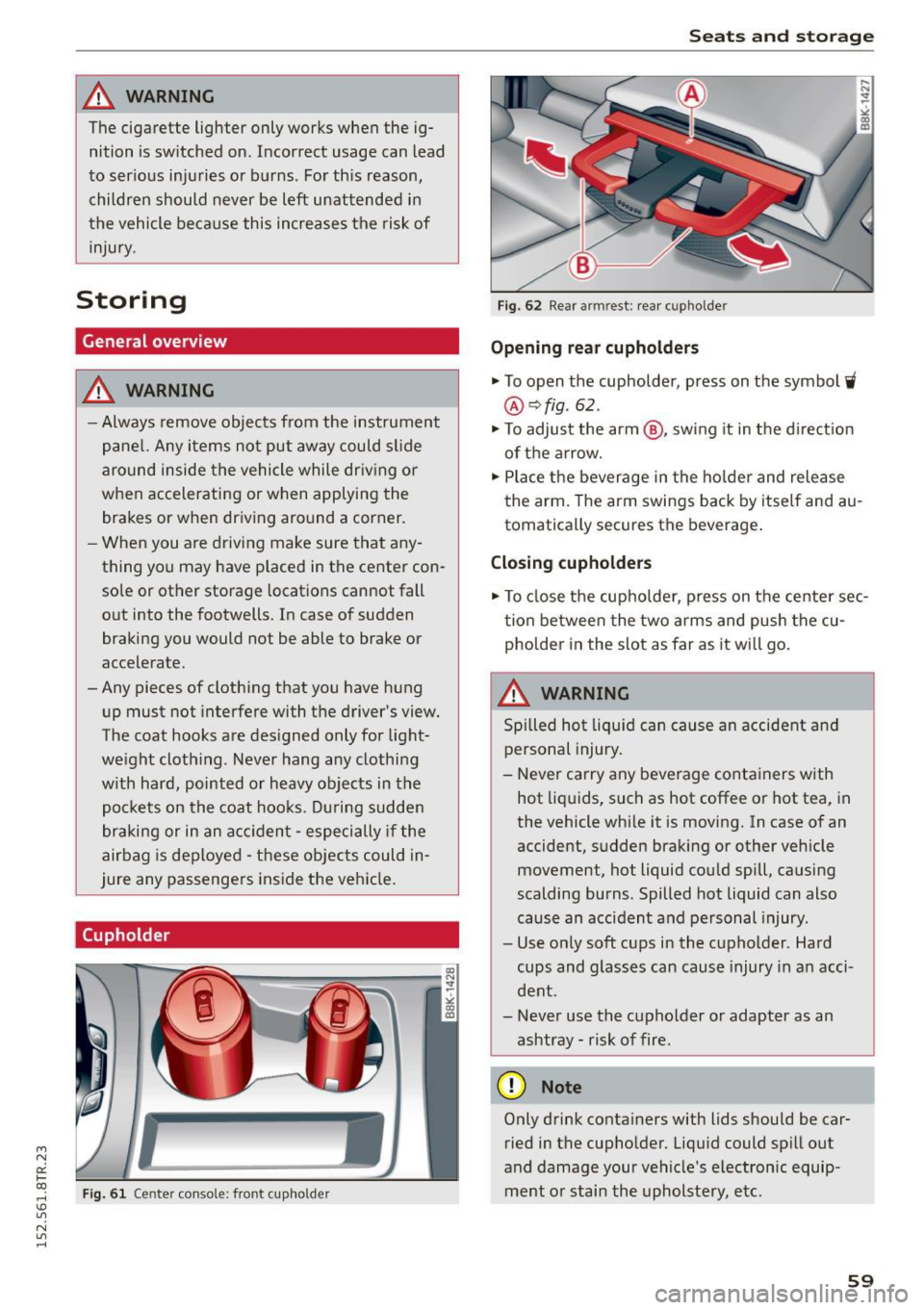
Cupholder
Fig. 61 Cen te r con sole: fron t cupho ld er
Seats and storage
Fig. 62 Rear armrest: rear cup hol der
Opening rear cupholders
.,. To open the cupholder, press on the symbol W
@ ¢fig . 62 .
.,. To adjust the arm @, swing it in the direction
of the arrow.
.,. Place the beverage in the holder and release
the arm. The arm swings back by itself and au
tomatically secures th e be verage .
Closing cupholders
.,. To close the cupholder , press on the center sec
tion between the two arms and push the cu
pholder in the slot as far as it wi ll go.
A WARNING
Spilled hot liquid can cause an accident and
personal injury.
- Never carry any beverage containers with
hot liquids, such as hot coffee or hot tea, in
the vehicle while it is moving. In case of an
accident, sudden braking or other vehicle movement, hot Liquid could spill, causing
scalding burns. Spilled hot Liquid can also
cause an accident and personal injury.
- Use only soft cups in the cupholder . Hard
cups and glasses can cause injury in an acci
dent .
- Never use the cupholder or adapter as an
ashtray- risk of fire .
(D Note
Only drink containers with lids should be car
ried in the cupholder . Liquid could spill out
and damage your vehicle's electronic equip
ment or stain the upholstery, etc.
-
59
Page 62 of 254
Seats and storage
Glove compartment
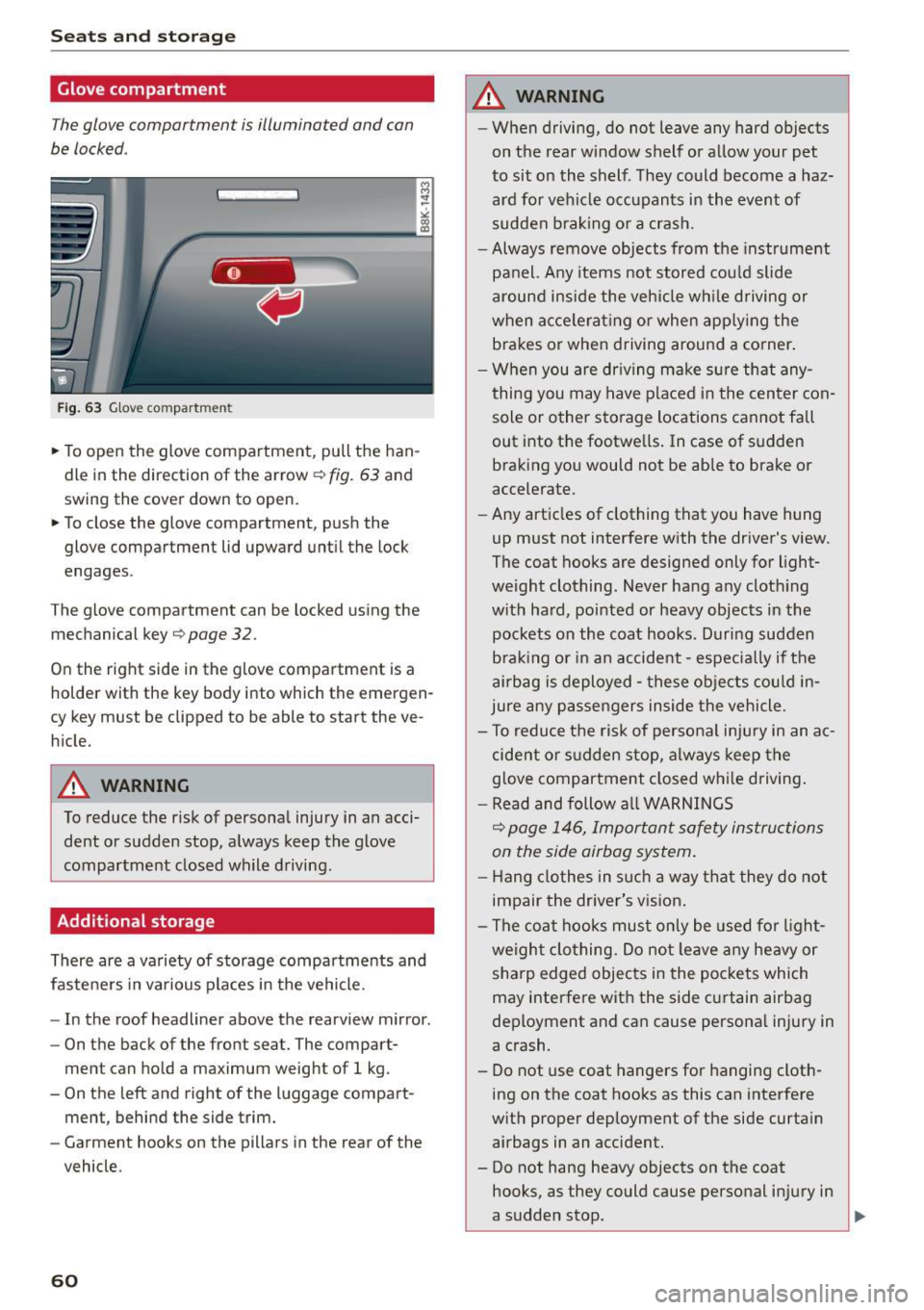
The glove compartment is illuminated and can
be locked .
Fig. 63 Glove compart ment
.. To open the glove compartment, pull the han
dle in the direction of the arrow
~fig. 63 and
swing the cover down to open.
.. To close the glove compartment, push the
glove compartment lid upward until the lock
engages .
The glove compartment can be locked using the
mechanical key
¢ page 32.
On the right side in the glove compartment is a
holder with the key body into which the emergen
cy key must be clipped to be able to start the ve
hicle.
A WARNING
To reduce the risk of personal injury in an acci dent or sudden stop, always keep the glove
compartment closed while driving.
Additional storage
There are a variety of storage compartments and
fasteners in various places in the vehicle.
- In the roof headliner above the rearview mirror .
- On the back of the front seat. The compart-
ment can hold a maximum weight of 1 kg.
- On the left and right of the luggage compart
ment, behind the side trim.
- Garment hooks on the pillars in the rear of the
vehicle.
60
A WARNING , -
- When driving, do not leave any hard objects
on the rear window shelf or allow your pet
to sit on the shelf . They could become a haz
ard for vehicle occupants in the event of
sudden braking or a crash.
-Always remove objects from the instrument
panel. Any items not stored could slide
around inside the vehicle while driving or
when accelerating or when applying the brakes or when driving around a corner.
- When you are driving make sure that any
thing you may have placed in the center con
sole or other storage locations cannot fall
out into the footwells. In case of sudden braking you would not be able to brake or
accelerate .
- Any articles of clothing that you have hung
up must not interfere with the driver's view .
The coat hooks are designed only for light
weight clothing. Never hang any clothing
with hard, pointed or heavy objects in the pockets on the coat hooks. During sudden
braking or in an accident -especially if the
airbag is deployed -these objects could in
jure any passengers inside the vehicle.
- To reduce the risk of personal inju ry in an ac
cident or sudden stop, always keep the
glove compartment closed while driving.
- Read and follow all WARNINGS
¢ page 146, Important safety instructions
on the side airbag system.
- Hang clothes in such a way that they do not
impair the driver's vision.
- The coat hooks must only be used for light
weight clothing. Do not leave any heavy or
sharp edged objects in the pockets which
may interfere with the side curtain airbag
deployment and can cause personal injury in
a crash.
- Do not use coat hangers for hanging cloth
ing on the coat hooks as this can interfere
with proper deployment of the side curtain airbags in an accident.
- Do not hang heavy objects on the coat
hooks, as they could cause personal injury in
a sudden stop .
~
Page 64 of 254

Seat s and storage
- After mounting a roof rack system, or when
you transport objects on the roof of your ve hicle, the height of the veh icle is naturally
i ncreased . Be caref ul when driv ing under
l ow bridges or in parking garages for exam
ple. This cou ld cause damage to the load
and even the vehicle itself.
- Make sure that the open rear lid and the
sunroof do not come into contact w ith ob
jects on the roof.
Loading the roof rack
Always distribute loads evenly. Make sure any thing on the roof rack is securely tied down.
"' Always distribute the loads on the roof rack
evenly .
"' Always attach items to the roof rack securely
before you drive off .
The max imum perm issib le roof weight is
165 lb
( 75 kg ). The roof weight is the total of the
weight of the roof rack, the attachments and the
cargo yo u are carry ing . You must also not exceed
the maximum load weight fo r the roof rack you
are using.
When us ing a roof rack system w hich has a lower
load carrying capacity, you must not use up the
tota l maxim um permissible load carry ing capac i
ty spe cified above . In stead, you shou ld load the
roof rack sys tem only to the maximum capaci ty
specified by the manufact urer of the roof rack
system.
A WARNING
Weak, damaged or improper straps used to
secure items to the roof rack can fa il dur ing
hard brak ing or in a co llision and cause seri
ous pe rsonal injury.
- Make sure the roof rack is installed exactly
as specified above
r:!) page 61.
- Always use suitable mounting straps for se
curing items to the roof rack to help prevent
items from shifting or flying fo rward .
- Items on the roof rack must always be se
cu rely mounted.
62
-
- The use of a roof rack can negat ively affect
the way a vehicle handles. Cargo that is
large, heavy, bulky, long or flat will have a
greater negative influence on the vehicle's
aerodynamics, center of gravity and overall
handling . Always drive slowly, avoid sudden
bra king and maneuvers w hen transporting
c a rgo on the roo f of your veh icle.
- Never exceed the maxim um permissible
load ca rrying capaci ty of the roof of your ve
hicle, the perm iss ible axle weights and the
pe rm issib le tota l we igh t of your vehicle
r::!) page 233, Weights.
@ For the sake of the environment
As a result o f the increased wind resistance
create d by a roof rac k, yo ur vehicle is using
f u el unnecessarily. So remove the roof rack af
ter using it.
Luggage compartment
General information
_& WARNING
Read and follow the important sa fety precau
tions on
r::!) page 117, Storing cargo correctly.
Page 119 of 254

"' N
0:: loo
rl I.O
"' N
"' rl
Storing cargo correctly
Loading the luggage compartment
All luggage and other objects must be properly
stowed and secured in the luggage compart
ment.
Fig . 120 Safe load position ing: place heavy objects as low
and as far forwa rd as poss ible.
"' N .,. ~ ,,: CX) ID
Loose items in the luggage compartment can
shift suddenly, changing vehicle handling charac
teristics. Loose items can also increase the risk of
serious personal injury in a sudden veh icle ma
neuver or in a coll is ion.
,.. Distribute the load evenly in the luggage com
partment.
,.. Always place and p roperly secure heavy items in
the luggage compartment as low and as far for
ward as possible
¢ fig . 120.
,.. Secure the load with the cargo net* or with
non-elastic straps secured to the tie-downs
Qpage 64.
,.. Make sure that the rear seatback is securely
latched in place.
A WARNING
Improperly stored luggage or other items can
fly through the veh icle causing serious per
sonal injury in the event of ha rd braking or an
accident. To help reduce the r isk of serious
personal injury:
- Always put objects, for examp le, luggage or
other heavy items in the luggage compart
ment.
- Always secure objects in the luggage com
partment us ing the tie-down eye lets and
suitable straps.
Dri vin g s afe ty
A WARNING
-Heavy loads wi ll influence the way your vehi-
cle handles . To help reduce the risk of a loss
of control leading to serious personal injury:
- Always keep in mind when transporting
heavy objects, that a change in the center of
grav ity can also cause changes in vehicle
handling:
- Always distribute the load as evenly as
possible .
- Place heavy objects as far forward in the
luggage compartment as possib le .
- Never exceed the Gross Axle We ight Rating
or the Gross Vehicle Weight Rating specified
on the safety compliance s ticker on the left
door jamb. Exceeding permissib le weight
standards can cause the vehicle to slide and
handle differently .
- Please observe information on safe dr iving
¢page 111 .
A WARNING
-To help prevent poisonous exhaust gas from
being drawn into the vehicle, always keep the
rear lid closed wh ile driving.
- Never transport objects la rger than those
fitting completely into the luggage area be
cause the rear lid cannot be fully closed .
- If you absolutely must dr ive with the rear lid
open, observe the following notes to reduce
the risk of poisoning:
- Close all windows,
- Close the s unroof,
- Open all a ir outlets in the ins trumen t pan-
el,
- Switch off the air recirculat ion,
- Set the fresh air fan to the highest speed.
A WARNING
-A lways make sure that the doors , all windows,
the sunroof and the rear lid are securely
closed and locked to reduce the risk of injury
when the vehicle is not being used.
- After closing the rear lid, always make sure that it is properly closed and locked.
~
117
Page 120 of 254
Driving safet y
-Never leave you r vehicle unattended espe
c ially w ith the rear lid left open. A chi ld
could crawl into the vehicle through the lug
gage compartment and close the rear lid be
coming trapped a nd u nable to get ou t. Be
ing trapped in a vehicle ca n lead to serious
persona l injury.
- Never let child ren p lay in o r around the vehi
cl e.
- Never let passe ngers r ide in the luggage
compartm ent . Ve hicle occupants must al
ways be proper ly restrained i n one of t he ve
hicle's seat ing positions.
- Air c irculat io n he lps to red uce window fog
ging . Stale air escapes to the outside
th roug h vents in t he tr im pane l. Be su re to
k eep the se s lots free and open.
- T he t ire pressur e must cor respond to the
l oad. The t ire pr ess ure is shown on the tire
p re ssu re la bel. The tire pressure labe l is lo
cated on t he d river 's s ide B -pillar . The t ire
pressure la bel lists the recommende d cold
tire inflation pressures for the vehicle at its maximum capacity weight and the t ires that
were on your vehicle at the time it was man
ufactured. For recomme nded tire pressures
for normal load cond itions, please see chap
ter ¢ pag e 206.
Tie-downs
Applies to vehicles: with tie-downs
The luggage compartment is equipped with four
tie-downs to secure luggage and other items .
Use the tie-downs to secure your cargo proper ly
¢ page 117, Loading the luggage comportment.
In a col lision, the laws of physics mean that even
sma ller items that are loose in the vehicle w ill
become heavy miss iles that can cause serious in
jury. Items i n the vehicle possess energy which
vary w ith veh icle speed and the weight of the
item . Vehicle speed is the most significant factor.
For examp le, in a frontal coll is io n at a speed of
30 mph (48 km/h) , the forces acting on a 10-lb
(4 .5 kg) object are about 20 times the normal
118
weight o f the item . This means that the weight
of the item would s udden ly be about
200 lbs. (90 kg) . You can imagine the injuries
that a 200 lbs. (90 kg) item flying freely through
the passe nger compartment co uld cause in a col
li sio n like this.
A WARNING
W eak, damaged or improper straps us ed to
secure i tems to tie-downs can fail d uring ha rd
b rak ing o r in a coll is io n an d cause se rious per
son al injury .
- Always use s uitable mou nting straps and
pr ope rly se cu re items to the tie-down s in
t he l uggage comp artme nt to he lp prevent
items from shift ing o r flying forwa rd as dan
ge rous m issi les.
- Wh en the rea r seat backres t is folded dow n,
always use s uita ble mo unti ng straps and
prope rly secure items to the tie-downs in
the l uggage compartment to help prevent
items from flying fo rward as dangerous mis
siles into the passenger compartment.
- Never attach a child safety seat tether strap to a tie-down.
-
Reporting Safety Defects
Applicable to U.S.A.
If you belie ve that your vehicle
has a defect which could cause a
crash or could cause injury o r
death, you should immediately in
form the National Highway Traffic
Safety Administration (NHTSA) in
addition to notify ing Audi of
America, Inc.
If NHTSA receives similar com
plaint s, it may open an in ve stiga
tion , and if it finds that a safety
d efe cts exi sts in a group of .,.
Page 123 of 254

"' N
0:: loo
rl I.O
"' N
"' rl
Why use safety belts?
Frontal collisions and the law of physics
Frontal crashes create very strong forces for peo
ple riding in vehicles .
Fig. 122 Unbelted occupants in a ve hicle heading for a wall
Fig . 123 The vehicle cras hes into th e wall
CD
~ ±
cle and the passengers possess energy which var ies with vehicle speed and body weight . Engi
neers call this energy "kinetic energy."
The higher the speed of the vehicle and the
greater the vehicle's weight, the more energy
that has to be "absorbed" in the crash.
Vehicle speed is the most significant factor. If the
speed doubles from 15 to 30 mph (25 to 50 km/
h) , the energy increases 4 times!
Because the passengers of this vehicle are not us
ing safety belts~
fig. 122, they will keep moving
at the same speed the vehicle was moving just
before the crash, until something stops them -
here, the wall
~fig. 123 .
The same principles apply to people sitting in a
vehicle that is involved in a frontal collision. Even
at city speeds of 20 to 30 mph (30 to 50 km/h),
the forces acting on the body can reach one ton
Safety belts
(2,000 lbs. or 1,000 kg) or more . At greater
speeds, these forces are even higher .
People who do not use safety belts are also not
attached to their vehicle. In a frontal collision
they will also keep moving forward at the speed
their vehicle was travelling just before the crash.
Of course, the laws of physics don't just apply to
frontal collisions, they determ ine what happens
in all kinds of accidents and collisions.
What happens to occupants not wearing
safety belts?
In crashes unbelted occupants cannot stop themselves from flying forward and being in
jured or killed . Always wear your safety belts!
Fig. 124 A driver not wea ring a safe ty belt is violen tly
thrown forwa rd
Fig. 125 A rear passenger not wear ing a safety belt w ill
fly
fo rward and strike t he dr ive r
Unbelted occupants are not able to resist the tre
mendous forces of impact by holding tight or
bracing themselves . Without the benefit of safe
ty restraint systems, the unrestrained occupant
will slam v iolently into the steering wheel, in
strument panel, w indshield, or whatever else is
i n the way~
fig. 124 . This impact with the veh i
cle inter ior has all the energy they had just before
the crash. .,.
121
Page 132 of 254

Airbag system
safety seat. It can be a very dangerous place for
an infant or a child in a rearward-facing seat.
The Advanced Airbag System in your veh icle has
been ce rtified to comp ly w ith the Requirements
of United States Federal Motor Vehicle Safety
Standard 208 as applicable at the time your vehi
cle was manufactured.
The Standard requires the front airbag on the
passenger side to be turned off ("suppressed") if
a child up to about one year of age restrained in
one of the rear-fac ing or forward-facing infant re
straints listed in Federal Motor Vehicle Safety
Standard 208 w ith which the Advanced A irbag
System in your vehicle was certified has been in
stalled on the front passenger seat. Fo r a listing
of the ch ild restraints that were used to certify
comp liance with the US Safety Standard
¢page 152.
The PASSENGER AIR BAG OFF light in the instru
ment panel tells you when the front Advanced
Ai rbag on the passenger side has been turned off
by the electron ic control unit.
E ach t ime you turn on the ignition, the
PASSEN
GER AIR BAG OFF light will come on for a few
seconds and:
- will stay on if the front passenger seat is not
occupied,
- will stay on if there is a small child or child re
stra int on the front passenger seat,
- will go off if the front passenger seat is occu
pied by an adult as registered by the weight
sensing mat¢
page 138, Monitoring the Ad
vanced Airbag System.
The PASSENGER AIR BAG OFF light comes on
when the control un it detects a total weight on
the front passenger seat that requ ires the front
ai rbag to be turned off.
If the tota l weight on the front passenger seat is
more than that of a typical 1 year -old child but
less than the we ight of a small adult, the front
ai rbag on the passenger side can deploy (the
PASSENGER AIR BAG OFF light does not come
on). If the
PASSENGER AIR BAG OFF light does
not come on, the front airbag on the passenger
side has not been turned off by the electronic
130
control unit and can dep loy if the control unit
senses an impact that meets the conditions stor
ed in its memory .
For example, the airbag may deploy if:
-a small ch ild that is heavier than a typical 1
year-old chi ld is on the front passenger seat (re
ga rdl ess of whethe r the child is in one of the
child safe ty seats listed¢
page 152), or
- a child who has outgrow n chi ld restraints is on
the front passenger seat .
If the front passenger airbag is turned off, the
PASSENGER AIR BAG OFF light comes on in the
instr ument cluster and stays on.
The front airbag on the passenger side may
not
deploy (the PASSENGER AIR BAG OFF light does
not illuminate and stay lit) even if a sma ll adult
o r teenager, or a passenger who is not sitt ing up
r ight w ith their back against a non-reclined back
rest with their feet on the vehicle floor in front of
the seat is on the front passenger seat
¢ page 112, Proper seating position for the driv
er .
If the front passenger airbag deploys, the Federal
Standard requires the airbag to meet the "low
risk" deployment criteria to reduce the risk of in
ju ry through interaction with the airbag. "Low
risk" deployment occurs in those crashes that
take place at lower decelerations as defined in
the electronic control unit ¢
page 138, PASSEN
GER AIR BAG OFF light .
Always remember, a child safety seat or infant
carr ier installed on the front seat may be struck
and knocked out of position by the rapidly inflat
i ng passenger's airbag in a frontal collision . The
airbag could greatly reduce the effectiveness of
the child restraint and even seriously injure the
child during inflation.
For th is reason, and because the back seat is the
safest place for children - when prope rly restra in
ed accord ing to their age and size -we strong ly
recommend that children always sit in the back
seat ¢
page 150, Child safety. ..,.
Page 133 of 254

M N
0:: loo ,...., \!) 1.1'1
N 1.1'1 ,....,
A WARNING ,~
A child in a rearward-facing child safety seat
installed on the front passenger seat will be
seriously injured and can be killed if the front
airbag inflates - even with an Advanced Airbag
System.
- The inflating airbag will hit the child safety
seat or infant carrier with great force and
will smash the child safety seat and child
against the backrest, center armrest, door
or roof.
- Always install rear-facing child safety seats
on the rear seat.
- If you must install a rearward facing child
safety seat on the front passenger seat be
cause of exceptional circumstances and the
PASSENGER AIR BAG OFF light does not
come on and stay on, immediately install
the rear-facing child safety seat in a rear
seating position and have the airbag system
inspected by your authorized Audi dealer.
- Forward-facing child safety seats installed
on the front passenger's seat may interfere
with the deployment of the airbag and cause serious personal injury to the child .
A WARNING
If, in exceptional circumstances, you must in
stall a forward-facing child restraint on the
front passenger's seat:
-Always make sure the forward-facing seat
has been designed and certified by its man
ufacturer for use on a front seat with a pas
senger front and side airbag.
- Never put the forward-facing child restraint
up against or very near the instrument pan
el.
- Always move the passenger seat into its
rearmost position in the seat's fore and aft
adjustment range, as far away from the air
bag as possible before installing the for
ward-facing child restraint. The backrest must be adjusted to an upright position.
- Make sure that the
PASSENGER AIR BAG
OFF
light comes on and stays on all the time
whenever the ignition is switched on.
Airbag system
A WARNING
To reduce the risk of serious injury, make sure
that the
PASSENGER AIR BAG OFF light will
be displayed whenever a child restraint is in
stalled on the front passenger seat and the ignition is switched on .
- If the
PASSENGER AIR BAG OFF light does
not stay on, perform the checks described
~ page 138, Monitoring the Advanced Air
bag System.
- Take the child restraint off the front passen
ger seat and install it properly at one of the
rear seat positions if the
PASSENGER AIR
BAG OFF
light does not stay on.
- Have the airbag system inspected by your
authorized Audi dealer immediately.
-Always carefully follow instructions from
child restraint manufacturers when instal
ling child restraints.
A WARNING
If, in exceptional circumstances, you must in
stall a forward or rearward-facing child re
straint on the front passenger's seat:
- Improper installation of child restraints can
reduce their effectiveness or even prevent
them from providing any protection.
- An improperly installed child restraint can
interfere with the airbag as it deploys and
seriously injure or even kill the child -even
with an Advanced Airbag System.
-Always carefully follow the manufacturer's
instructions provided with the child safety
seat or carrier.
- Never place additional items on the seat
that can increase the total weight registered
by the weight-sensing mat and can cause in
jury in a crash.
131
Page 135 of 254

M N
0:: loo ,...., \!) 1.1'1
N 1.1'1 ,....,
Advanced front airbag system
Your vehicle is equipped w ith a front Advanced
Airbag System in compliance with United States
F ederal Motor Vehicle Safety Standard 208 asap
plicable at the time your vehicle was manufac
tured.
The front Advanced Airbag System supplements
the safety belts to provide additiona l protection
for the driver's and front passenger's heads and
upper bodies in frontal crashes. The airbags in
flate only in frontal impacts when the vehicle de
celeration is high enough.
The front Advanced Airbag System for the front
seat occupants is not a substitute for your safety
be lts. Rather, it is part of the overall occupant re
straint system in your vehicle. Always remember
that the airbag system can only help to protect
you, if you are sitt ing upright, wearing your safe
ty belt and wearing it properly . This is why you
and your passengers must always be properly re
strained, not just because the law requires you to
be.
The Advanced Airbag System in your veh icle has
been certified to meet the "low risk" require
ments for 3 and 6 year-old children on the pas
senger side and very small adults on the driver
side . The low risk deployment criteria are intend
ed to help reduce the risk of injury through inter
action with the front airbag that can occur, for
examp le, by being too close to the steering whee l
and instrument panel when the airbag inflates.
I n addition, the system has been certified to
comp ly with the "suppression" requirements of
the Safety Standard, to turn
off the front airbag
for infants 12 months old and younger who are
restra ined on the front passenger seat in child re
straints that are listed in the Standard
c::> page 152, Child restraints and Advanced Air
bags.
"Suppression" requires the front airbag on the passenger side to be turned
off if:
- a ch ild up to about one year of age is restrained
on the front passenger seat in one of the rear
facing or forward-fac ing infant restraints listed
in Federa l Motor Veh icle Safety Standard 208
Airbag system
with which the Advanced Airbag System in your
vehicle was certified. For a listing of the child
restraints that were used to certify your veh i
cle's compliance with the US Safety Standard
c::>page 152,
- weight less than a thresho ld level stored in the
control unit is detected on the front passenger
seat.
When a person is detected on the front passen
ger seat, weighing more than the tota l weight of
a child that is about 1 year old restrained in one
of the rear-facing or forward-facing infant re
stra ints (listed in Federal Motor Vehicle Safety
Standard 208 with which the Advanced Airbag
System in your veh icle was certified), the front
airbag on the passenge r side may or may not de
ploy.
The
PASSENGER AIR BAG OFF light comes on
whe n the electronic contro l unit detects a total
weight on the front passenger seat that requires
the front airbag to be turned
off. If the PASSEN
GER AIR BAG OFF
light does not come on, the
front airbag on the passenger side has not been
turned
off by the control unit and can deploy if
the control un it senses an impact that meets the
condit ions stored in its memory.
If the total weight on the front passenger seat is
more than that of a typical 1 year-old, but less
than the weight of a small adult, the front airbag on the passenger s ide may deploy (the
PASSEN
GER AIR BAG OFF
light does not come on).
For example , the airbag may deploy if:
- a small child that is heav ier than a typical 1
yea r-old chi ld is on the front passenger seat (re
gardless of whether the chi ld is in one of the
child safety seats listed
c::> page 152),
- a child who has outgrown child restraints is on
the front passenger seat.
If the front passenger airbag is turned off, the
PASSENGER AIR BAG OFF light in the center of
the instrument panel wi ll come on and stay on.
T he front airbag on the passenge r sid e may
not
deploy (the PASSENGER AIR BAG OFF light does
not illuminate and stay lit) if: .,..
133