ESP AUDI S3 2009 Owner's Manual
[x] Cancel search | Manufacturer: AUDI, Model Year: 2009, Model line: S3, Model: AUDI S3 2009Pages: 324, PDF Size: 76.02 MB
Page 73 of 324
and farther away than when seen in a flat mirror. If you use this
mirror to esti mate distances of fo llowing vehicles when changing
lanes, you cou ld es timate incorrectly and cause an accident .
[ i] Tip s
If there shou ld be a malfunction in the electrica l system, you can
sti ll adjust the outside mirrors by pressing the edge of the mirror .•
Ap plie s to v ehicl es: wit h autom atic dim ming for out side m irro rs
Automatic dimming for outside mirrors
The outside mirrors are dimmed together with the automatic
dimming of the inside mir ror . When the ignition is switched on, the
mirrors darken automatical ly depending on the light striking them
(e .g. head lights from the rear) .
When the interior lighting is switched on and when reverse gear is
engaged , the mirrors are swi tched back to their original brightness
(not dimmed).
& WARNING
Broken glas s of automatic dimming mirror can c ause electrolyte
fluid le akage. Electrolyte fluid can ir ritate s kin , eyes , and re spir a
tory system .
• Repeated or prolonged e xposure to ele ctro lyte can cau se irrita
tion to the respi ratory sy stem , e specially among people with
asthm a or other respir atory co ndition s. G et fresh a ir i mmediately
by leaving the veh icle or , if that is not po ssible , open windows and
do ors all the way.
• If electrolyte get s into the eyes , flush them thoroughly with
large amounts of clean wate r fo r at least 15 minut es; medi cal
attention i s recommended .
• If ele ctrolyte cont acts sk in , flu sh affe cted are a with clean w ater
for at lea st 15 minute s and then wash affected area with soap and
Controls and equip
ment
Cl ea r vision
& WAR N IN G ( continued )
water; medic al attent ion is re commend ed . Thoroughly wash
affected clothing and shoes before reu se .
• If swallowed and person i s cons ciou s, rinse mouth w ith w ater
for at lea st 1 5 minute s. Do not indu ce vomitin g unles s instructed
to do so by medic al profession al. Get medi cal attent ion immed i
ately.
0 Note
Electrolyte leaki ng from a broken mirror g lass at tacks the veh ic le
paint and plastic surfaces . C lean up spilled electrolyte immediately
with c lear water and a sponge.
[ i ] Tips
• If automatic dimming for the inside mirror is swit ched off , the
out side m irrors are also not dimmed automati cally.
• Automatic di mming for the mirror only operates proper ly if the
sunshade * for the rear window is retracted, or the light striking the
ins ide mirror is not hindered by other ob jects. •
I • •
Page 76 of 324
Seats and storage
Seats and storage
General recommendations
Why is your seat adjustment so important?
The safety belts and the airbag system can only provide
maximum protection if the front seats are correctly
adjusted.
There are several different ways you can adjust the driver's seat and
the front passenger's seat so that it conforms to your body size. It is
especially important that the seat be adjusted properly so that:
• you can easily and quickly reach all the switches and controls in
the instrument panel
• your body is properly supported thus reducing physical stress
and fatigue
• the safety belts and airbag system can offer maximum protec
tion=>
page 147
In the following chapters, you will see exactly how you can best
adjust your seats.
There are special regulations and instructions for installing a child safety seat on the front passenger's seat. Always heed the informa
tion regarding child safety provided in=>
page 769, "Child Safety".
L1}. WARNING
Incorrect seating position of the driver and all other passengers
can result in serious personal injury.
• Always keep your feet on the floor when the vehicle is in motion
- never put your feet on top of the instrument panel, out of the
window or on top of the seat cushion! This applies especially to
the passengers. If your seating position is incorrect you increase
the risk of injury in the case of sudden braking or an accident. If
& WARNING (continued)
the airbag inflates and the seating position is incorrect this could
result in personal injury or even death.
• It is important for both the driver and front passenger to keep
a distance of at least 10 inches (25 cm) between themselves and
the steering wheel and/or instrument panel. If you're sitting any closer than this, the airbag system cannot protect you properly. In
addition to this, the front seats and head restraints must be
adjusted to your body height so that they can give you maximum
protection.
• Always try to keep as much distance as possible between your
self and the steering wheel or instrument panel.
• Do not adjust the driver's or front passenger's seat while the
vehicle is moving . Your seat may move unexpectedly, causing
sudden loss of vehicle control and personal injury. If you adjust
your seat while the vehicle is moving, you are out of position. •
Driver's seat
The correct seat position is important for safe and relaxed
driving.
We recommend that you adjust the driver's seat in the
following manner:
- Adjust the seat in fore and aft direction so that you can easily push the pedals to the floor while keeping your
knees slightly bent=>
& in "Why is your seat adjustment
so important?".
- Adjust the seatback so that when you sit with your back
against the seatback, you can still grasp the top of the
steering wheel.
~
Page 78 of 324
Seats and storage
Applies to vehicles : w ith m anual seat a djustm en t
Adjusting the manual seats
Po sition, angle and shape of the manual seats can be
adjusted to provide safe and comfortable seating.
Reed and heed all WARNINGS =:> & before you adjust your
seat.
Moving the front seats forward or backward
- Li ft the lever =:>
page 75, fig. 73 (D and slide the seat to
the desired p osition.
- Release the lever and then move the seat further until
you feel and hear it engage.
Adjusting the seat height
- Pull the lever @ up and pump it to raise the seat.
-Push the lever down and pump it to lower the seat .
Adjusting the seatback angle
- Lean forward to take your weight off the seatback.
- Turn the hand wheel© in the direction you want the
seatback to tilt.
& WARNING
• Never adjust the driver's or front passenger's seat while the
vehicle is moving . If you do this while the vehicle is moving , you
will be out of position . Always adjust the driver's or front
passenger's seat when the vehicle is not moving .
• Be careful when adjusting the seat height . Check to see that no
one is in the way, or serious injury could result!
& WARNING (continued)
• To reduce the risk of injury in the case of sudden braking or
accident, front passengers must never ride in a moving vehicle
with the seatback reclined. Safety belts and the airbag system
only offer maximum protection when the seatback is upright and
the safety belts are properly positioned on the body . The more the
seatback is reclined, the greater the risk of personal injury from an
incorrect seating position and improperly positioned safety
belts! •
Adjusting the power seat
Applies to vehi cles : wi th p ow er dr iv e r s eat
Adjustment switches
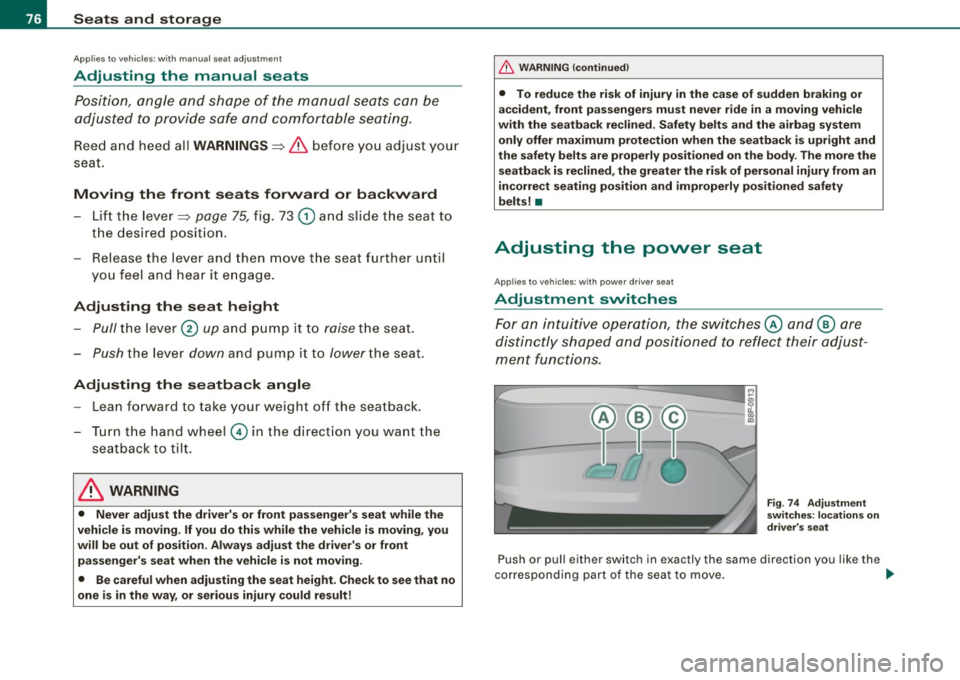
For an intuitive operation, the switches @ and @ are
distinctly shaped and posi tioned to reflect their adjust
ment functions.
Fig . 7 4 Adjustment
switches: locations on
driver's seat
Push or pul l either switch in exactly the same direction you like the
co rresponding part of the seat to move. .,,
Page 84 of 324

Seats and storage
& WARNING
When folded down, the armrest can restrict the driver's move
ment. When driving in conditions that may call for quick maneu
vers , fold up the armrest. This will allow you to react more quickly
to avoid an accident. •
Rear seats
General information
Safe transpo rtation of passengers on the rear seats
requires proper safety precautions.
All passengers on the rear seats must be seated in compliance with
the safety guidelines explained in=> page
137 and=> page 147. The
correct seating position is safety critical for front
and rear seat
passengers alike=> page
130.
& WARNING
• Vehicle occupants in the front and rear seats must always be
properly restrained.
• Do not let anyone ride in the vehicle without the head restraints
provided . Head restraints help reduce injuries .
• Loose items inside the passenger compartment, can fly
forward in a crash or sudden maneuver and injure occupants .
Always store articles in the luggage compartment and use the
fastening eyes, especially when the rear seat backs have been
folded down .
• Read and heed and all WARNINGS =>
page 130, "Proper seating
positions for passengers in rear seats ".•
Rear armrest
The armrest contains a storage compartment and a
cupholder for 2 drinks.
Folding dovvn the armrest
Fig. 82 Center of the
rear seatbench: rear
armrest folded down
-Pull the armrest down on the front :::} fig. 82.
Opening the storage bin
- Pull the handle in front. •
Page 88 of 324

Seats and storage
& WARNING
For strength-related reasons, heavy objects must not be hung on
the hooks. Heavy objects are not adequately secured -this
increases the risk of injury. •
Retractable luggage compartment cover
The luggage compartment cover keeps luggage or other
objects out of view.
Fig. 89 Rear lid open
with luggage compart ment cover
Removing the luggage compartment cover
Detach the retaining straps=> fig. 89 at the rear hatch G).
-Pull the cover 0 horizontally out of the mount@ in the
direction of the arrow.
Installing the luggage compartment cover
- Push the cover horizontally into the mounts provided
=> fig. 89@ on the side panel until the cover seats.
- Install the retaining straps in the rear hatch => fig. 89
G)
=>& .
& WARNING
• The luggage compartment cover must never be installed
without being secured -this creates an accident hazard.
• Whenever driving, never place any hard or heavy objects on the
luggage compartment or allow pets to sit on the luggage compart
ment cover . They could become a hazard to vehicle occupants in
the event of sudden braking or in an accident.
0 Note
Make sure that the heating wires in the rear lid do not get damaged
by objects scraping against them.
[ i ] Tips
• You can use the luggage compartment cover to store light
weight clothing but do not leave any heavy or sharp objects in the
pockets of the clothing.
• Remember that placing clothing on the luggage compartment
cover can block the driver's vision in the rear view mirror. This also
applies especially when you have to transport large objects.
• So that stale air can escape from the vehicle be sure not to cover
the ventilation slot between the rear lid and the luggage compart
ment cover installed. •
Page 96 of 324
Seats and storage
-Plu g in ap plia n ce to be us ed.
The ou tlet may be used for 12-volt app liances with maximum
consumption of up to 100 watts, such as a flash light , smal l vacuum
cleaner, etc .
Before you purchase any accessories, always read and follow the
inf orm ati on i n
=> page 305 , "Addi tiona l ac cess ories and parts
replacement" .
& WARNING
The outlet plu s any appliances plugged into it remain functional
even if the ignition is switched off or the ignition key is removed .
Ne ver leave children inside the vehicle without supervi sion .
0 Note
To avoid damaging the socket, only use p lugs that fit properly .
[ i ] Tips
When the engine is off and accessories are sti ll plugged in and are
on, the vehicle batte ry can sti ll be d rained .•
Storage
General overview
There are numer ous pl aces to store items i n your ve hicle.
Storage in the front arm rest
Storage in t h e rear ar m res t
=> page 87
Glove compart ment (A ir v enti lati on i n t he ::::> page 95
glove compartment*, CD changer *) Cent
er console
Compartments in the door trims
S to ra ge in the f ootwe ll
=> page9 5
=> page96
=> page96
Compartments in luggage compartment => page 97
Some of the s torage locations are only found on specific veh icle
models or are optional equ ipment .
& WARNING
• Always remove obje cts from the in strument panel. Any items
not put away could slide around inside the vehicle while driving or
when a ccelerating or when applying the bra kes or when driving
around a corner .
• When you are driving make sure that anything you may have
placed in the center console or other storage locations cannot fall
out into the footwells . In case of sudden bra king you would not be
able to brake , depress the clut ch or accelerate .
• Any pie ces of clothing that you have hung up mu st not interfere
with the driver's view. The coat hooks are designed only for light
weight clothing . Never hang any clothing with hard , pointed or
heavy objects in the pockets on the coat hooks . During sudden
bra king or in an accident -especially if the airbag is deployed -
these obje cts could in jure any passengers inside the vehicle. •
Page 100 of 324
Warm and cold
Warm and cold
Climate controls
Description
The air conditioner is fully automatic and is designed to
maintain a comfortable and uniform climate inside the
vehicle.
We recomme nd the following s ettings:
- Select and set a temperature between 64
°F (+22 °C) and
84 °F (+28 °C).
- Press the !AUTO
I button.
With this setting, you attain maximum comfort in the least amount
of time . Change this set ting, as desired, to mee t your pe rsonal
needs.
The climate controls are a combination of heating, venti lation and
cooling systems, which automatica lly reduce humidity and coo l the
air inside your vehic le .
The air temperature, air flow and air distribution are automatically
regu lated to achieve and maintain the desired passenger compart
ment temperature as quick ly as possible.
The system automatically compensates for changes in the outside
temperature and for the intensity of the sun light entering the
veh ic le. We recommend you use the
Automat ic mode=> page 101
for year -round comfort.
P lease note the following :
Turn on the air conditioner to reduce humidity in the vehic le. This
a lso prevent the window s from fogging up. When the outside temperature is high and the air is very humid,
c
ondensat ion from the evaporator may drip under the vehicle . T his
is normal and does not indicate a leak.
I f the outside temperature is low, the fan normally only switches to
a higher speed once the engine coola nt has war med u p sufficiently .
T he air conditioner temporarily sw itches off when you drive off from
a standstill using fu ll throttle to save engine power.
The comp ressor also swi tches off if the coolant temperatu re is to o
high so that the engine can be adequate ly cooled under extreme
lo ads .
Air pollutants filt er
The air po llutants fi lter (a combined partic le filter and activated
charcoal fi lter) reduces or eliminates outside air pollution (dust, or
p ollen) from en ter ing the vehic le .
The air po llutants fi lter must be changed at the intervals specified
in your Warranty
& Maintenance bo oklet, so that the ai r conditioner
can proper ly work.
I f you drive your vehicle in an area with high air pol lution, the filter
may need to be changed m ore freque ntly tha n specified in your
Audi Warranty
& Maintenance booklet. If in doubt, ask your autho
r iz ed Aud i Service Adviso r fo r a dvice .
& WARNING
Redu ced vi sibility i s dangerou s and can cause accidents .
• For saf e driving it is very important that all window s be free of
ice , sno w and conden sation.
• Fully familiarize yourself with the proper use and fun ction of
the heating and ventil ation sy stem and especially how to defog
and defrost the windows. ...
Page 105 of 324
_________________________________________________ w_ a_ r_ m __ a_n_ d_ c_ o_ld __ _
Switching between Fahrenheit and
Centigrade
You can change the temperature display from °F (Fahren
heit) to °C (Centigrade) and vice versa.
- Hold the [,;;S;)I button down=> page 100, fig. 108 .
- Turn the rotary sw itch (driver's s ide) @for 3 seconds +.•
Air recirculation (~ ]
The air recirculation prevents e xhaust fumes or other
pollution from entering the vehicle.
Switching air r ecircul ation on
- Press[ ~)=> page 100,fig. 108 =>&
Switching air recircul ation off
- Press~ again, or
- press [AUTO
J, or
- press[@ ).
I n the air recirculation mode, the air in the passenger compartment
is recirculated to prevent exhaust fumes and other pol lut ion from
entering the vehicle. We recommend that you use the manua l air
recirculat ion under the following conditions:
• when driving through tunnels
• in a traffic jam .
& WARNING
Do not use thi s setting f or e xte nded period s of time . The wind ows
c ould fog up sin ce no fre sh air ca n enter the v ehic le . If th e
Controls and equip
ment
& WARN ING (c ontinu ed)
window s fog up, pre ss the air r ecircul ation butt on agai n immed i
a te ly to sw itch off the air r ecirculation function or selec t defro st. •
Adjusting the fan speed 8 G
The automatically selected fan speed can be increased or
decreased .
-Press the 8 or G buttons in the center of the control
panel =>
page 100 , fig. 108 to adjust the fan speed to yo ur
comfo rt.
The air conditioning system automatically regu lates the fan speed
in response to the interior temperature . However, you can also
adjust the fan speed manua lly . A line of sma ll bars in the center
d isplay above the fan con trol buttons will retreat or extend to reflect
your adjustments to the fan speed .•
Air distribution
T he aut omatically controlled air distribution can be
changed manually.
You can use the [ 1!:. ), l~l or l~ l buttons separately or together in
combination. To switch back to the automa tic air distribu tion
setting, either switch off the buttons you previously selected, or
press
[ A UTO ).
Each of the three buttons has its own specific function (the re fer
ence numbers refer to the air outlets) :::>
page 104, fig . 109 .
Air dir ected to th e wind ows ~
All the air is directed to outlets G),@ and G). Contrary to when [@1
is pressed, th e amount of air remains the same. .,_
I • •
Page 113 of 324
On the road -
----------------
-Switch off the engine a nd rem ove the igni tion k ey from
t h e ign iti on loc k.
Wha t el se you should do when parking your vehic le on
a n in cline o r de cline
Turn the steering whee l so that if the vehicle shou ld start to rol l, it
wil l ro ll into the curb.
I f you are parking on a
de cline (the front of your vehic le facing
downh ill), turn the front wheels to the right so that they po int
toward the curb.
If you are parking on an
in cline (the fon t of your vehicle facing
uphill), turn the front whee ls to the left so that they point away from
the cu rb.
Move the selector lever into the
P pos it ion (a utomatic tran smiss ion )
or move the gearshift lever into 1st. gear (manual trans mission) .
& WARNING
This is how you can reduce the r isk of injury when leaving your
v ehi cle .
• Never p ark the vehicle where it can come in contact with dry
gr ass, s pilled fuel or any other fl ammable mater ial s.
• Never allow anyone -espec ially small ch ildren -to remain in the
v ehi cle when it i s loc ked . Lo cked door s make it more diffi cult f or
rescuer s to acce ss the pa ssenger compartm ent in the event of an
eme rgen cy. Dang er to life!
• Never l eave children un supervi sed in the vehicle. Children
c ould relea se the p ark ing br ake or move the ge ars h ift le ver out of
gear. The vehicle could start to roll away and cau se an a ccident.
• No matter wh at the se ason i s, the temperat ure in a p arked
vehicle can reach dangerou s levels. •
Controls and equip
ment
Ap plies to vehic les: with hill hol d ass is t
Starting on hills
Hi ll hold assist makes it easier t o sta rt on hills .
The system is activated when the brake pedal is depressed
for a fe w
s econds .
After re leas ing the brake peda l, the brake power is held for a brief
moment to prevent the vehic le from rolling back when starting . At
t his time, you can easily beg in to m ove your vehicle.
& WARNING
• If you did not begin mov ing immediately afte r relea sing the
brake pedal , unde r certain circumst ances , the v ehi cle would begin
to roll ba ckw ard . Depres s the brak e pedal immedi ately or engag e
the hand brake .
• Should the engi ne stall , depres s the brake ped al immedi ately
or eng age the hand bra ke.
• In order to pre vent the vehi cle from rolling ba ck unintentionally
when starting in stop-and-go traffic , ke ep th e brake pedal
depre ssed for a few second s before driving off .
[ i ] Tips
You can find out if your vehicle is equipped with "Hill hold assist" at
an authorized Audi dealership .•
I • •
Page 115 of 324

On the road -
-------------------'
- Press the switch P111A in the center console ::::, page 112,
fig. 115. A short confirmation tone sounds and the diode
in the switch lights.
Switching off
-Drive forward faster than 10 mph (15 km/h), or
press the switch
P" 'A or
- switch off the ignition.
& WARNING
• The parking assist cannot replace the driver's attention. The
driver alone is responsible for parking and similar driving maneu
vers. Always watch where you are driving.
• Sensors have blind spots in which objects cannot be detected.
Pay special attention to small children and animals. They cannot
always be detected by the sensors -danger of an accident!
• Always pay attention to the area around the vehicle -using the
rearview mirror, too .
0 Note
Low obstacles already signaled by a warning can disappear from
the system's detection range as they are approached and will not
continue to be signaled. Objects such as barrier chains, trailer draw
bars, thin painted vertical poles, or fences may not be detected by
the system -risk of damage.
[ i] Tips
You can change the volume and pitch of the signals~ page 23. •
Con tro ls and eq uip
ment
Cruise control
Switching the system on
The cruise control system makes it possible to drive at a
constant speed starting at 20 mph (30 km/h).
A 1----....;
Fig. 116 Control lever
with set button
Fig . 117 Display:
Selected speed
- Pull the lever to position (D::::, fig. 116 to switch the
system on.
- Drive at the speed you wish to set.
- Press button
© to set that speed.
The display~ fig. 117 will show the set speed. The display may vary
depending on the type of display in your vehicle. The indicator light _.,
Vehicle care I I irechnical data