light AUDI S3 2009 Repair Manual
[x] Cancel search | Manufacturer: AUDI, Model Year: 2009, Model line: S3, Model: AUDI S3 2009Pages: 324, PDF Size: 76.02 MB
Page 107 of 324
___________________________________________________ W_ a_ r_m _ a_ n_d_ c_ o_ ld _ __.lffllll
<£> For the s ake of th e envir onm ent
By reducing the amount of fue l you use, you a lso reduce the amount
of pollutants emitted into the air. •
Key coded settings
When the ignition is switched on, the air conditioner
settings are automatically assigned to the key being used.
The air conditioner settings selected are automatically stored and
assigned to the key being used. When the vehicle is started, the air
conditioner automatical ly selects the settings assigned to that key .
This way every driver will maintain his/her own personal settings and does not have to reset them manually.
[ i ] Tip s
If a different driver uses your key and changes the air conditioner
sett ings, the latest adjustments wil l erase and replace the settings
you hav e stored. •
Rear vvindovv defogger QiP
The rear window defogger clears the rear window of
condensation.
Con tro ls and eq uip
ment
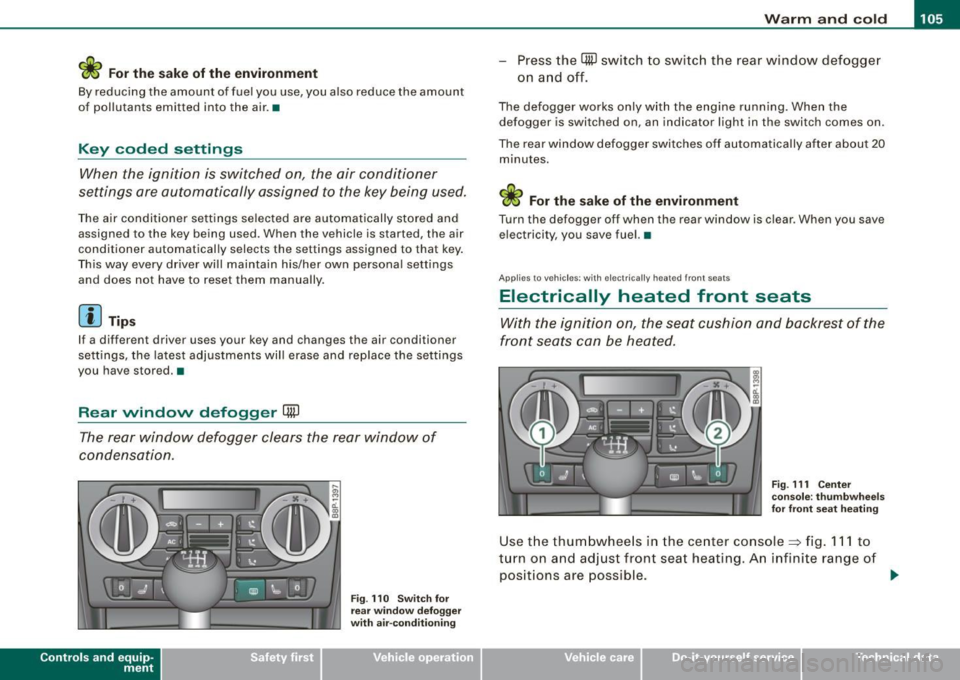
F ig . 11 O Sw itch for
rear window defogge r
w ith air-co nditionin g
-Press the CiiP switch to switch the rear wind ow defogger
on a nd off.
The defogger works only with the engine runn ing. When the
defogger is switched on, an indicator light in the switch comes on .
The rear window defogger switches off automatically after about 20 minutes.
<£> For the sake of the environment
Turn the defogger off when the rear window is c lear . When you save
electricity, you save fuel. •
Applies to vehi cles : with elec trica lly heated fr ont se ats
Electrically heated front seats
With the ignition on, the seat cushion and backrest of the
fr ont seats can be heated.
Fig. 111 Cen ter
co nso le: th umbwhee ls
for fro nt seat heat ing
Use the thumbwhee ls in the center console~ fig . 111 to
turn on and adjust front seat heating. An infinite range of
positions are possible .
~
Vehicle care I I irechnical data
Page 110 of 324
• ..__O_ n_ t_h _ e_ r_ o_ a_ d ____________________________________________________ _
Ignition lock and ignition switch
Ignition lock
The engine can be s tar ted or tu rned off with the ignition
key.
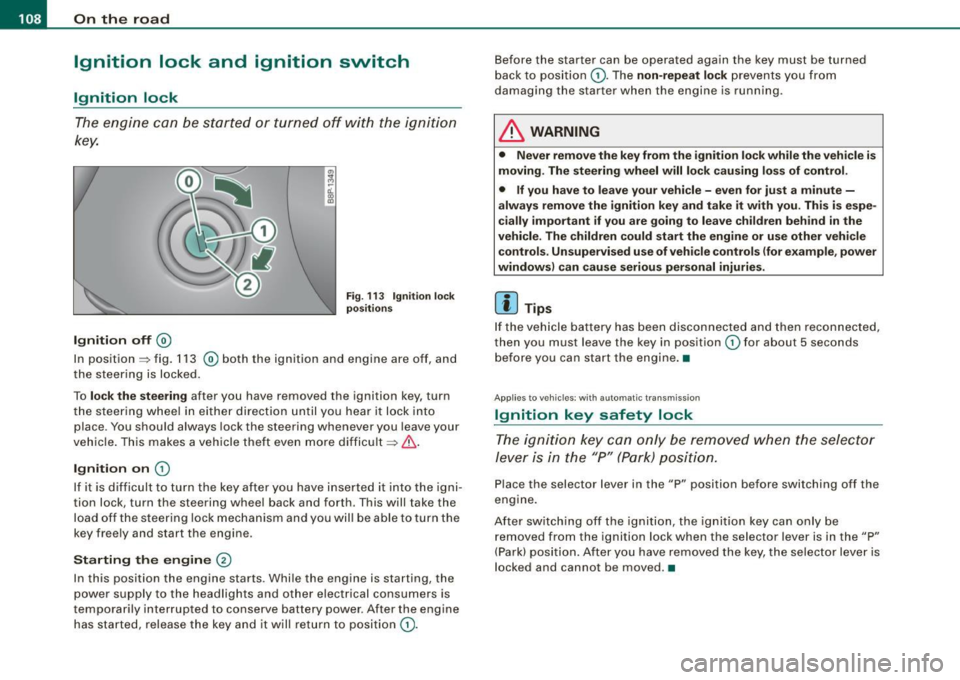
Ignition off ®
Fig . 11 3 Ignit ion lock
po sition s
In position => fig. 113 ® both the ignit ion and engine are off, and
the steering is locked .
To
lo ck the stee ring after you have removed the ignition key, turn
t he steering whee l in either direction until you hear i t lock into
place . You should always lock the steering whenever you leave your
vehic le . This makes a vehicle theft even more difficult => & .
Ignition on G)
If it is difficult to turn the key af ter you have inserted i t into the igni
tion lock, turn the steering wheel back and forth . This will take the
load off the steering lock mechanism and you wil l be able to turn the
key freely and start the engine .
Starting the engine @
In this position the engine starts . Whi le the engine is starting, the
power supply to the headlights and o ther elec trical consumers is
temporari ly interrupted to conserve battery power . After the engine
has started, release the key and it will return to position
G).
Before the starter can be operated again the key must be turned
back to posi tion
G) . The non -repeat lock prevents you from
damaging the starter when the engine is running.
& WARNING
• Never remove the key from the ign ition lo ck w hile the veh icle is
moving. The steering wheel will lo ck causing lo ss of control .
• If you h ave to leave your vehicle -even for just a minute -
alway s remove the ignition key and take it w ith you . Thi s is es pe
c ially important if you are going to leave ch ildren behind in the
vehicle. The children could start the engine or u se other vehi cle
c ontrol s. Unsupervi sed u se of veh icle cont rol s ( for e xamp le , powe r
window s) can cau se serious per sonal injurie s.
[ i ] Tips
If the veh icle battery has been disconnected and then reconnected,
then you must leave the key in position
G) for about 5 seconds
before you can start the engine .•
Ap plies to ve hicl es: w ith a utom at ic tra nsmi ss io n
Ignition key safety lock
The ign ition key can only be rem oved when the selec tor
le ver i s in the "P" (Par k) p osition.
Place the selector lever in the "P" position before switching off the
engine .
After switching off the ignition, the ignition key can only be
removed from the ignition lock when the se lector lever is in the "P"
(Park) position. A fter you have removed the key , the selector lever is
locked and cannot be moved .•
Page 111 of 324
___________________________________________________ O _n_ t_h _ e_ r_ o _ a_ d __ lfflll
Starting and stopping the engine
Starting the engine
The engine can only be started with on original Audi key
and the clutch pedal* depressed.
- Set the parking brake.
Move the selector lever to the neutral position (automatic
transmission): selector lever in P or N) =>
&.
- On vehicles with manual transmission, fully depress the
clutch pedal.
- Turn the ignition key to position@=>
page 108, fig. 113
- do not depress the gas pedal when starting the engine!
- Let go of the key as soon as the engine starts.
A cold engine may at first be loud after it has been started. This is
due to the hydraulic valves building up the oil pressure . This normal
and no need for concern.
If the engine does not star t immediately, stop trying after 10
seconds and then try to restart the engine about 30 seconds later.
& WARNING
Never start or let the engine run in a confined or enclosed area.
Exhaust fumes from the engine contain carbon monoxide, a color
less and odorless gas. Carbon monoxide can be fatal if inhaled .
• Never leave the engine idling unattended. An unattended
vehicle with a running engine poses a danger of personal injury or
theft.
Controls and equip
ment
0 Note
• Avoid high engine speeds, fast acceleration or heavy engine
loads while the engine is still cold. This could damage the engine!
• The engine cannot be started by pushing o r towing the vehicle.
~ For the sake of the environment
To avoid unnecessary engine wear and to reduce exhaust emis
sions, do not let your vehicle stand and warm up. Be ready to drive
off immediately after starting your vehicle. Maintain moderate
speed until the engine is completely warm. Remember, the engine
performs best at operating temperature. •
Stopping the engine
-Turn the ignition key to position@=> page 108 , fig. 113.
& WARNING
• Never turn off the engine until the vehicle has come to a
complete stop.
• The brake booster and servotronic only work when the engine
is running . With the ignition turned off, you have to apply more
force when steering or braking. Since you cannot steer and stop
normally, this can lead to accidents and serious injuries.
• The radiator fan can continue to run for up to 10 minutes even
after you have turned off the engine and removed the ignition key.
The radiator fan can also turn on again if the engine coolant heats
up because of intense sunlight or heat build-up in the engine
compartment. .,
I • •
Page 112 of 324

• ..__O_ n_ t_h _ e_ r_ o_ a_ d ____________________________________________________ _
0 Note
Do not stop the engine immediately after hard or extended driving.
Keep the engine running for approximately two minutes to prevent
excessive heat build-up. •
Parking brake
Parking brake
When the parking brake is set, it prevents the vehicle from
rolling away unintentionally.
Setting the parking brake
Fig . 114 Center
console: Parking brake
set
- Pull the parking brake lever all the way up.
Releasing the parking brake Pull the parking brake lever up slightly
and press the
release button at the same time=> fig. 114 -arrow-.
Keep the release button pressed and lower the parking
brake=>
& -
If you should drive off with the parking brake still set, a warning tone
will sound and the following will appear in the instrument cluster to remind you to release the parking brake:
Parking brake set
The parking brake warning comes on only after you have driven for longer than 3 seconds and faster than 5 mph (5 km/h).
The parking brake warning light Brake (USA)/
{CD) (CON) illuminates
when the parking brake is set and you switch on the ignition.
& WARNING
Always release the parking brake completely . A partially engaged
brake will overheat the rear brakes, reduce their effectiveness and
cause excessive wear. This could lead to brake failure and an acci
dent.
0 Note
Only after the vehicle has come to complete stop, should you firmly
set the parking brake and either move the gearshift lever into 1st .
gear (manual transmission) or move the selector lever into "P"
(Automatic transmission). •
Parking
To prevent a parked vehicle from rolling away, there are a
few things you should do.
When you park your vehicle, do the following:
- Stop the vehicle using the brake pedal.
- Set the parking brake firmly.
- Move the selector lever into the
P position (automatic
transmission)
or move the gearshift lever into 1st. gear
(manual transmission) => &. .,_
Page 115 of 324

On the road -
-------------------'
- Press the switch P111A in the center console ::::, page 112,
fig. 115. A short confirmation tone sounds and the diode
in the switch lights.
Switching off
-Drive forward faster than 10 mph (15 km/h), or
press the switch
P" 'A or
- switch off the ignition.
& WARNING
• The parking assist cannot replace the driver's attention. The
driver alone is responsible for parking and similar driving maneu
vers. Always watch where you are driving.
• Sensors have blind spots in which objects cannot be detected.
Pay special attention to small children and animals. They cannot
always be detected by the sensors -danger of an accident!
• Always pay attention to the area around the vehicle -using the
rearview mirror, too .
0 Note
Low obstacles already signaled by a warning can disappear from
the system's detection range as they are approached and will not
continue to be signaled. Objects such as barrier chains, trailer draw
bars, thin painted vertical poles, or fences may not be detected by
the system -risk of damage.
[ i] Tips
You can change the volume and pitch of the signals~ page 23. •
Con tro ls and eq uip
ment
Cruise control
Switching the system on
The cruise control system makes it possible to drive at a
constant speed starting at 20 mph (30 km/h).
A 1----....;
Fig. 116 Control lever
with set button
Fig . 117 Display:
Selected speed
- Pull the lever to position (D::::, fig. 116 to switch the
system on.
- Drive at the speed you wish to set.
- Press button
© to set that speed.
The display~ fig. 117 will show the set speed. The display may vary
depending on the type of display in your vehicle. The indicator light _.,
Vehicle care I I irechnical data
Page 116 of 324

• .___O_ n_ t_h _e _ r_o _a_ d __________________________________________________ _
CRUISE (US model)/ r,,f (Canadian model) will also light up in the
instrument cluster.
& WARNING
• Always pay attention to traffic even when the cruise control is
switched on. You are always responsible for your speed and the
distance between your vehicle and other vehicles.
• For safety reasons, the cruise control should not be used in the
city, in stop-and-go traffic, on twisting roads and when road condi
tions are poor (such as ice, fog, gravel, heavy rain and hydro
planing) -risk of accident.
• Turn off the cruise control temporarily when entering turn
lanes, highway exit lanes or in construction zones.
• Please note that inadvertently "resting" your foot on the accel
erator pedal causes the cruise control not to brake. This is because
the cruise control is overridden by the driver's acceleration.
[ i J Tips
• Vehicles with manual transmission : You can attain the set speed
only if the currently engaged gear allows it and the engine is not
stressed. Shifting to a higher or lower gear promptly will allow the
engine to run smoothly.
• The cruise control cannot maintain a constant speed when
driving downhill. The vehicle will accelerate under its own weight.
Downshift to a lower gear or use the brakes to slow down. •
Changing speed
- Press lever in the 0 or Q direction~ page 113, fig. 116
to increase or decrease your speed.
Release the lever to save that speed .
Change speed in increments of 1 mph (1 km/h) by lightly pressing
the lever. If you keep the lever pressed down, you will alter your
speed in 5 mph (10 km/h) increments.
You can also press the accelerator pedal down to increase your
speed, e .g. if you want to pass someone. The speed you saved
earlier will resume as soon as you release the accelerator pedal.
If, however, you exceed your saved speed by 5 mph (10 km/h) for
longer than 5 minutes, the cruise control will turn off temporarily.
The symbol will go out but the saved speed will be retained. •
Presetting your sp eed
You can preset your desired speed while the vehicle is not
moving.
- Turn on the ignition.
Pull lever into position
G) ~ page 113, fig. 116.
Press the lever in the
0 or Q direction to increase or
decrease your speed.
- Release the lever to save that speed.
This function makes it possible, for example, to save the speed you
want before driving on the highway. Once on the highway, activate
the cruise control by pulling the lever toward
G) . •
Switching th e system off
Temporary deactivation
Press the brake pedal, or
- Keep the clutch pedal pressed down
longer, or
Press the lever into position
0 (not clicked into place)
~ page 113, fig. 116, or ._
Page 117 of 324

On th e road 1111
--------------~:.:..--J
- Drive for longer than 5 minutes at more than 5 mp h
(10 km/h) above the stored speed .
Switchin g o ff compl ete ly
- Press lever into position@ (clicked into place), or
- Switch the ign ition of f.
The system retains the saved speed if you deactivate the cruise
control temporarily. To resume the saved speed, release the brake or
clutch pedal and pull the lever to position
G) .
Switching the ignition off erases the saved speed.
& WARNING
You s hould only return t o th e sa ved sp ee d if it i s not to o fast fo r
the curre nt traff ic condi tio ns -ris k of an a ccident! •
Applies to ve hic les: with m agn etic r id e
Audi magnetic ride
Damping can be adjusted to the driver's preference and it
adapts automatically to the curren t driving situation.
t 9 1 ] J
Fi g. 11 8 Ce nte r
co nso le: Sw itc h for
A ud i m agn etic rid e
Press the switch ~ fig. 118 to turn sport setting on or off.
Con tro ls and eq uip
ment
Audi magnetic ride is an e lectronically control led damping system.
This chassis system assists the driver by adapt ing to the particular
s ituation through imperceptible control processes . The
dampin g
provides individua l modulation of damping forces . For example,
with damping characteristics set to provide greater comfort ,
damping is set somewhat harder for a brief period on ly as required,
when rounding a curve and when braking.
Standard settin g
Select the standard setting if you prefer a suspension setting
emphasizing comfort .
Sp or t setting
Select the sport setting if you prefer a sporty suspension setting .
The LE D in the switch comes on to indicate sport setting .
[ i ] Tip s
The warning/indicator light in the instrumen t cluster comes on in
the event of a malfunction. Drive to the closest authorized Audi
dea le r as soon as possible and have the malfunction repaired .•
Vehicle care I I irechnical data
Page 118 of 324
• ..__T_ ra_ n_s_ m_ i_ s _s_ i_ o _n ___________________________________________________ _
Transmission
Manual transmission
Applies to vehicles: with manual transmission
Gearshift lever
The clutch pedal must be depressed all the way bef ore
you can start the engine .
The manual transmission in your Audi is equipped with an
interlock-feature .
-Depress the clutch pedal all the way.
- Start the engine w ith the gearsh ift lever in Neutral and
the clutch pedal depressed.
0 Note
Always depress the clutch pedal fully when changing gears. Do not
hold the vehicle on a hi ll with the c lu tch pedal par tia lly depressed.
This may cause premature clutch wear or damage .
[ i J Tip s
• Resting your hand on the gearshift lever knob while driving will
cause prematu re wear in the transmission .
• The back -up lights go on when you shift into Reverse with the
ignition on. •
Applies to vehicles: with 6-speed manual transmission
Gearshift pattern (6 -speed manual
transmission )
ra ...
-0:. ., m
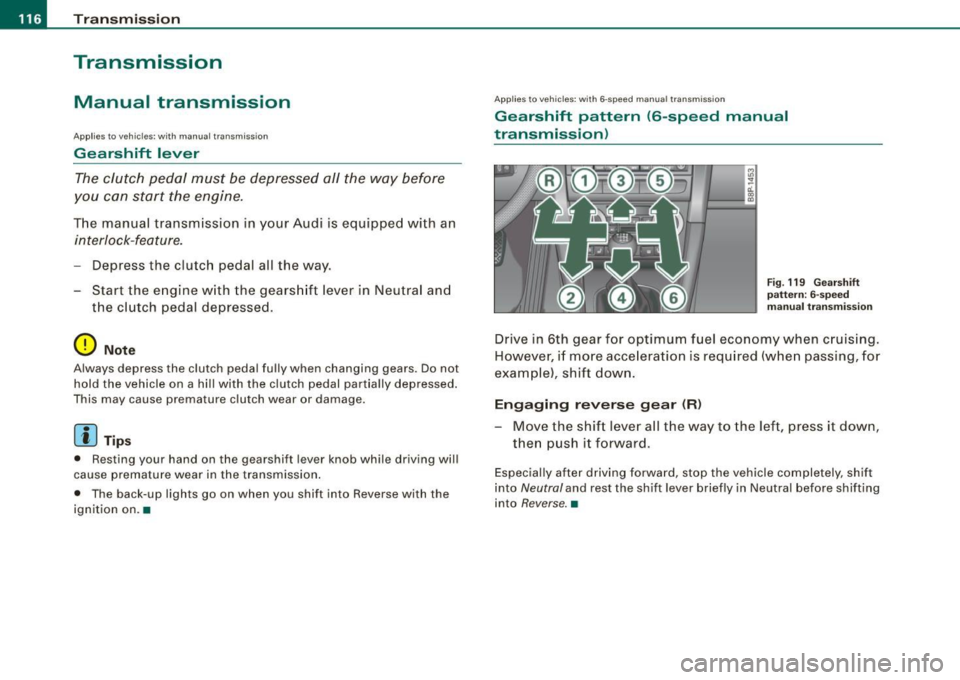
Fig. 11 9 Gea rsh ift
p att er n: 6-s pee d
m anu al tran sm ission
Drive in 6th gear for optimum fuel economy when cruising.
However, if more acce leration is required (when passing, for
example), shift down.
Engaging r evers e gear CR )
- Move the shift lever all the way to the left, press it down,
then push it forward.
Especial ly after driving forwa rd, stop the vehicle completely, shift
into
Neutral and rest the sh ift lever brief ly in Neutral before shifting
into
Reverse. •
Page 119 of 324

_______________________________________________________ T_ ra_ n_s_ m __ is_s_ io_ n __ ftllll
S tronic transmission
Ap plies to veh ic les: w ith S tronic®
Introduction
Your vehicle is equipped with a S tronic transmission, also called a
double -clutch system/transmission.
Power is transferred between the engine and the transmission by
means of two independent clutches. They replace the torque
~
converter of conventiona l automatic transmissions and allow the
vehic le to acce lerate without a noticeable break in the power flow.
With the aid of
tiptronic , the gears can optionally be shifted manu
ally => page 121. •
Ap plies to veh ic le s: w ith S troni c®
Selector lever positions
All the selector lever positions are explained in this
section.
Fig . 120 Display :
Selector lever posi
tion s
The se lector lever position is shown in the instrument cluster
display by highlighting the appropriate symbol.
Controls and equip
ment P
-Park lock
In this position the gears are mechanically locked .
The park lock must only be engaged with the veh icle
stationary
=> & .
To engage P and to remove the lever from this position, you must
depress the release button (button in the se lector lever handle)
and
simultaneously you must step on the brake pedal.
R -reverse
In this position, reverse is engaged.
Reverse gear must only be engaged with the vehicle
stationary and
the engine running at idle speed =>& .
To engage R, you have to depress the release button
and simulta
neously step on the brake pedal. In the R position, the back -up lights
illuminate with the ignition on.
N -Neutral
The transmission is in neutral in this position .
D -Normal position for driving forward
In this position, the forward gears are automatically shifted up and
down, depending on engine load and vehicle speed.
To engage S from N, the brake pedal must be depressed at speeds
below 5 km/h or when the vehicle is stationary=>& .
In certain circumstances (driving in the mountains for example) it
can be beneficial to switch temporarily to the manua l shift program
=> page 121 in order to adjust the gear ratios to driving conditions
manually .
S -Sport setting
The S setting should be selected for sporting driving . The power
reserves of the engine can be fully exploi ted through later upshifts.
To engage S from N, the brake pedal must be depressed at speeds
below 5 km/h or when the vehicle is stationary =>& .
~
I • •
Page 121 of 324
_______________________________________________________ T_ r _a_ n_s_ m __ is_s_ io_ n _ __.1111111
The selector lever lock is effective only when the vehicle is
stationary and at speeds below 5 km/h. At higher speeds, the lock in
the N position is automatically switched off .
The selector lever is not locked when rapid shifts are made through
the N position (e.g. from R to Dl. This allows you to "rock" the vehicle
if it becomes stuck. If the lever is in the N position for more than
1 second with the brake pedal not depressed, the selector lock
engages automatically .
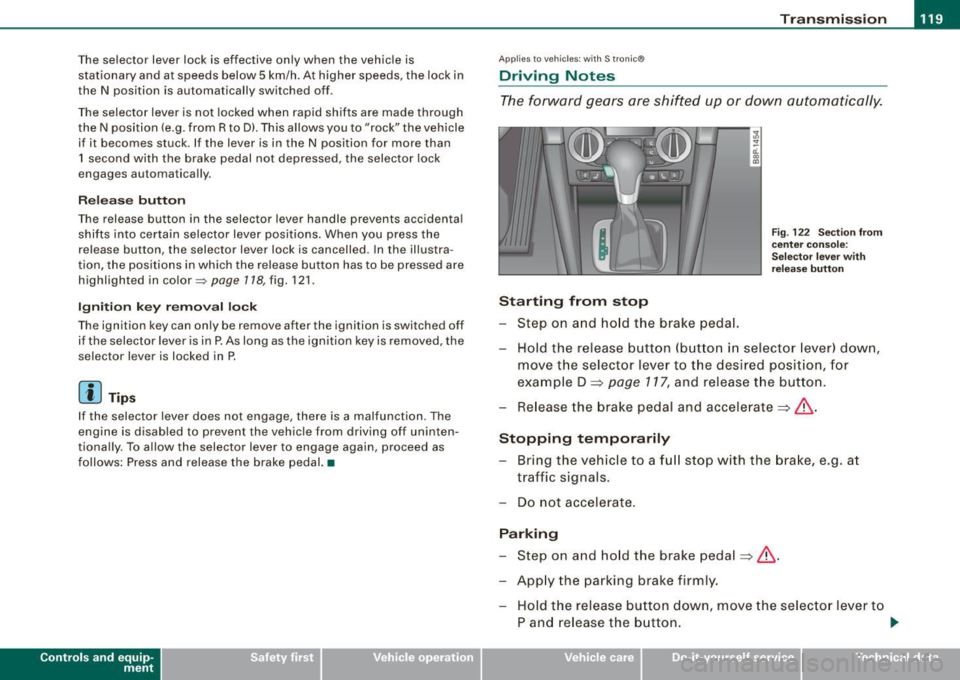
Release button
The release button in the selector lever handle prevents accidental
shifts into certain selector lever positions . When you press the
release button, the selector lever lock is cancelled . In the illustra
tion, the positions in which the release button has to be pressed are
highlighted in color~
page 718, fig. 121.
Ignition key removal lock
The ignition key can only be remove after the ignition is switched off
if the selector lever is in P. As long as the ignition key is removed, the
selector lever is locked in P.
[ i) Tips
If the selector lever does not engage, there is a malfunction . The
engine is disabled to prevent the vehicle from driving off uninten
tiona lly. To allow the selector lever to engage again, proceed as
follows: Press and release the brake pedal. •
Contro ls and eq uip
ment
Ap plies to vehic les: wit h S tron ic®
Driving Notes
The forward gears are shifted up or down automatically.
Starting from stop
Step on and hold the brake pedal.
Fig. 122 Section from
center console:
Selector lever with
release button
Hold the release button (button in selector lever) down,
move the selector lever to the desired position, for
example D =>
page 117, and release the button.
Release the brake pedal and accelerate => &, .
Stopping temporarily Bring the vehicle to a full stop with the brake, e.g. at
traffic signals.
Do not accelerate.
Parking Step on and hold the brake pedal=>&, .
Apply the parking brake firmly. Hold the release button down, move the selector lever to
P and release the button. .,.
Vehicle care I I irechnical data