light AUDI S3 2015 Owners Manual
[x] Cancel search | Manufacturer: AUDI, Model Year: 2015, Model line: S3, Model: AUDI S3 2015Pages: 310, PDF Size: 76.15 MB
Page 177 of 310
Child Safety 175
-The child and the passenger can also heater for child seats) on the front pas-
injure each other in an accident . senger seat if the device is connected
- Never install rear-facing child safety to the 12-volt socket or the cigarette
seats or infant carriers on the front pas- lighter
socket.
senger seat. A child will be seriously in- -If a seat heater has been retrofitted or
jured and can be killed when the passen- otherwise added to the front passen-
ger airbag inflates - even with an Ad -ger seat, never install any child re-
•
vanced Airbag System. straint system on this seat.
•
-The inflating airbag will hit the child -Make sure that there are no wet objects
safety seat or infant carrier with great (such as a wet towel) and no water or
force and will smash the child safety seat other liquids on the front passenger
and child against the backrest, center seat cushion.
armrest, door or roof. -Never place objects on the seat (such
- Always install rear-facing child safety as a laptop, CD player, electronic
seats or infant carriers on the rear seat. games device, power inverter or seat
- Forward-facing child safety seats instal- heater for child seats). These may
in-
led on the front passenger's seat can in- fluence the electrical capacitance
terfere with the airbag when it inflates measured by the capacitive passenger
and cause serious injury to the child. Al- detection system and can also fly
ways install forward-facing child safety around in an accident and cause serious
seats on the rear seat. personal injury.
- If exceptional circumstances require the -
Always buckle the child safety seat firmly
use of a forward-facing child restraint on in place even if a child is not sitting
in it.
the front passenger's seat, the child's A loose child safety seat can fly around
safety and well-being require that the during a sudden stop or in a collision
.
following special precautions be taken: -Always read and heed all WARNINGS
- Make sure the forward-facing seat has whenever using a child restrained in ave-
been designed and certified by its man- hide is being used
c> page 135, Safety
ufacturer for
use on a front seat with a belts, ¢ page 144, Airbag system and
passenger front and side airbag.
¢ page 170, Child Safety .
-Always carefully follow the manufac-
A WARNING turer's instructions provided with the
child safety seat or carrier. To reduce the risk of serious injury, make
- Always move the front passenger seat
sure that the
PASSENGER AIR BAG OFF
into the rearmost position of the pas-
light comes on and stays on whenever a
senger seat's fore and aft adjustment child restraint is installed on the front pas-
range, and as far away from the airbag senger seat and the ignition is switched
as possible before installing the child on.
restraint. - Take the child restraint off the front pas-
- Always make sure that nothing pre-
senger seat and install it properly at one
vents the front passenger's seat from of the rear seat positions if the
PASS EN-
being moved to the rearmost position GER AIR BAG OFF light does not stay on.
in its fore and aft adjustment range .
-Have the airbag system inspected by
- Always make sure that the backrest is
your authorized Audi dealer immediate-
M • N in the upright position. ly. 0 > - Never place or use any electrical device co ,....,
(such as a laptop, CD player, electronic \!) 1.1"1
M
games device, power inverter or seat 1.1"1 ,....,
Page 179 of 310
....,
N
0 > co
rl I.O
"' ....,
"' rl
It is a very dangerous place for an infant or a
la rger child in a rearward-facing seat.
A WARNING
Not using a child safety seat, using the
wrong child safety seat or improperly in stalling a child restraint increases the risk
of serious personal injury and death in a
crash.
- Never install rear-facing child safety
seats or infant carriers on the front pas
senger seat -even with an Advanced Air
bag System. A child will be seriously in
jured and can be killed when the inflat
ing airbag hits the child safety seat or in
fant carrier with great force and smashes
the child safety seat and child against
the backrest, center armrest, door or
roof
c::> page 146, Child restraints on the
front seat -some important things to
know.
- Always install rear-facing child safety
seats or infant carriers on the rear seat.
- Never install a rear-facing child restraint in the forward-facing direction. Such re
straints are designed for the special
needs of infants and very small children
and cannot protect them properly if the
seat is forward-facing .
-If you must install a rearward facing
child safety seat on the front passenger
seat because of exceptional circumstan
ces and the
PASSENGER AIR BAG OFF
light does not come on and stay on, im
mediately install the rear-facing child
safety seat in a rear seating position and have the airbag system inspected by your
Audi dealer.
- Never place or use any electrical device
(such as a laptop, CD player, electronic
games device, power inverter or seat
heater for child seats) on the front pas
senger seat if the device is connected to
the 12-volt socket or the cigarette light
er socket .
- If a seat heater has been retrofitted or
otherwise added to the front passenger
Child Safety 177
seat, never install any child restraint sys
tem on this seat.
- Make sure that there are no wet objects
(such as a wet towel) and no water or
other liquids on the front passenger seat
cushion.
- Never place objects on the seat (such as
a laptop, CD player, electronic games de
vice, power inverter or seat heater for
child seats). These may influence the
electrical capacitance measured by the
capacitive passenger detection system
and can also fly around in an accident
and cause serious personal injury.
- Always read and heed all WARNINGS
whenever using a child restrained in ave
hicle is being used
c::> page 135, Safety
belts,
c::> page 144, Airbag system and
c::> page 170, Important things to know.
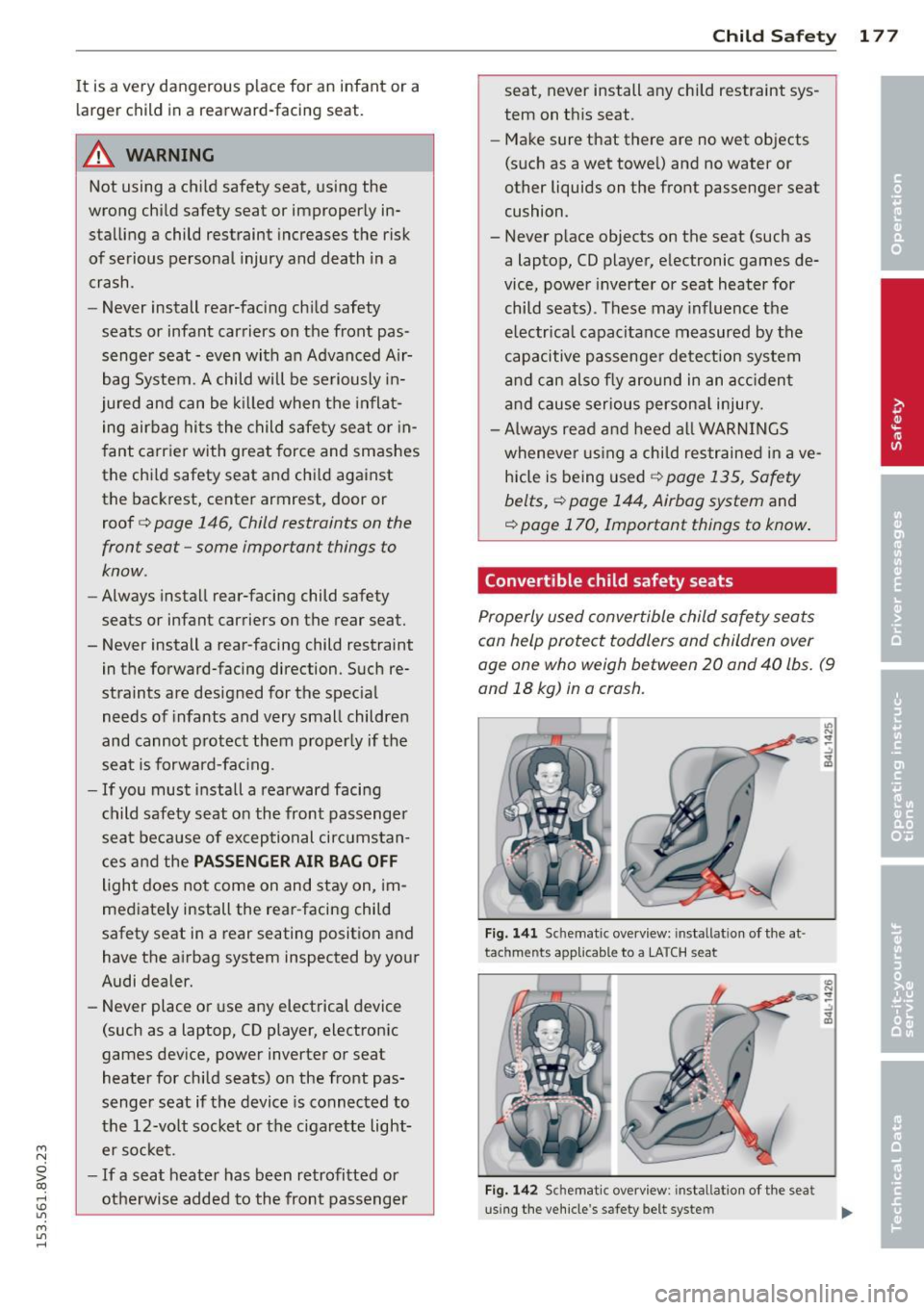
Convertible child safety seats
Properly used convertible child safety seats
can help protect toddlers and children over
age one who weigh between 20 and 40 lbs. (9
and 18 kg) in a crash.
Fig. 141 Schematic overview: installat ion of the at
tachments applicable to a LATCH seat
Fig. 142 Schematic overview: installation of the seat
using the vehicle 's safety be lt system
I),,
Page 180 of 310
178 Child Saf ety
• When using the vehicle safety be lt to insta ll
a chi ld safety seat, you must first activate
the convertible locking retractor on the
safety belt to prevent the child safety seat
from moving ¢
page 181 or install the seat
using the LATCH attachments .
• Push the child safety seat dow n with your
full weight to get the safety belt rea lly t ight
so that the sea t ca nnot move forward or
s ideways more than one inch ( 2.5 cm)
¢page 181.
• If the child safety seat is eq uipped with a
tether strap, attach it to the tether anchors
¢ page 187.
• Secure unused safety belts on the rear seat
¢ page 176.
A toddler or child is usually too large for an in
fant restraint if it is more than one year o ld
and weighs more than 20 lbs. (9 kg) .
Todd lers and c hildren who are o lder than one
yea r up to abo ut 4 years o ld and weigh more
than 20 lbs (9 kg) up to 40 lbs . (18 kg) must
a lways be properly restrained in a ch ild safety
seat certified for the ir s ize and weight
¢
fig . 141 and ¢ fig. 142.
The airbag on the passenger side makes the
front seat a potentially dangerous place for a child to r ide . The fro nt seat is not the safest
p lace for a child in a forwa rd-facing child safe
ty seat.
It is a very dange rous p lace for an in
fant or a la rger chi ld in a rearwa rd-fa cing seat.
A WARNING
Not u sing a ch ild safety se at, using the
wrong ch ild safety sea t or improper ly in
stal ling a child restraint increases the risk
of serious personal injury and death in a
co llision or other emergency s ituation.
- Children on t he front seat of any car,
even w ith Advanced A irbags, can be seri
o usly injured or even killed when an a ir
bag inf lates. A child in a rearward-facing
child safety seat installed on the front
passenge r seat w ill be seriously injured
and can be kil led if the front ai rbag in-
-
f lates -even with an Advanced Airbag
System .
- The inflating air bag will h it the ch ild
safety seat or infant carrier with great
force and will smash the child safety seat
and child aga inst the backrest , center
arm rest, door or roof .
- Always install rear-fac ing ch ild safety
seats on the rear seat .
- If you must install a rearward fac ing
child safety seat on the front passenger
seat because of exceptiona l circumstan
ces and the
PASSENGER AIR BAG OFF
light does not come on and stay on, im
mediately insta ll t he rear-fac ing c hild
s a fety se at in a re ar seating positi on and
have the air bag system ins pected by your
Aud i deale r.
- T he rear side o f the child safety seat
should be pos itioned as close as possi ble
to the backrest on the vehicle seat .
- For a djustable head restra ints: adjust or
remove the rea r seat hea d restra int if it
is difficult to install the c hild seat w ith
the head restraint in place¢
page 59. In
stall the head restraint again immed iate
ly once the child seat is removed. Dr iv ing
without head restraints o r with head re
s traints that are not properly adjus ted
increases the risk of serious or fatal neck
in jur y drama tically.
- Always read and heed all WAR NIN GS
wheneve r using a child restraine d in ave
h icle is being u sed
¢ page 135, Safe ty
bel ts,
¢ page 1 44, Airbag system and
¢ page 170, Important things to know .
A WARNING
-
If exceptional circums tances require the
use of a fo rward-facing child restraint on
the front passenger 's seat, the child's safe
ty and well -being require that the follow
i ng spec ial precautions be taken:
- Make sure the forward- facing seat has
been designed and cert ified by its man u
facturer fo r use on a front seat with a
passenger front and side airbag.
Page 181 of 310
....,
N
ci > co
rl I.O
"' ....,
"' rl
-Always follow the manufacturer's in
structions provided with the child safety
seat or infant carrier.
- Always move the front passenger seat in
to the rearmost position of the passen
ger seat's fore and aft adjustment range,
and as far away from the airbag as possi
ble before installing the child restraint.
- Always make sure that nothing prevents
the front passenger's seat from being
moved to the rearmost position in its
fore and aft adjustment range.
- Always make sure the backrest is in an
upright position .
- Never place or use any electrical device (such as a laptop, CD player, electronic
games device, power inverter or seat
heater for child seats) on the front pas
senger seat if the device is connected to
the 12-volt socket or the cigarette light er socket.
-If a seat heater has been retrofitted or
otherwise added to the front passenger
seat, never install any child restraint sys
tem on this seat.
- Make sure that there are no wet objects
(such as a wet towel) and no water or
other liquids on the front passenger seat
cushion.
- Never place objects on the seat (such as
a laptop, CD player, electronic games de
vice , power inverter or seat heate r for
child seats). These may influence the
electrical capacitance measured by the
capacitive passenger detection system
and can also fly around in an accident
and cause serious personal injury.
- Make sure that the
PASSENGER AIR BAG
OFF
light comes on and stays on all the
time whenever the ignition is switched
on.
- If the
PASSENGER AIR BAG OFF light
does not come on and stay on, immedi
ately install the forward-facing child seat
at a seating position on the rear seat and
have the airbag system inspected by your
authorized Audi dealer . Child Safety 1 79
- Ta ke the child restraint off the front pas
senger seat and install it properly at one
of the rear seat positions if the
PASSEN
GER AIR BAG OFF
light does not stay on
whenever the ignition is switched on.
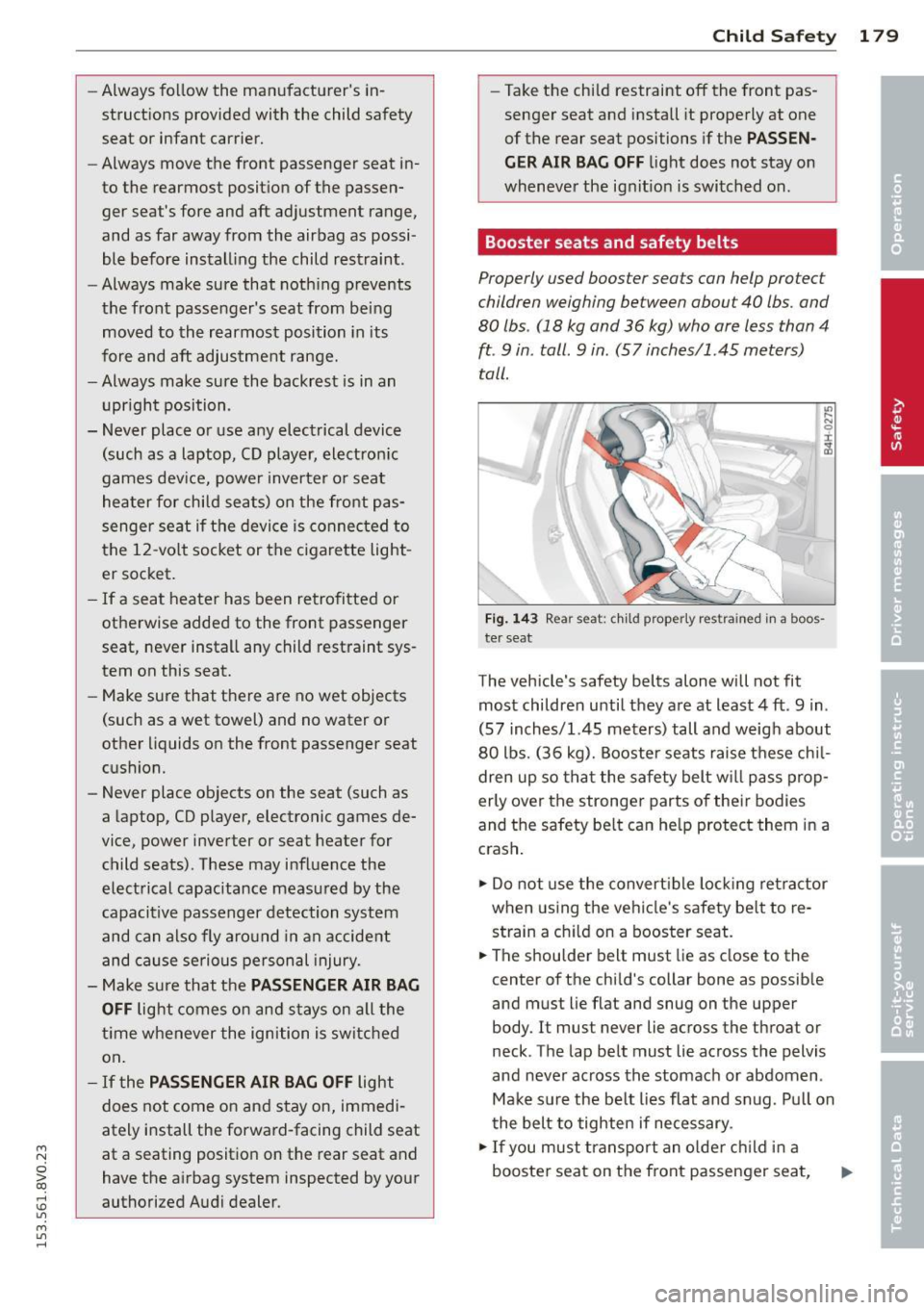
Booster seats and safety belts
Properly used booster seats can help protect
children weighing between about 40 lbs . and
80 lbs. (18 kg and 36 kg) who are less than 4
ft. 9 in. tall. 9 in . (57 inches/1 .45 meters)
tall .
Fig. 143 Rear seat: ch ild prope rly restraine d in a bo os
ter seat
The vehicle's safety belts alone will not fit
most children until they are at least 4 ft . 9 in .
(57 inches/1.45 meters) tall and weigh about
80 lbs. (36 kg). Booster seats raise these chil
dren up so that the safety belt will pass prop
erly over the stronger parts of their bodies and the safety belt can help protect them in a
crash.
.. Do not use the convertible locking retractor
when using the vehicle's safety belt to re
strain a child on a booster seat .
.. The shoulde r belt must lie as close to the
center of the child's collar bone as possible
and must lie flat and snug on the upper
body. It mus t never lie across the throat or
neck . The lap belt must lie across the pelvis
and never across the stomach or abdomen .
Make sure the belt lies flat and snug. Pull on
the belt to tighten if necessary .
.. If you must transport an older child in a
booster seat on the front passenger seat, .._
Page 183 of 310
M N
0 > co ,...., \!) 1.1'1
M 1.1'1 ,....,
without head restraints or with head re
straints that are not pr operly ad justed
increases the risk of ser ious or fatal neck
injury dramat ically .
- Children on the front seat of any car,
even with Advanced A irbags, can be seri
ously injured or even killed when an a ir
bag inflates .
- Never let a child stand or knee l on any
seat, for example the front seat.
- Never let a child ride in the cargo area of
your vehicle .
- Always remember that a ch ild lean ing
forward, sitt ing s ideways o r out of posi
t ion i n any way during an acc ident can be
st ruck by a deploying airbag . This will re
s u lt in se rious personal injury or death.
- If you must install a booster seat on the
front passenger seat because of excep
tio nal circumstan ces the
PASSENGER
AIR BAG OFF
light must come on and
stay on, whenever the igni tion is switch
ed on .
-If the PASSENGER AIR BAG OFF light
does not come on and s tay on, per form
the checks described ¢
page 156, Moni
toring the Advanced Airbag System.
- Take the child rest raint off the front pas
senger seat and install it proper ly at one
of the rear seat positions if the
PASSEN
GER AIR BAG OFF
light does not stay on
whenever the ignition is switched on.
- Always read and heed all WARNINGS whenever using a child restrained in ave
hicle is bei ng used ¢
page 135 , Safety
belts, ¢ page 144, Airbag system
and
¢ page 170, Important things to know .
Child Safet y 181
Installing a child safety
seat
Securing a child safety seat using a
safety belt
Safety belts for the rear seats and the front
passenger con be locked with the convertible locking retractor to properly secure child
safety sea ts.
T he safety belts emergency locking retractors
fo r the rear seats safety belts and for the
front passenger's seat safety belt have a con
vertib le locking retractor for child restraints.
The safety belt must be locked so that be lt
webb ing cannot unreel. The retractor can be
activated to loc k the safe ty belt and prevent
t h e safety be lt webb ing from looseni ng up
dur ing no rm al driv in g. A ch ild safety seat can
o nl y be prope rly installed w hen t he s afety bel t
is locked so that the chi ld and child sa fety
seat w ill stay in place.
A lways remember: Even tho ugh yo ur vehicle is
equipped wi th an A dvanced Airbag sys tem, all
c hi ldren, es pecially those 12 years and young
er, sho uld always r ide in the back seat proper
l y restra ined for t he ir age and size.
A WARNING
Im properly installed chi ld safety seats in
crease the risk of serious personal injury
a n d death in a co llision .
- Always make sure that the safety belt re
tractor is locked w hen insta lling a child
safety seat. An unlocked safety belt re
trac to r cannot hold the child safety seat
in place dur ing norma l dr iving o r in a
crash.
- Always buckle the child safe ty seat firmly
i n place even if a ch ild is not sitt ing in it.
A l oose child safe ty se at can fly aroun d
du ring a sudden stop or in a collision.
- Always ma ke sure tha t the rear seat
b ackrest to which the ce nter re ar safe ty
be lt * is attache d is se curely latched
wheneve r the rea r cente r safety belt is
be ing used to secure a child rest raint .
•
•
•
Page 184 of 310
182 Child Safety
-If the backrest is not securely latched,
the child and the child restraint will be
thrown forward together with the back
rest and will strike parts of the vehicle
interior. The child can be seriously in
jured or killed.
- Never install rear -facing child safety
seats or infant carriers on the front pas
senger seat. A child will be seriously in
jured and can be killed when the passen ger airbag inflates.
- The inflating airbag will hit the child
safety seat or infant carrier with great
force and will smash the child safety seat
and child against the backrest, center
armrest, door or roof.
- Always install rear-facing child safety
seats or infant carriers on the rear seat.
- Forward-facing child safety seats or in
fant carriers installed on the front pas
senger's seat may interfere with the de
ployment of the airbag and cause serious
injury to the child.
- It is safer to install a forward-facing
child safety seat on the rear seat.
- Always read and heed all WARNINGS
whenever using a child restrained in ave
hicle is being used ¢
page 170. Special
precautions apply when installing a child
safety seat on the front passenger seat
¢ page 146, Child restraints on the front
seat -some important things to know .
A WARNING
-
Always take special precautions if you
must install a forward or rearward-facing
child restraint on the front passenger's
seat in exceptional situations:
- Whenever a forward or rearward-facing
child restraint is installed on the front
passenger seat, the
PASSENGER AIR
BAG OFF
light must come on and stay on
whenever the ignition is switched on.
- If the
PASSENGER AIR BAG OFF light
does not come on and stay on, perform
the checks described ¢
page 156, Moni
toring the Advanced Airbag System.
- Take the child restraint off the front pas
senger seat and install it properly at one
of the rear seat positions if the
PASSEN
GER AIR BAG OFF
light does not stay on
whenever the ignition is switched on.
- Improper installation of child restraints
can reduce their effectiveness or even
prevent them from providing any protec
tion .
-An improperly installed child restraint can interfere with the airbag as it de
ploys and seriously injure or even kill the
child.
-Always carefully follow the manufactur
er's instructions provided with the child
safety seat or carrier.
- After checking to make sure that the
child restraint is properly installed, make
certain that the child restraint is correct ly recognized by the capacitive passenger
detection system in the front passenger
seat and that the
PASSENGER AIR BAG
OFF
light signals the correct front pas
senger frontal airbag status.
A WARNING
-Forward-facing child restraints:
- Always make sure the forward-facing seat has been designed and certified by
its manufacturer for use on a front seat
with a passenger front and side airbag.
- Never put the forward-facing child re
straint up, against or very near the in
strument panel.
- Always move the passenger seat into its
rearmost position in the seat's fore and
aft adjustment range, as far away from
the airbag as possible before installing
the forward-facing child restraint. The
backrest must be adjusted to an upright
position.
- Make sure that the
PASSENGER AIR BAG
OFF
light comes on and stays on all the
time whenever the ignition is switched
on.
Page 185 of 310
M N
0 > co ,...., \!) ..,.,
M ..,., ,....,
A WARNING ,~
Rearward-facing ch ild restraints:
-A chi ld in a rearward-facing child safety
seat installed on the front passenger
seat will be ser iously injured and can be
killed if the front airbag inflates -even
with an Advanced Airbag System .
- The inflating a irbag w ill hit the child
safety seat or infant carrier w ith great
force and w ill smash the ch ild safety seat
and child against the backrest, cente r
armrest, door or roo f.
- Always be especially caref ul if you must
install a rearwa rd fa cing child safety seat
on the front passenge r sea t in exception
al circumstances .
- Make su re that the
PASSENGER AIR BAG
OFF
light comes on and s tays on all the
time whenever the ignition is switched
on .
- If the
PASSENGER AIR BAG OFF light
does not come on and stay on, immedi
ately install the rea r-facing chi ld safety
seat in a rear seating position and have
the a irbag system inspected by you r Audi
dealer.
Activating the convertible locking retractor
Use the convertible locking retractor to se
cure a child restraint.
Always heed the child safety seat ma nufactur
er's instructions when install ing a chi ld re
straint in your vehicle . To activate t he conver
tible locking retracto r:
.,. Place the child restraint on a seat, prefera
bly on the rear sea t.
.,. Slow ly pull the be lt
all the way out .
.. Route it around or through the ch ild re
st ra int be lt path ¢&, .
.,. Push the child safety seat dow n with your
f ull weight to ge t the safety belt really t ight.
.,. Insert the be lt tongue into the buckle for
that seating position .
Child Safet y 183
.,. Guide the sa fe ty be lt back into the retractor
until the be lt lies flat and sn ug on the child
safety seat .
.,. You shou ld hear a "clicking" noise as the
be lt winds back into the iner tia ree l. Test the
convert ible lock ing retractor by pulling on
the belt. You sho uld no lo nger be able to
pull the be lt out of the retracto r. T he con
ver tible locking re trac to r i s now ac tiva ted .
.,. Mak e s ure t hat t he red release b utton is fac
ing away from the child rest rain t so t hat i t
can be unbuckled q uic kly .
.. Pull on the belt to make sure the safety be lt
is properly tight and fastened so that the
seat cannot move forward or sideways more
than one inch (2 .5 cm).
A WARNING
Using the wrong child restraint o r an im
p roperly installed chi ld restraint can cause
serious pe rsonal injury or death in a crash.
- Always ma ke sure that the safe ty belt re-
tracto r is loc ked when insta lling a child
safety seat. An unlocked safety belt re
tracto r can not hold the child safety seat
in place dur ing no rma l driving o r in a
cras h.
- Always buckle the child sa fe ty seat firmly
in place even i f a ch ild is not sitt ing in it.
A loose child safety seat can fly aroun d
during a sudden stop or in a crash .
- Always ma ke s ure the seat backrest to
which the child restraint is installed is in
an upright pos ition and securely latched
into place and can not fold forward . Oth
erw ise, the seatback with the child safety
seat attached to it could fly forward in
the ev ent of an accident o r othe r emer
gency situatio n.
- Always read a nd heed al l WAR NINGS
wheneve r us ing a child restrained in ave
hicle is being used ¢
page 170. Special
pre cau tions apply whe n inst alling a child
safety sea t on the fron t passenger seat
¢ page 146, Child restraints on the front
seat -some important things to know.
-
•
•
•
Page 191 of 310
M N
0 > co ,...., \!) 1.1'1
M 1.1'1 ,....,
Smart Technology
Information about
data recorded by
vehicle control
modules
Your vehicle is not equipped with a crash data
recorder. This device is installed by some vehi
cle manufacturers to record data about crash
es so that it can be analy zed later . Crash data
recorders are also called "Event Data Record
ers ( EDR)" .
In some legal jurisdictions, it is not permitted
to access or download data recorded by pre
installed crash data recorders in order to eval
uate a crash without clear consent of the vehi
cle owner .
Your vehicle is not equipped with a crash data recorder. However it does contain a variety of
electronic control modules for various vehicle
systems such as engine function, exhaust
treatment or airbags and safety belts .
These electronic control modules record vehi cle data during normal driving for diagnosis
and repair purposes . The recording capability
of the electronic control modules is limited to
data only- no sound is recorded.
If the control
module detects a system ma lfunction or other
change in status, a very limited amount of da
ta is recorded for an extremely small period of
time . Data that is recorded in such a case may
include vehicle speed, d riving direction, the
load on the brakes and head restraints and
performance in the event of an acciden t or
other change in status . The stored data can
only be read or downloaded with special devi
ces.
Electronic stabilization
control (ESC)
Description
The Electronic Stabilization Control (ESC) con
tr ibutes to driver safety. It reduces the risk of
slipp ing and improves driving stability. ESC
Smart Technolog y 189
detects critical situations such as the vehicle
oversteering and understeering or the wheels
are spinning . The vehicle is stabilized by ap
plying the brakes or reducing engine torque.
Once the ESC is activated, the indicator light
m blinks in the instrument cluster .
The following systems are integrated in the
ESC:
Anti-lock braking system (ABS )
ABS prevents the whee ls from locking when
braking. The vehicle can still be steered even
during hard braking. Apply steady pressure to
the brake pedal. Do not pump the pedal. A
pulsing in the brake peda l indicates that the
system is acting to stabilize the vehicle.
Brake assi st sys tem
The brake assist system can decrease braking
distance. It increases braking power when the
driver presses the brake pedal quickly in emer
gency situations. You must press and hold the brake pedal until the dangerous situation is
over . In vehicles with adaptive cruise control*,
the brake assist system is more sensit ive if the
distance detected to the vehicle ahead is too
small.
Anti-slip regulation (ASR)
ASR reduces engine power when the drive
wheels begin spinning and adapts the force to
the road conditions . This makes it easier to
start , accelerate and dr ive up inclines .
Electronic differential lock (EDL)
The EDL brakes wheels that are spinning and
transfers the drive power to the other drive
wheel or wheels if the vehicle is equ ipped with
all wheel drive*). This function is not available
at higher speeds .
In extreme cases, EDL automatically switches
off to keep the brake on the braked wheel
from overheating . The vehicle is still working
correctly. EDL will switch on aga in automat i
cally when cond itions have returned to nor-
mal. .,..
•
•
•
Page 192 of 310
190 Smart Technology
Steering r ecommendat ion
The ESC helps to stabilize the vehi cle by
changing the steering torque.
Select ive wh eel torqu e co ntrol
Select ive wheel torque control is used when
driving on curves . The front wheel on the in
side of the curve or both wheels on the inside
of the curve are braked selective ly as needed.
Th is a llows more precise driv ing in c urves.
Automatic post -collision braking system
The "Automatic post-collision braking system"
can he lp to reduce the risk of sliding and of
other coll is ions after an acc ident. If the airbag
control mod ule detects a collision above acer
tain vehicle speed, the vehicle is braked by the
ESC.
The vehicle does not brake automatically if:
- the driver presses the accelerator pedal , or
- the braking fo rce genera ted by the pressed
brake pedal is greater than the braking force
that would be initiated by the system, or
- the ESC, the brake system or the vehicle
electrical system are not functioning .
A WARNING ,.
- The ESC and its integrated systems can
not overcome the lim its posed by natural
physical laws. This is especia lly impor
tant on s lippery or wet roads. If the sys-
Switching on /off
terns begin acting to stabilize your vehi
cle, you should immediately a lter your
speed to match the road and traffic con
ditions . Do not let the increased safety
provided tempt you into taking r isks .
This could increase your risk of a co lli
sion .
- Please note the r isk of a coll is ion increas
es when driving fast, especially through
curves and o n slippe ry or wet roads, and
when dr iv ing too close to objects ahead.
The ESC and i ts integrated systems can
not a lways p revent collisions -there is
still a risk of accidents!
- Press the acce lerator pedal caref ully
when acce lerating on even, slippery sur
faces such as ice and snow. The drive wheels can spin even when these control
systems are installed and this can affect
driving stability and increase the risk of a
coll is io n.
(D Tips
- ABS and ASR only function correctly
when all four wheels are equ ipped w ith
identical t ires . Different t ire sizes can
lead to a reduction in engine power.
- You may hear noises when the systems
descr ibed are working .
- If the
DJ or [IJ indicator light appears,
there may be a malfunction¢
page 22.
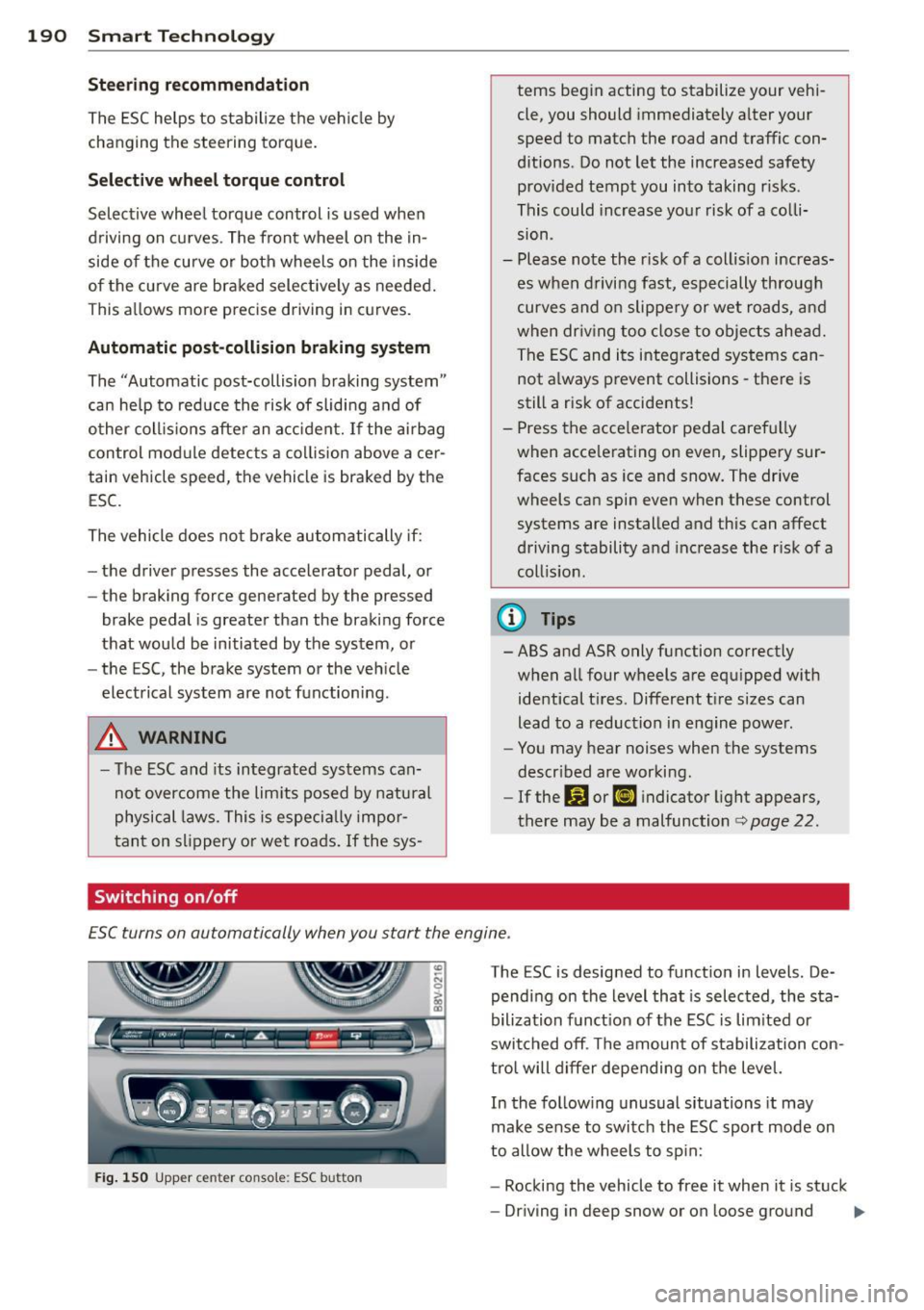
E SC turns on automatically when you start the engine .
Fig. 1 50 Upper c ente r conso le : ESC but to n
The ESC is designed to funct ion in levels . De
pending on the level that is selected, the sta
bilization funct io n of the ESC is lim ited or
swit ched off . The amoun t of stabilization con
tro l will differ depending on t he level.
In the follow ing unusual situations it may
make sense to switch the ESC sport mode on
to allow the wheels to sp in:
- Rocking the vehicle to free it when it is stuck
- Driving in deep snow or on loose ground
ll>
Page 193 of 310
M N
0 > co ,...., \!) ..,.,
M ..,., ,....,
Smart Technology 191
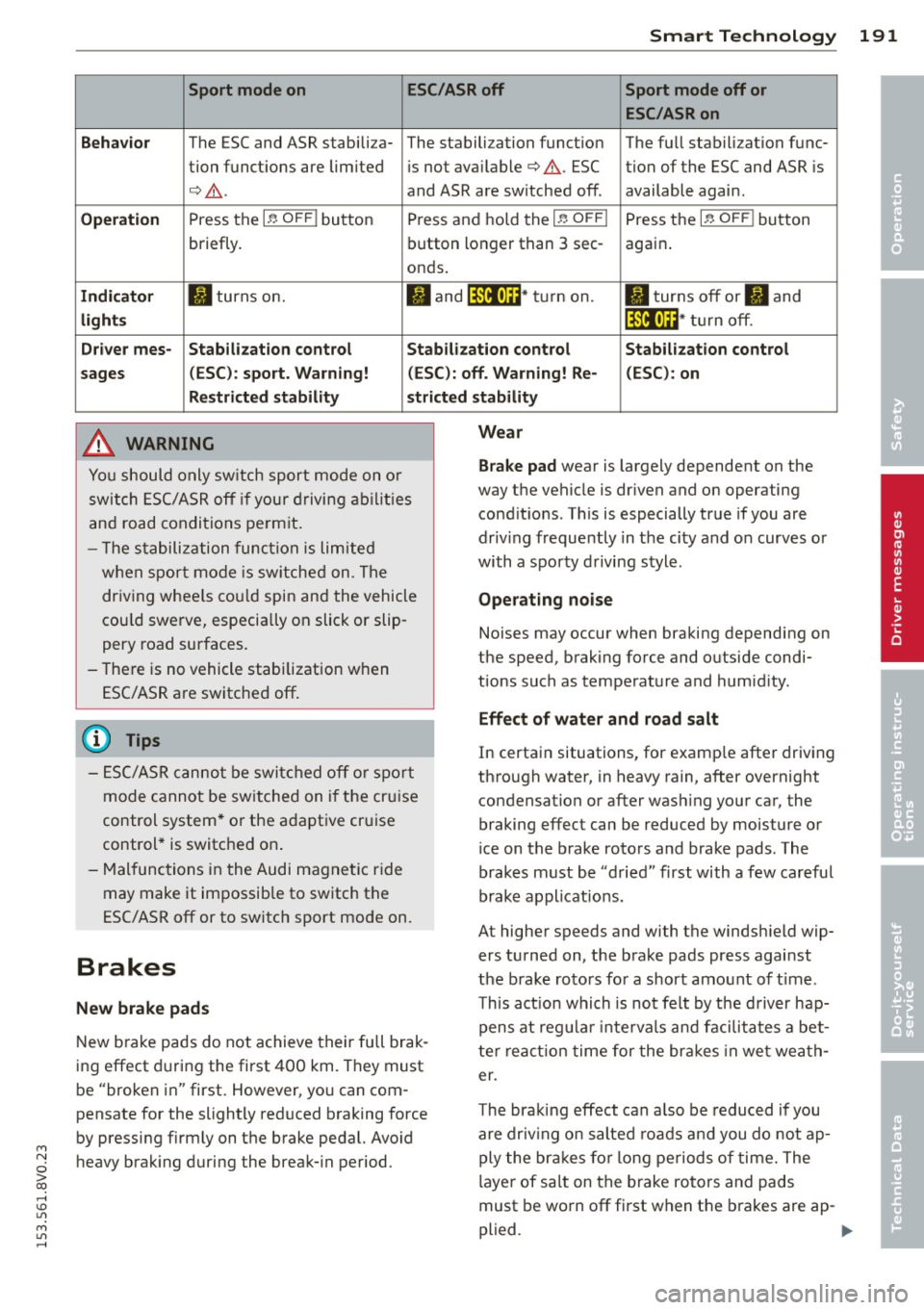
Sport mode on ESC/ASR off Sport mode off or
ESC /ASR on
Behavior
The ESC and ASR stabili za- The sta lbili zation funct ion The fu ll stabili zation f unc-
tion func tions are lim ited is not available¢ .&,.. ESC tion of the ESC and ASR is
¢ .&,. .
and ASR are switched off . available again .
Operation P ress the I~ OFF I button Press and ho ld the I~ OFFI Press the I~ OFF I button
briefly. b
utton lo nger than 3 sec-
again.
onds.
Indi cator II turns on. II and jf'illt)H * tu rn on. II tur ns off or II and
light s jf 'ilftli~ * tur n off.
Driv er mes -Stab ilization control Stab ilization control Stabilization control
sages (ESC ): sport. Warning! (ESC ): off. Warning! Re- (ESC) : on
Restricted stability st ricted stability
_& WARNING
Yo u should o nly sw itch spor t mode on o r
switch ESC/ASR o ff if your driving abilities
and road condi tions pe rm it .
- T he s tabili zation func tion is limited
when sp ort mode is sw itche d on . T he
dr iving w hee ls co uld spin and the vehicle
cou ld swerve, especia lly on slick or slip
pery road surfaces.
- The re is no vehicle stabilization when
ESC/ASR a re switc hed off.
@ Tips
-
- ES C/ASR canno t be swi tched off or spor t
mode cannot be sw itche d on i f the cr uise
control system * or the a daptive cr uise
control * is switc hed on .
- Malfunc tions in the Audi mag net ic r ide
may make it impossib le to sw itch the
ESC/ASR off or to switch sport mode on.
Brakes
New brake pads
New b ra ke pads do not achieve their full brak
i n g effect d uring the first
4 00 km. They must
be "broken in" first. However, yo u can com
pensate for the slightly reduced braking force
by pressing firmly on the brake pedal. Avoid
heavy brak ing duri ng the break- in period.
Wear
Brake pad
wear is largely dependent on the
way the vehicle is driven and on operating
cond it ions . This is especially true if you are
driv ing frequently in the city and on curves or
with a sporty d riving style .
Operating noise
Noises may occur when bra king depending on
the speed, brak ing force and outs ide condi
tions such as temperature and humid ity.
Effect of water and road salt
In certa in situations, for examp le after driv ing
th ro ugh water, in heavy rain, after overnight
condensation or after was hing your car, the
braking effect can be reduced by mois ture or
ice on the brake rotors and brake pads . The
brakes must be "d ried" first with
a few car eful
brake applications .
At higher speeds and with the windsh ield wip
ers turned on, the brake pads press against
the b rake ro to rs fo r a shor t amo unt of t ime .
T h is act ion whi ch is not felt by the driver hap
pens at reg ular intervals and facilita tes a bet
t e r r ea ct ion time for the br ake s in we t wea th
er.
T he bra king effect can a lso be reduced if you
are driv ing o n salted roa ds an d you do not ap
ply the br akes fo r long peri ods of time. The
l aye r of sa lt on the brake rotors and pads
must be wo rn off first when the b rakes are ap -
plied. .,.
•
•
•