light AUDI S3 2015 Repair Manual
[x] Cancel search | Manufacturer: AUDI, Model Year: 2015, Model line: S3, Model: AUDI S3 2015Pages: 310, PDF Size: 76.15 MB
Page 113 of 310
....,
N
ci > co
rl I.O
"' ....,
"' rl
position longer than approximately 2 seconds
when the brake pedal is not pressed.
Interlock button
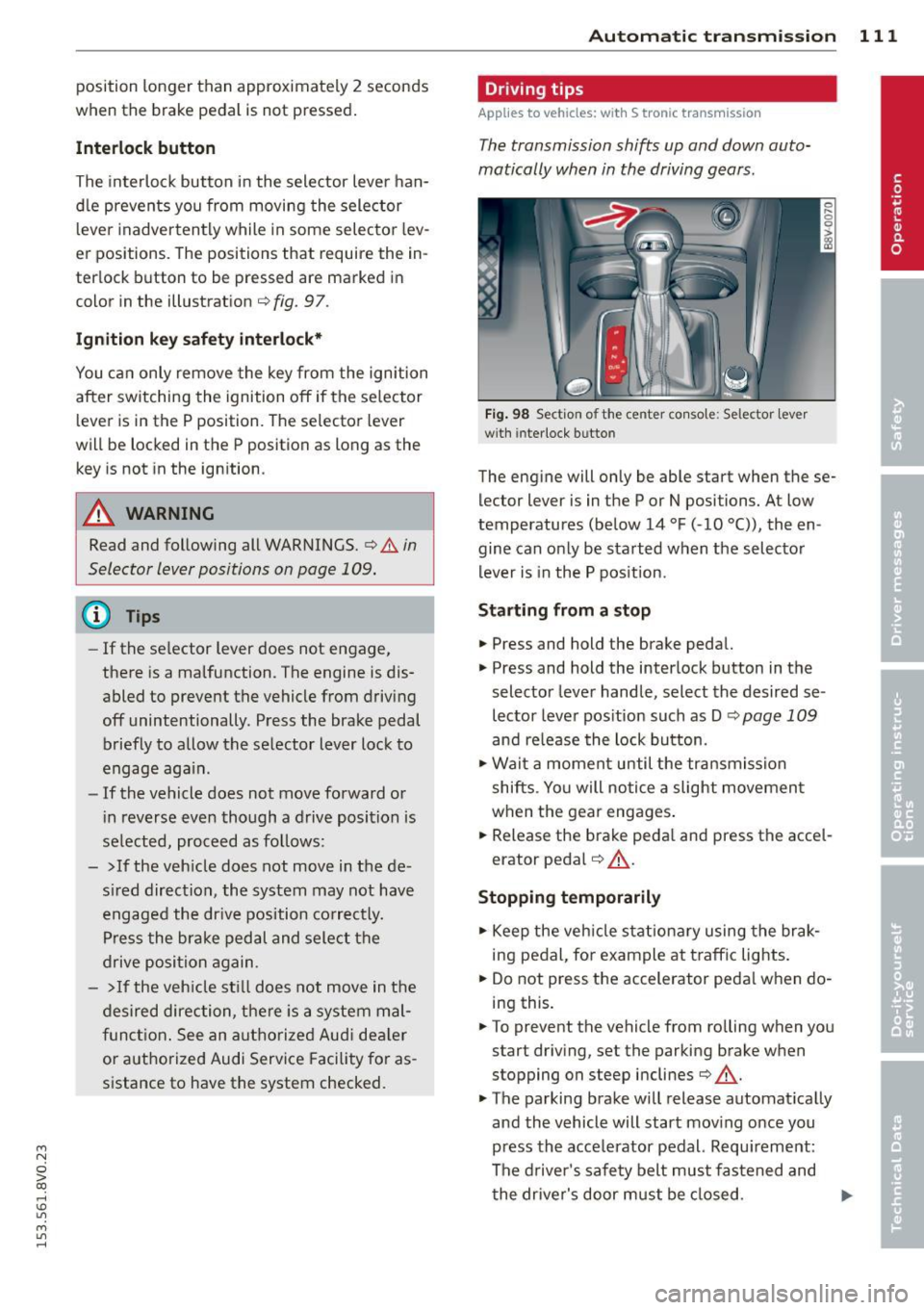
The interlock button in the selector lever han
dle prevents you from moving the selector
l eve r inadvertently while in some selecto r lev
er positions. The positions that require the in
terlock button to be pressed are marked in
color in the illustration
c::;, fig. 97.
Ignition key safety interlock*
You can only remove the key from the ignition
after switching the ignition off if the se lector
lever is in the P position. The selector lever
will be locked in the P position as long as the
key is not in the ignition .
A WARNING
Read and following all WARNINGS. c::;, &. in
Selector lever positions on page 109.
{D) Tips
- If the selector lever does not engage,
there is a malfunction. The engine is dis
abled to prevent the vehicle from driving
off unintentionally . Press the brake pedal
briefly to allow the selector lever lock to
engage again.
- If the vehicle does not move forward or
i n reverse even though a drive position is
se lected, proceed as follows:
- > If the veh icle does not move in the de
sired direction, the system may not have
engaged the dr ive position correctly.
Press the brake pedal and select the
drive position again.
- >If the vehicle still does not move in the
desired direction, there is a system mal
function. See an authorized Aud i dea ler
or authorized Audi Service Facility for as
sistance to have the system checked.
Autom atic transm ission 111
Driving tips
Applies to veh icles: w it h S tronic transm iss ion
T he transmission shifts up and down auto
matically when in the driving gears.
Fig. 98 Section of the center co nsole: Selector lever
w ith interlock b utto n
The engine will only be able start when these
lector lever is in the P or N positions. At low
temperatures (below 14 °F (-10 °C)), the en
gine can only be started when the selector
lever is in the P position.
Starting from a stop
.,. Press and hold the brake pedal.
.,. Press and hold the interlock button in the
selector lever handle, select the desired se
lector lever position such as D
c::;, page 109
and re lease the lock button.
.,. Wait a moment until the transmission
shifts . Yo u will notice a slight movement
when the gear engages.
... Release the brake peda l and press the accel
erator pedal
c::;, .&_ .
Stopping temporarily
.,. Keep the vehicle stationary using the brak
ing pedal, for example at traffic lights.
.,. Do not press the accelerator peda l when do
ing this.
.,. To prevent the vehicle from ro lling when you
start driving, set the parking brake when
stopping on steep inclines
c::;, .&_ .
.,. The parking brake will release automat ically
and the vehicle will start moving once you
press the acce lerator pedal. Requ irement:
The driver's safety belt must fastened and
the driver's door must be closed.
IJll,,
Page 115 of 310
M N
0 > co ,...., \!) 1.1'1
M 1.1'1 ,....,
the overload. The ml indicator light
turns on and a message appears
Q page 115 when the clutch is overload
ed .
-If the engine must run while you are
working in the eng ine compartment with
the hood open, make sure a gear is not engaged . T he selecto r leve r must be
firmly in the P pos ition and locked in
pla ce and t he pa rking brake must be set
Qpage217. Otherwise, the veh icle
cou ld beg in moving when the eng ine
speed is high, even with the parking
brake set.
W Note
- When stopping on an incline, do not try
to ho ld the vehicle in place by pressing
the accelerator peda l w hile a dr iving gear
i s selected. This can cause the automatic
transmission to overheat and can dam
age it. Set the parking b rake or press the
brake pedal to p revent the veh icle from
ro lling .
- Allow ing the ve hicle to roll when the en
gine is stopped and the selector lever is
i n the N position will damage the auto
matic transmission beca use it is not lu
b ricated unde r tho se c ircumstances.
- The t ransm ission can overheat and be
damaged under certa in d riving and traf
fi c condition s suc h as frequent s tarts ,
creeping for a long time , or s top-and-go
traff ic. W hen the
ml or . indicator
light turns on, stop the vehicle at the
next oppo rtunity and let the t ransmis
s ion coo l
Qpage 115.
-Allow ing the ve hicle to roll when the en
gine is stopped w ill damage the S tron ic
transmission because it is not lubricated
Q page 282 , Emergency towing with
commercial tow truck .
@ Tips
For safety reasons, the park ing brake re
leases automatically only when the driver's
door is closed and dr iver 's safety belt is
fastened.
Automa tic tran sm iss ion 113
Hill descent control
App lies to vehicles : wi th 5 tronic tra nsmi ssio n
Hill descent control assists the driver when
driving down hills .
Hill descent control is activated when these
l ector lever is in the D or S position and you
press the brake peda l. The transmission auto
matically selects a gear that is suitable for the
i ncl ine. Hill descent cont ro l t ries to ma inta in
t h e speed ac hieved a t the t ime of b raking,
within physic al and tec hnical lim it a tions. If
may sti ll be ne cessa ry to adju st the speed
with t he b rakes . Because hi ll descent control
cannot sh ift down farthe r than 3rd gear, it
may be necessary to sh ift into t iptronic mode
in very steep areas. In this case, shift into 1st
o r 2nd gear in tiptro nic mode to use the en
gine's brak ing force to relieve the brakes .
Hill descent control switches off once the hi ll
levels out or you press the accelerator pedal.
On vehicles with a cruise contro l system*
Q page 83, hill descent control is also activat
ed when the speed is set .
A WARNING
-
Hill descent control cannot overcome
physical lim itations, so it may not be ab le
to maintain a co nsta nt speed unde r all
conditions . A lways be ready to apply the
b rakes .
•
Page 117 of 310
M N
ci > co ,...., \!) ..,.,
M ..,., ,....,
Launch Control-Program
App lies to vehicles: with launch control
The Launch Control Program enables maxi
mum acceleration.
Requirement : The engine must be at operat
ing temperature and the steering wheel must
not be turned .
.. With the engine running, press the
!.$OFFI
button briefly one time 1) .
.. Pull the selector lever back out of the 0/S
position briefly to select the S position, or
press it toward the right into the t ipt ronic
pos ition or select the
d ynamic driv ing mode
i n drive select*
~ page 106.
.. Press the brake peda l firmly with your left
foot and hold it all the way down for at least
1 second.
.. At the same time, press the gas peda l all the
way down with your right foot unti l the en
gine reaches and stays at a high RPM level.
.. Remove your left foot from the brake.
A WARNING
- Always adapt your driving to the traffic
flow.
- Only use Launch Control when road and
t raff ic conditions a llow it and other driv
ers wi ll not be endangered or impacted
by yo ur driving and the veh icle's acceler
a tion.
- Please note tha t the dr ive whee ls can
spin and the vehicle can brea k away
when sport mode is switched on, espe
c ially when the road is sl ippery.
- Once the vehicle has started moving,
press the
I.$ OFF I button br iefly to turn
the sport mode off.
(j) Tips
- The transm ission tempe rat ure may in
crease significantly after using the
l ) In vehicles with a dr iver info rmat ion system, an ESC
light in the in stru m ent cl us ter stays on contin uo usly
and the m essage
Stabilizatio n cont rol (ESC): spor t.
W arning! Restricted stability
appears temporarily.
Automa tic tran sm iss ion 115
Launch Control Program . If that hap
pens, the program may not be availab le
for a few m inutes. It will be ava ilable
again after a cool-down per iod.
- When accelerating using the Launch
Contro l Program, all vehicle parts are
subject to heavy loads. Th is can lead to
increased wear .
Emergency mode
Applies to vehicles: with S tronic transm ission
In the event of a system malfunction, there is
an emergency program.
If all of the selector lever positions are high
li ghted with a light backgro und in the instru
ment cluster d isplay, there is a system mal
funct ion and the S tronic transmission is run
ning in the emergency program . The vehicle
can still be driven in emergency mode, but on
ly w ith reduced speed and not in all gears. In
some cases, the veh icle
c ann ot driv e in re
v e rs e .
(D Note
If the transmission runs in emergency
mode, drive to your author ized Audi dealer
or q ua lified repa ir facil ity immed iate ly to
have the ma lf u nction corrected.
Transmission malfunction
• Tran smiss ion malfuncti on! Please stop
the vehicle and select P
T here is a malfunction in the transmiss ion .
Park the vehicle securely and do not continue
driv ing. See an authorized Audi dealer or au
thorized Audi Service Facility for assistance.
• Tran smi ssion overh eatin g! Plea se stop
the vehicle!
The transm iss io n is too hot and can become
damaged . Stop and let the transmission cool .,.
•
Page 118 of 310
116 Automatic transmission
with the eng ine runn ing (a t id le) in the P se
lector lever position . Then the indicator light
and the message turn off, drive to an author
ized A udi dealer or qualified repair facility im
mediately to have the malfunct ion corrected.
If the indicator lig ht and the dr ive r message
do not tur n off, do not cont inue dr iv ing. See
a n author ized Audi d eal er or author ized A udi
S ervi ce Fa cili ty for a ssis tance.
Di] Transmiss ion malfunction: you can con
tinue driving
Drive to an autho rized Aud i dea le r or a uthor
ized A udi Service Facility immed iate ly to have
the ma lf u nction corrected .
Di] Transmission malfunction: no reverse
gear (you can continue driving)
D rive to an authorized Aud i dea le r or a uthor
ized A udi Service Facility immediate ly to have
the ma lf u nct ion co rrected .
Di] Transmi ssion malfunction: You can con
tinue dri ving in D until engine off
Drive the ve hicle away from mov ing traff ic and
p ar k. See an au thori zed A udi d ealer or author
iz ed A udi Service F acility for assis tance .
Di] Transmi ssion overheating! Please adapt
driving style
Continue driving moderate ly. When t he in di
cato r ligh t turns off, you can continue dr iving
normally .
Di] Transmission : Please press brake pedal
and select gear again
If t h e tra nsmission mal functions beca use the
temperature is too h igh , a message appears
when t he transmission is coo led.
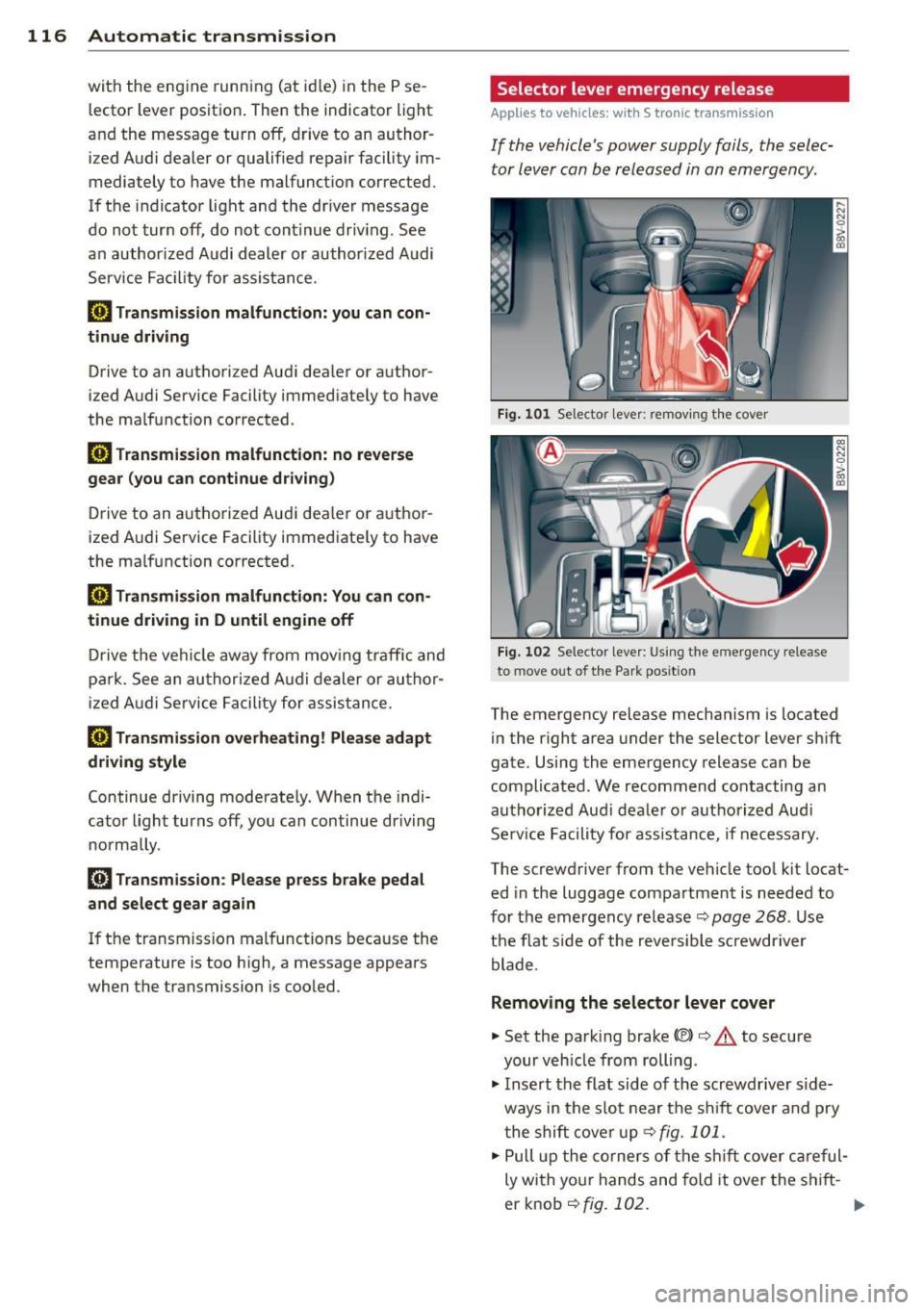
Selector lever emergency release
Applies to vehicles: with S tronic transmission
If the vehicle 's power supply fails, the selec
tor lever can b e released in an emergency.
Fig. 101 Se lector leve r: remov ing t he cover
Fig. 10 2 Selector leve r: Us ing the emergency re lease
to move out of t he Park pos itio n
The emergency release mechanism is located
in the right a rea under the selector lever sh ift
gate. Using the eme rgency release ca n be
complicated. We recommend contacting an
au tho rize d Audi d eale r o r a uth o rized Aud i
Se rv ice Facility for assistance, if necessary.
The sc rewd river from t he ve hicle too l kit locat
ed in the luggage compartmen t is needed to
fo r the emergency release ¢ page
268 . Use
the f lat s ide of the reve rsible screwdriver
blade .
Removing the selector lever cover
"'Set the park ing brake «el)¢&. to secure
your veh icle from rolling .
"' Insert the flat side o f the scr ewdr ive r side
ways in the s lot near the s hift cove r and pry
t he shi ft cove r up <=> fig.
101 .
.,. Pull up the co rner s of the shift c over car eful
ly wi th yo ur hands and fold it over the s hift-
er knob ¢fig.
10 2. ..,.
Page 120 of 310
118 Parking systems
Parking systems
General information
Appl ies to vehicles: with rea r parking sys te m s/park in g
syste m plus/rearv iew camera
Depending on your vehicle's equipment, vari
ous parking aids will help you when parking
and maneuvering.
The
rear parking system is an audible parking
aid that warns you of obstacles
behind the ve
hicle
¢ page 119.
The parking system plus assists you when
parking by audibly and visually indicating ob
jects detected
in front of and behind the vehi
cle
¢ page 119.
The rearview camera shows the area behind
the vehicle in the MMI display . This display as
sists you when you are cross or parallel park ing. The parking system plus functions are al
so available ¢
page 120.
& WARNING
-Always look for traffic and check the area
around your vehicle by looking at it di
rectly as well. The parking system cannot
replace the driver 's attention. The driver
is always responsible when entering or
leaving a parking space and during simi
lar maneuvers .
- Please note that some surfaces, such as
clothing, are not detected by the system.
- Sensors and cameras have blind spots in
which people and objects cannot be de
tected . Be especially cautious of small
children and animals .
- Always pay attention to the area around
the vehicle -using the rearview mirror,
too.
- The sensors can be displaced by impacts
or damage to the radiator grille, bumper,
wheel housing and the underbody. The
parking system may become impaired as
a result . Have your authorized Audi deal
er or authorized service facility check
their function . -
Make sure the sensors are not obstructed
by stickers, deposits or other materials.
If they are, the sensor function could be impaired. For additional information on
cleaning, refer to¢
page 205.
(D Note
- Some objects are not detected or dis
played by the system under certain cir
cumstances:
- Objects such as barrier chains, trailer
draw bars, vertical poles or fences
- Objects above the sensors such as wall
extensions
- Objects with specific surfaces or struc
tures such as chain link fences or pow
der snow
- If you continue driving closer to a low-ly
ing object, it may disappear from the
sensor range. Note that you will no lon
ger be warned about this obstacle.
- The sensors can be displaced by impacts
or damage to the radiator grille, bumper,
wheel housing and the underbody. The
parking system may become impaired as
a result. Have your authorized Audi deal
er or authorized service facility check
their function .
(D Tips
- The system may provide a warning even
though there are no obstacles in the cov
erage area in some situations, such as:
- certain road surfaces or for long grass.
- external ultrasonic sources e.g. from
cleaning vehicles.
- heavy rain, snow, or thick vehicle ex
haust.
- We recommend that you practice park
ing in a traffic-free location or parking
lot to become familiar with the system.
When doing this, there should be good
light and weather conditions.
- You can change the volume and pitch of
the signals as well as the disp lay
¢ page 124.
Page 128 of 310
126 Driving safety
• Make sure that all lights and signals are op
erating correctly .
• Make sure that the tire pressure is correct .
• Make sure that a ll windows are clean and af
ford good visibility to the o utside.
• Secure all luggage and other items ca refully
c:::> page 64, c:::>page 62 .
• Make sure that noth ing can i nterfere with
t h e pedals.
• Adjust front seat, head rest rain t and mirro rs
correct ly for your he ight .
• Instr uct passenge rs to adjust the head re
straints according to their height.
• Make sure to use the right child restraint
correctly to protect chi ldren
c:> page 170 ,
Child Safe ty .
• Sit properly i n your seat and make sure that
you r passenge rs do the same
c:::> page 57,
Front seats .
• Fasten your safety be lt and wear it properly.
Also ins truc t your passengers to faste n their
sa fety belts proper ly
c:> pag e 13 5.
What impairs driving safety?
Safe driving i s direc tly rela ted to the condi
tion of the vehicle, the driver as well as the
driver 's ability to concentrate on the road
without being distracted .
The driver is respons ib le for the safety of the
ve hicl e and a ll of its occupants . If you r ability
to drive is impaired , safety r is k s for everybody
in the vehicle increase and you a lso become a
hazard to everyone else on the road
c:> &_ .
Therefore:
• Do not let you rself be distracted by passen
gers or by using a cellular telephone.
• NEV ER dr ive when your dr iv ing ability is im
paired (by medicat ions, alcohol, drugs, etc.).
• Observe all traffic laws , rules of the road
and speed limits and plain common sense .
• ALWAYS ad just your speed to road, t raff ic
and weathe r condit ions .
• Take frequent breaks on long t rips. Do not
dr ive for mo re th an two hours a t a str etc h .
• Do N OT drive when you are t ired, under
pressure or when you are stressed .
A WARNING
-Impaired driving safety increases the r isk
of ser ious perso nal inju ry and death when
ever a vehicle is bei ng use d.
Proper occupant
seating positions
Proper seating position for the driver
The proper driver seating position is impor
tant for safe, relaxed driving.
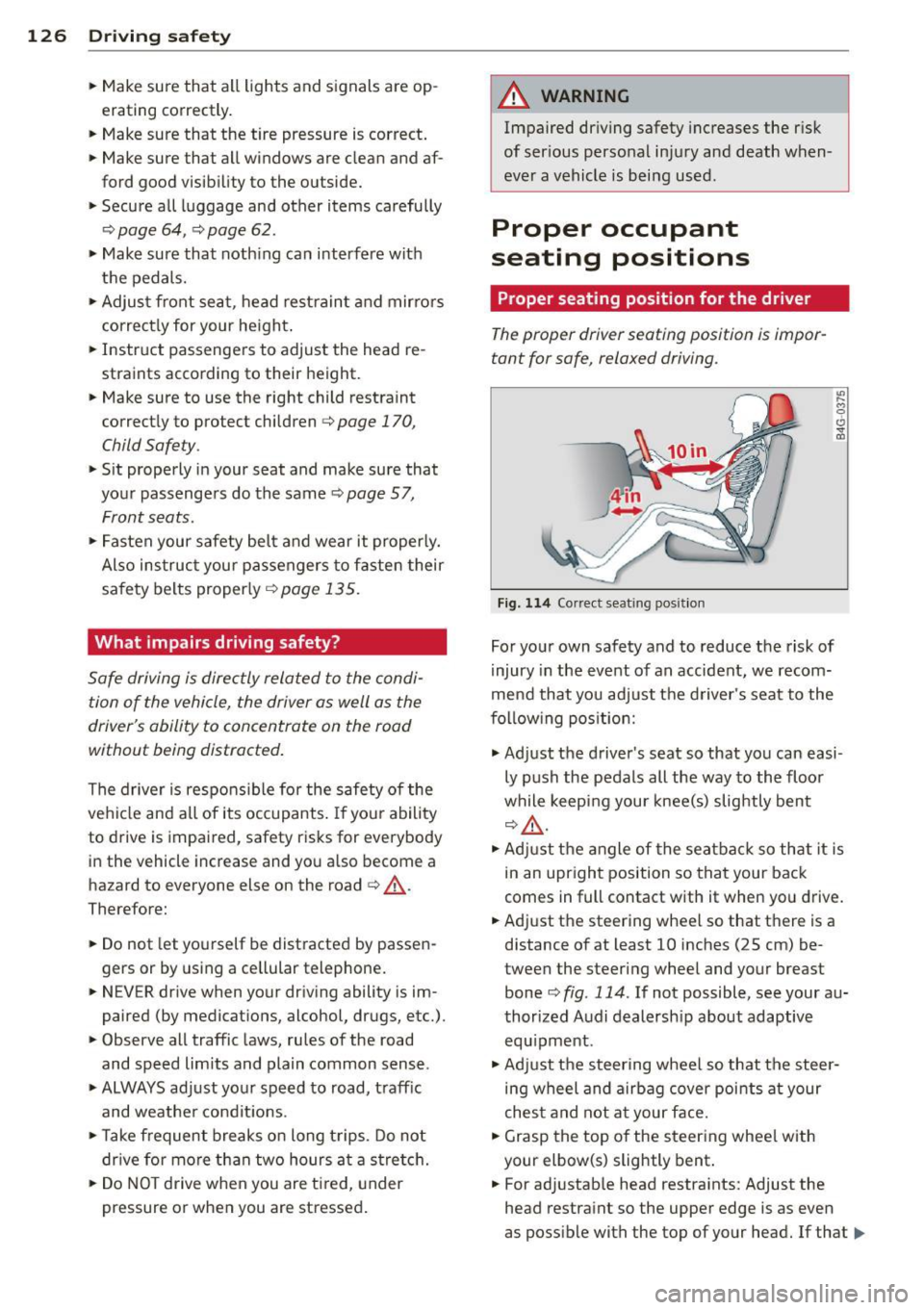
Fig . 11 4 Correct seat ing pos it io n
For you r own safety and to reduce t he risk of
injury in the event of an accident, we recom
me nd that you adjust t he d river's seat to the
f o llow ing pos ition:
.,. Ad just the driver's seat so that you can easi
ly p ush the pedals all the way to the floo r
while keep ing you r knee(s) slightly bent
c:>& ,
.,. Adj ust t he an gle of the seatba ck so th at it is
in an uprigh t position so that your back
comes in full contact with it when you drive.
• Adj ust the steering whee l so that t here is a
distance of at least 10 inches
(25 cm) be
tween the steering wheel and your breast bone
c:::> fig. 114 . If not possible, see your a u
thor ized Audi dealersh ip about adaptive
equ ipment .
.. Ad just t he steering whee l so that the steer
ing wheel and airbag c over poi nts at your
ches t and not a t your f ace.
• Grasp the top o f the steering whee l with
your elbow(s) slightly bent .
• For ad justab le head restra ints : Adjust the
head restra int so the uppe r edge is as even
as poss ible with the top of your head. If that..,_
Page 137 of 310
M N
0 > co ,...., \!) 1.1'1
M 1.1'1 ,....,
Safety belts
General notes
Always wear safety belts!
Wearing safety belts correctly saves lives!
T his chapter explains why safety belts are nec
essary, how they work and how to adjust and
wear them correctly .
~ Read all the information that follows and
heed all of the instructions and WARNINGS.
A WARNING
Not wearing safety belts or wearing them
improperly increases the risk of serious
personal injury and death.
- Safety belts are the single most effective
means available to reduce the risk of se
rious injury and death in automobile acci
dents. For your protection and that of
your passengers, always correctly wear
safety belts when the vehicle is moving .
- Pregnant women, injured, or physically
impaired persons must also use safety
belts. Like all vehicle occupants, they are
more likely to be seriously injured if they
do not wear safety belts. The best way to
protect a fetus is to protect the mother -
throughout the entire pregnancy.
Number of seats
Your Audi has a total of five seating positions:
two in the front and three in the rear. Each
seating position has a safety belt .
A WARNING
Not wearing safety belts or wearing them
improperly increases the risk of serious
personal injury and death.
- Never strap more than one person, in
cluding small children, into any belt. It is
especially dangerous to place a safety
belt over a child sitting on your lap.
- Never let more people ride in the vehicle
than there are safety belts available.
Safety belts 13 5
-Be sure everyone riding in the vehicle is
properly restrained with a separate safe
ty belt or child restraint.
~ Safety belt warning light
Your vehicle has a warning system for the
driver and front seat passenger (on USA mod
els only) to remind you abou t the importance
of buckling-up.
Fig. 117 Safety bel t warn ing light in the instr ume nt
cl uster -enla rged
Before driving off, always:
~ Fasten your safety belt and make sure you
are wearing it properly.
~ Make sure that your passengers also buckle
up and properly wear their safety belts.
~ Protect children with a child restraint sys-
tem appropriate for the size and age .
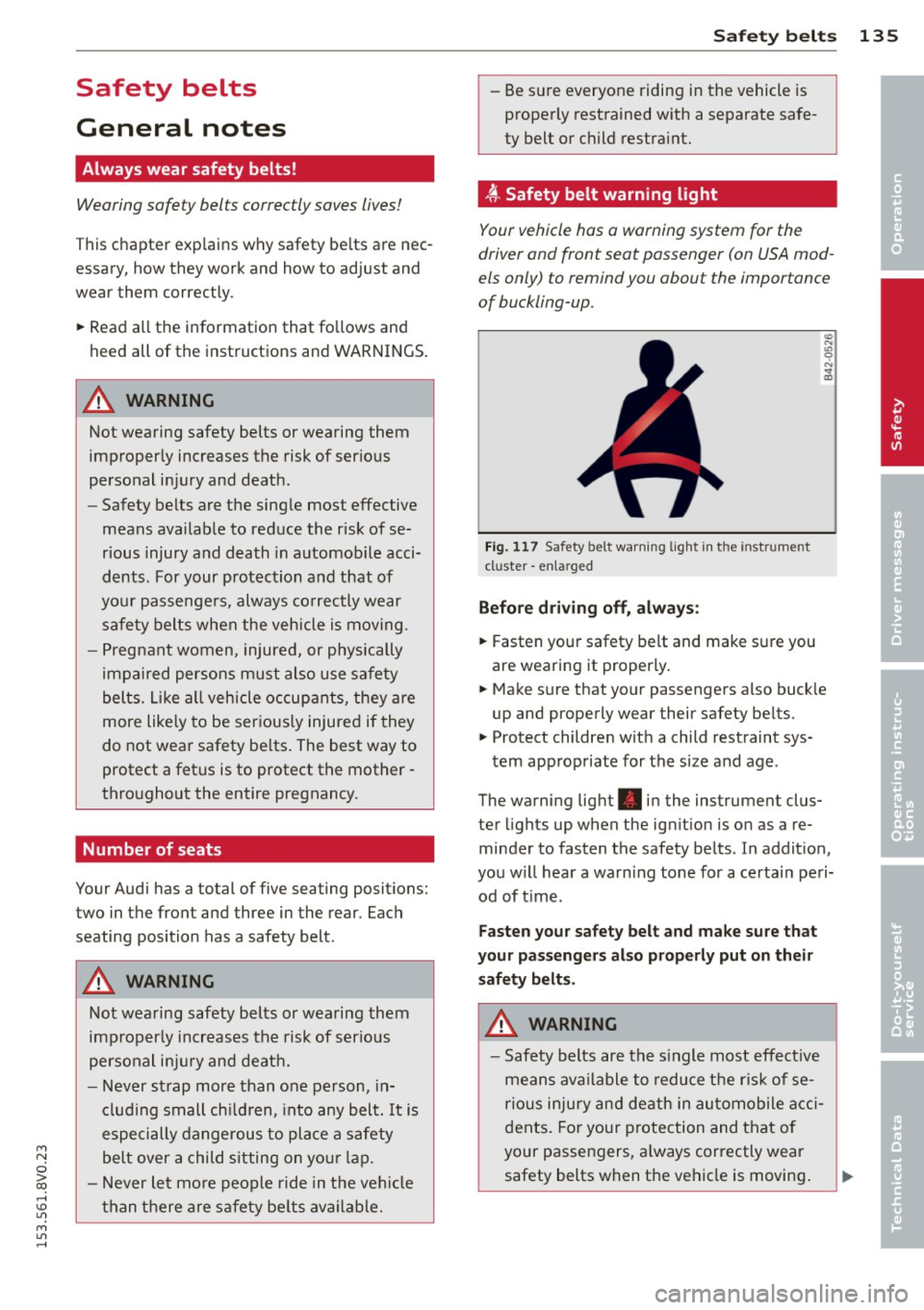
The warning light . in the instrument clus
ter lights up when the ignition is on as a re
minder to fasten the safety belts . In addition,
you will hear a warning tone for a certain peri
od of time .
Fasten your safety belt and make sure that
your passengers also properly put on their
safety belts.
A WARNING
- Safety belts are the single most effective
means available to reduce the risk of se
rious injury and death in automobile acci
dents. For your protection and that of
your passengers, always correctly wear
safety belts when the vehicle is moving. •
•
•
Page 138 of 310
136 Safet y belt s
-Failure to pay attention to the warning
light that come on, could lead to person
al injury.
Why safety belts?
Frontal collisions and the law of physics
Frontal crashes create very strong forces for
people riding in vehicles.
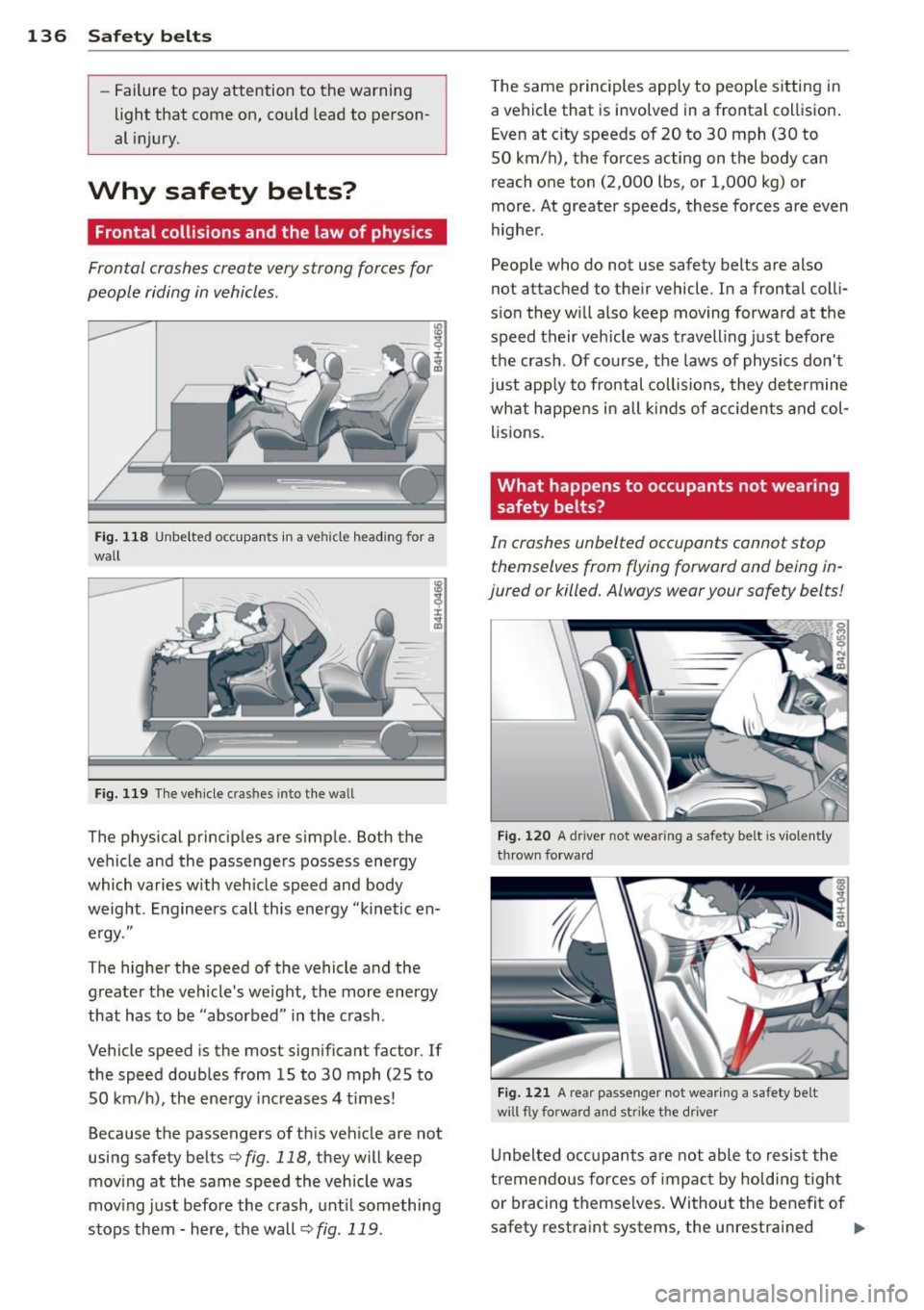
F ig. 11 8 Unbelted occ upants in a ve hicle h eading for a
wall
Fig. 1 19 Th e vehicle c rash es into t he wall
The physical principles are simple. Both the
vehicle and the passengers possess energy
which varies w ith veh icle speed and body
weight . Engineers call this energy "kinetic en
e rgy ."
T he higher the speed of the vehicle and the
g reater the vehicle's we ight, the more energy
that has to be "absorbed" in the crash .
Vehicle speed is the most sign ificant factor.
If
the speed doubles from 15 to 30 mph (25 to
50 km/h), the energy increases 4 t imes!
Because the passengers of this veh icle are not
using safety belts
c::;, fig. 118, they w ill keep
mov ing at the same speed the vehicle was
mov ing just before the c rash, unt il something
stops them - here, the wall ¢
fig. 119 .
The same principles apply to people sitting in
a vehicle that is involved in a frontal collision .
Even at c ity speeds of 20 to 30 mph (30 to
50 km/h), the forces acting on the body can
reach one ton (2,000 lbs , or 1,000 kg) or
more . At greater speeds, these forces are even
highe r.
Peop le who do not use safety belts are also
not attached to their vehicle. In a frontal colli
s io n they will also keep moving forward at the
speed their veh icle was t ravell ing just before
the crash . Of co urse, the laws of physics don't
just app ly to frontal collisions, they determine
what happens i n all kinds of acc idents and col
lisions .
What happens to occupants not wearing
safety belts?
In crashes unbelted occupants cannot stop
themselves from flying forward and being in
jured or killed. Always wear your safety belts!
F ig . 120 A d river not wea ring a safety b elt is viol en tly
thrown fo rwa rd
F ig . 12 1 A rear passe nge r no t wea ring a safety be lt
w ill fl y forward a nd strike the dr iver
Un belted oc cupants a re not able to resist the
t remendous forces o f impac t by ho lding tight
o r bracing themse lves. Withou t the benefit of
safety restraint systems , the unrestrained
ll-
Page 141 of 310
....,
N
0 > co
rl I.O
"' ....,
"' rl
To provide maximum protection, safety belts
must always be positioned correctly on the
wearer's body.
... Adjust the front seat and head restraint
properly
c::> page 5 7, Front seats.
• Make sure the seatback of the rear seat
bench is in an upright position and securely
latched in place before using the belt
c::> ,&..
... Hold the belt by the tongue and pull it even
ly across the chest and pelvis
c::> ,&. .
""Insert the tongue into the correct buckle of
your seat until you hear it latch securely
c::> fig. 123.
.., Pull on the belt to make sure that it is se-
curely latched in the buckle.
Automatic safety belt retractors
Every safety belt is equipped with an automat
ic belt retractor on the shoulder belt . This fea
ture locks the belt when the belt is pulled out
fast, during hard braking and in an accident.
The belt may also lock when you drive up or
down a steep hill or through a sharp curve. During normal driving the belt lets you move
freely.
Safety belt pretensioners
The safety belts are equipped with a belt pre
tensioner that helps to tighten the safety belt
and remove slack when the pretensioner is ac
tivated
c::> poge 142. The function of the pre
tensioner is monitored by a warning light
c::> page 21.
Convertible locking retractor
Every safety belt except the one on the driver
seat is equipped with a convertible locking re
tractor that
must be used when the safety
belt is used to attach a child seat. Be sure to
read the important information about this
feature
c::> poge 181.
A WARNING
Improperly positioned safety belts can
cause serious injury in an accident
o::> page 139, Safety belt position.
-Safety belts offer optimum protection
only when the seatback is upright and
Safety belts 139
belts are properly positioned on the
body.
- Always make sure that the rear seat
backrest to which the center rear safety
belt* is attached is securely latched
whenever the rear center safety belt is
being used. If the backrest is not secure
ly latched, the passenger will move for
ward with the backrest during sudden
braking, in a sudden maneuver and espe
cially in a crash .
- Never attach the safety belt to the buck
le for another seat. Attaching the belt to
the wrong buckle will reduce safety belt
effectiveness and can cause serious per
sonal injury.
- A passenger who is not correctly restrain
ed can be seriously injured by the safety
belt itself when it moves from the stron
ger parts of the body into sensitive areas
like the abdomen.
- Always lock the convertible locking re
tractor when you are securing a child seat in the vehicle
c::> page 183.
(D Tips
For information on safety belt pretension
ers, refer to
c::> page 142.
Safety belt position
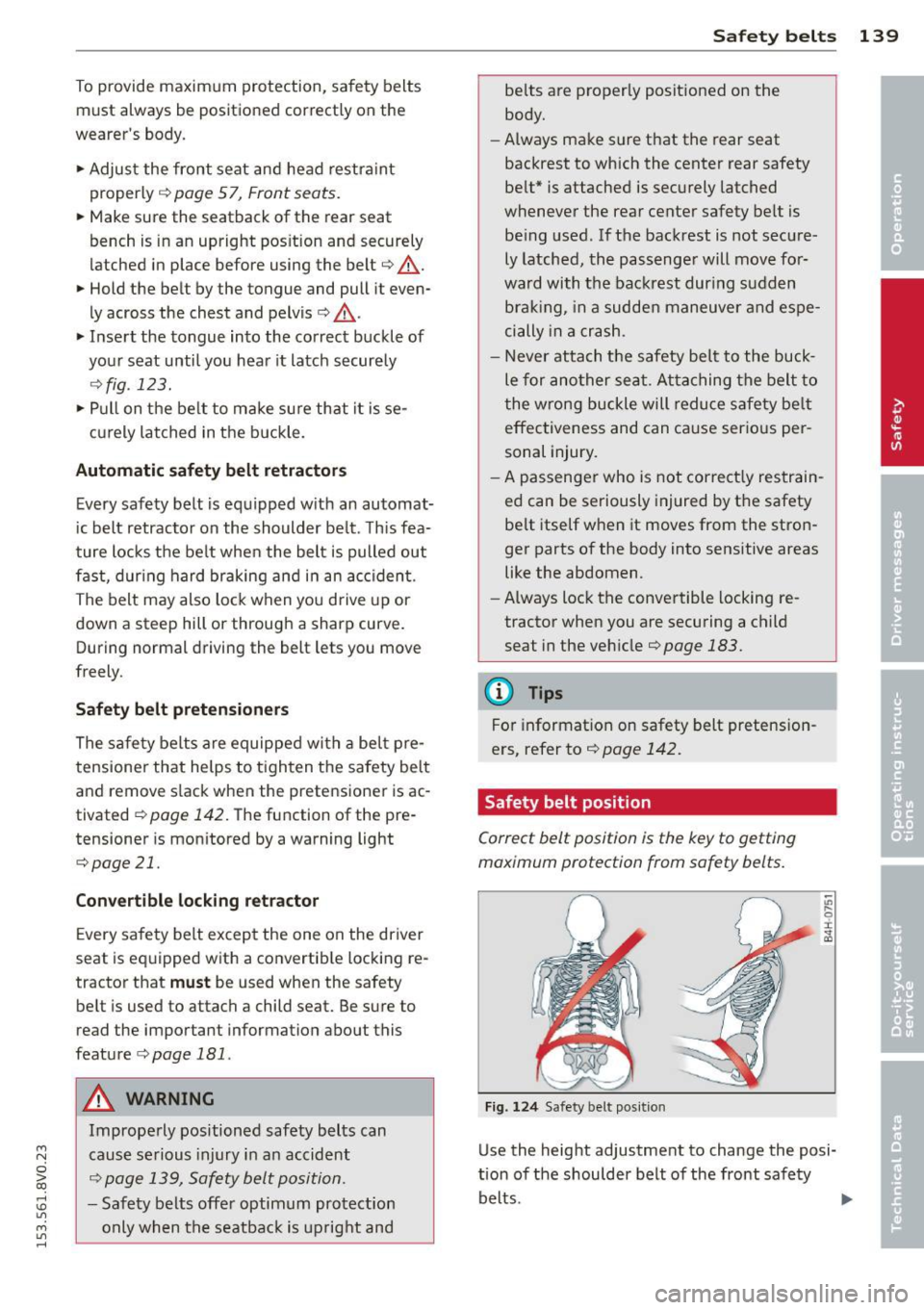
Correct belt position is the key to getting
maximum protection from safety belts.
Fig. 124 Safety belt position
Use the height adjustment to change the posi
tion of the shoulder belt of the front safety
belts .
~
Page 148 of 310
146 Airbag sys te m
and dia gnostic equipmen t to pro perly re
place any a irbag in y our vehicle and
assure system eff ectiveness in a crash.
- Never permit salvaged or recycle d air
bags to be installed in your veh icle.
Child restraints on the front seat - some
important things to know
~ Be sure to read the important informat ion
and heed the WARNINGS for important de
ta ils about ch ild ren and Advanced Airbags
Qpage 170.
Even though your vehicle is equ ipped with an
Advanced Airbag System, make certain that
all c hildren, especially those 12 years and
younger, a lways ride in the back seat properly
restrained for their age and size . The airbag
on the passenger side makes the front seat a potentially dangerous place for a child to ride.
The front seat is not the safest place for a
child in a forward-facing child seat. It can be a
ve ry dangerous place for an infant or a ch ild in
a rearward-facing seat.
The Advanced Airbag System in your veh icle
has been certified to comply with the require
ments of United States Federal Motor Veh icle
Safety Standard 208 as applicable at the time
your ve hicle was manufactured.
The Standard requires the front a irbag on the
passenger side to be turned off ("sup
p ressed") if a ch ild up to about one year of
age restra ined in one of the rear-facing o r fo r
ward-facing infan t restra ints listed in Federal
M otor Vehicle Safety Standard 208 with w hich
the Advanced A irbag System in your vehicle
was certified has been installed on the front
passenger seat. Fo r a listing of the child re
straints that were used to certify compliance
with the US Safety Standard
Q page 172.
The PASSENGER AIR BAG OFF light in the in
strument panel te lls you when the front Ad
vanced Airbag on the passenger side has been turned off by the e lectronic control unit. E
ach time you switch on the ignition, the
PAS
SENGER AIR BAG O FF
light will come on for a
few seconds and :
- w ill stay on if the front passenge r seat is not
occupied,
- w ill stay on if the e lec trica l ca pa citance
meas ured by the capacitive passenger de
tection system for the front passenger seat equa ls the combined capacitance of an in
fant up to about one year of age and one of
the rearward-facing or forward-fac ing ch ild
restraints listed in Federal Motor Vehicle
Safety Standard 208 with wh ich the Ad
vanced Airbag System in your vehicle was
cert ified . For a listing of the chi ld restraints
tha t were used to certify you r vehi cle's com
p lia nce w it h t he U.S. Safety Standard
Q page 172.
-w ill stay on i f there is a small ch ild or child
restraint on the front passenge r seat,
- will go off if the front passenger seat is oc
cupied by an adult as registered by the ca
pacitive passenger de tection system
c::> page 156, Monitoring the Advanced Air·
bag System.
The PASSENGER AIR BAG OFF light comes on
when e lectrica l capacitance registered on the
front passenger seat is eq ua l to or less tha n
the comb ined capacitance of a typica l 1 year
o ld infant and one of the rearward-facing or
forward-facing chi ld restraints listed in Feder
al Motor Vehicle Safety Standard 208 with
wh ich the Advanced Airbag System in your ve
hicle was certified.
If the total electr ica l capacitance registered
on the front passenger seat is more than that
of a typical 1 year -o ld child but less than the
weight of a small adult , the front airbag on
t h e passenger side can deploy (the
PASSEN
GER AIR BAG OFF
light does not come on).
If the
PASSENGER AIR BAG OFF light does
not come on, the front airbag on the passen
ger side has not been turned off by t he e lec
t ro ni c cont ro l unit and can deploy if the con
t ro l uni t se nses an impact tha t mee ts the con-
di tions stored in its memory .
1J1>