light AUDI S3 2015 Owners Manual
[x] Cancel search | Manufacturer: AUDI, Model Year: 2015, Model line: S3, Model: AUDI S3 2015Pages: 310, PDF Size: 76.15 MB
Page 217 of 310
....,
N
0 > co
rl I.O
"' ....,
"' rl
Selective catalytic reduction
General information
Applies to vehicles: with diesel e ngine
In vehicles with se lective cata lytic reduction, a
urea solut ion (Ad Blue) is injected into the ex
haust system before a nitrogen oxide catalytic
converter to reduce nitrogen -emissions .
Ad Blue is the marketing name for Diese l Ex
ha ust Fluid (DEF) .
The AdBlue is carried in a separa te tank in t he
vehicle . The AdBl ue usage accounts for ap
proximately 0.5% to 1.2% of the diese l fuel
that is used .
When a message abo ut refil ling the Ad Blue
appears in the inst rume nt cl uste r dis play, you
must refi ll the Ad B lue yourse lf or have it refil
l ed by an authorized Audi dealer or aut horized
Aud i Service Facility
Q page 216.
A WARNING
Failure to heed Ad Blue refill information in
the inst rume nt cluste r can p revent the
ve
hicle from being started and driven . If the
veh icle cannot be driven and an eme rgency
ar ises, perso na l inju ry can occur.
- Always have the Ad Blue tank refilled well
before the tank r uns d ry.
(!) Tips
- The instrument cluster display indicates
the d istance remaining that ca n be dr iv
en
Q page 215. If the AdBlue tank is
complete ly empty, the engi ne will not
sta rt again after the ign ition is switched
o ff.
- Ad B lue is requ ired by law to operate this
vehicle.
Che cking and Fillin g 215
Indicators in the instrument cluster
d isplay
Appl ies to vehicles: with diesel engine
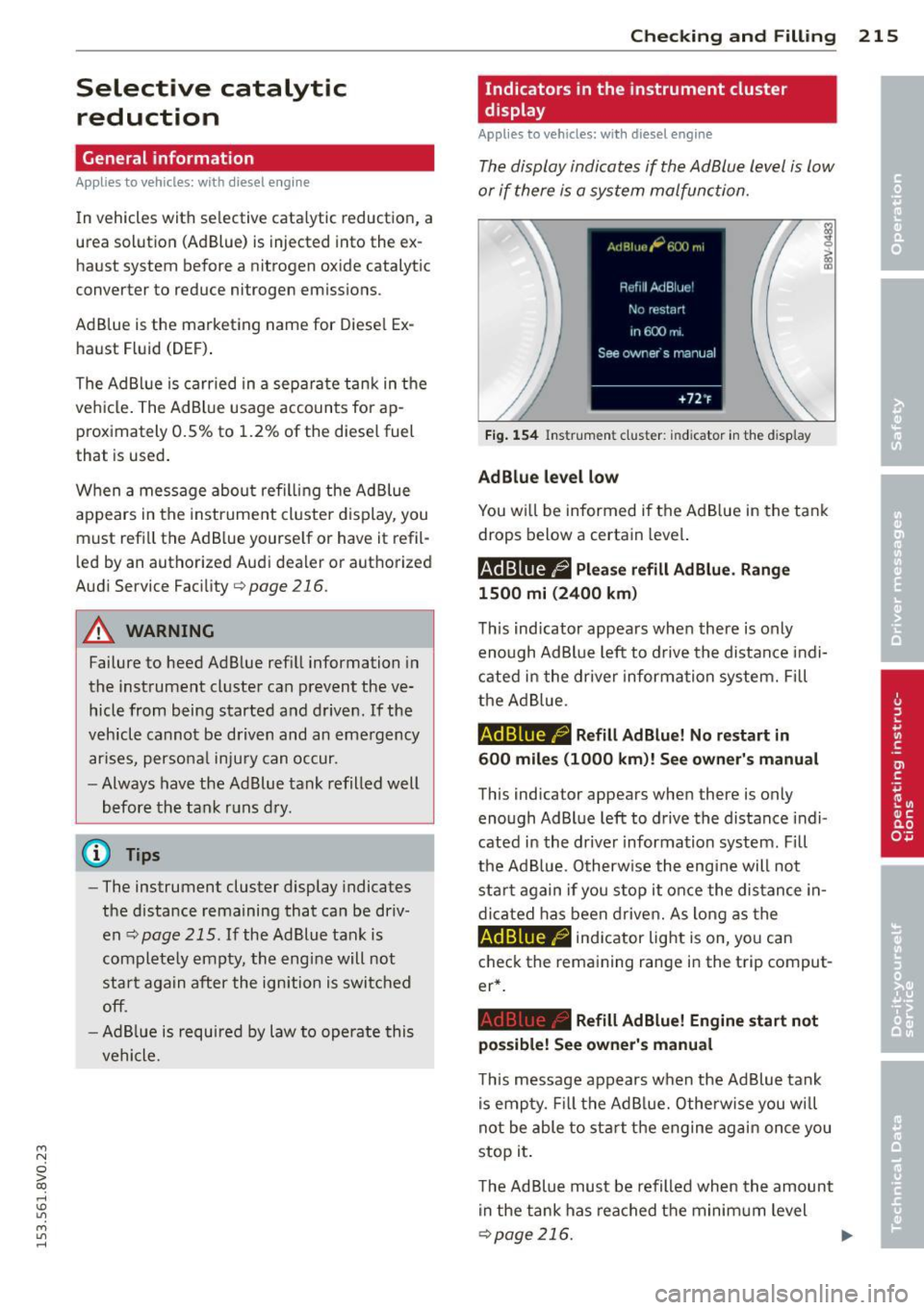
Th e display indicates if th e Ad Blue lev el is low
or if there is a system malfunction.
Fi g. 1 54 Ins trum ent cluster : indicator in the display
AdBlue level low
You w ill be informed if t he AdBlue in the ta nk
drops below a certain leve l.
Ad Blue /9 Please refill Ad B lu e. Range
1500 mi (2400 km)
T his ind icator appea rs whe n there is only
eno ugh Ad Bl ue left to d rive the distance i ndi
cated in the driver information system. F ill
the Ad Blue .
AdBlue /9 Refill AdBlue! No re start in
600 mile s (1000 km )! See owner' s manual
This indicator appears when there is only
enough AdBlue left to drive the distance indi
cated in the dr iver information syst em. F ill
the Ad Blue. Otherwise the eng ine will not
star t again if you s top it o nce the dis tance in
dicated has been drive n. As long as the
AdBlue /9 ind icator light is on, yo u can
check the remaining range in the trip comput
er* .
Refill AdBlue! Engine start not
po ssible! See owner' s manual
This message appears w hen the Ad Blue tank
i s emp ty. Fill the AdB lue. Othe rw ise you w ill
not be able to sta rt the engine ag ain on ce you
stop it .
T he Ad Blu e mu st be refilled when the amount
i n the tank has rea ched t he minim um level
Q poge 216.
Page 218 of 310
216 Checking and Filling
¢..ij Incorrect filling /sy stem malfunction
A message ap pears if the Ad Bl ue tank was fil
l ed with a fluid other t han Ad B lue and the sys
tem has detected t hat the tank was fi lled in
correctly, or if the re is a system malfunction .
Ad Blue/ Ad Blue: Sy stem fault! No re start
in 600 miles (1000 km ). See owner' s man
ual.
This message appears whe n it is only poss ible
to drive the distance i ndi cated in the dr iver in
formation system. Drive to the neares t au
thorized A udi dealer or author ized A udi Se rv
ice Facility to have the ma lfunction co rrected.
Otherwise the engine will not start again if
you stop it once the distance i nd icated has
been drive n.
AdBlue: system fault . Engine
start not possible! See owner 's manual
This message appears if the system has de
tected t hat the ta nk was fi lled incorrectly or
that the re is a ma lfunction . Drive immediate ly
to the nearest authorized A udi dealer or au
thor ized Audi Serv ice Facility to have the ma l
function corrected . Otherwise you will not be
ab le to start the engine aga in o nce you stop
it .
Filling the Ad Blue
App lies to vehicles: with selective cata lyt ic reduction
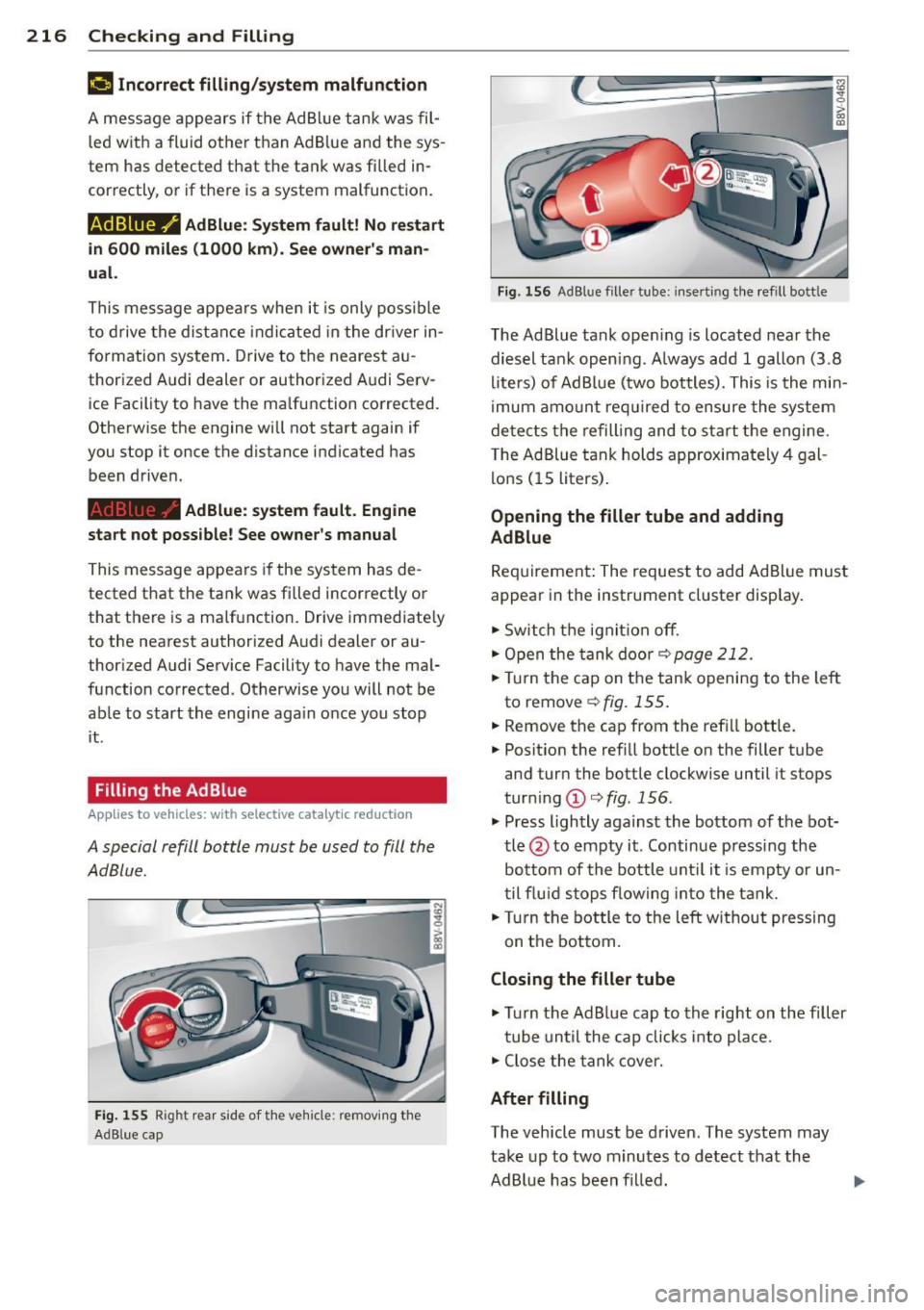
A special refill bottle must be used to fill the
AdBlue .
Fig. 155 R ig ht re ar s id e of th e v ehi cle: re mov ing the
Ad Blue cap
F ig . 1 56 AdBl ue f ille r tube: i nse rtin g the ref ill bottl e
The Ad Blue tank ope ning is located near the
di ese l ta nk open ing . A lways ad d 1 gallon (3.8
li te rs) of AdB lue ( two bottles). This is the min
i mum amo unt req uired to ensure the system
de te ct s the refilling and to s tart the engine .
T he Ad Blue tank holds approximately
4 gal
lo ns
(1 5 liters) .
Opening the filler tube and adding
AdBlue
Req uirement : The request to add Ad Blue mus t
appea r in the instrument cluster disp lay.
" Switch th e ignit io n off.
.. Open the tank door¢
page 212.
.. Tur n the cap on the tank opening to the left
to remove
¢ fig . 155 .
.. Remove the cap from the ref ill bott le.
.. Posit ion the refill bottle on the filler tube
and tur n the bottle clockwise until it stops
turn ing (D ¢fig .156 .
" Press lightly aga inst the bottom of the bot
tle @to empty it . Continue pressing the
bo ttom of the bottle unt il it is empty or un
t il f lu id stop s flow ing in to the ta nk.
" Turn the bottle to t he left w it h out pressing
on t he bot tom.
Closing the filler tube
" Tur n the Ad B lue cap to the right on the filler
t ube until the cap clicks into pla ce.
" Clo se the tank cover.
After filling
The vehicle must be driven. The system may
ta ke up to two m inutes to detect that the
AdBl ue has been f illed . .,.
Page 221 of 310
....,
N
0 > co
rl I.O
"' ....,
"' rl
Opening the hood
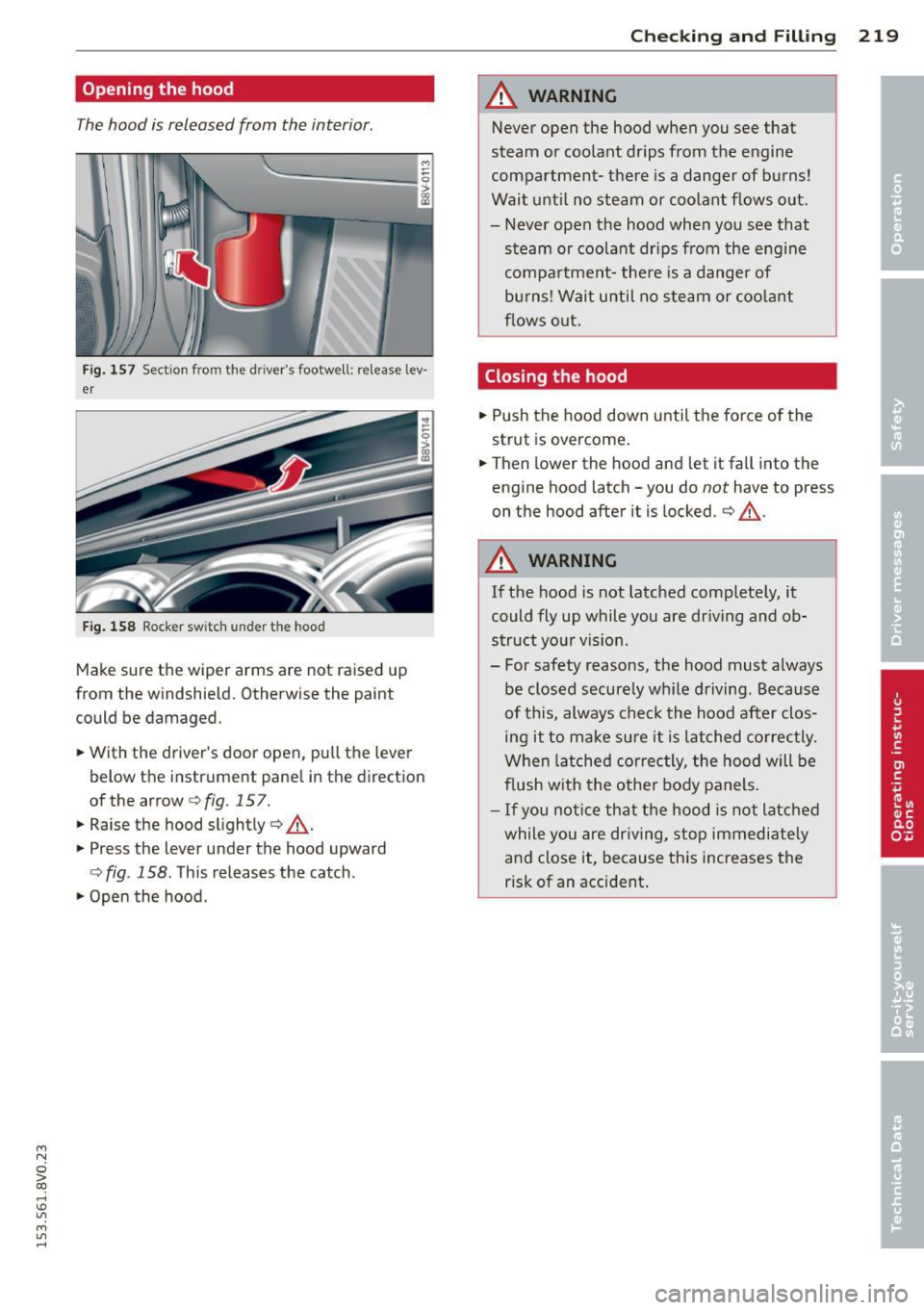
The hood is released from the interior.
Fig. 157 Sect ion from the driver's footwe ll: release lev·
er
F ig. 158 Rocker switch un de r the hood
Make sure the wiper arms are not raised up
from the windshield. Otherwise the paint
could be damaged.
• With the driver's door open, pu ll the lever
below the instrument pane l in the direction
of the arrow
¢ fig. 157.
• Raise the hood slightly c;, &_ .
• Press the lever under the hood upward
c;, fig . 158. This releases the catch .
• Open the hood .
Che cking and Fillin g 219
A WARNING
Never open the hood when you see that
steam or coo lant drips from t he e ngine
compartment· there is a danger of burns!
Wait unti l no steam or coolant flows o ut.
- Never open the hood when you see that
steam or coo lant dr ips from the engine
compa rtment- the re is a dange r of
bu rns! Wai t until no ste am or coo lan t
flows o ut.
Closing the hood
• Push the hood down unti l the fo rce of the
strut is overcome .
• Then lower the hood and let it fall into the
engine hood latch -you do
not have to press
on the hood after it is locked.
c;, &_ .
A WARNING
If the hood is not latched complete ly, it
could fly up while you are dr iv ing and ob
struct you r vis io n.
- For safety reasons, the hood must always
be closed secure ly wh ile d riving. Because
of this, always check the hood after clos
ing it to make sure it is lat ched co rrectly.
When latched correc tly, the hood will be
f lush w ith the othe r body panels .
-If you no tic e th at t he hood is not latched
while you are dr iving, stop immedi ately
and close it, because this increases the
ris k of an accident .
Page 224 of 310
222 Check ing and F illin g
Using the proper engine o il is important for
the functionality and service life of the en
g ine. Your engine was factory-filled with a
high-quality oil which can usua lly be used
throughout the entire year.
0 Note
Your L imited New Vehicle Warranty does
not cover damage or ma lfunctions due to
fai lure to follow recommended mainte
nance and use requ irements as set forth in
the Audi Owner's Manual and Warranty
&
Ma intenance booklet.
- Use only a high quality eng ine oil that ex
pressly complies w ith the Audi o il quality
standard spec ified for your veh icle's en
gine. Using any other oil can cause seri
ous eng ine damage.
- Do not mix any lubricants o r othe r addi
tives into the eng ine o il. Doing so can
ca use engine damage.
If you need to add oi l and there is no ne
availab le tha t mee ts the Audi oil qua lity
s tandard your engine requires, yo u may
add a tota l of no more than 0 .5 quart/liter
of a high-quality "synthetic"oil that meets
the following specifications.
- Vehicles with gaso line engine: ACEA A3
or API SM with a viscosity grade of
SAE 0W-30, SAE SW-30 or SAE SW-40.
- Vehicles with diesel engine: ACEA C3 or
API CF with a v iscosity grade of
SAE 0W-30 or SAE SW-30.
- For more information abo ut eng ine oil
that has been approved for your vehicle, please contact either your a uthorized
Audi dealer or Audi Customer Relations
at 1 (800) 822-2834 or visit our web site
at www.audiusa .com or
www.aud icanada.ca.
Engine oil consumption
The engine in your vehicle depends on on ade
quate amount of oil to lubricate and cool all
of its moving ports .
In order to provide effective lubricat ion and
cooling of interna l eng ine components, all in
ternal combust ion e ngines consume a certain
amount of oil. Oil consumpt ion va ries from
engi ne to engine and may change sig nifican tly
over the life of the engine. Typically, engines
with a spec ified break -in period (see
¢ page 197) consume more oil during the
break-in period than they cons ume after oi l
consumption has stabilized.
U nder normal cond itions, the rate o f oi l con
s u mption depends on the q uality and viscos ity
of the oil, the RPM (revolutions per minute) at
which the engine is operated, the ambient
temperature and road conditions. Further fac
tors are the amount of oil dilut ion from water
condensation or fue l residue a nd the oxida
t ion level of the oil. As any eng ine is subject to
wea r as m ileage builds up, t he oil co nsump
t ion may increase over time until replacemen t
of worn components may be come necessary.
With a ll these variab les coming into play, no
standard rate of oil consumpt io n can be es
tabl ished o r spe cified . There i s no alte rnative
to regu lar and frequent che ck ing of the o il lev
el , see
Note.
If the yellow engine oil leve l wa rning symbo l
Ill in the inst rument cl uste r lights up, you
sho uld check the oil leve l as soon as possib le
i=> page 223 . Top off the oil at your earliest
convenience
i=> page 223 .
A WARNING
--
Before you check anything in the engine
compartment, always read and heed a ll
WARNINGS¢ page 217.
(D Note
Driving wit h an insufficient o il level is like -
l y to cause severe damage to the engine.
liJJ,
Page 228 of 310
226 Checking and Fill in g
- Do not add any type of radiator leak sea l
ant to your ve hicle's engine coolant.
Adding rad iator repair fluid may adverse
ly affect the function and performance of
your cooling system and could result in damage not covered by your New Vehicle
Limited Warranty.
Adding coolant
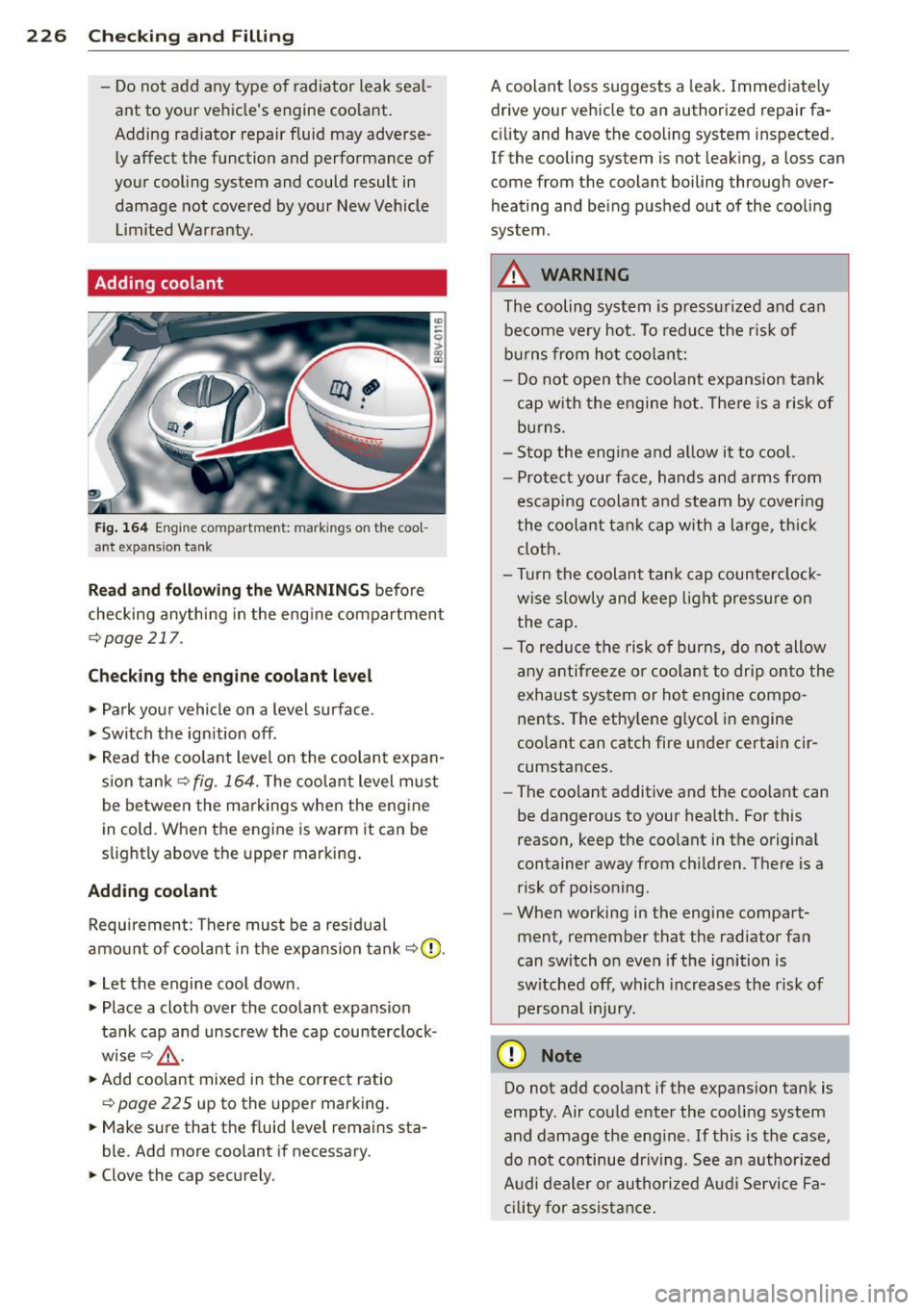
Fig . 164 Engine co mpa rtment: mark in gs on the coo l
ant expans ion tank
R ea d a nd f ollow ing th e W ARNING S before
checking anything in the eng ine compartment
¢ page 217.
Ch eck ing t he e ngi ne coolant level
"Park your vehicle on a level surface .
.. Switch the ign ition off .
" Read the coo lant level on the coolant expan
s ion tank ¢
fig. 164. The coo lant level must
be between the markings when the eng ine
in cold. When the engine is warm it can be
sl ightly above the upper marking .
Adding coolan t
Requirement : There must be a residual
amount of coolant in the expansion tank ¢(D .
.. Let the engine cool down.
" Place a cloth over the coolant expansion
tank cap and unscrew the cap counterclock
wise ¢&_ .
.. Add coolant mixed in the correct ratio
¢ page 225 up to the upper marking.
.. Make sure that the fluid level remains sta
ble. Add more coolant if necessary.
" Clove the cap securely. A coolant loss suggests a
leak. Immediately
drive your vehicle to an authorized repair fa
c ility and have the cooling system inspected.
If the cooling system is not leaking, a loss can
come from the coolant boiling through over
heating and being pushed out of the cooling
system.
A WARNING
The cooling system is press urized and can
become very hot. To reduce the r isk of
b urns from hot coolant:
- Do not open the coolant expansion tank
cap with the engine ho t. T here is a risk of
burns.
- Stop the eng ine and a llow it to cool.
- Protect your face, hands and arms from
escaping coolant and steam by covering
the coolant tan k cap with a large, th ick
cloth.
- Turn the coolan t tank cap counterclock
wise slowly and keep light pressure on
the cap .
- To reduce the risk of burns, do not allow
any antifreeze or coolant to drip onto the
exhaust system or hot engine compo
nents. The ethy lene g lycol in engine
coo lant can catch fire under certain cir
cumstances.
- The coolant additive and the coolant can
be dangerous to your health . For this
reason, keep the coo lant in the origina l
container away from ch ildren . There is a
risk of poisoning.
- When working in the engine compart
ment, remember that the rad iator fan
can switch on even if the ignition is
sw itched off, which increases the risk of
pe rsonal injury.
(D Note
Do not add coolant if the expansion tank is
empty . Air could enter the cooling system
and damage the eng ine .
If this is the case,
do no t continue dr iving. See a n author ized
A udi dealer or authori zed Aud i Service Fa
cility for assist ance.
Page 229 of 310
....,
N
0 > co
rl I.O
"' ....,
"' rl
Radiator fan
The radiator fan switches on automatically by
itself
An auxiliary electric radiator fan switches on
and off depending on coolan t temperature
and other vehicle operating conditions .
After you switch the engine off, the auxiliary
fan can continue running for up to 10 minutes
- even with the ignition off. It can even switch
on again later by itself<=>.& , if
- the temperature of the engine coolant rises
due to the heat build-up from the engine in
the engine compartment, or
- the engine compartment heats up because
the vehicle is parked in intense sunlight.
A WARNING
-To reduce the risk of personal injury nev
er touch the radiator fan.
- The auxiliary electric fan is temperature
controlled and can switch on suddenly
even when the engine is not running.
- The auxiliary radiator fan switches on au
tomatically when the engine coolant
reaches a certain temperature and will
continue to run until the coolant temper
ature drops.
Brake fluid
Checking brake fluid level
N
N
N
>< ~
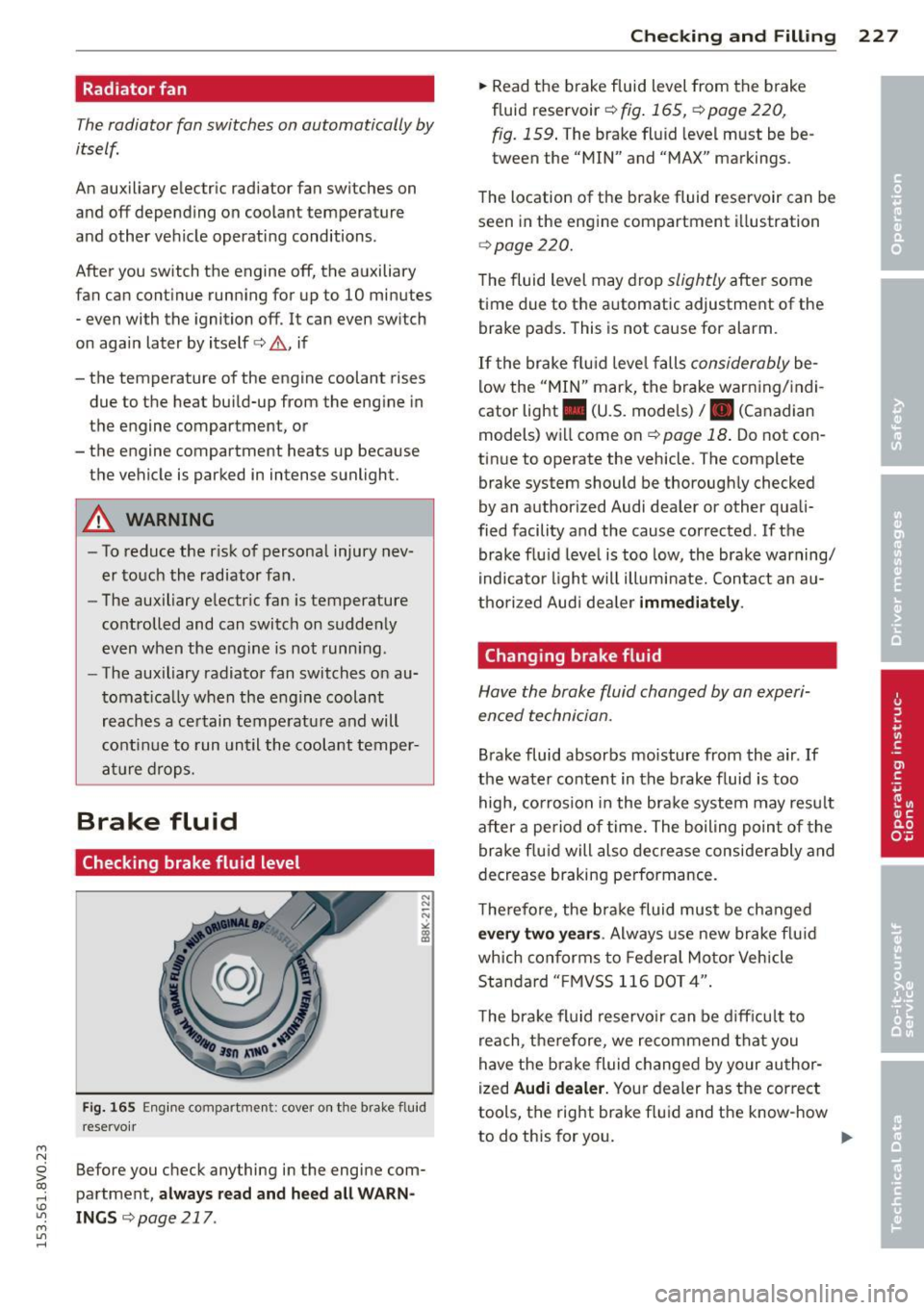
Fig. 165 Engine compa rtment: cove r on the brake fluid
rese rvoir
Before you check anything in the engine com
partment,
always read and heed all WARN
INGS r::;, page 217 .
Checking and Filling 22 7
.. Read the brake fluid level from the brake
fluid reservoir <=>
fig. 165, <=> page 220,
fig. 159.
T he brake fluid level must be be
tween the "MIN" and "MAX" markings.
The location of the brake fluid reservoir can be seen in the engine compartment illustration
<=>page 220.
The fluid level may drop slightly after some
time due to the automatic adjustment of the
brake pads. This is not cause for alarm.
If the brake fluid level falls considerably be
low the "MIN" mark, the brake warning/indi
cator light . (U.S. models)
I. (Canadian
models) will come on
c:> page 18 . Do not con
tinue to operate the vehicle. The complete
brake system should be thoroughly checked
by an authorized Audi dealer or other quali
fied facility and the cause corrected . If the
brake fluid level is too low, the brake warning/
indicator light will illuminate. Contact an au
thorized Audi dealer
immediately.
Changing brake fluid
Have the brake fluid changed by an experi
enced technician.
Brake fluid absorbs moisture from the air . If
the water content in the brake fluid is too
high, corrosion in the brake system may result
after a period of time. The boiling point of the
brake fluid will also decrease considerably and
decrease braking performance.
Therefore, the brake fluid must be changed
every two years . Always use new brake fluid
which conforms to Federal Motor Vehicle
Standard "FMVSS 116 DOT 4".
The brake fluid reservoir can be difficult to
reach, therefore, we recommend that you
have the brake fluid changed by your author
ized
Audi dealer. Your dealer has the correct
tools, the right brake fluid and the know-how
to do this for you.
II>-
Page 230 of 310
228 Check ing and F illin g
8_ WARNING
-Brake fluid is poiso nous. It must be sto r
ed only in th e closed original container
out o f the reach of children!
- Brake fa ilure can result from old or inap
propriate brake fluid. Observe these pre
caut ions:
- Use only brake fluid that meets SAE specification
J 1703 and conforms to
Federal Motor Vehicle Standard 116.
Always check with your authorized Audi
dealer to make sure you are using the
correct brake flu id. The correct type of
brake fluid is also indicated on the
b rake fluid reservoir.
- The brake fluid must be new. Heavy use
of the brakes can cause a vapor lock if
the brake fluid is left in the system too
l ong. This can serious ly affect the effi
ciency of the bra kes as well as yo ur
safety . This could result in an acc ident.
@ Note
Brake flu id will damage the paint of your
veh icle.
@i For the sake of the environment
Because of the problem of proper d isposa l
of brake flu id as we ll as the special tools
requ ired and the ne cessary expert ise, we
recommend that you have the brake fluid
changed by your author ized Audi dealer .
Battery
General information
The battery in your Audi does not need any
maintena nce under
normal operating condi
tions. Aud i recommends having the elect ro
l yte level check by a n author ized Audi dealer
or author ized Audi Se rv ice Facili ty when there
are
high outside temperat ures or when driving
all day. The e lectrolyte level shou ld a lso be
checked each time the battery is charged
¢ page 230.
Have the batte ry checked when yo u bring your
vehicle in for an inspection . It is a good idea
to replace the battery if it is more than 5 years
o ld.
D uring certain types of airbag deployments,
the battery is disconnected from the vehicle electrical system for safety reasons¢
& in
Repair, care and disposal of the airbags on
page 160.
Di sconnecting the battery te rminals
Some vehicle functions (such as power win
dows) are not avai lable when the battery is
disconnected. These functions must be pro
grammed after the battery is reconnected. To
avo id hav ing to do this, only disconnect the
battery from the vehicle electrical system
when that is necessary to perform repairs .
To reprogram the functions, proceed as fol
lows:
Function Reprogramming
Power window one-¢ page 44, Correcting
touch up/down power window ma/-
function functions
Remote control key
If the vehicle does not
or r
eact to the key, it
convenience key must be synchronized
¢ page37
Dig ita l cl ock ¢page 10
ESC indicator light The indicator light
goes out after driving
a few meters
Not running the vehicle for long periods
of time
If you do not drive your vehicle fo r several
days or weeks, electrical components are
gradua lly reduced or switched off. This re
duces e nergy consumption and maintains the
vehicle's ability to start over a long per iod of
time
¢ page 194. Some convenie nce func
tions, such as interior lig hting or power seats *
may not work. These convenience functions
will be ava ilable again once you switch the ig-
nition on and start the engine. .,.
Page 231 of 310
Winter operati on
During the winter months, it is common for
the battery capacity to decrease as the tem
peratures become lower. This is because more
pow er is n eeded to start the vehicle and com
ponents such as the headlights and the rear
window defogger are used more frequently.
Avoid using power unnecessarily, especially in
city driving or on short trips . Have your a u
thorized Audi dealer or authorized Audi Serv
ice Facility check the battery capac ity before
the start of winter ¢
page 230 . A well-charg
ed battery will not only reduce starting prob
l ems in cold weather, but it wi ll also last lon
ge r.
A WARNING
- Wor k on the battery requires expert
knowledge. Con tact your au thori zed Audi
dealer q ua lified repai r fac ility for infor
mation regarding the vehicle battery.
The re is a risk for chemical burns or ex
plos ions.
- Never open the vehicle battery. Do not
try to change the battery e lectrolyte lev
el. Otherwise explosive gas will escape
from the battery and increase the risk of an exp losion .
@ Tips
If your vehicle is not driven for severa l
weeks in very cold temperatures, remove
the battery and store it in a place where it
w ill no t freeze . This prevents the battery
from being damaged and need ing to be re
placed.
Working on the battery
Be especially careful when working on or near the battery .
The battery is located in the lugg age compart
ment under the floor. Before you check any -
"' N thing in the luggage compartment, read and 0
iii heed all WARNINGS ¢ _&.
Checking and Fillin g 229
Always heed the safety warning s, when work
ing on the vehicle battery or the vehicle e lec
trical system to prevent in jury.
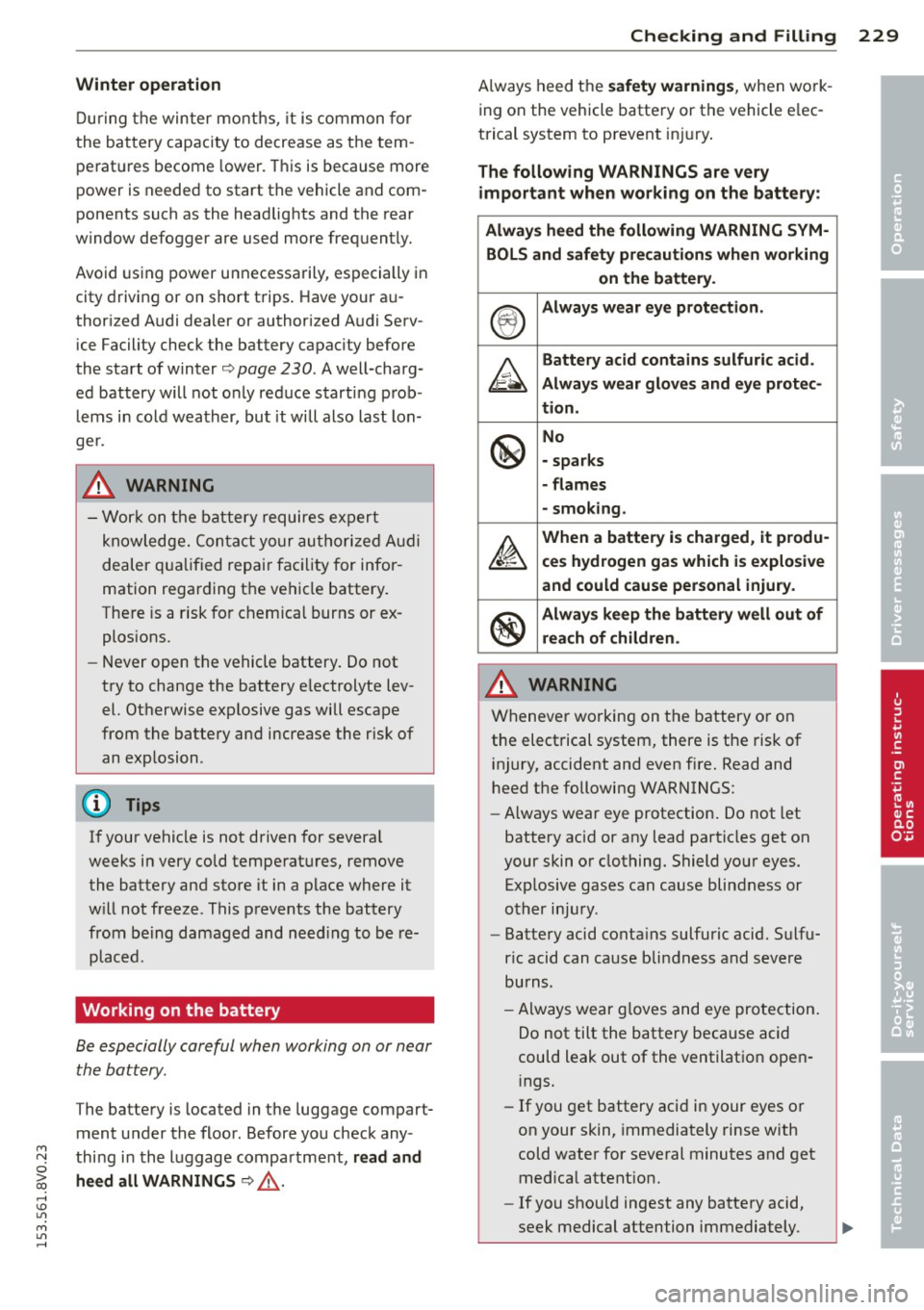
The following WARNINGS are very
important wh en working on the batte ry :
Alway s heed th e following WARNING SYM -
BOLS and safety pre caution s when working
on the battery .
®
Always wear eye p rotection .
A
Battery acid contain s sulfuric acid .
Always wear glov es and eye protec -
tion .
@
No
- sparks
- flames
- smoking .
~
When a battery is charged, it produ-
ce s hydrogen g as wh ich i s ex plo sive
and could c au se per sonal injury .
®
Always keep the battery well out of
re ac h of children .
A WARNING
Whenever working on the battery o r on
the elect rical system, there is the risk of
injury, accident and even fire. Read and
heed the following WARNINGS :
- Always wear eye protection. Do not let
-
battery ac id or any lead particles get on
your skin or clothing. Shield your eyes.
Exp losive gases can cause blindness or
other inju ry.
- Battery acid conta ins sulfuric acid. Sulfu
ric acid can cause blindness and severe
bu rns.
- Always wear g loves and eye protection.
Do not tilt the battery because acid
could leak out of the ventilat ion open
i ngs.
- If you get battery aci d in your eyes or
on your skin, immediately rinse with
cold water for several minutes and get med ica l attent ion.
- If you should ingest any battery acid,
seek medical attention immediately . •
•
•
Page 232 of 310
230 Checking and Filling
-Do not expose the battery to an open
flame, electric sparks or an open light.
- Do not smoke.
- Do not interchange the positive and neg-
ative cables.
- When working on the battery, be sure
not to short-circuit the terminals with
tools or other metal objects. This would
cause the battery to heat up very quickly,
which could lead to damage or explosion
and personal injury.
- When a battery is charged, it produces
hydrogen gas which is explosive and
could cause personal injury.
- Always keep the battery well out of the
reach of children.
- Before work is done on the electrical sys
tem, disconnect the negative ground ca ble.
- Before performing any work on the elec
trical system, switch off the engine and ignition as well as any electrical equip
ment . The negative cable on the battery
must be disconnected . If you are just go
ing to replace a light bulb, then it is
enough to switch off the lights.
- Before disconnecting the battery, switch
off the anti-theft alarm system! Other
wise you will set off the alarm.
- When disconnecting the battery, first
disconnect the negative cable and then
the positive cable .
- Before reconnecting the battery, make
sure all electrical consumers are switch
ed off. Reconnect the positive cable first
and then the negative cable. Never inter
change the cables -this could start a fire!
- Never charge a frozen or a thawed-out
battery. It could explode! If a battery has
frozen, then it must be replaced. A dead battery can free ze over at 32°F (O°C).
- Make sure the vent hose is always attach
ed to the opening on the side of the bat
tery.
- Never use batteries which are damaged.
There is the danger of an explosion! Al
ways replace a damaged battery . A WARNING
-California Proposition 65 Warning:
- Battery posts, terminals and related ac
cessories contain lead and lead com
pounds, chemicals known to the State of
California to cause cancer and reproduc
tive problems . Wash hands after han
dling.
(D Note
- Do not disconnect the vehicle battery
when the ignition is on or when the en
gine is running, otherwise, you will dam
age electronic components in the electri
cal system.
- If your vehicle is going to stand for a
long period of time without being driven,
protect the battery from "freezing", oth
erwise it will be damaged and will then
have to be replaced.
Battery charging
Starting the engine requires a well charged
battery.
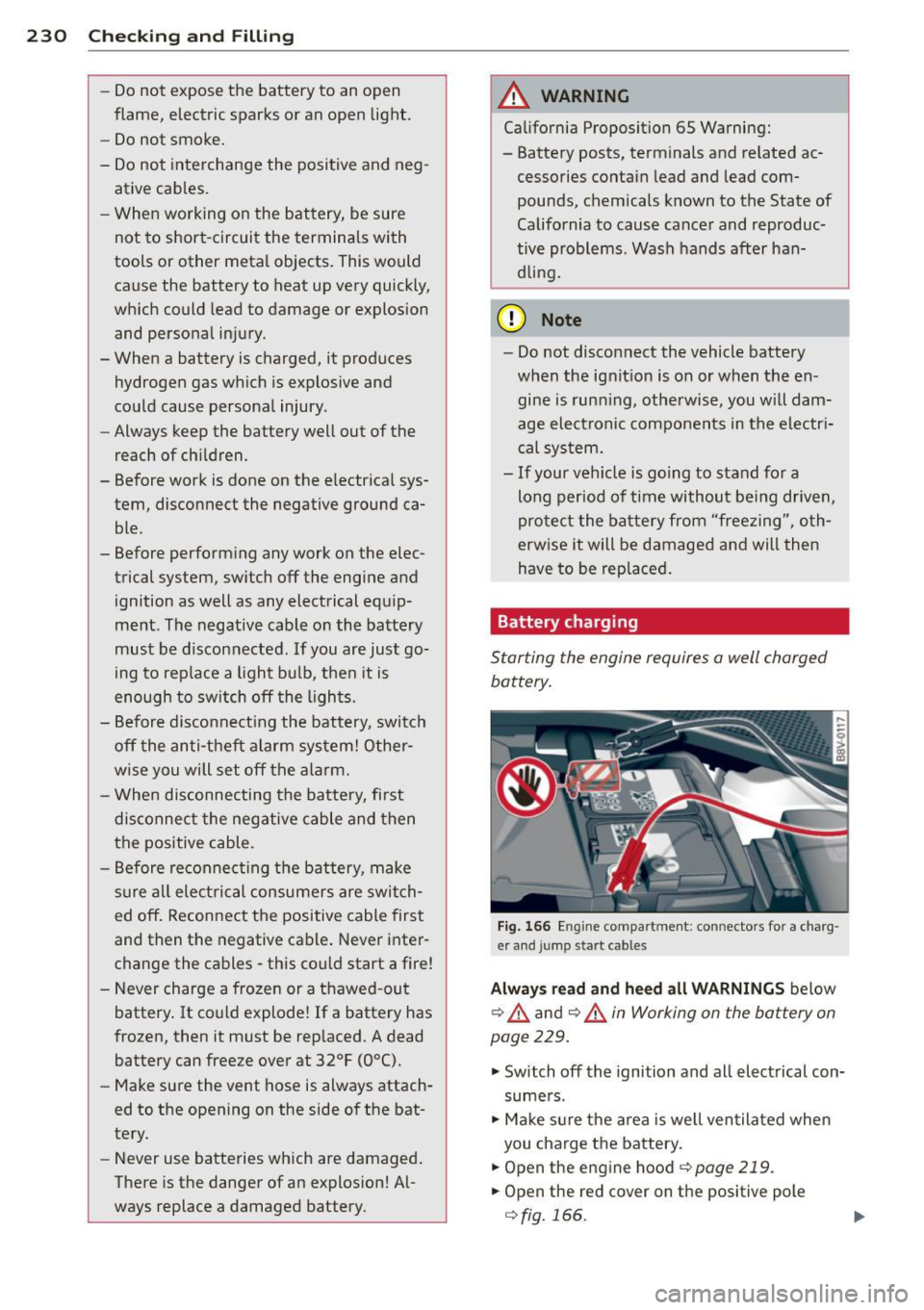
Fig. 166 E ngin e compart men t: co nnecto rs for a charg
e r and jump st art ca bles
Always read and heed all WARNINGS below
~ .&_ and q .&_ in Working on the battery on
page 229.
~ Switch off the ignition and all electrical con
sumers.
~ Make sure the area is well ventilated when
you charge the battery.
~ Open the engine hood q page 219 .
~ Open the red cover on the positive pole
qfig. 166 .
Page 244 of 310
242 Tires and wheel s
If you wish to improve comfort See the illustration c::;, fig. 168
when operating the vehicle at for the locati on of the labe l on
normal load (up to 3 occu -driver's side B-pillar (color of
pants), you can adjust tire the actual label and exact loca-
pressures to those specified tion on the vehic le will vary
for normal vehicle load. Before slight ly) .
operat ing the vehicle at maxi -Note that the following table is
mum load , you must increase accurate at the time of going to
the ti re pressu res to those press and is subject to change .
specified for maximum vehicle In the event of discrepancies,
load c::;, &. the tire pressure labe l is locat-
Bear in mind that the tire pres- ed on the driver's side 8-pi llar
sure monitoring system can on -always takes precedence .
ly monitor the tire pressures The table below lists the rec-
you have stored . The system
ommended cold tire inflation
does not recogn ize the load
pressures for the Audi model
condition of your vehic le.
covered by your Owner's Litera-
T he effectiveness of the tire ture at the vehicle's capacity
pressure monitoring system weight and the tire sizes instal -
will be impaired if you store led on the respective mode ls as
normal load pressures but then original equipment, or as a fac-
operate the vehicle at its maxi- tory option.
...
mum load c::;, & .