seats AUDI S3 2015 User Guide
[x] Cancel search | Manufacturer: AUDI, Model Year: 2015, Model line: S3, Model: AUDI S3 2015Pages: 310, PDF Size: 76.15 MB
Page 68 of 310
66 Seats and st o rage
• Observe the safety notes q page 132 , Tie-
downs.
Due to the laws of phys ics , even small objects
that are loose in the vehicle can become heavy
p rojectiles and cause serious inj uries during a
collision . Objects in the vehicle inc rease in ki
neti c energy, wh ich varies depend ing on the
vehicle and the we ight of the objec t. The vehi
cle speed is the most important factor in t his.
F or example: In a fronta l impact at a speed of
30 mph (48 km/h). the weight of a 10 lb
(5 kg) object increa ses to approxima tely
20 times its normal weight due to the forces
acting upon it . This means the we ight of the
object is suddenly equ ivalent to approximate
ly 200 lb (90 kg) . It is easy to imagine the
type of injuries a n objec t of that weight could
cause if it slides thro ugh the passenger com
pa rtment unrestrained during a collision at a
re lative ly low speed.
A WARNING
Weak, damaged or faulty straps used to
secure objects to the tie-downs can fa il
during heavy braking or a collision and
lead to serious injuries .
- Always use suitable straps and secure
objects to the t ie-downs in the luggage
compartment to prevent objects from
shifting and slid ing fo rward.
- Never secure a ch ild seat restraint to a
t ie-down .
- Because of their load capacity, the hooks
should only be used to secu re objects
that weigh a max imum of 10 lb (5 kg) .
Heavy objec ts will not be secured suffi
c iently, a nd this increases the risk of in
jury.
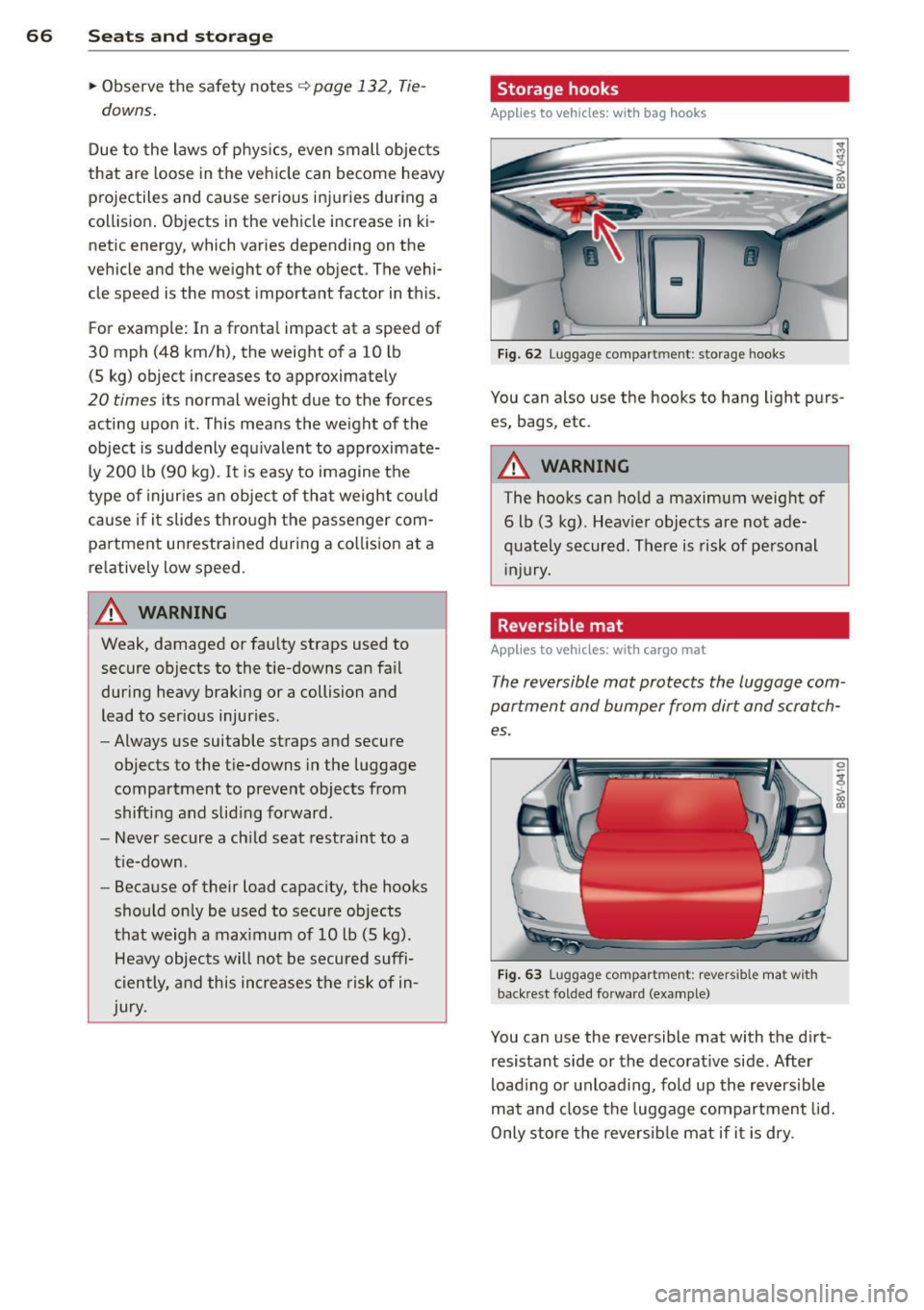
Storage hooks
Applies to vehicles: with bag hooks
F ig. 62 Lugg age compart men t: s torage hooks
You can also use the hooks to hang light purs
es, bags , etc .
A WARNING
-The hooks can ho ld a maximum weight of
6 lb (3 kg). Heav ier objects are not ade
q uate ly secured . Th ere is risk of personal
Injury.
. Reversible mat
Applies to vehicles: with cargo mat
The reversible mat protects the luggage com
partment and bumper from dirt and scratch
es.
F ig . 63 Lu gg age compar tment: re vers ible mat w it h
back re st fo lded fo rwa rd (example)
You can u se the reversible mat with the d irt
resistant side or the decorat ive side. After
load ing or unload ing, fold up the revers ible
mat and close the luggage compartment lid.
Only store the reversib le mat if it is dry .
Page 69 of 310
....,
N
0 > co
rl I.O
"' ....,
"' rl
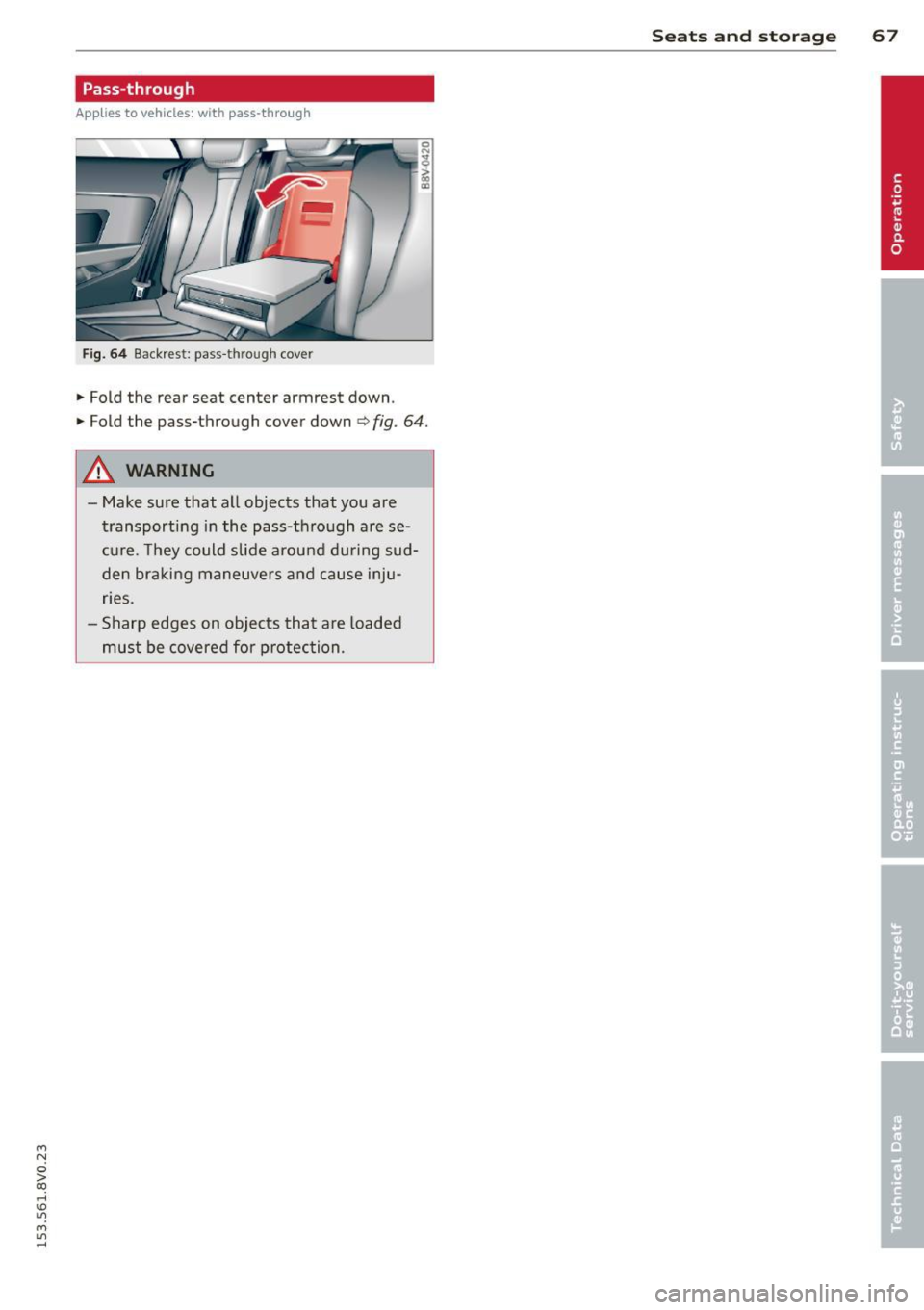
Pass-through
Applies to vehicles: wit h pass -through
Fig. 64 Backrest : pass -t h roug h cove r
• Fold the rear seat center armrest down .
• Fold the pass-through cover down
<=> fig . 64 .
A WARNING
-Make sure that all objects that you are
transporting in the pass-through are se
cure. They could slide around during sud
den braking maneuvers and cause inju
ries .
- Sharp edges on objects that are loaded
must be covered for protection .
-
Seats and storage 67
Page 71 of 310
....,
N
0 > co
rl I.O
"' ....,
"' rl
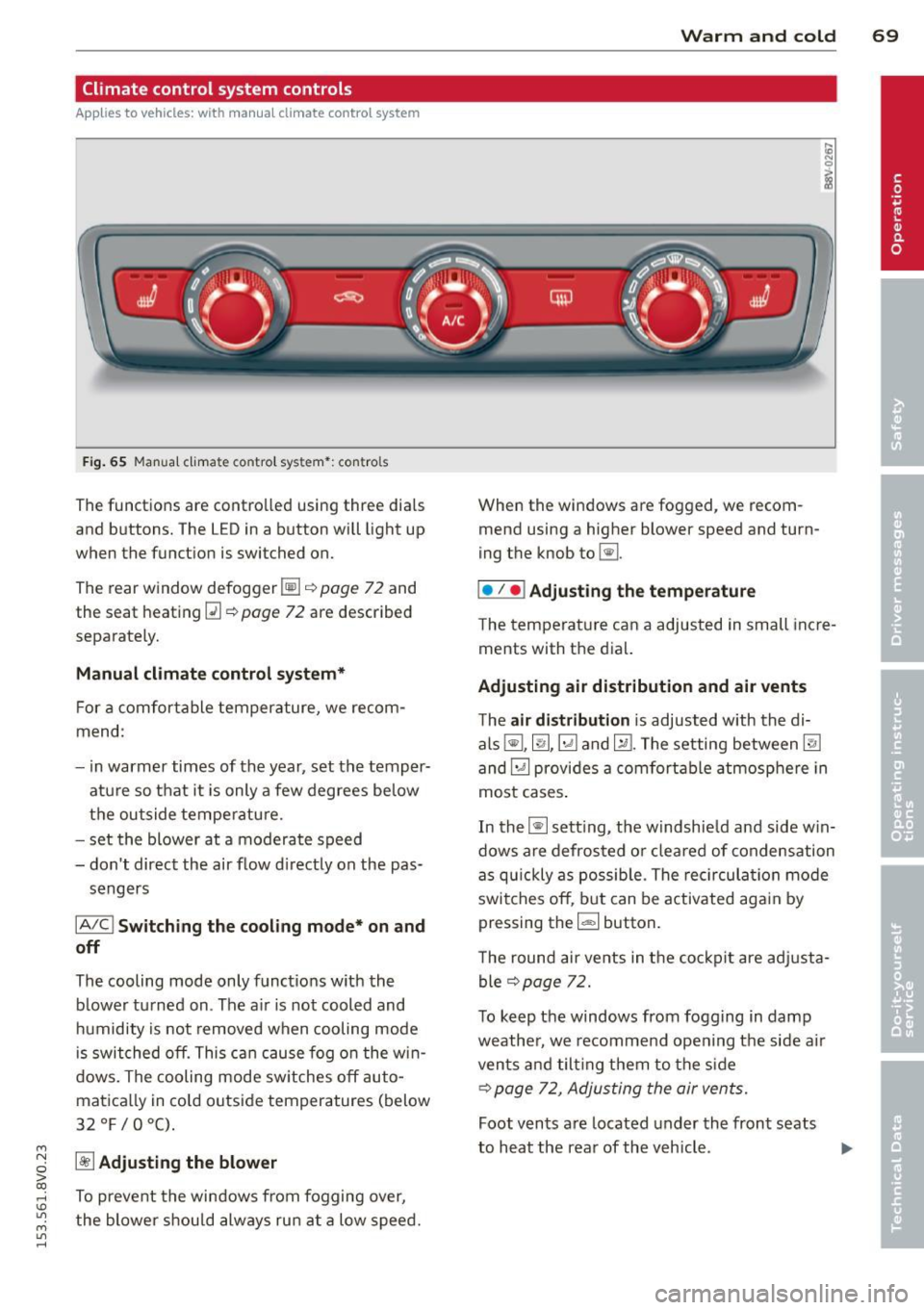
Climate control system controls
App lies to ve hicles: with manu al cl im ate c ontrol syst em
F ig . 65 Man ual cl ima te con tro l sy ste m•: con tro ls
The functions are contro lled using three dia ls
and buttons. The L ED in a button will light up
when the function is switched on.
The rear window defogger~¢
page 72 and
the seat heating~
c::> page 72 are described
separate ly.
Manual climat e control sy stem*
For a comfortable temperature, we recom
mend :
- in warmer times of the yea r, set the temper
atu re so that it is only a few degrees be low
the outside tempe ratu re.
- set the blower at a moderate speed
- don't direct the air flow d irectly on the pas-
sengers
IA/C l Switching the cooling mode* on and
off
The cooling mode only f unct ions w ith the
b lower turned on . The a ir is not cooled and
h umidity is not removed when cooling mode
i s swit ched off. This c an cause fog o n the w in
dows. The cooling mode sw itches off auto
matica lly in co ld outside temperatures (below
32°F/0°C) .
~ Adjusting the blower
To prevent the windows from fogging over,
the blower shou ld always ru n at a low speed .
W arm and cold 69
When the w indows are fogged , we recom
mend using a h igher blowe r speed and tu rn
ing t he knob to~-
I• I • I Adjusting the temperature
T he tempera ture can a adjusted in small inc re
ments with t he dial.
Adjusting air distribution and air vents
The air di stribution is adjusted with the di
als ~'~ .~ and ~-The setting between
@J
and~ provides a comf ort abl e atmosphere in
most cases .
In the~ setting, the windshie ld and side w in
dows are defros ted o r cleared of condensation
as q uickly as possib le . The rec ircul ation mode
switche s off , b ut can be activated aga in by
pressing the
l d;) I button.
T he round air ve nts in t he coc kp it are adj usta
ble
¢ page 72.
T o keep the windows from fogg ing in damp
weathe r, we recomme nd open ing the side a ir
vents and tilt ing them to the s ide
c::> page 7 2 , Adjusting the air vents.
Foot vents a re located under the front seats
to h eat the rear of the veh icle . ...,
Page 73 of 310
M N
0 > co ,...., \!) ..,.,
activates the "eco" mode*1>. I n "eco" mode*,
a ll settings are lowered slightly to save fuel.
When in "eco" mode* ,
eco is shown in the dis
play. To ex it "eco" mode*, press the
!AU TO !
button again .
I• I • I Setting the temperature
The temperature can be adjusted individually
for the driver and front passenger using the
dials . Temperatu res between 60 °F (+16 °C)
and 84 °F (+28 °C) can be set . Outs ide of this
range,
Lo or Hi will appear in the climate con
trol system display. In both settings, the cli mate control runs with constantly at the max
i mum cooling or heating level. The tempera
ture is not regu lated.
Synchronization: By pressing the ! AU TO I but
ton for two seconds , the temperature setting
for the driver is transferred to the front pas
senger's side. This applies a temperature
change to the front passenger's side.
~ Adjusting the blower
To prevent the windows from fogging over,
the blower should always run at a low speed.
You can adj ust the volume of air generated by
the blower to you r preference. To have the
blower regulated automatically, press the
!AU TO! button.
Adjusting the air distribution
The air distribution is adjusted with the~, [Ml
and ~ buttons. To have the air distribution
r eg ulated automatically, press the
!AUTO ! but
ton .
The round air vents in the cockpit are adjusta
ble
~ page 72.
T o keep the w indows from fogging in damp
weather, we recommend opening the side air
vents and tilting them to the side
~ page 72, Adjusting the air vents.
Foot vents are located under the front seats
and adjustable vents on the end of the center
console to heat the rear of the vehicle.
M "' l) This func tio n is not available in all c oun tri es . ,....,
Warm and cold 71
~ Switching the defroster on and off
The w indshield and side windows are defrost
ed or cleared of condensation as quickly as
possible . The maximum amount of air flows
main ly from the vents below the windshield.
Recircu lation mode switches off. The tempera
ture is controlled automatically. In the
[i] set
ting, the
! AIC ! cooling mode sw itches on auto
matically, depending on the outside air tem
perature .
The
! AU TO ! button sw itches the defroster off.
l""'I Switching recirculation mode on and
off
The recircu lation mode can be turned on man
ually or automatically* .
- Switching manual recirculation mode on and
off: Press the~ button. The LED light up
when switched on.
- Automatic* recirculation mode: The recircu
lation mode must be activated in the MMI.
Select: the
I MENU I button >C ar> Systems*
con trol button> AC > Auto recirculation.
The a ir quality sensor that is des igned for
diesel and gasoline exhaust automatically
switches the recirculation mode on or off
depending on the leve l of pollutants in the
outside air .
In recirculation mode, the air inside the vehi
cle is circulated and filtered . This prevents the
unfiltered air outside the vehicle from enter
ing the vehicle interior. We recommend
switching recircu lation mode on when driving
th rough a tunne l or when sitting in traffic
~ .&. .
The 1- 1 button, IAU TO ! or the [i] button
switches rec irc ulation mode off.
The system switches to recirculation mode
whe n driving in reverse when the engine is
cold.
•
Page 75 of 310
M N
0 > co ,...., \!) 1.1'1
M 1.1'1 ,....,
When seat heating should not be
switched on
Do not turn the seat heating on under the fol
lo wing circumstances:
- The seat is unoccupied.
- The seat is covered with a seat cover.
- The seat is covered with a child seat .
- The seat is damp or wet .
A WARNING
Individuals with reduced sensitivity to pain
or temperature could develop burns when
using the seat heating function. To reduce
the risk of injury, these individuals should
not use seat heating.
(D Note
To avoid damage to the heating elements
in the seats, do not kneel on the seats or
place heavy loads on a small area of the
seat.
(D Tips
- The setting for the seat heating on the
driver's side is assigned to the key that is
1n use.
- If the front passenger's seat heating is
turned on, it will not turn on again auto
matically if more than
10 minutes have
passed between switching the ignition
off and switching it on again.
Auxiliary heater
App lies to vehicles: with d iesel e ngin e
In cool outside temperatures, the electric aux
iliary heater helps the vehicle interior to warm
more quickly . The auxiliary heater switches on
and off automatically according to the vehicle heating settings .
The "auxiliary heater" function can be switch
ed on and off in the
MMI. Select: the !MENUI
button
> Car > Systems * control button > AC
> Auxiliary heater .
Warm and cold 73
•
Page 127 of 310
M N
0 > co ,...., \!) ..,.,
M ..,., ,....,
Driving safety
General notes
Safe driving habits
Please remember -safety first!
This chapter contains important information,
tips, instructions and warnings that you need
to read and observe for your own safety, the
safety of your passengers and others . We have
summarized here what you need to know
about safety belts, airbags, ch ild restraints as
well as child safety. Your safety is fo r us
priori
ty number 1.
Always observe the information
and warnings in this sect ion - for yo ur own
safety as well as that of your passengers.
The information in this section app lies to all
model ve rsions of your vehicle . Some of the
feat ures described in this sections may be
standard equipment on some models, or may
be optional equipment on others. If you are
not sure, ask your authorized Audi dea ler.
A WARNING
- Always make sure that you follow the in
struct ions and heed the WARNINGS in
this Manual. It is in your interest and in
the interest of your passengers.
- Always keep the complete Owner's Liter
ature in your Audi when you lend or sell
your vehicle so that this important infor
mation will always be ava ilable to the
dr iver and passengers.
- Always keep the Owner's literature handy
so that you can find it eas ily if you have
questions.
- Always adjust your speed to the weather
traffic and conditions. Follow the speed
limits.
- Always drive in such a way that you can
stop your vehicle safely .
- Always adjust your speed to the general
flow of traffic. Fo llow the speed limits.
Dri ving sa fe ty 12 5
Safety equipment
The safety features are part of the occupant
restraint system and work together to help
reduce the risk of injury in a wide variety of
accident situations.
Your safety and the safety of your passengers
should not be left to chance . Advances in
techno logy have made a variety of features
available to help reduce the risk of injury in an
acc ident. The following is a list of just a few of
the safety features in yo ur Audi :
- sophisticated safety be lts fo r driver and all
passenger seating posit ions,
- safety belt pretens ioners,
- safety belt force lim iters for the front seats,
- safety belt he ight adjustment systems for
the front seats,
- front airbags,
- knee airbags for the front seats*
- side airbags in the front seats and outer rear seats *,
- side curtain ai rbags with ejec tion mitiga tion
features,
- specia l LATCH an chorages for child re-
straints,
- head restra ints for each seating posit ion,
- adjustab le steer ing column.
- pre sense basic* (preventat ive passenger
protect ion)
These ind iv idual safety features, can work to
gether as a system to help protect you and
your passengers in a wide range of accide nts .
T hese features cannot work as a system if
they a re not always correctly adjusted and co r
rect ly used .
Safety is ev erybody' s respon sibil it y !
Important things to do before driving
Safety is everybody's job! Vehicle and occu
pant safety always depends on the informed and careful driver .
For your safety and the safety of your passen
gers,
b efor e driv ing alw ay s: ...
•
•
•
Page 128 of 310
126 Driving safety
• Make sure that all lights and signals are op
erating correctly .
• Make sure that the tire pressure is correct .
• Make sure that a ll windows are clean and af
ford good visibility to the o utside.
• Secure all luggage and other items ca refully
c:::> page 64, c:::>page 62 .
• Make sure that noth ing can i nterfere with
t h e pedals.
• Adjust front seat, head rest rain t and mirro rs
correct ly for your he ight .
• Instr uct passenge rs to adjust the head re
straints according to their height.
• Make sure to use the right child restraint
correctly to protect chi ldren
c:> page 170 ,
Child Safe ty .
• Sit properly i n your seat and make sure that
you r passenge rs do the same
c:::> page 57,
Front seats .
• Fasten your safety be lt and wear it properly.
Also ins truc t your passengers to faste n their
sa fety belts proper ly
c:> pag e 13 5.
What impairs driving safety?
Safe driving i s direc tly rela ted to the condi
tion of the vehicle, the driver as well as the
driver 's ability to concentrate on the road
without being distracted .
The driver is respons ib le for the safety of the
ve hicl e and a ll of its occupants . If you r ability
to drive is impaired , safety r is k s for everybody
in the vehicle increase and you a lso become a
hazard to everyone else on the road
c:> &_ .
Therefore:
• Do not let you rself be distracted by passen
gers or by using a cellular telephone.
• NEV ER dr ive when your dr iv ing ability is im
paired (by medicat ions, alcohol, drugs, etc.).
• Observe all traffic laws , rules of the road
and speed limits and plain common sense .
• ALWAYS ad just your speed to road, t raff ic
and weathe r condit ions .
• Take frequent breaks on long t rips. Do not
dr ive for mo re th an two hours a t a str etc h .
• Do N OT drive when you are t ired, under
pressure or when you are stressed .
A WARNING
-Impaired driving safety increases the r isk
of ser ious perso nal inju ry and death when
ever a vehicle is bei ng use d.
Proper occupant
seating positions
Proper seating position for the driver
The proper driver seating position is impor
tant for safe, relaxed driving.
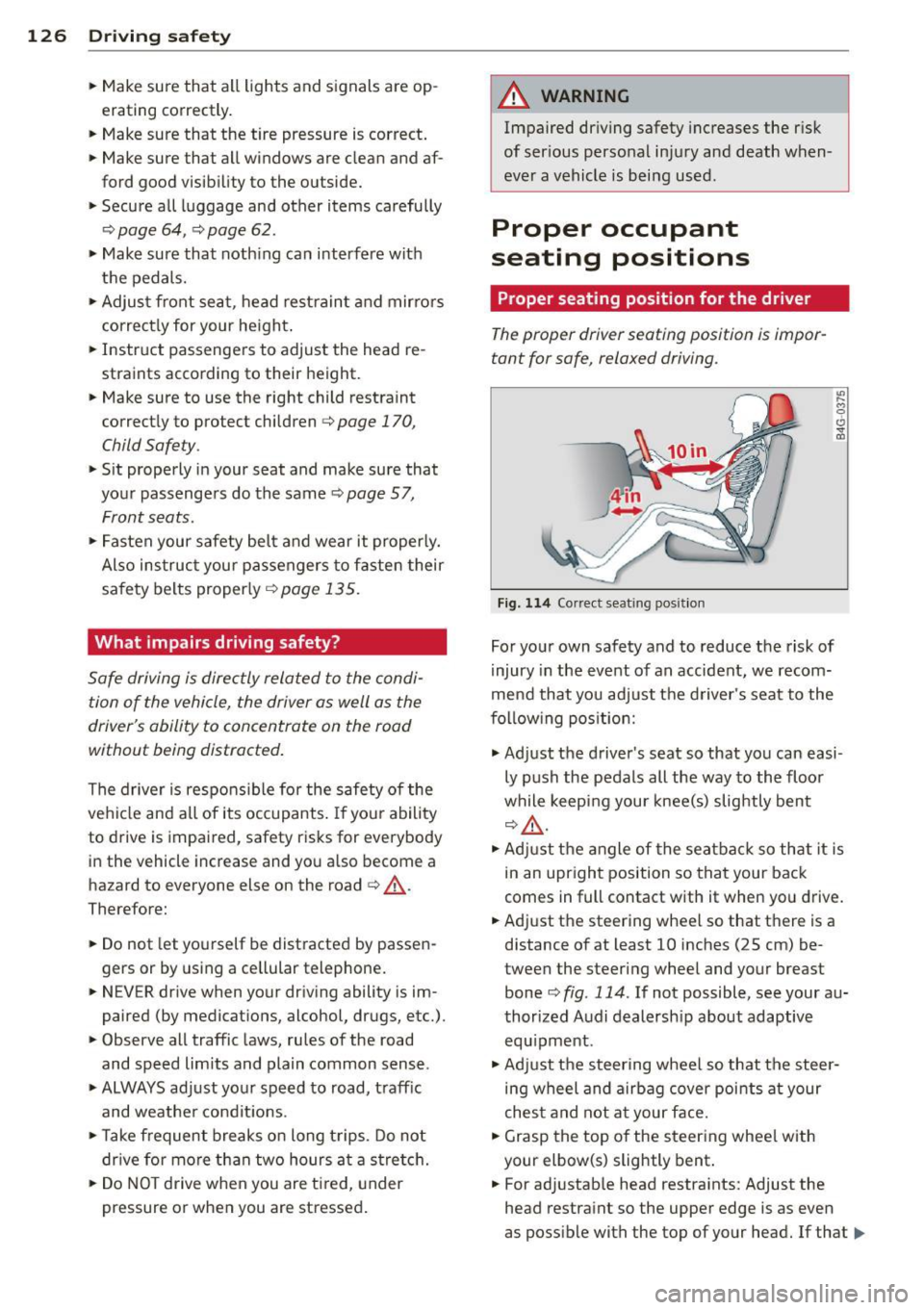
Fig . 11 4 Correct seat ing pos it io n
For you r own safety and to reduce t he risk of
injury in the event of an accident, we recom
me nd that you adjust t he d river's seat to the
f o llow ing pos ition:
.,. Ad just the driver's seat so that you can easi
ly p ush the pedals all the way to the floo r
while keep ing you r knee(s) slightly bent
c:>& ,
.,. Adj ust t he an gle of the seatba ck so th at it is
in an uprigh t position so that your back
comes in full contact with it when you drive.
• Adj ust the steering whee l so that t here is a
distance of at least 10 inches
(25 cm) be
tween the steering wheel and your breast bone
c:::> fig. 114 . If not possible, see your a u
thor ized Audi dealersh ip about adaptive
equ ipment .
.. Ad just t he steering whee l so that the steer
ing wheel and airbag c over poi nts at your
ches t and not a t your f ace.
• Grasp the top o f the steering whee l with
your elbow(s) slightly bent .
• For ad justab le head restra ints : Adjust the
head restra int so the uppe r edge is as even
as poss ible with the top of your head. If that..,_
Page 129 of 310
M N
0 > co ,...., \!) 1.1'1
M 1.1'1 ,....,
is not possible, try to adjust the head re
straint so that it is as close to this position
as possible. Move the head restraint so that
it is as close to the back of the head as pos
sible.
.. Fasten and wear safety belts correctly
Q page 138.
.. Always keep both feet in the footwell so
that you are in control of the vehicle at all
times.
For detailed information on how to adjust the
driver's seat, see
Q page 58.
.&, WARNING
Drivers who are unbelted, out of position
or too close to the airbag can be seriously
injured by an airbag as it unfolds. To help
reduce the risk of serious personal injury:
- Always adjust the driver's seat and the
steering wheel so that there are at least
10 inches (25 cm) between your breast
bone and the steering wheel.
- Always adjust the driver 's seat and the
steering wheel so that there are at least
4 inches (10 cm) between the knees and
the lower part of the instrument panel.
- Always hold the steering wheel on the
outside of the steering wheel rim with
your hands at the 9 o'clock and 3 o'clock positions to help reduce the risk of per
sonal injury if the driver's airbag inflates.
- Never hold the steering wheel at the
12 o'clock position or with your hands at
other positions inside the steering wheel
rim or on the steering wheel hub. Hold
ing the steering wheel the wrong way
can cause serious injuries to the hands,
arms and head if the driver's airbag in
flates.
- Pointing the steering wheel toward your
face decreases the ability of the supple
mental driver's airbag to protect you in a
collision.
- Always sit in an upright position and nev
er lean against or place any part of your
body too close to the area where the air
bags are located.
-
Driving safety 127
-Before driving, always adjust the front
seats properly and make sure that all passengers are properly restrained .
- For adjustable head restraints: before
driving, always also adjust the head re
straints properly.
- Never adjust the seats while the vehicle is moving. Your seat may move unexpect
edly and you could lose control of the ve hicle .
- Never drive with the backrest reclined or
tilted far back! The farther the backrests are tilted back, the greater the risk of in
jury due to incorrect positioning of the safety belt and improper seating posi
tion .
- Children must always ride in child seats
Q page 170 . Special precautions apply
when installing a child seat on the front
passenger seat ¢
page 144.
Proper seating position for the front
passenger
The proper front passenger seating position
is important for safe, relaxed driving.
For your own safety and to reduce the risk of
injury in the event of an accident, we recom
mend that you adjust the seat for the front
pass enger to the following position :
.. Adjust the angle of the seatback so that it is
in an upright position and your back comes
in full contact with it whenever the vehicle is
moving.
.. Fo r adjustable head restraints: adjust the
head restraint so the upper edge is as even
as possible with the top of your head. If that
is not possible, try to adjust the head re
straint so that it is as close to this position
as possible
¢ page 129. Move the head re
straint so that it is as close to the back of
the head as possible .
.. Keep both feet flat on the floor in front of
the front passenger seat.
.. Fasten and wear safety belts corr ectly
¢ page 138.
•
•
•
Page 130 of 310
128 Driving safety
For detailed information on how to adjust the
front passenger's seat, see ¢
page 5 7.
A WARNING
Front seat passengers who are unbelted,
out of position or too close to the airbag
can be seriously injured or killed by the air
bag as it unfolds. To help reduce the risk of
serious personal injury:
- Passengers must always sit in an upright
position and never lean against or place
any part of their body too close to the
area where the airbags are located.
- Passengers who are unbelted, out of po
sition or too close to the airbag can be
seriously injured by an airbag as it un
folds with great force in the blink of an
eye.
- Always make sure that there are at least
10 inches (25 cm) between the front
passenger's breastbone and the instru
ment panel.
- Always make sure that there are at least
4 inches (10 cm) between the front pas
senger's knees and the lower part of the
instrument panel.
- Each passenger must always sit on a seat
of their own and properly fasten and
wear the safety belt belonging to that
seat.
- Before driving, always adjust the front
passenger seat properly .
- For adjustable head restraints: before
driving, always also adjust the head re
straints properly.
- Always keep your feet on the floor in
front of the seat. Never rest them on the
seat, instrument panel, out of the win
dow, etc. The airbag system and safety
belt will not be able to protect you prop
erly and can even increase the risk of in
jury in a crash .
- Never drive with the backrest reclined or
tilted far back! The farther the backrests are tilted back, the greater the risk of in
jury due to incorrect positioning of the
safety belt and improper seating posi
tion. -
Children must always ride in child seats
¢
page 170. Special precautions apply
when installing a child seat on the front passenger seat
c> page 144.
Proper seating positions for passengers
in rear seats
Rear seat passengers must sit upright with
both feet on the floor consistent with their
physical size and be properly restrained whenever the vehicle is in use.
To reduce the risk of injury caused by an incor
rect seating position in the event of a sudden
braking maneuver or an accident, your pas
sengers on the rear bench seat must always
observe the following:
"" For adjustable head restraints: adjust the
head restraint so the upper edge is as even
as possible with the top of your head. If that
is not possible, try to adjust the head re
straint so that it is as close to this position
as possible
¢ page 129.
.,. Keep both feet flat in the footwell in front of
the rear seat.
.,. Fasten and wear safety belts properly
¢page 138.
.,. Make sure that children are always properly
restrained in a child restraint that is appro
priate for their size and age¢
page 170.
A WARNING
Passengers who are improperly seated on
the rear seat can be seriously injured in a
crash.
- Each passenger must always sit on a seat
of their own and properly fasten and
wear the safety belt belonging to that
seat.
- Safety belts only offer maximum protec
tion when the safety belts are properly positioned on the body and securely
latched. By not sitting upright, a rear
seat passenger increases the risk of per
sonal injury from improperly positioned
safety belts!
Page 131 of 310
....,
N
0 > co
rl 1.0
"' ....,
"' rl
-For adjustable head restraints : always
adjust the head restra int properly so that
it can give maximum protection .
Proper adjustment of head restraints
Applies to vehicles: with adjustable head restraints
Correctly adjusted head restraints are an im
portant part of your vehicle's occupant re
st raint system and can help to reduce the risk
of injuries in acciden t situations.
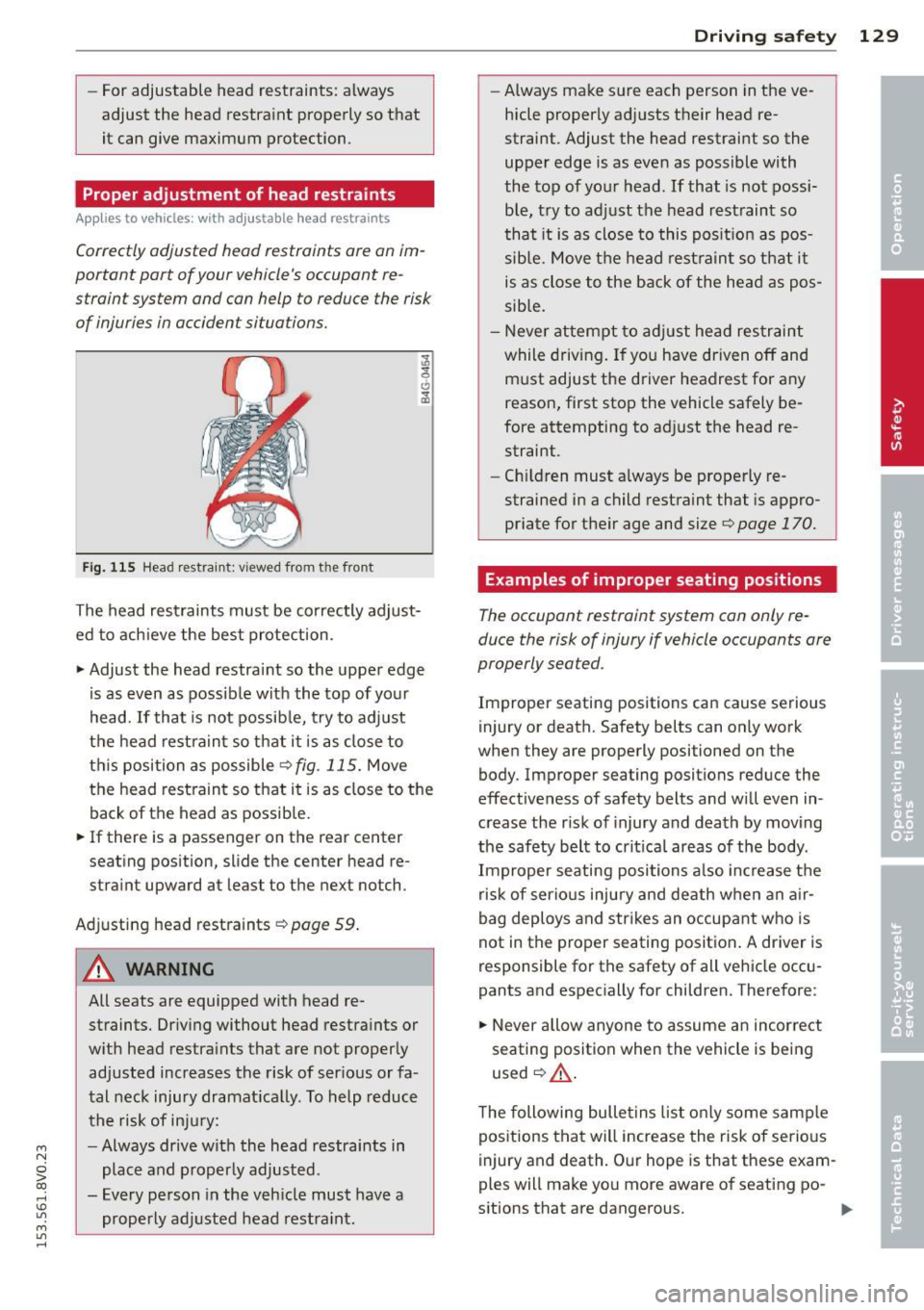
Fig. 115 Hea d restr aint: vie wed fro m the fron t
The head restraints must be correctly adjust
ed to ach ieve the best protection .
.,. Adjust the head restraint so the upper edge
is as even as poss ible w ith the top of your
head .
If that is not possib le, try to adjust
the head restra int so that it is as close to
this position as possible
r:!.>fig . 115. Move
the head restraint so that it is as close to the
back of the head as possible.
.,. If there is a passenger on the rear cent er
seat ing position, slide the center head re
stra int upward at least to the next notch .
Adj usting head restraints¢
page 59.
_& WARNING
All seats are equipped with head re
straints. Dr iving without head restra ints or
w ith head restra ints that are not proper ly
adjusted increases the risk of ser ious or fa
tal neck injury dramat ically . To help reduce
the risk of inju ry:
- Always drive with the head restraints in
place and properly adjusted .
- Every person in the veh icle must have a
properly ad justed head restra int .
Dri ving sa fety 129
- Always make sure each person in the ve
hicle properly ad justs their head re
straint. Adjust the head restraint so the
upper edge is as even as possible with
the top of your head .
If that is not possi
ble, t ry to ad just the head restraint so
that it is as close to this pos it ion as pos
sible. Move t he head rest raint so that i t
is as close to the back of the head as pos
sible.
- Never attempt to adjust head res traint
while driving . If you have driven off and
m ust adjust the driver headrest for any
reason, first stop the vehicle safely be
fore attempting to adjust the head re
straint .
- Ch ildren must a lways be properly re
strained in a child restraint that is appro
priate for their age and size¢
page 170.
Examples of improper seating positions
The occupan t restraint syst em can only re
duce the risk of injury if vehicle occupants are
properly seated .
Improper seating positions can cause serious
injury or death. Safety belts can only work
when they are properly positioned on the body . Improper sea ting positions reduce the
effectiveness of safety belts and will even in
crease the r isk of injury and death by mov ing
the safety be lt to crit ica l areas of the body.
Improper seating posi tions a lso increase the
risk of serio us inju ry and de ath when an a ir
bag deploys and strikes an occupant who is
not in the proper seating position . A driver is
responsible for the safety of all veh icle occu
pants and espec ially for children. Therefore :
.,. Never allow anyone to assume an incorrect
seating position when the vehicle is being
used
r:!.> _&. .
The following bulle tins list o nly some samp le
pos itions that will increase the risk of serio us
injury and death. Our hope is that these exam
ples will make yo u more aware of seating po-
sitions that are dangerous. ..,.