wheel AUDI S3 2015 Manual PDF
[x] Cancel search | Manufacturer: AUDI, Model Year: 2015, Model line: S3, Model: AUDI S3 2015Pages: 310, PDF Size: 76.15 MB
Page 254 of 310
252 Tires and wheels
Tire service life
The service life of tires depends
on a lot of different things in
cluding proper installation and
balancing, correct tire pressure
and driving style.
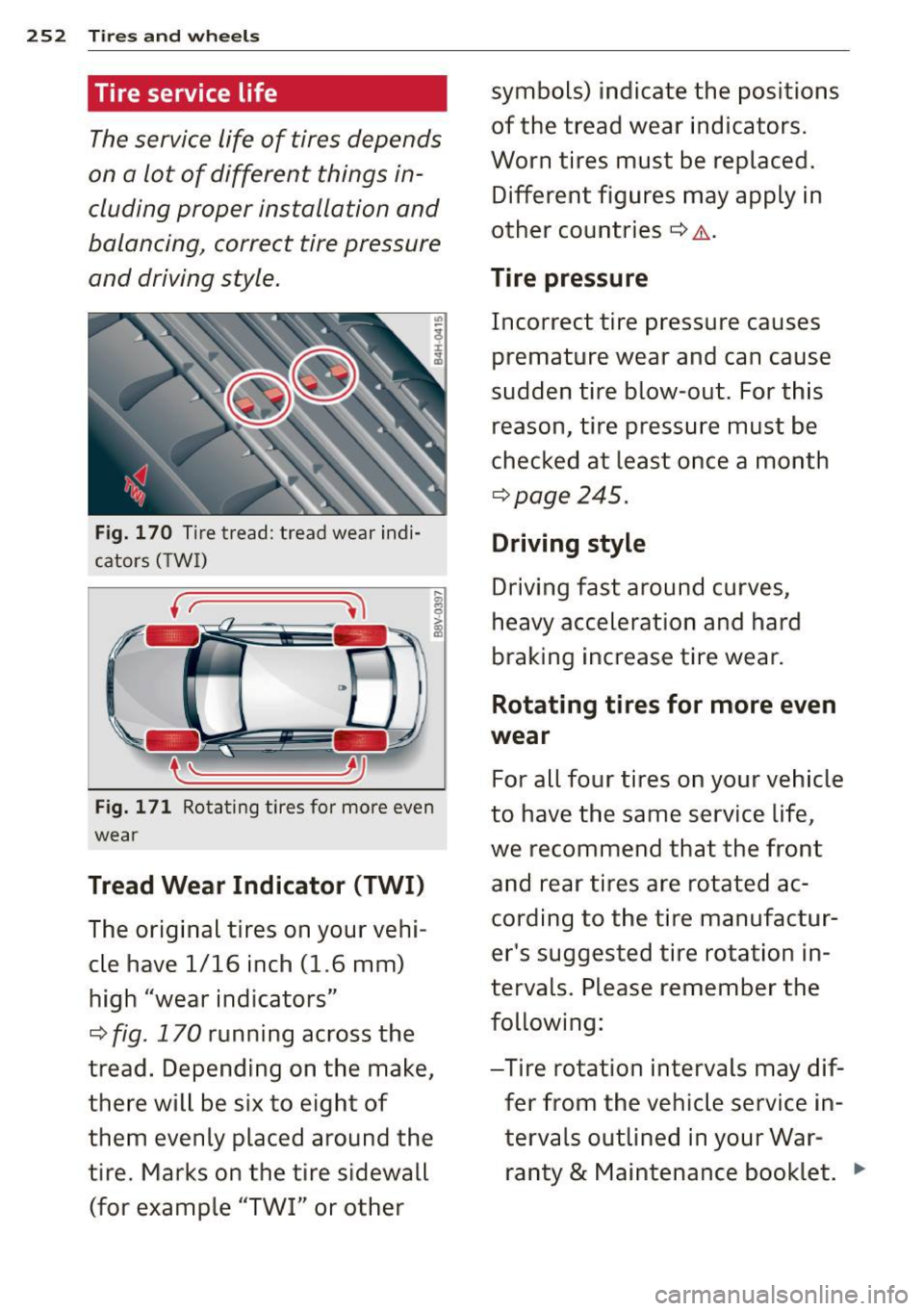
Fig. 170 Tire tread: tread wear indi
cators (TWI)
Fig. 171 Rotating tires for more even
wear
Tread Wear Indicator (TWI)
The original tires on your vehi
cle have 1/16 inch (1.6 mm)
high "wear indicators"
¢ fig. 170 running across the
tread. Depending on the make,
there will be six to eight of
them evenly placed around the
tire. Marks on the tire sidewall (for example "TWI" or other symbols)
indicate the positions
of the tread wear indicators.
Worn tires must be replaced.
Different figures may apply in
other countries
¢ ..1.. .
Tire pressure
Incorrect tire pressure causes
premature wear and can cause
sudden tire blow-out. For this
reason, tire pressure must be
checked at least once a month
¢page 245.
Driving style
Driving fast around curves,
heavy acceleration and hard
braking increase tire wear.
Rotating tires for more even
wear
For all four tires on your vehicle
to have the same service life,
we recommend that the front and rear tires are rotated ac
cording to the tire manufactur
er's suggested tire rotation in
tervals. Please remember the
following:
-Tire rotation intervals may dif
fer from the vehicle service in
tervals outlined in your War
ranty
& Maintenance booklet. ""
Page 255 of 310
-The longer one tire is used in one location on the vehicle,
the more it wears at certain points; therefore, we recom
mend that you follow the tire
manufacturer's suggested tire
rotation intervals.
-Vehicles with front-wheel drive experience more tread
wear on the front wheels com pared to all-wheel drive (quat
tro).
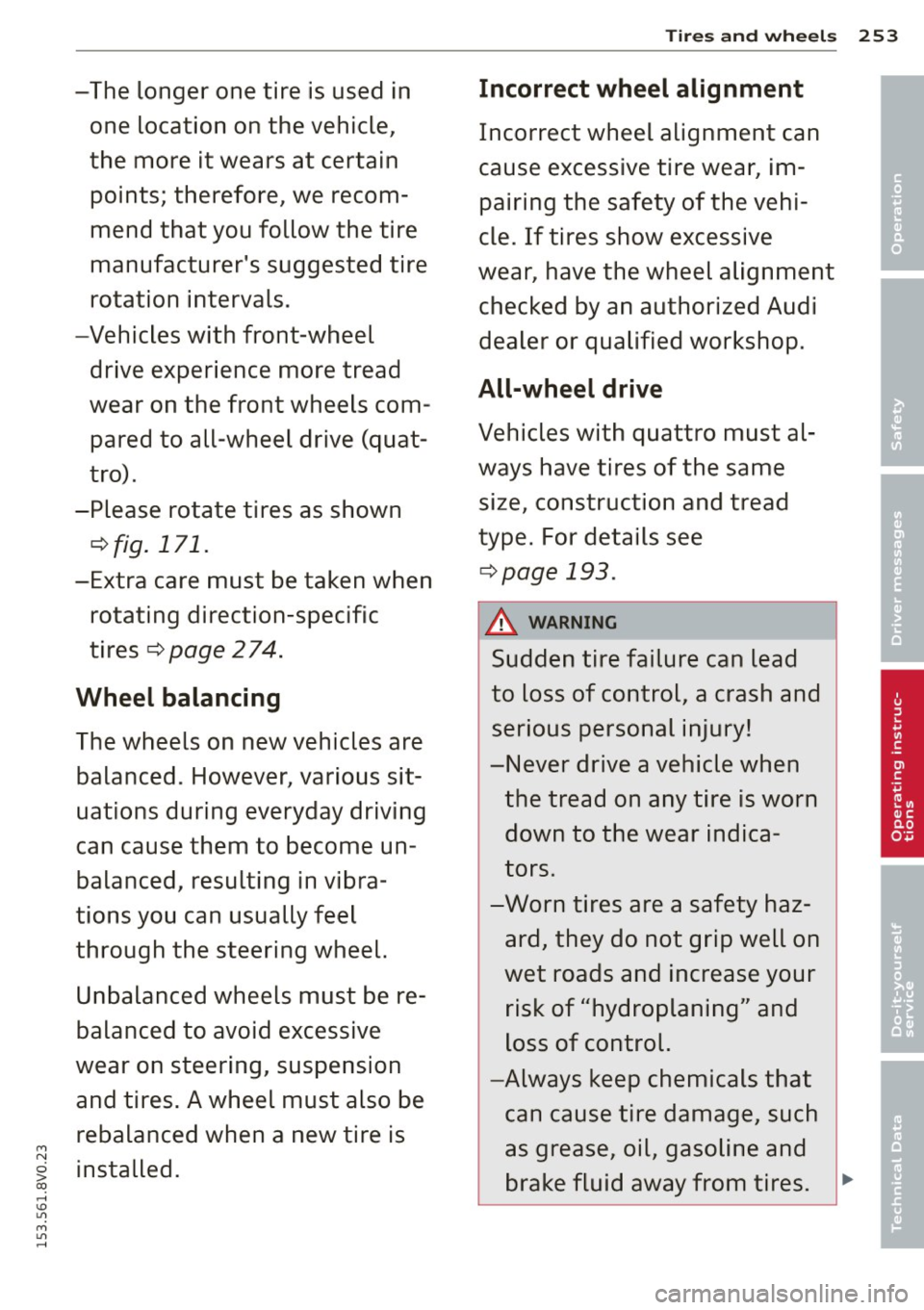
-Please rotate tires as shown
¢ fig. 171.
-Extra care must be taken when
rotating direction-specific
tires
Q page 2 74.
Wheel balancing
The wheels on new vehicles are balanced. However, various sit
uations during everyday driving
can cause them to become un
balanced, resulting in vibra
tions you can usually feel
through the steering wheel.
Unbalanced wheels must be re
balanced to avoid excessive
wear on steering, suspension
and tires. A wheel must also be
rebalanced when a new tire is
M N
~ installed. co ,...., \!) 1.1"1
M 1.1"1 ,....,
Tires and wheels 253
Incorrect wheel alignment
Incorrect wheel alignment can
cause excessive tire wear, impairing the safety of the vehi
cle. If tires show excessive
wear, have the wheel alignment checked by an authorized Audi
dealer or qualified workshop.
All-wheel drive
Vehicles with quattro must al
ways have tires of the same size, construction and tread
type. For details see
¢ page 193 .
.8, WARNING
Sudden tire failure can lead
to loss of control, a crash and serious personal injury!
-Never drive a vehicle when the tread on any tire is worn down to the wear indica
tors.
-Worn tires are a safety haz ard, they do not grip well on
wet roads and increase your risk of "hydroplaning" and
loss of control.
-Always keep chemicals that can cause tire damage, such
-
as grease, oil, gasoline and
brake fluid away from tires.
~
' •
•
' •
Page 256 of 310
254 Tires and wheels
-Tires age even if they are
not being used and can fail
suddenly, especially at high
speeds. Tires that are more
than 6 years old can only be
used in an emergency and
then with special care and at lower speeds.
-Never mount used tires on your vehicle if you are not sure of their "previous histo
ry." Old used tires may have
been damaged even though
the damage cannot be seen
that can lead to sudden tire
fa ilure and loss of vehicle
control. New tires and replacing
tires and wheels
New tires and wheels have to
be broken in.
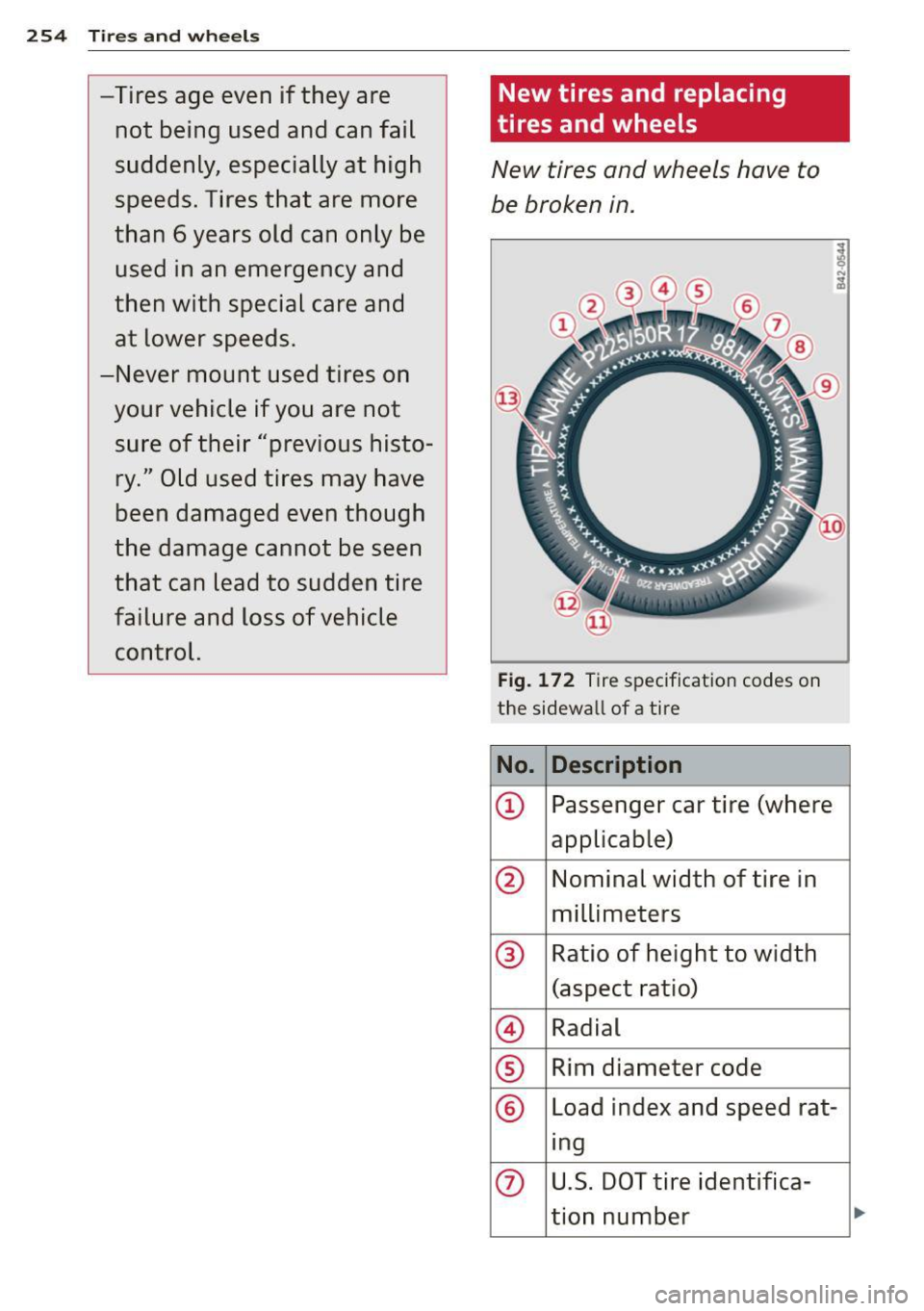
Fig. 172 Tire specification codes on
the sidewall of a tire
No. Description
CD Passenger car tire (where
applicable)
@ Nominal width of tire in
millimeters
@ Ratio of height to width
(aspect ratio)
@) Radial
® Rim diameter code
® Load index and speed rat -
1ng
0 U .S . DOT tire identifica-
tion number
Page 257 of 310
M N
0 > co ,...., \!) 1.1'1
M 1.1'1 ,....,
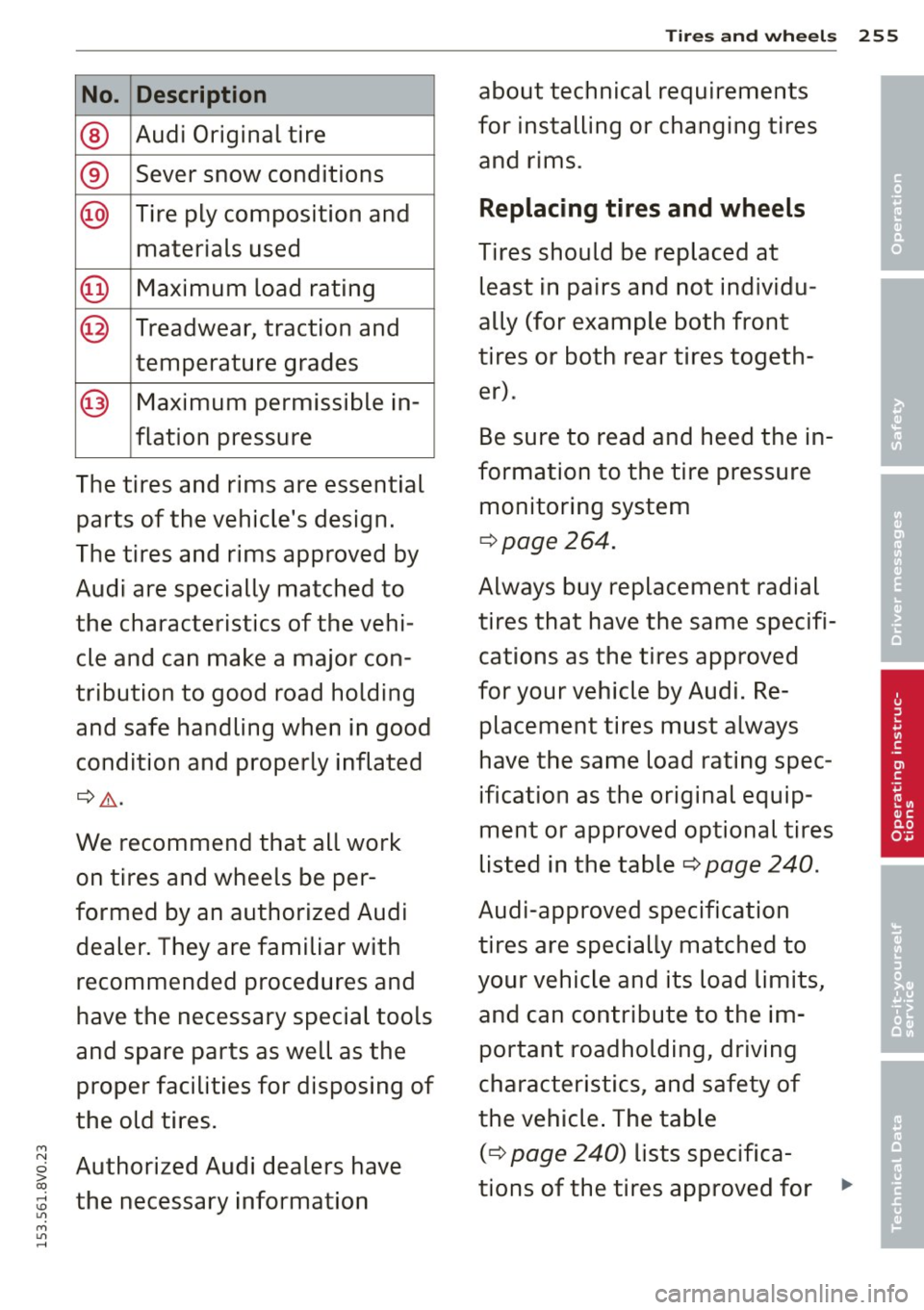
No. Description
® Audi Original tire
® Sever snow conditions
@ Tire ply composition and materials used
@ Maximum load rating
@ Treadwear, traction and
temperature grades
@ Maximum permissible in-
flation pressure
The tires and rims are essential parts of the vehicle's design.
The tires and rims approved by
Audi are specially matched to
the characteristics of the vehi
cle and can make a major con
tribution to good road holding
and safe handling when in good
condition and properly inflated
¢ ,&.
We recommend that all work
on tires and wheels be per
formed by an authorized Audi dealer. They are familiar with
recommended procedures and
have the necessary special tools
and spare parts as well as the
proper facilities for disposing of
the old tires.
Authorized Audi dealers have
the necessary information
Tires and wheels 255
about technical requirements
for installing or changing tires and rims.
Replacing tires and wheels
Tires should be replaced at least in pairs and not individu
ally (for example both front
tires or both rear tires togeth er).
Be sure to read and heed the in
formation to the tire pressure monitoring system
i=> page 264.
Always buy replacement radial
tires that have the same specifi
cations as the tires approved
for your vehicle by Audi. Re
placement tires must always
have the same load rating spec
ification as the original equip
ment or approved optional tires
listed in the table
c> page 240.
Audi-approved specification
tires are specially matched to
your vehicle and its load limits, and can contribute to the important roadholding, driving
characteristics, and safety of
the vehicle. The table
{ c> page 240) lists specifica
tions of the tires approved for
' •
•
' •
Page 258 of 310
256 Tires and wheels
the Audi models covered by
your Owner's Literature.
The tire pressure label located
on driver's side B-pillar
(¢ page 240, fig . 169) lists the
specifications of the original
equipment tires installed on
your vehicle at the time it was
manufactured .
Federal law requires tire manu
facturers to place standardized
information on the sidewall of
all tires
¢ fig. 172. This infor
mation identifies and describes
the fundamental characteris
tics, the quality grade of the
tire and also provides a tire identification number for safety
standard certification and in
case of a recall.
Tire specifications
Knowledge of tire specifications
makes it easier to choose the
correct tires . Radial tires have
the tire specifications marked
on the sidewall, for example:
255/40 R 19 100 H XL
This contains the following in
formation :
P Indicates the tire is for pas
senger cars (where applica
ble)
255 Nominal tire width in mm
of the tire from sidewall
edge to sidewall edge. In
general, the larger the num
ber, the wider the tire
40 Height/width ratio in per
cent (aspect ratio)
R Tire construction: Radial
19 Rim diameter code (in in-
ches)
100 Load rating code
H Speed rating letter code
XL (or "xl", "EXTRA LOAD" or
"RF") Indicates that the tire
is a "Reinforced" or an "Extra
Load" tire
M+S (or "M/5 ") Indicates that
the tire has some mud and
snow capability
The tires could also have the in
formation of direction of rota
tion
¢ page 234.
Tire manufacturing date
The manufacturing date is also
indicated on the tire sidewall
(possibly only on the
inner side
of the wheel) : .,..
Page 259 of 310
M N
0 > co ...... \!) 1.1'1
M 1.1'1 ......
"DOT ... 2214 ... " means, for ex
ample, the tire was produced in
the 22nd week of 2014.
Speed rating (letter code)
The speed rating letter code on
the wheels indicates the maxi
mum permissible road speeds
¢ &. in Winter tires on
page 261.
P up to 93 mph (150 km/h)
Q up to 99 mph (158 km/h)
R up to 106 mph (170 km/h)
S up to 110 mph (180 km/h)
T up to 118 mph (190 km/h) U up to 124 mph (200 km/h)
H up to 130 mph (210 km/h)
V up to 149 mph (240 km/h)1
)
Z over 149 mph (240 km/h)1
)
W up to 168 mph (270 km/h)1
)
Y up to 186 mph (298 km/h)1
)
Your vehicle is normally factory
equipped with tires, which pos
sess excellent driving character
istics and give your Audi opti
mum driving comfort. An elec
tronic speed limiter¢
page 31
will normally prevent your vehi-
1) For tires with a maximum speed ca
pability over 149 mph (240 km/h),
tire manufacture rs sometimes use
the let ters "ZR."
Tires and wheels 257
cle from going faster than the
tire speed rating ¢
&.-
U.S. DOT Tire Identification
Number (TIN) and tire
manufacture date
This is the tire's "serial num
ber". It begins with the letters
"DOT" and indicates that the
tire meets all federal stand ards. The next two numbers or
letters indicate the plant where
it was manufactured, and the
last four numbers represent the
week and year of manufacture.
For example, the numbers
2214 mean the tire was pro
duced in the 22nd week of 2014. The other numbers are
marketing codes that may or
may not be used by the tire
manufacturer. This information
is used to contact consumers if
a tire defect requires a recall.
Audi Original tire
Tires with the identification "AO" or "RO" have been specially matched with your Audi. We
recommend using only these
' •
•
Page 260 of 310
258 Tires an d whee ls
tires because they meet the
h ighest standards regarding
safety and driving characteris
tics when used correctly. Your
authorized Audi dealer w ill
g ladly provide you with more
information.
Tire ply composition and materials used
T he number of plies indicates
the number of layers of rubber
coated fabric in the tire. In gen
eral, the greater the number of
plies , the more weight a tire
can support . Tire manufactur
ers also must indicate the ma
ter ia ls in the tire, wh ich include
steel, nylon, polyester, and oth
ers .
Maximum Load Rating
This number indicates the max
imum load in kilograms and
pounds that can be carried by
the tire.
Tire quality grading for
treadwear, traction, and
temperature resistance
Tread wear, trac tion and tem
perature grades
¢ page 260.
Maximum Permissible
Inflation Pressure
T his number is the g reatest
amount of air pressure that should ever be put in the tire
under normal driv ing condi
tions.
A WARNING
-Using incorrect or unmatch ed tires and/or wheels or
improper t ire and wheel
combinations can lead to loss of control , collision and
ser ious personal injury.
-Always use tires, rims and
wheel bolts that meet the
specifications of original
factory-installed tires o r
other combinations that
have been specifically ap
proved by the vehicle manu
facturer.
- Tires age even if they a re
not being used and can fail
sudden ly, especially at high
speeds. Tires that a re more
than 6 years old can on ly be
used in an eme rgency and
then with special care and
at lower speeds.
-Never mount used tires on
your vehicle if you are no t
Page 261 of 310
Tires and wheels 259
sure of their "previous histo-and sudden deflation and
ry." Old used tires may have loss of control.
been damaged even though -Temperature grades apply
the damage cannot be seen to tires that are properly in-
that can lead to sudden tire flated and not over or un-
' •
•
failure and loss of vehicle derinflated.
control. -For technical reasons it is
-All four wheels must be fit- not always possible to use
ted with radial tires of the wheels from other vehicles -
same type , size (rolling cir-
in some cases not even
cumference) and the same wheels from the same vehi-
tread pattern. Driving with cle model.
different tires reduces vehi- -If you install wheel trim
cle handling and can lead to discs on the vehicle wheels,
a loss of control. make sure that the air flow
-If the spare tire is not the to the brakes is not blocked.
same as the tires that are Reduced airflow to the
mounted on the vehicle - for brakes can them to over-
example with winter tires - heat, increasing stopping
only use the spare tire for a distances and causing a col-
short period of time and lision.
drive with extra ca re. Refit -Run flat tires may only be
the normal road wheel as used on vehicles that were
soon as safely possible. equipped with them at the
-Never drive faster than the factory. The vehicle must
maximum speed for which have a chassis designed for
the tires on your vehicle are run flat tires. Incorrect use
rated because tires that are of run flat tires can lead to
driven faster than their rat- vehicle damage or acci-
ed speed can fail suddenly. dents. Check with an au-
-Overloading tires cause heat thorized Audi dealer or tire
' M • N
0 > co build-up, sudden tire fail- specialist to see if your vehi-
......
ure, including a blowout cle can be equipped with ... \!) 1.1'1
M 1.1'1 ......
Page 262 of 310
260 Tires and wheels
run flat tires. If run flat tires
are used, they must be in
stalled on all four wheels. Mixing tire types is not per
mitted.
@) Note
-For technical reasons, it is not generally possible to
use the wheel rims from
other vehicles. This can hold
true for wheels of the same
vehicle type.
- If the spare tire is different
from the tires that you have mounted on your vehicle
(for example winter tires or
wide prof ile tires), then use
the spare tire for a short pe
riod of time only and drive
with extra care. Replace the
flat tire with the tire match ing the others on your vehi
cle as soon as possible.
- Never drive without the
valve stem cap . The valves
could get damaged.
@) For the sake of the environment
Dispose of old tires in accord
ance w ith the local require
ments.
Uniform tire quality grading
- Tread wea r
- Traction AA A B C
- Temperature ABC
Quality g rades can be foun d where applicab le
on the t ire s ide wall between t read sho ulder
and maximum section width¢
page 254,
fig . 172 .
For example: Tread wear 200 , Traction AA,
Tempera ture A .
All passenge r ca r tir es must con fo rm to Feder
al Safety Req uirements in ad dition to these
grades.
Tread wear
T he tread we ar g rade is a c omparative r ati ng
b as ed on the wea r ra te of the tire when tes ted
u nder con tro lled cond itions o n a specifie d
government test course .
F o r ex am ple, a tire gr aded 1 S0 would wear
o n e and one h alf ( 11/ 2) times as well on the
government course as a ti re gr aded 10 0 .
T he re lative per forman ce of tires depen ds
up on the actu al cond itions of the ir use, h ow
ever, and m ay dep art s ignific antly from the
no rm due to va ria tions i n driving ha bits, se rv
ice p ractices and differe nces in road c haracter
ist ics and climate.
Traction
The tr actio n gr ad es, fro m hig hest to lowes t,
are AA, A, Ban d
C. Those grades represent t he
ti re 's ability to stop on wet pavement as
measured unde r cont rolled conditions on
specified g overnment test surfaces of aspha lt
and co ncrete. A t ire mar ked C may have poor
traction performance ¢
A.
Temperature
The temperature g rades are A (the highest),
B, an d C, represe nting the tire's resistance to
the generation of heat and its ab ility to dissi
pate heat when tested unde r controlled condi
t ions on a specif ied ind oor l abo rato ry test
whee l.
Page 263 of 310
M N
0 > co ,...., \!) 1.1"1
M 1.1"1 ,....,
Sustained high tem perature can cause the
materia l of the tire to degenerate and reduce
tire life, and excessive temperature can lead
to su dden ti re fa ilure <=>,& .
The grade C corresponds to a level of per form
a nce which a ll passenger car tires must meet
under the Federa l Motor Veh icle Safety Stand
ard No. 109. Grades Band A represent higher levels of performance on the laboratory test
wheel than the m inimum required by law.
_&. WARNING
The traction grade assigned to this t ire is
based on stra ight-ahead b raking t raction
tests, and does not include acceleration,
cornering, hydrop lan ing o r peak traction
character istics .
_&. WARNING
The temperature grade for this t ire is es
tablished for a ti re that is properly inflated
and not overloaded . Excessive speed, un
derinflation, or excessive loading, either
separately or in combination, can cause
heat buildup and possible tire fa ilure.
Winter tires
Winter tires can improve vehicle handling on
snow and ice. At temperatures below 45 °F
(7 °C) we recommend changing to winter
tires .
In some heavy snow areas, loca l governments
may require true winter or "snow" tires, those
with very deeply cut tread. These tires shou ld
only be used in pa irs and be installed on all
four wheels. Make sure you pu rchase snow
tires that are the same size and const ruct ion
type as t he other tires on your ve hicle.
If your vehicle is equipped with all-wheel
d rive*, this will improve tract ion during winte r
d riving, eve n w it h the standard t ires. Howev
e r, we strong ly recommend t hat you a lways
eq uip a ll four wheels on yo ur vehicle wi th cor
rectly fitted win ter t ires or a ll-season tires,
when winter road conditions are expected .
Tires an d wheel s 261
This also improves the veh icle's b rak ing per
formance and reduces stopping distances.
Summe r ti res prov ide les s gr ip on i ce and
snow.
Winter tires (snow tires) must always be fitted
o n all fo ur whee ls.
Ask your authorized Audi dealer or qualified
workshop for permitted winter tire sizes. Use
o nl y rad ial winter t ires.
Winter tires lose their effectiveness whe n the
tread is worn down to a depth of0 .157 inch
(4 mm) .
Only drive w ith w inter t ires under w inter con
dit ions. Summer t ires handle better when
there is no snow or ice on the roads and the
temperature is above 45 °F (7 °() .
If you have a flat tire, see notes on spare
whee l
r=;,page 254.
Please a lways remember that winter tires may
have a lower speed rating t han the tires o rigi
nally installed on your vehicle at the time it
was manufactured. P lease seer=;,
page 257,
Speed rating (letter code)
for a listing of the
speed rating le tter codes and the max imum
speed at which the tires can be d rive n.
The speed rating letter code(¢
page 238) is
o n the side wall of the t ire r=;,
page 254.
_&. WARNING
Winter t ires have maximum speed limits
that may b e lower than yo ur vehicle's max
imum speed. Always know the max imum
speed before dr iv ing off. Never dr ive faster
than the speed permitted for yo ur spe cific
win ter tires . This wi ll ca use damage to the
tires leading to an accident and ser ious
personal injury to you and your passen
gers.
_&. WARNING
Driving faster than the maximum speed
for which the winter tires on your ve hicle
were designed can cause t ire failure in
cluding a blowout and sudden d eflation,
-
•
•
•