wheel AUDI S3 2015 Workshop Manual
[x] Cancel search | Manufacturer: AUDI, Model Year: 2015, Model line: S3, Model: AUDI S3 2015Pages: 310, PDF Size: 76.15 MB
Page 196 of 310
194 Smart Technology
Winter tires By using all wheel drive, your vehicle has good
forward motion with standard tires in winter
cond itions. However, in winter we recommend
using winter or all season tires on
all four
wheels, because this will improve the braking
effect .
Snow chains
If there are snow chain laws, snow chains
must also be used on vehicles with all whee l
drive ¢
page 262, Snow chains .
Replacing tires
Fo r vehicles w ith all whee l dr ive , only wheels
with the same rolling circumference should be
used . Avoid whee ls with different tread
depths ¢
page 254.
Offroad vehicle?
Your Aud i is not an offroad vehicle -there is
not enough ground clearance. For this reason,
avoid difficult terrain. Refer to¢
page 287.
&_ WARNING
- Also, in vehicles with all whee l dr ive,
adapt yo ur driving style to the current
road and traffic conditions. Do not let
the increased safety provided tempt you
into taking risks.
- The braking ability of your vehicle is lim
ited to the traction of the wheels . In this
way, it is not different from a two wheel
dr ive vehicle. Do not be tempted to ac
celerate to a high speed when the road is
slippery this increases the risk of an acci
dent .
- Note that on wet streets, the front
wheels can "hydroplane" if driving at
speeds that are too high. Unlike front
wheel drive vehicles, the engine does not
rev higher suddenly when the vehicle be
gins hydroplan ing. For this reason, pay
attention to the road conditions regard
less of your speed.
Energy management
The starting ability is optimized
The energy management system manages
the electrical energy distribution and optimiz
es the availability of electrical energy for
starting the engine.
When a vehicle with a conventional energy
system is not driven for a long time , the bat
tery is drained by equ ipment (for example the
immobilizer). In certain circumstances, there
could may not be enough energy to start the
engine .
Your vehicle is equipped with an intel ligent
energy management system for d istr ibut ing
electricity. This s ignificantly improves the
sta rting ability and increases the battery life.
The energy management sy stem Is made up
of
battery diagnosis , idling current manage·
ment
and dynamic energy management .
Battery diagnosis
The battery d iagnosis determ ines the battery
charge leve l. The sensors determine the bat
tery voltage, the battery current, and the bat
tery temperature. The curren t cha rge leve l
and the performance of the battery are deter
mined based on this.
Idling current management
The idling current management decreases the
energy used wh ile parked. With the engine
switched off, it manages the energy distribu
tion to the different elect rical componen ts.
Date from battery diagnosis is taken into ac
count for this.
Depending on the battery charge level, elec
trical equip ment is switched off one item after
the o ther, to prevent the battery from drain
ing and to retain the starting ability.
Dynamic energy management
While driving, dynamic energy management
distributes the appropriate amount of energy
to the e lectr ica l equipment.
It controls the
battery charge level so that more energy is ..,.
Page 206 of 310
204 Trailer towing
different weight distribution. Safety, perform
ance and economy wi ll greatly depend on how
carefu lly you load your trailer and operate
your rig.
Before you actually tow your trailer, practice
turning, stopping and backing up in a n area
away from traffic. Keep practicing until you
have become comp letely fam iliar with the way
your veh icle-trailer comb ination behaves and
responds.
Backing up is d iff icult and requires practice.
Backing up with a tra iler genera lly requires
steering action opposite to that when back ing
up your veh icle without a trailer.
Maintain a greater distance between your ve
h icle and the one in front of you. You will need
more room to stop. To compensate for the
trailer, you will need a larger than normal
turning radius.
When passing, remember that yo u cannot ac
celerate as fast as you normally would be
cause of the added load. Make sure you have
enough room to pass. After passing, allow
p lenty of room for your tra iler before chang
ing lanes aga in.
Avoid jerky starts, sharp turns or rapid lane
changes.
(D Tips
- Do not tow a tra iler dur ing the break-in
period of you r vehicle.
- If you tow a trailer, your Audi may re
quire more frequent maintenance due to
the ext ra load
¢ page 289.
Parking on a slope
Do not park on a slope with a trailer. If it can
not be avoided, do so only after doing the fol
lowing:
Wh en park ing:
.. Apply the foot brake .
.. Have someone place chocks under both the
vehicle and the trailer wheels. ..
With chocks in place, slowly release the
brakes unti l the whee l chocks absorb the
load.
.. Turn the whee ls towards the curb.
.. App ly the parking brake.
.. Select the P selector lever posit ion.
When re starting afte r park ing :
.. App ly the foot brake.
.. Start the engine.
.. Select the D/S se lector lever position.
.. Release the parking brake and s lowly pull
out and away from the wheel chocks .
.. Stop and have someone retr ieve the wheel
chocks .
@ Tips
If you move the selector leve r of the auto
matic transmission to P befo re applying
the pa rking brake and before bloc king the
whee ls, you may h ave to use more force
la ter to move the lever out of the P posi
tion .
Page 208 of 310
206 Care and cleaning
_& WARNING
- Only wash the vehicle when the ignition
is off and follow the instructions from
the car wash operator to reduce the risk
of accidents.
- To reduce the risk of cuts, protect your
self from sharp meta l components when
wash ing the underbody or the inside of
the wheel housings.
- After washing the vehicle, the braking ef
fect may be de layed due to mo isture on
the brake rotors or ice in the winter. The
brakes must be dried first with a few
careful brake applicat ions .
@ Note
- If you wash t he vehicle in an automatic
ca r wash, you must fold the exterior m ir
r o rs in to reduce the r isk of damage to
t h e m irrors. Power foldi ng exterior m ir
r o rs* must on ly be folded in and o ut us
i ng the p ower folding function.
- To prevent pa int damage, do not wash
t h e ve hicle in direc t sunli ght. -
To reduce the ris k of damage to the sur
face, do not use insect removing spong
es, kitchen sponges or similar items.
- Matte finish painted veh icle compo
nents:
- To reduce the risk of damage to the
surface, do not use polishi ng agen ts or
h a rd wax.
- Never use protect ive wax. It can de
stroy the matte fi nish effec t.
- Do not place any stickers o r mag net ic
s igns on vehicle parts painted w ith
matte fi nish pa int. The paint cou ld be
d amaged when the sticke rs o r mag nets
ar e removed. @ For the sake of the environment
Only wash the ve hicl e in facilities spec ia lly
de signed for that purpose. This will red uce
the r is k of dirty w ater contam ina ted with
oi l from entering the sewer sys tem.
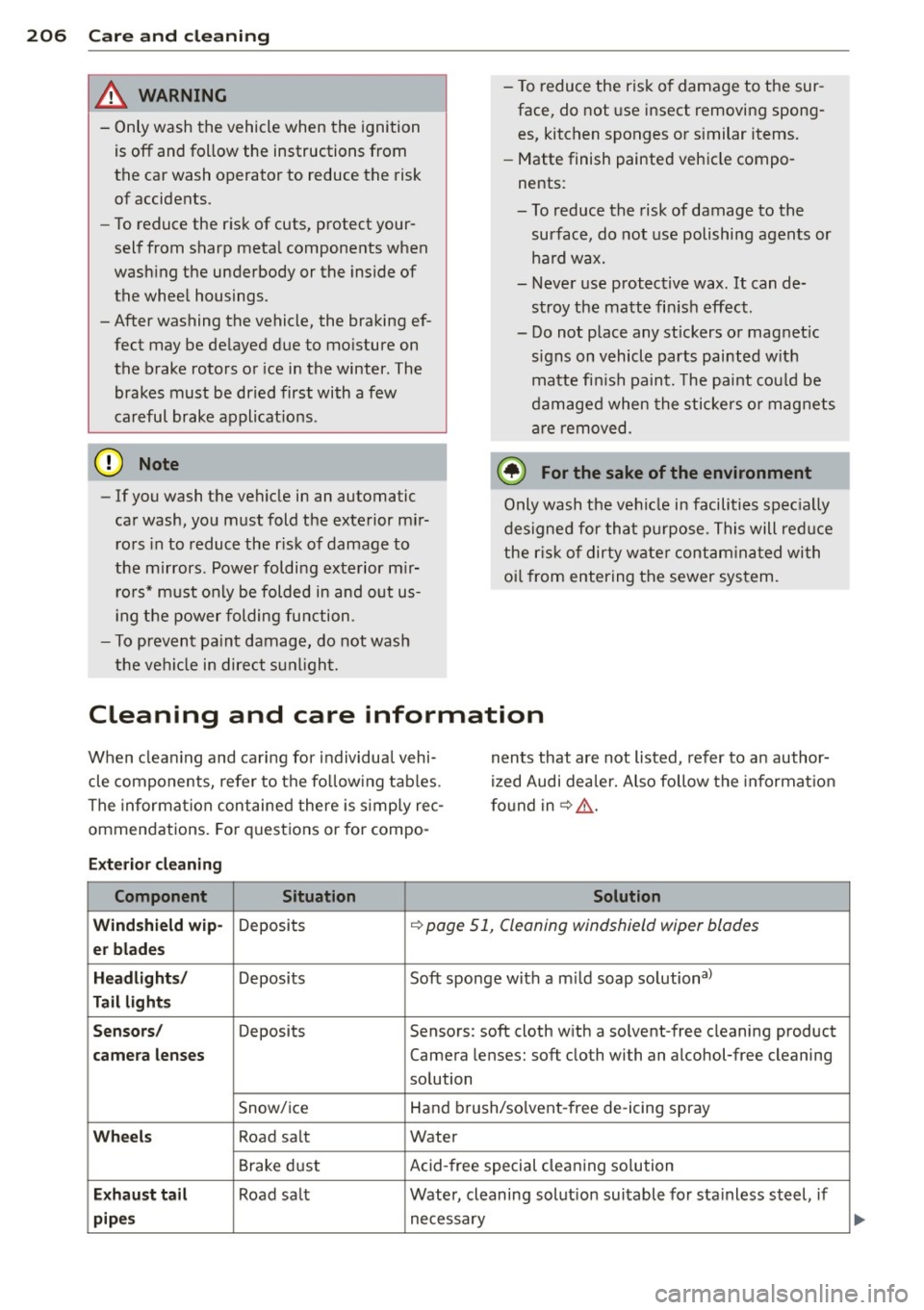
Cleaning and care information
When clea ning and ca rin g for individua l vehi
cle components, refer to the fo llow ing tab les.
The informa tion con taine d there is s imp ly rec
ommendations. Fo r quest ions or for compo -nents that ar
e not listed, refer to an author
i z ed Audi dea ler. Also follow the in format io n
f o und in¢ ,&..
Exterior cleaning
Component Situation Solution
Wind shield wip-
Deposi ts ¢ page 51, Cleaning windshield wiper blades
er blade s
H eadlights /
Deposits Soft sponge with a m ild soap solutiona>
Tail lights
Sensors /
Deposits Sensors: soft cloth with a so lvent-free cleaning product
camera lenses Camera lenses: soft cloth with an alcohol-free cleaning
so lution
Snow/ ice Hand brush/solvent -free de -icing spray
Wheels Road sa lt Water
Brake d ust Acid-free special cleaning so lution
E x haust ta il Road sa lt Water, cleaning solut ion sui table fo r sta inless steel, if
pipes necessary
Page 235 of 310
Tires and wheels
Tires
General notes
Tires may be the least appreci
ated and most abused parts of
a motor vehicle .
Tires may be the least appreci
ated and most abused parts of
a motor vehicle. Tires are, how
ever, one of the most important
parts of a vehicle, particularly
considering the comparatively
small patch of rubber on each
tire that assures that all-impor
tant contact between you, your
vehicle and the road.
Maintaining the correct tire
pressure, making sure that your
vehicle and its tires do not have
to carry more weight than they can safely handle, avoiding
damage from road hazards and
regularly inspecting tires for
damage including cuts, slashes
irregular wear and overall con
dition are the most important
things that you can do to help avoid sudden tire failure includ
ing tread separation and blow-
~ outs.
0 > co ,...., \!) 1.1'1
M 1.1'1 ,....,
Tires and wheels 233
Avoiding damage
If you have to drive over a curb
or similar obstacle, drive very
slowly and as close as possible
at a right angle to the curb.
Always keep chemicals includ ing grease, oil, gasoline and
brake fluid off the tires.
Inspect the tires regularly for
damage (cuts, cracks or blis
ters, etc.). Remove any foreign
bodies embedded in the treads.
Storing tires
Mark tires when you remove
them to indicate the direction
of rotation. This ensures you to be able to mount them correct
ly when you reinstall them.
When removed, the wheels or
tires should be stored in a cool, dry and preferably dark place.
Store tires in a vertical position if they are not mounted on
rims, in a horizontal position if
they are mounted on rims.
New tires
New tires have to be broken in
¢ _&. .
The tread depth of new tires
may vary , according to the type .,.
' •
•
' •
Page 236 of 310
234 Tires and wheels
and make of tire and the tread
pattern.
Hidden damage
Damage to tires and rims is of
ten not readily visible. If you
notice unusual vibration or the
vehicle pulls to one side, this may indicate that one of the
tires has been damaged . The
tires must be checked immedi
ately by an authorized Audi
dealer or qualified workshop.
Unidirectional tires
A unidirectional tire can be identified by arrows on the
sidewall, that point in the direc
tion the tire is designed to ro
tate. You must follow the speci
fied direction of rotation. This is
necessary so that these tires
can develop their optimum
characteristics regarding grip,
road noise, wear and hydro
planing resistance. For more in
formation
¢page 274.
&_ WARNING
New tires or tires that are
old, worn or damaged cannot provide maximum control
and braking ability. -New
tires tend to be slip
pery and must also be bro
ken-in. To reduce the risk of
losing control, a collision
and serious personal inju
ries, drive with special care
for the first 350 miles (560 km).
-Driving with worn or dam aged tires can lead to loss of
control, sudden tire failure,
including a blowout and
sudden deflation, crashes
and serious personal injuries. Have worn or damaged
tires replaced immediately.
-Tires age even if they are
not being used and can fail
suddenly, especially at high
speeds. Tires that are more
than 6 years old can only be
used in an emergency and
then with special care and at low speed.
-Never mount used tires on your vehicle if you are not sure of their "previous histo
ry." Old used tires may have
been damaged even though
the damage cannot be seen
that can lead to sudden tire
failure and loss of vehicle
control.
...
Page 237 of 310
M N
0 > co ...... \!) 1.1'1
M 1.1'1 ......
-If you notice unusual vibration or if the vehicle pulls to one side when driving, al
ways stop as soon as it is safe to do so and check the
wheels and tires for dam age.
(D Note
-Please note that summer and winter tires are de
signed for the conditions
that are typical in those sea
sons. Audi recommends using winter tires during the
winter months. Low tem peratures significantly de
crease the elasticity of
summer tires, which affects
traction and braking ability.
Tires and wheels 235
If summer tires are used in
very cold temperatures, cracks can form on the tread bars, resulting in perma
nent tire damage that can
cause loud driving noise and unbalanced tires. Audi is not
responsible for this type of
damage.
-Burnished, polished or chromed rims must not be used in winter road condi
tions. The surface of the
rims does not have suffi
cient corrosion protection
for this and could be perma
nently damaged by road salt
or similar substances.
' •
•
Glossary of tire and loading terminology
Accessory weight
means the combined weight (in
excess of those standard items
which may be replaced) of auto matic transmission, power
steering, power brakes, power
windows, power seats, radio, and heater, to the extent that
these items are available as fac
tory-installed equipment (whether installed or not).
Aspect ratio
means the ratio of the height to
the width of the tire in percent. Numbers of 55 or lower indi
cate a low sidewall for im proved steering response and
better overall handling on dry
pavement.
' •
Page 239 of 310
M N
0 > co ,...., \!) 1.1'1
M 1.1'1 ,....,
Maximum load rating
means the load rating for a tire
at the maximum permissible in
flation pressure for that tire.
Maximum loaded vehicle
weight
means the sum of:
(a) Curb weight
(b) Accessory weight
(c) Vehicle capacity weight, and
(d) Production options weight
Maximum (permissible)
inflation pressure
means the maximum cold infla
tion pressure to which a tire
may be inflated. Also called
"maximum inflation pressure."
Normal occupant weight
means 150 lbs. (68 kilograms)
times the number of occupants seated in the vehicle up to the
total seating capacity of your
vehicle.
Occupant distribution
means distribution of occu pants in a vehicle.
Outer diameter
means the overall diameter of
an inflated new tire.
Tires and wheels 237
Overall width
means the linear distance be
tween the exteriors of the side
walls of an inflated tire, includ ing elevations due to labeling,
decorations, or protective bands or ribs.
Ply
means a layer of rubber-coated
parallel cords.
Production options weight
means the combined weight of
those installed regular produc
tion options weighing over 5 lbs. (2 . 3 kg) in excess of those
standard items which they re place, not previously consid
ered in curb weight or accessory
weight, including heavy duty
brakes, ride levelers, roof rack,
heavy duty battery, and special
trim.
Radial ply tire
means a pneumatic tire in
which the ply cords that extend
to the beads are laid at sub stantially 90 degrees to the
centerline of the tread.
' •
•
' •
Page 240 of 310
238 Tires a nd whee ls
Recommended inflation
pressure
see c:::> page 236, Cold tire infla
tion pressure.
Reinforced tire
means a tire design to operate
at higher loads and at higher
inflation pressures than the
corresponding standard t ire .
Reinforced tires may be identi
fied as "XL", "xl", "EXTRA
LOAD", or "RF" on the sidewa ll.
Rim
means a meta l support for a
tire or a tire and tube assembly
upon which the tire beads are
seated .
Rim diameter
means nominal diameter of the
bead seat. If yo u change your
wheel size, you will have to pur
chase new t ires to ma tch the
new rim d iameter .
Rim size designation
means rim diameter and width.
Rim width
means nominal distance be
tween rim flanges.
Sidewall
means that por tion of a tire be
tween the tread and bead.
Speed rating (letter code)
means the speed at wh ich a tire
is designed to be driven for ex
tended periods of time . The rat
ings range from 93 mph
( 1 50 km/h) to 186 mph
( 2 98 km/h)
c:::> page 257 . You
may not find th is informat ion
on all tires because it is not re
quired by law.
The speed rating letter code,
where applicable, is molded on
the ti re sidewall and ind icates
the maximum permissible road
speeds
c:::> & in Winter tires on
page 261.
Tire pressure monitoring
system
means a system that detects
when one or more of a vehic le's
tires a re underinflated an d ill u
m inates a low tire press ure
warn ing telltale.
Tread
means that por tion of a tire
that comes into contact with
the road.
Page 241 of 310
Tires and wheels 239
Tread separation UTQG information on the tires,
means pulling away of the molded into the sidewalls.
tread from the tire carcass.
U.S. DOT Tire Identification
Treadwear indicators (TWI) Number (TIN)
'
This is the tire's "serial num-
means the projections within
•
•
the principal grooves designed ber". It begins with the letters
to give a visual indication of the "DOT" and indicates that the
degrees of wear of the tread. tire meets all federal stand-
See
r=>page 252, Tread Wear ards. The next two numbers or
Indicator (TWI) for more infor- letters indicate the plant where
mation on measuring tire wear. it was manufactured, and the
Uniform Tire Quality Grading
last four numbers represent the
week and year of manufacture.
is a tire information system de- For example,
veloped by the United States
DOT ... 2214 ...
National Highway Traffic Safety
Administration (NHTSA) that is means that the tire was pro-
designed to help buyers make duced in the 22nd week of
relative comparisons among 2014. The other numbers are
tires. The UTQG is not a safety marketing codes that may or
rating and not a guarantee that may not be used by the tire
a tire will last for a prescribed manufacturer. This information
number of miles (kilometers) or is used to contact consumers if
perform in a certain way. It a tire defect requires a recall.
simply gives tire buyers addi-
Vehicle capacity weight
tional information to combine means the rated cargo and lug-
with other considerations, such gage load plus 1
SO lbs.
as price, brand loyalty and deal- (68 kilograms) times the vehi-
er recommendations. Under cle's total seating capacity as
UTQG, tires are graded by the listed on the label located on
' M tire manufacturers in three N the driver's side 8-pillar.
•
0 ...
> areas: treadwear, traction, and co ...... \!) 1.1'1 temperature resistance. The M 1.1'1 ......
Page 243 of 310
Tires and wheels 241
Tire pressure generally refers to tant things you can do to help
the amount of air in a tire that avoid sudden tire failure. Un-it needs it to do its job and derinflated tires are a major
safely carry the combined load cause of sudden tire failure. of the entire vehicle and its con- Keeping tires at the right pres-
' •
•
tents. Tire pressure is measured sure is also important for safe
in kilopascals (kPa), the inter- and responsive vehicle han-
national measuring unit and in dling, traction, braking and
pounds per square inch (PSI) . load carrying.
Tire pressures
Tire pressure is based in part on are particularly important
the vehicles design and load when the vehicle is being driv-
limit - the greatest amount of en at higher speeds, and then
weight that the vehicle can car -especially when heavily loaded
ry safely and the tire size. The even within the permissible
proper tire pressure is frequent-load-carrying capacities ap-
ly referred to as the "recom-proved for your vehicle.
mended cold tire inflation pres-
The recommended tire pres-
sure." Air in the tires expands sures for your Audi depend on
when the tire heats up because the kind of tires on your vehicle
of internal friction when it flex- and the number of passengers
es in use. The tire pressure is and/or amount of luggage you
higher when the tire has will be transporting.
warmed up than when it is The tire pressure label is locat-
"cold." It is the inflation pres-
ed on the driver's side B-pillar.
sure in a "cold" tire that counts.
Therefore, you should never let The tire pressure label lists the
recommended cold tire infla-
air out of a warm tire to match
"cold tire inflation pressure" tion pressures for the vehicle at
its maximum capacity weight
recommendations. The tires
would then be underinflated and tires that were on your ve
-
and could fail suddenly. hicle at the time it was manu-
' M factured
. • N
0 > co Maintaining proper tire pres-
...... \!)
sure is one of the most impor-1.1'1
M 1.1'1 ......