wheel AUDI S3 2015 Repair Manual
[x] Cancel search | Manufacturer: AUDI, Model Year: 2015, Model line: S3, Model: AUDI S3 2015Pages: 310, PDF Size: 76.15 MB
Page 244 of 310
242 Tires and wheel s
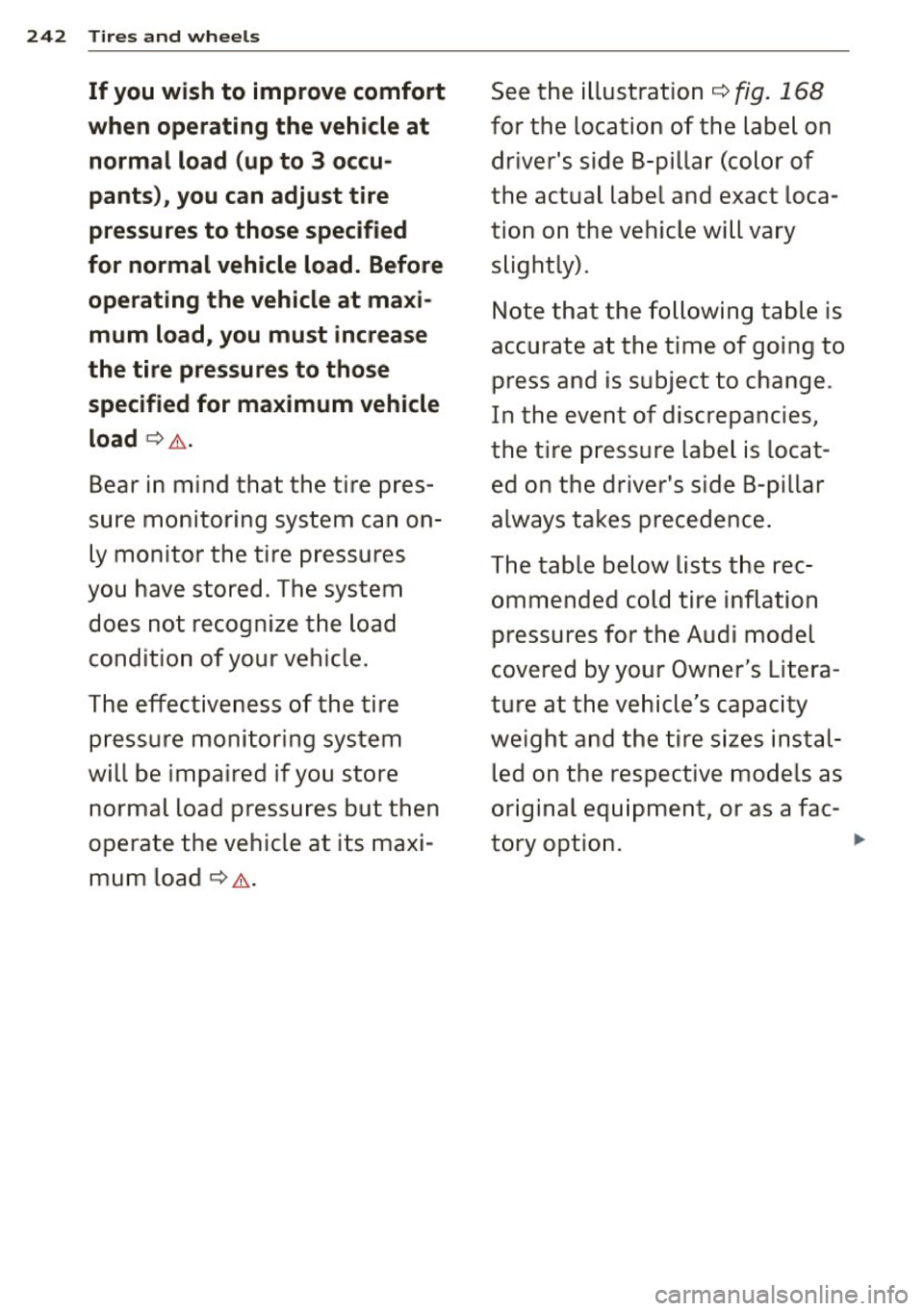
If you wish to improve comfort See the illustration c::;, fig. 168
when operating the vehicle at for the locati on of the labe l on
normal load (up to 3 occu -driver's side B-pillar (color of
pants), you can adjust tire the actual label and exact loca-
pressures to those specified tion on the vehic le will vary
for normal vehicle load. Before slight ly) .
operat ing the vehicle at maxi -Note that the following table is
mum load , you must increase accurate at the time of going to
the ti re pressu res to those press and is subject to change .
specified for maximum vehicle In the event of discrepancies,
load c::;, &. the tire pressure labe l is locat-
Bear in mind that the tire pres- ed on the driver's side 8-pi llar
sure monitoring system can on -always takes precedence .
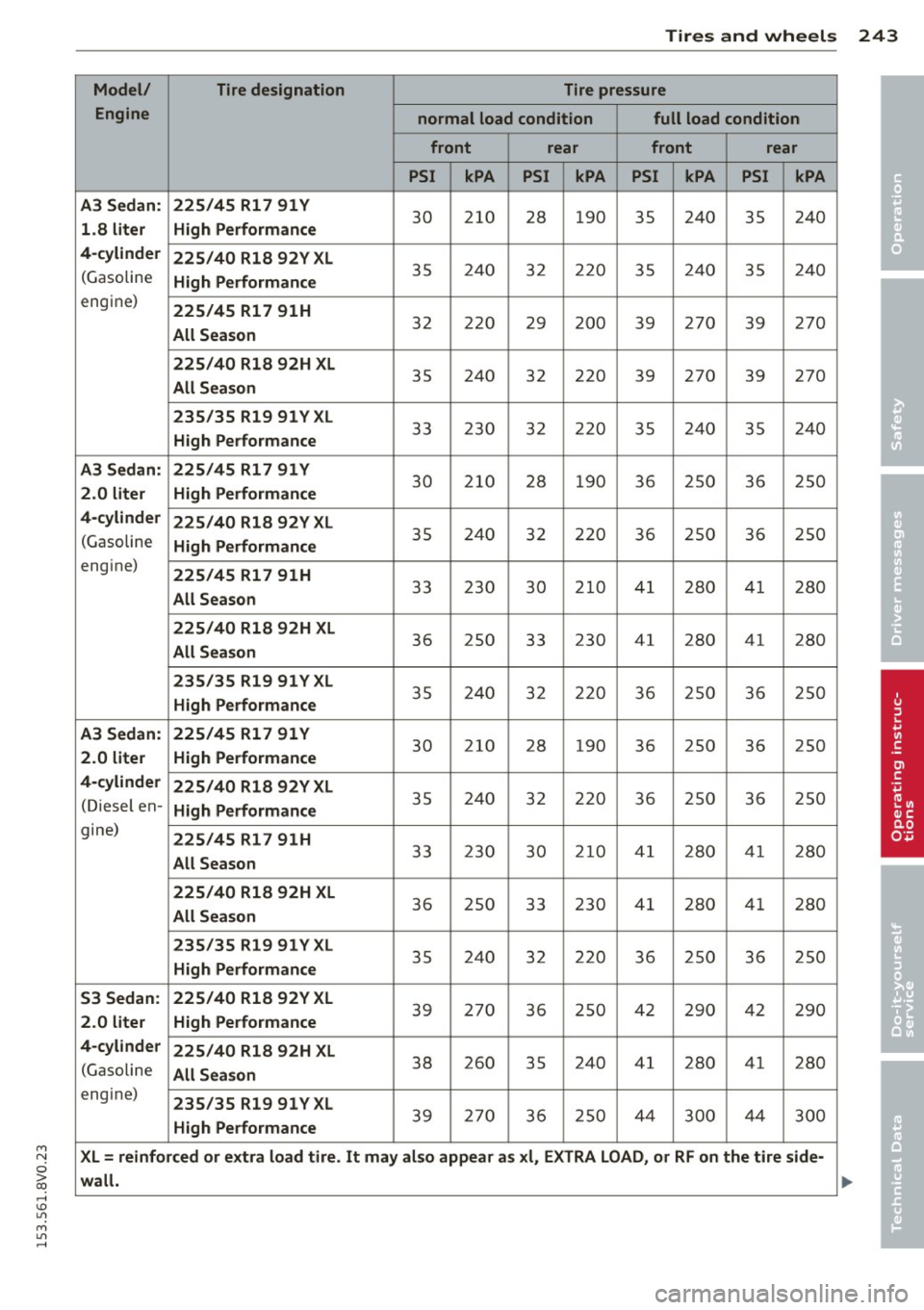
ly monitor the tire pressures The table below lists the rec-
you have stored . The system
ommended cold tire inflation
does not recogn ize the load
pressures for the Audi model
condition of your vehic le.
covered by your Owner's Litera-
T he effectiveness of the tire ture at the vehicle's capacity
pressure monitoring system weight and the tire sizes instal -
will be impaired if you store led on the respective mode ls as
normal load pressures but then original equipment, or as a fac-
operate the vehicle at its maxi- tory option.
...
mum load c::;, & .
Page 245 of 310
M N
0 > co ,...., \!) 1.1'1
M 1.1'1 ,....,
Model/ Tire designation
Engine
A3 Sedan: 225 /45 Rl7 91 Y
1 .8 liter High Performance
4-cylinder 225/40 Rl8 92Y XL
(Gasoline High Performance
engine) 225/45 Rl7 91H
All Season
225 /40 Rl8 92H XL
All Season
235/35 Rl9 91 Y XL
High Perfo rmance
A3 Sedan: 225 /45 Rl 7 91 Y
2.0 liter High Performance
4-cylinder 225/40 Rl8 92Y XL
(Gasoline High Performance
engine) 225/45 R17 91H
All Season
225 /40 Rl8 92H XL
All Season
235 /35 Rl9 91 Y XL
High Performance
A3 Sedan: 225/45 Rl 7 91 Y 2.0 liter High Performance
4-cylinder 225/40 Rl8 92Y XL
(Diesel en- High Performance
gine) 225/45 Rl7 91H
All Season
225 /40 Rl8 92H XL
All Season
235 /35 Rl9 91 Y XL
High Performance
53 Sedan : 225 /40 R18 92Y XL
2.0 liter High Performance
4 -cylinder
225/40 Rl8 92H XL
(Gasoline All Season
engine) 235/35 Rl9 91 Y XL
High Performance
Tires and wheels 243
Tire pressure
normal load condition front
rear
PSI kPA PSI kPA
30 210 28 190
35 2
40 32 2 20
32 220 29 200
35 240 32 220
33 230 3 2 220
30 210 28 190
35 240 3 2 220
33 2
30 30 2 10
36 250 33 230
35 240 3 2 220
30 210 28 190
35 240 32 220
33 230 30 2 10
36 250 33 230
35 2
4 0
32 220
39 270
36 250
38 260 35 240
39 270 36 250 full load condition
front
rear
PSI kPA PSI kPA
35 240
35 240
35 2 40 3 5 24 0
39 270
39 270
39 2 70 39 270
35 2 40 35 2 40
36 250 36 250
36 2 50 3 6 25 0
41 280 41 280
41 280 41
280
36 2 50 36 250
36 250
36 250
36 250 36 2 50
41 280 41 280
41 280 41
280
36 2 50 3 6 250
42 290 42 290
41 280 41
280
44 300 44 300
•
•
XL= reinfor ced or extra load tire. It may al so appear a s xl , EXTRA LOAD , or RF on the tire side-
wall.
Page 246 of 310
244 Tires and wheels
The correct tire pressure for the
spare wheel is located on a la
bel on the driver's side 8-pillar .
Because technical changes may
be made to vehicle equipment
during the model year, always
compare the tire size designa
tion on the tire pressure label
on your vehicle with the tires on
your vehicle. Make sure that the
tire size information on the ve
hicle label is the same as the
size of the tires on the vehicle.
This is especially important if
the vehicle belongs to someone else or you bought the vehicle
with different rims/tires or you bought the vehicle as a previ
ously owned vehicle.
Remember, your safety and
that of your passengers also de
pends on making sure that load
limits are not exceeded. Vehicle
load includes everybody and ev
erything in and on the vehicle.
These load limits are technical
ly referred to as the vehicle's
Gross Vehicle Weight Rating
("GVWR"). The Gross Axle
Weight Rating ("GAWR") is the maximum load that can be ap
plied at each of the vehicle's
two axles. The Gross Vehicle Weight Rating and the Gross
Axle Weight Rating are listed
on the safety compliance stick
er label located on the driver's
side 8-pillar.
The tire pressure
label on your Audi lists the
maximum combined weight of
all of the occupants and lug gage or other cargo that the ve
hicle can carry. For the location
of the tire pressure label
~fig. 168.
A WARNING -
Overloading a vehicle can
cause loss of vehicle control,
a crash or other accident, se
rious personal injury, and
even death.
-Carrying more weight than your vehicle was designed to carry will prevent the ve
hicle from handling properly
and increase the risk of a
loss of vehicle control.
-The brakes on a vehicle that has been overloaded may not be able to stop the vehi
cle within a safe distance.
-Tires on a vehicle that has been overloaded can fail
suddenly causing loss of
control and a crash.
Page 247 of 310
M N
0 > co ...... \!) 1.1'1
M 1.1'1 ......
-Always make sure that the total load being transported - including the weight of a
trailer hitch and the tongue
weight of a loaded trailer - does not make the vehicle heavier than the vehicles
Gross Vehicle Weight Rat
ing.
_& WARNING
- Incorrect tire pressures
and/or underinflation can
lead to a serious or fatal ac
cident.
- Incorrect tire pressures
and/or underinflation cause
increased tire wear and can
affect the handling of the
vehicle.
-Incorrect tire pressures and/or underinflation can
also lead to sudden tire failure, including a blowout
and sudden deflation, caus ing loss of vehicle control.
Tires and wheels 245
Checking tire pressure
The correct tire pressure for the
tires originally installed on
your vehicle is listed on the tire pressure label located on driv er's side 8-pillar.
The recommended tire pres
sures are on the tire pressure label and in the table
¢ page 240~ Cold tire inflation
pressure.
This means that the
pressure must be checked and
adjusted when the tire has not
been driven for more than a
couple of miles (kilometers) at
low speeds during the previous
three hours. Air in the tires ex pands when the tire heats up as
a result of internal friction as it
flexes in use. The tire pressure is higher when the tire has
warmed up than when it is "cold ."
It is the inflation pressure in a
"cold" tire that counts. There
fore, you should never let air
out of a warm tire to match
"Cold tire inflation pressure" recommendations ¢
page 240.
The tires would then be under
inflated and could fail sudden
ly .
...
' •
•
' •
Page 248 of 310
246 Tires and wheels
The tire pressure label on your sures. Check all of the tires and
Audi lists the recommended be sure not to forget the spare cold tire inflation pressures at tire. If the pressure in any tire is
maximum capacity for the new, too high when the tire is "cold,"
original equipment tires that let air out of the tire slowly
were on your vehicle at the time with the edge of the tire gauge
it was manufactured. For the and keep checking the pressure
location of the label until you reach the pressure
¢ page 240, fig. 168. that is correct for the load (pas-
Most tires lose air naturally sengers and luggage) and
kind
over time. They can also lose of driving you plan to do.
some air if you drive over a pot- If the pressure in any tire is too
hole or hit a curb while parking. low, note the difference be-
It is usually not possible to see tween the pressure in the cold
whether the radial tires used tire and the pressure you need
today are underinflated just by and add the air that you need to
looking at them. reach the correct pressure for
Therefore, be sure to check tire the vehicle
load (passengers
pressures at least once a month and luggage) for the tires on
and always before going on a your vehicle as listed on the on
long trip. Make sure to take the your vehicle and in this manual
number of people and the and the kind of driving you plan
amount of luggage into ac- to do.
count when adjusting tire pres-
Never exceed the maximum in-
sure for a trip -even one that flation pressure listed on the
you would not consider to be tire sidewall for any reason.
"long." See ¢page 249, Tires Remember that the vehicle
and vehicle load limits for more
manufacturer, not the tire man-
important information. ufacturer, determines the cor-
Always use an accurate tire rect tire pressure for the tires pressure gauge when checking on your vehicle.
..
and adjusting inflation pres-
Page 249 of 310
Tires and wheels 24 7
It is important to check the tire sure for the spare wheel
pressure when the tires are
¢page 268.
cold.
When should I adjust the
-Read the required tire pres-tire pressures?
'
sure from the tire pressure la-
Adjust the tire pressure to the •
•
bel. The tire pressure label is load you are carrying. After
located on the driver's side B- changing a wheel
or replacing
pillar. wheels you have to adjust the
-Turn the valve stem cap coun- tire pressures on all wheels. In
ter-clockwise to remove it addition, you must then store
from the tire valve. the new tire pressures in the
-Place the air pressure gauge tire pressure monitoring sys-
on the valve. tern
¢ page 264.
-The tire pressures should only
A WARNING
be checked and adjusted when
Incorrect tire pressures and/
the tires are cold . The slightly
or underinflation can lead
raised pressures of warm tires
sudden tire failure, loss of
must not be reduced.
control, collision, serious per-
-Adjust the tire pressure to the
sonal injury or even death.
load you are carrying.
-When the warning symbol
-Reinstall the valve stem cap
RI] appears in the instru-
on the valve.
ment cluster, stop and in-
When should I check the tire spect the tires.
pressure? -Incorrect tire pressure and/
The correct tire pressure is es- or underinflation can cause
pecially important at high increased tire wear and can
speeds. The pressure should affect the handling of the
therefore be checked at least vehicle and stopping ability.
once a month and always be- -Incorrect tire pressures
fore start ing a journey. Do not
and/or underinflation can
' • M N
forget to check the tire pres-0 > co .... \!) 1.1'1
M 1.1'1 ....
Page 250 of 310
248 Tires and wheels
also lead to sudden tire failure, including a blowout
and sudden deflation, caus ing loss of vehicle control.
-The driver is responsible for the correct tire pressures for
all tires on the vehicle. The
applicable pressure values
are located on a sticker on
the driver's side B-pillar.
-Only when all tires on the vehicle are filled to the cor
rect pressure, the tire pres
sure monitoring system can
work correctly.
-The use of incorrect tire
pressure values can lead to
accidents or other damage.
Therefore it is essential that
the driver observe the speci
fied tire pressure values for
the tires and the correct
pressures for the function of
the tire pressure monitoring
system.
-Always inflate tires to the recommended and correct
tire pressure before driving off.
- Driving with underinflated
tires bend more, letting
them get too hot resulting
in tread separation, sudden tire failure and loss of con
trol.
-Excessive speed and/over
loading can cause heat
build-up, sudden tire failure
and loss of control.
-If the tire pressure is too
low or too high, the tires
will wear prematurely and the vehicle will not handle
well.
-If the tire is not flat and you
do not have to change a
wheel immediately, drive at
reduced speed to the near
est service station to check
the tire pressure and add air
as required.
(D Note
Driving without valve stem
caps can cause damage to
the tire valves . To prevent
this, always make sure that
factory installed valve stem caps on all wheels are securely mounted on the valve.
@ For the sake of the environment
Underinflated tires will also
increase the fuel consump
tion .
Page 251 of 310
M N
0 > co ,...., \!) 1.1'1
M 1.1'1 ,....,
Tires and vehicle load limits
There are limits to the amount of load or weight that any vehi
cle and any tire can carry. Ave
hicle that is overloaded will not
handle well and is more diffi
cult to stop. Overloading can
not only lead to loss of vehicle
control, but can also damage
important parts of the vehicle
and can lead to sudden tire fail
ure, including a blowout and
sudden deflation that can cause
the vehicle to crash.
Your safety and that of your
passengers also depends on
making sure that load limits are
not exceeded. Vehicle load in
cludes everybody and every
thing in and on the vehicle.
These load limits are technical
ly referred to as the vehicle's
Gross Vehicle Weight Rating
("GVWR").
The "GVWR" includes the
weight of the basic vehicle, all
factory installed accessories, a
full tank of fuel, oil, coolant and other fluids plus maximum
load. The maximum load in
cludes the number of passen
gers that the vehicle is intend-
Tires and wheels 249
ed to carry ("seating capacity")
with an assumed weight of 1
SO lbs (68 kg) for each pas
senger at a designated seating
position and the total weight of
any luggage in the vehicle. If
you tow a trailer, the weight of
the trailer hitch and the tongue
weight of the loaded trailer must be included as part of the
vehicle load.
The
Gross Axle Weight Rating
("GAWR") is the maximum load
that can be applied at each of
the vehicle's two axles.
The Gross Vehicle Weight Rat
ing and the Gross Axle Weight
Rating are listed on the safety
compliance sticker label locat
ed on the driver's side 8-pillar.
Your Audi has 5 seating posi
tions, 2 in the front and 3 in the rear for total seating capacity
of 5. Each seating position has
a safety belt¢
page 135, Safe
ty belts.
The fact that there is an upper
limit to your vehicle's Gross Ve
hicle Weight Rating means that
the total weight of whatever is
being carried in the vehicle (in
cluding the weight of a trailer ""
' •
•
' •
Page 252 of 310
250 Tires and wheels
hitch and the tongue weight of
the loaded trailer) is limited.
The more passengers in the ve hicle or passengers who are
heavier than the standard
weights assumed mean that
less weight can be carried as
luggage .
The tire pressure label on your
Audi also lists the maximum combined weight of all of the
occupants and luggage or other
cargo that the vehicle can carry.
For the location of the label
q page 240, fig. 168 .
_& WARNING
~ -
Overloading a vehicle can
cause loss of vehicle control,
a crash or other accident, se
rious personal injury, and
even death.
-Carrying more weight than
your vehicle was designed to carry will prevent the vehicle from handling properly
and increase the risk of the
loss of vehicle control.
-The brakes on a vehicle that
has been overloaded may
not be able to stop the vehi
cle within a safe distance . -Tires
on a vehicle that has
been overloaded can fail
suddenly, including a blow
out and sudden deflation,
causing loss of control and a
crash.
-Always make sure that the
total load being transported
- including the weight of a
trailer hitch and the tongue
weight of a loaded trailer -
does not make the vehicle
heavier than the vehicles
Gross Vehicle Weight Rat
ing .
Determining correct load
limit
Use the example below to cal
culate the total weight of the
passengers and luggage or oth
er things that you plan to trans port so that you can make sure
that your vehicle will not be
overloaded.
Steps for Determining
Correct Load Limit
1. Locate the statement "THE
COMBINED WEIGHT OF OC
CUPANTS AND CARGO
SHOULD NEVER EXCEED XXX .,..
Page 253 of 310
M N
0 > co ,...., \!) 1.1'1
M 1.1'1 ,....,
KG OR XXX LBS" on your ve
hicle's placard (tire inflation
pressure label)
c:> page 240,
fig. 168.
2. Determine the combined
weight of the driver and pas sengers that will be riding in
your vehicle.
3 . Subtract the combined
weight of the driver and pas sengers from
"XXX" kilo
grams or
"XXX" pounds
shown on the sticker
c:> page 240 , fig. 168.
4. The resulting figure equals
the available amount of car
go and luggage load capaci
ty. For example, if the "XXX"
amount equals 1400 lbs.
and there will be five 150 lbs. passengers in your vehi
cle, the amount of available
cargo and luggage load ca
pacity is 650 lbs. (1400-750 (5
X 150) = 650 lbs.)
5. Determine the combined weight of luggage and cargo being loaded on the vehicle.
That weight may not safely
exceed the available cargo
and luggage load capacity
calculated in Step 4.
Tires and wheels 251
6. If your vehicle will be towing a trailer, load from your trail
er will be transferred to your
vehicle. Consult this manual
to determine how this re
duces the available cargo
and luggage load capacity of
your vehicle.
~check the tire sidewall
(¢ page 254, fig . 172) to de
termine the designated load rating for a specific tire.
' •
•
' •