ECO mode AUDI S6 2009 Owner's Guide
[x] Cancel search | Manufacturer: AUDI, Model Year: 2009, Model line: S6, Model: AUDI S6 2009Pages: 398, PDF Size: 43 MB
Page 193 of 398
______________________________________________________ H_o_ m.....: e..:L:.; i __ n ;..k __ ® .:.R __ _
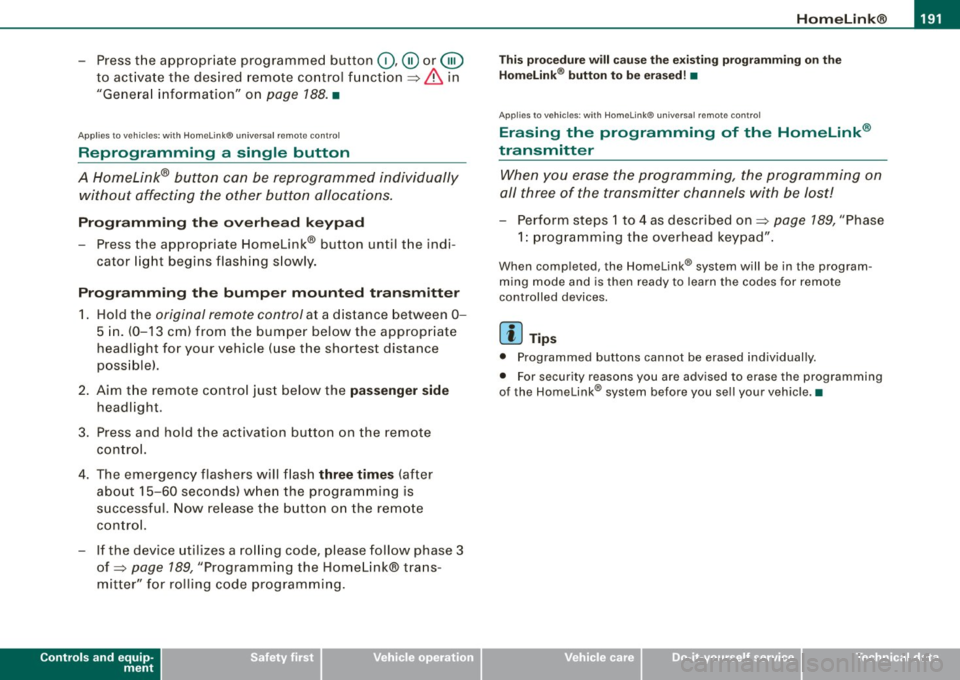
-Press the appropriate programmed button G),@ or @
to activate the desired remote control function~
& in
"General information" on
page 188. •
Applies t o ve hicl es: wit h Hom elin k® universal re mote co nt ro l
Reprogramming a single button
A Homelink ® button can be reprogrammed individually
without affecting the other button a/locations.
Programming the overhead keypad
- Press the appropriate Homelink® button unt il the indi
cator light begins flashing slowly.
Programming the bumper mounted transmitter
1. Hold the original remote control at a distance between 0-
5 in. (0-13 cm) from the bumper below the appropriate
headlight for your vehicle (use the sho rtest distance
possible) .
2. Aim the remote control just below the
passenger side
headlight.
3. Press and hold the activation button on the remote control.
4. The emergency flashers will flash
three times (after
about
15-60 seconds) when the programm ing is
successful. Now release the button on the remote
control.
- If the device ut ilizes a rolling code, please follow phase 3
of ~
page 189, "Programming the Homelink® trans
mitter" for rolling code programming.
Controls and equip
ment This procedure
will cause
the existing programming on the
Homelink ® button to be erased! •
App lies t o ve hicles : with Homeli nk® universa l re m ote contro l
Erasing the programming of the Homelink ®
transmitter
When you erase the programming , the programming on
all three of the transmitter channels with be lost!
- Perform steps 1 to 4 as descr ibed on~ page 189, "Phase
1: programm ing the overhead keypad ".
When completed , the Homelin k® system will be in the program
ming mode and is then ready to learn the cod es for remote
controlled devices.
(I) Tips
• Programmed buttons cannot be erased individually.
• For security reasons you ar e advis ed to erase the programming
of the Homelink ® system befo re you sell your vehicle. •
I • •
Page 232 of 398
-Airbag system ----=--a.---------------------------------------
& WARN ING (continued )
• Always make sure that the side airbag can inflate without inter
fe rence :
- Never install seat covers or replacement upholstery over the
front seatback s that have not been spe cifically approved by
Audi.
- Never use additional seat cushions that cover the areas
where the side airbags inflate .
- Damage to the original seat covers or to the seam in the area
of the side airbag module must always be repaired immedi
ately by an authorized Audi dealer .
• The airbag system can be activated only once. After an airbag
ha s inflated , it must be replaced by an authorized Audi de aler or
qualified technician who has the technical information , training
and special equipment necessary .
• The airbag system can be deployed only once. After an airbag
has been deployed , it must be repla ced with new repla cement
parts designed and approved especially for your Audi model
version . Replacement of complete airbag systems or airbag
components must be performed by qualified workshops only .
Make sure that any airbag service action is entered in your Audi
Warranty
& Maintenance booklet under AIRBAG REPLACEMENT
RECORD .
• For safety reasons in severe accidents , the alternator and
starter are separated from the vehicle battery with a pyrotechn ic
circuit interrupter.
-Work on the pyrotechni c circuit interrupter must only be
performed by a qualified dealer -risk of an accident!
- If the vehi cle or the circuit inte rrupter is scrapped , all appli
cable safety precautions must be followed.
W For the sake of the environment
Undeployed a irba g mo dules and prete nsioners might be c lass if ied
as Perchlorate Material -special handling may apply, see
www.dtsc.ca.gov/hazardouswaste/p erc hlo ra te. W hen t he ve hicle or
parts of the restraint system inc luding airbag modules and safety
b elts wi th pre tens io ners a re s crappe d, all ap plicab le laws a nd reg u
l ations must be observed . Your authorized Audi dealer is fam iliar
wit h these req uire ments an d we rec ommend th at yo u have your
dea ler perform this service for you. •
Other things that can affect Advanced Airbag
performance
Changing the vehic le 's suspension system can change the way that
t h e Adva nced Ai rbag Syste m performs in a c rash. Fo r example,
using tire -rim combinations not approved by Audi, lowering the
ve hicle, c hang ing the s tif fne ss of the su spe nsio n, in cl ud in g th e
springs, suspens ion struts, shoc k absorbers etc. can change the
f o rce s tha t are m eas ure d b y the air bag senso rs and se nt to the e lec
tronic control unit. Some suspension changes can, for example,
increa se the fo rce levels measured by the senso rs and ma ke the
airbag system dep loy in crashes in which it wou ld not deploy if the
changes had not been made . Othe r kinds of changes may reduce
t h e force lev els measured by the sensors and preve nt the airbag
from dep loying when it sho uld.
T he s ensors i n the safet y be lt buc kle for the driver a nd fr ont
passenger seat tell the e lectronic contro l modu le if the safety belt is
l a tc h ed or not. If the sa fety belt is b eing use d, th e front airbag wi ll
deploy at a slightly higher rate of v ehic le dece leration than if the
safety be lt is n ot be ing use d. T herefo re, i n a partic ular collision, it i s
possible that an air bag wi ll not deploy at a seating position where
the safety be lt i s being used but wi ll inflate at the position whe re the
sa fety be lt is not bei ng used. It is important tha t noth ing i nte rfer e
with the safety belt buckles so that the sensors can send the correct
i nfo rmati on about saf ety belt use to the e lectr onic co ntrol unit. .,.
Page 242 of 398
-Child Safety -----<------------------------------
restraints and for the different models of the same kind of child
restraint offered by child restraint manufacturers.
The weight ranges for the individual types, makes and models of
child restraints that the NHTSA has specified in the Safety Standard
together with the weight ranges of typical infants and typical 1 year old child have been stored in the control unit of the Advanced
Airbag System. When a child restraint is being used on the front passenger seat with a typical 1 year-old child, the Advanced Airbag
System compares the weight measured by the weight sensing mat
with the information stored in the electronic control unit.
The electronic control unit also registers the tension on the front
passenger safety belt. The tension on the safety belt for the front
passenger seat will be different for an adult who is properly using
the safety belt as compared to the tension on the belt when it is
used to attach a child restraint to the seat. The sensor below the
latch for the safety belt for the front seat passenger measures the
tension on the belt . Th e input from this sensor is then used with the
weight to "decide" , whether there is a chi ld restraint with a typica l 1
year-old child on the front passenger seat and whether or not the
airbag must be turned off.•
Child restraints and Advanced Airbags
Regard less of the child restraint that you use, make sure that it has
been certified to meet United States Federal Motor Vehicle Safety
Standards and has been certified by its manufacturer for use with
an airbag. Always be sure that the child restraint is properly
installed at one of the rear seating positions. If in exceptional
circumstances you must use it on the front passenger seat, carefully read all of the information on child safety and Advanced Airbags
and heed all of the applicable WARNINGS. Make certain that the
child restraint is correctly recognized by the weight -sensing mat
inside the front passenger seat, that the front passenger airbag is
turned off and that the airbag status is always correctly signaled by
the
PASSENGER AIR BAG OFF light . Many
types and models of child restraints have been available over
the years, new mode ls are introduced regularly incorporating new
and improved designs and older models are taken out of produc
tion. Child restraints are not standardized. Child restraints of the
same type typically have different weights and sizes and different
'footprints,' the size and shape of the bottom of the child restraint
that sits on the seat, when they are installed on a vehicle seat. These
differences make it virtually impossible to certify compliance with
the requirements for advanced airbags with each and every child
restraint that has ever been sold in the past or will be sold over the
course of the usefu l life of your vehicle.
For this reason, the United States National Highway Traffic Safety
Administration has pub lished a list of specific type, makes and
models of child restraints that must be used to certify compliance
of the Advanced Airbag System in your vehicle with the suppression
requirements of Federal Motor Vehicle Safety Standard 208. These
child restraints are:
A. Car beds, manufactured on or after September 1,
2004:
• Cosco Dream Ride 02-719
B. Rear facing child restraint systems, manufactured
on or after September 1, 2004:
(When the restraint system comes equipped with a removable base,
compliance has to be certified with or without the basel.
• Britax Handle with Care 191
• Century Assura 4553
• Century Smart Fit 4543
• Cosco Arriva 02727
• Evenflo Discovery Adjust Right 212
• Evenflo First Choice 204
• Graco Infant 8457
Page 265 of 398
The direction in which the driver wishes to travel is determined with
t he aid of the steering angle and vehicle speed and is continua lly
compared with the actual behavior of the vehicle. If the two do not
match, for example, when the vehic le starts hydrop laning on a wet
road, ESP will automatically brake the appropriate whee l to correct
the prob lem.
The vehicle is then stab ilized by the forces acting on the whee l
during braking. If the vehicle is
oversteering (rear tends to skid out
of the turn), the brakes are mainly app lied on the wheel that is on
the outside of the curve. In the case of a vehicle that is
understeering
(tendency to sl ide out of the curve), the brakes are applied at the
rear wheel that is on the inside of the curve . An acoustic signal indi
cates when ESP brake application cuts in
~ & .
The system operates across the entire speed range in combination
with the ABS system
~ page 266 . If the Anti -Lock Brake System
(ABS) malfunctions, the ESP wi ll be out of action as well.
Ac tivat ing
When you turn on the eng ine, ESP will automatically be activated
and will perform a se lf -test . As soon as the test is comp leted, the
system is in norma l operating mode.
You can activate a deactivated ESP or deactivated ESP/ASR if required by pressing the~
page 262, fig. 232 button . When they are
activated, the message
E S P/AS R on appears briefly in the display.
D eactiv ating
The ESP should normally be activated al l the time . If necessary, you
can deactivate An ti- Slip Regulation (ASR) or the E lectronic Stabiliza
tion Program (ESP) by pressing the button~
page 262, fig. 232 .
• Dea ct iv at ing A SR: Tap the button . In certain exceptional situa
tions (e.g. driving with t ire chains) , the Anti-Sl ip Regulation (ASR)
can be deactivated ~
page 264. The message ASR off appears in the
display as we ll.
• Dea ctiv at ing E SP/ASR Press the button for more than 3 seconds.
With the ESP/ASR deactivated, the ESP check light comes on, see
Controls and equip
ment Safety first Vehicle operation
In
te llig ent tec hn olo gy
~ page 18 . The message ES P sw itched off appears in the disp lay as
we ll.
& WARNING
The Electroni c Stabili zation Program i s never thele ss subject to the
la ws o f physics . It is p articularl y import ant t o pay a ttent ion t o th is
f a ct on wet and slippery road s. It is ther efore important tha t y ou
a lw ays a dapt your dr iving to the c ondit ion of th e ro ad and t raffi c
c ondition s. Do n ot allow the inc rea sed safety pro vided b y th e Elec
tr on ic S ta bili zatio n Pr ogram sys tem to lull you in to acc epting
add iti onal safet y risk s. C
Electronic differential tock (EDL)
The electronic differential lock monitors the rotational
speed of the drive wheels.
Gener al note s
The electronic differential lock (EDU helps the car to start moving,
accelerate and c limb a gradient on surfaces providing poor or
almost no grip . Without EDL, this would be difficult, if not impos
sib le .
How th e sys te m wo rk s
The EDL operates automatical ly . It monitors the rotational speed of
the drive wheels on an axle with the he lp of the ABS sensors
~ page 266 . If a noticeable difference in rotational speed between
the drive wheels on one axle is detected (e.g. on slippery ground
on
one side),
the spinning wheel is braked, thereby transferring power
to the other drive wheel or whee ls (a ll -whee l drive) . Th is is done up
to a speed of about 60 mph ( 100 km/h). Noises from the brake
system signal that wheel spin is being control led .
Dr iving off
When driving off , always be sure to keep road conditions in mind as
you accelerate. If one drive wheel spins because it is on a surface
Iii>
Vehicle care Do-it-yourself service Technical data
Page 275 of 398
- Lack of proper maintenance as wel l as improper use of the
vehic le wi ll impair the func tion of the emission con tro l system
and could lead to damage.
<£> For the sake of th e envir onm ent
Even when the Emission Control System is operating properly, the
exhaust gas can have a su lfur -like exhaust gas smell under some
operating states . This depends on the sulfur content of the fuel
being used. Using a different brand of fue l may help, or filling the
tank with lead-free super grade gasoline. •
Avoid damaging the vehicle
When you are driving on poor roads, or over curbs, steep ramps,
etc., make certain that low- lying parts such as spoi lers and exhaust
system parts do not bottom out and get damaged.
This is especially true for vehicles with low-slung chassis (sports
chassis) * and fully loaded vehicles .
a
Operate your vehicle economically
and minimize pollution
General
Your personal style of driving will determine the economy
of your vehicle, as well as exhaust and noise levels.
Fuel economy, environmental impact, and wear on your engine,
brakes and tires largely depend on three factors:
• your personal driving style
• operating cond itions
• technica l limitations
Controls and equip
ment Safety first Vehicle operation
Dri
ving and environm ent
If you anticipate what you need to do next and drive economica lly,
you can easily cut your fuel consumption by 10 -15 percent . This
section wil l give you some tips on how you can help the environ
ment and your pocketbook.
[ i ] Tips
The consumption estimates as published by ENV IRONMENTAL
PRO TEC TION AGENCY (EPA) and Transport Canada may not corre
spond to your actua l consumption on the road, which wi ll vary
depending upon vehic le load and speed, road and weather condi
tions, trip length, etc. •
Drive smoothly and keep a lookout ahead
Vehicles use the most fuel when they ore accelerating.
-Avoid unnecessary accelerat ing and braking.
Vehicles use the most fuel when they are accelerating . If you antici
pate what is going to happen next, you wi ll need to brake less and,
thus, acce lerate less. Let the vehicle coast whenever possib le - for
examp le when you see that the next traffic light is red. •
Avoid full throttle
Driving at moderate speeds saves fuel and improves your
mileage.
-Try and keep well below your car 's max imum speed.
Acce lerating gently reduces fue l consumption , engine wear, and
does not disturb the environment.
Fue l consumption, exhaust emissions and engine noise increase
disproportionately at high speeds . If you drive at approximate ly
three quarters of top speed, fuel consumption wil l be reduced by
Vehicle care Do-it-yourself service Technical data
Page 278 of 398
ll}JI __ T_ r _a_ il_e _r_ t_ o_ vv_ in__... g,_ __________________________________________________ _
Trailer towing
Driving with a trailer
General information
Your Audi was designed primarily for passenger transpor
tation.
If you plan to tow a trailer, please remember that the additional load
wi ll affect durability, economy and performance.
Trai ler towing not on ly p laces more stress on the vehicle, it a lso ca lls
for more concentration from the driver.
For this reason, always fol low the operating and driving instructions
provided and use common sense.
0 Note
If you are going to tow a trai ler, you must activate the trailer opera
tion mode =>
page 186, "Towing a trailer".
Technical requirements
Tra iler hitch
Use a weight-carrying hitch conforming to the gross trailer weight .
The hitch must be suitable for your vehicle and trailer and must be
mounted secure ly on the ve hicle's chass is at a
technically sound
location. Use only a trailer hitch with a removable ball mount.
Always check with the trai ler hitch manufacturer to make sure that
you are using the correct hitch .
Do not use a bumper hit ch.
The hitch must be installed in such a way tha t it does not interfere
with the impact-absorbing bumper system. No modifications should be made to the vehic le exhaust and brake systems. From time to time, check that all hitch mounting bolts remain securely
fastened.
When you are no
t towing a trailer, remove the traile r hitch ball
mount. This prevents the hitch from causing damage shou ld your
vehic le be struck from behind=>& .
Traile r br akes
If your trailer is equipped with a braking system, check to be sure
that it conforms to al l regu lations .
The trai ler hydraulic brake system must no t be direct ly connected to
the vehicle's hydraulic brake system.
Safet y chains
Always use safety chains between your vehicle and the trailer.
Trailer light s
Trailer lights must meet a ll regulations. Be sure to check with your
Audi dealer for correc t wiring, sw itches and relays .
Mirrors
If you are unable to see the traf fic behind you using the regu lar
outside mirrors, then you
must install extended mirrors. It is impor
tant that you
always have c lear vision to the rear.
& WARNING
After rem oving the tr aile r hitch , do not store it in your vehi cle. In
ca se of sudde n braking , the hit ch co uld fl y for ward and injure you
or your p asseng ers. a
Page 305 of 398
_____________________________________________ C_h_ e_ c_k _in ___;;:;; g'--- a_n _d_ f_il _li _n __ g ____ lllll
•
& WARNING
B efo re you c heck anythin g in th e engine comp artme nt, a lways
r e ad and heed all WARNING S
~ & in "Workin g in the en gine
co mp art m ent " o n page 301 . •
Engine oil
Engine oil specifications
The engine oil used in your Audi needs the right kind of
oil.
The engine in your Audi is a sophisticated powerplant that was built
to exacting specifications. This engine needs the right kind of
engine oil that meets specifications regarding quality and viscosity
so that it can run smoothly and reliably . Choos ing the right oil and
changing oil within the time and mileage intervals printed in your
vehic le's Warranty
& Maintenance booklet matters a lot more today
than it did years ago. Audi has developed a special quality standard for engine oil that will help assure that your vehicle's engine will get
t he lubr ication it needs for proper operation .
Modern engine lubrication has taken a quantum leap in the last few
years . Many synthetic oi ls availab le today provide better engine
lubrication that can outlast traditional petroleum-based oils,
making them a smart choice for use throughout the life of your Audi.
Whether you use synthetic or petroleum -based engine oi l, the oi l
that you use must conform to Audi's oi l quality standard VW 502 00
t o help keep your vehic le's engine running smoo th ly and help
prevent the formation of harmful deposits, sometimes called
"s ludge," that over time can lead to expensive repairs.
At the time of printing, engine oi ls avai lable in the U.S. and Canada
that meet the exacting specifications of Audi oil standard VW 502 00
are synthetic engine oils . This does not mean, however, that every synthetic engine oil will meet Audi oil standard VW 502 00
. So
a lways be sure tha t you use an approved o il.
To help prevent the formation of harmful deposits use only oil with
the fo llowing specifications printed on the oil container:
Audi oil standard VW 50 2 00
Oil container labels may carry the specification singly or in combi
nation with other designa tions and oil quality standards .
Viscosity
Engine oils are graded according to their viscosity. The proper
viscosity grade oi l for your engine depends on c limactic or seasona l
conditions where you drive. You can use oil with a viscosity grade of
SAE 5W40 across all temperature ranges for normal driving condi
tions .
However, if engine oil viscosity grade SAE 5W40 is not available, you
can a lso use viscos ity grade SAE 5W-30 or SAE 0W -40 as long as it
meets Audi oil qua lity standard VW 502 00 specifications .
Because engine o il that meets the Audi o il standard may not be
avai lable everywhere when you need it, we strongly recommend
that you a lways carry with you an extra quart (l iter) of oil that
express ly conforms to the VW 502 00 specification, in case you have
to top off the oil while on the road .
Only if the level of the o il is at or be low the minimum mark on the
oi l dipstick - and no oil that expressly conforms to Audi oi l standard
VW 502 00 specifica tions is avai lable -may you top off wit h a high
quality engine oi l, preferably synthetic-based, that meets ACEA A3,
ACEA A5 or ACEA 85, AP I SL or ILSAC GF -3 spec ifications, but even
then, only in viscosity grades SAE 5W-40 , SAE 5W -30, or SAE 0W -40 .
However, during the enti re time between oi l cha nge interva ls, never
top off with more than a total of 0.5 qt/ liter engine oi l that does not
conform to Audi oil specification VW 502 00.
For more information about engine oi l that has bee n approved for
your vehicle, p lease contact either your authorized Audi dea ler or
Audi C ustomer Relations at 1 (800) 822 -2834 or visit our web site at
www.audiusa.com or www.audicanada.ca . Here you will a lso find a .._
Vehicle care I t •
Page 310 of 398
lffl __ C _h_ e_ c_k _in --== g'-- a_n _d_ f_il _li _n ..:::g:::..- ___________________________________________ _
models; 60% for Canadian models). This mixture both assures the
necessary frost protection and protects metal components in the
engine's cooling system from corrosion and scaling. It also raises
the boiling point of the coolant.
Do not reduce the concentration of the coolant in the summer by
adding plain water.
Th e pro port io n of coo la nt additi ve mu st be at
lea st 50 % but n ot mor e th an 60 %
to maintai n ant ifreeze protection
and cooling efficiency. If the coolant frost protection is too low , the
coolant could free ze and damage the veh icle heating and engine
cooling system .
For year-round driving , antifreeze is added at the factory for temper
atures down to:
• -31 °F ( -35 °c1 usA
• - 40 °F ( - 40 °C) Canada.
You can mix the
Gl 2+ + coolant additive with other additives (G12+
or G12). Always check w ith your authorized Audi dealer.
& WARNING
B efo re you che ck anyt hing in th e eng ine compartmen t, alway s
re ad a nd he ed all WARN ING S~
& in " Working in the engine
c ompar tm ent " on
page 30 1.
0 Not e
• Before winter sets in, have the coolant checked to see if the
coo lant additive in your vehicle is sufficient to meet the climate
conditions. This is especia lly important if you live in a region where
the winter is extremely cold . If necessary, increase the proportion of
coolant additive to 60%.
• When adding coolan t additive to your coo ling system,
remember:
-We recommend using only coolant additive
G12+ + (check the
label) for your vehicle. This coolant additive is avai lable at autho
riz ed Audi dealers. Other types of antifreeze can significantly reduce corrosion protection. The resulting corrosion can cause a
loss of coolant and serious engine damage.
• Do not add any type of radiator leak sealant to your vehicle's
engine coolan t. Adding radiator repair fluid may adversely affect the
function and performance of your cooling system and could result
in damage not covered by your New Vehicle Limited Warranty. •
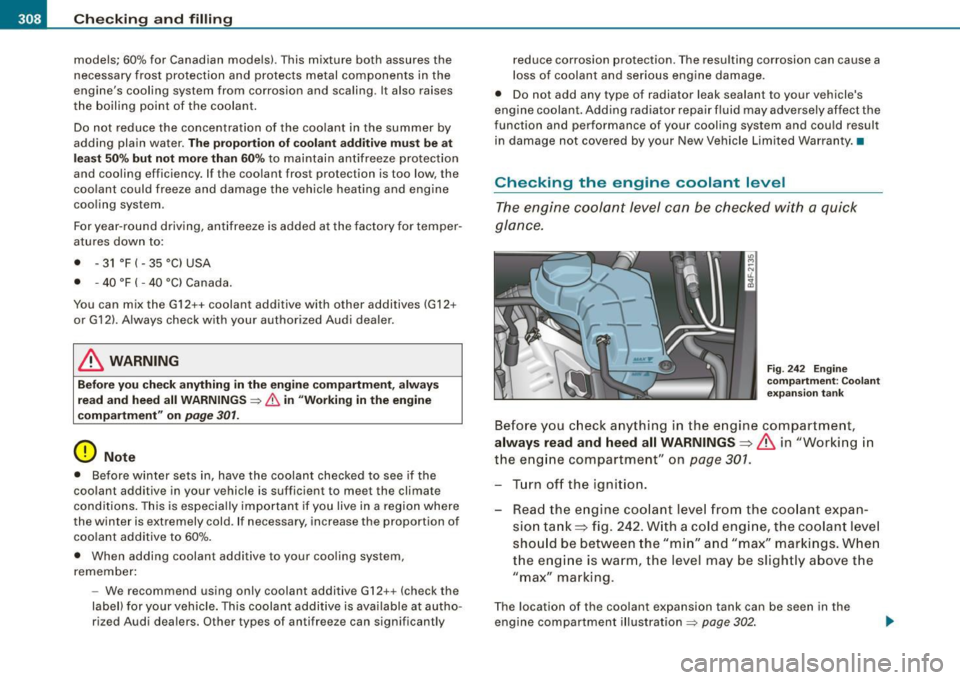
Checking the engine coolant level
The engine coolant level can be checked with a quick
glance.
F ig . 2 42 E ngin e
com partm ent : Cool ant
ex pans io n tank
Before you check anything in the engine compartment,
alw ays read and h eed all WARNINGS ~ & in "Working in
the eng ine compartment" on page 301.
- Turn off the ignition.
- Read the e ngine coo lant level from the coo lant expan -
sion tank~ fig. 242. With a cold engi ne, the coolant level
sho uld be between the "min" and "max" markings. W hen
the engine is warm, the level may be slightly above the
"max" marking .
The location of the coolant expansion tank can be seen in the
engine compartment illustration~
page 302.
Page 313 of 398
Checkin g and fillin g Ill
--------------~-
•
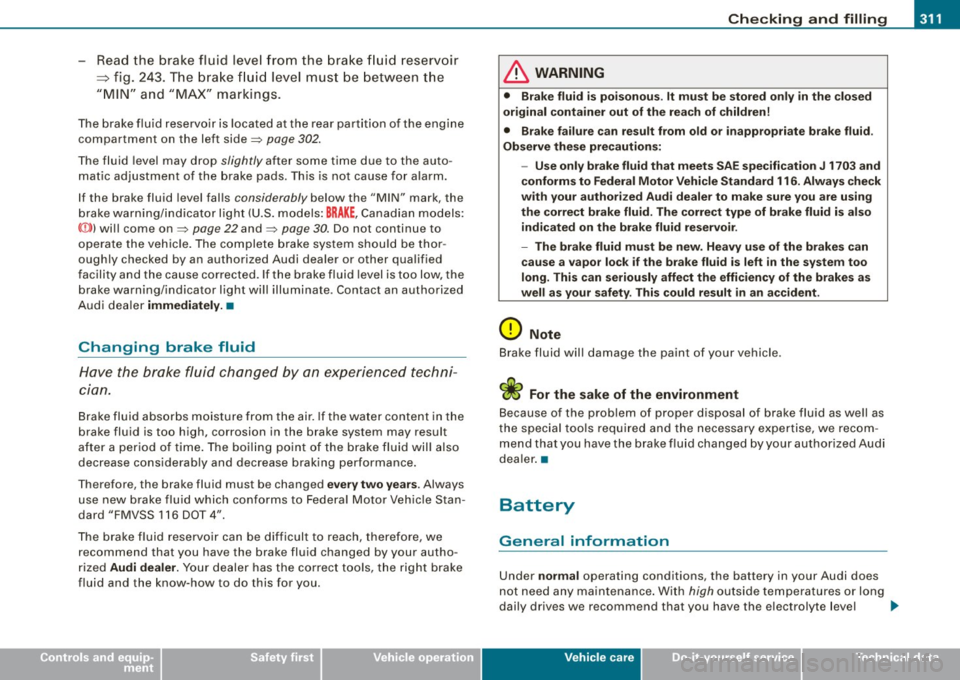
-Read the brake fluid level from the brake fluid reservoir
~ fig. 243. The brake fluid level must be between the
"MIN" and "MAX" markings.
The brake fluid reservoir is located at the rear partition of the engine
compartment on the left side=> page 302.
The fluid level may drop slightly after some time due to the auto
matic adjustment of the brake pads . This is not cause for alarm.
If the brake fluid level falls considerably below the "MIN" mark, the
brake warning/indicator l ight (U.S. models:
BRAKE , Canadian models:
CCD> l will come on=> page 22 and=> page 30. Do not continue to
operate the vehicle . The complete brake syste m shou ld be thor
oughly checked by an authorized Audi dealer or other qualified
facility and the cause corrected. If the brake fluid level is too low, the
brake warning/indicator light will illuminate . Contact an authorized
Audi dea ler
immedi ately. •
Changing brake fluid
Have the brake fluid changed by an experienced techni
cian.
Brake fluid absorbs moisture from the air. If the water content in the
brake fluid is too high, corrosion in the brake system may result
after a period of time . The boiling po int of the brake fluid will also
decrease considerably and decrease braking performance.
T herefore, the brake fluid must be changed
ever y two yea rs. Always
use new brake fluid which conforms to Federa l Motor Veh ic le Stan
dard "FMVSS 116 DO T 4".
The brake fluid reservoir can be difficult to reach, therefore, we recommend that you have the brake fluid changed by your autho
rized
Audi deal er. Your dealer has the co rrect tools, the right brake
fluid and the know-how to do this for you.
& WARNING
• Bra ke fluid i s poi sonou s. It m ust be stor ed only in the closed
or iginal container out of the reach of children!
• Brake f ailur e can result fr om old or in approp riat e bra ke fluid .
Ob serve the se pre cauti ons:
- Use o nly br ake fluid that me ets SAE specifi cation
J 1703 and
c onfo rm s t o Fed eral Mo to r V ehicle Standard 116 . Alway s check
w ith your auth oriz ed A udi de aler t o m ake sure you are usin g
the correct b rake flu id . The corre ct ty p e of brake flu id i s al so
indi cate d on the br ake fl uid r eservo ir .
- The brake f luid mu st be new . Heav y use of the brake s can
ca us e a va por lo ck if the brake fluid is left in the sy stem too
long. Thi s ca n seriou sly affect th e effic iency of the brake s as
well as your safe ty. T his co uld r esult i n an a ccide nt.
0 No te
Brake fluid wil l damage the paint of your vehicle .
'£> For the sake of the environm ent
Because of the problem of proper disposal of brake fluid as well as
the special too ls required and the necessary expertise, we recom
mend that you have the brake fluid changed by your authorized Audi
dea ler. •
Battery
General information
Under norm al operating conditions, the battery in your Audi does
not need any maintenance . With high outside temperatures or long
daily drives we recommend that you have the electrolyte level ._
Vehicle care I t •
Page 324 of 398
-Tires and wheels
PW-------------------
If you wish to improve comfo rt when operating the vehicle at
normal load (up to 3 occupants) , you can adjust tire pressures to
those spec ified for normal vehi cle load . Before operating the vehi cle
at maximum load, you must in crease the tire pressures to those
specified for ma ximum vehi cle load =>
&.
Bear in mind that the tire pressure monitoring system can on ly
m onito r the t ire pressures you have stored. The syste m does not
recognize the load condition of your vehic le .
The effect iveness of the tir e pr essure moni toring syste m will be
impaired if you store normal load pressures but then operate the
veh ic le a t its ma ximum load=>& . See the
illustrat ion=>
page 321, fig. 247 for the location of the label
on driver's sid e 8-pi llar (c olor of the actual label and exac t loca tion
on the veh ic le wi ll vary slight ly) .
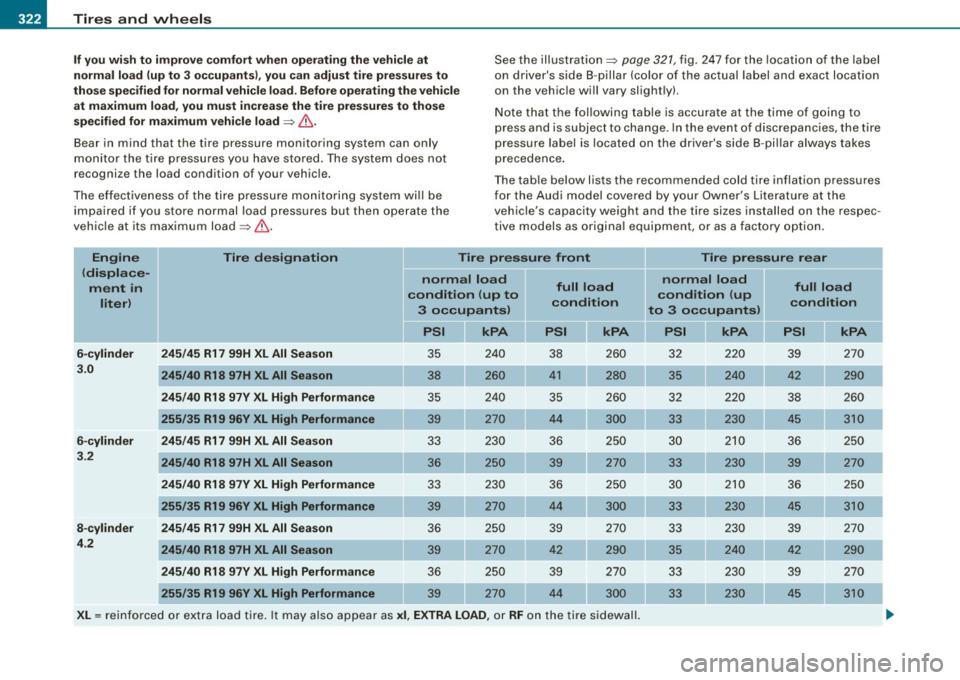
N ote that the fol lowing tab le is accurate at the time of going to
press and is subject to cha nge . In the eve nt of d iscrepa nc ies, t he tire
pressure label is located on the driver's side 8 -pi llar always takes
p recedence .
T he tab le below lists the recommended cold tire inflation pressures
fo r th e A udi m odel co ve red by you r Owner 's Litera ture at the
vehic le's capacity weight and the tire sizes installed on the respec
t ive mode ls as o rigi nal equipment, o r as a fac to ry o ption.
Engine Tire designation Tire pressure front Tire pressure rear
(displace- normal load normal load
ment in condition (up to full load
condition (up full load
liter ) condition
condition
3 occupants) to 3 occupants)
PSI kPA
PSI kPA
PSI kPA PSI
kPA
6-cylinder
245/45 R17 99H XL All Season 35 240 38 260 32 220 39 270
3 .0
245/40 R18 97H XL All Season 38 41 280 35 240 290
245 /40 R18 97V XL High Performance
35 240
35 260 32 220 38 2 60
255 /35 R19 96V XL High Performance 39 270 44 300 33 230 45 3 10
6 -cylinder 245 /45 R17 99H XL All Season 33 230 36 250 3 0 210 36 250
3 .2
245/40 R18 97H XL All Season
36 250 39 270 33 230 39 270
245 /40 R18 97V XL High Performance 33 230 36 250 3 0 21 0 36 250
255 /35 R19 96V XL High Performance 39 270 44 300 33 230 45 310
8 -cylinder 245 /45 R17 99H XL All Season
36 250 39 270
33 230 39 270
4 .2
245/40 R18 97H XL All Season 39 270 42 290 35 2 40 42 2 90
245 /40 R18 97V XL High Performance 36 250 39 270 33 230 39 270
255 /35 R19 96V XL High Performan ce
39 270
44 300 33 230 45 310
XL= reinforce d or ex tra load tire . It may als o ap pear as xi, EXTRA LOAD, or RF o n the tire s ide wall.