airbag off AUDI S8 2009 Owner's Manual
[x] Cancel search | Manufacturer: AUDI, Model Year: 2009, Model line: S8, Model: AUDI S8 2009Pages: 408, PDF Size: 91.63 MB
Page 233 of 408
Airbag system -----------------=~-
& WARNING (continued )
airbag dur ing braking or in a sudden maneuver . Objects ne ar the
airbags can become proje ctile s and cau se injury , particularly when
the seat is reclined .
& WARNING
The fine dust created when airbags deploy can cause breathing
p roblems for people with a history of asthma or other breathing
c onditions .
• To reduce the risk of breathing problems , those with asthma or
other respir atory cond itions should get fresh air right away by
getting out of the vehicle or opening windows or doors.
• If you are in a collision in which airbags deploy, wash your
hands and face with mild soap and water before eating.
• Be careful not to get the dust into your eyes, or into any cuts or
scratches.
• If the residue should get into your eyes , flush them with
water .•
Monitoring the Advanced Airbag
System
Airbag monitoring indicator light t~
Tw o separate indicators monitor th e funct ion of the
Adva nced A irbag Syst em : the a ir b ag mon itor in g i ndicator
l ig ht an d the
PASSENGER AIR BAG OFF light.
The Advanced Airbag System (including the electronic control unit,
s en sor cir cu its a nd sys tem wiring) is mon itored co ntinuous ly to
make sure that it is functioning properly whenever the ignition is on.
E ac h tim e you turn on th e ig niti on, the ai rbag monito ring ind icator
light
t~ w ill come on for a few seconds (se lf diagnostics) .
Controls and equip ment Safety first Vehicle operation
The system must be inspected wh
en the indicator
light ~:
• does not come on when the ignition is switched on,
• does not go ou t a few sec ond s a fter you have swi tc hed on the
ignition, or
• comes on while d riv in g.
I f an airbag system malfunction is detected, the indicator light will
fi rst sta rt fla sh ing to catch the d rive r's atten tion an d t hen stay on
cont inuously to serve as a constant reminder to have the syst em
inspected i mmedia tely.
If a mal funct ion occurs that tu rns the fro nt a irbag o n th e passe nger
side off, the PASSENGER AIR BAG OFF light will come on and stay on
whe neve r the ig nit ion is on.
& WARNING
An airbag system that is not functioning properly cannot provide
supplemental protection in a frontal crash .
• If the airbag indicator light comes on , it means that there may
be something wrong with the Advanced Airbag System. It is
possible that the airbag will inflate when it is not supposed to , or
will not inflate when it should .
• Have the airbag system inspected immediately by your Audi
dealer .•
Vehicle care Do-it-yourself service Technical data
Page 234 of 408
-Airbag system PW,._____ -=--=-----------------
PASSENGER AIR BAG OFF light
1~ J,
i
( ~ I :."!l.t.~ A I ~ )
Fig. 235 Sectio n fr om
th e i nstrument panel:
PAS SENGER AIR BAG
OFF light
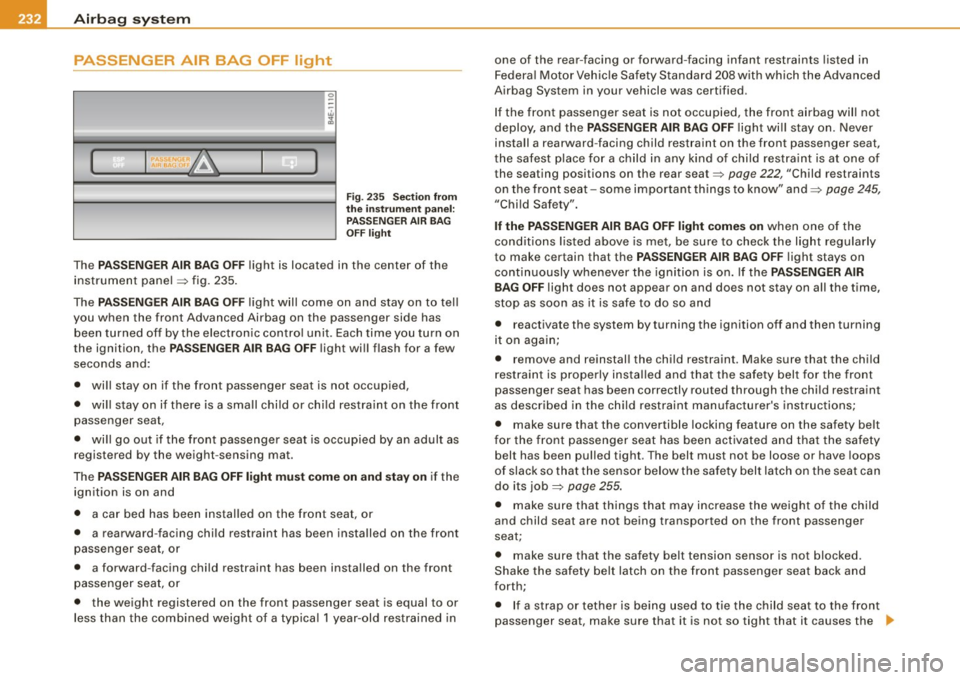
The PASSENGER AIR BAG OFF light is located in the center of the
instrument pane l => fig.
235 .
The PASSENGER AIR BAG OFF light will come on and stay on to tel l
you when the front Advanced Airbag on the passenger side has
been turned off by the electronic contro l unit . Each time you turn on
the ignition, the
PAS SENGER AIR BAG OFF light wi ll flash for a few
seconds and :
• will stay on if the front passenger seat is not occupied,
• will stay on if there is a small chi ld or chi ld restraint on the front
passenger seat ,
• will go out if the front passenger seat is occupied by an adult as
registered by the weight -sensing mat .
The
PASSENGER AIR BAG OFF light must come on and stay on if the
ignition is on and
• a car bed has been installed on the front seat, or
• a rearward-facing child restraint has been installed on the front
passenger seat, or
• a forward-facing child restraint has been insta lled on the front
passenger seat, or
• the weight registered on the front passenger seat is equal to or
less than the combined weight of a typical 1 year-old restrained in one of the rear
-facing or forward-facing infant restraints listed in
Federa l Motor Vehicle Safety Standard 208 with which the Advanced
Airbag System in your vehicle was certified .
I f the front passenger seat is not occupied, the front airbag wil l not
deploy, and the
PASSENGER AIR BAG OFF li ght wi ll stay on. Never
install a rearward -facing child restraint on the front passenger seat,
the safest place for a child in any kind of child restraint is at one o f
the seating posi tions on the rear seat=>
page 222, "Child restraints
o n the front seat -some important things to know" and=>
page 245,
"Chi ld Safety".
If the PASSENGER AIR BAG OFF light comes on when one of the
conditions listed above is met , be sure to check the light regularly
to make certain that the
PASSENGER AIR BAG OFF light stays on
continuously whenever the ignition is on. If the
PASSENGER AIR
BAG OFF
light does not appear on and does not stay on all the time,
stop as soon as it is safe to do so and
• reactivate the system by turning the ignition off and then turning
it on again;
• remove and reinstal l the child restraint. Make sure that the child
restraint is properly insta lled and that the safety belt for the front
passenger seat has been correctly routed through the child restraint
as described in the child restraint manufacturer's instructions;
• make sure that the convertible locking feature on the safety belt
for the front passenger seat has been activated and that the safety
belt has been pulled tight . The belt must not be loose or have loops
of slack so that the sensor below the safety belt latch on the seat can
do its job =>
page 255.
• make sure that things that may increase the weight of the child
and child seat are not being transported on the front passenger
seat;
• make sure that the safety belt tension sensor is not blocked .
Shake the safety belt latch on the front passenger seat back and
forth;
• If a strap or tether is being used to tie the child seat to the front
passenger seat, make sure that it is not so tight that it causes the .,_
Page 235 of 408
Airbag syst em -----------------=~-
weight -sensing mat to measure more weight than is actually on the
seat .
If th e PA SSENGER AIR BAG OFF light still d oes not come on and does
not stay on continuously (when the ignition is switched on),
• t ake the child r estraint off the front passenger seat and install it
properly at one of the rear seat positions. Have the airbag system
inspected by your Audi dealer immediately.
• move the child to a rear seat position and make sure that the
child is proper ly restrained in a child restraint that is appropria te for
its size and age .
The
PA SSENGER AIR BAG OFF light shou ld NOT come on when the
ignition is on and an adult is sitting in a proper seating posi tion on
the front passenger seat . If the
PASSENGER AIR BAG OFF light
comes on and stays on or flashes for about 5 seconds whi le driving,
under these circumstances, make sure that :
• the adu lt on the front passenger sea t is properly seated on the
center of the seat cushion w ith his or her back up against the back
res t and the backrest is not reclined => page 202, "Proper occupant
sea ting positions" ,
• the adult is not taking weight of f the sea t by holding on to the
passenger assist handle above the front passenger door or
supporting their we ight on the armrest,
• the safety belt is being proper ly worn and that there is not a lot
of slack in the safety belt webbing,
• accessory seat covers or cushions or other things that may cause
an incorrect reading or impression on the weight -sensing mat
under the upho lstery of the seat have been removed from the front
passenger sea t,
• a safety belt extender has not been left in the safety be lt latch for
t he front passenger seat .
In addition to the
PASSENGER AIR BAG OFF light in the center of the
instrument pane l, the message
PASSENGER AIR BAG O FF o r
PAS SEN GER AIR BA G ON will briefly appear in the instrument c luster
Controls and equip
ment Safety first Vehicle operation
display. This is to inform the driver of the current front passenger
a
irbag status .•
Important safety instructions on monitoring
the Advanced Airbag System
& WARNING
An airbag sy stem that is not functioning properly cannot provide
supplemental protection in a front al cra sh .
• If the airbag ind icator li ght come s on , it means that there may
be something wrong with the Advanced Airbag S ystem . It is
po ssible that the airbag will inflate when it is not suppo sed to , or
w ill not infl ate when it should .
• Have the airb ag system inspe cted immediatel y by you r Audi
dealer.
& WARNING
If the front airba g inflates , a child with out a child re straint , or in a
re arw ard -fa cing chi ld safety seat , or
in a forward-fa cing child
r e str aint that has not been properly installed will be seriously
inj ured and can be killed .
• Even though your vehicle i s equipped with an Adv anced Airbag
Sy stem , m ake cert ain that all children , e speci ally 12 year s and
younger , always ride on the bac k seat prope rly re strain ed for their
a ge and siz e .
• Alway s install forw ard or rear -facing child seat s on the rear
se at - ev en with an Ad vanced Airbag Sy stem .
• If you mu st install a rearward -fa cing child se at o n th e front
p ass enger sea t be cau se of e xceptional circumstan ce s and the
PASSENGER AIR BAG OFF light doe s not appear and stay on , imme
diately in stall the rear -fac ing child seat in a r ear sea ting pos itio n
and have the airbag system inspect ed b y your Audi dealer . .,,
Vehicle care Do-it-yourself service Technical data
Page 236 of 408
llffll,___A_ ir_ b_ a.::g <-- s--
• A tight tether or other strap on a rearward-facing child restraint
attached to the front passenger seat c an put too much p res su re
on the weight-sensing mat in the seat and reg ister more weight
than is actually on the seat . The heavier weight registered can
make the system work as though an adult were on the seat and
deploy the Advanced Airbag when it mu st be suppre ssed causing
serious or even fatal injury to the child .
• If, in exceptional circumstances , you must install a forward
f ac ing child restraint on the front passenger seat , always move the
seat into its rearmost position in the seat's fore and aft adjust
ment range , as far away from the airbag as possible . The ba ckrest
must be adju sted to an upright position. Make sure that the
PASSENGER AIR BAG OFF light comes on and stays on all the time
whenever the ignition is switched on .
& WARNING
• If the PASSENGER AIR BAG OFF light does not go out when an
adult is sitting on the front passenger seat after tak ing the steps
described above, make sure the adult i s properly seated and
restrained at one of the rear seat ing positions .
• Have the airbag system inspected by your Audi dealer before
transporting anyone on the front passenger seat .
[ i ] Tips
If the we ight -sens ing mat in the front passenger seat detects an
e m pty s eat, th e front airbag on the passenge r side wil l be tur ned
off , and the PASSENGER AIR BAG OFF li ght wil l stay on .•
Repair, care and disposal of the airbags
Parts of the airbag system are insta lled at many different places on
yo ur Audi. Ins tal li n g, r em oving, s ervicing o r rep airi ng a part in an area of the vehicle can damage a part of an airbag system and
p revent that sys tem from wo rking pr operly in a c ollisi on.
Th ere are some important th ings you have to know to ma ke sure
that the effectiveness of the system will not be impai red and that
discarded co mponents do no t cause i njury or po llute the enviro n
ment.
& WARNING
Improper care , servicing and repair procedures can increase the
risk of personal injury and death by preventing an airbag from
deploying when needed or deploying an airbag unexpectedly :
• Never cover , obstruct , or change the steering wheel horn pad
or airbag cover or the instrument panel or modify them in any way.
• Never atta ch any objects su ch as cup holders or telephone
mountings to the surfaces covering the airbag units .
• For cleaning the horn pad or instrument panel , use only a soft ,
dry cloth or one moistened with plain water . Solvents or cleaners
could damage the airbag cover or change the stiffness or strength
of the material so that the airbag cannot deploy and protect prop
erly .
• Never repair , adjust, or change any parts of the airbag system .
• All work on the steering wheel , instrument panel , front seats or
electrical system (including the installation of audio equipment ,
cellular telephones and CB radios , etc .I must be performed by a
qualified technician who has the train ing and special equipment
necessary .
• For any work on the airbag system, we strongly recommend
that you see your author ized Audi dealer or qualified workshop .
• Never modify the front bumper or parts of the vehicle body .
• Always make sure that the side airbag can inflate without inter-
ference :
~
Page 238 of 408
___ A_ ir_b _a_ g;:::;_ s--:.. y_s _t _e _m _________________________________________________ _
& WARNING
Changing the vehicle's su spension includ ing use of un approved
tire -rim combinations can change Advanced Airbag performance
and increase the ris k of serious personal injury in a crash .
• Never install suspen sion component s that do not have the
same performance chara cteristics as the components or iginally
installed on your vehicle.
• Never use tire-r im comb inations that have not been approved
by Audi.
& WARNING
Items stored between the safety belt bu ckle and the center
c onsole can cause the sensors in the buc kle to send the wrong
information to the electroni c control module and prevent the
Advanced Airbag System from working properly .
• Alway s make sure that nothing can interfere with the safety
belt buckles and that they are not obstructed .
<£> For the sake of the environment
Undeployed airbag modules a nd pretensioners might be classified
as Pe rchlorate Mat erial -spe cia l han dling may a pply, see
www.dtsc.ca.gov/hazardouswaste/perchlorate. When the vehicle or
par ts o f the restraint syst em i ncludi ng ai rbag modules and saf ety
belts with pretensioners are scrapped, a ll app licab le laws and regu
latio ns must be observed . Yo ur au thori zed A udi dealer is fam ilia r
with these requirements and we recommend that you have your
dealer perfo rm this serv ice for you .•
Knee airbags
Description of knee airbags
T he airba g sys tem c an prov id e sup plemen tal prot ect ion
t o pro pe rly rest rained fron t seat occ upant s.
0
Fig. 2 36 Drive r's
airba g
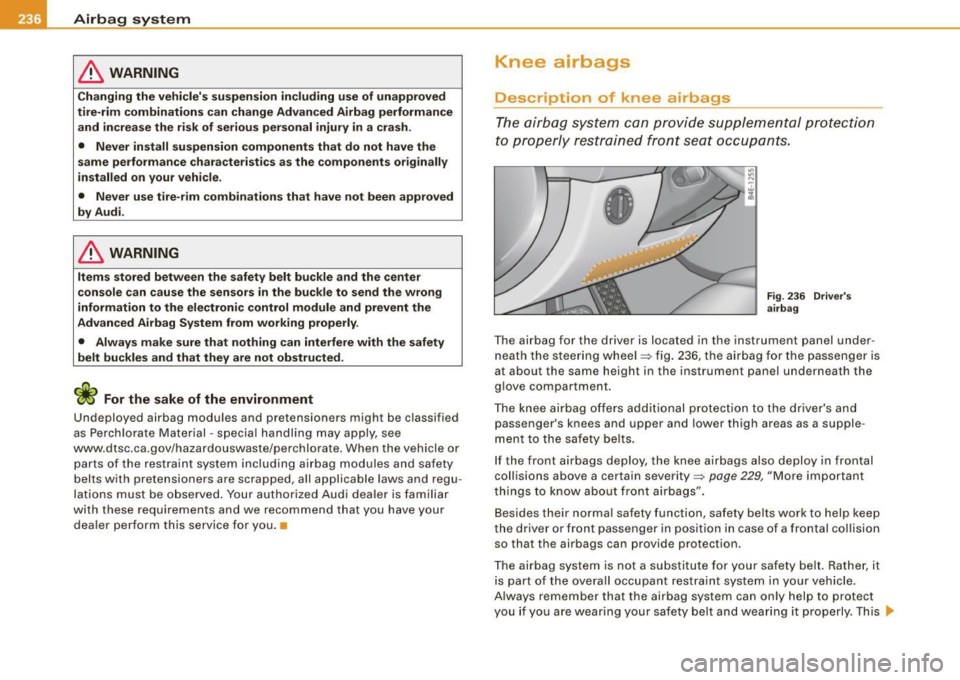
The airbag for the driver is located in the instrument panel under
neath the steering wheel=> fig. 236, the airbag for the passenger is
at about the same height in the instrument panel und erneath the
glove compartment.
T he knee air bag offe rs addi tio nal pr ote cti on to the d river's a nd
passenger 's knees and upper and lower thigh ar eas as a supple
me nt to t he sa fety be lts.
I f the front airbags deploy , the knee airbags also deploy in frontal
collisions above a certain severity=> page
229, "M ore important
thi ngs to kno w about fron t a irba gs" .
B esides their normal safety function, safety belts wor k to help keep
t h e dri ver o r fr on t passeng er in pos itio n in case of a fro ntal col lis ion
so that the airbags can provide protection .
T he airbag system is not a substitute for your safety belt . Rathe r, it
i s part of the overa ll occupa nt res tra int system i n your ve hi cle.
A lwa ys re member that the airbag system can on ly help to protect
you if you a re wearing your safe ty belt and weari ng it properly . T hi s .,,_
Page 239 of 408
is why you should always wear your safety belt, not just because the
l a w requ ire s you to do so =>
page 211, "Genera l notes" .
The safety belt buckle for the driver and front seat passenger have switches that tell the airbag control module if the safety belt is
being used or not. If the safety belt is being used , the knee airbag
will deploy at a s lightly higher rate of deceleration than if the belt is
not be ing used . Therefore, in a par ticular collision, it is possib le that
an airbag will not deploy a t a seating position where the safety belt
is be ing used but will inflate at the position where the safety belt is
not being used .
Remember too, airbags will deploy only once and only in ce rtain
kinds o f accidents - your safety be lts are always there to offer
protection in those accidents in wh ich airbags are not supposed to
deploy or when they have already deployed, for examp le when you r
vehicle strikes or is struck by another after the first collision.
T his is just one of the reasons why an ai rbag is not a substitute for
the safety be lt. The airbag system works most effectively when used
with the safety belts . Therefore, a lways wear your safety belts
correctly.
I t is important to remember that while the supplemental airbag
system is designed to reduce the like lihood of ser ious injuries, o ther
injuries, for example, swelling, bruising, and minor abrasions can
a lso be associated with airbags.
The kn ee airbag s ystem bas ically con sists of:
• The electronic control module
• Two inflatable airbags (ai rbag and gas generato r), one for the
driver and one for the front passenger
• T he airbag indicator light in the instrument panel
The kn ee airbag system w ill not deploy :
• whe n the ignit ion is turned off
• in front -end collisions when the deceleration measured by the
control uni t is too low
• in side collisions
Safety first
Airb ag sy ste m
• in rear -end co llisions
• in ro llovers
• in the event of a system malfunction (warning/indicator light illu
minated)=>
page 19 .
& WARNING
• Safety belt s and the airbag sy stem ca n only p rov ide protec tion
when o ccupants are in the proper seating po sition
=> page 229 .
• If the airbag indi cator light come s when the vehi cle is b eing
u sed , have the system in spected immediately by your authori zed
Audi deale r. Th e airbag may no t work prope rly when the vehicle
acceleration in a side colli sion is high enough to deploy the airbag.
See also =>
page 19. •
How knee airbags work
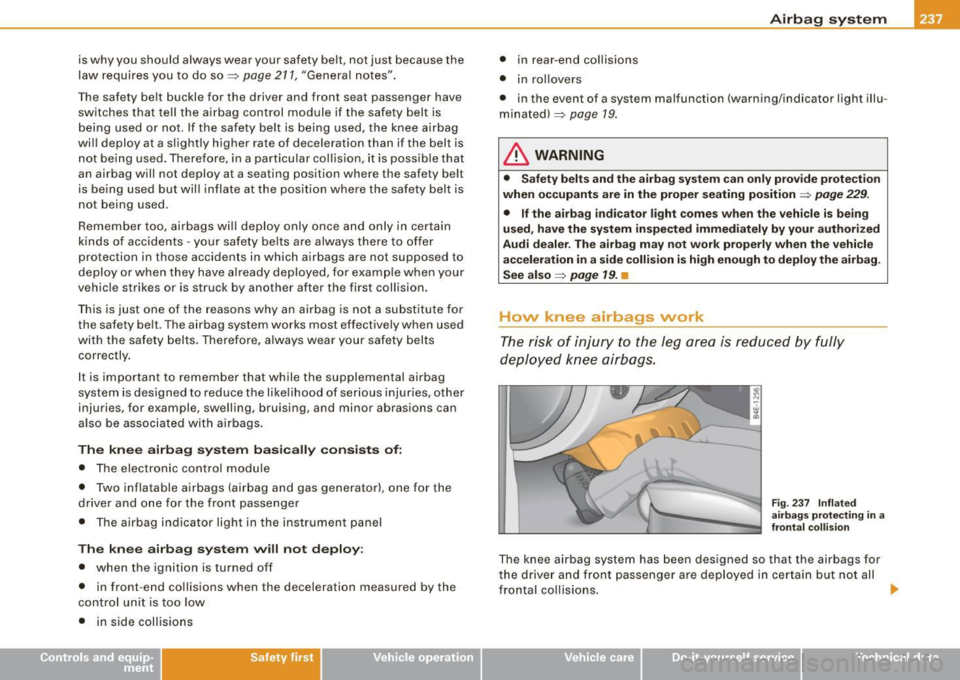
The risk of injury to the leg are a i s reduce d by fully
depl oyed knee airb ags .
Fig . 237 In fl ate d
ai rba gs prot ecting in a
frontal colli sio n
The knee airbag system has been designed so that the airbags for
the drive r and front passenger a re depl oyed in certain but not all
frontal col lisions.
ai,.
Vehicle care I I irechnical data
Page 241 of 408
Side airbags
Description of side airbags
The airbag system can provide supplemental protecti on
to properly rest rained occupants.
Fi g. 238 Si de a ir b ag
lo ca tio n in th e driv er's
seat
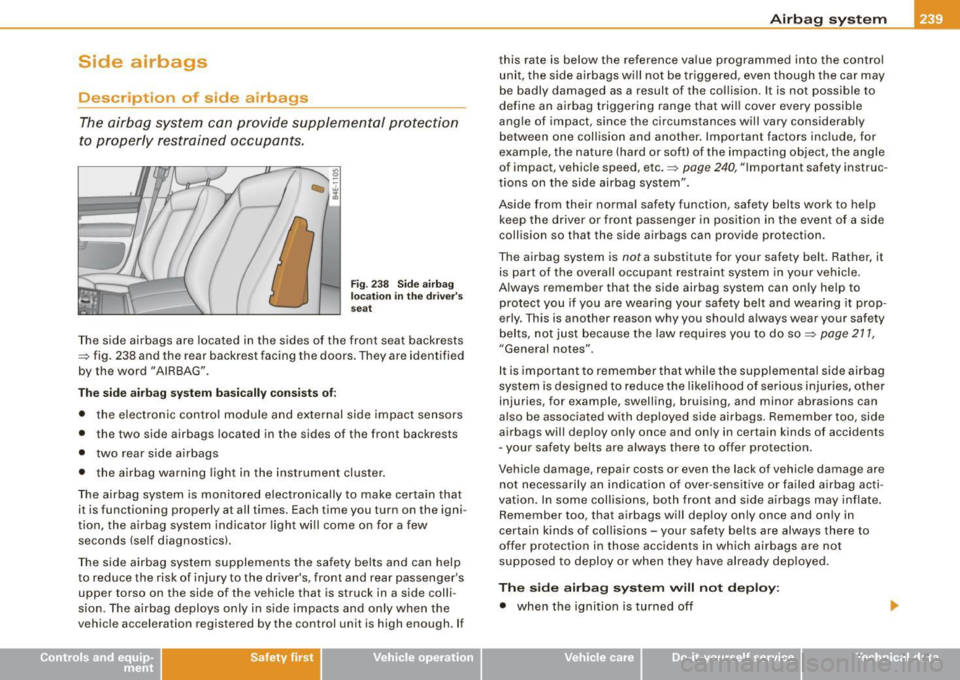
The side airbags are located in the sides of the front seat backrests
=> fig. 238 and the rear backrest facing the doors . They are identified
by the word "AIRBAG" .
The sid e ai rbag sy stem b asica lly consis ts of :
• t he electronic control module and external side impact sen sors
• the two side airbags located in the sides of the front backrests
• two rear side airbags
• the a irbag warning light in the instrument cluster.
The airbag system is monitored electronically to make certain that it is functioning properly at all times. Each time you turn on the igni
tion, the airbag system indicator light wi ll come on for a few
seconds (self diagnostics).
The side airbag system supplements the safety belts and can help to reduce the risk of injury to the driver's, front and rear passenger's
upper torso on the side of the vehicle that is struck in a side colli
sion. The airbag deploys only in side impacts and on ly when the
vehicle acceleration registered by the control unit is high enough . If
Safety first
Airb ag sy ste m
this rate is below the reference value programmed into the control
unit, the side airbags w ill not be triggered, even though the car may
be badly damaged as a result of the col lision. It is not possible to
define an airbag triggering range that wi ll cover every possible
ang le of impact, since the circumstances will vary considerably
between one collision and another. Important factors include, for
examp le, the nature (hard or soft) of the impacting object, the angle
of impact, vehicle speed, etc.=>
page 240, "Important safety instruc
tions on the side airbag system".
Aside from their norma l safety function, safety belts work to he lp
keep the driver or front passenger in position in the even t of a side
collision so that the side airbags can provide protection .
The airbag system is
not a substitute for your safety belt. Rathe r, it
is part of the overall occupant restraint system in your vehicle.
Always remember that the side airbag system can only he lp to
pro tect you if you are wearing your safety belt and wear ing it prop
erly. This is another reason why you should always wear your safety
belts, not just because the law requires you to do so==>
page 211,
"General notes" .
I t is important to remember that while the supplementa l side airbag
system is designed to reduce the likelihood of serious injuries, other
injuries, for example, swelling, bruising, and minor abrasions can
a lso be associated with deployed s ide airbags . Remember too, side
airbags will deploy only once and only in certain kinds of accidents
- your safety belts are always there to offer pro tec tion .
Vehicle damage, repair costs or even the lack of vehicle damage are not necessarily an indication of over -sensitive or failed airbag acti
vation . In some collisions, both front and side airbags may inflate.
Remember too, that airbags will deploy on ly once and only in
certain kinds of collisions -your safety belts are always there to
offer protection in those acc idents in which airbags are not
supposed to deploy or when they have already dep loyed.
The sid e airbag system w ill not deploy :
• when the igni tion is turned of f
•
Vehicle care I I irechnical data
Page 244 of 408
___ A_ ir_b _a_ g;:::;_ s--=- y_s _t _e _m _________________________________________________ _
& WARNING (c ont in ued)
- Alwa ys ha ve work on th e doo rs done by an auth ori ze d Aud i
d ea le r or q ualified works hop . •
Side curtain airbags
Description of side curtain airbags
The side curtain airbag system can provide supplemental
protection to pr operly restrained occupants .
Fig. 240 Side cu rtai n
ai rb ags, drive r's side:
s ide c urt a in airb ag
l oca tion
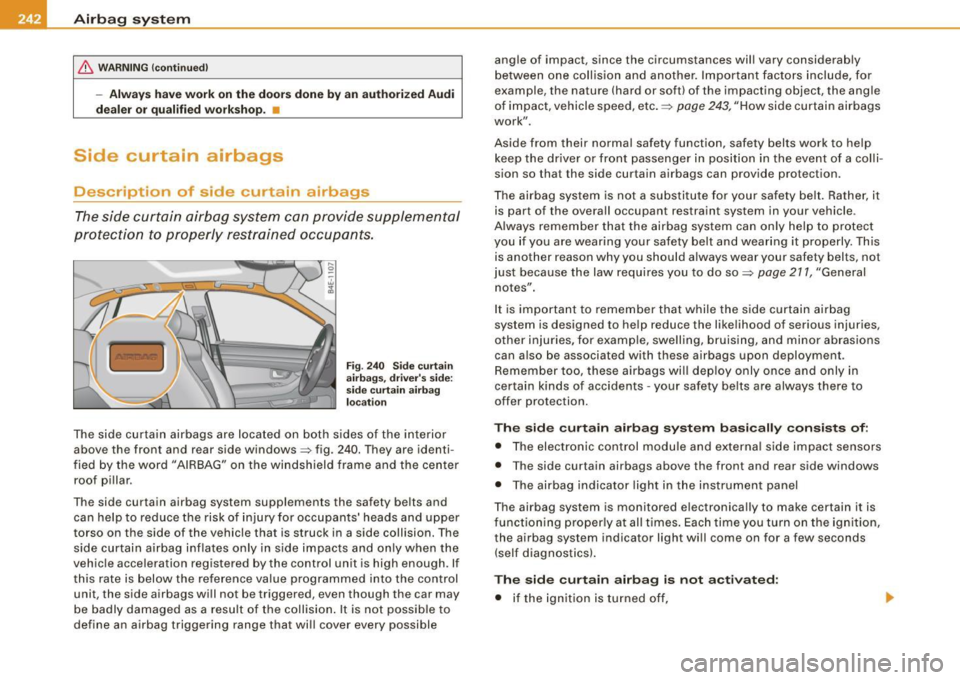
The side curtain airbags are located on both sides of the interior
above the front and rear side windows~ fig. 240. They are identi
fied by the word "AIRBAG" on the windshield frame and the center
roof pillar.
The side curtain airbag system supplements the safety belts and can help to reduce the risk of injury for occupants' heads and upper
torso on the side of the vehicle that is struck in a side collision. The
side curtain airbag inflates only in side impacts and on ly when the
vehic le acceleration registered by the control unit is high enough . If
t his rate is below the re ference value programmed into the control
unit, the side airbags will not be triggered, even though the car may
be badly damaged as a result of the collision . It is not possib le to
define an airbag triggering range that will cover every possible angle of
impact, since the circumstances will vary considerably
be tween one collision and another. Important factors include, for
example, the nature (hard or soft) of the impacting object, the ang le
of impact, vehicle speed, etc.~
page 243, "How side curtain airbags
work" .
Aside from their normal safety function, safety belts work to help
keep the dr iver or front passenger in position in the event of a colli
sion so that the side curtain airbags can prov ide protection .
The airbag system is not a substitute for your safety belt. Rathe r, it
is part of the overall occupant restraint system in your vehicle .
A lways remember that the airbag system can on ly help to protect
you if you are wearing your safety belt and wearing it properly. This
is another reason why you should always wear your safety belts, not
just because the law requires you to do so~
page 211, "General
notes".
It is important to remember that while the side curtain airbag
system is designed to he lp reduce the like lihood of serious injuries,
other injuries, for example, swelling, bruising, and minor abrasions
can a lso be associated with these airbags upon deployment.
Remember too, these airbags wi ll dep loy only once and only in
certain kinds of accidents -your safety belts are always there to
offer protection.
Th e s ide cu rtai n air ba g sys te m b asi ca lly co nsis ts of:
• The electronic control modu le and external side impact sensors
• T he side curtain airbags above the front and rear side windows
• The airbag indicator light in the instrument panel
The airbag system is monitored electronically to make certain it is
funct ion ing proper ly at all times . Each time you turn on the ignition,
the airbag system indicator light will come on for a few seconds (self diagnostics).
The s ide c urtain a irbag is no t activa te d:
• if the ignition is tu rned off,
Page 248 of 408
-Child Safety -------=---------------------------------------
& WAR NIN G (co ntinued )
• Alw ays in sta ll re ar-facin g child safety s eats on the r ear seat .
• If you m us t in sta ll a rear ward f acing child saf ety s eat on th e
fr ont pa ssenger seat in exceptional circum stan ces and the
PA SSEN GER AIR BAG OFF light do es not come on and sta y on ,
immediately in sta ll the re ar-facing child safety s eat in a rear
s eating po sit ion and ha ve th e airb ag s ystem insp ected immedi
atel y by your Audi dea ler .
& WARNING
If, in exceptional circum stance s, you mu st in sta ll a forward -f a cing
c hild re str ain t on th e fr ont p assenger's s eat:
• Always mak e sure the forward -fac ing seat ha s been de signed
a nd ce rt ified by it s m anufa cturer for u se on a fr ont se at w ith a
pa ssenger front and side airbag.
• Always follow the m anufacturer's instru ctions provided w ith
the child safety seat or carr ier.
• Alwa ys mo ve the pa ssenger seat into it s rea rmost positi on in
the seat' s fore and aft adju stment range , as far aw ay from the
ai rbag as possib le bef ore installing the ch ild r estr aint . The ba ck
re st mu st b e adjusted to an upright po sition.
• Alway s m ake sure that the PASSENGER AIR BAG OFF l ight
c om es on and sta y s on all the time whenever the ignition is
s w it c hed on . •
Advanced front airbag system and children
Your vehicle is equipped with an "Advanced Airbag System" in
complia nce with United States Federa l Motor Vehicle Safety Stan
dard (FMVSS) 208 as applicable at the time your vehicle was manu
factu red. T
he Advanced Airbag system in your vehicle has been certified to
meet the " low -risk" requirements for 3 and 6 year -old chi ldren on
the passenger side and smal l adults on the driver side . The low risk
deployment criteria are intended to reduce the risk of injury through
interaction with the airbag that can occur, for example, by being too
close to the steering wheel and instrument panel when the airbag
inflates. In addition, the system has been certified to comply with
the "suppression" requirements of the Safety Standard, to turn off
the front airbag for infants up to 12 months who are restrained on
the front passenger seat in child restraints that are listed in the
S tandard.
Even though your vehicle is equipped with an Advanced Airbag
system, all ch ildren, especially those 12 years and younger, should
always ride in the back seat properly restrained for their age and
size . The airbag on the passenger side makes the front seat a poten
tially dangerous p lace for a child to ride. The front seat is not the
safest p lace for a child in a forward -facing child safety seat. It can be
a very dangerous p lace for an infant or a larger ch ild in a rearward
facing seat. •
Advanced Airbags and the weight-sensing
mat in the front seat
The Advanced Airbag System in your vehicle detects the presence
of an infant or child in a chi ld restraint on the front passenger seat
using the weight -sensing mat in the seat cushion and the sensor
below the safety belt latch on the front passenger seat that
measures the tension on the safety belt.
The weight -sensing mat measures total weight of the chi ld and the
child safety seat and a child blanket on the front passenger seat . The
weight on the front passenger seat is related to the design of the
child restraint and its "footprint", the size and shape of the bottom
of the child restraint as it sits on the seat . The weight of a child
restraint and its "footprint" vary for different kinds of child ..,.
Page 249 of 408
-----------------------------------------~C::_! h~ i~ ld ~ S~a !_!f ~e _!;tY L _ffllll
restraints and for the different models of the same kind of child
restraint offered by child restraint manufacturers.
The weight ranges for the individual types, makes and models of
child restraints that the NHTSA has specified in the Safety Standard
together with the weight ranges of typ ical infants and typical 1 year
old child have been stored in the control unit of the Advanced
Airbag System. When a child restraint is being used on the front
passenger seat with a typical 1 year -old child, the Advanced Airbag
System compares the weight measured by the weight sensing mat
with the information stored in the electronic control unit.
The electronic control unit also registers the tension on the front
passenger safety belt. The tension on the safety belt for the front
passenger seat will be different for an adult who is properly using
the safety belt as compared to the tension on the belt when it is
used to attach a child restraint to the seat. The sensor below the
latch for the safety belt for the front seat passenger measures the
tension on the belt . The input from this sensor is then used with the
weight to "decide" , whether there is a child restraint with a typical 1
year-old child on the front passenger seat and whether or not the airbag must be turned off.•
Child restraints and Advanced Airbags
Regardless of the child restraint that you use, make sure that it has
been certified to meet United States Federal Motor Vehicle Safety
Standards and has been certified by its manufacturer for use with
an airbag. Always be sure that the chi ld restraint is properly
installed at one of the rear seating positions. If in exceptiona l
circumstances you must use it on the front passenger seat, carefully
read all of the information on child safety and Advanced Airbags
and heed a ll of the applicable WARNINGS. Make certain that the
child restraint is correctly recognized by the weight -sensing mat
inside the front passenger seat, that the front passenger airbag is
turned off and that the airbag status is always correctly signaled by
th e
PASSENGER AIR BAG OFF light .
Controls and equip
ment Safety first Vehicle operation
Many
types and models of child restraints have been available over
the years, new mode ls are introduced regularly incorporating new
and improved designs and older mode ls are taken out of produc
tion. Child restraints are not standardized . Child restraints of the
same type typically have different weights and sizes and different
'footprints,' the size and shape of the bottom of the chi ld restraint
that sits on the seat, when they are installed on a vehicle sea t. These
differences make it virtual ly impossible to certify comp liance with
the requirements for advanced airbags with each and every child
restraint that has ever been sold in the past or will be sold over the
course of the usefu l life of your vehic le.
For this reason, the United States National Highway Traffic Safety
Administration has pub lished a list of specific type, makes and
models of child restraints that must be used to certify compliance
of the Advanced Airbag System in your vehicle with the suppression
requirements of Federal Motor Vehicle Safety Standard 208. These
child restraints are:
A. Car beds, manufactured on or after September 1,
2004:
• Cosco Dream Ride 02-719
B. Rear facing child restraint systems, manufactured
on or after September 1, 2004:
(When the restraint system comes equipped with a removable base,
compliance has to be certified with or without the base) .
• Britax Handle with Care 191
• Century Assura 4553
• Century Smart Fit 4543
• Cosco Arriva 02727
• Evenflo Discovery Adjust Right 212
• Evenflo First Choice 204
• Graco lnfant8457
Vehicle care Do-it-yourself service Technical data