warning light AUDI S8 2010 Owners Manual
[x] Cancel search | Manufacturer: AUDI, Model Year: 2010, Model line: S8, Model: AUDI S8 2010Pages: 384, PDF Size: 90.95 MB
Page 239 of 384

-Push the child safety seat down with your full weight to
get the safety belt really tight so that the seat cannot
move forward or sideways more than one inch (2.5 cm).
Infants up to about one year (20 lbs. or 9 kg) are best protected in
special infant carriers and chi ld safety seats designed for t heir age
group. Many experts believe that infants and small childr en should
r ide only in spec ia l restra ints in w hich the child faces the back of the
vehicle. These infant seats support the baby's back, neck and head in
a crash=> fig. 222.
The airbag on the passenger side makes the front seat a potentially
dangerous place for a child to ride. The front seat is not the safest
place for a ch ild in a forward-facing child seat.
It is a very dangerous
place for an infant or a large r child in a rear ward-fac ing seat.
& WARNING
Not using a child safety seat, using the wrong child safety seat or
improperly installing a child restraint increases the risk of serious
personal injury and death in a crash.
• Never install rear-facing child safety seats or infant carriers on
the front passenger seat· even with an Advanced Airbag System.
A child will be seriously injured and can be killed when the
inflating airbag hits the child safety seat or infant carrier with
great force and smashes the child safety seat and child against the
backrest, center armrest, door or roof=>
page 208, "Child
restraints on the front seat -some important things to know".
• Always install rear-facing child safety seats or infant carriers
on the rear seat.
• Never install a rear-facing child rest raint in the forward-facing
direction. Such restraints are designed for the special needs of
infants and very small children and cannot protect them properly
if the seat is forward-facing.
• If you must install a rearward facing child safety seat on the
front passenger seat because of exceptional circumstances and
the PASSENGER AIR BAG
OFF light does not come on and stay on,
Safety
first Vehicle OP-eration
Child Safety
& WARNING (continued)
immediately install the rear-facing child safety seat in a rear
seating position and have the airbag system inspected by your
Audi dealer.
• Always read and heed all WARNINGS whenever using a child
restrained in a vehicle is being used=>
page 197, "Safety belts",
=>
page 206, "Airbag system" and => page 231, "Important
things to know ".•
Convertible child safety seat:s
Properly used convertible child safety seats can help
protect toddlers and children over age one who weigh
b etween 20 and 40 lbs. (9 and 18 kg) in a crash.
Vehicle care
Fig . 223 Schematic
overview: installation
of the attachments
applicable to a LATCH
seat
ti,
Do-it-yourselt service iTechnical data
Page 240 of 384
___ C_h _i_ld _ S_ a_ f_ e_ t_,, y'-----------------------------------------------
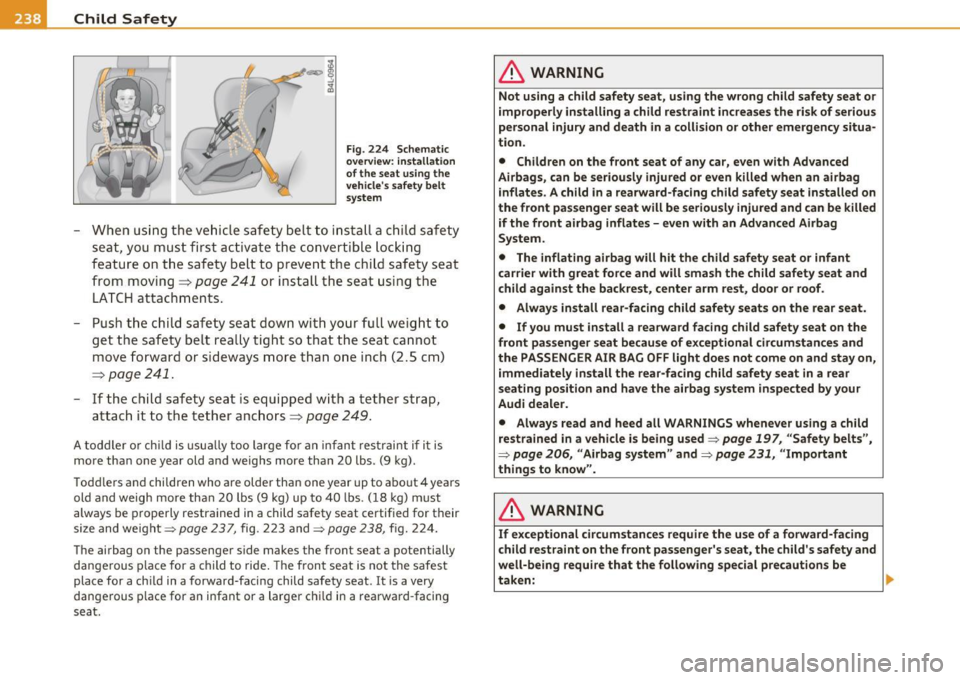
F ig. 22 4 Schema tic
overvie w: insta llatio n
of the seat using the
vehicle's sa fety be lt
sys tem
- When using the vehicle safety belt to insta ll a child safety
seat, you must first activate the convertible lock ing
feature on the safety belt to prevent the child safety seat
from moving~
page 241 or install the seat using the
LA TCH attachments .
- Push the child safety seat down with your full we ight to
get the safety belt really tight so that the seat cannot
move forward or s ideways more than one inch
(2.5 cm)
=>
page 241 .
- If the child safety seat is equipped w ith a tether strap,
attach it to the tether anchors=>
page 249.
A todd le r o r ch ild is usually too large for an i nfant res traint if it is
more than one year old and weighs more than 20 lbs . (9 kg) .
Todd lers and children who are older than one year up to about 4 years
old and weigh more tha n 20 lbs (9 kg) up to 40 lbs. (18 kg) must
always be properly restrained in a child safety seat certif ied for their
size and weight~
page 237, fig. 223 and~ page 238 , fig. 224.
The airbag on the passenger s ide makes the front seat a poten tially
dangerous place for a child to ride . The front seat is not the safest
place for a ch ild in a forward-facing child safety seat . It is a very
dangerous p lace for an infant or a larger chi ld in a rearward -facing
seat .
& WARNING
Not using a child safet y seat , us ing the w rong child safety seat or
improperl y install ing a child re straint in cre a ses the ri sk of seriou s
per sonal injury and death in a c olli sion or oth er em erg ency situa
tion.
• Children on th e front seat of any ca r, ev en with Ad vanced
Airbags , can be seriou sly injured or even killed when an air bag
i nflat es. A child in a re arward-facing child safet y seat installed on
the front pa ssenger seat will be seri ously injured and can be killed
i f the front a irbag inflates -ev en w ith an Advanc ed Airbag
System .
• The inflating airbag will hit th e child saf ety s eat or infant
carrier with grea t fo rce and will sma sh the child safet y seat and
child against the backrest, center arm rest , door or roof .
• Alway s in stall rear-f acing child safety seat s on the rear seat.
• If you must install a r ear ward fa cing ch ild safety seat on the
front p assenger seat becau se of except ional circum stance s and
th e PAS SENGER AIR BAG OF F light d oes not com e on and st ay on,
imm edia tel y i nstall the rear -facing child safet y se at in a re ar
seating position and ha ve the airbag s ystem insp ect ed by y our
Audi de aler.
• Alway s re ad and h eed all WARNINGS when ever u sing a child
re st rained
in a vehicle i s being use d~ page 197, "Safety belts ",
~ page 206 , "Airbag system " a nd ~ page 2 31 , "Important
thing s to know ".
& WARNING
If exc eptional cir cum stan ce s re quire the u se of a forward -f aci ng
c hild re straint on th e front p assenger 's seat, th e child 's saf ety and
w ell-being requ ire that the following sp eci al precauti ons b e
tak en:
11'-
Page 241 of 384

& WARNING (continued)
• Make sure the forward-facing seat has been designed and certi·
fied by its manufacturer for use
on a front seat with a passenger
front and side airbag.
• Always follow the manufacturer's instructions provided with
the child safety seat or infant carrier.
• Always move the front passenger seat into the rearmost posi
tion of the passenger seat's fore and aft adjustment range, and as
far away from the airbag as possible before installing the child
restraint.
• Always make sure that nothing prevents the front passenger's
seat from being moved to the rearmost position in its fore and aft
adjustment range.
• Always make sure the backrest is in an
upright position.
• Make sure that the PASSENGER AIR BAG
OFF light comes on
and stays on all the time whenever the ignition is switched
on.
• If the light does not stay on, perform the checks => page 217,
"Monitoring the Advanced Airbag System".
• Take the child restraint off the front passenger seat and install
it properly at one of the rear seat positions if the PASSENGER AIR
BAG
OFF light does not stay on whenever the ignition is switched
on. a
Safety first Vehicle OP-eration
Child Safety
Booster seats and safety belts
Properly used booster seats can help protect children
weighing between about 40 lbs. and 80 lbs. (18 kg and
36 kg) who are less than 4 ft.
9 in.
(57 inches/1.45 meters) tall .
Fig. 225 Rear seat:
child properly
restrained in a booster
seat
The vehicle's safety belts alone will not fit most children until
they are at least 4 ft. 9 in. (57 inches/1.45 meters) tall and
weigh about 80 lbs. (36 kg). Booster seats raise these chil
dren up so that the safety belt will pass properly over the
stronger parts of their bodies and the safety belt can help
protect them in a crash.
- Do not use the convertible locking retractor when using
the vehicle's safety belt to restrain a child on a booster
seat.
- Always position the shoulder portion of the safety belt
midway over the child's shoulder. If you must transport an
older child in a booster seat on the front passenger seat,
you can use the safety belt height adjustment to help
adjust the shoulder portion prop erly.
- Always make sure that the shoulder portion of the safety
belt never rests against or across the child's neck.
9'>
Vehicle care Do-it-yourselt service iTechnical data
Page 243 of 384

_______________________________________________ C_ h_ il_d _ S_a _ f_ e _ t..,. Y :...._ __
& WA RNING (c on tinued )
• If you mu st install a booster seat on the front pa ssenger seat
becau se of exceptional circumstance s the PASSENGER AIR BAG
OFF light must come on and stay on , whenever the ignition is
switched on.
• If the PASSENGER AIR BAG OFF light does not come on and
stay on, perform the checks described=>
page 217, "Monitoring
the Advanced Airbag System ".
• Take the child re straint off the front pa ssenger seat and install
it p roperly at one of the rear seat positions if the PASSENGER AIR
BAG OFF light does not stay on whenever the ign ition i s switched
on.
• Always read and heed all WARNINGS whenever using a child
restrained in a vehicle i s being used=>
page 197, "Safety belts",
=> page 206, "Airbag sy stem " and => page 231, "Important
things to know ".•
Installing a child safety seat
Securing a child safety seat using a safety
belt
S af ety b elts f or the re ar seats and th e fr on t passen ger
can be lock ed wit h the converti ble locking ret ract or to
properly secu re child safety seats.
The safety be lts emergency lo ck ing re trac tors for the rear seats
safety belts and for the front passenge r's seat safety belt have a
convertib le locking retractor for child rest raints . The safety be lt must
be locked so that belt webbing canno t un reel. The retractor can be
activated to lock the safety be lt and prevent the safety belt webbing
from loose ning up during normal dr iv ing. A child saf ety sea t can only
be properly insta lled when the safety belt is locked so that t he chi ld
and child s afety seat will stay in pla ce.
Controls and equip
ment Safety first Vehicle operation
Always remember:
Even though yo ur vehicle is equipped w ith a n
Adv anced Air bag system, all ch ild ren, espe cially those 12 ye ars and
younger, should always ride in the back seat properly restra ined for
their age and size.
& WARNING
Improperly installed child safety seats increase the risk of seriou s
personal injury and death in a collis ion.
• Alway s make sure that the safety belt retractor is locked when
installing a child safety seat . An unlocked safety belt retractor
c annot hold the child safety seat in place during normal driving or
in a crash .
• Always bu ckle the child safety seat firmly in pla ce even if a
child is not sitting in it. A loose child safety seat can fly around
during a sudden stop or in a colli sion .
• Always make sure that the rear seat backrest to which the
center rear safety belt is attached is securely latched whenever the
rear cente r safety belt is being used to secure a child restraint.
• If the backrest is not securely latched, the child and the child
restraint will be thrown forward together w ith the backrest and
will strike part s of the vehicle interior. The child can be seriou sly
injured or killed .
• Never install rear-facing child safety seat s or infant carriers on
the front passenger seat . A child w ill be seriously injured and can
be killed when the pa ssenger airbag inflates.
• The inflating airbag will hit the child safety seat or infant
carrier with great force and will smash the child safety seat and
child against the backrest, center armrest, door or roof.
• Always install rear-facing child safety seats or infant carriers
on the rear seat .
• Forward-facing child safety seats or infant carriers installed on
the front pas senger' s seat may interfere with the deployment of
the airbag and cause ser iou s injury to the child. .,
Vehicle care Do-it-yourself service Technical data
Page 244 of 384
-Child Safety ------ ~---------------------------------
& WARNING (cont inued)
• It is safer to install a forward-facing child safety seat on the
rear seat.
• Always read and heed all WARNINGS whenever using a child
restrained in a vehicle is being used=>
page 231. Special precau
tions apply when installing a child safety seat on the front
passenger seat=>
page 208, "Child restraints on the front seat -
some important things to know".
& WARNING
Always take special precautions if you must install a forward or rearward-facing child restraint on the front passenger's seat in
exceptional situations:
• Whenever a forward or rearward-facing child restraint is installed on the front passenger seat, the PASSENGER AIR BAG
OFF light must come on and stay on whenever the ignition is
switched on .
• If the PASSENGER AIR BAG OFF light does not come on and
stay on, perform the checks described=>
page 217, "Monitoring
the Advanced Airbag System".
• Take the child restraint off the front passenger seat and install
it properly at one of the rear seat positions if the PASSENGER AIR
BAG OFF light does not stay on whenever the ignition is switched
on.
• Improper installation of child restraints can reduce their effec
tiveness or even prevent them from providing any protection .
• An improperly installed child restraint can interfere with the
airbag as it deploys and seriously injure or even kill the child.
• Always carefully follow the manufacturer's instructions
provided with the child safety seat or carrier.
• Never place additional items on the seat that can increase the
total weight registered by the weight-sensing mat and can cause
injury in a crash .
& WARNING
Forward-facing child restraints:
• Always make sure the forward -facing seat ha s been designed
and certified by its manufacturer for use on a front seat with a
passenger front and side airbag.
• Never put the forward-facing child restraint up, against or very
near the instrument panel.
• Always move the passenger seat into its rearmost position in
the seat's fore and aft adjustment range, as far away from the airbag as possible before installing the forward-facing child
restraint. The backrest must be adjusted to an upright position .
• Make sure that the PASSENGER AIR BAG OFF light comes on
and stays on all the time whenever the ignition is switched on.
& WARNING
Rearward-facing child restraints:
• A child in a rearward-facing child safety seat installed on the
front passenger seat will be seriously injured and can be killed if
the front airbag inflates - even with an Advanced Airbag System.
• The inflating airbag will hit the child safety seat or infant
carrier with great force and will smash the child safety seat and
child against the backrest, center armrest, door or roof.
• Always be especially careful if you must install a rearward
facing child safety seat on the front passenger seat in exceptional
circumstances.
• A tight tether strap on a rearward-facing child restraint
attached to the front passenger seat can put too much pressure on
the weight-mat in the seat and register a heavier weight in the
Advanced Airbag System. The heavier weight registered can make
the system work as though an adult were on the seat and deploy
the Advanced Airbag when it must be suppressed causing serious
or even fatal injury to the child.
Ill-
Page 245 of 384

_____________________________________________ C _h_i_ld _ S_ a_ f_ e_ t ... Y'--- __
& WARNING (continued)
• Make sure that the PASSENGER AIR BAG OFF light comes on
and stays on all the time whenever the ignition is switched on.
• If the PASSENGER AIR BAG OFF light does not come on and
stay on, immediately install the rear-facing child safety seat in a
rear seating position and have the airbag system inspected by
your Audi dealer. •
Activating the convertible locking retractor
Use the convertible locking retractor to secure a child
restraint.
Always heed the child safety seat manufacturer 's instruc
tions when installing a child restraint in your vehicle. To acti
vate the convertible locking retractor:
- Place the child restraint on a seat, preferably on the rear
seat .
- Slowly pull the belt
all the way out.
- Route it around or through the child restraint belt path
=>& .
- Push the child safety seat down with your full weight to
get the safety belt really tight.
- Insert the belt tongue into the buckle for that seating
position.
- Guide the safety belt back into the retractor until the belt
lies flat and snug on the child safety seat.
Controls and equip
ment Safety first Vehicle operation
-
You should hear a "clicking" noise as the belt winds back
into the inertia reel. Test the convertible locking retractor
by pulling on the belt. You should no longer be able to pull
the belt out of the retractor. The convertible lock ing
retractor is now activated.
- Make sure that the red release button is facing away from
the child restraint so that it can be unbuckled quickly.
- Pull on the belt to make sure the safety belt is properly
tight and fastened so that the seat cannot move forward
or sideways more than one inch (2.5 cm).
& WARNING
Using the wrong child restraint or an improperly installed child
restraint can cause serious personal injury or death in a crash.
• Always make sure that the safety belt retractor is locked when
installing a child safety seat. An unlocked safety belt retractor
cannot hold the child safety seat in place during normal driving or
in a crash.
• Always buckle the child safety seat firmly in place even if a
child is not sitting in it. A loose child safety seat can fly around
during a sudden stop or in a crash.
• Always make sure the seat backrest to which the child restraint
is installed is in an upright position and securely latched into place
and cannot fold forward. Otherwise, the seat back with the child
safety seat attached to it could fly forward in the event of an acci
dent or other emergency situation.
• Always read and heed all WARNINGS whenever using a child
restrained in a vehicle is being used
=> page 231. Special precau
tions apply when installing a child safety seat on the front passenger seat =>
page 208, "Child restraints on the front seat -
some important things to know". •
Vehicle care Do-it-yourself service Technical data
Page 252 of 384
...,. Child Safety Pfl'I ____ _,.__ __________________________ _
& WARNING (continued)
• If you must install a rearward facing child safety seat on the
front passenger seat because of exceptional circumstances and
the PASSENGER AIR BAG OFF light does not come on and stay on,
immediately install the rear-facing child safety seat in a rear
seating position and have the airbag system inspected by your
Audi dealer. •
Installing the upper tether strap on the
anchorage
Installing the tether strap
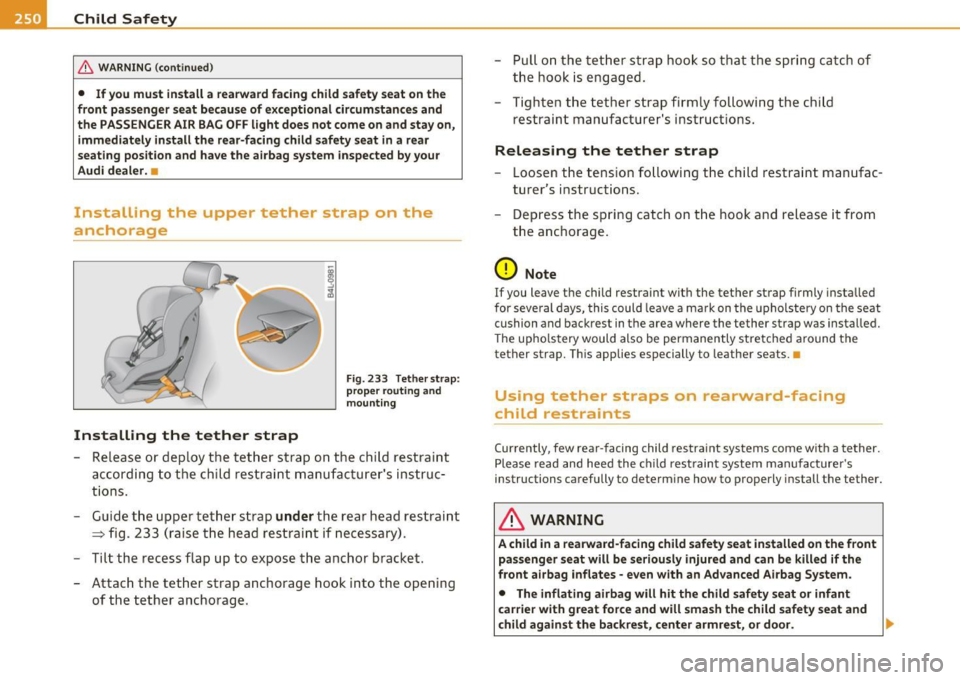
Fig. 233 Tether strap:
proper routing and
mounting
- Release or deploy the tether strap on the child restraint
according to the child restraint manufacturer's instruc
tions.
- Guide the upper tether strap
under the rear head restraint
=> fig. 233 (raise the head restraint if necessary).
- Tilt the recess flap up to expose the anchor bracket.
- Attach the tether strap anchorage hook into the opening
of the tether anchorage. -
Pull on the tether strap hook so that the spring catch of
the hook is engaged.
- Tighten the tether strap firmly following the child
restraint manufacturer's instructions.
Releasing the tether strap
-Loosen the tension following the child restraint manufac
turer's instructions.
- Depress the spring catch on the hook and release it from
the anchorage.
0 Note
If you leave the child restraint with the tether strap firmly installed
for several days, this could leave a mark on the upholstery on the seat
cushion and backrest in the area where the tether strap was installed.
The upholstery would also be permanently stretched around the
tether strap. This applies especially to leather seats.•
Using tether straps on rearward-facing
child restraints
Currently, few rear-facing child restraint systems come with a tether.
Please read and heed the child restraint system manufacturer's
instructions carefully to determine how to properly install the tether.
& WARNING
A child in a rearward-facing child safety seat installed on the front
passenger seat will be seriously injured and can be killed if the
front airbag inflates -even with an Advanced Airbag System.
• The inflating airbag will hit the child safety seat or infant
carrier with great force and will smash the child safety seat and
child against the backrest, center armrest, or door.
~
Page 253 of 384

Child Safety -
-------------------"'---
& WARNING (c on tinued )
• A tight tether or other strap on a rearward-facing child
restraint attached to the front pas senger seat can put too much
pressure on the weight-mat in the seat and register a heavier
weight in the Advanced Airbag System. The heavier weight regis
tered can make the system work as though an adult were on the
s eat and deploy the Advan ced Airbag when it must be suppressed
caus ing serious or e ven fatal injury to the child.
• If you must install a rearward facing child safety seat on the
front passenger seat because of exceptional circumstances and
the PASSENGER AIR BAG OFF light does not come on and stay on,
immediately install the rear-facing child safety seat in a rear
seating position and have the airbag system inspected by your
Audi dealer .•
Additional Information
Sources of information about child
restraints and their use
T here are a number of sources of addi tional information about child
restra in t selec tion , in stalla tion and use:
N HTSA a dvises t hat the best ch ild safety s eat is the one that fits you r
child and fits in your vehicle, and that yo u will use co rrectly and
consiste ntly.
Try before you buy!
U .S National Highway Traffic Safety Administration
Tel. : 1-88 8-327- 4236 (T TY: 1-800- 424 -9153)
www.n htsa .gov
National SAFE KIDS Campaign
Tel. : (202) 662-0600
www.safe kids .org
Controls and equip
ment Safety first Vehicle operation Safety BeltSafe U
.S.A
T el. : (800 ) 74 5-SAFE ( Eng lish)
Tel. : (800) 747 -SA NO (Spa nish)
www.carseat.org
Transport Canada Information Centre
T el. : 1 (80 0) 333-037 1 or call 1 (6 13) 99 8-8 616 if you are i n the
Ottawa area
www. tc.gc.c a/ro ads afety
Audi Customer CARE
T el. : (800) 822-2834 •
Vehicle care Do-it-yourself service Technical data
Page 255 of 384

_________________________________________ I_ n_ t_ e_ ll_,igent technology ,__E~-
acting on the vehicle, the brake pressure and the steering angle are
all meas ured.
The direction in which the driver wishes to travel is determined with
the aid of the steering angle and vehicle speed and is continually
compared with the actual behavior of the vehicle. If the two do not
match, for example , when the vehicle starts hydroplaning on a wet
road, ESP will automatically brake the appropriate wheel to correct
the problem.
The vehicle is then stabi lized by the forces acting on the whee l during
braking. If the vehicle is
oversteering (rear tends to skid out of the
turn), the brakes are main ly applied on the wheel that is on the
outs ide of the curve. In the case of a vehicle that is
understeering
(tendency to slide out of the curve), the brakes are applied at the rear
wheel that is on the inside of the curve. An acoustic signal ind icates
when ESP brake application cuts in =>
&.
Th e system operates across the entire speed range in combination
with the ABS system=>
page 256. If the Anti-Lock Brake System
(ABS) malfunctions, the ESP will be out of action as we ll.
Activation
When you turn on the engine, ESP will automatically be activated and
will perform a self-test .
The system can be activated or deactivated by pressing the button
=>
page 252, fig. 234 . The warning light comes on when the system
is switched off=>
page 16.
Normally, the ESP should always be on, however, it may be advanta
geous to turn off the sys tem in certain special cases when some
degree of whee l spin is desired such as:
• when driving with snow chains
• when driving in deep snow or on a loose surface (to allow the
wheels to dig in to reach firm ground)
• when trying to "roc k" the vehicle free when it has become stuck.
The system should be reactivated once you are no longer in such situ
ations.
Controls and equip ment Safety first Vehicle operation
Both the ABS and
EDS systems are still functioning even if the ESP is
switched off.
& WARNING
The Electroni c Stabilization Program is nevertheless subject to the
laws of physics. It is particularly important to pay attention to
this fact on wet and slippery roads. It is therefore important that
you always adapt your driving to the condition of the road and
traffic conditions. Do not allow the increased safety provided by
the Electronic Stabilization Program system to lull you into
accepting additional safety risks. •
Electronic differential lock (EDL)
The electronic differential lock monitors the rotational
speed of the drive wheels.
General notes
The electronic differential lock (EDL) helps the car to start moving,
acce lerate and climb a gradient on surfaces providing poor or almost
no grip . Without EDL, this would be difficult, if not impossible .
How the system works
The EDL operates automatically. It monitors the rotational speed of
the drive wheels on an axle with the he lp of the ABS sensors
=>
page 256 . If a noticeable difference in rotational speed between
the drive wheels on one axle is detected (e .g . on slippery ground
on
one side),
the spinning wheel is braked, thereby transferring power to
the other drive whee l or wheels (all -wheel drive). This is done up to a
speed of about 60 mph (100 km/h) . Noises from the brake system
signal that wheel spin is being contro lled.
Driving off
When driving off, always be sure to keep road conditions in mind as
you accelerate. If one drive wheel spins because it is on a surface with
less grip , gradually increase the pressure on the accelerator peda l
Iii>
Vehicle care Do-it-yourself service Technical data
Page 256 of 384

Intelligent technology
'-----------------------------------------------
until the car starts to move . The whee l less ab le to transfer power
spins .
Overheating of brakes
To prevent the disc b rake of the bra ked wheel from ove rhea ting if
subjected to excessive loads, the EDL cuts out temporarily . The
veh icle remains operat ional and beh aves in the same way as a vehicle
without EDL .
As soon as the brake has coo led down, EDL switches on again auto
matically .
& WARNING
• When a ccelerating on slippery surfaces, such as on ice or snow,
alw ay s be careful when depre ssing the a ccelerator pedal. E ven
with the EDL working, the drive wheel s can spin and reduce your
ability to control your car . Risk of crash !
• The in creased safety afforded by EDL does not mean that you
can take safety ri sks. Always adapt your driving st yle to the road
condition s and traffic situation .
fi Tips
If a fault occurs i n the ABS, the EDL is also no t fu nct ion ing . This is
indicated by the ABS warning light~
page 19. •
Anti-Slip Regulation System (ASR)
The Anti-Slip Regulati on System prevents the driven
wheels from spinning when the car is a ccel erating.
General notes
T he Anti-S lip Regulation System (ASR) is integrated in the electronic
stabilization program (ESP). When the veh icle starts up and acceler
ates , the wheels are p reve nted from sp inning by adjust ing the eng ine
powe r to match t he amo unt of grip avai lab le from the road s urface.
How the system works
ASR perfo rms au toma tica lly, i .e . witho ut the drive r's in tervent ion .
With the aid of the A BS sensors~
page 256, ASR monitors the speed
of the driven wheels . If the wheels start to spin, the engine powe r is
reduced automat ically u nti l the t ires find enough gr ip to lock onto
the road s urface. The system is active across the entire speed range.
Th e ASR wor ks in con ju nction with the A BS .
If a m alfu nction sho uld
occur in the ABS, the ASR w ill also be out of action.
& WARNING
The increased safety afforded by ASR does not mean that you can
take safety ri sks . Always adapt your driving style to the road
condit ions and traffic situation.
[ i ] Tips
To ensure that the ASR works prope rly, all four wheels must be fitted
w ith ident ic a l ti res Any differences in rollin g radius of the tires can
cause the system to reduce engine power when t his is not desired .
See also ~
page 318, "N ew t ires and replacing tires and whee ls" .•
Braking
General Information
What affects b raking efficiency ?
Operating cond itions and driving habits
Th e bra kes on t oday's automo biles are still subjec t to we ar,
depending large ly on operating conditions a nd driving habits~ &.
O n ve hicles tha t are eithe r driven mostly in stop- and-go city t raff ic or
are drive n hard, the brake pads should be checked by your author ized
Audi de aler more o ften than specified in the
Warranty & Mainte
nance booklet .
Failure to have your brake pads i nspected can result
in re duced brake pe rformance. .,