wheel AUDI TT COUPE 2009 User Guide
[x] Cancel search | Manufacturer: AUDI, Model Year: 2009, Model line: TT COUPE, Model: AUDI TT COUPE 2009Pages: 316, PDF Size: 71.16 MB
Page 93 of 316
On the road
Steering
Adjusting the steering wheel column
The steering wheel position can be continuously adjusted
in height and distance.
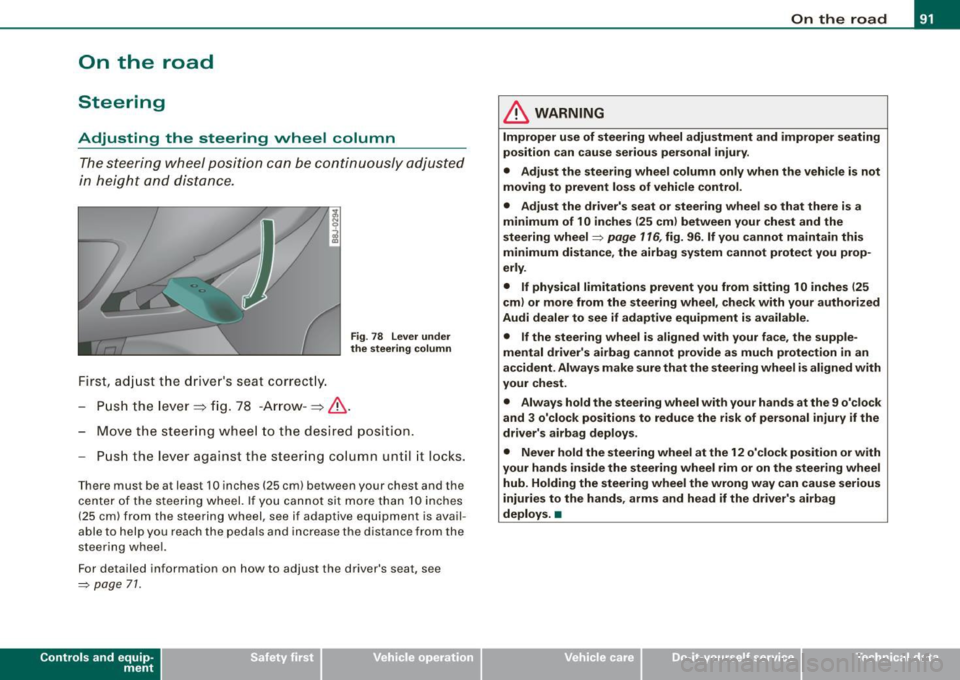
First, adjust the driver's seat correctly.
Fig. 78 Lever under
the steering column
-Pu sh the lever~ fig. 78 -Arrow- ~& .
- Move the steering wheel to the desired position.
Pu sh the lever against the steering column until it locks.
T here must be at least 10 inches (25 cm) between your chest and the
center of the steering wheel. If you cannot sit more than 10 inches
(25 cm) from the steering wheel, see if adaptive equipment is avail
able to help you reach the pedals and increase the distance from the
steering wheel.
For detailed information on how to ad just the driver's seat, see
=> page
71.
Con tro ls and eq uip
ment
On the road
& WARNING
Improper use of steering wheel adjustment and improper seating
position can cause serious personal injury.
• Adjust the steering wheel column only when the vehicle is not
moving to prevent loss of vehicle control.
• Adjust the driver's seat or steering wheel so that there is a
minimum of 10 inches (25 cm) between your chest and the
steering wheel=> page 116, fig.
96. If you cannot maintain this
minimum distance , the airbag system cannot protect you prop
erly .
• If physical limitations prevent you from sitting 10 inches (25
cm) or more from the steering wheel, check with your authorized
Audi dealer to see if adaptive equipment is available.
• If the steering wheel is aligned with your face, the supple
mental driver's airbag cannot provide as much protection in an
accident. Always make sure that the steering wheel is aligned with
your chest .
• Always hold the steering wheel with your hands at the 9 o'clock
and 3 o'clock positions to reduce the risk of personal injury if the
driver's airbag deploys .
• Never hold the steering wheel at the
12 o'clock position or with
your hands inside the steering wheel rim or on the steering wheel
hub . Holding the steering wheel the wrong way can cause serious
injuries to the hands , arms and head if the driver's airbag
deploys .•
Vehicle care
I I irechnical data
Page 94 of 316
On the ro ad
Ignition lock and ignition switch
Ignition lock
The igniti on key starts or s tops the eng ine.
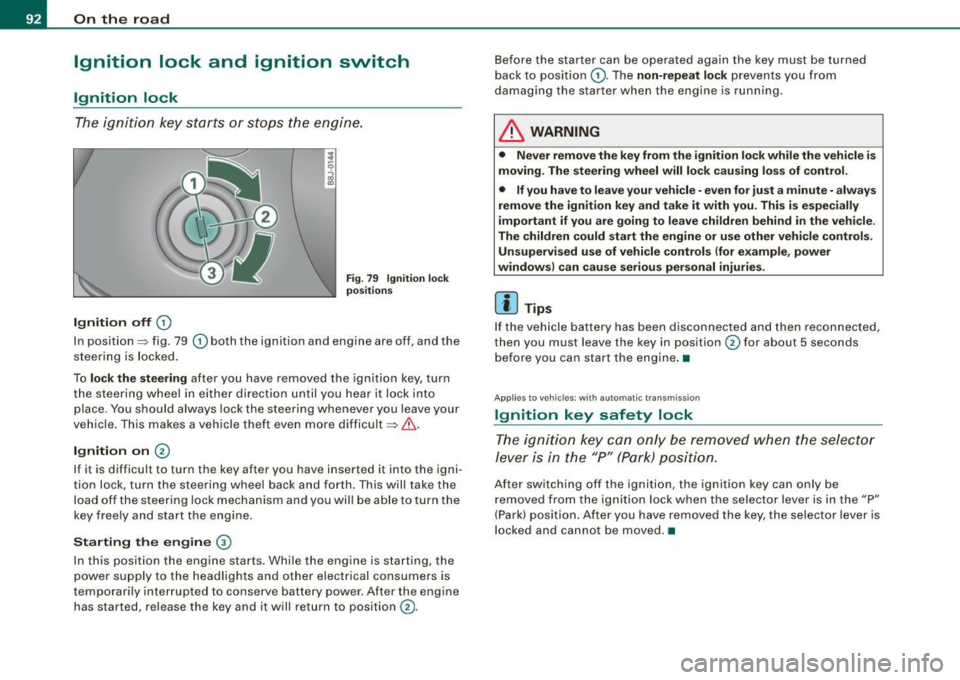
Ignition off G)
Fi g. 7 9 I gnition lock
po sition s
In position => fig . 79 G) both the ignition and engine are off , and the
steering is locked.
To
lo ck the steering after you have removed the ignition key, turn
the steering whee l in either direction until you hear it lock into
place . You should always lock the steering whenever you leave your
vehic le. This makes a vehicle theft even more difficult=>& .
Ignition on 0
If it is difficult to turn the key after you have inserted it into the igni
tion lock, turn the steering wheel back and forth. This will take the
load off the steering lock mechanism and you wil l be able to turn the
key freely and start the engine.
Starting the engine ®
In this position the engine starts . Whi le the engine is starting, the
power supply to the headlights and other electrical consumers is
temporari ly interrupted to conserve battery power . After the engine
has started, release the key and it will return to position
G) .
Before the starter can be operated again the key must be turned
back to posi tion
G) . The non -repeat lock prevents you from
damaging the starter when the engine is running.
& WARNING
• Never remove the key from the ignition lo ck while the veh icle is
moving. The steering wheel will lo ck causing lo ss of control .
• If you have to leave your vehicle -even for just a minute -always
remove the ign ition key and take it with you . This i s especially
i mportant if you are going to l eave children behind in the vehi cle .
The children could start the eng ine or u se other vehi cle control s.
Unsupe rv ised use of vehicle controls (for e xample , power
window s) can cau se serious per sonal injurie s.
[ i ] Tips
If the veh icle ba ttery has been disconnected a nd then reconnected,
then you must leave the key in position
G) for about 5 seconds
bef ore you can start the engine .•
Ap plies to v ehicle s: w ith a utom at ic tr ansmiss io n
Ignition key safety lock
The ig nition ke y can only be rem oved when the selec tor
le ver i s in the "P" (Par k) p osition.
After switching off the ignition, the ignition key can only be
r emoved from the igni tio n lock w hen the se lector leve r is in the "P"
(Park) position . After you have removed the key, the selector lever is
l ocked and cannot be moved. •
Page 97 of 316

-Wit h a manual transm issi on, engage 1st gea r, or with a n
a utomatic transmission place the se lector lever in P
=> & .
- Remove the ignition key from the ignit io n lock.
Wha t el se you should do wh en parking yo ur v ehi cle on
a n incli ne or d ecline
Turn the steering whee l so that if the vehicle shou ld start to rol l, it
wi ll roll into the curb.
I f you are park ing on a
decline (the front of you r ve hicle facing
downhill) , turn the front wheels to the right so that they poin t
toward the curb .
If you are park ing on an in cline (the font of your vehicle facing
uphill!, turn the front whe els to the left so that they point
away from
the curb .
& WARNING
This is how you can reduce the ri sk of injury when le avi ng your
vehicle .
• Never p ark the vehi cle w here it can come
in cont act w ith dry
gra ss, s pilled fuel or any other flammable mater ial s.
• Never allow anyone -espe cially small ch ildren -to remain
in the
vehicle when it is locked . Locked doors make it more difficult for
re scu ers to ac ce ss the pa ssenger compartment in the e vent of an
emergency . Danger to life!
• Never lea ve childr en un super vis ed in the vehicle . Children
c ould release the parking brake or move the gearsh ift l ever out of
gear . The vehicle could start to r oll away a nd cau se an a ccident .
• No matter what the season i s, the temperature
in a parked
v ehi cle can reach dangerou s level s. •
Controls and equip
ment
On th e road
Acoustic parking system
Applies to veh ic les : wit h 4 -ch anne l a cou stic park ass is t
Rear acoustic park assist
Acoustic park assist gives a warning a bout o bstacles
behind the vehicle.
Description
The rear acoustic park assist (4 -channel acoustic park assist) deter
mines the d istance of the vehic le from an obstac le using u ltrasonic
sensors. The sensors are in the rear bumper. The volume and the
pitch of the chimes can be adjusted through the menu display
=> page 27.
The range at which the sensors start to m easure is about :
To the side
Center rear
Acti v atio n
2 feet (0 .60 m)
5 feet (1.60 ml
The pa rking assist is activated when rever se ge ar is engaged . A brief
tone confirms that the system is activated .
Backing up
Distance warning when backing up starts when an obstacle is
detec ted in the range of the park ass ist system . As the distance
decreases, the time interval between the aud ible tones becomes
shorter .
When the distance is less than 1 foot (0.30 m) , the tone becomes
continuous . At this point you should stop backing up.
Please note that low objects a lready signalled by a warning can
disappear from the sys tem's detection range and wil l not continue
t o be signa lled . ..,
I • •
Page 106 of 316
• ..__T_ ra_ n_s_ m_ i_ s _s_ i_ o _n ___________________________________________________ _
Switching to manual
-Push the selector lever to the right from D. As the trans
mission has switched,
6 5 4 3 2 1 appears in the display,
with the gear that is engaged highlighted.
Upshifting
Tap the selector lever forward (in the tiptronic setting)
=> page 103, fig. 88 G).
Downshifting
- Tap the selector lever backward (in the tiptronic setting)
o.
Switching to manual can be carried out with the vehic le stationary
as well as moving .
When accelerating, the transmission shifts into the next gear in gears 1 , 2, 3, 4 and 5 shortly before the maximum permissible
engine speed is reached.
If you have selected a lower gear than the current one , the transmis
sion will only shift down when the engine cannot be overspeeded.
If kick -down is actuated, the transmission shifts into a lower gear
independently of speed and engine rpm .•
Ap plies to vehicles: w ith S tronic ® and wi th Tipt ro nic co ntrols o n the st eer in g w hee l
Steering wheel with Tiptronic ® controls
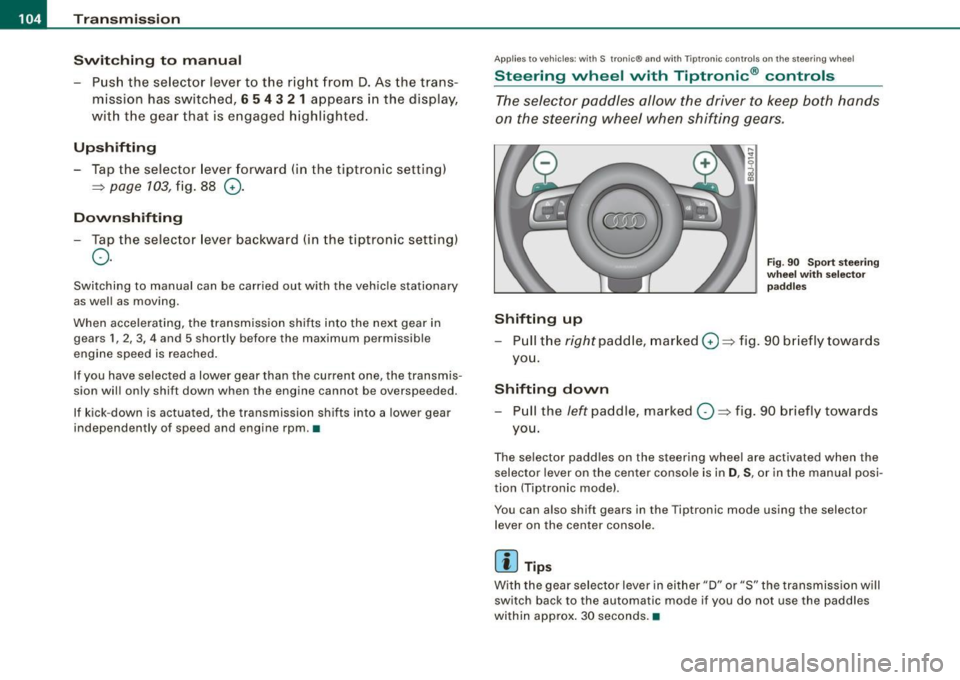
The selector paddles allow the driver to keep both hands
on the steering wheel when shifting gears.
Shifting up
Fig. 90 Sport steering
wheel with selec tor
paddles
- Pull the right paddle, marked 0=> fig. 90 briefly towards
you.
Shifting down
- Pull the left paddle, marked O => fig. 90 briefly towards
you.
The selector padd les on the steering wheel are activated when the
selector lever on the center console is in
D, S, or in the manual posi
tion (Tiptronic mode) .
You can also shift g ears in the Tiptronic mode using the selector
lever on the center console.
[ i ] Tips
With the gear selector lever in ei ther "D" or "S" the transmission will
switch back to the automa tic mode if you do not use the paddles
within approx . 30 seconds. •
Page 107 of 316
____________________________________________________ T_ r_a _n _ s_ m __ is_s_ i _o _ n __ llll
Ap plies to vehicles : wit h S tro ni c®
Kick -dovvn feature
The kick-down feature allows maximum acceleration.
If you depress the accelerator pedal fully beyond the full-throttle
position, the transmission automatically downshifts one gear,
depending on vehicle speed and engine rpm. The upshift into the
next higher gear takes place as soon as the maximum specified
engine speed is reached.
& WARNING
Please note that the drive wheels can spin if the kick-down is used
on a smooth slippery road -risk of skidding! •
Applies to vehicles : withs t ro ni c®
Launch Control Program
The Launch Control Program permits maximum accelera
tion .
In order to use Launch Control, the ASR (Anti-Slip Regula
tion) must be disabled. When ASR is disabled, the ESP
warning/indicator light 9 in the instrument cluster illumi
nates . So that Launch Control can be used, the engine must
be at operating temperature and the steering wheel must
not be turned .
- With the engine running, briefly press the ESP button.
The message "ASR off" appears in the instrument cluster
d isplay.
- Shift the gear lever to "S" or the tiptronic® position.
- Step on the brake pedal with your left foot and keep the
brake pedal fully depressed for at least one second.
Controls and equip
ment
- With your right foot, step on the accelerator to the wide
open throttle position or Kickdown. The engine speed
settles at about 3,200 rpm.
- Take your left foot off the brake.
The S tronic® in your vehicle is electronically controlled. A special
Launch Control Program provides the best acceleration from a
standing start .
& WARNING
• Always adapt your driving to the traffic flow.
• Only use Launch Control when road and traffic conditions allow
it and other drivers will not be endangered or annoyed by your
driving and the acceleration of the vehicle.
• Make sure that ESP remains enabled. With the ESP disabled,
the vehicle could brake away, particularly on a slick and slippery road -risk of skidding!
• Once acceleration is finished, switch ASR on again by briefly
pushing the ESP button. •
Applies to vehicles: with S tronic®
Back-up program
In the event of a system malfunction, there is an back-up
program.
In the event of system malfunctions, the automatic transmission
switches to the fail- safe mode. This is signalled by one segment or
all the segments in the display illuminating or going out .
Th e effect of a system malfunction can be one of the following:
• The program shifts only into certain gears.
• Reverse gear can no longer be engaged.
I • •
Page 118 of 316
___ D_ r_ i_v _in -= g;... S _ a_f _e _ly...._ ______________________________________________ _
Proper occupant seating positi·ons
Proper seating position for the driver
The proper driver seating position is important for safe,
relaxed driving.
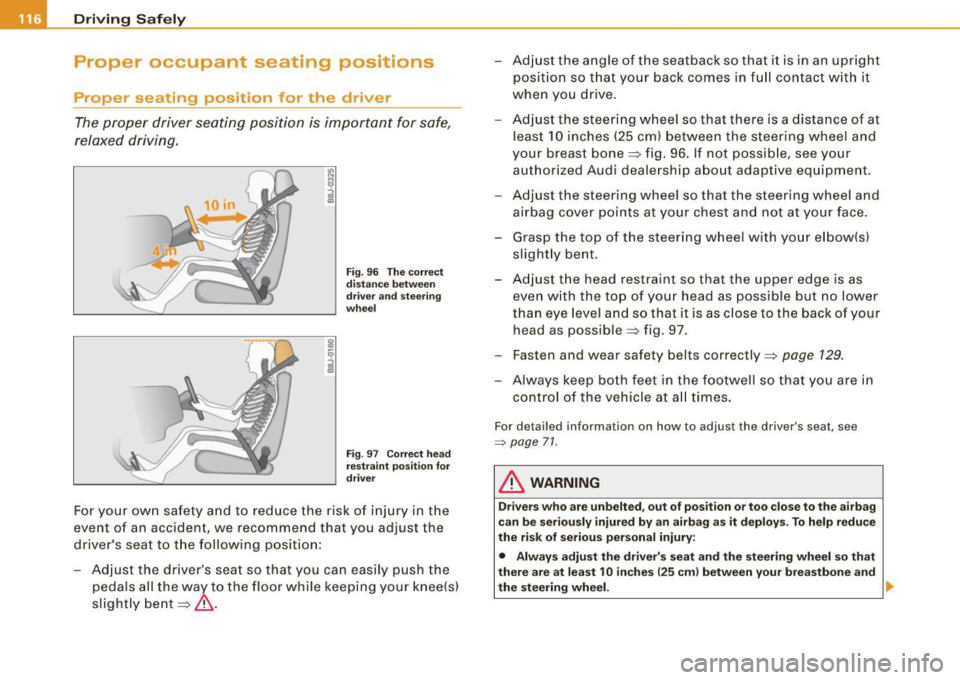
"' N
;
Fig . 96 The correct
distance between
driver and steering
wheel
Fig. 97 Correct head
restraint position for
driver
For your own safety and to reduce the risk of injury in the
event of an accident, we recommend that you adjust the
driver's seat to the following position:
- Adjust the driver's seat so that you can easily push the
pedals all the way to the floor while keeping your knee(s)
slightly bent=:>& . - Adjust the angle
of the seatback so that it is in an upright
position so that your back comes in full contact with it
when you drive.
- Adjust the steering wheel so that there is a distance of at
least 10 inches (25 cm) between the steering wheel and
your breast bone=:> fig. 96. If not possible, see your
authorized Audi dealership about adaptive equipment.
- Adjust the steering wheel so that the steering wheel and
airbag cover points at your chest and not at your face.
- Grasp the top of the steering wheel with your elbow(s)
slightly bent.
- Adjust the head restraint so that the upper edge is as
even with the top of your head as possible but no lower
than eye level and so that it is as close to the back of your
head as possible =:> fig. 97.
- Fasten and wear safety belts correctly=:>
page 129.
- Always keep both feet in the footwell so that you are in
control of the vehicle at all times.
For detailed information on how to adjust the driver's seat, see
=> page 71.
& WARNING
Drivers who are unbelted, out of position or too close to the airbag
can be seriously injured by an airbag as it deploys. To help reduce
the risk of serious personal injury:
• Always adjust the driver's seat and the steering wheel so that
there are at least 10 inches
125 cm) between your breastbone and
the steering wheel. ..
Page 119 of 316

________________________________________________ D_r_iv _ i _n_ g~ S_ a_ fe_ ly __ !II
& WARNING (continued)
• Always adjust the driver's seat and the steering wheel so that
there are at least 4 inches (10 cm) between the knees and the
lower part of the instrument panel.
• Always hold the steering wheel on the outside of the steering
wheel rim with your hands at the
9 o'clock and 3 o'clock positions
to help reduce the risk of personal injury if the driver's airbag inflates .
• Never hold the steering wheel at the
12 o'clock position or with
your hands at other positions inside the steering wheel rim or on
the steering wheel hub. Holding the steering wheel the wrong way
can cause serious injuries to the hands, arms and head if the
driver's airbag inflates
• Pointing the steering wheel toward your face decreases the
ability of the supplemental driver's airbag to protect you in a colli
sion .
• Always sit in an upright position and never lean against or
place any part of your body too close to the area where the airbags
are located.
• Before driving, always adjust the front seats and head
restraints properly and make sure that all passengers are properly
restrained .
• Never adjust the seats while the vehicle is moving. Your seat
may move unexpectedly and you could lose control of the vehicle.
• Never drive with the backrest reclined or tilted far back! The
farther the backrests are tilted back, the greater the risk of injury due to incorrect positioning of the safety belt and improper
seating position.
• Children must always ride in child seats=>
page 157. Special
precautions apply when installing a child seat on the front
passenger seat =>
page 135. •
Controls and equip
ment Safety first
Vehicle operation
Proper seating position for the front
passenger
The proper front passenger seating position is important
for safe, relaxed driving.
For your own safety and to reduce the ris k of injury in the
event of an accident, we recommend that you adjust the
seat for the front passenger to the following pos ition:
- Move the front passenger seat back as far as possible.
There must be a minimum of 10 inches (25 cm) between
the breastbone and the instrument panel =>
&.
- Adjust the angle of the seatback so that it is in an upright
position and your back comes in full contact with it
whenever the vehicle is moving.
- Adjust the head restraint so that the upper edge is as
even with the top of your head as possible but not lower
than eye level and so that it is as close to the back of your
head as possible =>
page 119.
-Keep both feet flat on the floor in front of the front
passenger seat.
- Fasten and wear safety belts correctly=>
page 129.
For detailed information on how to adjust the front passenger's
seat, see => page 69.
& WARNING
Front seat passengers who are unbelted, out of position or too
close to the airbag can be seriously injured or killed by the airbag
as it unfolds. To help reduce the risk of serious personal injury : .,
Vehicle care Do-it-yourself service Technical data
Page 129 of 316
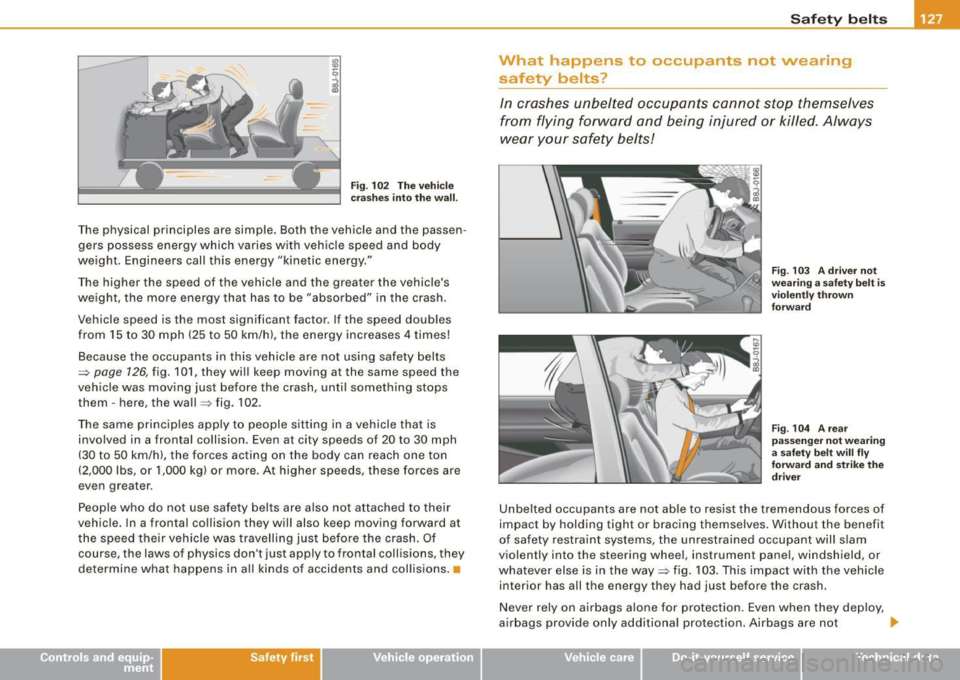
Fig. 102 The vehicle
crashes into the wall.
The physical principles are simple. Both the vehicle and the passen
gers possess energy which varies with vehicle speed and body
weight . Engineers call this energy "kinetic energy."
The higher the speed of the vehicle and the greater the vehicle's
weight, the more energy that has to be "absorbed" in the crash.
Vehicle speed is the most significant factor. If the speed doubles
from 15 to 30 mph (25 to 50 km/h), the energy increases 4 times!
Because the occupants in this vehicle are not using safety belts
~ page 126, fig . 101, they will ke ep moving at the same sp eed the
vehicle was moving just before the crash, until something stops them -here, the wall~ fig. 102 .
The same principles apply to people sitting in a vehicle that is
involved in a frontal collision . Even at city speeds of 20 to 30 mph
(30 to 50 km/h), the forces acting on the body can reach one ton
(2,000 lbs, or 1,000 kg) or more . At higher speeds , these forces are
even greater.
People who do not use safety belts are also not attached to their
vehicle. In a frontal collision they will also keep moving forward at
the speed their vehicle was travelling just before the crash. Of
course, the laws of physics don't just apply to frontal collisions, they
determine what happens in all kinds of accidents and collisions. •
Safety first
Safety belts
What happens to occupants not wearing
safety belts?
In crashes unbelted occupants cannot stop themselves
from flying forward and being injured or killed. Always
wear your safety belts!
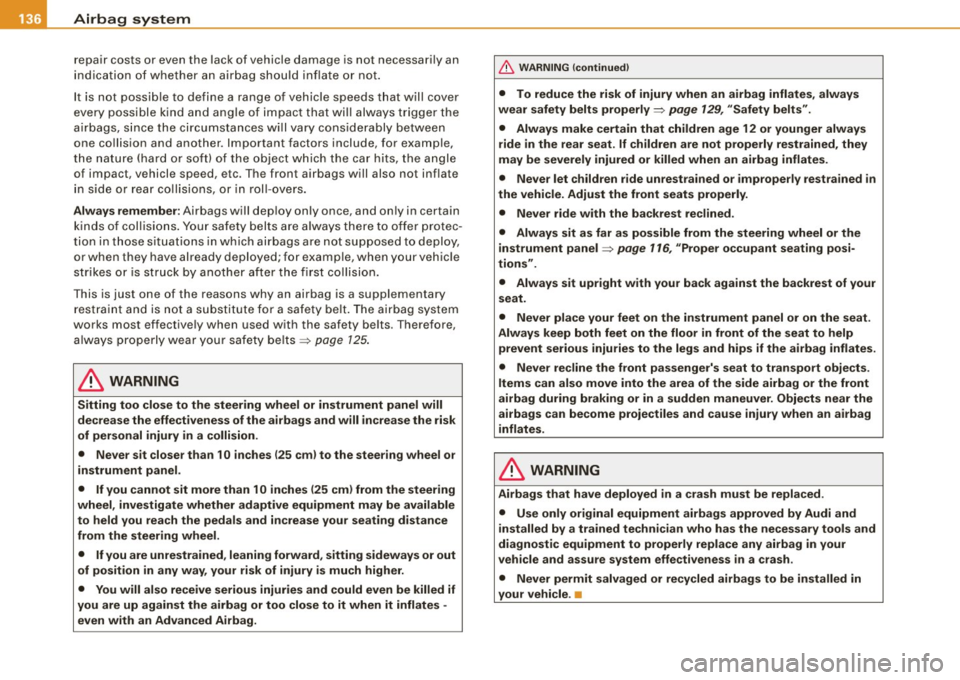
Fig. 103 A driver not
wearing a safety belt is
violently thrown
forward
Fig . 104 A rear
passenger not wearing
a safety belt will fly
forward and strike the
driver
Unbelted occupants are not able to resist the tremendous forces of
impact by holding tight or bracing themselves. Without the benefit
of safety restraint systems, the unrestrained occupant will slam
violently into the steering wheel , instrument panel , windshield , or
whatever else is in the way~ fig. 103 . This impact with the vehicle
interior has all th e energy they had just before the crash.
Never rely on airbags alone for protection. Even when they deploy,
airbags provide only additional protection. Airbags are not
91>
Vehicle care I I irechnical data
Page 137 of 316

Airbag system -----------------=~-
Airbag system
Important things to know
Importance of wearing safety belts and
sitting properly
Airbags are only supplemental restraints. For airbags to
do their job, occupants must always properly wear their
safety belts and be in a proper seating position.
For your safety and the safety of your passengers, before
driving off, always:
- Adjust the driver's seat and steering wheel properly
~ page 116,
-Adjust the front passenger's seat properly~ page 70,
-Wear safety belts properly~ page 128,
- Always properly use the proper child restraint to protect
children~
page 157.
In a collision airbags must inflate within the blink of an eye and with
considerable force. The supplemental airbags can cause injuries if
the driver or the front seat passenger are not seated properly. There
fore in order to help the airbag to do its job, it is important, both as
a driver and as a passenger to sit properly at all times.
By keeping room between your body and the steering wheel and the
front of the passenger compartment, the airbag can inflate fully and
completely and provide supplemental protection in certain frontal
collisions =>
page 116, "Proper occupant seating positions". For
details on the operation of the seat adjustment controls=>
page 70
and=> page 71.
It's especially important that children are properly restrained
=>
page 157.
Controls and equip ment Safety first Vehicle operation
There is a lot that the driver and the passengers can and must do to
help the individual safety features installed in your Audi work
together as a system.
Proper seating position is important so that the front airbag on the
driver side can do its job. If you have a physical impairment or
condition that prevents you from sitting properly on the driver seat
with the safety belt properly fastened and reaching the pedals, or if
you have concerns with regard to the function or operation of the
Advanced Airbag System, please contact your authorized Audi
dealer or qualified workshop, or call Audi Customer CARE at 1-800-
822 -2834 for possible modifications to your vehicle.
When the airbag system deploys, a gas generator will fill the
airbags, break open the padded covers, and inflate between the
steering wheel and the driver and between the instrument panel
and the front passenger. The airbags will deflate immediately after
deployment so that the front occupants can see through the wind
shield again without interruption.
All of this takes place in the blink of an eye, so fast that many people don't even realize that the airbags have deployed. The airbags also
inflate with a great deal of force and nothing should be in their way
when they deploy. Front airbags in combination with properly worn
safety belts slow down and limit the occupant's forward movement .
Together they help to prevent the driver and front seat passenger
from hitting parts of the inside the vehicle while reducing the forces acting on the occupant during the crash. In this way they help to
reduce the risk of injury to the head and upper body in the crash.
Airbags do not protect the arms or the lower parts of the body.
Both front airbags will not inflate in all frontal collisions. The trig
gering of the airbag system depends on the vehicle deceleration
rate caused by the collision and registered by the electronic control
unit. If this rate is below the reference value programmed into the
control unit, the airbags will not be triggered, even though the car
may be badly damaged as a result of the collision. Vehicle damage,
9J),
Vehicle care Do-it-yourself service Technical data
Page 138 of 316
___ A_ ir_ b_ a-g _ s_y _s_ t_ e_ m _________________________________________________ _
repair costs or even the lack of vehicle dama ge is not necessa rily an
in dic ati on of wh ether a n airb ag s hould infl ate or not.
It is not possib le to define a ran ge of v ehicle spe eds t hat w ill cover
every possible kind and angle of impact that wi ll always trigge r the
a irbags, s ince the circu msta nce s will v ary co nside ra bl y bet ween
one co llision and another. Impo rtant factors include, for e xample,
th e nature (h ard or so ft) o f th e obje ct w hich th e ca r hi ts, the a ng le
of impact, vehicle speed, etc . T he front airbags will also not inflate
i n sid e or r ea r co ll isions, o r in roll-o ve rs.
Always remember : Airba gs will d ep loy only once, and on ly in c ertain
k ind s of co llision s. Yo ur s afe ty bel ts are a lways the re t o offe r protec
ti on i n tho se situat io n s in whic h airba gs a re not suppose d to dep loy,
or when they have a lready dep loye d; f or examp le, when yo ur veh ic le
str ikes o r is s truc k by anot her afte r the fi rst collision .
T his is just one of the reasons why an airbag is a supplementary
r es train t an d is not a su bstit u te fo r a sa fe ty belt. T he ai rbag system
works most eff ectively when used with the safety be lts . T herefore,
a lw ays pro per ly wea r your safe ty be lts ~
page 125.
& WARNING
Sitting too close to the steering wheel or instrument panel will
decrease the effectiveness of the airbags and will increase the risk
of personal injury in a collision.
• Never sit closer than 10 inches (25 cm) to the steering wheel or
instrument panel .
• If you cannot sit more than 10 inches (25 cm ) from the steering
wheel , investigate whether adaptive equipment may be available
to held you reach the pedals and increase your seating distance
from the steering wheel.
• If you are unrestrained , leaning forward, sitting sideways or out
of position in any way, your risk of injury is much higher.
• You will also receive serious injuries and could even be killed if
you are up against the airbag or too close to it when it inflates -
even with an Advanced Airbag .
& WARNING (continued)
• To reduce the risk of injury when an airbag inflates, always
wear safety belts properly=:>
page 129 , "Safety belts".
• Always make certain that children age 12 or younger always
ride in the rear seat. If children are not properly restrained , they
may be severely injured or killed when an airbag inflates.
• Never let children ride unrestrained or improperly restrained in
the vehicle. Adjust the front seats properly .
• Never ride with the backrest reclined.
• Always sit as far as possible from the steering wheel or the
instrument panel=:>
page 116 , "Proper occupant seating posi
tions ".
• Always sit upright with your back against the backrest of your
seat.
• Never place your feet on the instrument panel or on the seat .
Always keep both feet on the floor in front of the seat to help
prevent serious injuries to the legs and hips if the airbag inflates.
• Never recline the front passenger's seat to transport objects .
Items can also move into the area of the side airbag or the front
airbag during braking or in a sudden maneuver. Objects near the
airbags can become projectiles and cause injury when an a irbag
inflates.
& WARNING
Airbags that have deployed in a crash must be replaced .
• Use only original equipment airbags approved by Audi and
installed by a trained technician who has the necessary tools and
diagnostic equipment to properly replace any airbag in your
vehicle and assure system effectiveness in a crash .
• Never permit salvaged or recycled airbags to be installed in
your vehicle . •