door lock AUDI TT COUPE 2016 User Guide
[x] Cancel search | Manufacturer: AUDI, Model Year: 2016, Model line: TT COUPE, Model: AUDI TT COUPE 2016Pages: 322, PDF Size: 52.86 MB
Page 40 of 322

Downloaded from www.Manualslib.com manuals search engine Lights and Vision
Canada models: this function cannot be switched
off. They activate automaticall y each time the ig
n ition is switched on. T his menu item is shown
with a "gray background".
Com ing home , Leaving home
The coming home function illuminates the area
outside the vehicle when you turn the ignition off
and open the driver 's door. To switch on the func
tion, select Entry /exit lighting .
The leaving home ill uminates the area outside
the vehicle when you unlock the vehicle . To
switch
on the function, select Entry/exit light
ing .
The coming home and leaving home f unctions
only operate when it is dark and the lig ht switch
is in
the AUTO position.
Emergency flasher
Fig. 32 Center conso le : eme rge ncy flash er button
The emergency flashers makes other drivers
aware of your vehicle in dangerous situations.
• Press the~ button to switch the emergency
flashers on or off.
You can indicate a
lane change or a turn when the
emergency fla sh ers are switched on by us ing the
turn sig nal lever. The emergency flashers stop
temporarily.
The emergency flashers also work when the igni
tion is turned off.
(!) Tips
You should switch the emergency flashers on
if:
38
- You are the last c a r in a tra ffic jam so that
all other vehi cles approaching from behind
can see you, or if
- Your vehicle
has broken down or you are
having
an emergency, or if
- You r vehicle is
being towed or i f you are
towing another vehicle.
Interior lighting
Interior lighting
Fig. 33 Headlin e r: i nterior lighti ng
[!]-Door contact switch. The interior lighting is
controlled automatically.
A switch is no longer needed to switch the read
ing lights on. A swiping movement or a brief tap
on the light is all that is needed to switch the
light on or off. If you hold your finger on the
reading light when switching it on, this ca n dim
the light down t o a certain level.
Interior light ing
There are other interior lighting functions that
are availab le. Several functions can be set in the
Infotainment system. Select in the Infotainment
system: I MENUl button > Vehicle > left control
b u
tton >Vehicle settings> Interior lighting.
Page 41 of 322

Downloaded from www.Manualslib.com manuals search engine ..... N
G'. co ..... ID VI ..... ID .....
Instrument illumination
Fig. 34 Instrument illumination
The brightness of the instrument cluster and the
center console can be adjusted.
• Press th e knob to release it.
•Turn the knob toward"-" or"+" to reduce or in
crease
the brightness.
•Press the knob again to return it to its original
position.
Vision
Adjusting the exterior mirrors
Fig. 35 Driver's door: knob for the exterior mirrors
Turn the knob to the desired posit ion:
Q/P -adjusting the left/right exterior mirror.
Move
the knob in the desired direction .
4iil -Heating the mirror glass depending on the
outside temperature .
8 -Folding exterior mirrors*. In the Infotain
ment system, you can select if the mirrors fold in
automatically when you lock
the vehicle
~page29.
Lights and Vision
Front passenger's exterior mirror tilt
function*
To help you see the curb when backing into a
parking space,
the surface of the mirror tilts
slightly. For this to happen, the knob must be in
the position for the front passenger 's outside
mirror.
You can adjust the tilted mirror surface by turn
ing the knob in the desired direction . When you
move
out of reverse and into another gear, the
new
mirror position is stored and assigned to the
key you are using.
The
mirror goes back into its original position
once you drive forward faster than 9
mph
(15 km/h) or turn the ignition off.
A WARNING
Curved mirror surfaces (convex) enlarge the
field of vision. However, they make objects in
the mirror appear smaller and further away.
Your may estimate incorrectly when you use
these mirrors
to gauge your distance from the
vehicles behind you when changing lanes -ac
cident risk!
CJ) Note
If the mirror housing was moved by outside
f orces (such
as an impact when maneuver
ing), you
must use the power folding function
to fold the mirror all the way out. The mirror
housing must not be moved back into place
by hand because
this would impair the func
tion of the mirror mechanism.
@ Tips
If the power adjusting function malfunctions,
the glass in both mirrors can be adjusted by
pressing on
the edge of it by hand.
39
Page 50 of 322

Downloaded from www.Manualslib.com manuals search engine Seats and storage
Storage
Beverage holders
Fig . 48 Cup holder
Fig.
49 Center armrest folded up: cup holder*
Cup holder • under the center arm res t
.. Fold up the center armrest Q page 46.
.. Fold the plastic bracket toward the rear, if nec
essary Q fig. 49.
&_WARNING
-Spilled hot liquid can increase the risk of acci-
dents and injur ies.
-Never drive with containers that contain hot
liquid s uch as coffee or tea. The hot liquid
could spill
and cause burns during a colli
sion, sudden braking or other veh icle move
ment. Spilled hot liquid can also increase
the risk of accidents and injuries.
-
Only use soft containers in the cup holders.
Hard cups
and glasses can increase the risk
of injury during a collision.
- Never
use the cup holder or the adapter as
an ashtray -this is a fire hazard.
48
CD Note
Make sure your beverage container has a lid.
If not, your beverage could spill out and cause
damage to the vehicle electronic or stain the
seat covers.
Additional storage compartments
You will find a range of storage compartments
and holders at different locations in the vehicle.
-
Compartments in the doors
-Storage area in the glove compartment. The
glove
compartment can be locked using the
mechanical key¢ page 26.
-Storage compartment under the front center
armrest*
-Storage compartment on the rear side of the
front seat*. The compartment can hold a maxi
mum weight of 2.2 lbs (1 kg) .
-
Coat hooks
I"
&_WARNING
-No heavy or hard objects may be placed on
the storage compartment behind the rear
seat backrest. There is a risk of injuring the
vehicle passengers when braking suddenly .
-Always leave the lid on the glove compart
ment cover closed while driving to reduce
the risk of injury.
-
Only use the s t o rage compartments in the
door trim panels to store small objects, that
will not stick out of the compartment a nd
impair the range of the side airbags.
- Make
sure that the view to the rear is not
impaired by hanging garments.
-Hang only lightweight clothing and be sure
that there are no heavy or sharp-edged ob
jects in the pockets.
-
Do not use coat hangers to hang the cloth
ing
because this could impair the effective
ness of the side air bags*.
Objects
on the rear shelf that rub against the
rear window can damage the rear window
heating wires.
Page 62 of 322
Downloaded from www.Manualslib.com manuals search engine Driving
Messages
Turn off ignition before leaving vehicle. Battery
is discharging
This message appears and a warning tone sounds
if you open the driver's door when the ignition is
switched on. Switch
the ignition off so that the
battery will not discharge.
Pressing start/stop b utton again will switch off
engine.
This
message appears when you press the
I START ENGINE STOPI button while driving .
Engine
start system: malfunction! Please con
tact Service
The engine automatic start system has a mal
function. Drive
to an authorized Audi dealer or
authorized Audi Service Facility immediately to
have the malfunction corrected. To start the en
gine,
press and hold the I START ENGINE STOPI
button.
II Remote control key : hold back of key
against the designated area. See owner's man
ual
This message appears if there is no convenience
key inside
the vehicle or ifthe system does not
recognize the key. The convenience key may not
be recognized, for example, if it is covered by an
object that disrupts the signal (such as a brief
case), or if
the key battery is weak. Electronic de
vices su ch as cell phones can also interfere with
the signal.
To still be able to start or stop the engine, refer
to "Correct ing a malfunction" Q page 60.
ml Remote control key : key not recognized . Is
the key still in the vehicle?
The
ml indicator light turns on and this message
appears if the convenience key was removed from
the vehicle when the engine was running. If the
convenience key is no longer in the vehicle, you
cannot switch the ignition on or start the engine
once you stop it. In addition, you cannot lock the
vehicle from the outside.
Please press brake pedal
60
This message appears if you do not press the
brake pedal when starting the engine.
Please select N or P
This
message appears when starting or stopping
the engine if the selector lever is not in the N or P
posi tion. The engine will not start/stop.
Shift to P, otherwise vehicle can roll away.
Doors
can be locked only in P
This
message appears for safety reasons along
with a warning
tone. It appears if the selector
lever for the automatic transmission is not in the
P position when switch ing the ignition off w ith
the I START ENGIN E STOPI button. Sh ift these
lector lever to the P pos ition. Otherwise, the vehi
cl e could roll.
You also cannot lock the ve hicl e us
ing
the loc kin g sensor on the door hand le or us
ing
the convenience key.
Starting the engine when there is a
malfunction
It may not be possible to start the engine under
certain circumstances, for example
if the battery
in the vehicle key is drained , if interference is af
fected
the key or if there is a system malfunc
tion .
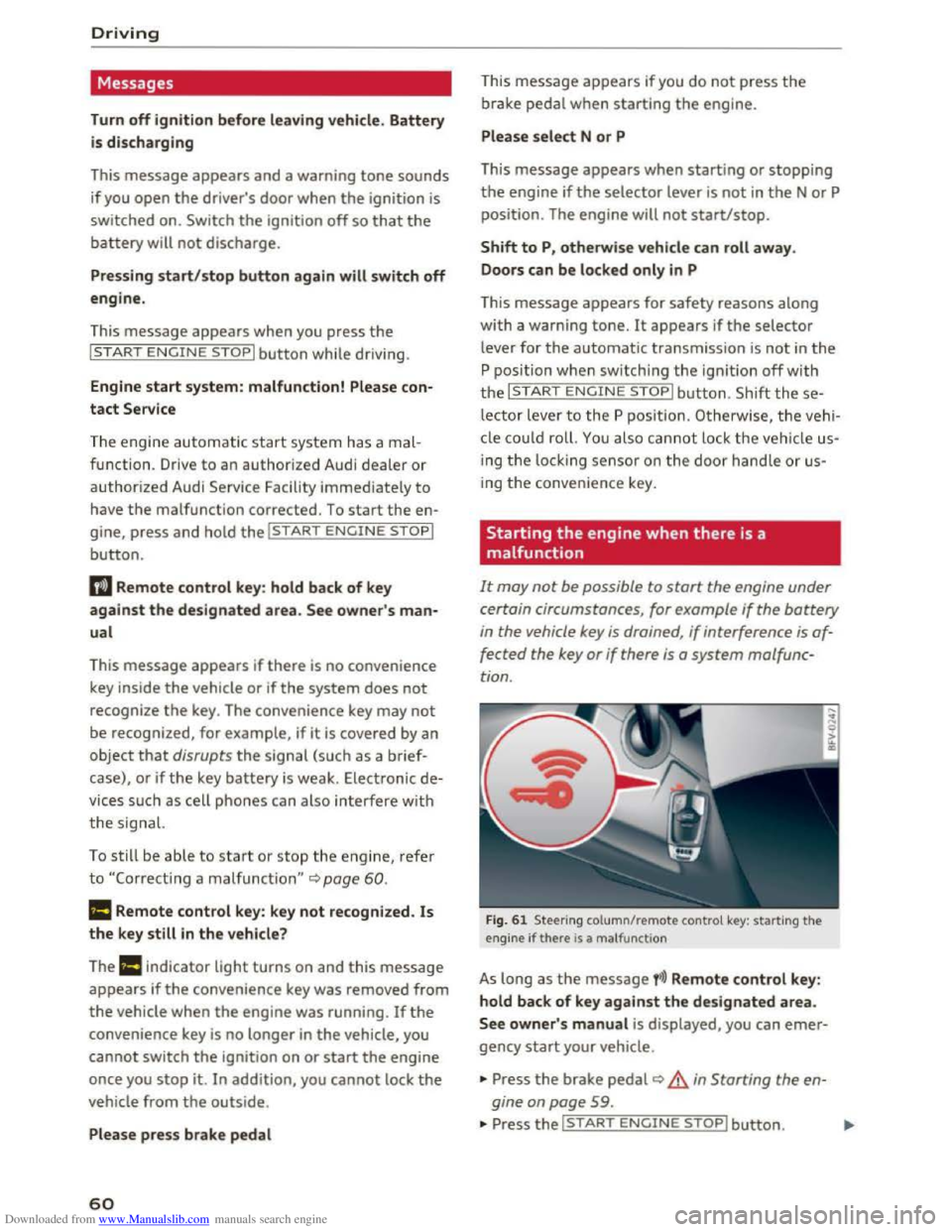
Fig. 61 Steering column/remote control key: starting the
engine if there is a ma lfunction
As long as the message fi)) Remote control key:
hold back of key against the designated area.
See owner' s manual is displayed, you can emer
gency start your vehicle .
... Press the brake pedal~ A in Starting the en
gine on page
59 .
... Press the~, S~T~A~R~T~E_N _G ~l-N~E-S_T_ O_P~I button. ....
Page 64 of 322
Downloaded from www.Manualslib.com manuals search engine Driving
-If driver's door is opened while the ignition
is
switched on, the parking brake sets auto
matically. This prevents unintended rolling
of the vehicle.
- Occasional noises
when the parking brake is
applied
and released are normal and are not
a cause for concern.
-
When the vehicle is parked, the parking
brake goes through a self-test cycle at regu
lar intervals. Any noises associated with this
are normal.
-If the. (USA models) I. (Cana-
da models) indicator lights or llJ indicator
lig ht
turn on, there could be a malfunction
in the park ing brake ~page 11.
-If there is a power failure, the parking brake
will not set if it is released, and it will not
release if it is set~.&.. See an authorized
Audi dealer or authorized Audi Service Fa
cility for
assistance.
Parking
.... Press the brake pedal to stop the vehicle.
.... Pull the switch~ to set the parking brake .
.... Place the selector lever in the P position.
.... Turn the engine off~,&.
.... Turn the steering wheel when parking on in
clines
so that the wheels will roll into the curb
if the vehicle starts moving .
A WARNING
-Always take the vehicle key with you when
leaving the vehicle, even for a short period
of time. This applies particularly when chi l
dren remai n in the vehicle. Otherwise the
children could start the engine, release the
parking brake or operate electrical equip
ment (e.g. power windows). There is the risk
of an accident.
-
When the vehicle is locked, no one -particu
larly
not children should remain in the vehi
cle. Locked
doors make it more difficult for
emergency workers to get into the vehicle,
which
puts lives at risk.
62
Starting from a stop
The start assist function ensures that the park
ing brake
is released automatically upon start
mg.
Stopping and applying parking brake
.... Pull the switch~ to set the parking brake.
Starting and automatically releasing the
parking brake
Requirement: the driver's door must be closed
and the driver's safety belt must be fastened.
.... When you press the accelerator pedal, the
parking brake is automatically released and
your vehicle begins to move.
When stopping at a traffic signal or stopping in
city traffic, the park ing brake can be applied. The
vehicle
does not have to be held with the brake
pedal. The parking brake eliminates the tendency
to creep when a selector lever position is engag
ed. As soon as you press the accelerator pedal,
the parking brake releases automatically and the
vehicle starts to move .
Starting on slope s
When starting on inclines, the hill start assist
prevents the vehicle from unintentionally rolling
back. The braking force
of the parking brake is
not released until sufficient driving force has
been built up at the wheels.
(0 Tips
For safety reasons, the parking brake is re
l
eased automatically onl y when the driver's
safety be lt is fastened and the driver's door is
l ocked.
Emergency braking function
In the event that the conventional brake system
fails or locks.
.... To brake your vehicle in an emergency, pull the
~switch and hold it pulled.
.... As soon as you release the button or accelerate,
the braking stops. .,..
Page 68 of 322
Downloaded from www.Manualslib.com manuals search engine Automatic t ra nsmission
Interlock button
The interlock button in the selector lever handle
prevents you from moving the selector lever in
advertently while in some selector lever posi
tions. The positions that require the lock button
to be pressed are marked in color in the illustra
tion c::> fig. 64.
A WARNING
Read and follow all WARNINGS . c::> .&. in Selec
tor lever positions on page
64.
(!') Tips
-If the selector lever does not engage, there
is a malfunction. The engine is disabled to
prevent the vehicle from driving off unin
tentionally. To allow the selector lever to
engage agai n , proceed as follows :
- Briefly
press the brake pedal.
-If the vehicle does not move forward or in
reverse even though a drive position is se
lected, proceed as follows:
-
>Ifthe vehicle does not move in the desired
direction, the system may not have engaged
the drive position correctly . Press the brake
pedal and select the drive position again.
-
>If the veh icle sti ll does not move in the de
s ired direction, there is a system malfunc
tion. See an authorized Audi dealer or au
thorized Audi Service Facility for assistance
to have the system checked.
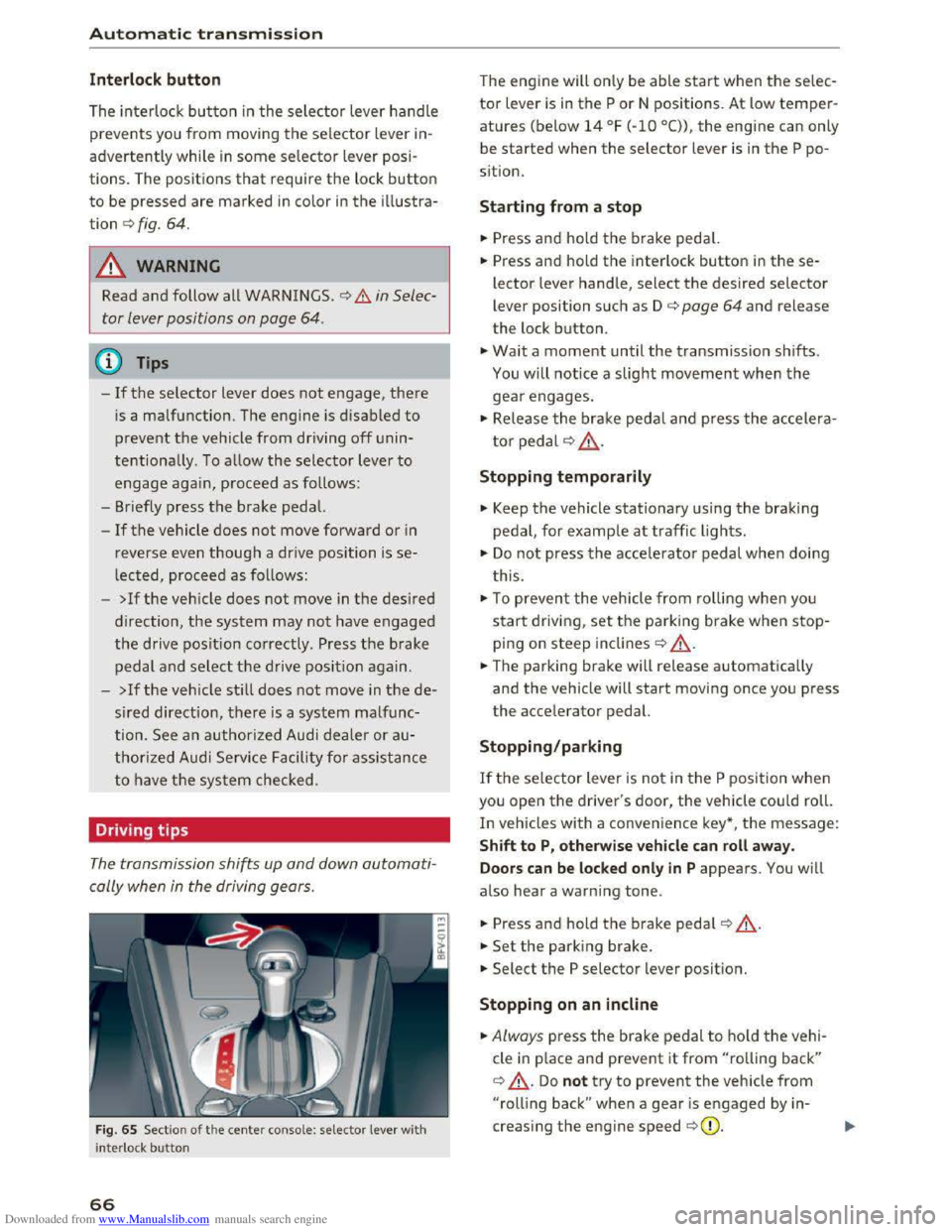
Driving tips
The transmission shifts up and down automati
cally when
in the driving gears.
Fig. 65 Sect io n of the cente r conso le: selecto r lever wit h
i nte rlock bu
tton
66
The engine will only be able start when the selec
tor lever is in the P or N positions. At low temper
atures (below 14 °F (-10 °C)), the engine can only
be
started when the selector lever is in the P po
s i
tion.
Starting from a stop
... Press and hold the brake pedal.
... Press and hold the interlock button in these
lector lever handle, select the desired selector
lever position such as D c::> page 64 and release
the lock button .
... Wait a moment until the transmission shifts.
You will notice a slight movement when the
gear engages.
... Release the brake pedal and press the accelera
tor pedal c::> .& ..
Stopping temporaril y
.,. Keep the vehicle stationary using the braking
pedal, for example at traffic lights.
.,. Do not press the accelerat o r pedal when doing
t his .
.,. To preven t the vehicle from ro llin g when you
start driving, set the parking brake when stop
ping on steep inclines c::> ,&..
... The parking brake will release automatically
and the vehicle will start moving once you press
the accelerator pedal.
Stopping/par king
If the selector lever is not in the P position when
you open the driver's door, the vehicle could roll.
In vehicles with a convenience key*, t he message:
S h ift to P, otherwise veh icle can roll awa y.
Door s can be locked only in
P appears. You will
also hear a warning tone .
... Press and hold the b rake pedal c::> ,&. .
... Set the park ing brake .
... Select the P selector lever position.
Stopping on an incl in e
... Always press the brake pedal to ho ld the vehi
cle
in p lace and prevent it from "rolling back"
c::> ,&.. Do not try to prevent the vehicle from
"rolling back" when a gear is engaged by in
creasing the engine speed c::>(D.
Page 179 of 322
Downloaded from www.Manualslib.com manuals search engine -Please observe information on safe driving
r:;. page 171.
A WARNING
r-=-
To help prevent poisonous exhaust gas from
being drawn into the vehicle, always keep the
rear lid closed while driving.
- Never
transport objects larger than those
fitting completely into the luggage area be
cause the rear lid cannot be fully closed.
-
If you absolutely must drive with the rear lid
open, observe the following notes to reduce
the risk of poisoning:
-
Close all windows,
-
Open all air outlets in the instrument pan-
el,
-Switch off the air recirculation,
-
Set the fresh air fan to the highest speed.
A WARNING
Always make sure that the doors, all windows
and the rear lid are securely closed and locked
to reduce the risk of injury when the vehicle is
not being used.
- After closing
the rear lid, always make sure
that it is properly closed and locked.
- Never leave your vehicle
unattended espe
cially with the rear lid left open. A child
could crawl into
the vehicle through the lug
gage compartment and close the rear lid be
coming trapped and unable to get out. Be
ing trapped in a vehicle can lead to serious
personal injury.
- Nev er
let children play in or around the vehi
cle.
- Never
let passengers ride in the luggage
compartment. Vehicle occupants must al
ways be properly restrained in one of the ve
hicle's seating positions.
(D Tips
-Air circulation helps to reduce window fog
ging. Stale air escapes to the outside
through vents in the trim panel, on the left
side of the luggage compartment. Be sure
to keep these slots free and open.
Safe driving
-The tire pressure must correspond to the
load. The tire pressure is shown on the tire
pressure label. The tire pressure label is lo
cated on the driver's side B-pillar. The tire
pressure label lists the recommended cold
tire inflation
pressures for the vehicle at its
maximum capacity
weight and the tires that
were on your vehicle at the time it was man
ufactured. For recommended tire pressures
for normal load conditions, please see chap
ter r:;. page 261.
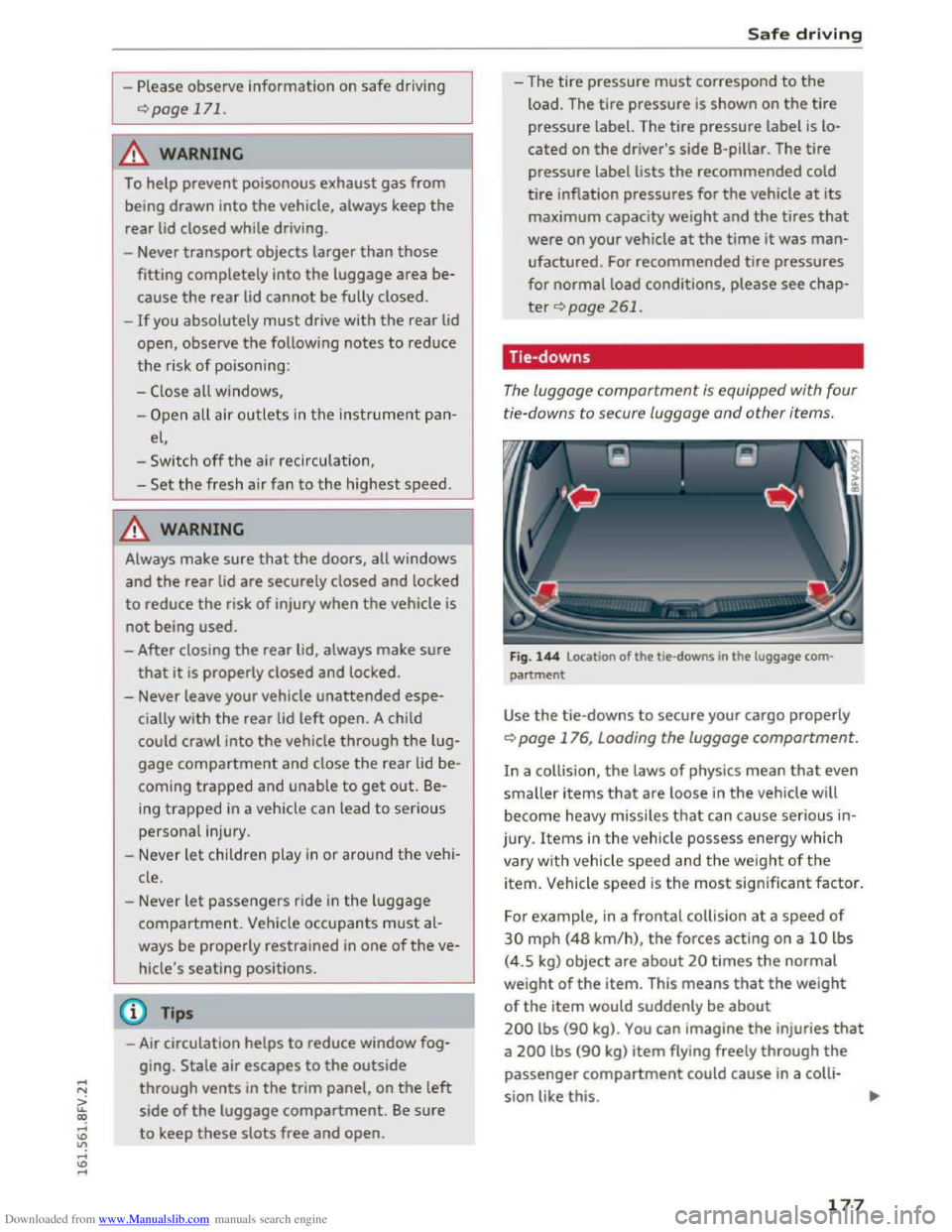
Tie-down s
The luggage compartment is equipped with four
ti e-downs to secure luggage
and other items.
Fig. 144 Location of the tie-downs in the luggage com
partment
Use the tie-downs to secure your cargo properly
r:;. page 176, Loading the luggage compartment.
In a collision, the laws of physics mean that even
smaller items that are loose in the vehicle will
become heavy missiles that can cause serious in
jury . Items in the vehicle possess energy which
vary with vehicle
speed and the weight of the
item. Vehicle speed is the most significant factor.
For example, in a frontal collision at a speed of
30 mph (48 km/h), the forces acting on a 10 lbs
(4.5 kg) object
are about 20 times the normal
weight of the item. This means that the weight
of the item would suddenly be about
200 lbs (90 kg). You can imagine the injuries that
a 200 lbs (90 kg) item flying freely through the
passenger compartment could cause in a colli
sion like this.
177
Page 203 of 322
Downloaded from www.Manualslib.com manuals search engine .....
the combined capacitance of a typical l year
old
infant and one of the rearward-facing or
forward-facing child restraints listed in Federal
Motor Vehicle
Safety Standard 208 with which
the Advanced Airbag System in your vehicle was
certified.
If the front passenger seat is not occupied, the
front airbag will not deploy, and the PASSENGER
AIR BAG OFF light will stay on. Never install a
rearward -facing child
restraint on the front pas
senger seat, the safest place for a child in any
kind
of child restraint is at one of the seating po
sitions on
the rear seat ~page 189, Child re
straints on the front
seat -some important
things to know
and ~page 212, Child safety.
If the PASSENGER AIR BAG light comes
on ...
If the PASSENGER AIR BAG OFF light comes on
when one of the conditions listed above is met,
be sure to check the light regularly to make cer
tain that the PASSENGER AIR BAG OFF light
stays on continuously whenever the ignition is
on. If the PASSENGER AIR BAG OFF light does
n
ot appea r on and does not stay on all the time,
stop as soo n as it is safe to do so and
- reactivate
the system by turning the ignition
off for more than 4 seconds and then turning it
on again;
- remove and reinstall
the child restraint. Make
sure that the child restraint is properly instal
led and
that the safety belt for the front pas
senger seat has been correctly routed through
the child restrain t as described in th e child re
straint manufacturer's instructions;
- make
sure that the convertible locking retrac
tor on the safety belt for the front passenger
seat has been activated and that the safety belt
has been pulled tight.
-make sure that no electrical device (such as a
laptop,
CD player, electron ic games device,
power inverter
or seat heater for child seats) is
placed or used on the front passenger seat if
the device is connected to the 12-volt socket or
~ the cigarette lighter socket;
co -make sure that no seat heater has been retro-...
~ fitted or otherwise added to the front passen-
..... :::: ger seat;
Airbag system
-make sure that nothing can interfere with the
safety belt buckles and that they are not ob
structed;
-make sure that there are no wet objects (such
as a wet towel) and no water or other liquids on
the front passenger seat cushion.
If the PASSENGER AIR BAG light still does
not come on ...
If the PASSENGER AIR BAG OFF light still does
not come on and does not stay on continuously
(when
the ignition is switched on),
-
take the child restraint off the front passenger
seat and install it properly at one of the rear
seat positions. Have the airbag system inspect
ed
by your Audi dealer immediately.
-move the child to a rear seat position and make
sure that the child is properl y restrained in a
child
restraint that is appropriate for its size
and age.
The PASSENGER AIR BAG light should NOT
come on ...
The PASSENGER AIR BAG OFF light should NOT
come on when the ignition is on and an adult is
sitting in a prope r seating position on the front
passenger seat. If the PASSENGER AIR BAG OFF
light comes on and stays on or flashes for about
5 seconds while driving, under these circumstan
ces,
make sure that:
-the adult on the front passenger seat is proper
ly seated on the center of the seat cu sh ion wit h
his or
her back up against the backrest and the
backrest is not reclined,
-
the adult is not taking weight off the seat by
holding on to the passenger assist handle
above
the front passenger door or supporting
their weight on the armrest,
-the safety belt is being properly worn and that
there is not a lot of slack in the safety belt web
bing,
-
there are no aftermarket seat covers or cush
ions or
other things (such as blankets) on the
front passenger seat that might cause the ca
pacitive passenger detection system to miscal
culate electrical capacitance.
201
Page 220 of 322

Downloaded from www.Manualslib.com manuals search engine Child safety
as by fastening the unused safety belt be
hind the child seat and letting the belt re
tractor wind up the webbing.
Child seats
Infant seats
Babies and infants up to about one year old and
20 lbs or 9 kg need special rearward-facing child
restraints
that support the back, neck and head
in a crash.
Fig. 166 Schemat ic overview : rearward -facing infant seat,
properly installed on the rear seat
"'When using the veh icle safety belt to install a
child
safety seat, you must first activate the
convertible locking retractor on the safety belt
to prevent the child safety seat from moving
9page 223.
"'Push the child safety seat down with your full
weight to get the safety belt really tight so that
the seat cannot move forward and sideways
more than 1 in (2.5 cm).
"'Secure unused safety belts on the rear seat
9page 217.
Infants up to about one year (20 lbs or 9 kg) are
best protected in specia l infant carriers and child
safety seats designed for their age group. Many
experts believe that infants and small children
should ride only in special restraints in which the
child faces the back of the vehicle. These infant
seats support the baby 's back, neck and head in a
crash 9fig. 166.
The airbag on the passenger side makes the front
seat a potentially dangerous place for a child to
ride. The front seat is not the safest place for a
child
in a forward-facing child seat. It is a very
218
dangerous place for an infant or a larger child in
a rearward-facing seat.
A WARNING
Not using a child safety seat, using the wrong
child safety seat or improperly installing a
child
restraint increases the risk of serious
personal injury and death in a crash.
- Never install rear-facing child
safety seats
or infant carriers on the front passenger
seat -even with an Advanced Airbag System.
A child will be seriously injured and can be
killed when the inflating airbag hits the
child safety seat or infant carrier with great
force and smashes the child safety seat and
child
against the backrest, center armrest,
door or roof~ page 189, Child restraints on
the front seat -some important things to
know.
-Always install rear-facing chi ld safety seats
or infant carriers on the rear seat.
-Never install a rear-facing child restraint in
the forward-facing direction. Such restraints
are designed for the special needs of infants
and very small children and cannot protect
them properly if the seat is forward-facing.
-
If you must install a rearward facing child
safety seat on the front passenger seat be
cause of exceptional circumstances and the
PASSENGER AIR BAG OFF light does not
come on and stay on, immediately install
the rear-facing child safety seat in a rear
seating position and have th e a irbag system
inspected by your Audi dealer.
- Never pl
ace or use any electrical device
(such
as a laptop, CD player, electronic
games d evice, power inverter or seat heater
for child seats) on the front passenger seat
if the device is connected to the 12-volt
socket or the cigare tte lighter socket.
-
If a seat heater has been retrofitted or oth
erwise added to the front passenger seat,
never install any child restraint system on
this seat.
-Make sure that there are no wet objects
(such as a wet towel) and no water or other
liquids on the front passenger seat cushion. ..,.
Page 221 of 322

Downloaded from www.Manualslib.com manuals search engine ..... N
G: CX)
.....
"' U"I
.....
"' .....
-Never place objects on the seat (such as a
laptop, CD player, electronic games device,
power inverter or seat heater for child
seats). These may influence the electrical
capacitance measured by the capacitive pas
senger detection system and can also fly
around in an accident and cause serious per
sonal injury .
- Always
read and heed all WARNINGS when
ever using a child restrained in a veh icle is
being
used r:'.> page 180, Safety belts,
r:'.>page 188, Airbag system and
r:'.>page 212, Important information.
Convertible child safety seats
Properly used convertible child safety seats con
help protect toddlers and children over age one
who weigh between
20 and 40 lbs (9 and 18 kg)
in a crash.
Fig. 167 Schematic overv iew : installat io n of the attach
m
ents applicab le to a LATCH seat
Fig. 168 Sche matic overview: i nstallat io n of t he sea t using
the vehicle 's safety belt syste m
•When using the vehicle safety belt to install a
child
safety seat, you must first activate the
convertible locking retractor on the safety belt
to prevent the child safety seat from moving
Child safety
r:'.>poge 223 or install the seat using the LATCH
attachments.
•Push the child safety seat down with your full
weight to get the safety belt really tight so that
the seat cannot move forward or sideways
more than 1 in (2 .5 cm) r:'.>page 223.
"' If the child safety seat is equipped with a tether
strap, attach it to the tether anchors
r:'.> page 228.
"'Secure unused safety belts on the rear seat
r:'.> page 217.
A toddler or child is usually too large for an in
fant restraint if it is more than one year old and
weighs more than 20 lbs (9 kg).
Toddlers
and children who are older than one
year up to about 4 years old and weigh more than
20 lbs (9 kg) up to 40 lbs (18 kg) must always be
properly
restrained in a child safety seat certified
for
their size and weight r:'.> fig. 167 and
r:'.> fig. 168.
The airbag on the passenger side makes the front
seat a potentially dangerous place for a child to
ride . The front seat is not the safest place for a
child
in a forward -facing child safety seat. It is a
v e
ry dangerous place for an infant or a larger
child in a rearward-facing seat.
_&WARNING
f-=-
Not using a child safety seat, using the wrong
child
safety seat or improperly i nstalling a
child
restraint increases the risk of serious
personal i njury and death in a collision or oth
er emergency situation.
-
Children on the front seat of any car, even
with Advanced Airbags, can be seriously in
jured or even killed when an airbag inflates.
A child in a rearward-facing child safety seat
installed on the front passenger seat will be
seriously injured and can be killed if the
front airbag inflates -even with an Ad
vanced Airbag System.
- The inflating airbag will hit
the child safety
seat or infant carrier with great force and
will smash the child safety seat and child
against the backrest, center arm rest, door
or roof.
219