ignition AUDI TT COUPE 2016 Workshop Manual
[x] Cancel search | Manufacturer: AUDI, Model Year: 2016, Model line: TT COUPE, Model: AUDI TT COUPE 2016Pages: 322, PDF Size: 52.86 MB
Page 209 of 322
Downloaded from www.Manualslib.com manuals search engine ..... N
G'. co ..... ID VI ..... ID .....
The side airbag system supplements the safety
belts and can help to reduce the risk of injury to
the driver's and front passenger's upper torso on
the side of the vehicle that is struck in a side col
lision. The
airbag deploys in side impacts and on
ly when the vehicle acceleration registered by the
control unit is high enough. If this rate is below
the reference value programmed into the control
unit, the side airbags will not be triggered, even
though the car may be badly damaged as a result
of the collision. It is not possible to define an air
bag
triggering range that will cover every possi
ble
angle of impact, since the circumstances will
vary considerably
between one collision and an
other. Important factors include, for example,
the nature (hard or soft) of the impacting object,
the angle of impact, vehicle speed, etc.
Q page 208, Important safety instructions on
the side airbag system.
Aside from their normal safety function, safety
belts work to help keep the driver or front pas
senger in position in the event of a side collision
so that the side airbags can provide protection.
The airbag system is not a substitute for your
safety belt. Rather, it is part of the overall occu
pant restraint system in your vehicle. Always re
member that the side airbag system can only
help
to protect you if you are wearing your safety
belt and wearing it properly. This is another rea
son why you should always wear your safety
belts, not just because the law requires you to do
so Qpage 180, General notes.
It is important to remember that while the sup
plemental side a irbag system is designed to re
duce the lik eli hood of serious injuries, other inju
ries, for
example, swelling, bruising, friction
burns and minor abrasions can also be associated
with deployed side airbags. Remember too, side
airbags will deploy only once and only in certain
kinds of accidents -your safety belts are always
there to offer protection.
Vehicle damage, repair costs or even the lack of
vehicle damage are not necessarily an indication
of over-sensitive or failed airbag activation. In
some collisions, both front and side airbags may
inflate .
Remember too, that airbags will deploy
only once
and only in certain kinds of collisions -
Airbag system
your safety belts are always there to offer protec
tion
in those accidents in which airbags are not
supposed to deploy or when they have already
deployed.
The side airbag system will not deploy:
-when the ignition is switched off
-in side collisions when the acceleration meas-
ured by
the sensor is too low
-
in front-end collisions
- in rear-end collisions
-
in rollovers.
In
some types of accidents the front a irbags, side
curtain airbags and side airbags may be triggered
together.
A WARNING
--Safety belts and the airbag system will only
provide protection
when occupants are in
the proper seating position Q page 208.
-If the airbag indicator light Q page 15
comes when the vehicle is being used, have
the system inspected immediately by your
authorized Audi dealer. It is possible that
the airbag will inflate when it is not sup
posed to, or will not inflate when it should.
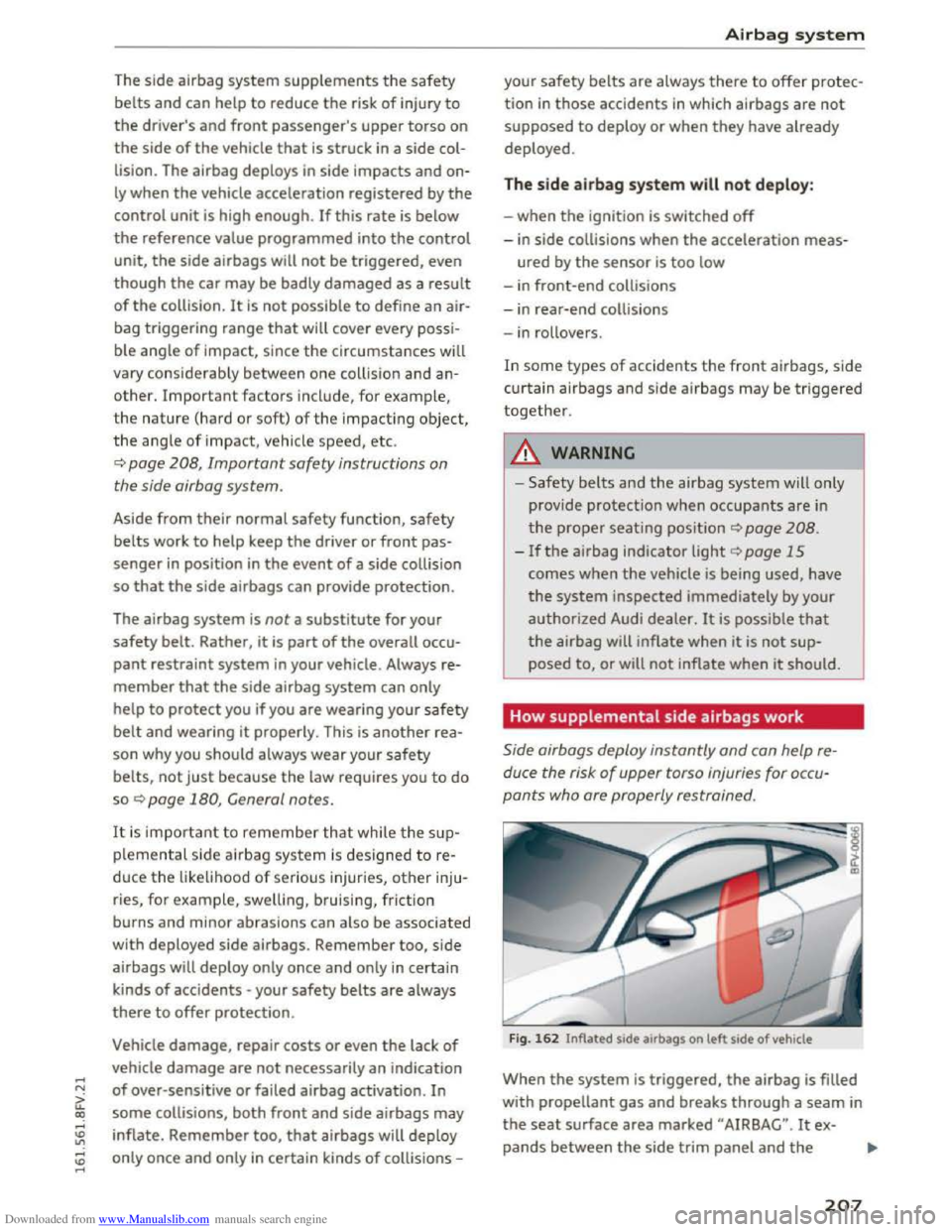
How supplemental side airbags work
Side airbags deploy instantly and can help re
duce the risk
of upper torso injuries for occu
pants who are properly restrained.
Fig. 162 Inflated side airbags on left side of vehicle
When the system is triggered, the airbag is filled
with propellant gas and breaks through a seam in
the seat surface area marked "AIRBAG". It ex-
pands between the side trim panel and the ..,..
207
Page 212 of 322
Downloaded from www.Manualslib.com manuals search engine Airbag sy stem
Aside from their normal safety function, safety
belts work to help keep the driver or front pas
senger in position in the event of a collision so
that the side curtain airbags can provide protec
tion .
The airbag
system is not a substitute for your
safety belt. Rather, it is part of the overall occu
pant restraint system in your vehicle. Always re
member that the airbag system can only help to
protect you if you are wearing your safety belt
and wearing it properly . This is another reason
why you
should always wear your safety belts,
not just because the law requires you to do so
~page 180, General notes.
It is important to remember that while the side
curtain a irbag system is designed to help reduce
the likelihood of serious injuries, other injuries,
for
example, swelling, bruising, friction burns
and minor abrasions can also be associated with
these airbags upon deployment. Remember too,
these airbags will deploy only once and only in
certain kinds of accidents -your safety belts are
always there to offer protection.
The side curta in airbag sy stem basically
consists
of:
-The electronic control module and external side
impact sensors
-The side curtain airbags above the front and
rear side windows with ejection mitigation fea
tures
-The airbag indicator light in the instrument
panel
The airbag system is monitored electronically to
make certain it is function ing properly at all
times. Each time you switch on the ignition, the
airbag system indicator light will come on for a
few seconds (self diag nasties).
The side curtain airbag is not activated:
-if the ignition is switched off,
-
in side collisions when the acceleration meas-
ured by the sensor is too low,
- in
rear-end collisions .
210
A WARNING
-Safety belts and the airbag system will only
provide
protection when occupants are in
the proper seating position Q page 44,
Seats and storage.
-If the airbag indicator light Q page 15
comes when the vehicle is being used, have
the system inspected immediately by your
authorized Audi dealer. It is possible that
the airbag will inflate when it is not sup
posed to, or will not inflate when it should.
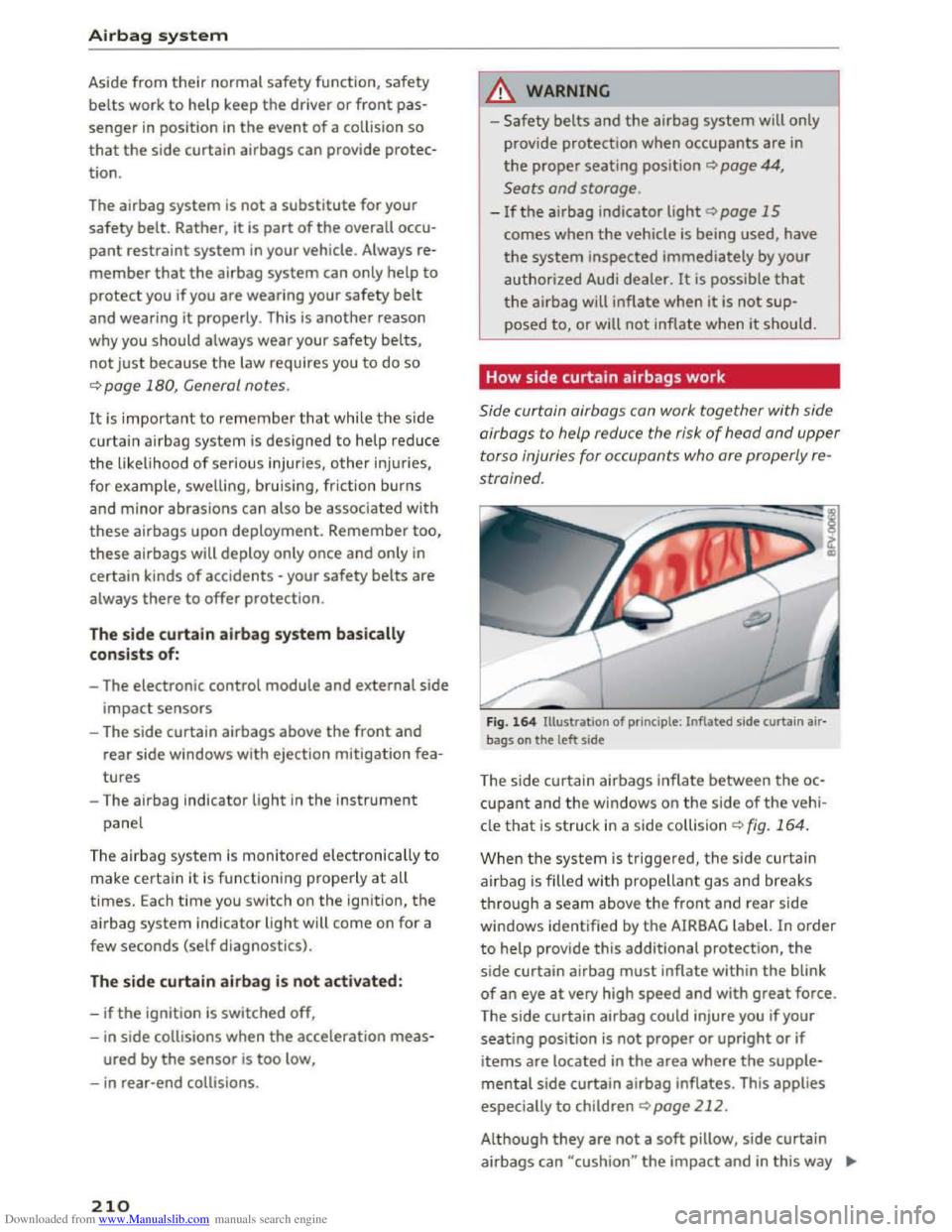
How side curtain airbags work
Side curtain airbags can work together with side
airbags to help reduce
the risk of head and upper
t orso injuries for occupants who are properly re
strained.
Fig. 164 Illustration of principle: Inflated side curtain air
bags on
the left side
The side curtain airbags inflate between the oc
cupant and the windows on the side of the vehi
cle
that is struck in a side collision Q fig. 164.
When the system is triggered, the s ide curtai n
airbag
is filled with propellant gas and breaks
th rough a seam above the front and rear side
windows identified by the AIRBAG label. In order
to help provide this additional protection, the
side curtain airbag must inflate within the blink
of an eye at very high speed and with great force .
The
side curtain airbag could injure you if your
seating position is not proper or upright or if
items are located in the area where the supple
mental side curtain airbag inflates. This applies
especially to children Qpage 212.
Although they are not a soft pillow, side curtain
airbags can "cushion" the impact and in this way .,..
Page 215 of 322

Downloaded from www.Manualslib.com manuals search engine ..... N
G'. CX)
..... ID IJ' ..... ID .....
exceptional circumstances and the
PASSENGER AIR BAG OFF light does not
come on and stay on, immediately install
the rear-facing child safety seat in a rear
seating position and have the airbag system
inspected immediately by your Audi dealer.
A WARNING
-Forward-facing child seats installed on the
front passenger seat may interfere with the
deployment of the airbag and cause serious
personal injury to the child.
-If exceptional circumstances require the use
of a forward-facing child restraint on the
front passenger's seat, the child's safety
and well-being require the following special
precautions to be taken:
-Always make sure that the forward-facing
seat has been designed and certified by its
manufacturer for use on a front passenger
seat with a front and side airbag.
- Always carefully follow
the manufacturer's
instructions provided with the child seat
or infant carrier.
- Never install a child
restraint without a
properly
attached top tether strap if the
child restraint manufacturer's instructions
require the top tether strap to be used.
- Never
put the forward-facing child re
straint up against or very near the instru
ment panel.
- Always move
the passenger seat into its
rearmost position in the seat's fore and
aft adjustment range, as far away from
the airbag as possible before installing the
child restraint. The backrest must be ad
justed to an upright position.
- Always
make sure that nothing prevents
the front passenger's seat from being
moved
to the rearmost position in its fore
and aft adjustment range.
- Never place objects on the seat (such as a
laptop, CD player, electronic games de
vice, power inverter or seat heater for
child
seats). These may influence the elec
trical
capacitance measured by the capaci
tive
passenger detection system and can
Child safety
also fly around in an accident and cause
serious personal injury.
- Never place
or use any electrical device
(such as a
laptop, CD player, electronic
games device, power inverter or seat heat
er for child seats) on the front passenger
seat if the device is connected to the 12-
volt socket or the cigarette lighter socket.
-
If a seat heater has been retrofitted or
otherwise added to the front passenger
seat, never install any child restraint sys
tem on this seat.
-Make sure that there are no wet objects
(such as a wet towel) and no water or oth
er liquids on the front passenger seat
cushion.
- Always
make sure that the PASSENGER
AIR BAG OFF light comes on and stays on
a ll
the time whenever the ignition is
switched on.
-If the PASSENGER AIR BAG OFF light
does not come on and stay on, immediate
ly install the forward-facing child seat in a
rear seating position and have the airbag
system inspected by your authorized Audi
dealer.
- Always buckle
the child seat firmly in
place even if a child is not sitting in it. A
loose child seat can fly around during a
sudden stop or in a collision.
- Always read
and heed all WARNINGS
whenever using a child restraint in a vehi
cle
c> page 180, Safety belts, c> page 188,
Airbag system
and ~page 212, Impor
tant information .
(D Tips
Always replace child restraints that were in
stalled in a vehicle during a crash. Damage to
a child restraint that is not visible could cause
it to fail in another collision situation.
Advanced front airbag system and children
Your vehicle is equipped with a front "Advanced
Airbag System" in compliance with United States
Federal Motor Vehicle Safety Standard (FMVSS) ~
213
Page 222 of 322

Downloaded from www.Manualslib.com manuals search engine Child safety
-Always install rear-facing child safety seats
on the rear seat.
-If you must install a rearward facing child
safety seat on the front passenger seat be
cause
of exceptional circumstances and the
PASSENGER AIR BAG OFF light does not
come on and stay on, immediately install
the rear-facing child safety seat in a rear
seating position and have the airbag system
inspected by your Audi dealer.
-The rear side of the child safety seat should
be positioned
as close as possible to the
backrest on the vehicle seat.
-Always read and heed all WARNINGS when
ever using a child
restrained in a vehicle is
being used~ page 180, Safety belts,
~page 188, Airbag system and
~page 212, Important information.
A WARNING
If exceptional circumstances require the use
of a forward-facing child restraint on the
front passenger's seat, the child's safety and
well-being require that the following special
precautions be taken:
- Make
sure the forward-facing seat has been
designed and certified by its manufacturer
for use on a front seat with a passenger
front and side airbag.
- Always follow
the manufacturer's instruc
tions provided with the child safety seat or
infant carrier.
- Always move
the front passenger seat into
the rearmost position of the passenger
seat's fore and aft adjustment range, and as
far away from the airbag as possible before
installing
the child restraint.
-Always make sure that nothing prevents the
front passenger's seat from being moved to
the rearmost position in its fore and aft ad
justment range.
- Always
make sure the backrest is in an up
right position.
- Never place
or use any electrical device
(such
as a laptop, CD player, electronic
games device, power inverter or seat heater
for child seats) on the front passenger seat
220
if the device is connected to the 12-volt
socket or the cigarette lighter socket.
-
If a seat heater has been retrofitted or oth
erwise added to the front passenger seat,
never install any child restraint system on
this seat.
-Make sure that there are no wet objects
(such
as a wet towel) and no water or other
liquids on the front passenger seat cushion.
- Never place objects on
the seat (such as a
laptop, CD player, electronic games device,
power inverter
or seat heater for child
seats). These may influence the electrical
capacitance
measured by the capacitive pas
senger detection system and can also fly
around in an accident and cause serious per
sonal injury.
- Make
sure that the PASSENGER AIR BAG
OFF light comes on and stays on all the time
whenever the ignition is switched on.
-
If the PASSENGER AIR BAG OFF light does
not come on and stay on, immediately in
stall the forward-facing child seat at a seat
ing position on the rear seat and have the
airbag system inspected by your authorized
Audi dealer.
-Take the child restraint off the front passen
ger seat and install it properly at one of the
rear seat positions if the PASSENGER AIR
BAG OFF light does not stay on whenever
the ignition is switched on.
Page 224 of 322
Downloaded from www.Manualslib.com manuals search engine Child safety
.&_ WARNING
Not using a booster seat, using the booster
seat improperly, incorrectly installing a boos
ter seat or using the vehicle safety belt im
properly increases the risk of serious personal
injury and death in a collision or other emer
gency situation. To help reduce the risk of se
rious personal injury and/or death:
-The shoulder belt must lie as close to the
center of the child's collar bone as possible
and must lie flat and snug on the upper
body. It must never lie across the throat or
neck. The lap belt must lie across the pelvis
and never across the stomach or abdomen.
Make sure that the belt lies flat and snug.
Pull on the belt to tighten if necessary.
- Failure
to properly route safety belts over a
ch i
ld's body will cause severe injuries in an
accident or other emergency situation
qpage 180.
-The rear side of the child safety seat should
be positioned as close as possible to the
backrest on the vehicle seat.
-Children on the front seat of any car, even
with Advanced Airbags, can be seriously in
jured or even killed when an airbag inflates.
- Never
let a child stand or kneel on any seat,
for example the front seat.
-Never let a child ride in the cargo area of
your vehicle .
- Always
remember that a child leaning for
ward, sitting sideways or out of position in
any way
during an accident can be struck by
a deploying airbag. This will
result in seriou s
personal injury or death.
-If you must install a booster seat on the
front passenger seat because of exceptional
circumstances the PASSENGER AIR BAG
OFF light must come on and stay on, when
ever the ignition is switched on.
-If the PASSENGER AIR BAG OFF light does
not come on and stay on, perform the
checks described q page 199, Monitoring
the Advanced Airbag System.
-Take the child restraint off the front passen
ger seat and install it properly at one of the
rear seat positions if the PASSENGER AIR
222
BAG OFF light does not stay on whenever
the ignition is switched on.
- Always
read and heed all WARNINGS when
ever using a child restrained in a vehicle is
being
used q page 180, Safety belts,
q page 188, Airbag system and
q page 212, Important information.
Booster seats on the rear seat
Children who are about 7 years and older, who
weigh more than SS lbs (2S kg) and are not taller
than 4 ft 9 in (S7 in/1.4S m) are best protected
when properly restrained on the rear seat.
Due to limited rear seat head clearance chi ld ren
4 ft 3 in (Sl in/1.30 m) and taller must not use
booster seats on the rear seat of your Audi TT
Coupe. The rear seat of your Audi TT Coupe has
been specially designed to permit children who
are between 4 ft 3 in (Sl in/1.30 m) and 4 ft 9 in
(S7 in/1.4S m) tall (about 7 to 12 years old) to
use the available three -point lap and shoulder
safety belts.
.&. WARNING
lo= ----The rear seat area is too small to safely
transport passengers taller than 4 ft 9 in
(S7 in/1.4S m).
-
Persons taller than 4 ft 9 in (S7 in/1.4S m)
as well as children in booster seats who are
too close to the rear window and roof can
suffer severe head and neck injuries when
the rear lid is closed or in a crash.
- The
minimum clearance between the pas
sengers' heads and the rear window must
never -under any circumstances -be less
than l in(2.S cm.) when the passengers sits
fully upright.
- Always make sure that the rear seat passen
gers cannot be struck when the rear lid is
closed.
Booster seats on the front seat
Children aged about 7 years and older and weigh
ing more than SS lbs (2S kg) who are between
4 ft 3 in (Sl in/1.30 m) and 4 ft 9 in (S7 in/
l.4S m) tall may in exceptional circumstances ~
Page 226 of 322
Downloaded from www.Manualslib.com manuals search engine Child safety
-It is safer to install a forward-facing child
safety seat on the rear seat.
-Always read and heed all WARNINGS when
ever using a child restrained in a vehicle is
being used c'.) page 212. Special precautions
apply when installing a child safety seat on
the front passenger seat c'.) page 189, Child
restraints on the front seot -some impor
tant things to know.
..&_WARNING
....
Always take special precautions if you must
install a forward or rearward-facing child re
straint on the front passenger's seat in excep
tional situations:
- W
henever a forward or rearwa rd-facing
chi ld r
estraint is installed on the front pas
senger seat, the PASSENGER AIR BAG OFF
ligh t must come on and stay on whenever
the ignition is switched on.
-
If the PASSENGER AIR BAG OFF light does
not come on and stay on, perform the
checks described c'.) page 199, Monitoring
the Advanced Airbag System.
-Take the child restraint off the front passen
ger seat and install it properly at one of the
rear seat positions if the PASSENGER AIR
BAG OFF light does not stay on whenever
the ignition is switched on.
-
Improper installation of child restraints can
reduce their effectiveness or even prevent
them from providing any protection.
-An improperly installed child restraint can
interfere with the airbag as it deploys and
seriously injure
or even kill the child .
-Always carefu lly follow the manufacturer's
instructions prov ided with the child safety
seat or carrier.
- After checking
to make sure that the child
restraint is properly installed, make certain
that the child restraint is correctly recog
nized by the capacitive passenger detection
system in the front passenger seat and that
the PASSENGER AIR BAG OFF light signals
the correct front passenger frontal airbag
status.
224
-
..&. WARNING
Forward-facing child restraints:
-Always make sure the forward-facing seat
has been designed and certified by its man
ufacturer for use on a front seat with a pas
senger front and side airbag.
- Never
put the forward-facing child restraint
up, against or very near the instrument pan
el.
-Always move the passenger seat into its
rearmost position in the seat's fore and aft
adjustment range, as far away from the air
bag as possible before installing the for
ward-facing child restraint. The backrest
m ust be adjusted to an upr ight position.
- M ake
sure that the PASSENGER AIR BAG
OFF light comes on and stays on all the time
whenever the ign ition is switched on.
..&_WARNING
Rearward-facing child restraints:
-A ch ild in a rearward-facing child safety seat
installed on the front passenger seat will be
seriously injured
and can be killed if the
front airbag inflates -even with an Ad
vanced Airbag System.
-The inflating airbag will hit the child safety
seat or infant carrier with great force and
will smash the child safety seat and child
against the backrest, center armrest, door
or roof.
-Always be especia lly careful if you must in
stall a rearward facing child safety seat on
the front passenger seat in exceptiona l cir
cumstances.
- Make
sure that the PASSENGER AIR BAG
OFF light comes on and stays on all the time
whenever the ignition is switched on.
-If the PASSENGER AIR BAG OFF light does
not come on and stay on, immediately in
stall the rear-facing child safety seat in a
rear seating position and have the airbag
system inspected by your Audi dealer.
Page 236 of 322
Downloaded from www.Manualslib.com manuals search engine Checking and Filling
explos ive and increases the risk of serious
injury or death.
- Follow legal requirements when using,
storing and transporting fuel containers.
-Make sure the fuel container conforms to
industry standards (ANSI/ASTM F852-86).
CD Note
- Remove any overflowing fuel from the vehi
cle
paint immediately.
- Never drive
until the fuel tank is completely
empty. The irregular supply of fuel that re
sults from that can cause engine misfires.
Uncombusted
fuel will enter the exha ust
system and increase the risk of damage to
the catalytic converter.
@ For the sake of the environment
If the fuel nozzle is used correctly, it will indi
cate that the tank is full the first time it
switches off automatically. Do not try to add
more fuel, because it can spill over. Also, the
expansion space in the tank will fill, which can
result in fuel spilling out when it becomes
warm and polluting the environment.
Tips
If adverse weather conditions cause the fuel
filler door to freeze shut, press on the center
of the filler door with the heel of your hand
and then try opening it again.
(0 Tips
-If the engine is running while fueling, va
pors
can escape or the fuel can spill over.
Because
of this, the fuel nozzle switches off
before the tank is full.
-
Do not fuel the vehicle when the ignition is
switched on. Otherwise, the fuel gauge may
not show the correct level after fueling the
vehicle.
- Your vehicle
is equipped with a misfueling
guard.
It allows the vehicle to be fueled on
ly with the correct fuel pump nozzle.
- A worn
or damaged nozzle or a nozzle that
is too small may not be able to open the
diesel misfueling protector. If this is the
234
case, try turning the nozzle before inserting
it in the fuel filler neck, use a different fuel
pump or see an authorized Audi dealer or
authorized Audi Service Facility for assis
tance.
-The misfueling guard does not open when
adding fuel from a fuel container. When re
fueling with a reserve canister, you
must
use the funnel stored in the luggage com
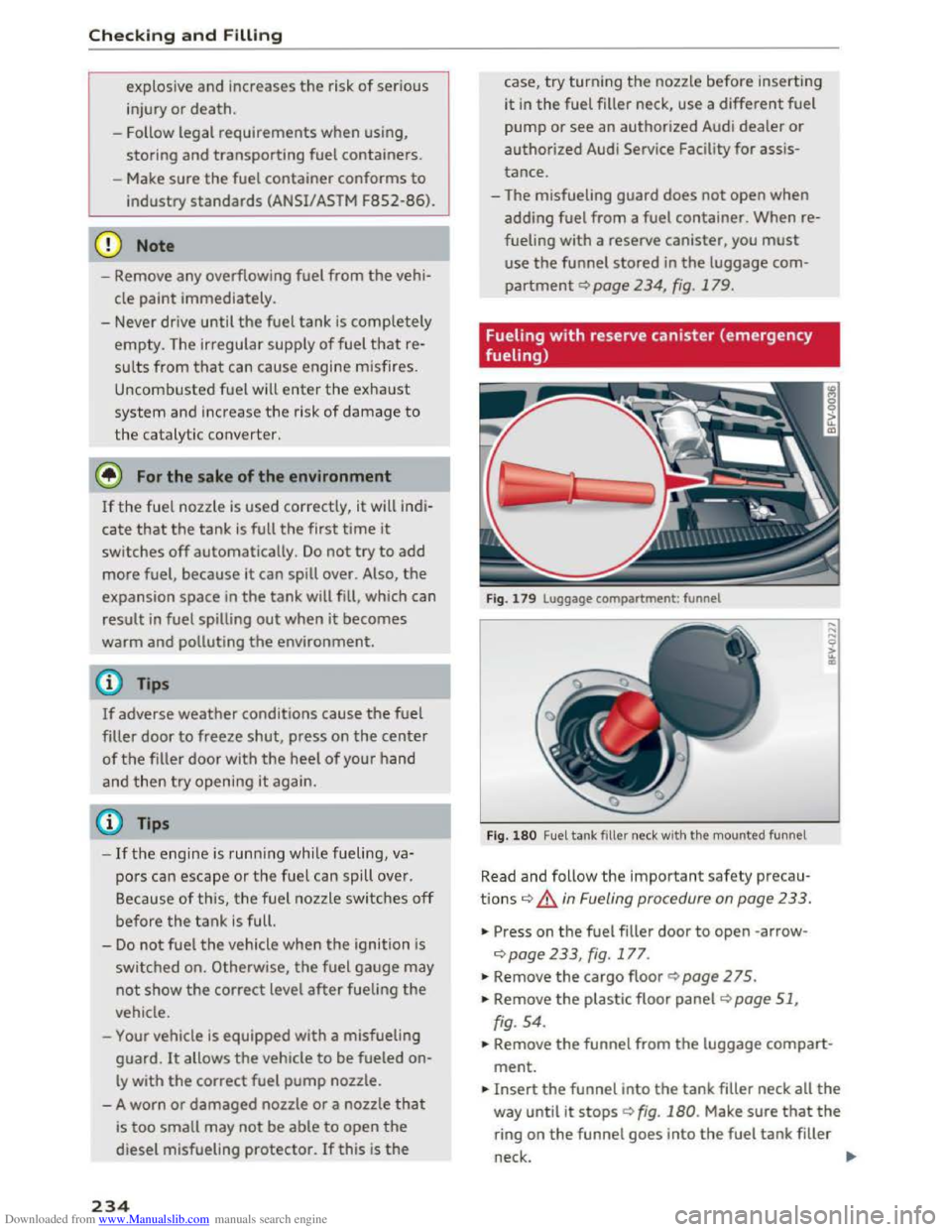
partment qpoge 234, fig. 179.
Fueling with reserve canister (emergency
fueling)
F ig . 179 Luggage compartment: funnel
Fig .
180 Fuel tank filler neck with the mou nted funnel
Read and follow the important safety precau
tions c:) ,&. in Fueling procedure on page 233.
"'Press on the fuel filler door to open -arrow-
q page 233, fig. 177.
"' Remove the cargo floor q page 2 75.
"'Remove the plastic floor panel qpage 51,
fig.
54.
"' Remove the funnel from the luggage compart
ment.
"' Insert the funnel into the tank filler neck all the
way until it stops q fig. 180. Make sure that the
ring on the funnel goes into the fuel tank filler
neck.
1111>
Page 237 of 322
Downloaded from www.Manualslib.com manuals search engine ..... N
G: CX)
.....
"' U"I
.....
"' .....
.. Guide the reserve canister filler tube into the
funnel and start the emergency fueling.
.. Remove the funnel after refueling and close the
fuel filler door so that it latches shut.
CD Note
Remove any overflowing fuel from the ve hicle
paint immediately.
Fuel filler door emergency release
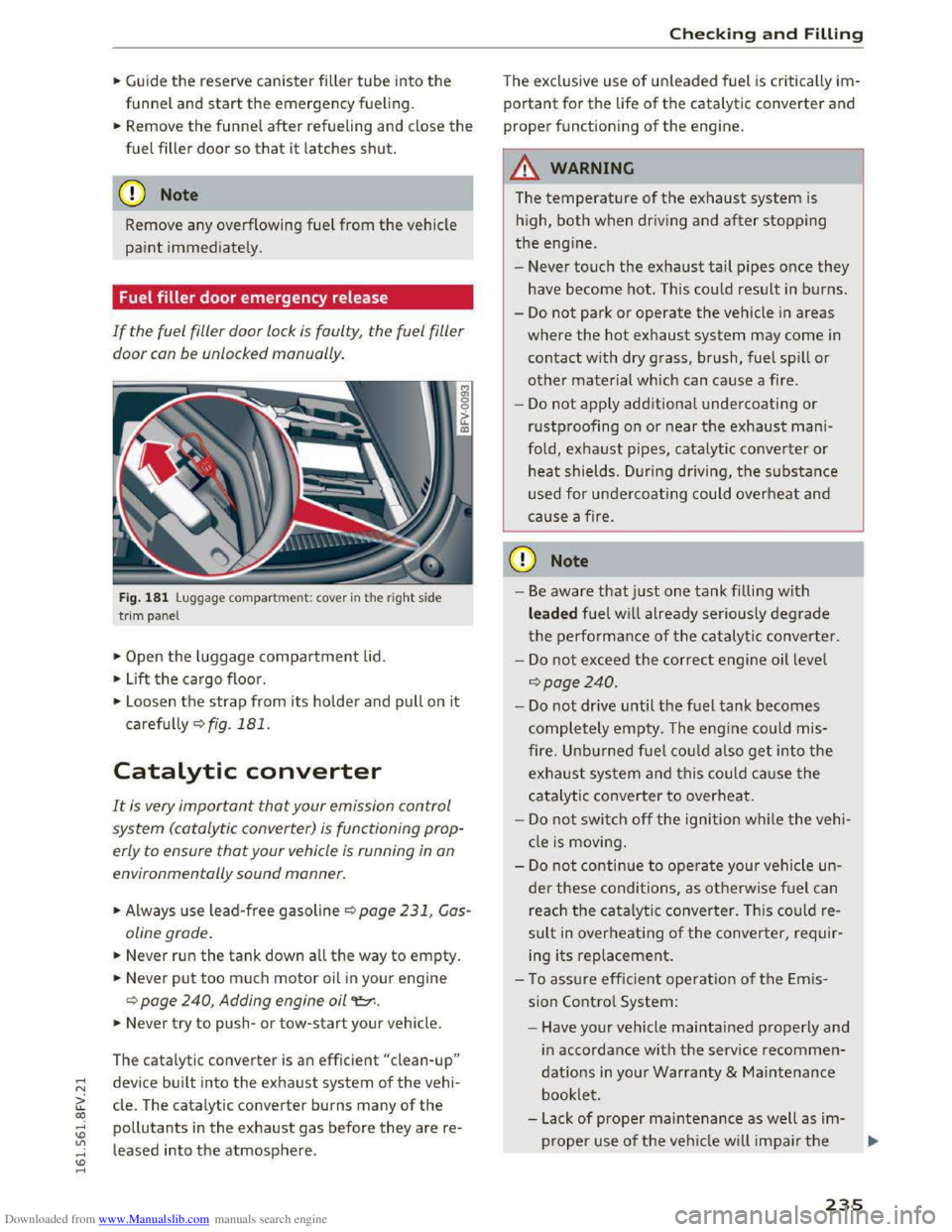
If the fuel filler door lock is faulty, the fuel filler
door con be unlocked manually.
Fig. 181 L uggage compa rtment: cover in t he r ight side
t
rim panel
.,.. Open the luggage compartment lid.
.. L ift the cargo floor .
"'
"' 0 0
it IIl
.,.. Loosen the strap from its holde r and pull on it
carefu lly Qfig. 181.
Catalytic converter
It is very important that your emission control
system (catalytic converter) is functioning prop
erly to ensure
that your vehicle is running in on
environmentally sound manner.
.,.. Always use lead-free gasoline Q page 231, Gas
oline grade .
.. Never run the tank down all the way to empty.
.. Never put too m uch motor oil in your engine
Q page 240, Adding engine oil "t::r..
.. Never try to push-or tow-start your vehicle.
The
catal ytic converter is an efficient "clean-up"
device built into the exhaust system of the vehi
cle. The catalytic
converter burns many of the
pollutants in the exhaust gas before they are re
leased into
the atmosphere .
Checking and Filling
The exclusive use of unleaded fuel is critically im
portant for the life of the catalytic converter and
proper functioning of the engine.
A WARNING
f= - I
The temperature of the exhaust system is
high, both when driving and after stopping
the engine.
- Never
touch the exhaust tail pipes once they
have become hot. This could result in burns.
-Do not park or operate the vehicle in a reas
where the hot exhaust system may come in
contact with dry grass, brush, fuel spill or
other material which can cause a fire .
-
Do not appl y additional undercoating or
r ustproofing on or near the exhaust mani
fold, exhau
st pipes, catalytic converter or
heat shields. During driving, the substance
used for un dercoating could overheat and
cause a fire.
CD Note
-Be aware that just one tank filli ng with
leaded fuel w ill already seriously degrade
the performance of th e c atalytic converter .
-
Do not exceed the correct engine oil leve l
Qpoge240 .
-Do not drive until the fuel tank becomes
completely empty. The engi ne could mis
fire. Unbu r
ned fuel coul d also get into the
exhaust system and this could cause the
ca ta lyt ic co nver ter to overheat.
-Do not swi tch off the ignition whil e the vehi
cl e is moving .
-
Do not continue to operate your vehi cle un
der these condi tions, as o therwise fuel c a n
reach the catalytic converter. This could re
sult in over heating of the converter, requir
ing
its replacement .
- T o assu re
effic ient operatio n of the E mis
sion Contro l System:
-Have your vehicle maintained properly and
in accordance wi th the service recommen
dations in yo ur Warranty & Main tenance
bookle t.
- L ack
of proper maintenance as well as im-
p r
oper use of the veh icle w ill impair the .,..
235
Page 238 of 322
Downloaded from www.Manualslib.com manuals search engine Checking and Filling
function of the emission control system
and could lead to damage.
@ For the sake of the environment
Even when the Emission Control System is op
erating properly, the exhaust gas can have a
sulfur-like
exhaust gas smell under some op
erating states. This depends on the sulfur
content of the fuel being used. Using a differ
ent brand of fuel may help, or filling the tank
with lead-free super grade gasoline.
Engine compartment
Working in the engine compartment
Special care is required if you are working in the
engine compartment
For work in the engine compartment such as
checking and filling fluids, there is a risk of in
jury, scald ing , accidents, and burns. For this
reason, follow all the following listed warnings
and general safety precautions. The engine
compartment is a dangerous area. ~ & .
I'
A WARNING
-Turn the engine off.
-switch the ignition off.
-
Set the parking brake.
-
Place the selector lever in the P position.
- Let
the engine cool down.
- Never
open the hood when you see that
steam or coolant drips from the engine
compartment-there is a danger of burns!
Wait unti l no steam or coolant flows out.
- Keep children away from the engine com
partment.
- Never spill fluids on a hot engine. These flu
ids (such
as the freeze protection contained
in the coolant) can catch fire.
- Avoid
short circuits in the electrical system,
especially the battery.
-When working in the engine compartment,
remember that the radiator fan can switch
on even
if the ignition is switched off, which
increases
the risk of personal injury.
236
- Never open the cap on the coolant expan
sion
tank when the engine is warm. The
cooling
system is under pressure.
-To protect your face, hands, and arms from
hot steam or coolant, cover the cap with a
large cloth when opening.
-Do not remove the engine cover under any
circumstances. This increases the risk of
burns.
-
If tests need to be performed with the en
gine running, there is additional danger due
to moving components (such as the ribbed
belt, alternator and radiator fan) and from
the high voltage ignition system.
-Do not under any circumstances give gas in
advertently (for example, by hand from the
engine compartment) if the vehicle is sta
tionary but the engine is running and a gear
is engaged. Otherwise the veh icle will start
to move immediately and could result in a
crash.
-
Pay attention to the following warnings list
ed when work on the fuel system or on the
electrical equipment is required.
- Always
disconnect the vehicle battery
from the vehicle electrical system.
-Do not smoke.
-Never work near open flames.
-Always have a working fire extinguisher
nearby
- To reduce
the risk of electric shock and in
jury, never
touch the follow ing components
when t he engine is running or is being start
ed:
- Ignition cable
-
Other components in the electronic high
voltage ignition system
-If you must check or perform work on the
engine while it is running:
-
Set the parking brake and place the selec
tor lever in the P (park) position first.
- Always
proceed with extreme caution so
that clothing, jewelry or long hair do not
become caught in the radiator fan, fan
belt or other moving components or do
not come into contact with hot compo-
nents. Tie back long hair before beginning .,..
Page 245 of 322
Downloaded from www.Manualslib.com manuals search engine ...... N
> u. CX> ...... u:>
"' ...... u:> ......
Read and follow the WARNINGS before check
ing anything
in the engine compartment
Qpage236.
Checking the engine coolant level
""Park your vehicle on a level surface.
"" switch the ignition off.
.. Read the coolant level on the coolant expansion
tank
Q page 238, fig. 184. The coolant level
must be between the markings when the en
gine
in cold. When the engine is warm it can be
slightly above
the upper marking.
Adding coolant
Requirement: there must be a res idual amount of
coo l
ant in the expans io n tank c:?(i) .
""Let the engine cool down.
.. Place a cloth over the coolant expansion tank
cap and unscrew
the cap counterclockwise
c:?,8..
""Add coolant mixed in the correct ratio
i:?page 242 up to the upper marking.
""Make sure that the fluid level remains stable.
Add more coolant if necessary.
"" Close the cap securely .
A coolant loss suggests a leak. Immediately drive
your vehicle
to an authorized Audi dealer or au
thorized
Audi Service Facility and have the cool
ing system inspected.
If the cooling system is not
leaking, a loss can come from
the coolant boiling
through overheating and being pushed
out of the
cooling system.
.&. WARNING
-The cooling system is pressurized and can be-
come very hot.
To reduce the risk of burns
from hot coolant:
-
Do not open the coolant expansion tank cap
w ith
the engine hot. There is a risk of burns .
- Stop
the engine and allow it to cool.
-
Protect your face, hands and arms from es-
caping coolant and
steam by covering the
coolant tank cap with a large, thick cloth.
- Turn
the coolant tank cap counterclockwise
slowly and keep light pressure on
the cap.
-
To reduce the risk of burns, do not allow any
antifreeze or coolant to dr
ip onto the ex-
Checking and Filling
ha ust system or hot engine components.
The ethylene glycol in engine coolant can
catch fire under certain circumstances.
- The coolant additive and the coolant can be
dangerous to your health.
For this reason,
keep
the coolant in the original container
away from children. There is a
risk of poi
soning.
-When working in the engine compartment,
remember
that the radiator fan can switch
on even if
the ignition is switched off, which
increases
the risk of personal injury.
CD Note
Do not add coolant if the expans ion tank is
empty . Air could enter the cooling system and
damage
the eng ine. If this is the case, do not
continu e driving. See an authorized
Audi dea l
er or authorized
Audi Service Facility for assis
tance.
Radiator fan
The radiator fan switches on automatically by it
self.
An auxiliary electric radiator fan switches on and
off depending on coolant temperature and other
vehicle operating conditions.
After you switch
the engine off, the auxiliary fan
can continue running for
up to 10 minutes -even
with
the ignit ion off. It can even switch on again
later by itself c:? & . if
- the temperature of
the engine coolant rises due
to
the heat build-up from the engine in the en
gine compartment, or
-
the engi ne compartment heats up because the
vehicle is parked in intense sunlight.
.&. WARNING
-To reduce the risk of personal injury never
touch
the radiator fan.
- The auxiliary electric fan
is temperature
controlled and can switch on suddenly even
when
the engine is not running.
243